 Скачать презентацию Proton Beam Requirements for a Neutrino Factory and
c710491840a03b2cc7cc125ede6e3aa8.ppt
- Количество слайдов: 28



Proton Beam Requirements for a Neutrino Factory and Muon Collider Michael S. Zisman Center for Beam Physics Accelerator & Fusion Research Division Lawrence Berkeley National Laboratory Workshop on Applications of High Power Accelerators—Fermilab October 19, 2009 NF-MC Proton Beam Requirements: Zisman
Outline • Introduction • Muon accelerator pros & cons • Neutrino factory ingredients • Muon collider beam preparation • Proton beam requirements • Implementation options • Summary October 19, 2009 NF-MC Proton Beam Requirements: Zisman 2
Introduction • Design and performance evaluations for Neutrino Factory and Muon Collider have been ongoing for nearly 10 years — fully international effort for NF o U. S. – Neutrino Factory and Muon Collider Collaboration (NFMCC) o EU – UK Neutrino Factory group – EUROnu Design Study o Asia – Japan Neutrino Factory Working Group • Here we will consider the requirements such facilities place on the proton beam parameters — power, energy, bunch length, repetition rate, bunch train structure October 19, 2009 NF-MC Proton Beam Requirements: Zisman 3
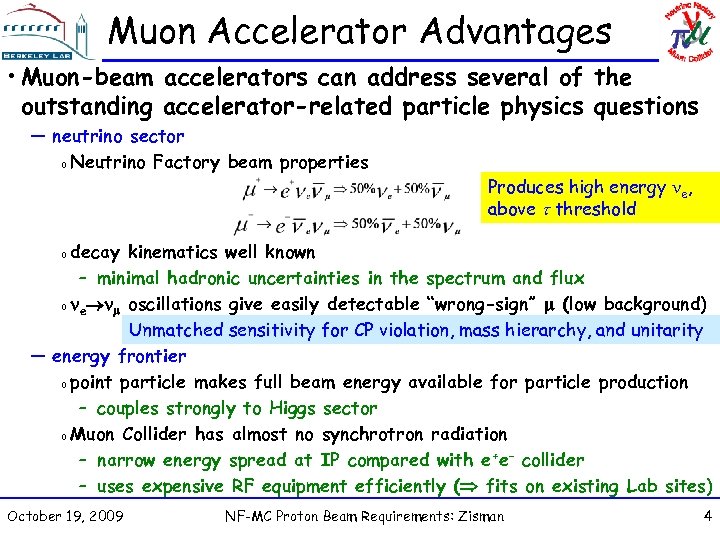
Muon Accelerator Advantages • Muon-beam accelerators can address several of the outstanding accelerator-related particle physics questions — neutrino sector o Neutrino Factory beam properties Produces high energy e, above threshold o decay kinematics well known – minimal hadronic uncertainties in the spectrum and flux o e oscillations give easily detectable “wrong-sign” (low background) Unmatched sensitivity for CP violation, mass hierarchy, and unitarity — energy frontier o point particle makes full beam energy available for particle production – couples strongly to Higgs sector o Muon Collider has almost no synchrotron radiation – narrow energy spread at IP compared with e+e– collider – uses expensive RF equipment efficiently ( fits on existing Lab sites) October 19, 2009 NF-MC Proton Beam Requirements: Zisman 4
Muon Beam Challenges • Muons created as tertiary beam (p ) — low production rate o need target that can tolerate multi-MW beam (+ source to provide it!) — large energy spread and transverse phase space o need solenoidal focusing for the low energy portions of the facility – solenoids focus in both planes simultaneously o need emittance cooling o high-acceptance acceleration system and decay ring If intense • Muons have short lifetime (2. 2 s at rest) muon beams were easy to — puts premium on rapid beam manipulations produce, we’d o high-gradient RF cavities (in magnetic field) for cooling already have o presently untested ionization cooling technique them! o fast acceleration system • Decay electrons give rise to heat load in magnets and backgrounds in collider detector October 19, 2009 NF-MC Proton Beam Requirements: Zisman 5
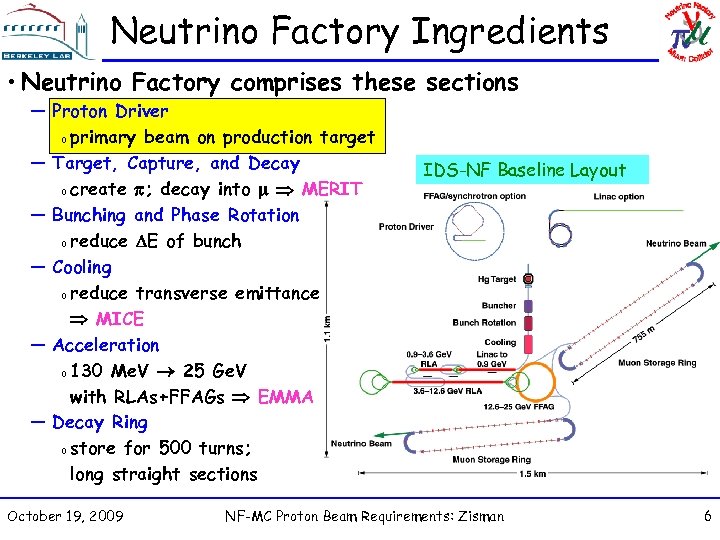
Neutrino Factory Ingredients • Neutrino Factory comprises these sections — Proton Driver o primary beam on production target — Target, Capture, and Decay o create ; decay into MERIT — Bunching and Phase Rotation o reduce E of bunch — Cooling o reduce transverse emittance MICE — Acceleration o 130 Me. V 25 Ge. V with RLAs+FFAGs EMMA — Decay Ring o store for 500 turns; long straight sections October 19, 2009 IDS-NF Baseline Layout NF-MC Proton Beam Requirements: Zisman 6
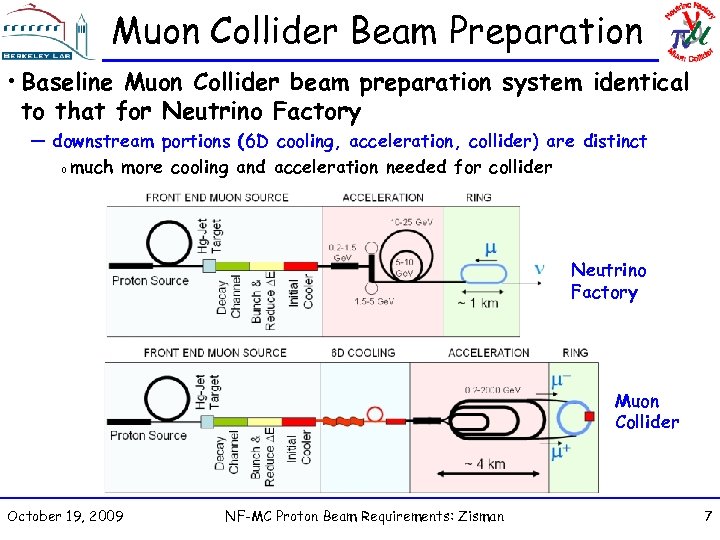
Muon Collider Beam Preparation • Baseline Muon Collider beam preparation system identical to that for Neutrino Factory — downstream portions (6 D cooling, acceleration, collider) are distinct o much more cooling and acceleration needed for collider Neutrino Factory Muon Collider October 19, 2009 NF-MC Proton Beam Requirements: Zisman 7
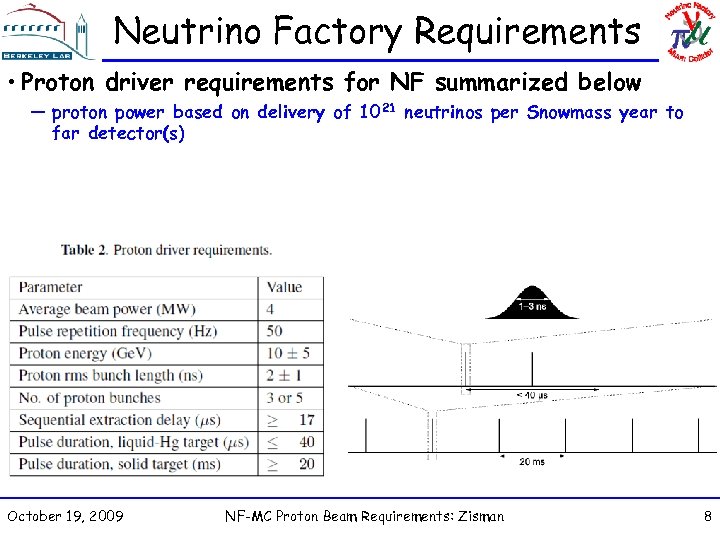
Neutrino Factory Requirements • Proton driver requirements for NF summarized below — proton power based on delivery of 1021 neutrinos per Snowmass year to far detector(s) October 19, 2009 NF-MC Proton Beam Requirements: Zisman 8
![Muon Collider Requirements • Typical example parameters for MC scenarios given below [Alexahin, Palmer]](https://present5.com/presentation/c710491840a03b2cc7cc125ede6e3aa8/image-9.jpg "Muon Collider Requirements • Typical example parameters for MC scenarios given below [Alexahin, Palmer]")
Muon Collider Requirements • Typical example parameters for MC scenarios given below [Alexahin, Palmer] — caveat: power estimates based on assumed transmission values o could go up or down. . . – smart money is on “up” Needed to meet luminosity specification October 19, 2009 NF-MC Proton Beam Requirements: Zisman 9
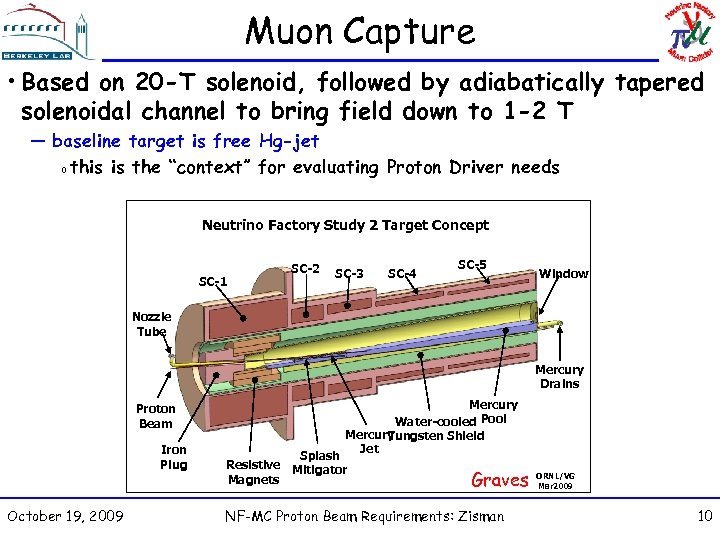
Muon Capture • Based on 20 -T solenoid, followed by adiabatically tapered solenoidal channel to bring field down to 1 -2 T — baseline target is free Hg-jet o this is the “context” for evaluating Proton Driver needs Neutrino Factory Study 2 Target Concept SC-1 SC-2 SC-3 SC-4 SC-5 Window Nozzle Tube Mercury Drains Proton Beam Iron Plug October 19, 2009 Mercury Water-cooled Pool Mercury Tungsten Shield Jet Splash Resistive Mitigator Magnets Graves NF-MC Proton Beam Requirements: Zisman ORNL/VG Mar 2009 10
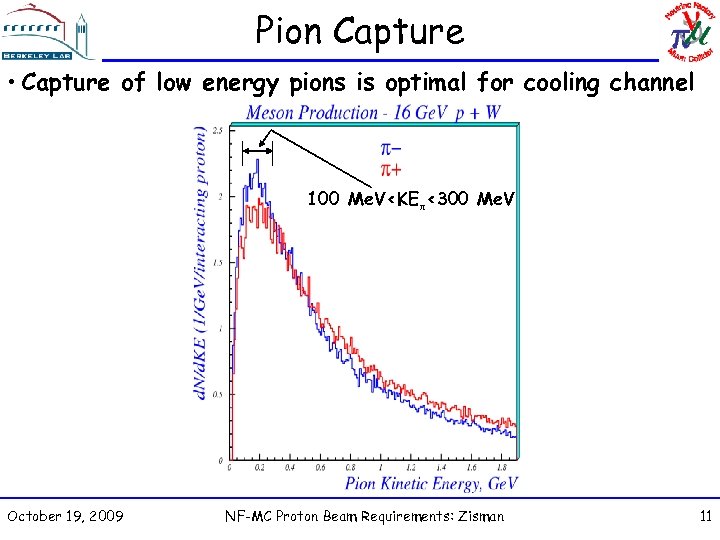
Pion Capture • Capture of low energy pions is optimal for cooling channel 100 Me. V<KE <300 Me. V October 19, 2009 NF-MC Proton Beam Requirements: Zisman 11
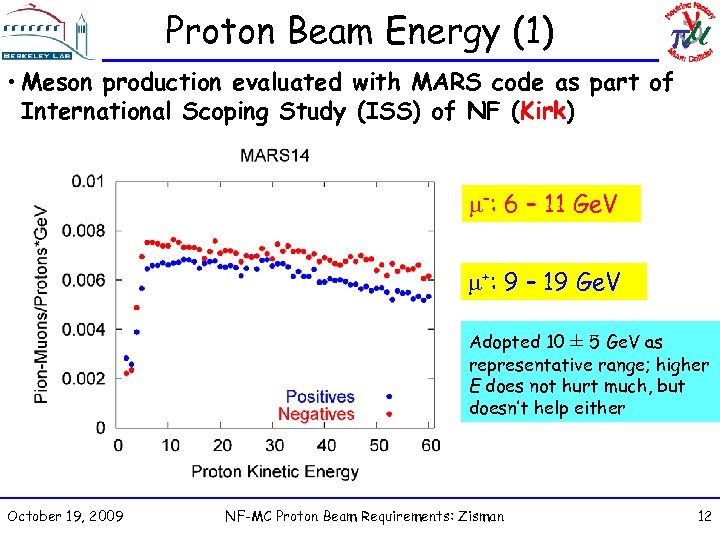
Proton Beam Energy (1) • Meson production evaluated with MARS code as part of International Scoping Study (ISS) of NF (Kirk) –: 6 – 11 Ge. V +: 9 – 19 Ge. V Adopted 10 ± 5 Ge. V as representative range; higher E does not hurt much, but doesn’t help either October 19, 2009 NF-MC Proton Beam Requirements: Zisman 12
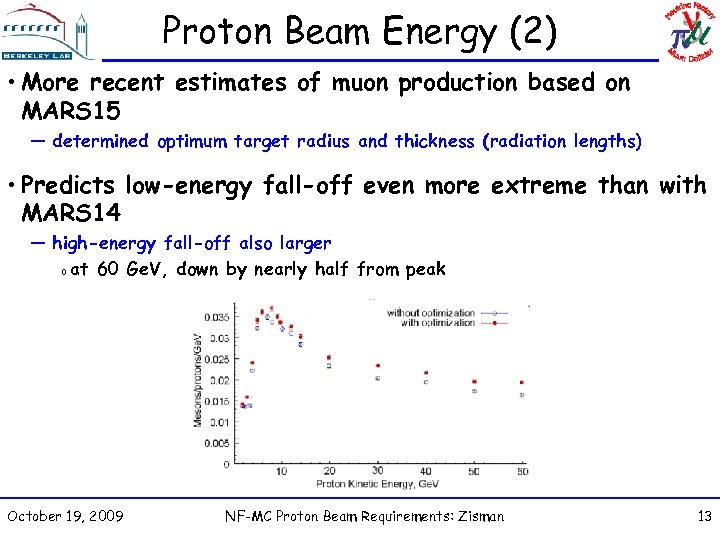
Proton Beam Energy (2) • More recent estimates of muon production based on MARS 15 — determined optimum target radius and thickness (radiation lengths) • Predicts low-energy fall-off even more extreme than with MARS 14 — high-energy fall-off also larger o at 60 Ge. V, down by nearly half from peak October 19, 2009 NF-MC Proton Beam Requirements: Zisman 13
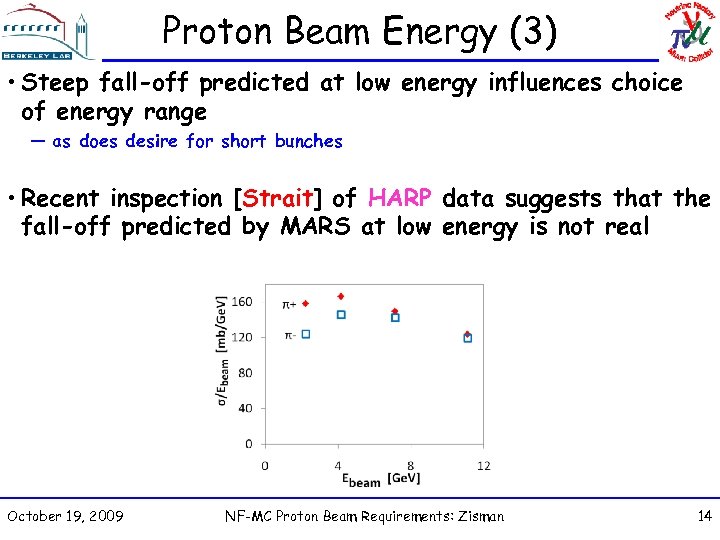
Proton Beam Energy (3) • Steep fall-off predicted at low energy influences choice of energy range — as does desire for short bunches • Recent inspection [Strait] of HARP data suggests that the fall-off predicted by MARS at low energy is not real October 19, 2009 NF-MC Proton Beam Requirements: Zisman 14
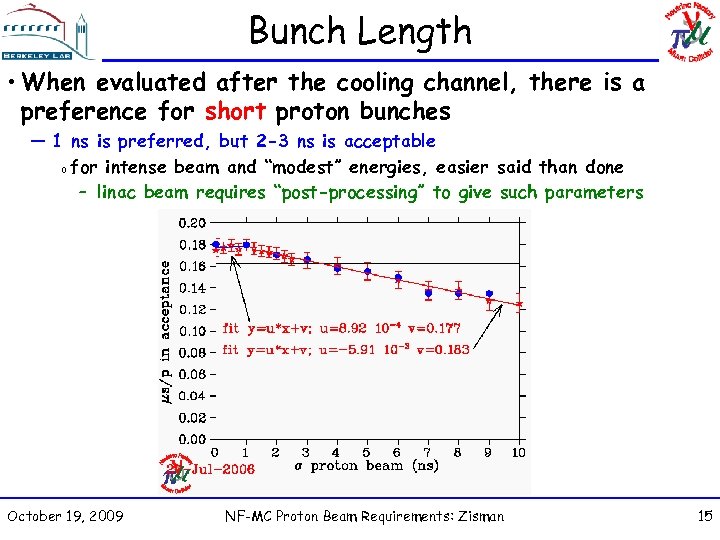
Bunch Length • When evaluated after the cooling channel, there is a preference for short proton bunches — 1 ns is preferred, but 2 -3 ns is acceptable o for intense beam and “modest” energies, easier said than done – linac beam requires “post-processing” to give such parameters October 19, 2009 NF-MC Proton Beam Requirements: Zisman 15
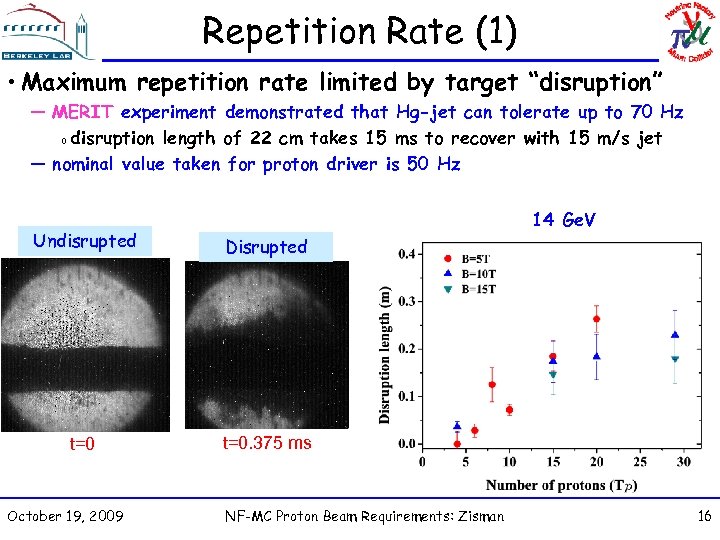
Repetition Rate (1) • Maximum repetition rate limited by target “disruption” — MERIT experiment demonstrated that Hg-jet can tolerate up to 70 Hz o disruption length of 22 cm takes 15 ms to recover with 15 m/s jet — nominal value taken for proton driver is 50 Hz 14 Ge. V Undisrupted Disrupted t=0. 375 ms October 19, 2009 NF-MC Proton Beam Requirements: Zisman 16
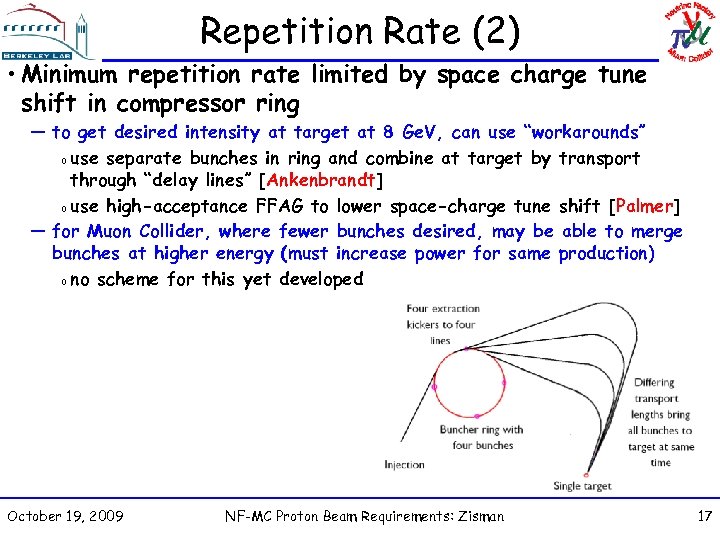
Repetition Rate (2) • Minimum repetition rate limited by space charge tune shift in compressor ring — to get desired intensity at target at 8 Ge. V, can use “workarounds” o use separate bunches in ring and combine at target by transport through “delay lines” [Ankenbrandt] o use high-acceptance FFAG to lower space-charge tune shift [Palmer] — for Muon Collider, where fewer bunches desired, may be able to merge bunches at higher energy (must increase power for same production) o no scheme for this yet developed October 19, 2009 NF-MC Proton Beam Requirements: Zisman 17
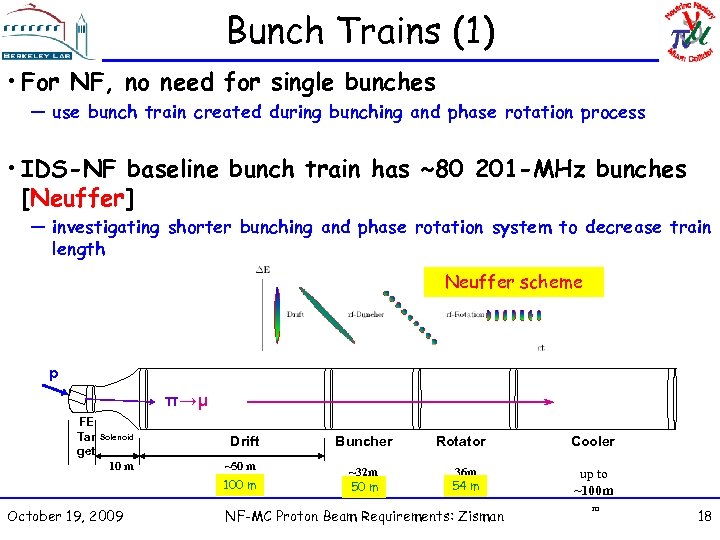
Bunch Trains (1) • For NF, no need for single bunches — use bunch train created during bunching and phase rotation process • IDS-NF baseline bunch train has ~80 201 -MHz bunches [Neuffer] — investigating shorter bunching and phase rotation system to decrease train length Neuffer scheme p π→μ FE Tar get Solenoid 10 m Drift ~50 m 100 m October 19, 2009 Buncher ~32 m 50 m Rotator 36 m 54 m NF-MC Proton Beam Requirements: Zisman Cooler up to ~100 m m 18
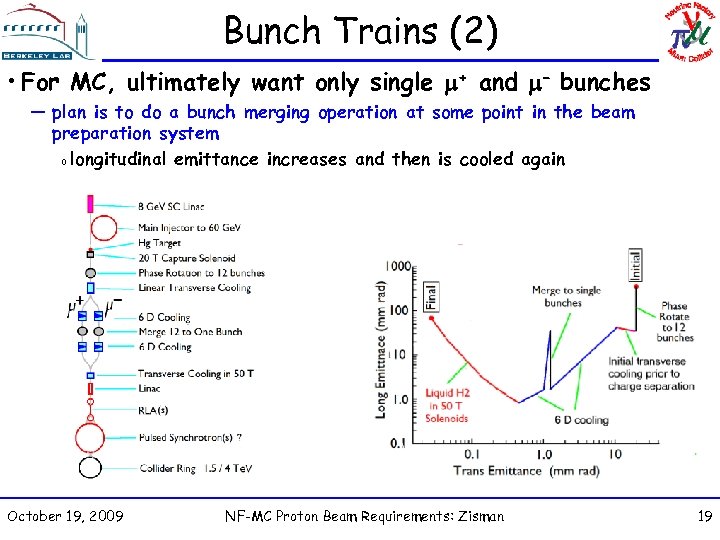
Bunch Trains (2) • For MC, ultimately want only single + and – bunches — plan is to do a bunch merging operation at some point in the beam preparation system o longitudinal emittance increases and then is cooled again October 19, 2009 NF-MC Proton Beam Requirements: Zisman 19
Implementation Schemes • There a number of ways to develop a proton driver for the muon-based facilities — a few representative examples will be outlined on the next few slides October 19, 2009 NF-MC Proton Beam Requirements: Zisman 20
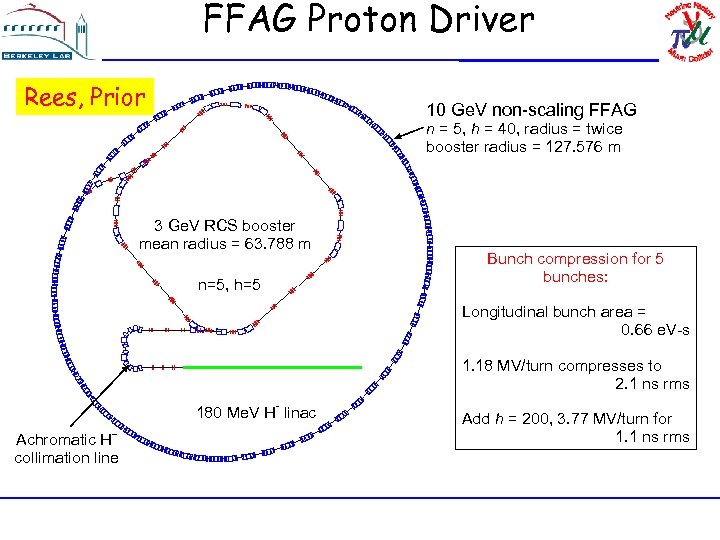
FFAG Proton Driver Rees, Prior 10 Ge. V non-scaling FFAG n = 5, h = 40, radius = twice booster radius = 127. 576 m 3 Ge. V RCS booster mean radius = 63. 788 m n=5, h=5 Bunch compression for 5 bunches: Longitudinal bunch area = 0. 66 e. V-s 1. 18 MV/turn compresses to 2. 1 ns rms 180 Me. V Hˉ linac Achromatic Hˉ collimation line Add h = 200, 3. 77 MV/turn for 1. 1 ns rms
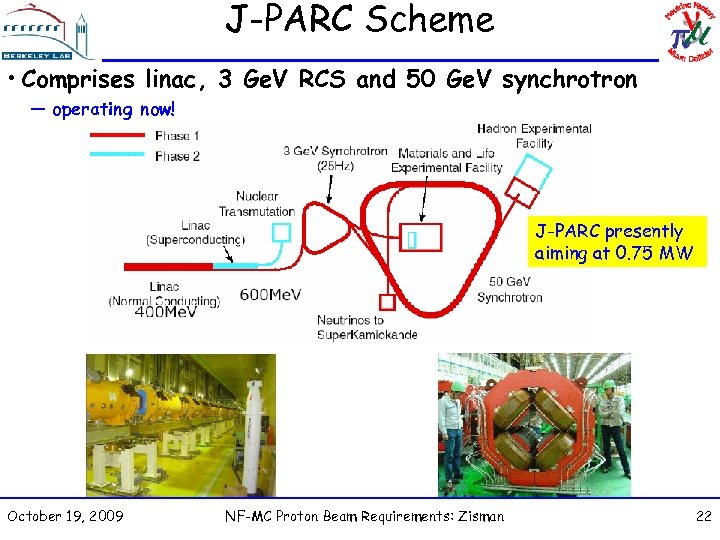
J-PARC Scheme • Comprises linac, 3 Ge. V RCS and 50 Ge. V synchrotron — operating now! J-PARC presently aiming at 0. 75 MW October 19, 2009 NF-MC Proton Beam Requirements: Zisman 22
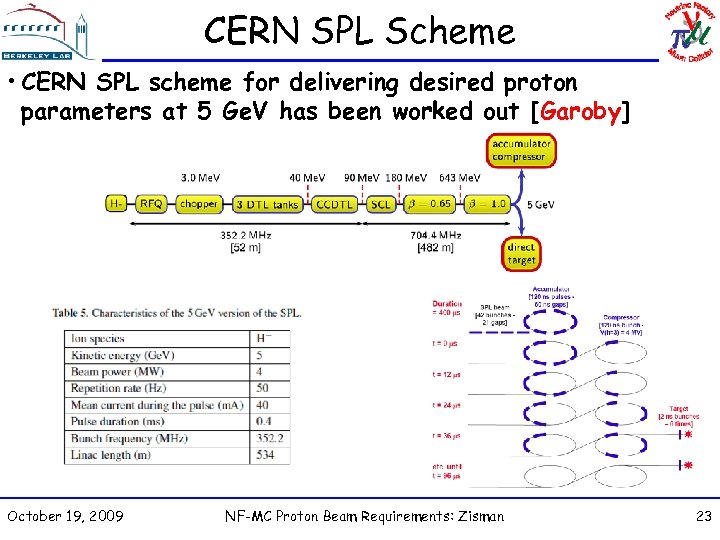
CERN SPL Scheme • CERN SPL scheme for delivering desired proton parameters at 5 Ge. V has been worked out [Garoby] October 19, 2009 NF-MC Proton Beam Requirements: Zisman 23
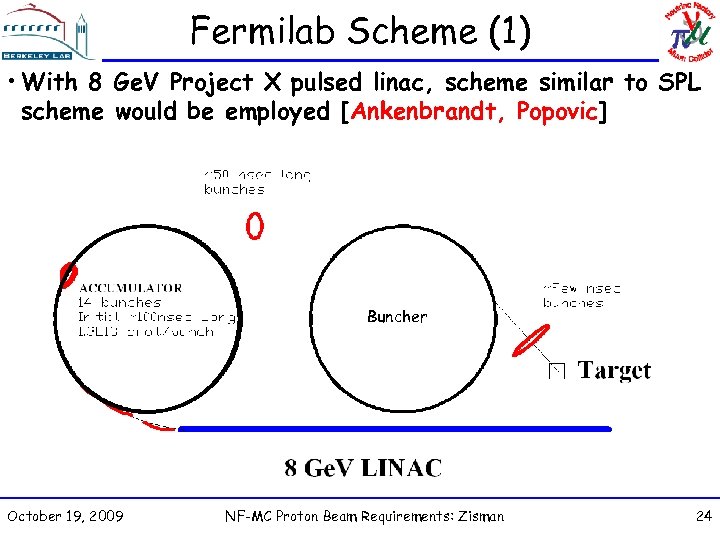
Fermilab Scheme (1) • With 8 Ge. V Project X pulsed linac, scheme similar to SPL scheme would be employed [Ankenbrandt, Popovic] Buncher October 19, 2009 NF-MC Proton Beam Requirements: Zisman 24
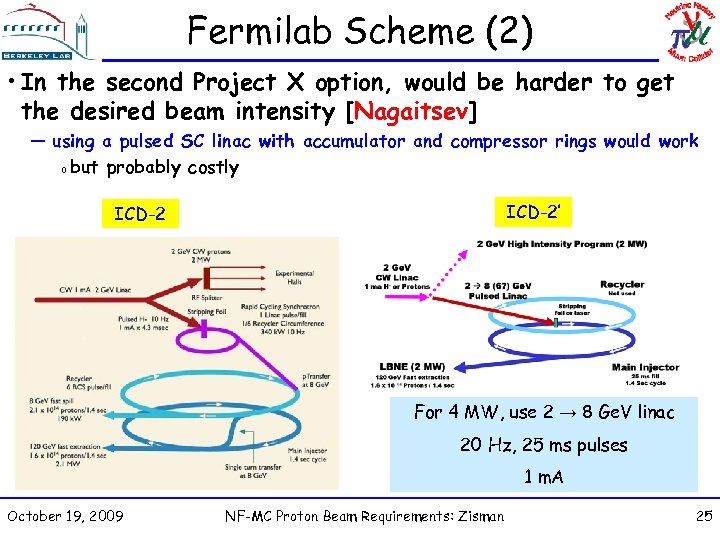
Fermilab Scheme (2) • In the second Project X option, would be harder to get the desired beam intensity [Nagaitsev] — using a pulsed SC linac with accumulator and compressor rings would work o but probably costly ICD-2’ ICD-2 For 4 MW, use 2 → 8 Ge. V linac 20 Hz, 25 ms pulses 1 m. A October 19, 2009 NF-MC Proton Beam Requirements: Zisman 25
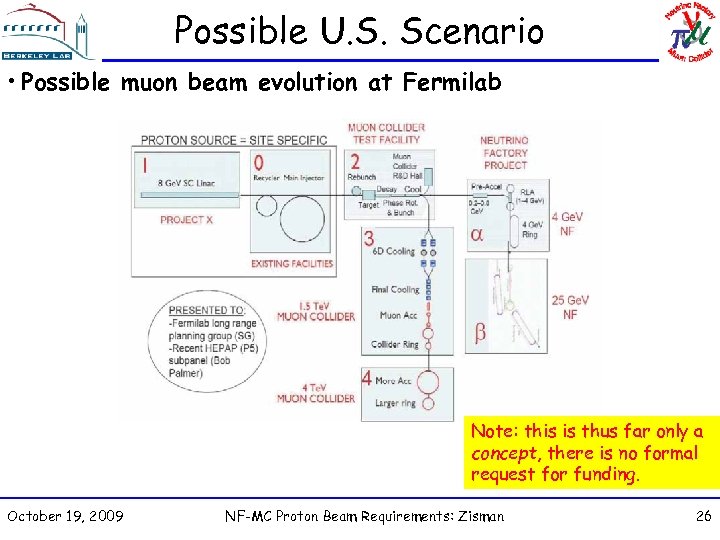
Possible U. S. Scenario • Possible muon beam evolution at Fermilab Note: this is thus far only a concept, there is no formal request for funding. October 19, 2009 NF-MC Proton Beam Requirements: Zisman 26
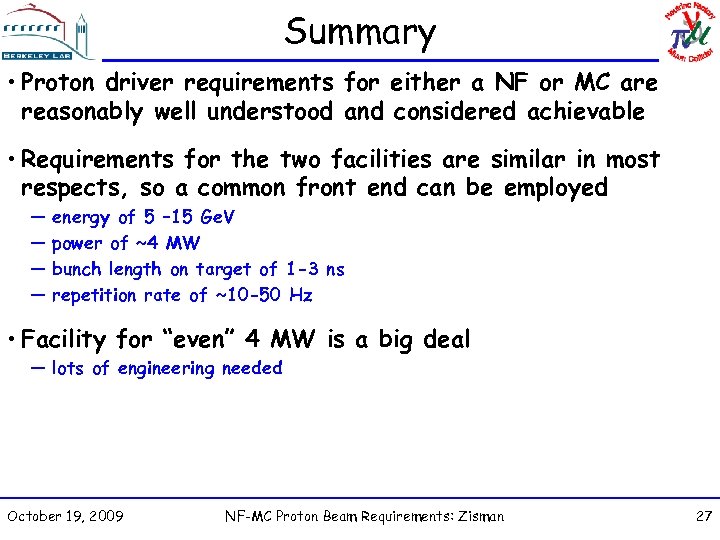
Summary • Proton driver requirements for either a NF or MC are reasonably well understood and considered achievable • Requirements for the two facilities are similar in most respects, so a common front end can be employed — — energy of 5 – 15 Ge. V power of ~4 MW bunch length on target of 1 -3 ns repetition rate of ~10 -50 Hz • Facility for “even” 4 MW is a big deal — lots of engineering needed October 19, 2009 NF-MC Proton Beam Requirements: Zisman 27
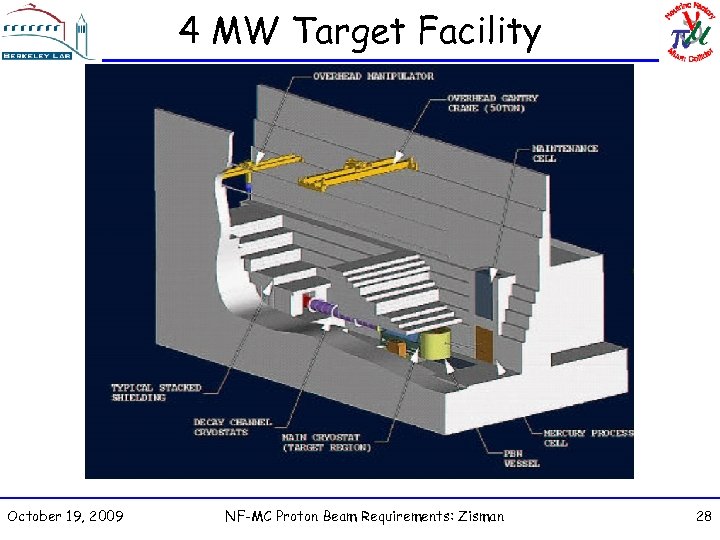
4 MW Target Facility October 19, 2009 NF-MC Proton Beam Requirements: Zisman 28
Скачать презентацию Proton Beam Requirements for a Neutrino Factory and
c710491840a03b2cc7cc125ede6e3aa8.ppt