


 Скачать презентацию Protocol Layering Sender Receiver Layer N Layer 2
3dbb08f77f058fa02e5121ac14ce56d3.ppt
- Количество слайдов: 19
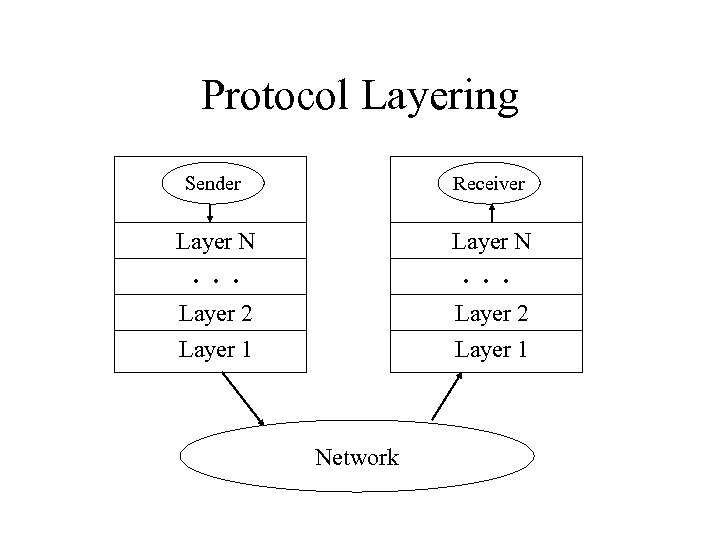 Protocol Layering Sender Receiver Layer N Layer 2 Layer 1 . . . Network
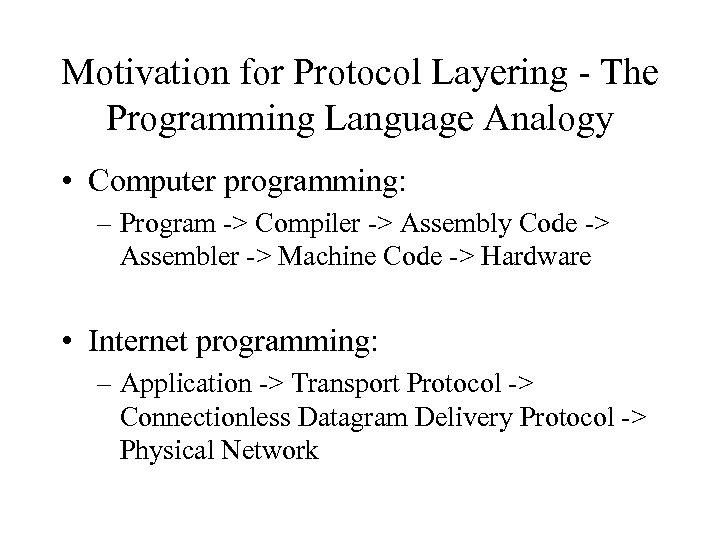 Motivation for Protocol Layering - The Programming Language Analogy • Computer programming: – Program -> Compiler -> Assembly Code -> Assembler -> Machine Code -> Hardware • Internet programming: – Application -> Transport Protocol -> Connectionless Datagram Delivery Protocol -> Physical Network
 The Internet Protocol Suite • Internetworking does not use a single protocol to transmit data • Imagine how hard it would be to write one that: – Ran on all underlying network technologies – Transmitted and routed all traffic on the internet – Handled: hardware failure, network congestion, delays, data loss, data corruption, data duplication, sequencing errors • Internetworking uses a set of cooperating protocols (each with its own job)
 Benefits of Protocol Layering • Complexity hidden from application-level programmer • Physical network details hidden in low-level protocols • Each layer of software can be written, tested, and modified independently
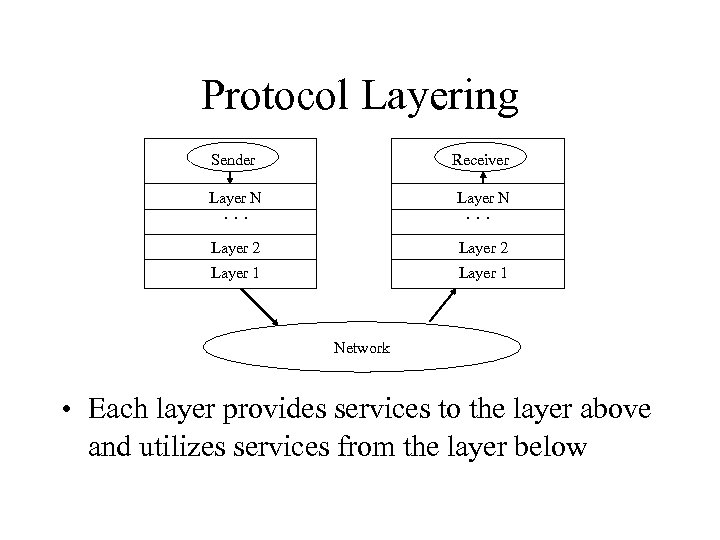 Protocol Layering Sender Receiver Layer N Layer 2 Layer 1 . . . Network • Each layer provides services to the layer above and utilizes services from the layer below
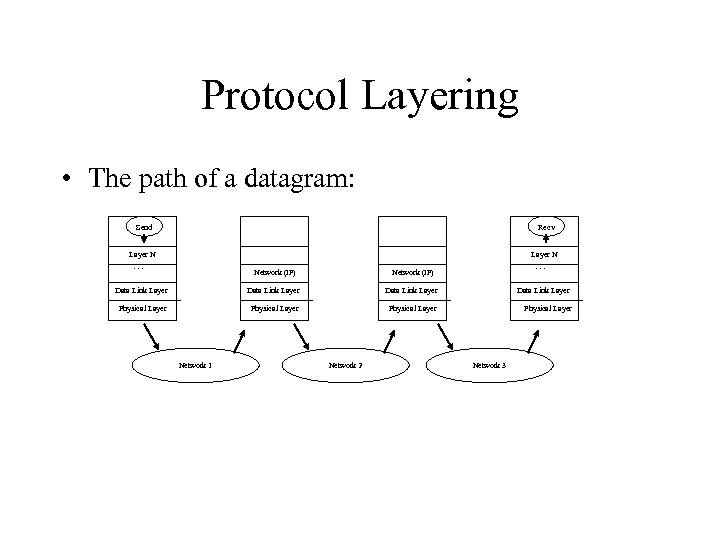 Protocol Layering • The path of a datagram: Send Recv Layer N . . . Network (IP) Data Link Layer Physical Layer Network 1 Network 2 Network 3
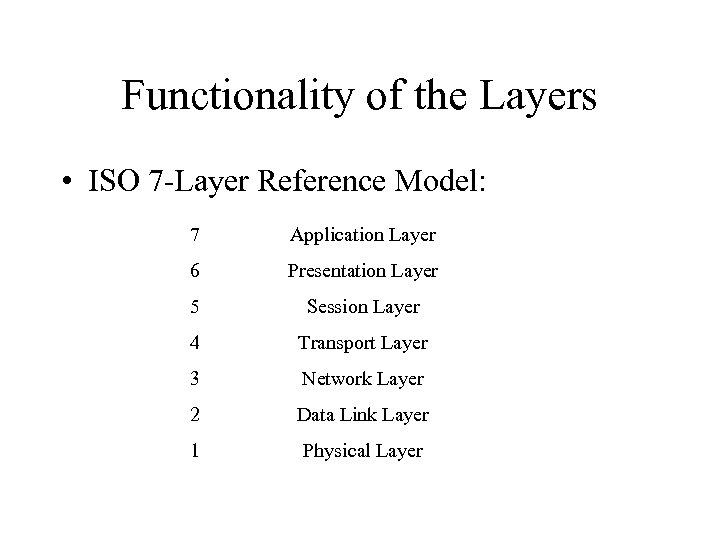 Functionality of the Layers • ISO 7 -Layer Reference Model: 7 Application Layer 6 Presentation Layer 5 Session Layer 4 Transport Layer 3 Network Layer 2 Data Link Layer 1 Physical Layer
 ISO 7 -Layer Reference Model • Physical Layer (ISO Layer 1) – Service: transmission of a raw bit stream over a communication channel ensuring a reliable delivery of 0’s and 1’s – Functions: conversion of bits into electrical or optical signals – Examples: X. 21, RS-232 -C
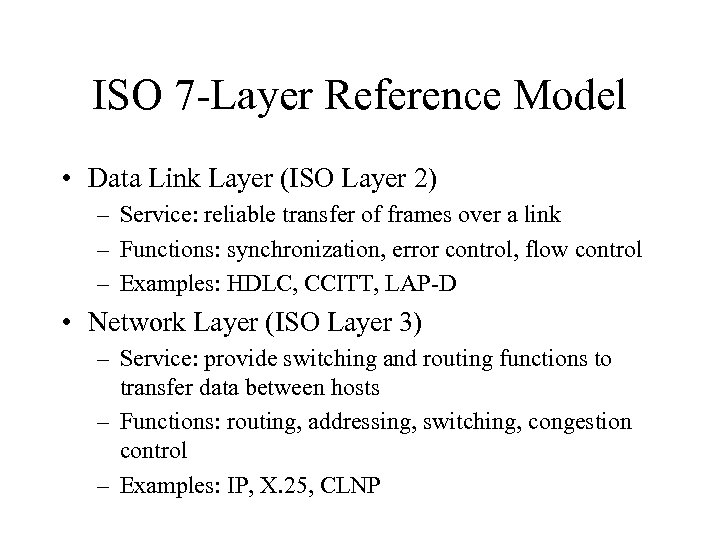 ISO 7 -Layer Reference Model • Data Link Layer (ISO Layer 2) – Service: reliable transfer of frames over a link – Functions: synchronization, error control, flow control – Examples: HDLC, CCITT, LAP-D • Network Layer (ISO Layer 3) – Service: provide switching and routing functions to transfer data between hosts – Functions: routing, addressing, switching, congestion control – Examples: IP, X. 25, CLNP
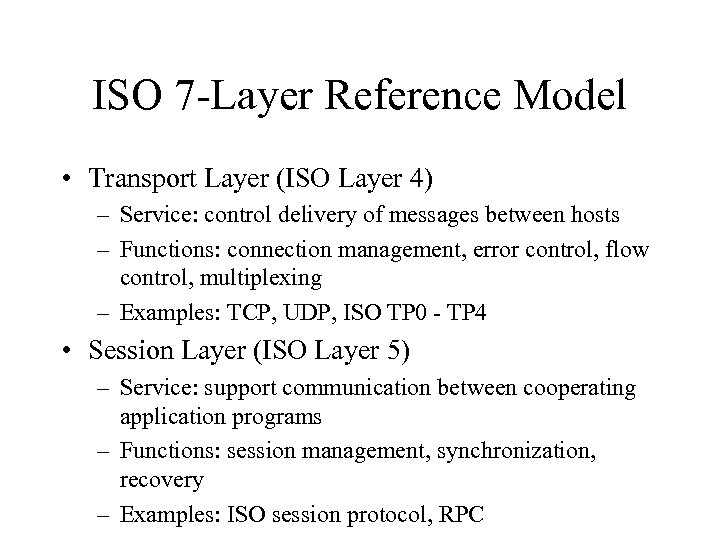 ISO 7 -Layer Reference Model • Transport Layer (ISO Layer 4) – Service: control delivery of messages between hosts – Functions: connection management, error control, flow control, multiplexing – Examples: TCP, UDP, ISO TP 0 - TP 4 • Session Layer (ISO Layer 5) – Service: support communication between cooperating application programs – Functions: session management, synchronization, recovery – Examples: ISO session protocol, RPC
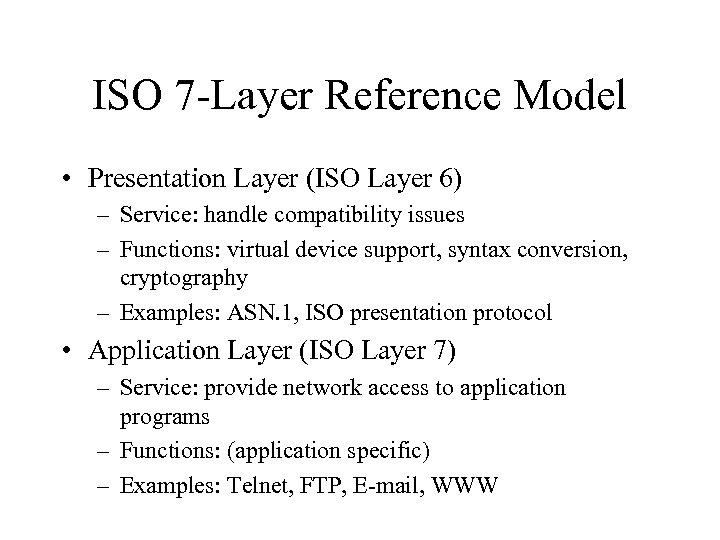 ISO 7 -Layer Reference Model • Presentation Layer (ISO Layer 6) – Service: handle compatibility issues – Functions: virtual device support, syntax conversion, cryptography – Examples: ASN. 1, ISO presentation protocol • Application Layer (ISO Layer 7) – Service: provide network access to application programs – Functions: (application specific) – Examples: Telnet, FTP, E-mail, WWW
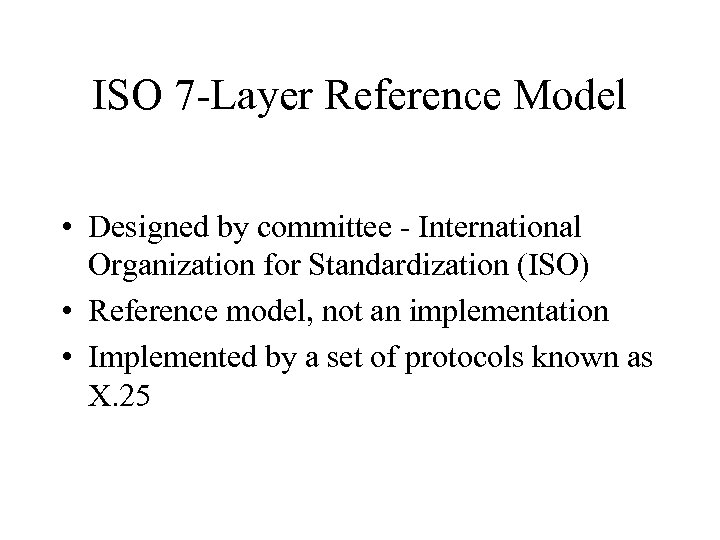 ISO 7 -Layer Reference Model • Designed by committee - International Organization for Standardization (ISO) • Reference model, not an implementation • Implemented by a set of protocols known as X. 25
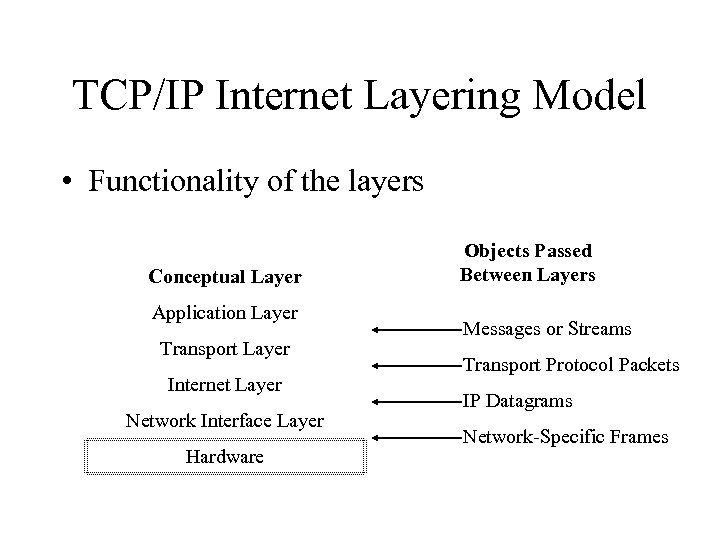 TCP/IP Internet Layering Model • Functionality of the layers Conceptual Layer Application Layer Transport Layer Internet Layer Network Interface Layer Hardware Objects Passed Between Layers Messages or Streams Transport Protocol Packets IP Datagrams Network-Specific Frames
 TCP/IP Internet Layering Model • Network Interface Layer (TCP/IP Layer 1) – Service: accepts IP datagrams and transmits them over a specific network – Functions: conversion of datagrams to physical frames – Examples: device drivers • Internet Layer (TCP/IP Layer 2) – Service: connectionless datagram delivery – Functions: inter-host communication, routing – Examples: IP
 TCP/IP Internet Layering Model • Transport Layer (TCP/IP Layer 3) – Service: provide reliable end-to-end communication – Functions: flow control, sequencing, acknowledgments – Examples: TCP • Application Layer (TCP/IP Layer 4) – Service: (application specific) – Functions: (application specific) – Examples: Telnet, FTP, E-mail, WWW
 Internet Model vs. ISO Model • Similarities • Differences
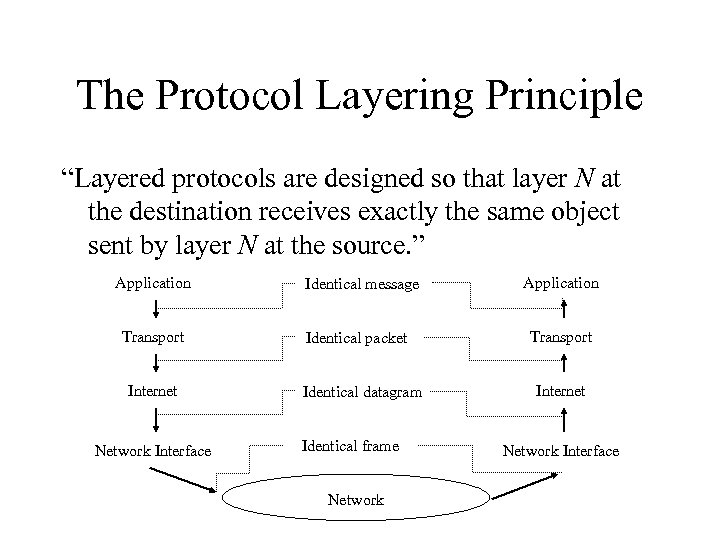 The Protocol Layering Principle “Layered protocols are designed so that layer N at the destination receives exactly the same object sent by layer N at the source. ” Application Transport Internet Network Interface Identical message Identical packet Identical datagram Identical frame Network Application Transport Internet Network Interface
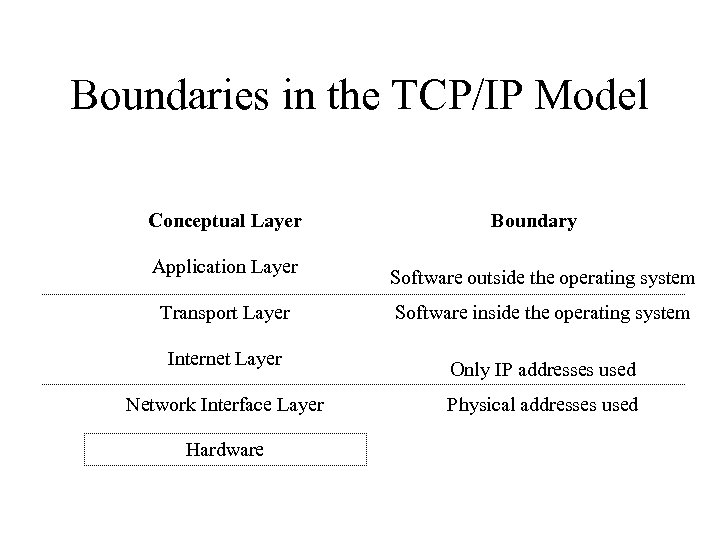 Boundaries in the TCP/IP Model Conceptual Layer Application Layer Transport Layer Internet Layer Network Interface Layer Hardware Boundary Software outside the operating system Software inside the operating system Only IP addresses used Physical addresses used
 Protocol Layering • Advantages • Disadvantages