


 Скачать презентацию PROTOCOL AND INFORMATION OFFICE PIO AN OVERVIEW CANCER
d6bd17bdd51dc0a248d1253df7858f49.ppt
- Количество слайдов: 24
 PROTOCOL AND INFORMATION OFFICE (PIO) AN OVERVIEW CANCER THERAPY EVALUATION PROGRAM
 National Cancer Institute The National Cancer Institute (NCI) is: The largest of the Institutes that constitute the National Institutes of Health The largest sponsor of research on anti-cancer agent development Organized into the Office of the Director, one Center, and six Divisions, each specializing in a different aspect of cancer research. 2
 3
3
 Protocol and Information Office (PIO) The Protocol and Information Office was created to serve as the central hub of information processing for maintaining the official files of all protocols in which CTEP is involved. 4
 Protocol and Information Office (PIO) (continued) The PIO manages the entire protocol process. Protocol processing begins with the submission of a clinical study via either a Letter of Intent (LOI) or a Concept Review. The PIO follows each protocol through the steps of the review and approval processes. Amendment changes, monitoring, correspondence, and receipt of a final published report are additional tasks of the PIO throughout the lifecycle of the protocol. 5
 Mission of the PIO The primary mission of the PIO is to facilitate the development of quality clinical trials in the most efficient and expeditious manner possible and to relieve the administrative burden related to clinical trial development and management on CTEP staff and the extramural community. 6
 PIO Operations In order to assist in meeting the mission of CTEP, the following services are in full operation: Document management Keywords and milestones abstraction into the Enterprise System (CTEP’s database for all protocol related activities) Education of all concerned parties regarding NCI programs, policies, and objectives related to clinical trial development and management Training of PIO staff, extramural investigators, and CTEP reviewers Administrative support, including document tracking, scientific writing, and technological discovery to streamline the protocol development process 7
 PIO Operations (continued) Support CTEP committees by organizing and preparing protocols for weekly Protocol Review Committee (PRC) and Investigational Drug Committee (IDB) meeting in which drug development strategies and related issues are discussed. Documentation accuracy and quality assurance (QA) to ensure that all official documentation is correctly noted and filed in database. Correspondence between CTEP and its investigators (protocol approval, Safety/Action Letters, etc. ) Responding to questions from clinical sites 8
 The PIO Staff The PIO staff is comprised of: 3 government staff: Head of PIO Deputy Head of PIO Technical Assistant 10 contract staff: Program Manager Deputy Program Manager LOI/Concept Coordinator 6 Protocol Specialists 1 Support Staff 9
 Types of Submissions - LOIs Letter of Intent (LOI): An investigator’s declaration of interest in conducting a Phase I or Phase II trial with an investigational drug LOIs should be submitted for all Phase I or Phase II trials that will utilize Division of Cancer Treatment and Diagnosis, CTEP supplied IND agents Once an LOI is approved by CTEP, a protocol submission is expected within 30 days LOI submission form (MS Word ) can be found on the CTEP Web site at: http: //ctep. cancer. gov/forms 10
 Types of Submissions - Concepts Concept: Disease oriented Phase III proposals that are not fully developed research protocols Once a Concept is approved by CTEP, the Concept Coordinator guides the investigator to the timely 30 day delivery of a protocol submission. Concept submission form (MS Word) can be found on the CTEP Web site at: http: //ctep. cancer. gov/forms 11
 Types of Submissions – New Protocols New CTEP Protocol: The detailed written plans of a clinical trial or experiment. A protocol must be approved by CTEP and the local IRB before any patients are enrolled (accrued/treated). Templates for all Phases of Clinical Trials are available on the Web site at: http: //ctep. cancer. gov/guidelines/templates. html Initial submission of a protocol must include the following: Cover letter from the Protocol Chair or PI stating the intent of the new submission Protocol Submission Worksheet (PSW): current version available on the web site at http: //ctep. cancer. gov. forms/PSW One electronic paginated, legible protocol, including all appendices, if applicable 12
 Types of Submissions - New Protocols (continued) Patient Informed Consent (guidelines available on the web site at: http: //www. cancer. gov/Clinical. Trials/AGuideto. Understandi ng. Informed. Consent) The Protocol document should contain the following: Title page including the title of the study, version date, local protocol number (if applicable), PI/Protocol Chair including name, address, phone number, fax number, and e-mail address and for DCTD-supplied IND drugs, a listing of each drug by name and NSC number Table of Contents (titles should match the body of the protocol) Body of Protocol (objectives, background, eligibility, etc. ) Appendices (if applicable) Model Patient Informed Consent (if applicable) 13
 Types of Submissions - Revisions Revision: Any protocol changes which occur before CTEP approval. All revised protocols submissions should include: Cover letter from the Protocol Chair or PI identify by page AND section each change made to a protocol document. All responses to the Consensus Review/Follow-up Review or additional changes shall be described in a point-by-point format (i. e. Page 3, section 1. 2, replace ‘xyz’ and insert ‘abc’). The original change request letter shall be attached. A revised un-marked (without handwritten notes or highlights) copy of the protocol document INCLUDING all protocol attachments listed in the table of contents regardless of whether any changes occurred to these sections. 14
 Types of Submissions – Revisions (continued) Informed Consent regardless of whether any changes occurred to this document. Protocol title page must include a Version Date that reflects the time-point of the most recent change to the document. OPTIONAL – In addition to the above, you may include a revised copy of the protocol with all changes specified in the Revision cover letter highlighted throughout the document utilizing a word-processing program. 15
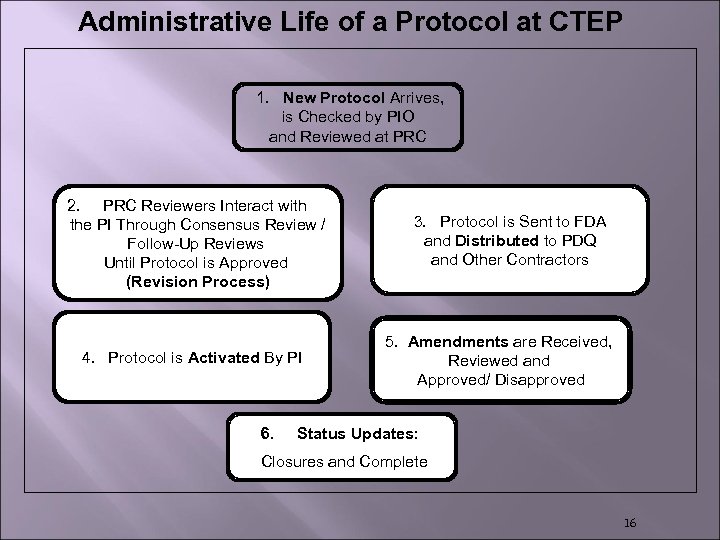 Administrative Life of a Protocol at CTEP 1. New Protocol Arrives, is Checked by PIO and Reviewed at PRC 2. PRC Reviewers Interact with the PI Through Consensus Review / Follow-Up Reviews Until Protocol is Approved (Revision Process) 4. Protocol is Activated By PI 6. 3. Protocol is Sent to FDA and Distributed to PDQ and Other Contractors 5. Amendments are Received, Reviewed and Approved/ Disapproved Status Updates: Closures and Complete 16
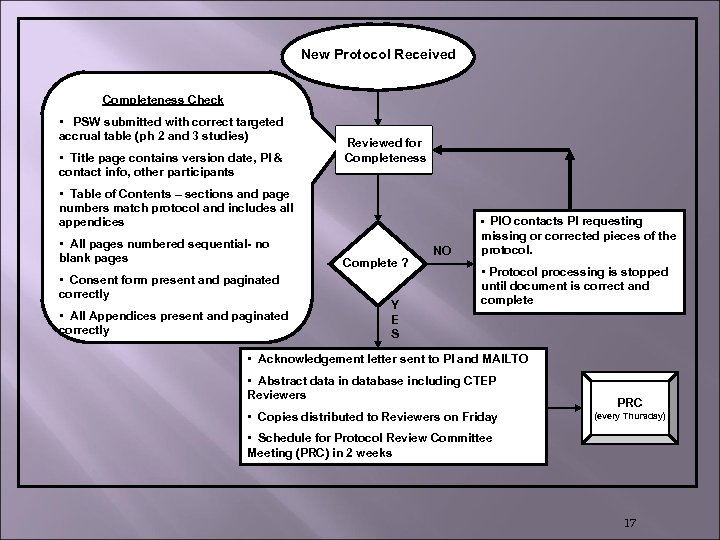 New Protocol Received Completeness Check • PSW submitted with correct targeted accrual table (ph 2 and 3 studies) • Title page contains version date, PI & contact info, other participants Reviewed for Completeness • Table of Contents – sections and page numbers match protocol and includes all appendices • All pages numbered sequential- no blank pages • Consent form present and paginated correctly • All Appendices present and paginated correctly • PIO contacts PI requesting Complete ? Y E S NO missing or corrected pieces of the protocol. • Protocol processing is stopped until document is correct and complete • Acknowledgement letter sent to PI and MAILTO • Abstract data in database including CTEP Reviewers • Copies distributed to Reviewers on Friday PRC (every Thursday) • Schedule for Protocol Review Committee Meeting (PRC) in 2 weeks 17
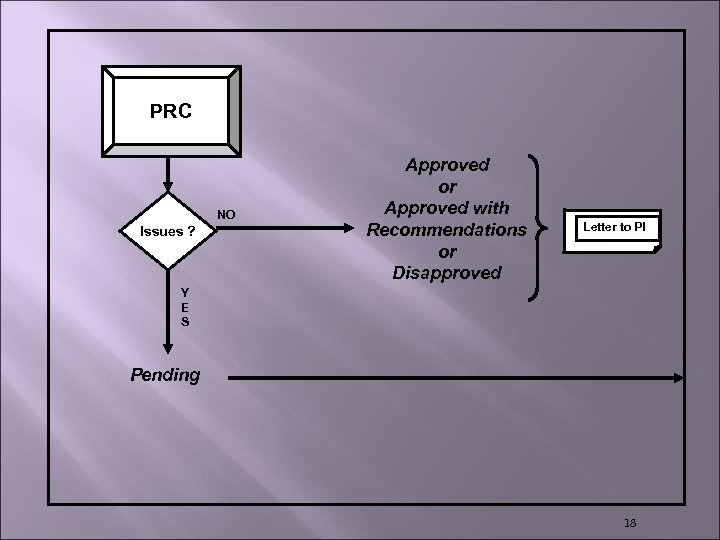 PRC NO Issues ? Approved or Approved with Recommendations or Disapproved Letter to PI Y E S Pending 18
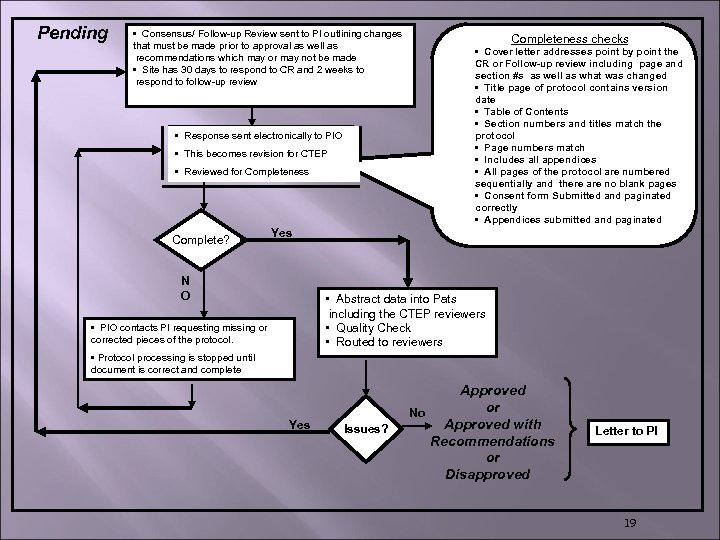 Pending • Consensus/ Follow-up Review sent to PI outlining changes that must be made prior to approval as well as recommendations which may or may not be made • Site has 30 days to respond to CR and 2 weeks to respond to follow-up review • Response sent electronically to PIO • This becomes revision for CTEP • Reviewed for Completeness Complete? Completeness checks • Cover letter addresses point by point the CR or Follow-up review including page and section #s as well as what was changed • Title page of protocol contains version date • Table of Contents • Section numbers and titles match the protocol • Page numbers match • Includes all appendices • All pages of the protocol are numbered sequentially and there are no blank pages • Consent form Submitted and paginated correctly • Appendices submitted and paginated Yes N O • Abstract data into Pats including the CTEP reviewers • Quality Check • Routed to reviewers • PIO contacts PI requesting missing or corrected pieces of the protocol. • Protocol processing is stopped until document is correct and complete Yes Issues? Approved or No Approved with Recommendations or Disapproved Letter to PI 19
 Types of Submissions Amendments Amendment: Any protocol changes which occur after CTEP approval. Amendment guidelines can be found on the CTEP Web site 20
 Types of Submissions- Amendments (continued) The following documentation MUST be included with every Amendment-request submission: Cover letter from the Protocol Chair or PI identify by page AND section each change made to a protocol document. All changes shall be described in a point-by-point format (i. e. Page 3, section 1. 2, replace ‘xyz’ and insert ‘abc’). When appropriate a brief justification for the change should be included. A revised un-marked (without handwritten notes or highlights) copy of the protocol document regardless of whether any changes occurred to the protocol INCLUDING all protocol attachments listed in the table of contents. Informed Consent regardless of which changes occurred to this document. Protocol title page shall include a Version date that reflects the timepoint of the most recent change to the document. If the amendment is in response to a CTEP or FDA request for change the original change request letter shall be attached. OPTIONAL – In addition to the above, you may include a revised copy of the protocol with all changes specified in the Amendment-request cover letter highlighted throughout the document utilizing a wordprocessing program. 21
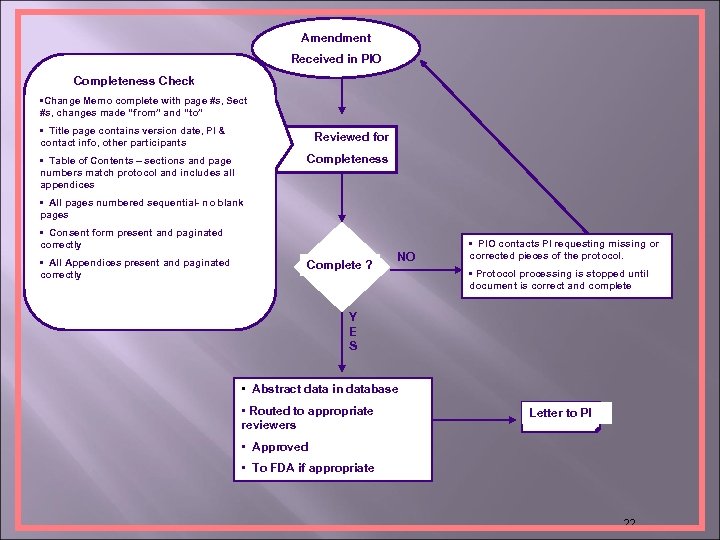 Amendment Received in PIO Completeness Check • Change Memo complete with page #s, Sect #s, changes made “from” and “to” • Title page contains version date, PI & contact info, other participants Reviewed for Completeness • Table of Contents – sections and page numbers match protocol and includes all appendices • All pages numbered sequential- no blank pages • Consent form present and paginated correctly • All Appendices present and paginated correctly Complete ? NO • PIO contacts PI requesting missing or corrected pieces of the protocol. • Protocol processing is stopped until document is correct and complete Y E S • Abstract data in database • Routed to appropriate reviewers Letter to PI • Approved • To FDA if appropriate 22
 Types of Submissions. Miscellaneous Status Notice/Protocol Status Update These are notices received in the PIO stating the status of a protocol (active, closed to accrual and treatment, administratively completed, or publication citation). Protocol Status Update form is available on the web site at: http: //ctep. cancer. gov/guidelines/templates. html IRB Approval Each investigator must meet the requirement of the Federal regulations for human subjects assurances and informed consent and for IRB review and approval. Evidence of IRB approval may be submitted to CTEP at any time in the review process. Each protocol must have documentation of IRB approval prior to CTEP approval. 23
 CTEP Web site and PIO Web page In order to better disseminate accurate and current information, the CTEP Web page is available to the public, investigators, and other Government officials as a resource: ctep. cancer. gov E-mail is the preferred method of communication with the PIO: PIO@ctep. nci. nih. gov Include the NCI Protocol number (if any) in the subject line of the e-mail. 24