


 Скачать презентацию Protocol Analysis Cryptographic Protocols Two or more
ceffa337ec9ca979d371ca1a0e91b2e7.ppt
- Количество слайдов: 32
 Protocol Analysis
 Cryptographic Protocols Two or more parties Communication over insecure network Cryptography used to achieve goal Exchange secret keys Verify identity (authentication) Secure transaction processing CSCE 522 - Farkas 2
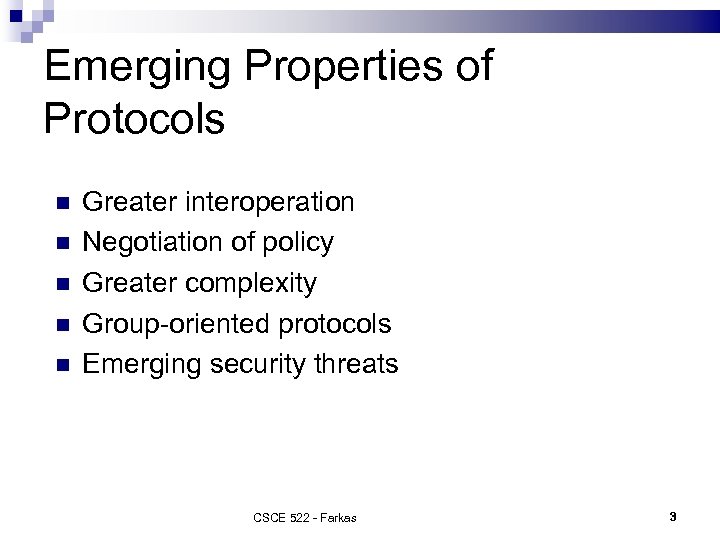 Emerging Properties of Protocols Greater interoperation Negotiation of policy Greater complexity Group-oriented protocols Emerging security threats CSCE 522 - Farkas 3
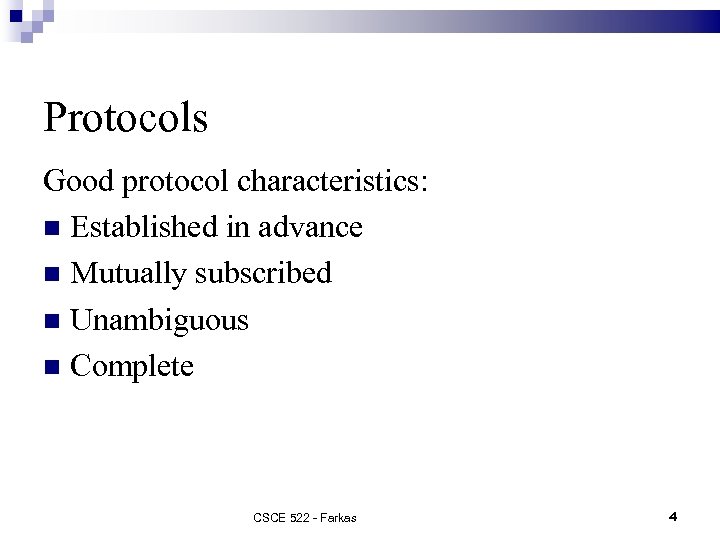 Protocols Good protocol characteristics: Established in advance Mutually subscribed Unambiguous Complete CSCE 522 - Farkas 4
 Symmetric-Key Distribution: Symmetric-Key Techniques (repeat from lecture on 05/13/2014) Symmetric-Key without Server Symmetric-Key with Server CSCE 522 - Farkas 5
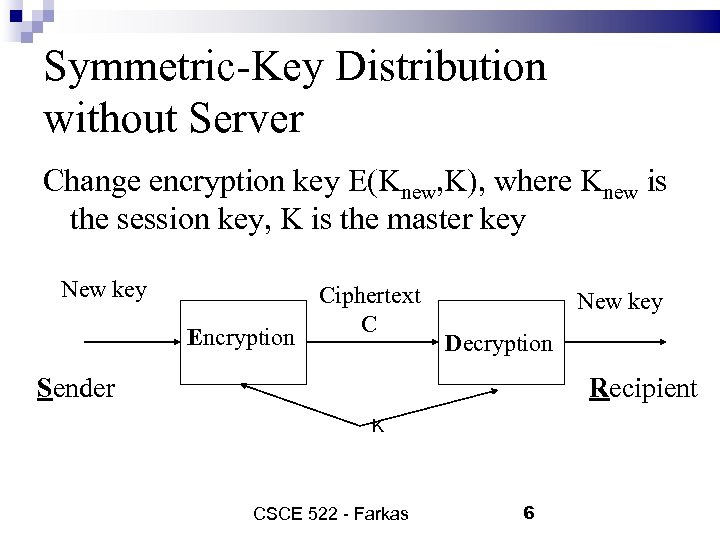 Symmetric-Key Distribution without Server Change encryption key E(Knew, K), where Knew is the session key, K is the master key New key Encryption Ciphertext C New key Decryption Sender Recipient K CSCE 522 - Farkas 6
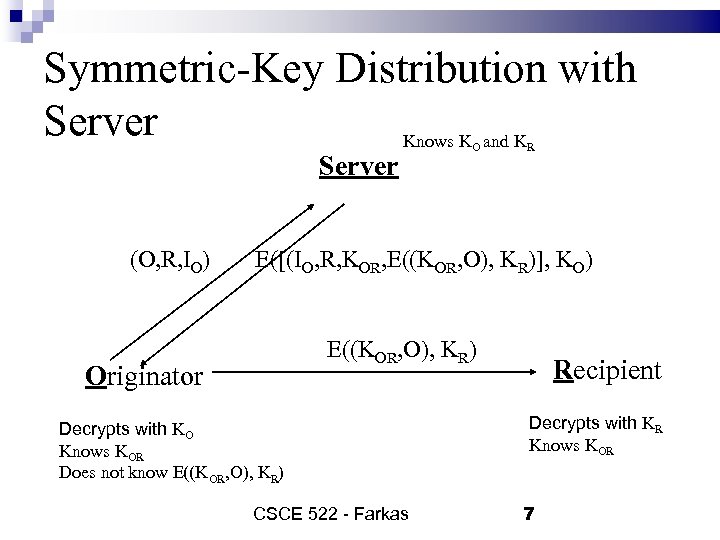 Symmetric-Key Distribution with Server Knows K and K Server (O, R, IO) O R E([(IO, R, KOR, E((KOR, O), KR)], KO) E((KOR, O), KR) Originator Decrypts with KO Knows KOR Does not know E((KOR, O), KR) CSCE 522 - Farkas Recipient Decrypts with KR Knows KOR 7
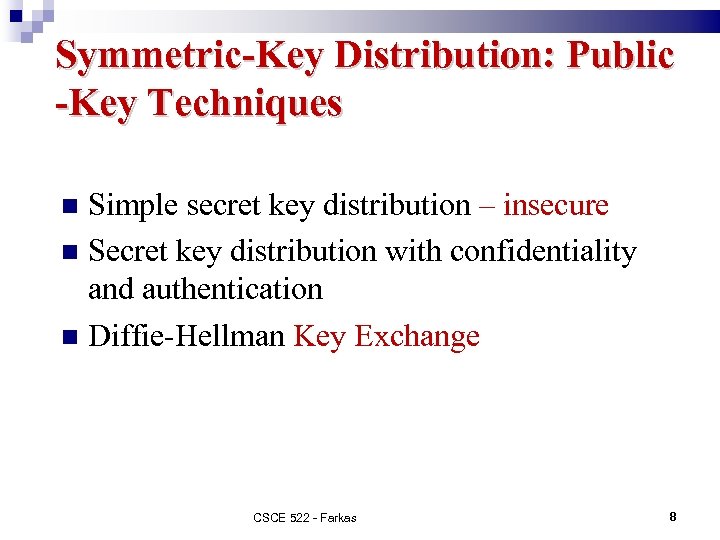 Symmetric-Key Distribution: Public -Key Techniques Simple secret key distribution – insecure Secret key distribution with confidentiality and authentication Diffie-Hellman Key Exchange CSCE 522 - Farkas 8
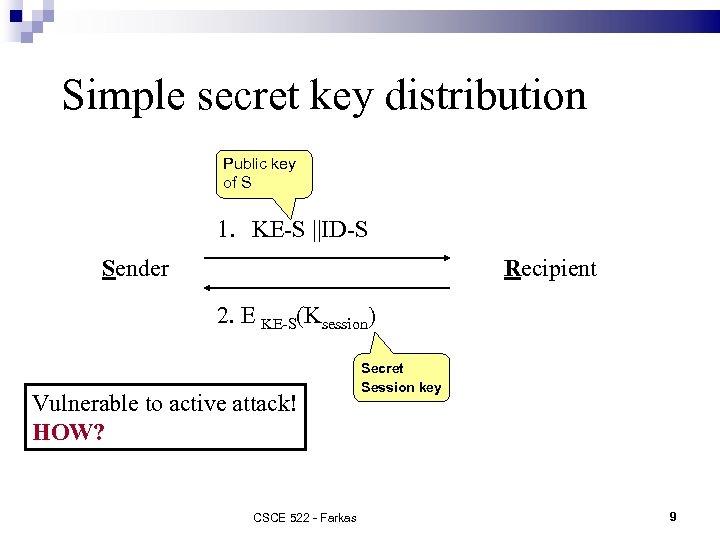 Simple secret key distribution Public key of S 1. KE-S ||ID-S Sender Recipient 2. E KE-S(Ksession) Vulnerable to active attack! HOW? CSCE 522 - Farkas Secret Session key 9
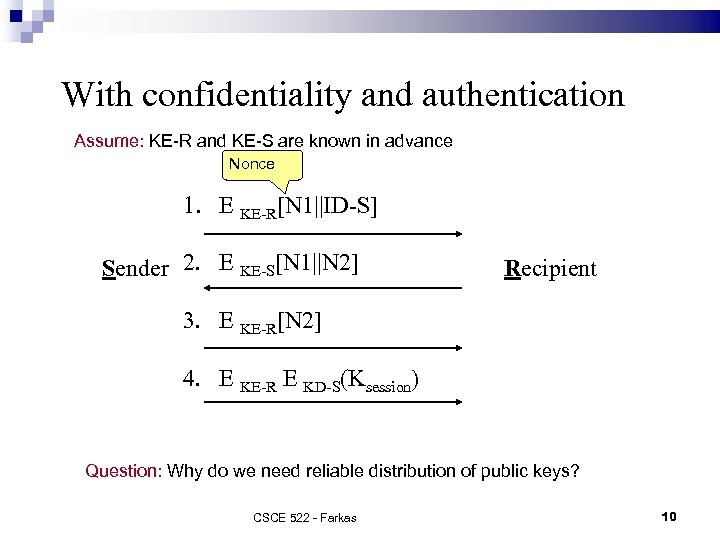 With confidentiality and authentication Assume: KE-R and KE-S are known in advance Nonce 1. E KE-R[N 1||ID-S] Sender 2. E KE-S[N 1||N 2] Recipient 3. E KE-R[N 2] 4. E KE-R E KD-S(Ksession) Question: Why do we need reliable distribution of public keys? CSCE 522 - Farkas 10
 Diffie-Hellman Key Exchange Proposed in 1976 First public key algorithm Allows group of users to agree on secret key over insecure channel Cannot be used to encrypt and decrypt messages CSCE 522 - Farkas 11
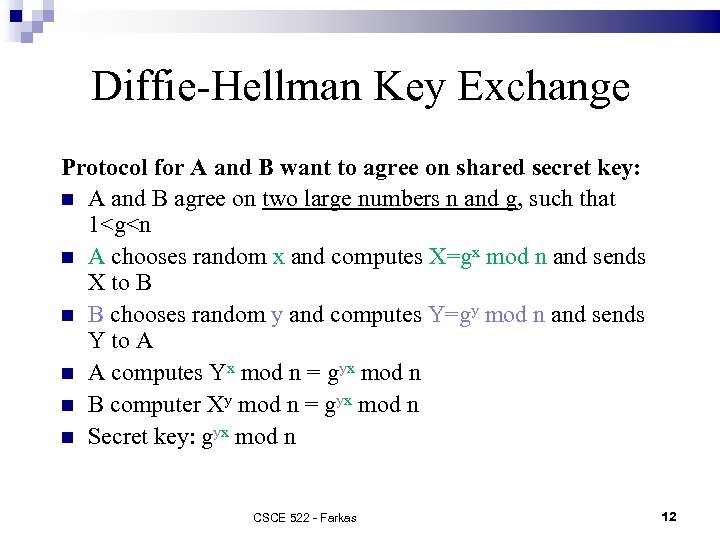 Diffie-Hellman Key Exchange Protocol for A and B want to agree on shared secret key: A and B agree on two large numbers n and g, such that 1
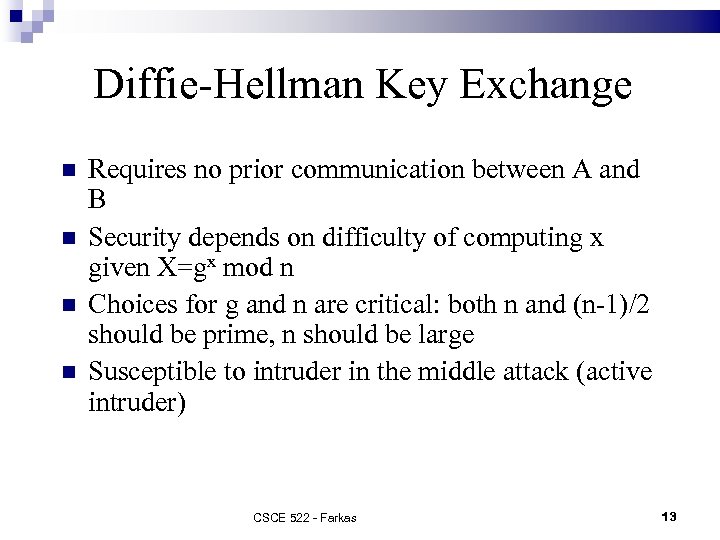 Diffie-Hellman Key Exchange Requires no prior communication between A and B Security depends on difficulty of computing x given X=gx mod n Choices for g and n are critical: both n and (n-1)/2 should be prime, n should be large Susceptible to intruder in the middle attack (active intruder) CSCE 522 - Farkas 13
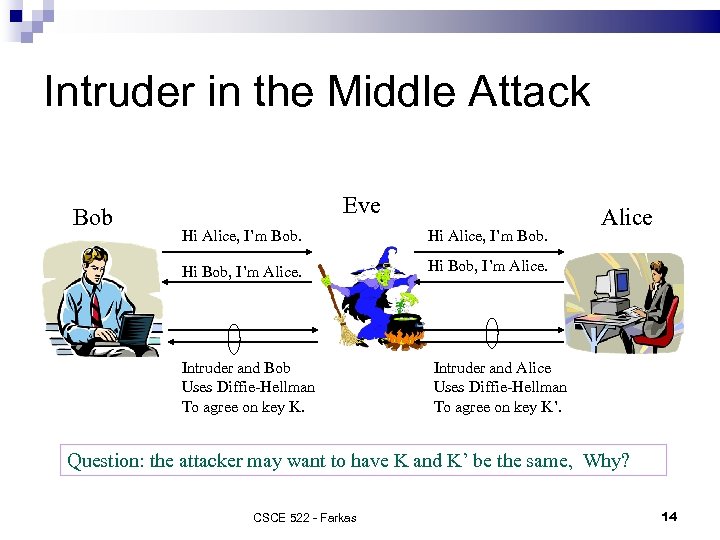 Intruder in the Middle Attack Bob Eve Hi Alice, I’m Bob. Hi Bob, I’m Alice. Intruder and Bob Uses Diffie-Hellman To agree on key K. Intruder and Alice Uses Diffie-Hellman To agree on key K’. Question: the attacker may want to have K and K’ be the same, Why? CSCE 522 - Farkas 14
 Public-Key Distribution Without server Broadcasting - insecure Publicly available directory With trusted server Public key distribution center Certificates CSCE 522 - Farkas 15
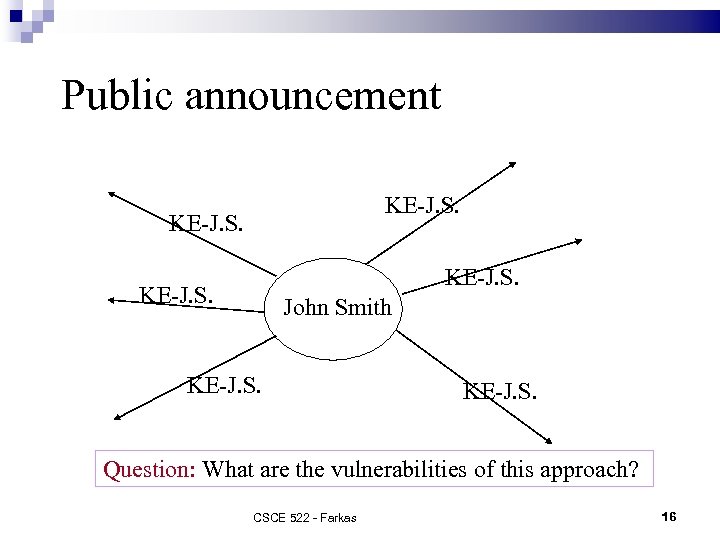 Public announcement KE-J. S. John Smith KE-J. S. Question: What are the vulnerabilities of this approach? CSCE 522 - Farkas 16
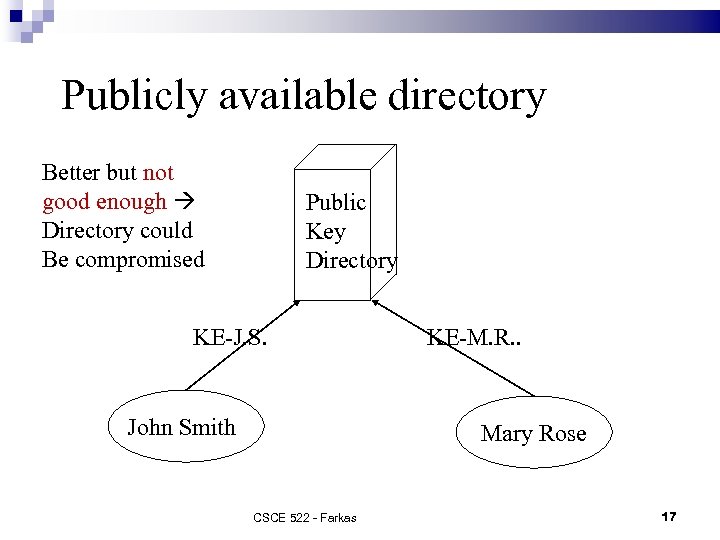 Publicly available directory Better but not good enough Directory could Be compromised Public Key Directory KE-J. S. John Smith KE-M. R. . Mary Rose CSCE 522 - Farkas 17
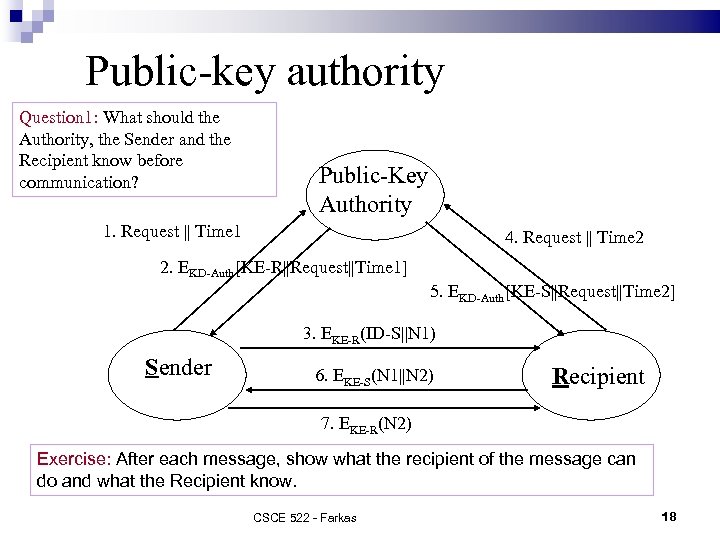 Public-key authority Question 1: What should the Authority, the Sender and the Recipient know before communication? Public-Key Authority 1. Request || Time 1 4. Request || Time 2 2. EKD-Auth[KE-R||Request||Time 1] 5. EKD-Auth[KE-S||Request||Time 2] 3. EKE-R(ID-S||N 1) Sender 6. EKE-S(N 1||N 2) Recipient 7. EKE-R(N 2) Exercise: After each message, show what the recipient of the message can do and what the Recipient know. CSCE 522 - Farkas 18
![Public-key certificates Certificate Authority KE-S C-S=EKD-CAuth[Time 1, ID-S, KE-S] KE-R CR=EKD-CAuth[Time 2, ID-R, KE-R]](https://present5.com/presentation/ceffa337ec9ca979d371ca1a0e91b2e7/image-19.jpg "Public-key certificates Certificate Authority KE-S C-S=EKD-CAuth[Time 1, ID-S, KE-S] KE-R CR=EKD-CAuth[Time 2, ID-R, KE-R]") Public-key certificates Certificate Authority KE-S C-S=EKD-CAuth[Time 1, ID-S, KE-S] KE-R CR=EKD-CAuth[Time 2, ID-R, KE-R] 1. C-S Sender 2. C-R CSCE 522 - Farkas Recipient 19
Public-key certificates Certificate Authority KE-S C-S=EKD-CAuth[Time 1, ID-S, KE-S] KE-R CR=EKD-CAuth[Time 2, ID-R, KE-R] 1. C-S Sender 2. C-R CSCE 522 - Farkas Recipient 19
 Certificates Guarantees the validity of the information Establishing trust Public key and user identity are bound together, then signed by someone trusted Need: digital signature CSCE 522 - Farkas 20
 Digital Signature Need the same effect as a real signature Un-forgeable Authentic Non-alterable Not reusable CSCE 522 - Farkas 21
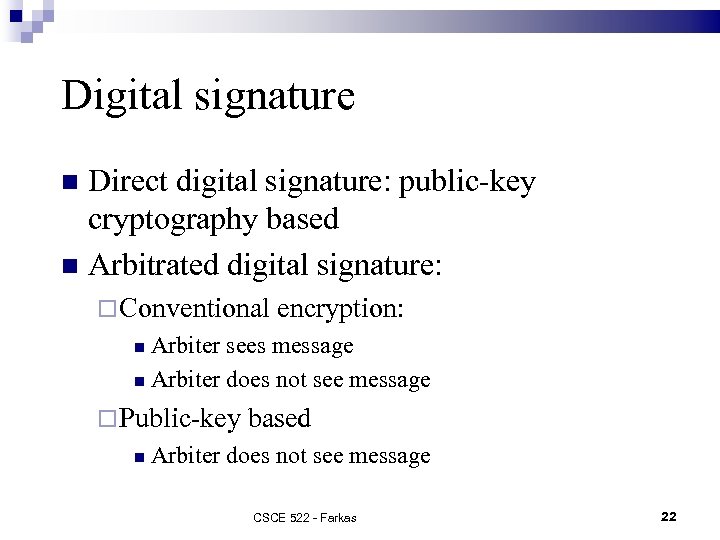 Digital signature Direct digital signature: public-key cryptography based Arbitrated digital signature: Conventional encryption: Arbiter sees message Arbiter does not see message Public-key based Arbiter does not see message CSCE 522 - Farkas 22
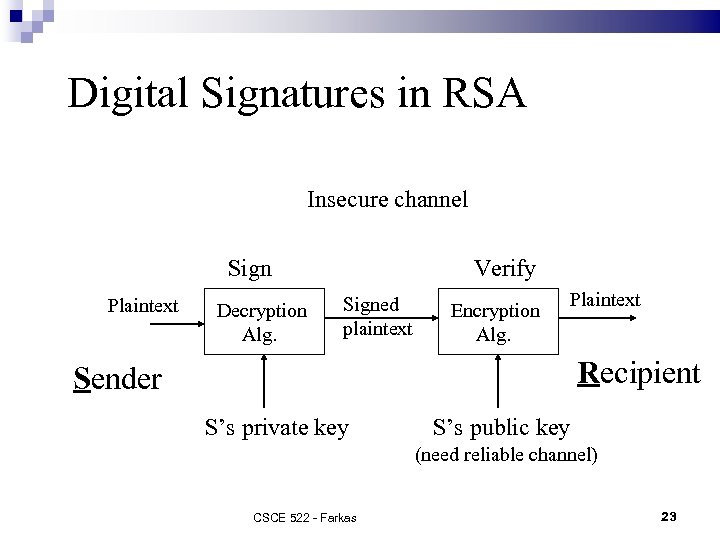 Digital Signatures in RSA Insecure channel Sign Plaintext Decryption Alg. Verify Signed plaintext Encryption Alg. Plaintext Recipient Sender S’s private key S’s public key (need reliable channel) CSCE 522 - Farkas 23
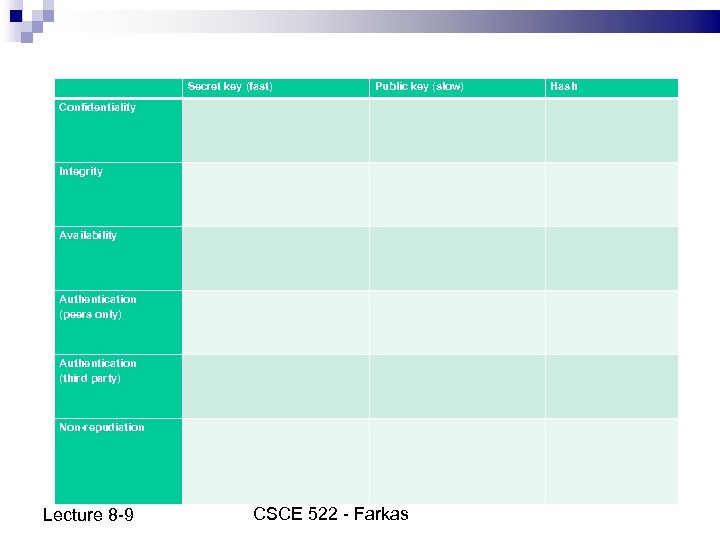 Secret key (fast) Public key (slow) Hash Confidentiality Integrity Availability Authentication (peers only) Authentication (third party) Non-repudiation Lecture 8 -9 CSCE 522 - Farkas
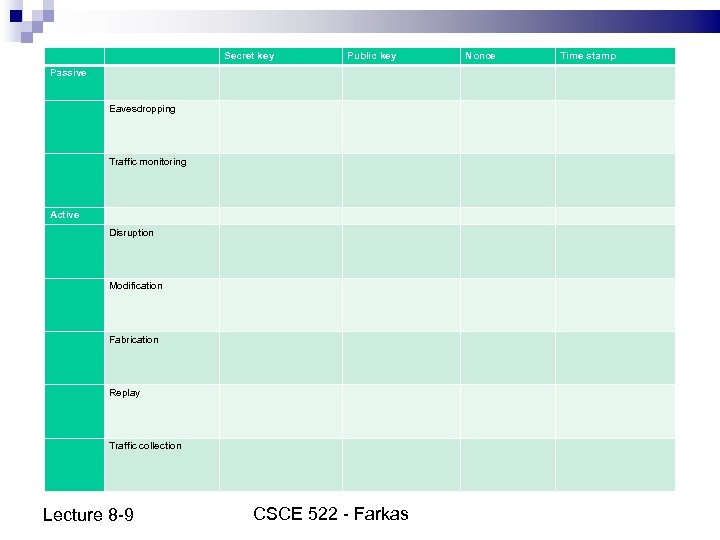 Secret key Public key Nonce Time stamp Passive Eavesdropping Traffic monitoring Active Disruption Modification Fabrication Replay Traffic collection Lecture 8 -9 CSCE 522 - Farkas
 Protocol Analysis Exercise 1. Assume that Jane and Paul want to efficiently send very large files to each other. They also want to provide integrity verification, thirdparty message authentication (i. e. , a third party can verify who the originator of the message is), and limit the scope of a compromise (i. e. , providing forward secrecy). You can assume that Jane and Paul have public and secret key encryption capabilities, can generate a hash function, and they have a shared secret key K 0 established before the communication. They do not have access to a mutually trusted server, and no other keys but K 0 are known at the beginning of the communication. Propose a security protocol to establish necessary keys and show Jane can send a file to Paul. Lecture 8 -9 CSCE 522 - Farkas
 Exercise 2. Message authentication and key agreement Alice wants to establish a secure communication with Bob. They agree to user the Yahalom protocol for mutual authentication and key agreement. The protocol uses symmetric key encryption only. Alice has a secret key shared with a trusted third party Server, KA and, similarly, Bob has a secret-key shared with Server, KB. NA and NB are nonces generated by Alice and Bob, respectively. E(M, K) indicates encryption of message M with key K, “||” means concatenation of messages. Explain after each protocol step what the recipient of the message knows based on the message and the properties of the encryption and what he/she is capable of doing. For example, Lecture 8 -9 CSCE 522 - Farkas
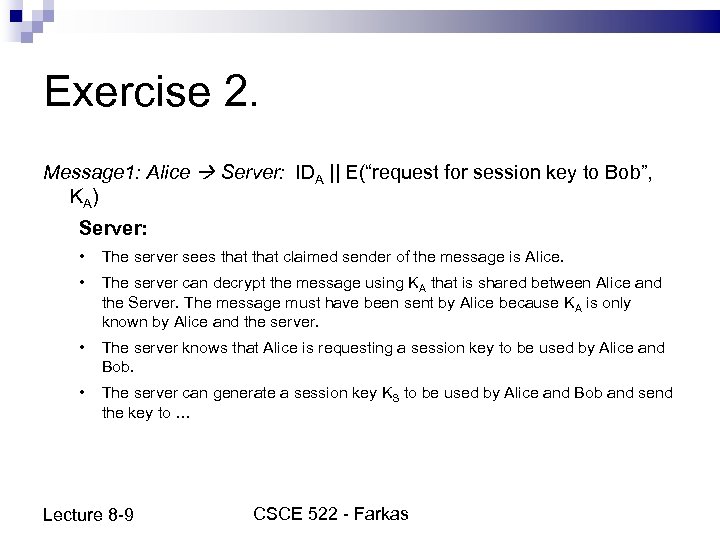 Exercise 2. Message 1: Alice Server: IDA || E(“request for session key to Bob”, KA) Server: • The server sees that claimed sender of the message is Alice. • The server can decrypt the message using KA that is shared between Alice and the Server. The message must have been sent by Alice because KA is only known by Alice and the server. • The server knows that Alice is requesting a session key to be used by Alice and Bob. • The server can generate a session key KS to be used by Alice and Bob and send the key to … Lecture 8 -9 CSCE 522 - Farkas
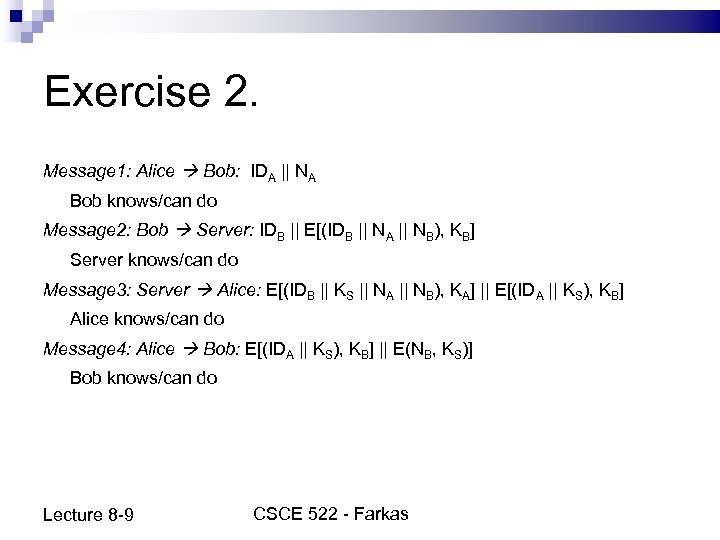 Exercise 2. Message 1: Alice Bob: IDA || NA Bob knows/can do Message 2: Bob Server: IDB || E[(IDB || NA || NB), KB] Server knows/can do Message 3: Server Alice: E[(IDB || KS || NA || NB), KA] || E[(IDA || KS), KB] Alice knows/can do Message 4: Alice Bob: E[(IDA || KS), KB] || E(NB, KS)] Bob knows/can do Lecture 8 -9 CSCE 522 - Farkas
 Exercise 3. Secure communication Consider the following protocol. Ann wants to send a message M securely to Bob but there is no shared secret key between Ann and Bob, Ann does not even know Bob’s public key. However, using the properties of RSA (in particular the commutative property), Ann proposes the following protocol, where E(M, K) indicates encryption/decryption of message M with key K, “||” means concatenation of messages, Kpub. A means the public key of A, Kpriv. A means private key of A. Lecture 8 -9 CSCE 522 - Farkas
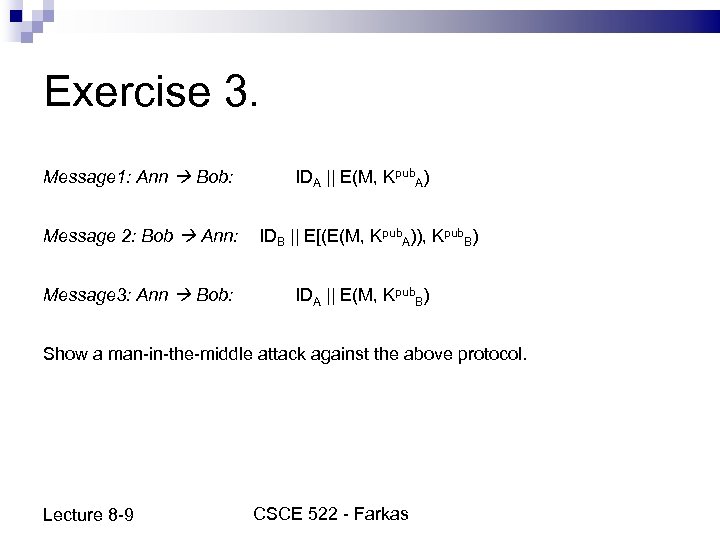 Exercise 3. Message 1: Ann Bob: IDA || E(M, Kpub. A) Message 2: Bob Ann: Message 3: Ann Bob: IDB || E[(E(M, Kpub. A)), Kpub. B) IDA || E(M, Kpub. B) Show a man-in-the-middle attack against the above protocol. Lecture 8 -9 CSCE 522 - Farkas
 Next class Review for Test 1 Lecture 8 -9 CSCE 522 - Farkas 32