 Скачать презентацию Protein Analysis Workshop 2008 Secondary Structure Prediction Bioinformatics
d7036c8628a5b4c2cc64263077971c4c.ppt
- Количество слайдов: 39



Protein Analysis Workshop 2008 Secondary Structure Prediction Bioinformatics group Institute of Biotechnology University of helsinki Hung Ta xuanhung. ta@helsinki. fi
Overview n n Hierarchy of protein structure. Introduction to structure prediction: • • n Different approaches. Prediction of 1 D strings of structural elements. Server/soft review: • • COILS, MPEx, … The Predict. Protein metaserver.
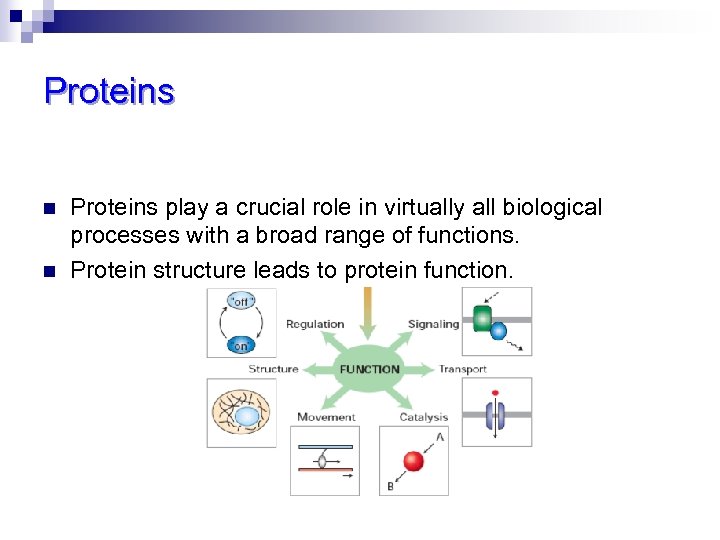
Proteins n n Proteins play a crucial role in virtually all biological processes with a broad range of functions. Protein structure leads to protein function.
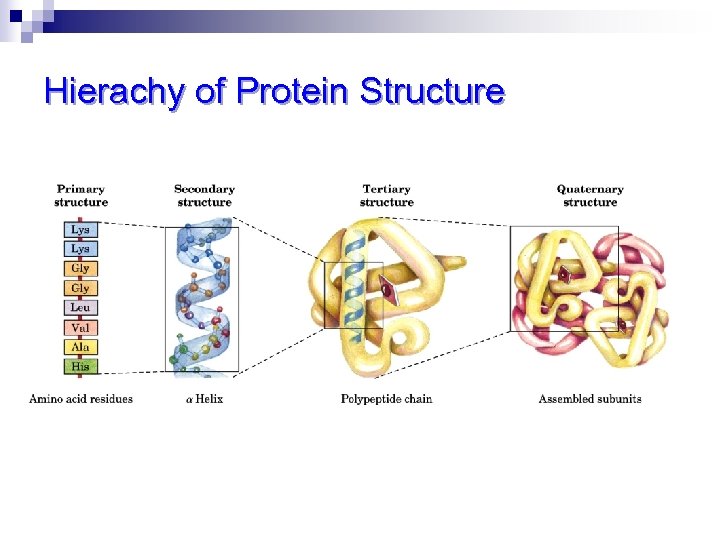
Hierachy of Protein Structure
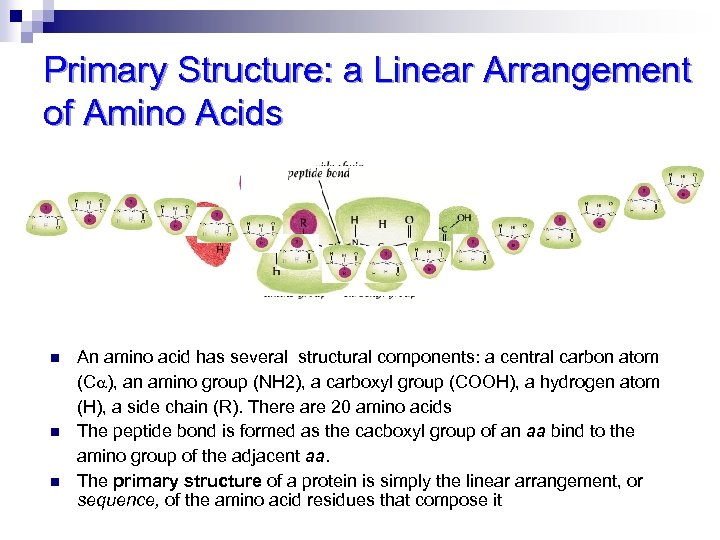
Primary Structure: a Linear Arrangement of Amino Acids n n n An amino acid has several structural components: a central carbon atom (Ca), an amino group (NH 2), a carboxyl group (COOH), a hydrogen atom (H), a side chain (R). There are 20 amino acids The peptide bond is formed as the cacboxyl group of an aa bind to the amino group of the adjacent aa. The primary structure of a protein is simply the linear arrangement, or sequence, of the amino acid residues that compose it
Secondary Structure: Core Elements of Protein Architecture n resulted from the folding of localized parts of a polypeptide chain. n α-helix n β-sheet n Coils, turns, major internal supportive elements, 60 percent of the polypeptide chain
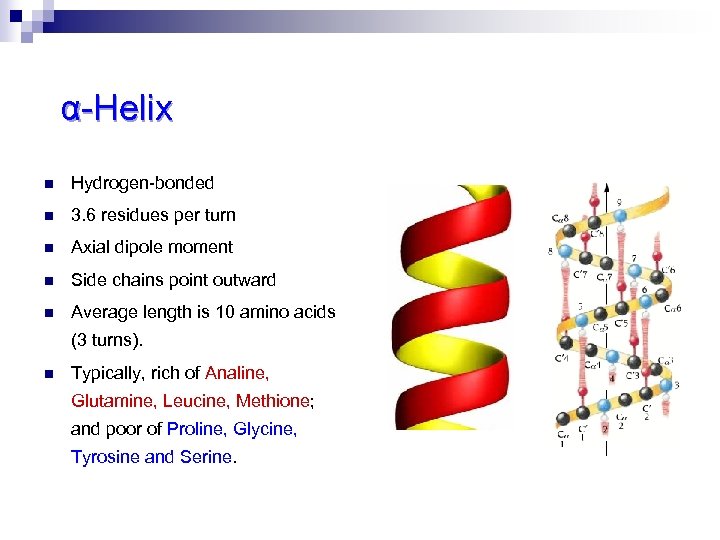
α-Helix n Hydrogen-bonded n 3. 6 residues per turn n Axial dipole moment n Side chains point outward n Average length is 10 amino acids (3 turns). n Typically, rich of Analine, Glutamine, Leucine, Methione; and poor of Proline, Glycine, Tyrosine and Serine.
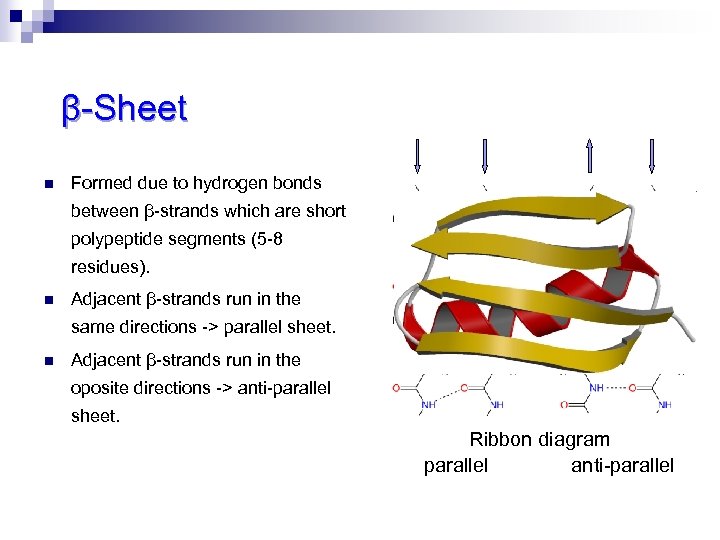
β-Sheet n Formed due to hydrogen bonds between β-strands which are short polypeptide segments (5 -8 residues). n Adjacent β-strands run in the same directions -> parallel sheet. n Adjacent β-strands run in the oposite directions -> anti-parallel sheet. Ribbon diagram parallel anti-parallel
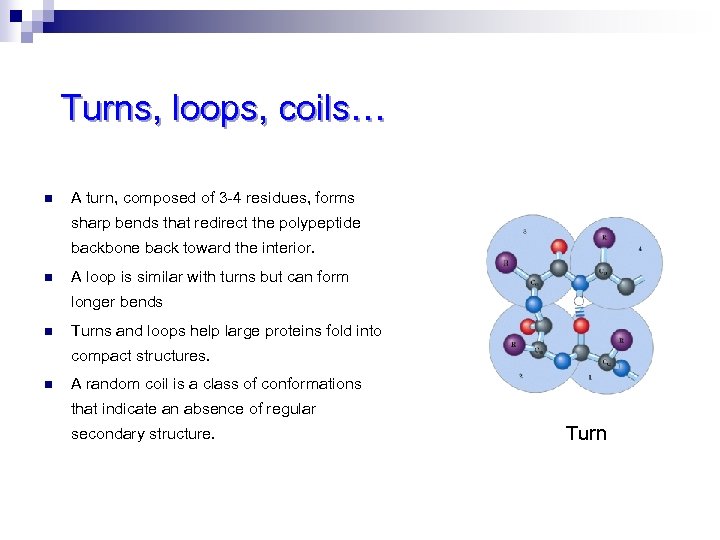
Turns, loops, coils… n A turn, composed of 3 -4 residues, forms sharp bends that redirect the polypeptide backbone back toward the interior. n A loop is similar with turns but can form longer bends n Turns and loops help large proteins fold into compact structures. n A random coil is a class of conformations that indicate an absence of regular secondary structure. Turn
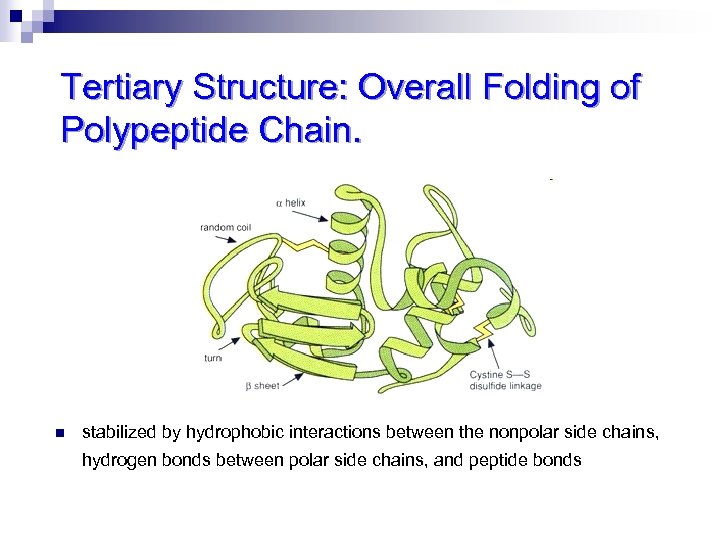
Tertiary Structure: Overall Folding of Polypeptide Chain. n stabilized by hydrophobic interactions between the nonpolar side chains, hydrogen bonds between polar side chains, and peptide bonds
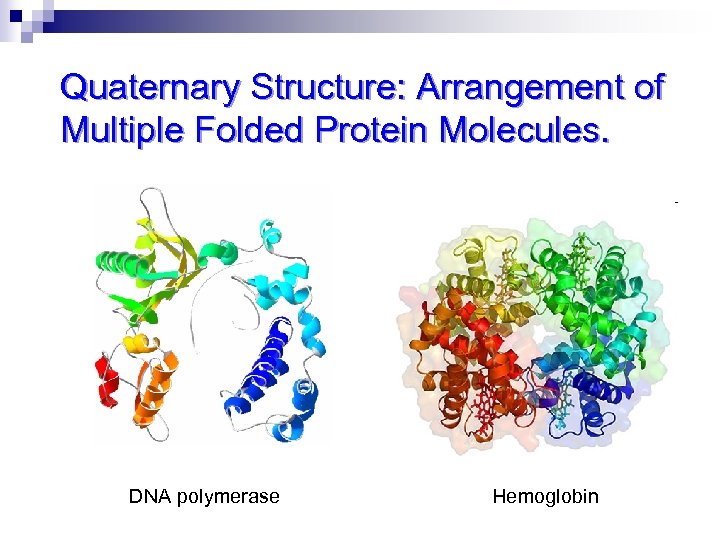
Quaternary Structure: Arrangement of Multiple Folded Protein Molecules. DNA polymerase Hemoglobin
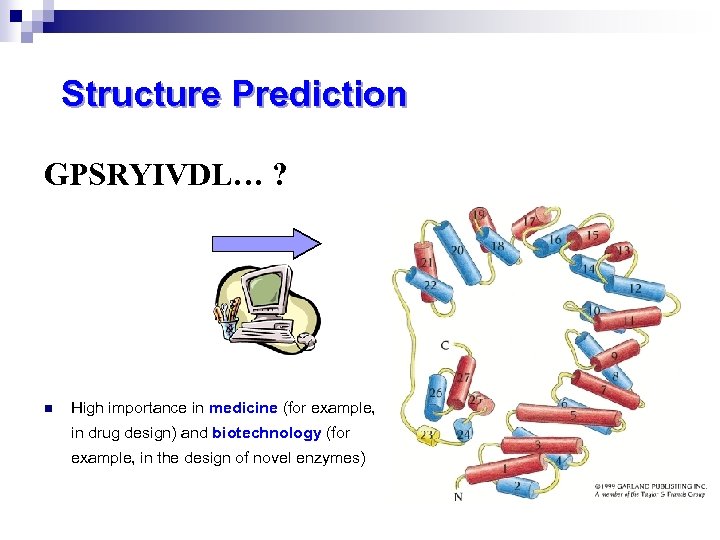
Structure Prediction GPSRYIVDL… ? n High importance in medicine (for example, in drug design) and biotechnology (for example, in the design of novel enzymes)
Structure Prediction n Why: experimental methods, X-ray crystallography or NMR spectroscopy, are very time-consuming and relatively expensive. n Challenges: ¨ Extremely large number of possible structures. ¨ the physical basis of protein structural stability is not fully understood. n In this lecture, discuss about the protein secondary strutures prediction.
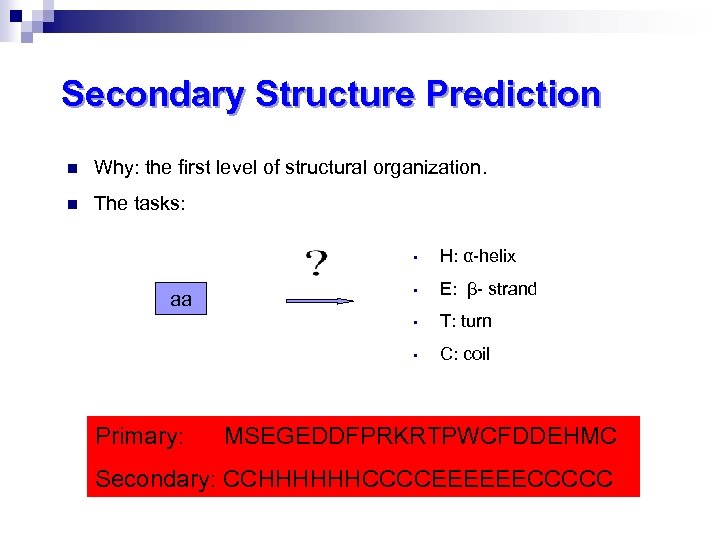
Secondary Structure Prediction n Why: the first level of structural organization. n The tasks: • E: β- strand T: turn • Primary: • • aa H: α-helix C: coil MSEGEDDFPRKRTPWCFDDEHMC Secondary: CCHHHHHHCCCCEEEEEECCCCC
Secondary Structure Prediction Single residue statistical analysis (Chou-Fasman -1974): ¨ For each amino acid type, assign its ‘propensity’ to be in a helix, βsheet, or coil. ¨ Based on 15 proteins of known conformation, 2473 total amino acids. ¨ Limited accuracy: ~55 -60% on average. ¨ Eg: Chou-Fasman (1974), not used any more
Secondary Structure Prediction Segment-based statistics: ¨ Look for correlations (within 11 -21 aa windows). ¨ Many algorithms have been tried. ¨ Most performant: Neural Networks: n Input: a number of protein sequences with their known secondary structure. n Output: a trained network that predicts secondary structure elements for given query sequences. n Accuracy < 70%.
POPULAR SERVERS FOR DEALING WITH SECONDARY STRUCTURES • Coiled-coils • Transmembrane helices • Secondary structure • Metaservers
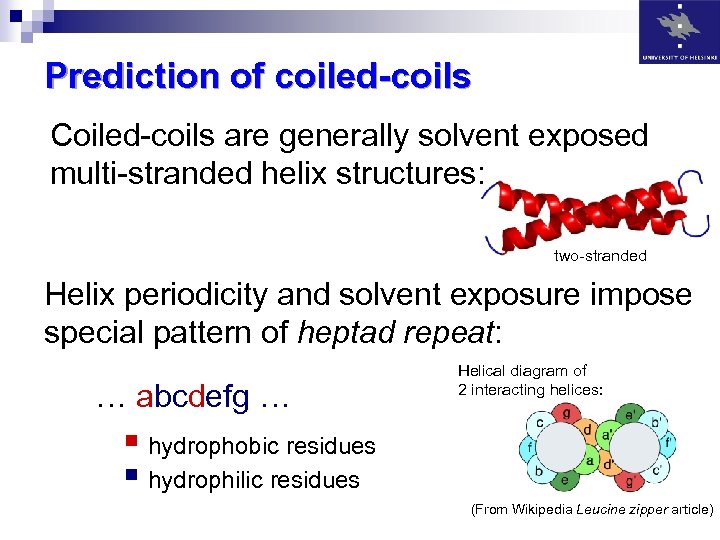
Prediction of coiled-coils Coiled-coils are generally solvent exposed multi-stranded helix structures: two-stranded Helix periodicity and solvent exposure impose special pattern of heptad repeat: … abcdefg … Helical diagram of 2 interacting helices: § hydrophobic residues § hydrophilic residues (From Wikipedia Leucine zipper article)
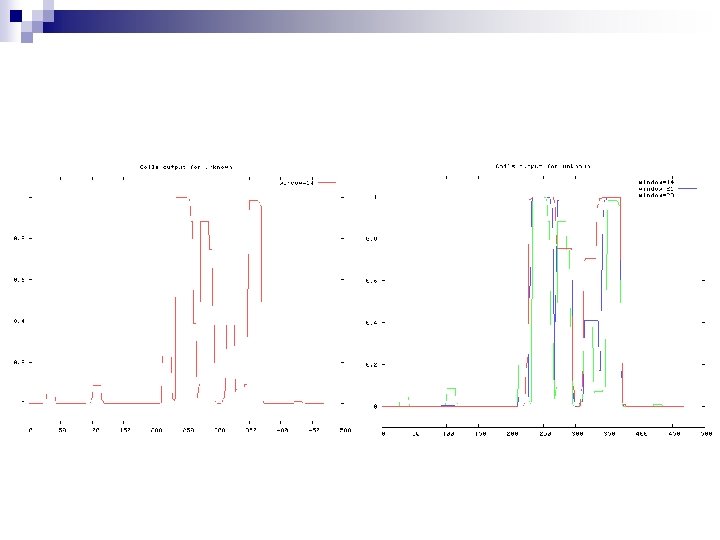
The COILS server at EMBnet n n n Compares a sequence to a database of known, parallel two-stranded coiled-coils, and derives a similarity score. By comparing this score to the distribution of scores in globular and coiled-coil proteins, the program then calculates the probability that the sequence will adopt a coiled-coil conformation. Options: • • • scoring matrices, window size (score may vary), weighting options.
COILS Limitations The program works well for parallel twostranded structures that are solventexposed but runs progressively into problems with the addition of more helices, their antiparallel orientation and their decreasing length. n The program fails entirely on buried structures. n
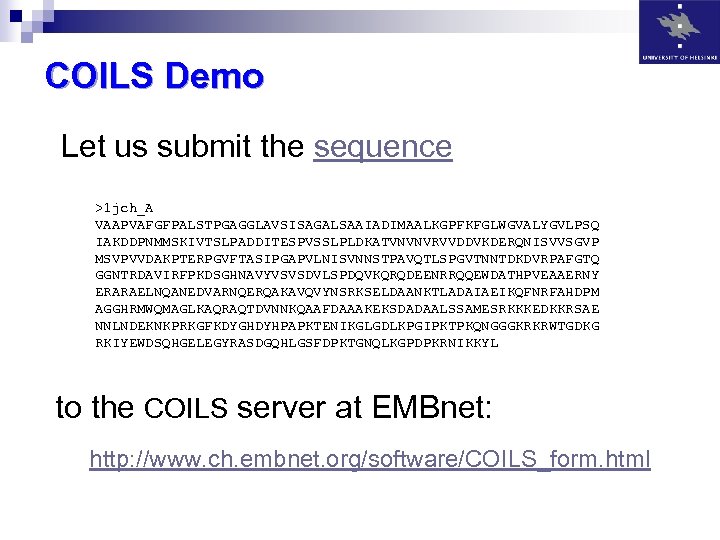
COILS Demo Let us submit the sequence >1 jch_A VAAPVAFGFPALSTPGAGGLAVSISAGALSAAIADIMAALKGPFKFGLWGVALYGVLPSQ IAKDDPNMMSKIVTSLPADDITESPVSSLPLDKATVNVNVRVVDDVKDERQNISVVSGVP MSVPVVDAKPTERPGVFTASIPGAPVLNISVNNSTPAVQTLSPGVTNNTDKDVRPAFGTQ GGNTRDAVIRFPKDSGHNAVYVSVSDVLSPDQVKQRQDEENRRQQEWDATHPVEAAERNY ERARAELNQANEDVARNQERQAKAVQVYNSRKSELDAANKTLADAIAEIKQFNRFAHDPM AGGHRMWQMAGLKAQRAQTDVNNKQAAFDAAAKEKSDADAALSSAMESRKKKEDKKRSAE NNLNDEKNKPRKGFKDYGHDYHPAPKTENIKGLGDLKPGIPKTPKQNGGGKRKRWTGDKG RKIYEWDSQHGELEGYRASDGQHLGSFDPKTGNQLKGPDPKRNIKKYL to the COILS server at EMBnet: http: //www. ch. embnet. org/software/COILS_form. html
Transmembrane Region Prediction Transmembrane regions: n Usually contain residues with hydrophobic side chains (surface must be hydrophobic). n Usually ~20 residues long, can be up to 30 if not perpendicular through membrane. Methods: n Hydropathy plots (historical, better methods now available) n Threading (TMpred, MEMSAT), n Hidden Markov Model (TMHMM), n Neural Network (PHDhtm).
Hydropathy Plots (Kyte-Doolittle) n The hydropathy index of an amino acid is a number representing the hydrophobic or hydrophilic properties of its side-chain n compute an average hydropathy value for each position in the query sequence, n window length of 19 usually chosen for membranespanning region prediction.
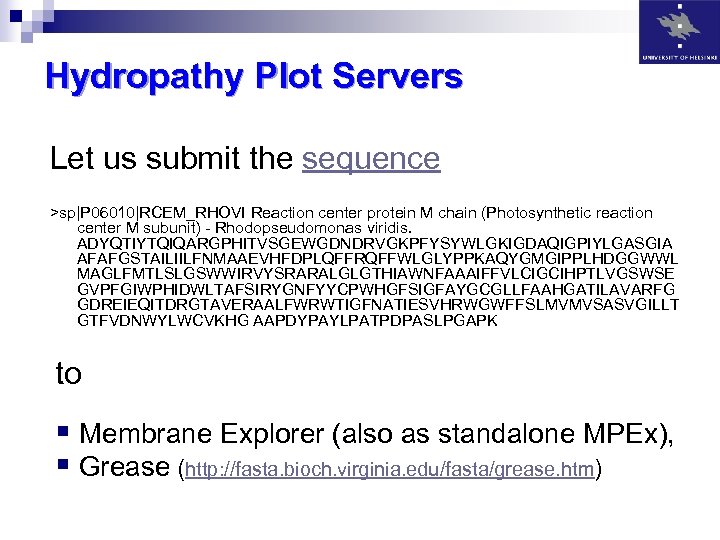
Hydropathy Plot Servers Let us submit the sequence >sp|P 06010|RCEM_RHOVI Reaction center protein M chain (Photosynthetic reaction center M subunit) - Rhodopseudomonas viridis. ADYQTIYTQIQARGPHITVSGEWGDNDRVGKPFYSYWLGKIGDAQIGPIYLGASGIA AFAFGSTAILIILFNMAAEVHFDPLQFFRQFFWLGLYPPKAQYGMGIPPLHDGGWWL MAGLFMTLSLGSWWIRVYSRARALGLGTHIAWNFAAAIFFVLCIGCIHPTLVGSWSE GVPFGIWPHIDWLTAFSIRYGNFYYCPWHGFSIGFAYGCGLLFAAHGATILAVARFG GDREIEQITDRGTAVERAALFWRWTIGFNATIESVHRWGWFFSLMVMVSASVGILLT GTFVDNWYLWCVKHG AAPDYPAYLPATPDPASLPGAPK to § Membrane Explorer (also as standalone MPEx), § Grease (http: //fasta. bioch. virginia. edu/fasta/grease. htm)
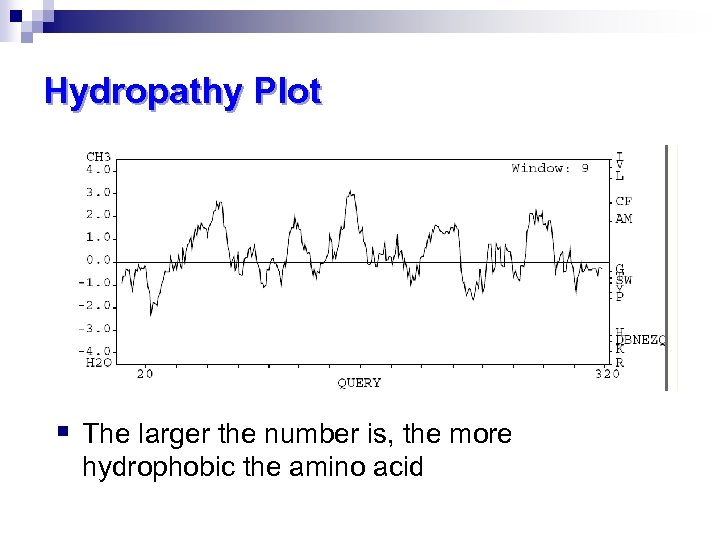
Hydropathy Plot § The larger the number is, the more hydrophobic the amino acid
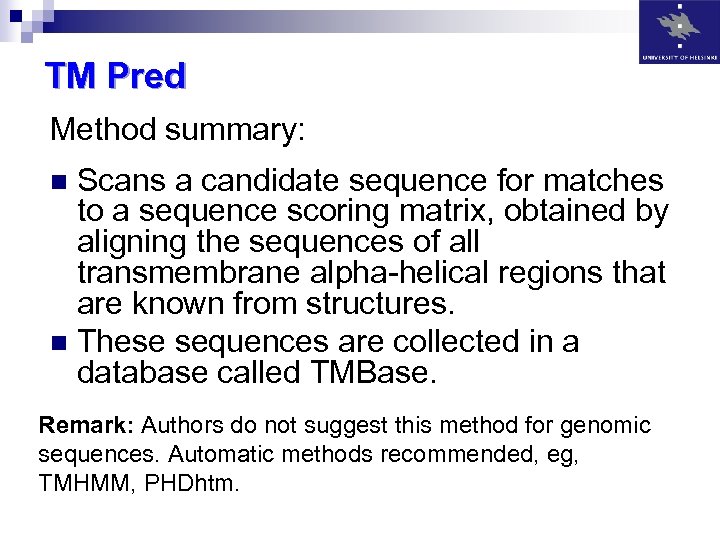
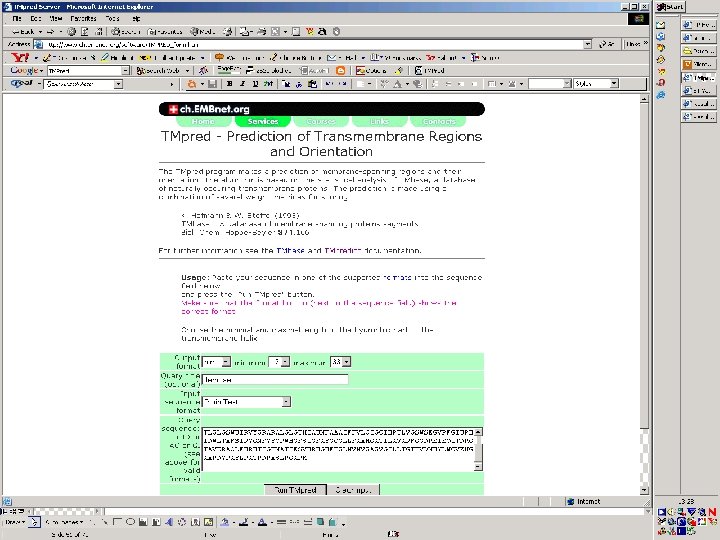
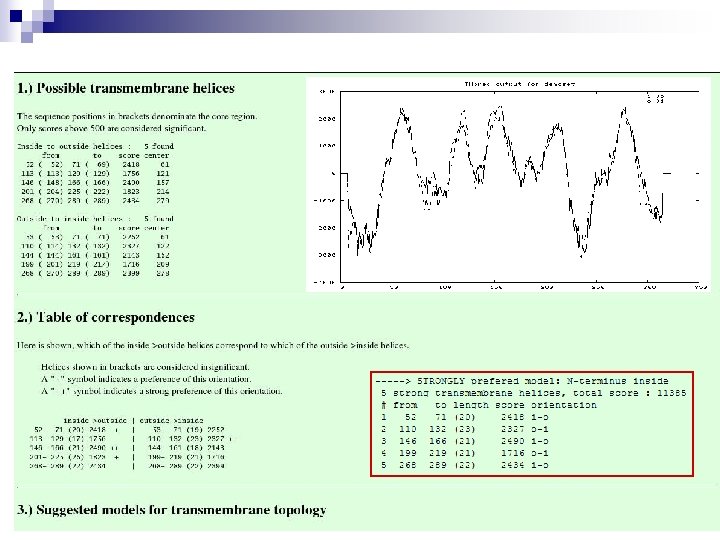
TM Pred Method summary: Scans a candidate sequence for matches to a sequence scoring matrix, obtained by aligning the sequences of all transmembrane alpha-helical regions that are known from structures. n These sequences are collected in a database called TMBase. n Remark: Authors do not suggest this method for genomic sequences. Automatic methods recommended, eg, TMHMM, PHDhtm.
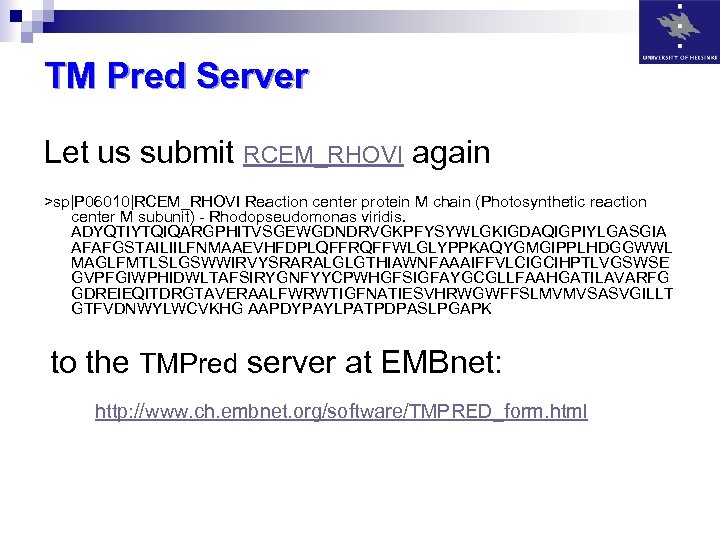
TM Pred Server Let us submit RCEM_RHOVI again >sp|P 06010|RCEM_RHOVI Reaction center protein M chain (Photosynthetic reaction center M subunit) - Rhodopseudomonas viridis. ADYQTIYTQIQARGPHITVSGEWGDNDRVGKPFYSYWLGKIGDAQIGPIYLGASGIA AFAFGSTAILIILFNMAAEVHFDPLQFFRQFFWLGLYPPKAQYGMGIPPLHDGGWWL MAGLFMTLSLGSWWIRVYSRARALGLGTHIAWNFAAAIFFVLCIGCIHPTLVGSWSE GVPFGIWPHIDWLTAFSIRYGNFYYCPWHGFSIGFAYGCGLLFAAHGATILAVARFG GDREIEQITDRGTAVERAALFWRWTIGFNATIESVHRWGWFFSLMVMVSASVGILLT GTFVDNWYLWCVKHG AAPDYPAYLPATPDPASLPGAPK to the TMPred server at EMBnet: http: //www. ch. embnet. org/software/TMPRED_form. html
Meta-Servers A server which allows you to obtain many informations based on your sequence including structure predictions, motif or domain search… The predictions are based on several methods. n Predict. Protein: http: //predictprotein. org n
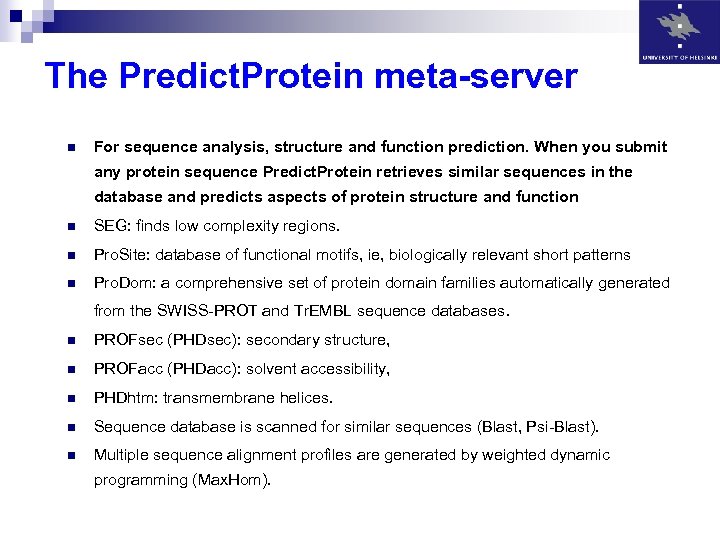
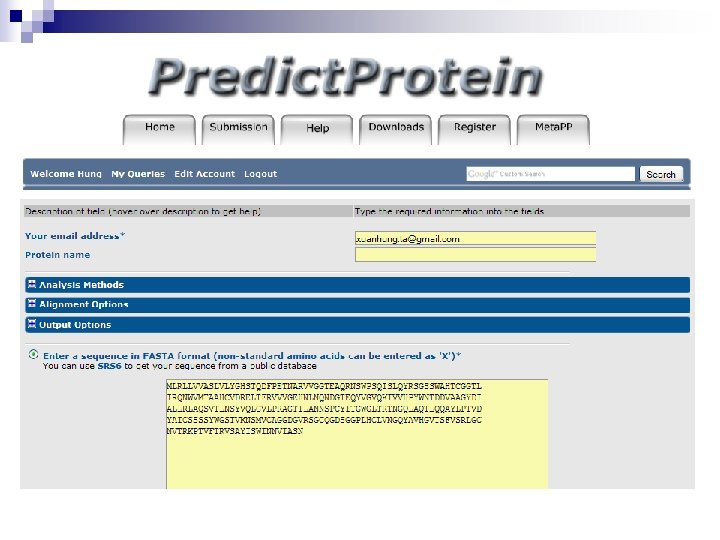
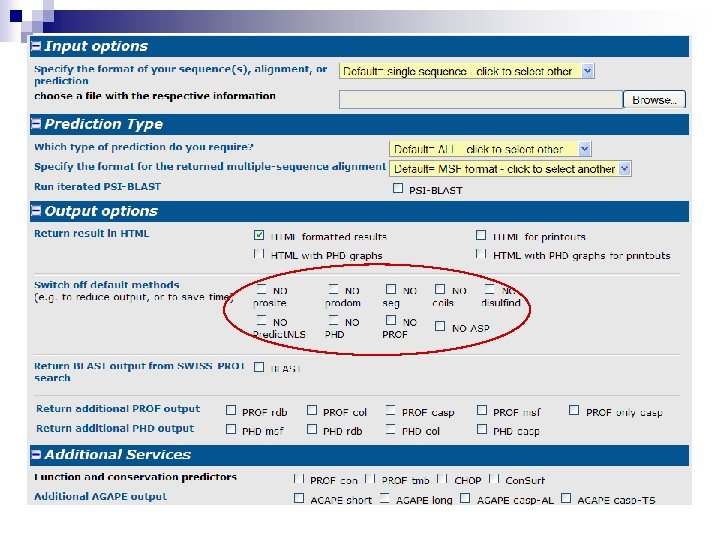
The Predict. Protein meta-server n For sequence analysis, structure and function prediction. When you submit any protein sequence Predict. Protein retrieves similar sequences in the database and predicts aspects of protein structure and function n SEG: finds low complexity regions. n Pro. Site: database of functional motifs, ie, biologically relevant short patterns n Pro. Dom: a comprehensive set of protein domain families automatically generated from the SWISS-PROT and Tr. EMBL sequence databases. n PROFsec (PHDsec): secondary structure, n PROFacc (PHDacc): solvent accessibility, n PHDhtm: transmembrane helices. n Sequence database is scanned for similar sequences (Blast, Psi-Blast). n Multiple sequence alignment profiles are generated by weighted dynamic programming (Max. Hom).
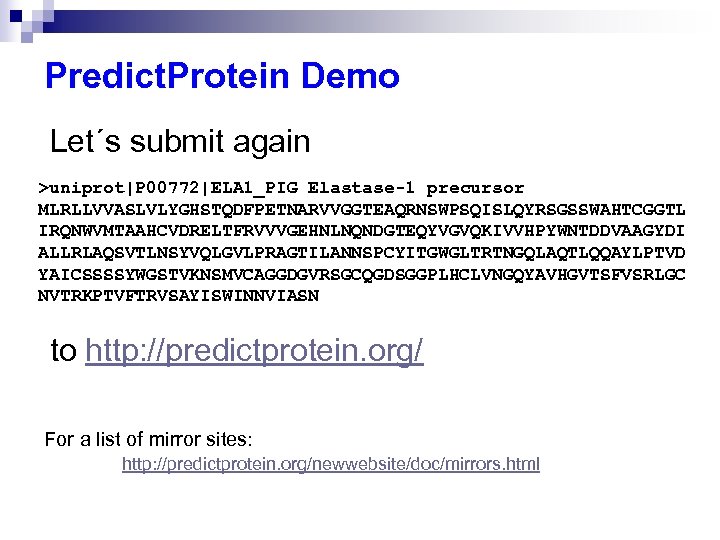
Predict. Protein Demo Let´s submit again >uniprot|P 00772|ELA 1_PIG Elastase-1 precursor MLRLLVVASLVLYGHSTQDFPETNARVVGGTEAQRNSWPSQISLQYRSGSSWAHTCGGTL IRQNWVMTAAHCVDRELTFRVVVGEHNLNQNDGTEQYVGVQKIVVHPYWNTDDVAAGYDI ALLRLAQSVTLNSYVQLGVLPRAGTILANNSPCYITGWGLTRTNGQLAQTLQQAYLPTVD YAICSSSSYWGSTVKNSMVCAGGDGVRSGCQGDSGGPLHCLVNGQYAVHGVTSFVSRLGC NVTRKPTVFTRVSAYISWINNVIASN to http: //predictprotein. org/ For a list of mirror sites: http: //predictprotein. org/newwebsite/doc/mirrors. html
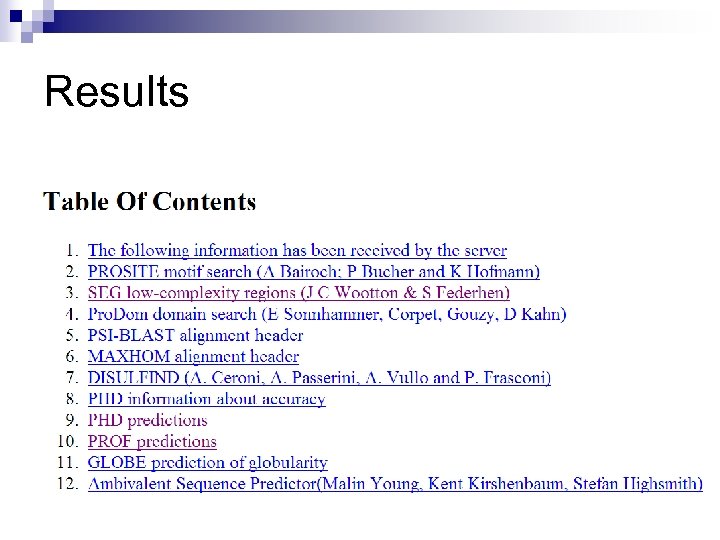
Results
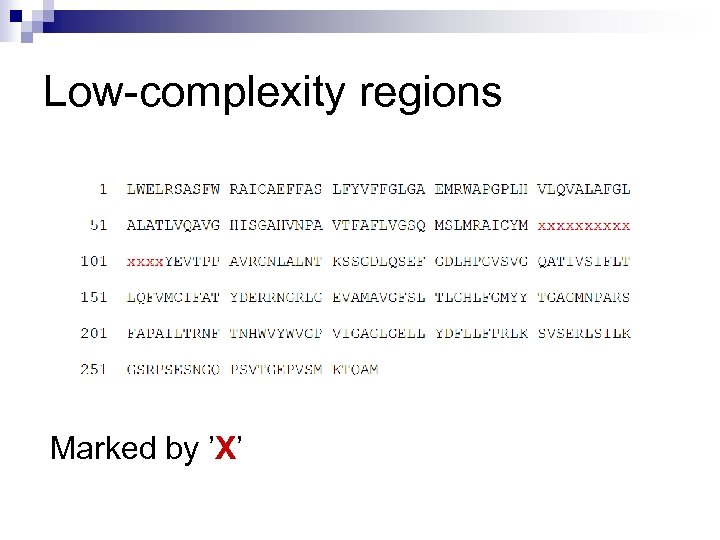
Low-complexity regions Marked by ’X’
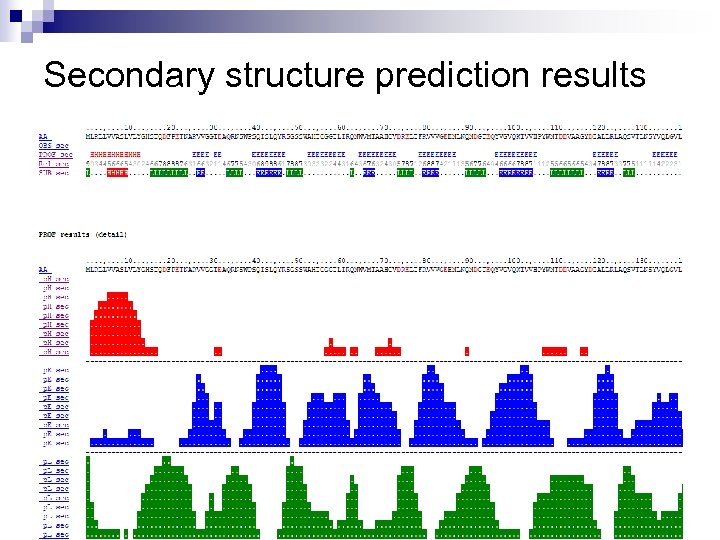
Secondary structure prediction results
References n Documentation: • • • n COILS: http: //www. ch. embnet. org/software/coils/COILS_doc. html TMPred: http: //www. ch. embnet. org/software/tmbase/TMBASE_doc. html MPEx: http: //blanco. biomol. uci. edu/mpex/MPEXdoc. html Articles: ¨ ¨ D. T Jones: Protein Secondary Structure Prediction Based on Position-specific Scoring Matrices. J. Mol. Biol. 292, 195 -202 (1999). ¨ n B. Rost: Evolution teaches neural networks. In Scientific applications of neural nets. Ed. J. W. Clark, T. Lindenau, M. L. Ristig, 207 -223 (1999). B. Rost: Prediction in 1 D: Secondary Structure, Membrane Helices, and Accessibility. In Structural Bioinformatics (reference below). Books: ¨ P. E. Bourne, H. Weissig: Structural Bioinformatics. Wiley-Liss, 2003. ¨ A. Tramontano: Protein Structure Prediction. Wiley-VCH, 2006.
Скачать презентацию Protein Analysis Workshop 2008 Secondary Structure Prediction Bioinformatics
d7036c8628a5b4c2cc64263077971c4c.ppt