 Скачать презентацию Protectionism Protectionism or liberalisation You should
cd8821b6c4ac2c21a55c78ddbb074b27.ppt
- Количество слайдов: 17



Protectionism
Protectionism or liberalisation?
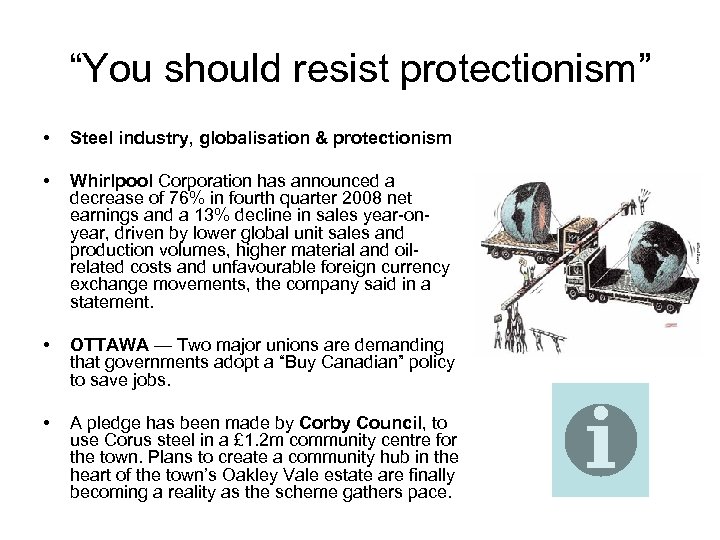
“You should resist protectionism” • Steel industry, globalisation & protectionism • Whirlpool Corporation has announced a decrease of 76% in fourth quarter 2008 net earnings and a 13% decline in sales year-onyear, driven by lower global unit sales and production volumes, higher material and oilrelated costs and unfavourable foreign currency exchange movements, the company said in a statement. • OTTAWA — Two major unions are demanding that governments adopt a “Buy Canadian” policy to save jobs. • A pledge has been made by Corby Council, to use Corus steel in a £ 1. 2 m community centre for the town. Plans to create a community hub in the heart of the town’s Oakley Vale estate are finally becoming a reality as the scheme gathers pace.
Many different forms of protectionism • Tariffs (import duties) - import taxes • Quotas – volume limits imports allowed • Voluntary Export Restraint Agreements • Embargoes - a total ban on imported goods • Subsidies - a government payment to encourage domestic production by lowering their costs • Export subsidies • Import licensing systems • Exchange controls - limiting the amount of foreign exchange that can move between countries
Tariffs – diagram! A tax imposed on imported goods
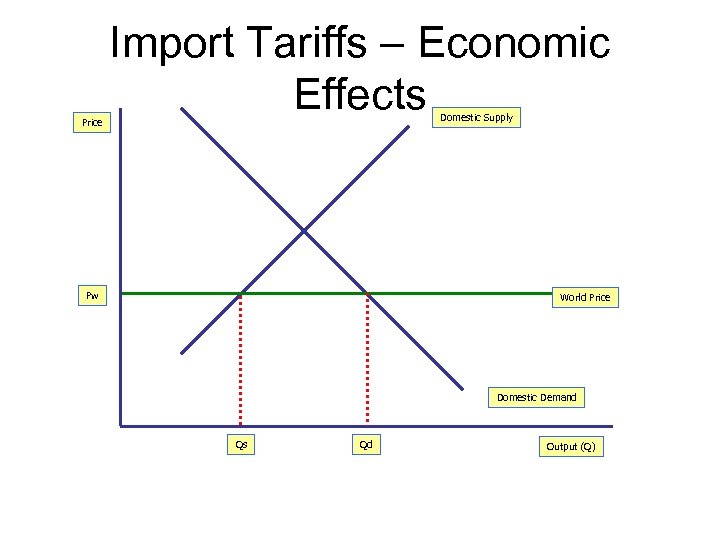
Price Import Tariffs – Economic Effects Domestic Supply Pw World Price Domestic Demand Qs Qd Output (Q)
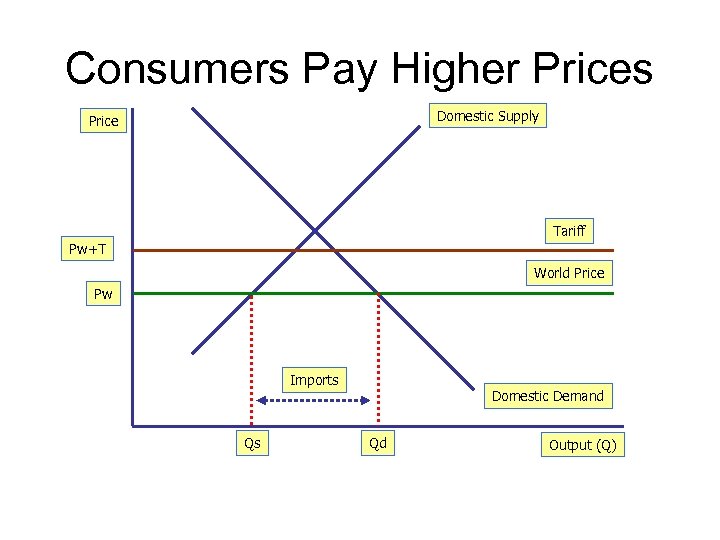
Consumers Pay Higher Prices Domestic Supply Price Tariff Pw+T World Price Pw Imports Qs Domestic Demand Qd Output (Q)
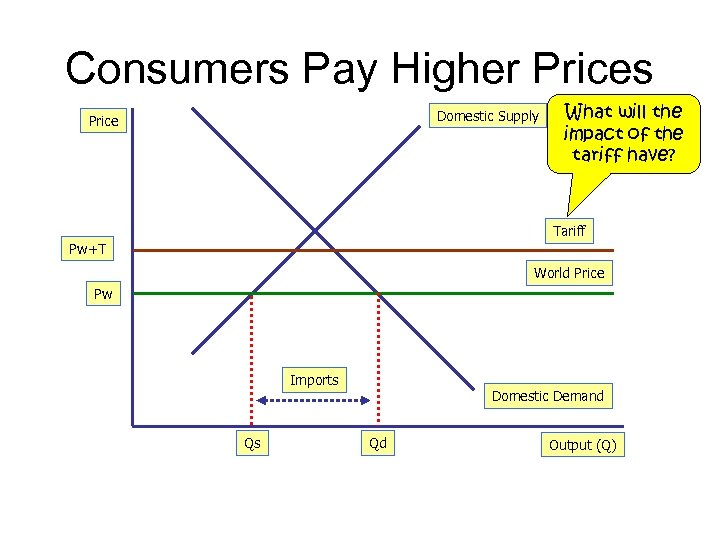
Consumers Pay Higher Prices Domestic Supply Price What will the impact of the tariff have? Tariff Pw+T World Price Pw Imports Qs Domestic Demand Qd Output (Q)
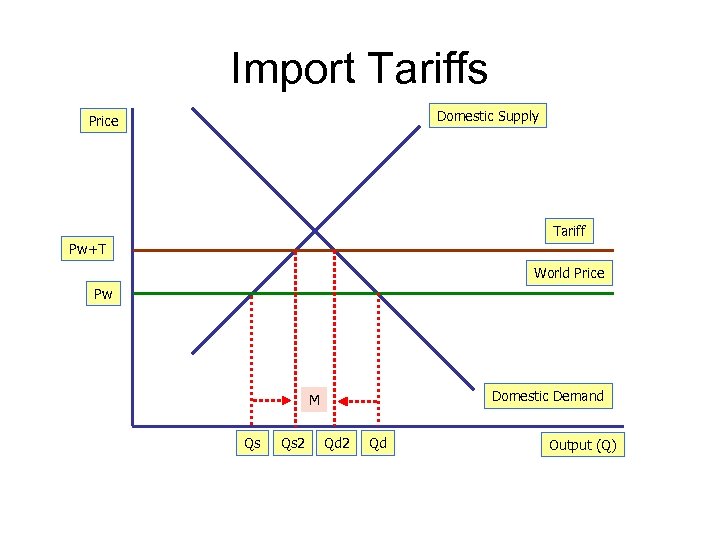
Import Tariffs Domestic Supply Price Tariff Pw+T World Price Pw Domestic Demand M Qs Qs 2 Qd Output (Q)
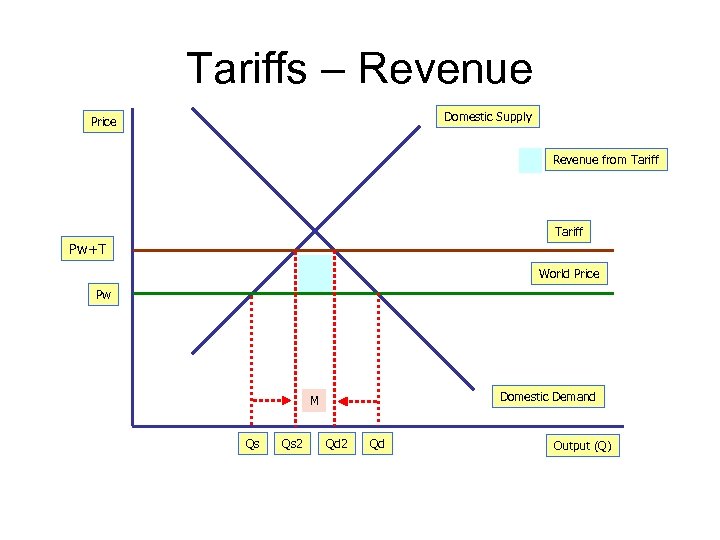
Tariffs – Revenue Domestic Supply Price Revenue from Tariff Pw+T World Price Pw Domestic Demand M Qs Qs 2 Qd Output (Q)
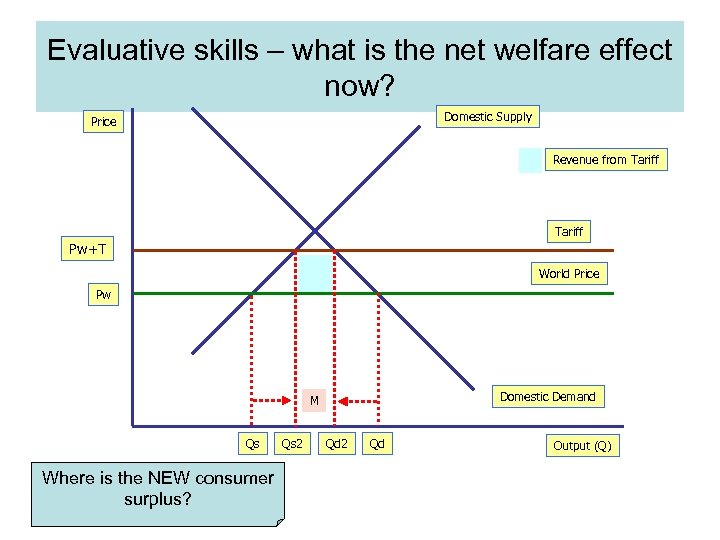
Evaluative skills – what is the net welfare effect now? Domestic Supply Price Revenue from Tariff Pw+T World Price Pw Domestic Demand M Qs Where is the NEW consumer surplus? Qs 2 Qd Output (Q)
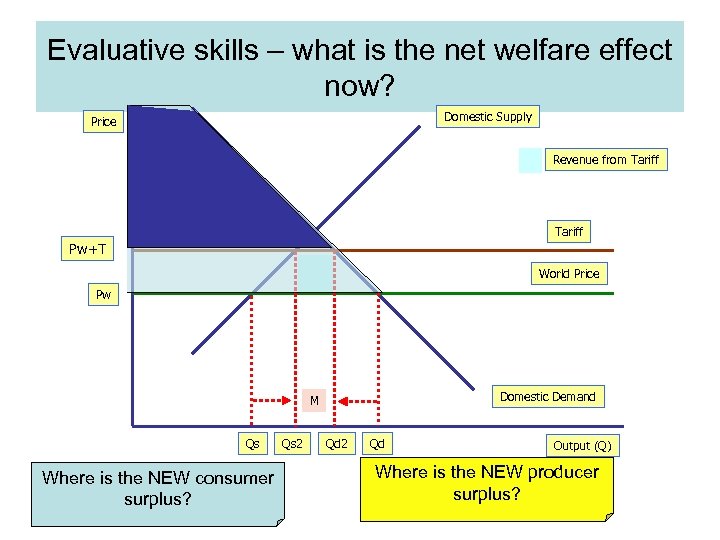
Evaluative skills – what is the net welfare effect now? Domestic Supply Price Revenue from Tariff Pw+T World Price Pw Domestic Demand M Qs Where is the NEW consumer surplus? Qs 2 Qd Output (Q) Where is the NEW producer surplus?
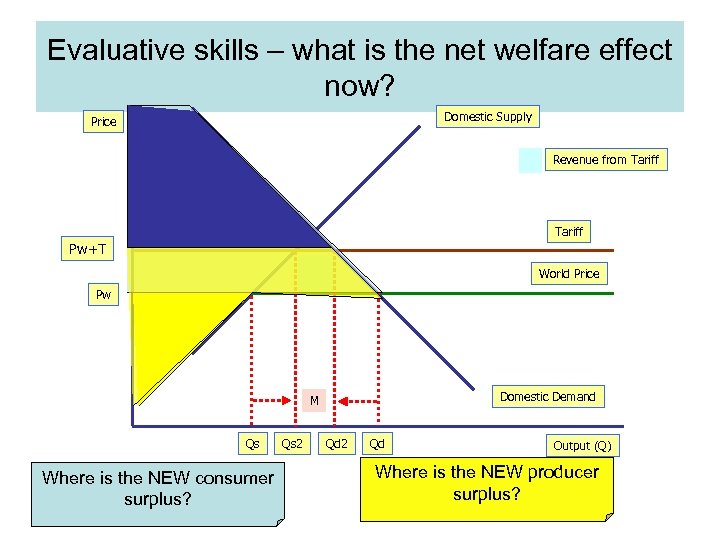
Evaluative skills – what is the net welfare effect now? Domestic Supply Price Revenue from Tariff Pw+T World Price Pw Domestic Demand M Qs Where is the NEW consumer surplus? Qs 2 Qd Output (Q) Where is the NEW producer surplus?
Evaluation skills • What is the net gain? • Has the welfare gain been greater or smaller than the welfare loss? • This can be used as an argument for & against use of quotas….
In defence of protectionism? • • Infant industries Strategic trade Agricultural efficiency Sunset industries To prevent dumping! Demerit goods Self sufficiency Employment
The end of a free trade union. • The 1 st of January 2010 marks an important day in global trade economics. China, and 10 South-East Asian countries formally join together from today to scrap import tariffs. • Duties will be scrapped on 90 pc of goods traded across China, Indonesia, Malaysia, Singapore, Thailand, Brunei and the Philippines. Over the next five years, tariffs will also be removed. This BBC news report looks at the background. There is little doubt about the potential economic significance of this development. This new free trade area will embrace 1. 9 billion people with trade worth around $200 billion. According to Reuters “China sees the agreement as a way of securing supplies of raw materials, while countries in ASEAN—an eclectic grouping ranging from highly advanced Singapore to Laos, a poor landlocked communist state—see opportunities in China’s huge market. ” • China-ASEAN trade is targeted to hit $200 billion by 2010, up from $192. 6 billion in 2008 and $113 billion in 2005. This will make it the third-largest free trade zone in trade volume after the European Economic Area and the North American Free Trade Area. The free trade area incorporates China and Brunei, Cambodia, Indonesia, Laos, Malaysia, Myanmar, the Philippines, Singapore, Thailand Vietnam (Ref: Tutor 2 U)
Further reading • http: //openaccessmarketing. com/blog/200 9/08/23/to-niche-his-own-how-do-weprotect-against-protectionism/
Скачать презентацию Protectionism Protectionism or liberalisation You should
cd8821b6c4ac2c21a55c78ddbb074b27.ppt