 Скачать презентацию Protection of Pharmaceutical Patent Rights vs Public Health
c2c01ff10d3c9c5799ef3042a36212bf.ppt
- Количество слайдов: 76



Protection of Pharmaceutical Patent Rights vs Public Health Interests in Access to Affordable Drugs — A view from the innovators and the generics Jordana Sanft, Partner — Norton Rose Fulbright Canada LLP Carol Hitchman, Partner — Gardiner Roberts LLP October 14, 2015
Overview • Pharmaceutical inventions are protected by patents • The legal framework for protection of pharmaceutical inventions includes unique policy tools that both affect and supplement patent rights • Disputes regarding market access for generics prior to patent expiry frequently result in litigation • Lengthy, expensive, and unpredictable litigation of pharmaceutical inventions is a major cost and source of business uncertainty for both pharmaceutical innovators and generics 2 Protection of Pharmaceutical Patent Rights vs Public Health Interests in Access to Affordable Drugs
Patents for pharmaceutical inventions • Pharmaceutical innovators operate at a largely international level; global investment in R&D is facilitated by global revenue, which is directly related to global protection for pharmaceutical patents • Pharmaceutical patents typically cover: – compounds and different forms thereof (e. g. , enantiomers, crystal polymorphs, solvates, salts, esters, etc. ) – formulations (e. g. , mixtures of excipients) – dosage forms (e. g. , controlled-release tablets) – uses (e. g. , different types of treatment) – processes & intermediates (e. g. , synthetic pathways for making a medicinal ingredient with greater purity, efficiency, etc. , or intermediates along the way) • Generics rely on pharmaceutical innovators: without a Canadian reference product, generics cannot benefit from the abbreviated approval pathway and associated costs savings 3 Protection of Pharmaceutical Patent Rights vs Public Health Interests in Access to Affordable Drugs
Unique policy tools re pharmaceutical patents (1) • Until 1993: Canada granted compulsory licences under innovators’ patents to generics with a low royalty rate (result: little litigation, but profound disincentive to innovators) • Since 1993: compulsory licensing replaced by two (ostensibly) matched policy tools: – In favour of generics, the “early-working exception”: – Blanket exception to patent infringement for activities related to drug approval – Allows generics to be ready to come to market on patent expiry (or earlier) – In favour of innovators, the PM(NOC) Regulations: – Protection for certain patents under the Patented Medicines (Notice of Compliance) (“PM(NOC)”) Regulations by listing on a “patent register” maintained by the Minister of Health – Allows innovators to keep generics off the market and prevent infringement of eligible patents: 24 -month statutory stay + prohibition application 4 Protection of Pharmaceutical Patent Rights vs Public Health Interests in Access to Affordable Drugs
Unique policy tools re pharmaceutical patents (2) • Since 1987: Canada tracks and regulates the price of all patented drugs in Canada (for the most part innovative) through the Patented Medicine Prices Review Board (“PMPRB”); PMPRB also tracks R&D spending in Canada as well as prescription drug usage trends • Since 1995: “data protection” for “innovative drugs”; currently, prevents approval for eight years of any drug for which approval is sought based upon a direct or indirect comparison with the innovative drug • Future — Patent-term restoration (“CETA”): up to two years (this is less than other jurisdictions) using a formula based on the time it takes to obtain a Notice of Compliance (“NOC”), with an exception for production and export of drugs, but details will not be known until enacted into Canadian law 5 Protection of Pharmaceutical Patent Rights vs Public Health Interests in Access to Affordable Drugs
Enforcing patents, generally • A major part of the value of patents lies in the ability to enforce them • Ordinary route: Patents are ordinarily enforced in Canada by means of action (usually in the Federal Court) seeking – a declaration of infringement, – an injunction against further infringement, – delivery up/destruction of infringing material, and/or – damages or an accounting of profits • Interlocutory injunctions to prevent patent infringement are generally unavailable due to difficulty proving irreparable harm under the current law 6 Protection of Pharmaceutical Patent Rights vs Public Health Interests in Access to Affordable Drugs
Enforcing pharmaceutical patents: two paths • Generics always have the benefit of the early-working exception; innovators cannot sue for infringement when generics take steps related to submissions for approval • First route: application under the PM(NOC) Regulations – Some (but not all) pharmaceutical patents are eligible for protection under the PM(NOC) Regulations — strict listing criteria apply – Unavailability of listing can be a powerful disincentive to market drugs in Canada – If patents are listed, the generic must address them before coming to market; litigation under the PM(NOC) Regulations is then the first stop • Second route: infringement/impeachment action – If patents are not listed and the generic comes to market, enforcement can proceed directly to an action for infringement – If proceedings under the PM(NOC) Regulations are unsuccessful, innovators can still pursue an action for infringement – Generics can always sue for a declaration of invalidity and/or non-infringement 7 Protection of Pharmaceutical Patent Rights vs Public Health Interests in Access to Affordable Drugs
QUESTION 1 As of March 31, 2015, there were 972 patents listed on the patent register against 552 drugs. From the perspective of your practice and clients, discuss two or three unique aspects of this system that affect the balance between enforcement and early generic entry.
The innovators’ perspective
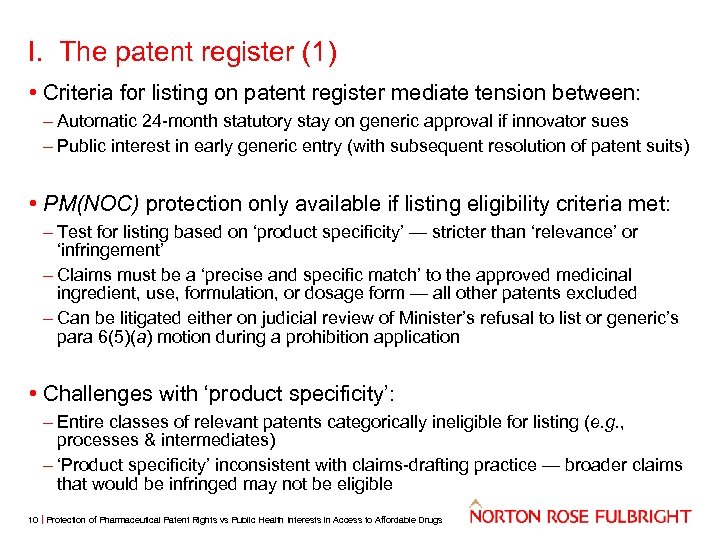
I. The patent register (1) • Criteria for listing on patent register mediate tension between: – Automatic 24 -month statutory stay on generic approval if innovator sues – Public interest in early generic entry (with subsequent resolution of patent suits) • PM(NOC) protection only available if listing eligibility criteria met: – Test for listing based on ‘product specificity’ — stricter than ‘relevance’ or ‘infringement’ – Claims must be a ‘precise and specific match’ to the approved medicinal ingredient, use, formulation, or dosage form — all other patents excluded – Can be litigated either on judicial review of Minister’s refusal to list or generic’s para 6(5)(a) motion during a prohibition application • Challenges with ‘product specificity’: – Entire classes of relevant patents categorically ineligible for listing (e. g. , processes & intermediates) – ‘Product specificity’ inconsistent with claims-drafting practice — broader claims that would be infringed may not be eligible 10 Protection of Pharmaceutical Patent Rights vs Public Health Interests in Access to Affordable Drugs
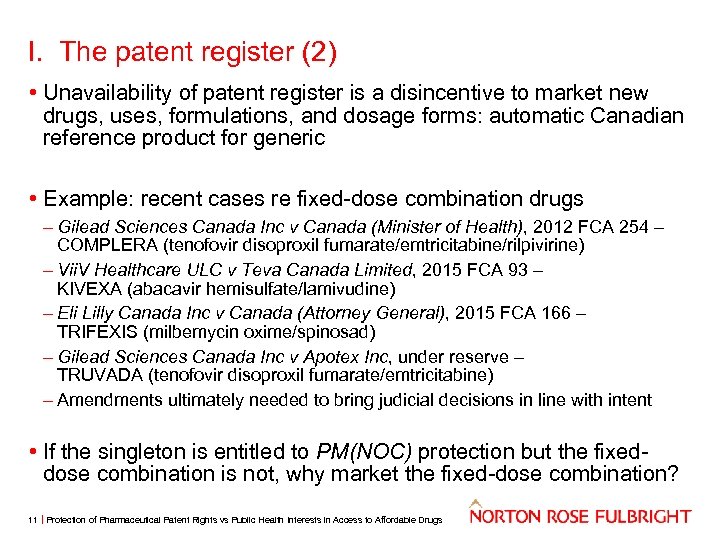
I. The patent register (2) • Unavailability of patent register is a disincentive to market new drugs, uses, formulations, and dosage forms: automatic Canadian reference product for generic • Example: recent cases re fixed-dose combination drugs – Gilead Sciences Canada Inc v Canada (Minister of Health), 2012 FCA 254 – COMPLERA (tenofovir disoproxil fumarate/emtricitabine/rilpivirine) – Vii. V Healthcare ULC v Teva Canada Limited, 2015 FCA 93 – KIVEXA (abacavir hemisulfate/lamivudine) – Eli Lilly Canada Inc v Canada (Attorney General), 2015 FCA 166 – TRIFEXIS (milbemycin oxime/spinosad) – Gilead Sciences Canada Inc v Apotex Inc, under reserve – TRUVADA (tenofovir disoproxil fumarate/emtricitabine) – Amendments ultimately needed to bring judicial decisions in line with intent • If the singleton is entitled to PM(NOC) protection but the fixeddose combination is not, why market the fixed-dose combination? 11 Protection of Pharmaceutical Patent Rights vs Public Health Interests in Access to Affordable Drugs
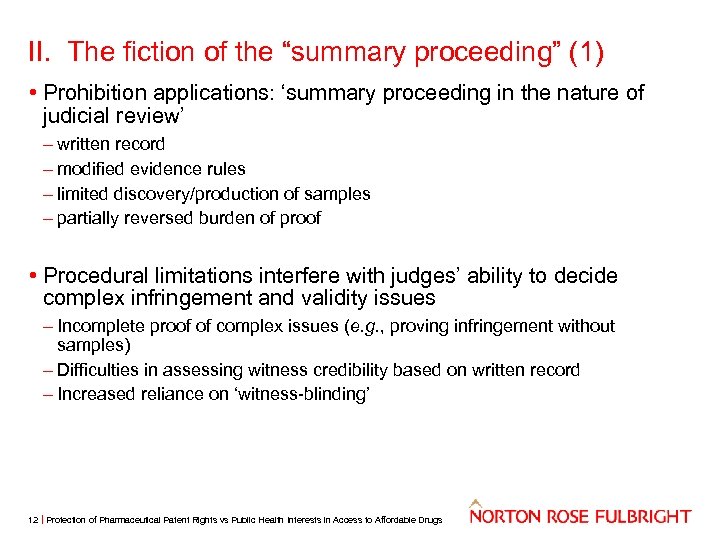
II. The fiction of the “summary proceeding” (1) • Prohibition applications: ‘summary proceeding in the nature of judicial review’ – written record – modified evidence rules – limited discovery/production of samples – partially reversed burden of proof • Procedural limitations interfere with judges’ ability to decide complex infringement and validity issues – Incomplete proof of complex issues (e. g. , proving infringement without samples) – Difficulties in assessing witness credibility based on written record – Increased reliance on ‘witness-blinding’ 12 Protection of Pharmaceutical Patent Rights vs Public Health Interests in Access to Affordable Drugs
II. The fiction of the “summary proceeding” (2) • Barnes J in Takeda Canada Inc. v. Canada (Health), 2015 FC 751: “As with many NOC proceedings, this one produced several evidentiary gaps. Indeed, it is disconcerting that the parties to NOC proceedings often fail to test in a meaningful way the reliability of the opinions expressed by opposing expert witnesses. By their very nature, NOC proceedings allow for the possibility of evidentiary gaps. Reply evidence is often not permitted and product samples and other relevant evidence not contained within an ANDS filing is usually not discoverable. In this context, it does not assist the Court in getting to a just and accurate result by failing to effectively join issue on the conflicting opinion evidence which does enter the record. ” • Counterpoint: – Testing often impractical: high cost, compressed timescale, limited availability of samples, and lack of reply (as of right) – Cross-examination of experts on opinion without experimental support often ineffective – Would judges prefer to proceed directly to a full action? 13 Protection of Pharmaceutical Patent Rights vs Public Health Interests in Access to Affordable Drugs
III. Asymmetric right of appeal • Result of a prohibition application: – Jurisdiction to prohibit, but not revoke, a generic’s NOC – If not prohibited, Health Canada usually grants NOC within days • Effect on appeal rights: – Innovator wins: A prohibition order issues; generic always has a right of appeal – Generic wins: An NOC issues forthwith; innovator’s appeal is moot and dismissed • Loss of an innovator’s rights under the PM(NOC) Regulations is effectively unreviewable: – Accumulation of FC precedent favouring non-infringement and invalidity – Innovators concerned that patents enforced in other jurisdictions (e. g. , U. S. ) will fail in Canada 14 Protection of Pharmaceutical Patent Rights vs Public Health Interests in Access to Affordable Drugs
The generics’ perspective
I. Patent Register • Concern regarding fixed-dose combination drugs has been addressed in recent amendments to the PM(NOC) Regulations SOR 2015 -169 – new section 4(2. 1) – a testament to the influence the brands have on the government 16
II. Automatic Injunction • Other industries in Canada do not get this benefit • Delays early generic entry by 2 years • Early warning to brands who can launch an ultra generic and undercut the generic’s market and early warning to other generic competitors • Can mean multiple injunctions on one active ingredient – given that patents can be listed for actives, formulations and uses; e. g. oxycodone 17
III. Early Working • Section 55. 2 did not provide any new rights – experimental working of an invention prior to patent expiry has always existed: Merck & Co Inc v Apotex Inc. 2006 FCA 323 • Experimental use would not result in any damages since there would be no sales 18
IV. Risk of Being Sued Twice • Applications under PM(NOC) Regulations are not the end of the litigation – generic can be sued for infringement of the same patent after succeeding under the regulations • Costly to have two sets of proceedings on one patent • Risk of damages to the generics can be very high since the brand profit margin much higher than the generic profit margin 19
IV. Risk of Being Sued Twice (2) • Can result in inconsistent decisions • e. g. Janssen-Ortho Inc. v. Novopharm Ltd. • Application under the PM(NOC) Regulations was dismissed – finding of obviousness: 2004 FC 1631 • Action succeeds – finding not obvious: 2006 FC 1234, aff’d 2007 FCA 217, leave to appeal refused [2007] S. C. C. A. No. 442. 20
V. The Summary Proceeding • There is no obligation on the brand to produce all of the invention documents, something relevant to the test for obviousness • Brands will often provide only those documents helpful to their case – provides partial evidence • Generics, on the other hand, must produce all the documents relating to their product and the process for making it 21
V. The Summary Proceeding (2) • Generics are required to conduct testing prior to the NOA and refer to it in the NOA • Asymmetric right to amend: • Generics have no right to amend the NOA although the brand can amend the Notice of Application • If new issues arise from the applicant’s evidence, difficult for generic to rely on it • All prior art should be listed in the NOA • Attacks on NOA are common and distract from substantive issues 22
QUESTION 2 2010/2011 is the most recent year where all prohibition application have been determined. Of 60 applications that were commenced: • 44 were discontinued • 7 were dismissed • 8 were ultimately allowed or partially allowed How does the outcome of these cases affect your clients?
The innovators’ perspective
I. What the numbers mean • Many reasons for discontinuance before judgment: – Strength of case clearer following exchange of expert evidence – Parties amenable to settlement on mutually favourable terms (or to trade risk for certainty) – Low product value (sales/remaining life/size of generic market) – Narrowing where >1 patent/application for a drug (focus on strongest patents) – Result dictated by resolution of proceeding regarding same drug/patent with another generic – Consideration foreign parallel proceedings • Settlement agreements can be examined by the Competition Bureau and sanctioned if found to be a “pay for delay” scheme 25 Protection of Pharmaceutical Patent Rights vs Public Health Interests in Access to Affordable Drugs
II. Section 8 damages • Generics have a cause of action for damages in respect of delay caused by a prohibition application that is withdrawn, dismissed, or discontinued (per “section 8” of the PM(NOC) Regulations) – Thus: in 52/60 applications commenced in 2010/2011, innovator is exposed to risk of section 8 damages – Section 8 damages may exceed the total size of the generic market when more than one generic sues – In addition, generics continue to argue for other forms of relief (e. g. , unjust enrichment, Statute of Monopolies) despite courts having held the PM(NOC) Regulations to establish a complete code • Settlement usually includes: – payment in satisfaction of a potential section 8 damages claim – waiver of same – agreement to permit early entry of the generic before expiry of the relevant patents 26 Protection of Pharmaceutical Patent Rights vs Public Health Interests in Access to Affordable Drugs
III. Market loss • Stockpiling no longer permitted, but generic quickly enters the market following dismissal of prohibition application • Innovators must choose how to respond: – Continue as before? – Reduce price to compete with generics? – Offer a pay card/reimbursement programme? – Launch an ‘authorised generic’? – Stop manufacture and withdraw branded version from the market? • In any event: – erosion of innovator’s market: usually very fast and extensive – innovator loses much of the revenue stream associated with the drug very quickly – negative impact on R&D budgets and difficulty converting the market back even if infringement damages are later recovered 27 Protection of Pharmaceutical Patent Rights vs Public Health Interests in Access to Affordable Drugs
IV. Repeat litigation? • Each generic generally limited to one notice of allegation (“NOA”) for each of non-infringement and invalidity, but can serve serially • Subsequent generics can make the same or different allegations: – Innovators generally cannot defend allegations that were successful in a previous proceeding: abuse of process – Generics can advance new bases/evidence for previously-litigated allegations – Generics can advance entirely new allegations • Generics can always still sue for a declaration of invalidity under the Patent Act (outcome of prohibition application not binding) • Result for innovators: – Patents always potentially in jeopardy – Prospect of years of continuous litigation to defend high-value products (e. g. , ALTACE (ramipril), NEXIUM (esomeprazole), VIAGRA (sildenafil)) 28 Protection of Pharmaceutical Patent Rights vs Public Health Interests in Access to Affordable Drugs
Verdict on the PM(NOC) Regulations • In the absence of interlocutory injunctions to prevent infringement, prohibition orders can be a powerful tool • In some cases, these applications allow the parties to explore their cases and reach conclusive settlement agreements early-on • In other cases, these proceedings are an expensive two-year overture on the way to an inevitable infringement/impeachment action in which the same issues will be re-litigated 29 Protection of Pharmaceutical Patent Rights vs Public Health Interests in Access to Affordable Drugs
The generics’ perspective
I. Impact of Decisions (1) • Not the statistics on the cases that influence the clients – more the reduction in the prices by the provincial governments which leaves less money for litigation budget • Change in law may lead to different view on certain patents, e. g. Viagra S. C. C. sufficiency decision 31
I. Impact of Decisions (2) • Generics have to consider each drug separately – in terms of the strength of the patents and the potential market – weigh the fact that there is no guaranteed exclusivity as is found in the US • Success by another generic can mean early entry for other generics 32
II. Impact of Discontinuance • Discontinuances can mean a number of things – often can be a positive settlement for the generic company • Problem with settlements today – Competition Bureau following the US in wanting to scrutinize payments to the generics and agreements to stay off the market (notwithstanding that patents are meant to keep others off the market and section 8 damages justify payments to the generics) 33
III. Section 8 Damages Cases • Like an undertaking as to damages given in an injunction • Very limited remedy for generics since their damages are always considerably less than the profits of the brands – even if the awards to separate generics add up to more than the whole generic market, it will still be less than the brand profit • Doesn’t act as disincentive to suing on weak patents and preventing generic entry • Doesn’t include claims for damages relating to ramp-up or other products which normally arise in a claim for damages 34
IV. Repeat Litigation • Second generic should be able to raise new arguments not raised in prior cases particularly since the second generic was not able to present evidence or argument in the first case – consistent with the law on abuse of process: Toronto (City) v. CUPE, Local 79, 2003 SCC 63 • Right to raise new arguments in subsequent cases on the same patent has always existed: e. g. Beloit Canada Ltd. v. Valmet Oy (1984), 78 C. P. R. (2 d) 1(rev’d 8 C. P. R. (3 d) 289); second trial on same patent: J. M. Voith Gmb. H v. Beloit Corp. (1989) 27 C. P. R. (3 d) 289 (rev’d 36 C. P. R. (3 d) 322) 35
V. Market • Once generic enters market, the brand has the option of introducing an “ultra” generic (its own generic) which can undercut the market for the generic if it launches before the generic can • Brands choose to stop marketing once a generic enters the market and so loss of market share is a self-inflicted wound e. g. Bristol-Myers Squibb Co v Apotex Inc. 2001 FCT 1086 36
QUESTION 3 In an action for infringement/impeachment of a pharmaceutical patent, testing may be needed to prove infringement, inherent anticipation, or utility in fact. How does experimental testing affect the cost, timing, and results of these cases?
The innovators’ perspective
I. FC Notice to the Profession: Experimental Testing • “In an action for infringement or validity of a patent, where a party intends to establish any fact in issue by experimental testing conducted for the purpose of litigation, it shall, no later than two months before the scheduled service of the expert report(s) in chief, advise the other parties as to: – the facts to be proven by such testing; – the nature of the experimental procedure to be performed; – when and where the adverse parties’ counsel and representative(s) can attend to watch the experiment(s); and – when and in what format the data and test results from such experiment(s) will be shared with the adverse parties. • “Unless a party intending to rely on such experiments has so advised the other parties, the party shall not, without leave of the Court, lead evidence at the trial or hearing as to any experiments conducted by or for it for the purpose of the litigation. ” 39 Protection of Pharmaceutical Patent Rights vs Public Health Interests in Access to Affordable Drugs
II. Costs of experimental testing • Experimental testing is expensive and time-consuming: – Testing must generally be done twice: once to determine the likely results and a second time in the presence of opposing counsel (per the Notice) – Locating qualified scientists and laboratories to conduct testing is laborious – Few independent witnesses exist in some fields of science – Travel to many different countries may be required for even one issue (e. g. , synthesis in one location and analysis in another) – Counsel for all parties generally must attend all testing (costly in time & money) – Separate fact & expert witnesses generally needed – All witnesses must generally testify – Evidentiary chain of custody must be closely monitored throughout (n. b. , challenges obtaining & moving samples) • As a result, testing is: – Impractical or impossible on the compressed timescale of prohibition applications – A significant logistical and scheduling concern in infringement/impeachment cases 40 Protection of Pharmaceutical Patent Rights vs Public Health Interests in Access to Affordable Drugs
III. What is proven? • Experimental testing can be very helpful if the tests are well-done, using appropriate equipment and analytical techniques – May lead to early resolution of issues before hearing – Addresses courts’ frustration with abstract or hypothetical expert evidence • As a result, at least some testing is now approaching standard practice in actions. • However: – Even with testing, experts frequently disagree about methodology and analysis – Parties may also conduct tests with conflicting results – Judges may still be required to decide between competing expert testimony 41 Protection of Pharmaceutical Patent Rights vs Public Health Interests in Access to Affordable Drugs
The generics’ perspective
I. Cost • Federal Court has brought in practice direction requiring both sides at testing • Testing will be costly and generally take time – usually there will be two sets of tests, one before inviting the other side and one with the other side 43
II. Benefit • Potential to affect the results of cases – particularly if they show inutility of what is covered by the patent or noninfringement – this ultimately can reduce cost if the parties settle after testing is done 44
III. Risk • Even if done well, testing will be subject to scrutiny and criticism by the other side • May not get results same from second test with counsel from the other side as were obtained in the first test without them (the shoot yourself in the foot problem) 45
QUESTION 4 What role does IP litigation play, if any, in balancing the need for access to affordable drugs with incentives to maintain a steady stream of innovative, new medicines?
The innovators’ perspective
I. Preliminary note: the PMPRB • The affordability of patented medicines is already controlled by the PMPRB, which has the authority to regulate excessive prices • The PMPRB’s jurisdiction results from patent protection, but enforcement is not an IP issue 48 Protection of Pharmaceutical Patent Rights vs Public Health Interests in Access to Affordable Drugs
II. Incentives for innovators • Globally, the market exclusivity is an important incentive to the private development and sale of (often expensive) pharmaceuticals • IP litigation provides the means for innovators to enforce market exclusivity and finance their activities • Monopoly revenue funds basic research and the extensive clinical programmes required to satisfy regulators that drugs are safe and effective 49 Protection of Pharmaceutical Patent Rights vs Public Health Interests in Access to Affordable Drugs
III. Incentives for generics • IP litigation also serves generics: – generics do not have to rely on CIPO’s determination that a patent is valid – the PM(NOC) Regulations are designed to permit early entry (works with the abbreviated drug approval process) – depending on the outcome of a prohibition application, innovators may never sue for infringement – in actions, generics are often successful in rebutting the presumption of validity in court • In short: litigation clears the path to market for relatively inexpensive generic versions of drugs • The incentive for generics to challenge patents is a powerful check on innovators 50 Protection of Pharmaceutical Patent Rights vs Public Health Interests in Access to Affordable Drugs
IV. Minimising costs of the incentive structure • Litigation is a cost for both generics and innovators • Together with competition, research, rebates, and other considerations, the costs of litigation is ultimately part of companies’ cost and pricing structure • The profitability of innovative and generic companies determines their ability to bring new, valuable products to market • Preserving the existing incentive structure while minimising the cost and unpredictability of dispute resolution should be a priority 51 Protection of Pharmaceutical Patent Rights vs Public Health Interests in Access to Affordable Drugs
The generics’ perspective
I. Cost • Cost of litigation is a factor for generic drug companies – can be a hurdle blocking access to affordable medicines particularly if the drug has small sales • For smaller generic companies, the cost of actions may be prohibitive • Companies have to determine if money spent on litigation in Canada could be better spent in developing markets in other countries 53
II. Benefit • Litigation allows for invalidating of weak patents that should not have been granted in the first place • In some cases the proceeding under the PM(NOC) Regulations will be the end of the litigation – and it is considerably less expensive than a full blown action • Without the PM(NOC) Regulations, there would likely be more generic entries into the market 54
QUESTION 5 Are patents the most effective means for allowing innovators to recoup their investment in innovative drugs? Or should that job be left to other policy tools, such as one-size-fits-all data protection?
The innovators’ perspective
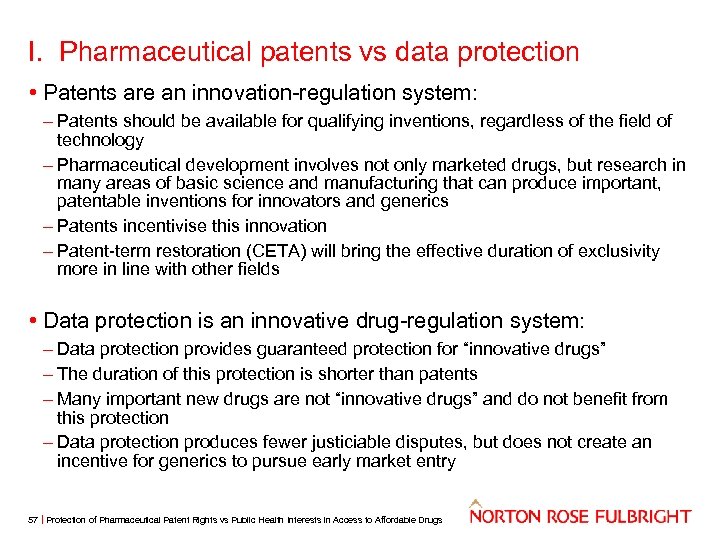
I. Pharmaceutical patents vs data protection • Patents are an innovation-regulation system: – Patents should be available for qualifying inventions, regardless of the field of technology – Pharmaceutical development involves not only marketed drugs, but research in many areas of basic science and manufacturing that can produce important, patentable inventions for innovators and generics – Patents incentivise this innovation – Patent-term restoration (CETA) will bring the effective duration of exclusivity more in line with other fields • Data protection is an innovative drug-regulation system: – Data protection provides guaranteed protection for “innovative drugs” – The duration of this protection is shorter than patents – Many important new drugs are not “innovative drugs” and do not benefit from this protection – Data protection produces fewer justiciable disputes, but does not create an incentive for generics to pursue early market entry 57 Protection of Pharmaceutical Patent Rights vs Public Health Interests in Access to Affordable Drugs
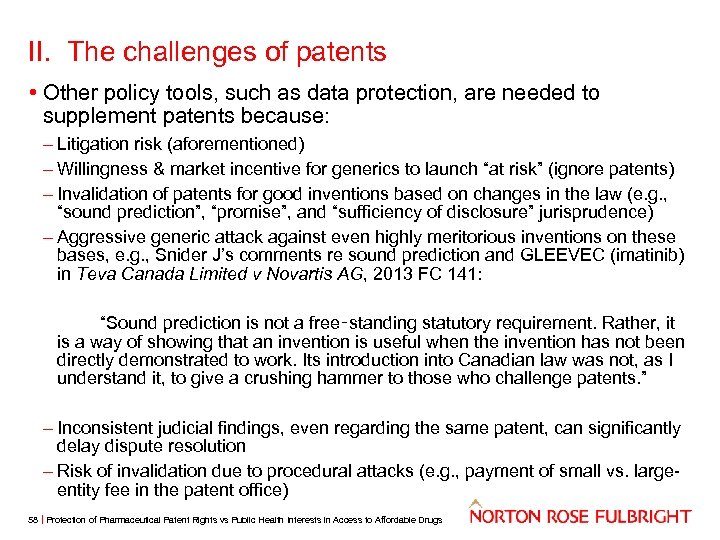
II. The challenges of patents • Other policy tools, such as data protection, are needed to supplement patents because: – Litigation risk (aforementioned) – Willingness & market incentive for generics to launch “at risk” (ignore patents) – Invalidation of patents for good inventions based on changes in the law (e. g. , “sound prediction”, “promise”, and “sufficiency of disclosure” jurisprudence) – Aggressive generic attack against even highly meritorious inventions on these bases, e. g. , Snider J’s comments re sound prediction and GLEEVEC (imatinib) in Teva Canada Limited v Novartis AG, 2013 FC 141: “Sound prediction is not a free‑standing statutory requirement. Rather, it is a way of showing that an invention is useful when the invention has not been directly demonstrated to work. Its introduction into Canadian law was not, as I understand it, to give a crushing hammer to those who challenge patents. ” – Inconsistent judicial findings, even regarding the same patent, can significantly delay dispute resolution – Risk of invalidation due to procedural attacks (e. g. , payment of small vs. largeentity fee in the patent office) 58 Protection of Pharmaceutical Patent Rights vs Public Health Interests in Access to Affordable Drugs
The generics’ perspective
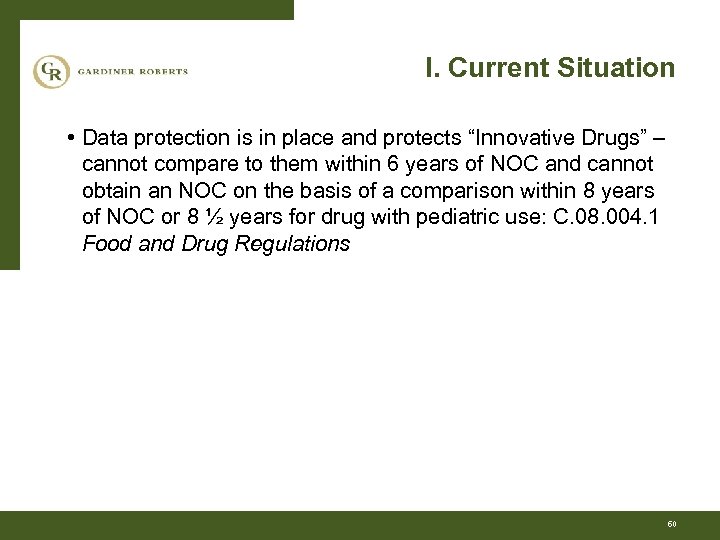
I. Current Situation • Data protection is in place and protects “Innovative Drugs” – cannot compare to them within 6 years of NOC and cannot obtain an NOC on the basis of a comparison within 8 years of NOC or 8 ½ years for drug with pediatric use: C. 08. 004. 1 Food and Drug Regulations 60
I. Current Situation (2) • Patent protection also in place, but currently no patent term extension as in the U. S. - to be introduced with CETA but limited to 2 years and doesn’t prevent production and export 61
II. Risk with Patents • Patents can discourage both generic competition and research when drafted broadly, e. g. covering billions of molecules that were not made or tested • Patents cover much more than the drugs themselves – for generics, limiting protection of PM(NOC) Regulations to new drugs rather than patents on formulations and uses would enable early entry of a lot of products 62
III. The Challenges of Patents • Sound prediction is a way of allowing patents where utility has not been established – it is a benefit to patentees since the Patent Act requires utility as a prerequisite to obtaining a patent • Promise of Patent not new: Fox on Patents 1969; Alsop’s Patent (1907) 24 R. P. C. 733 • Sufficiency: Viagra case – patentee should not “game the system” 63
IV. Risk – Litigation under the Food and Drug Regulations • A shift to data protection over patent protection would lead to litigation on what is an “innovative drug” – a “medicinal ingredient not previously approved in a drug by the Minister” as set out in the Food and Drug Regulations at C. 08. 004(1) • e. g. Celgene Inc. v. The Minister of Health 2013 FCA 43 looked at thalidomide for pain from leprosy and cancer – did not qualify 64
IV. Risk – Litigation under the Food and Drug Regulations (2) • Teva Canada Limited v. The Minister of Health 2012 FCA 106 oxaliplatin had been authorized under Special Access Program but not formally approved; still considered a “medicinal ingredient not previously approved in a drug by the Minister” 65
V. Benefit of Patents over Data Protection • Patents can be challenged and invalidated versus data protection which cannot be challenged • More case law relating to patents than relating to interpretation of “innovative drug” under the Food and Drug Regulations • However, if this were the only protection – and this section does not cover formulations and uses – this could pave the way for more generic entry 66
QUESTION 6 Should the PM(NOC) Regulations be amended to allow for a period of exclusivity for the first generic to challenge a patent?
The innovators’ perspective
First-generic exclusivity would not benefit Canada (1) • First-generic exclusivity would bring Canada in line with the U. S. Hatch-Waxman Act (their version of the PM(NOC) Regulations) – In the U. S. , the first generic to market receives 6 months’ exclusivity – Significant advantage to the first generic — supposed to incentivise patent challenges and early entry • This incentive already arguably exists in Canada: – Section 8 limits the cost of challenging patents and increases the odds that innovators will capitulate – The section 8 “but-for world” is based on the real world: earlier readiness means a longer period of sole-source (i. e. , higher) damages – Would first-generic exclusivity replace section 8? 69 Protection of Pharmaceutical Patent Rights vs Public Health Interests in Access to Affordable Drugs
First-generic exclusivity would not benefit Canada (2) • There are disadvantages to allowing first-generic exclusivity: – Real-world competition between generics benefits consumers – It is unlikely that generics are not challenging patents due to risk of simultaneous or subsequent market entry – Could further complicate section 8 damages cases (interaction between “butfor” and “real” worlds) if section 8 is not repealed 70 Protection of Pharmaceutical Patent Rights vs Public Health Interests in Access to Affordable Drugs
The generics’ perspective
I. Benefit • Gives the generic companies an incentive to challenge patents and a reward, particularly given the reduction in prices by the provinces • Could result in more patent challenges than are currently happening 72
II. Risk • In current system, generic can be sued for infringement even if successful in application under the PM(NOC) Regulations and if it is the only company on the market can lead to a large liability for damages • Section 8 damages is not much of an incentive, particularly for small market drugs – the cost of an action for damages is sometimes as large as the damages themselves • If exclusivity were to replace Section 8 damages claim, this could make settling more difficult as Canada would have the very same situation as exists now in the U. S. 73
Conclusion • The role of patents, regardless of technology, is best fulfilled when both the scope of patents and their enforceability is relatively certain • Lengthy, expensive, and unpredictable litigation of pharmaceutical patents arising from procedural and legal ambiguities is a major cost and source of revenue uncertainty for both innovators and generics • Correspondingly: efficient, affordable, and accurate resolution of pharmaceutical patent disputes would reduce the cost of delivering drugs to Canadians for generics and innovators 74 Protection of Pharmaceutical Patent Rights vs Public Health Interests in Access to Affordable Drugs
Disclaimer Norton Rose Fulbright US LLP, Norton Rose Fulbright Australia, Norton Rose Fulbright Canada LLP and Norton Rose Fulbright South Africa Inc are separate legal entities and all of them are members of Norton Rose Fulbright Verein, a Swiss verein. Norton Rose Fulbright Verein helps coordinate the activities of the members but does not itself provide legal services to clients. References to ‘Norton Rose Fulbright’, ‘the law firm’ and ‘legal practice’ are to one or more of the Norton Rose Fulbright members or to one of their respective affiliates (together ‘Norton Rose Fulbright entity/entities’). No individual who is a member, partner, shareholder, director, employee or consultant of, in or to any Norton Rose Fulbright entity (whether or not such individual is described as a ‘partner’) accepts or assumes responsibility, or has any liability, to any person in respect of this communication. Any reference to a partner or director is to a member, employee or consultant with equivalent standing and qualifications of the relevant Norton Rose Fulbright entity. The purpose of this communication is to provide general information of a legal nature. It does not contain a full analysis of the law nor does it constitute an opinion of any Norton Rose Fulbright entity on the points of law discussed. You must take specific legal advice on any particular matter which concerns you. If you require any advice or further information, please speak to your usual contact at Norton Rose Fulbright. 76
Скачать презентацию Protection of Pharmaceutical Patent Rights vs Public Health
c2c01ff10d3c9c5799ef3042a36212bf.ppt