


 Скачать презентацию Protection Against Radiation ACADs 08 -006 Covered 1
ebb291c0ff460ed41ce54e50cab0301d.ppt
- Количество слайдов: 82
 Protection Against Radiation ACADs (08 -006) Covered 1. 1. 8. 4. 4 1. 1. 8. 4. 5 3. 3. 1. 10 3. 3. 3. 9 3. 3. 3. 11 3. 3. 3. 14 3. 3. 4. 8 3. 3. 4. 12 3. 3. 4. 13 3. 3. 4. 14 3. 3. 6. 13 3. 3. 7. 4 3. 3. 8. 9 3. 3. 8. 10 3. 3. 8. 11 3. 3. 8. 18 3. 3. 9. 8. 1 3. 3. 9. 16 3. 3. 9. 21 3. 3. 9. 26 3. 3. 10. 13 3. 3. 11. 8 3. 3. 11. 13. 8 3. 3. 11. 20. 4 3. 3. 12. 1 3. 3. 12. 3 3. 3. 12. 18 3. 3. 14. 20. 1 3. 3. 14. 20. 2 3. 3. 14. 20. 3 3. 3. 14. 20. 4 3. 3. 14. 20. 5 4. 9. 9 4. 9. 10 4. 10. 3 4. 11. 5 4. 11. 7 4. 11. 8 4. 11. 9. 1 4. 11. 9. 2 4. 11. 9. 3 4. 11. 10 4. 12. 2 4. 14. 6. 1 4. 14. 6. 2 4. 15. 1 4. 16. 2 3. 3. 4. 8 Keywords contamination, decontamination, dose equivalent, effective dose, committed dose, absorbed dose, exposure dose, committed dose equivalent, committed effective dose equivalent, radiation exposure limits, airborne radiation, 10 CFR 20, 10 CFR 100, NRC, time distance shielding, exposure control, buildup, protective clothing, ALARA, deep, shallow. Description This module explains the legal requirements to ensure radiation exposure is controlled. Legal limits are discussed along with the ways to limit exposure.
 Overview • Legal standards and administrative procedures to protect radiation workers from the hazards of radiation exposure • All employees in nuclear industry required to comply with certain federal government regulations with respect to radiation protection • Plants licensed by the Nuclear Regulatory Commission (NRC) must meet all established radiation protection criteria NET 130 Module 4: Protection Against Radiation 2 2
 Overview • Protection from Radiation – Time-distance-shielding concept • If exposure time is minimized, dose is minimal • Shielding: when time and distance criteria are impractical – Decontamination (external) – Protective clothing • Internal contamination and resulting exposure is difficult to measure • Not all of the effects of radionuclides that may get into the body are known • Once radioactivity enters the body, only natural biological processes and radiological decay can remove it. • To avoid this hazard, respiratory protection equipment is worn to prevent inhaling airborne radioactivity in designated areas. NET 130 Module 4: Protection Against Radiation 3 3
 Overview • Actual incidents involving overexposure have contributed to knowledge about radiation damage. – Results studied and policies established to prevent recurrence – Can be avoided by: • Proper application of established procedure • Being aware of changing plant conditions • Adhering to basic exposure reduction principles of time, distance, and shielding – Studies of long-term effects still being conducted • Measures have been devised and implemented to prevent exposure to unnecessary radiation, even at low dose levels. – Refer to SOERs 85 -3 and 01 -1 NET 130 Module 4: Protection Against Radiation 4 4
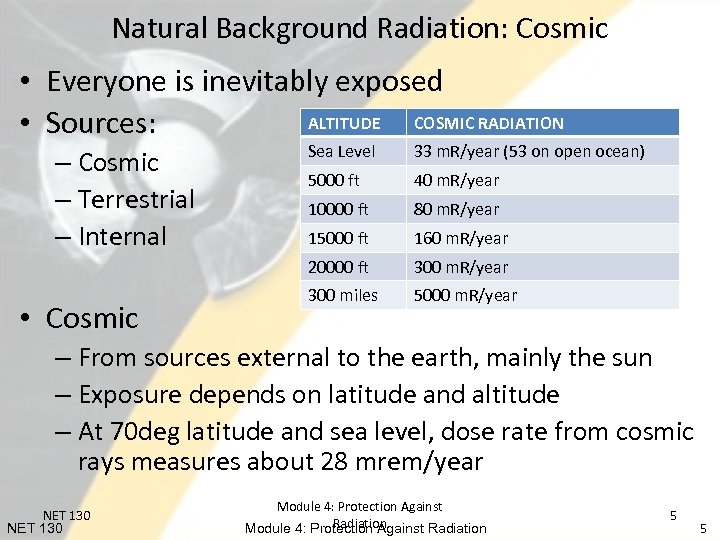 Natural Background Radiation: Cosmic • Everyone is inevitably exposed ALTITUDE COSMIC RADIATION • Sources: • Cosmic Sea Level 33 m. R/year (53 on open ocean) 5000 ft 40 m. R/year 10000 ft 80 m. R/year 15000 ft 160 m. R/year 20000 ft – Cosmic – Terrestrial – Internal 300 m. R/year 300 miles 5000 m. R/year – From sources external to the earth, mainly the sun – Exposure depends on latitude and altitude – At 70 deg latitude and sea level, dose rate from cosmic rays measures about 28 mrem/year NET 130 Module 4: Protection Against Radiation 5 5
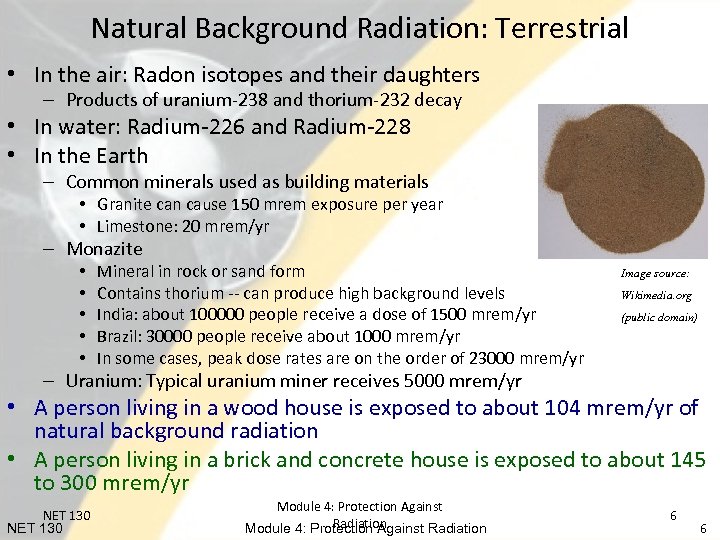 Natural Background Radiation: Terrestrial • In the air: Radon isotopes and their daughters – Products of uranium-238 and thorium-232 decay • In water: Radium-226 and Radium-228 • In the Earth – Common minerals used as building materials • Granite can cause 150 mrem exposure per year • Limestone: 20 mrem/yr – Monazite • • • Mineral in rock or sand form Contains thorium -- can produce high background levels India: about 100000 people receive a dose of 1500 mrem/yr Brazil: 30000 people receive about 1000 mrem/yr In some cases, peak dose rates are on the order of 23000 mrem/yr Image source: Wikimedia. org (public domain) – Uranium: Typical uranium miner receives 5000 mrem/yr • A person living in a wood house is exposed to about 104 mrem/yr of natural background radiation • A person living in a brick and concrete house is exposed to about 145 to 300 mrem/yr NET 130 Module 4: Protection Against Radiation 6 6
 Natural Background Radiation: Internal • Exposure from radioactive materials that are inside the body naturally. • Dose rate typically about 26 mrem/yr • Potassium-40 accounts for about 90% of the total • The average estimated dose rate person for all types of background radiation combined is approximately 125 mrem/year NET 130 Module 4: Protection Against Radiation 7 7
 Man-Made Radiation and Legal Limits • Protection from natural background radiation is impossible • Legal limits for protection are specifically for man-made radiation only • Major sources – Medical diagnosis and therapy • X-rays alone: average American is exposed to 50 mrem/yr whole body and up to 1000 mrem/yr local dose – Nuclear weapon testing – Some consumer products • Television sets, cigarettes, and watches contribute a few mrem/yr – Industrial exposure • Legal standards apply only to occupational exposure – People employed in industries where exposure to man-made (non-background) radiation occurs Module 4: Protection Against NET 130 8 NET 130 Radiation Module 4: Protection Against Radiation 8
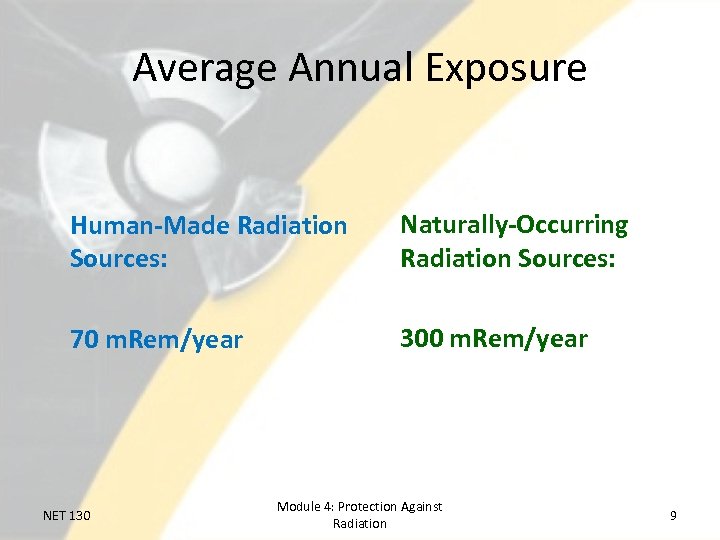 Average Annual Exposure Human-Made Radiation Sources: Naturally-Occurring Radiation Sources: 70 m. Rem/year 300 m. Rem/year NET 130 Module 4: Protection Against Radiation 9
 Human-Made Sources • Power generation – Nuclear – Coal – Gas • Nuclear weapons testing • Medical – X rays – Chemotherapy – etc • Industrial • Consumer products – Lantern mantles – Cigarettes – etc NET 130 Module 4: Protection Against Radiation 10 10
 Legal Standards for Rad. Protection: 10 CFR • Nuclear Regulatory Commission (NRC) – Licenses and regulates the nuclear industry – Derives authority from Title 10 of the Code of Federal Regulations • 10 CFR presently consists of about 180 parts • Parts that specifically address radiation: – Part 19 (10 CFR 19): “Notices, Instructions, and Reports to Workers; Inspections” – Part 20 (10 CFR 20): “Standards for Protection Against Radiation" – Part 100 (10 CFR 100): “Reactor Site Criteria” • Each licensed facility is legally required to comply with all regulations in Title 10, or be subject to civil penalties. • Every single individual employed in the nuclear industry should understand how he/she is legally protected. NET 130 Module 4: Protection Against Radiation 11 11
 10 CFR 19 • Details workers’ rights and responsibilities in regard to radiation exposure • Establishes requirements concerning radiological working conditions • Outlines options available to workers to ensure compliance • Each licensee (e. g. , a nuclear power plant) is required to post conspicuously within the facility the following documents: – – Regulations in 10 CFR 19 and 10 CFR 20 The facility's license and all associated amendments Operating procedures Notice of violations of radiological working conditions and response from licensee • If posting not practical, may post a description and location of the document • Must also post Form NRC 3, “Notice to Employees in Restricted Areas” frequented by employees Against Module 4: Protection NET 130 12 NET 130 Radiation Module 4: Protection Against Radiation 12
 10 CFR 19 • Licensee required to furnish exposure information to any individual upon request • Workers are to be kept informed of the status of radioactive materials or radiation levels in "restricted areas" • All employees are to be trained in health protection procedures involving radiation exposure • NRC may conduct inspections of physical working conditions, activities, and records of the plant. • Employees may be consulted during inspections, or they may report any possible violations to the inspector • In the event that an individual suspects violations of 10 CFR regulations, he/she may request an inspection – – A worker is permitted to conduct an inspection with the NRC Complaint must be warranted Arguments may be presented at an informal hearing instead of an inspection Name of person making complaint is withheld unless the individual authorizes its release NET 130 Module 4: Protection Against Radiation 13 13
 10 CFR 100 • “Reactor Site Criteria” • Regulations concerning public safety in the event of a major accident • Criteria used in evaluating a site for new nuclear deployment (NND – new reactor construction) – – – Intended use of reactor Application of engineering standards to design Safety features and radioactive release boundaries Population density and land use Physical characteristics such as seismology, meteorology, geology, and hydrology • NRC makes an evaluation for each new site and issues construction license if acceptable NET 130 Module 4: Protection Against Radiation 14 14
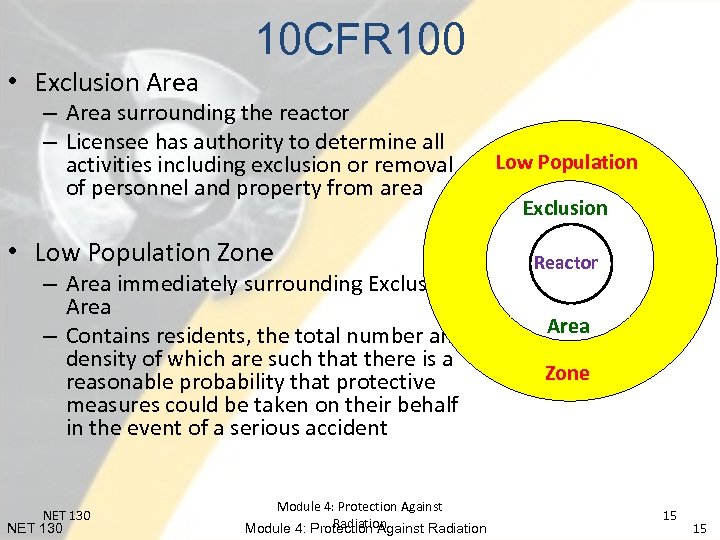 10 CFR 100 • Exclusion Area – Area surrounding the reactor – Licensee has authority to determine all activities including exclusion or removal of personnel and property from area • Low Population Zone – Area immediately surrounding Exclusion Area – Contains residents, the total number and density of which are such that there is a reasonable probability that protective measures could be taken on their behalf in the event of a serious accident NET 130 Module 4: Protection Against Radiation Low Population Exclusion Reactor Area Zone 15 15
 10 CFR 20 • Establishes industry standards and routine requirements for protecting plant personnel and the public from radiation hazards. • Maintain radiation exposures and radioactive releases As Low As Reasonably Achievable (ALARA) • Defines terms used in the regulations – Definitions are exact and must be known by operators – See “Vocabulary” section NET 130 Module 4: Protection Against Radiation 16 16
 Units of Radiation Dose • Occupational Dose – Dose received by an individual during course of employment, in activities/duties that involve exposure to radiation and/or radioactive materials • Exposure Dose – Units of Roentgen (R) – Measurement of the exposure to ionizing radiation equivalent to 2. 58 E-4 coulombs/kg of air • Absorbed Dose – Units of Rad or gray (1 gray = 100 rad) – Measurement of the amount of energy deposited (absorbed) in a material, equivalent to 100 ergs/gm. NET 130 Module 4: Protection Against Radiation 17 17
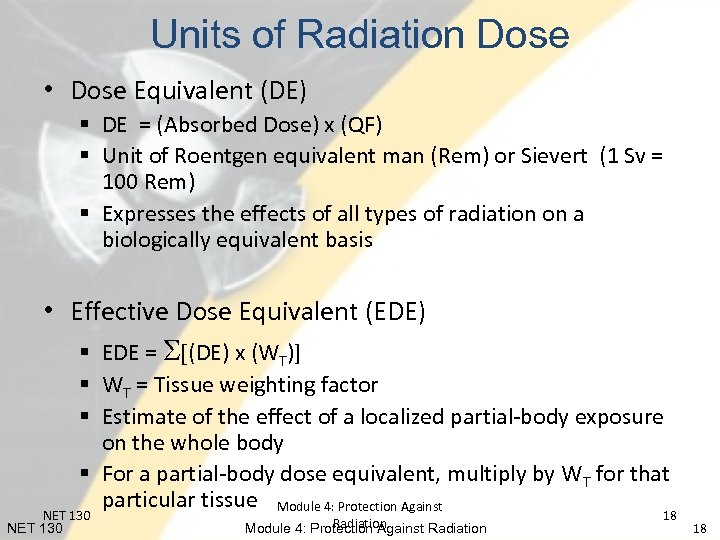 Units of Radiation Dose • Dose Equivalent (DE) § DE = (Absorbed Dose) x (QF) § Unit of Roentgen equivalent man (Rem) or Sievert (1 Sv = 100 Rem) § Expresses the effects of all types of radiation on a biologically equivalent basis • Effective Dose Equivalent (EDE) § EDE = S[(DE) x (WT)] § WT = Tissue weighting factor § Estimate of the effect of a localized partial-body exposure on the whole body § For a partial-body dose equivalent, multiply by WT for that particular tissue Module 4: Protection Against NET 130 18 NET 130 Radiation Module 4: Protection Against Radiation 18
 NET 130 Module 4: Protection Against Radiation 19 19
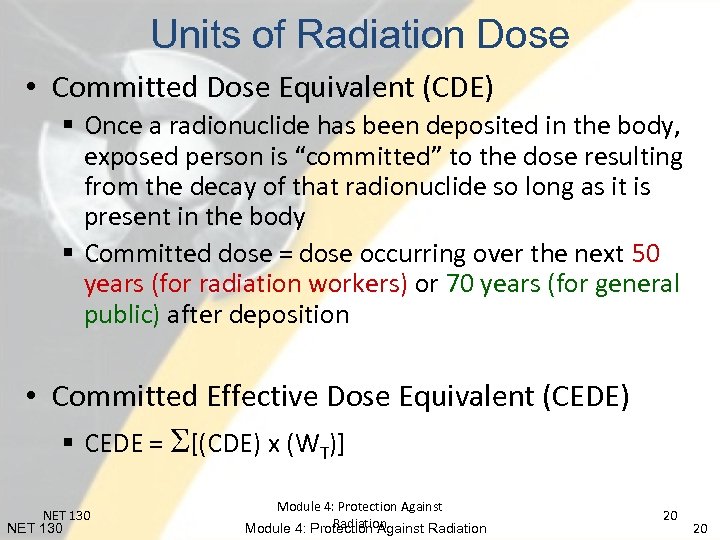 Units of Radiation Dose • Committed Dose Equivalent (CDE) § Once a radionuclide has been deposited in the body, exposed person is “committed” to the dose resulting from the decay of that radionuclide so long as it is present in the body § Committed dose = dose occurring over the next 50 years (for radiation workers) or 70 years (for general public) after deposition • Committed Effective Dose Equivalent (CEDE) § CEDE = S[(CDE) x (WT)] NET 130 Module 4: Protection Against Radiation 20 20
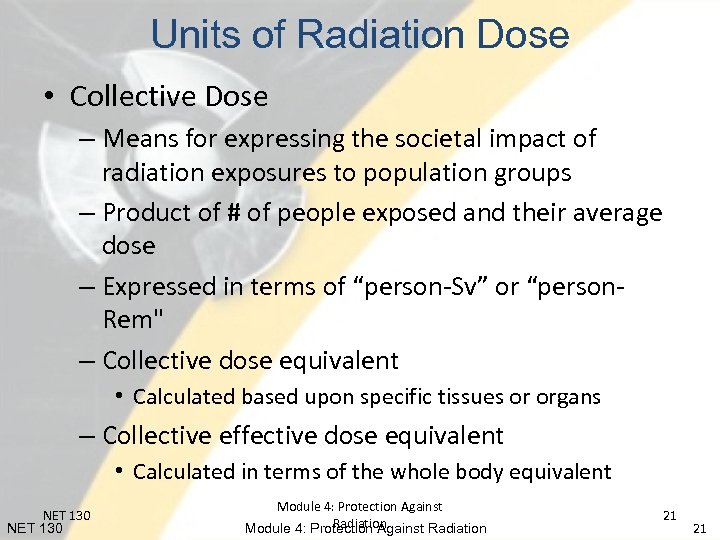 Units of Radiation Dose • Collective Dose – Means for expressing the societal impact of radiation exposures to population groups – Product of # of people exposed and their average dose – Expressed in terms of “person-Sv” or “person. Rem" – Collective dose equivalent • Calculated based upon specific tissues or organs – Collective effective dose equivalent • Calculated in terms of the whole body equivalent NET 130 Module 4: Protection Against Radiation 21 21
 Units of Radiation Dose • Deep Dose Equivalent (DDE) – Applies to external whole body exposure – Dose equivalent at tissue depth of 1 cm • Shallow Dose Equivalent (SDE) – Applies to the external exposure of the skin or an extremity – Dose equivalent at tissue depth of 0. 007 cm averaged over an area of 1 cm 2 • Total Effective Dose Equivalent (TEDE) – Sum of the DDE (external exposure) and the CEDE (internal exposure) 4: Protection Against Module NET 130 Radiation Module 4: Protection Against Radiation 22 22
 Radiation Exposure Limits • Occupational Exposure – 10 CFR 20 establishes occupational exposure limitations for individuals in restricted areas – Station Management for local plant also establishes site administrative limits • Minors – Annual occupational dose limits for minors are 10% of the annual dose limits specified for adult workers. NET 130 Module 4: Protection Against Radiation 23 23
 NET 130 Module 4: Protection Against Radiation 24 24
 Radiation Exposure Limits • General Public – Plants must keep TEDE to individual members of the public below 100 mrem/yr • Planned Special Exposures – Plant may authorize an adult worker to receive doses in addition to the daily occupational dose – Worker cannot exceed annual limit (about 5 Rem TEDE) as specified in 10 CFR 20 Worker cannot exceed 5 x the annual limits during his/her lifetime (5 X 5 = 25 Rem) during the planned special exposure period. NET 130 Module 4: Protection Against Radiation 25 25
 Radiation Exposure Limits • Whole Body Radiation Exposure – Head, trunk, extremities (hands, forearms, feet, and ankles), active blood forming organs, lens of the eyes, and gonads – Total lifetime whole-body accumulated dose to one individual may not exceed 5 N x 1000 mrem TEDE • N = age of the individual in years – Whole-body accumulated dose must be determined by the plant and recorded on Form NRC 4, “Occupational External Radiation Exposure History". • Radiation exposure is always restricted to the lowest value of any applicable limits (ALARA) NET 130 Module 4: Protection Against Radiation 26
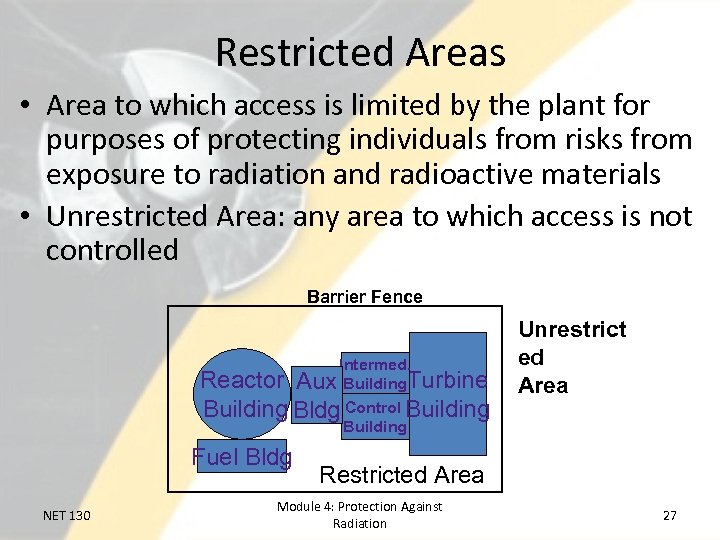 Restricted Areas • Area to which access is limited by the plant for purposes of protecting individuals from risks from exposure to radiation and radioactive materials • Unrestricted Area: any area to which access is not controlled Barrier Fence Intermed. Aux Building. Turbine Reactor Building Bldg Control Building Unrestrict ed Area Building Fuel Bldg NET 130 Restricted Area Module 4: Protection Against Radiation 27
 Radiation/High Radiation Areas • Restricted areas subdivided into: 1. Radiation Areas – Any area in which radiation levels could result in an individual receiving 5 m. REM in 1 hour, at a distance of 30 cm from the source – Typically defined as an area with general area dose rates of 5 – 99 m. Rem/hr 2. High Radiation Areas – Any area in which radiation levels could result in an individual receiving 100 m. REM in 1 hour, at a distance of 30 cm from the source – Typically defined as an area with general area dose rates of 100 – 999 m. REM/hr • 10 CFR 20 requires these areas to be marked with a radiation symbol plus identifying words – CAUTION: RADIATION AREA – CAUTION: HIGH RADIATION AREA – GRAVE DANGER: VERY HIGH RADIATION AREA Module 4: Protection Against NET 130 Radiation Image source: Wikimedia. org (public domain) 28
 NET 130 Module 4: Protection Against Radiation 29
 NET 130 Module 4: Protection Against Radiation 30
 Radiation/High Radiation Areas • 10 CFR 20: At any access point to a high radiation area, the following conditions must exist: – Access door must be equipped with a visible or audible alarm that will activate upon opening, warning the entrant – Access door must be locked except when access is required, at which point positive control over each entrant must be maintained. – Access point must be equipped with a control device (automatic shield) that will decrease the dose rate to < 100 m. REM/hr upon entry NET 130 Module 4: Protection Against Radiation 31
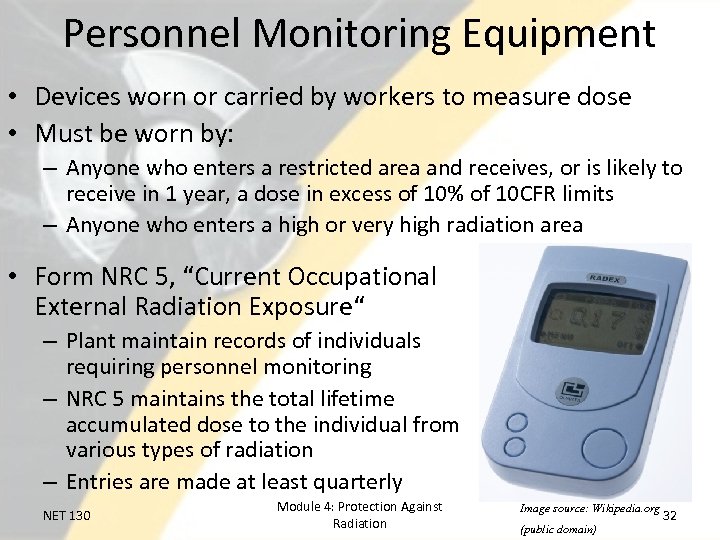 Personnel Monitoring Equipment • Devices worn or carried by workers to measure dose • Must be worn by: – Anyone who enters a restricted area and receives, or is likely to receive in 1 year, a dose in excess of 10% of 10 CFR limits – Anyone who enters a high or very high radiation area • Form NRC 5, “Current Occupational External Radiation Exposure“ – Plant maintain records of individuals requiring personnel monitoring – NRC 5 maintains the total lifetime accumulated dose to the individual from various types of radiation – Entries are made at least quarterly NET 130 Module 4: Protection Against Radiation Image source: Wikipedia. org (public domain) 32
 Airborne Radioactive Material • Radioactive material that has been dispersed through the atmosphere, in the form of either particles or gases • Can be caused from radioactive particulates, iodine, noble gases, or tritium oxide • Primary concern: potential for deposition inside the body – Ingestion: do not eat/drink inside Radiologically Controlled Areas – Absorption and Cuts: use protective clothing – Inhalation: use engineering controls, cleanliness controls, and respiratory equipment NET 130 Module 4: Protection Against Radiation 33
 10 CFR 20: Internal Exposure • To determine amount of radioactive material inside your body and as a baseline to detect any internal contamination in the future, a whole body count is given prior to entry into the reactor containment area • Additional whole body counts are given: – Annually – Anytime internal contamination is expected – Termination of employment • 10 CFR 20 appendices give specific limits regarding sources of internal exposure – Appendix B, Tables 1, 2, and 3 – Appendix C NET 130 Module 4: Protection Against Radiation 34
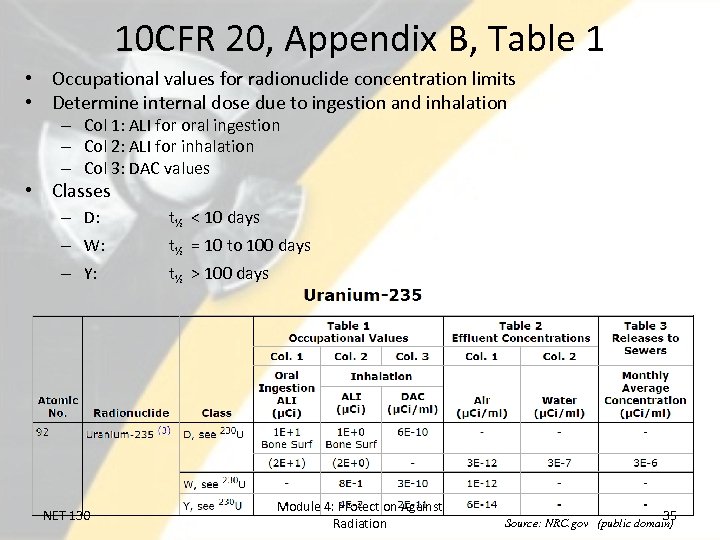 10 CFR 20, Appendix B, Table 1 • Occupational values for radionuclide concentration limits • Determine internal dose due to ingestion and inhalation – Col 1: ALI for oral ingestion – Col 2: ALI for inhalation – Col 3: DAC values • Classes – D: t½ < 10 days – W: t½ = 10 to 100 days – Y: t½ > 100 days NET 130 Module 4: Protection Against Radiation 35 Source: NRC. gov (public domain)
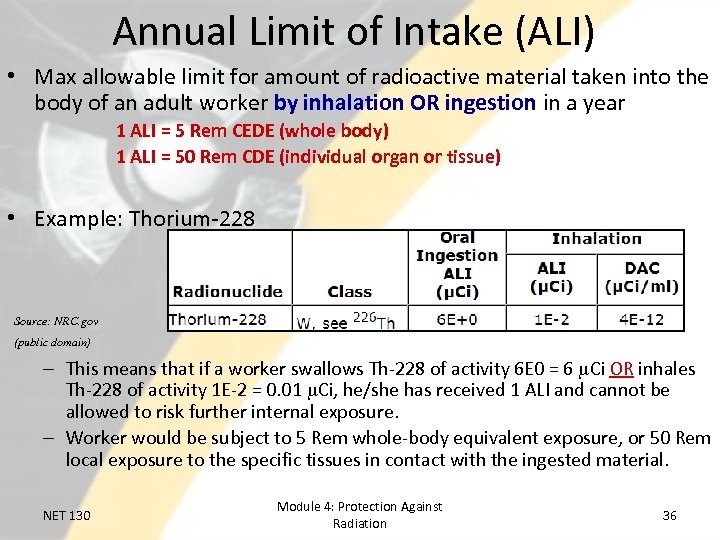 Annual Limit of Intake (ALI) • Max allowable limit for amount of radioactive material taken into the body of an adult worker by inhalation OR ingestion in a year 1 ALI = 5 Rem CEDE (whole body) 1 ALI = 50 Rem CDE (individual organ or tissue) • Example: Thorium-228 Source: NRC. gov (public domain) – This means that if a worker swallows Th-228 of activity 6 E 0 = 6 m. Ci OR inhales Th-228 of activity 1 E-2 = 0. 01 m. Ci, he/she has received 1 ALI and cannot be allowed to risk further internal exposure. – Worker would be subject to 5 Rem whole-body equivalent exposure, or 50 Rem local exposure to the specific tissues in contact with the ingested material. NET 130 Module 4: Protection Against Radiation 36
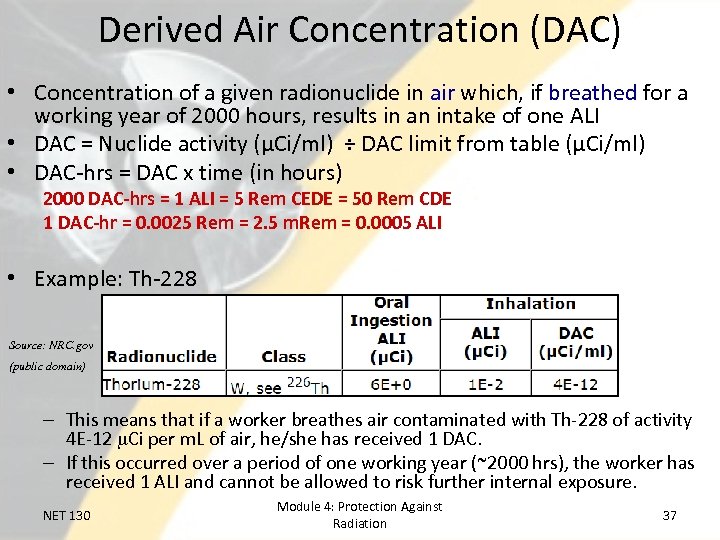 Derived Air Concentration (DAC) • Concentration of a given radionuclide in air which, if breathed for a working year of 2000 hours, results in an intake of one ALI • DAC = Nuclide activity (µCi/ml) ÷ DAC limit from table (µCi/ml) • DAC-hrs = DAC x time (in hours) 2000 DAC-hrs = 1 ALI = 5 Rem CEDE = 50 Rem CDE 1 DAC-hr = 0. 0025 Rem = 2. 5 m. Rem = 0. 0005 ALI • Example: Th-228 Source: NRC. gov (public domain) – This means that if a worker breathes air contaminated with Th-228 of activity 4 E-12 m. Ci per m. L of air, he/she has received 1 DAC. – If this occurred over a period of one working year (~2000 hrs), the worker has received 1 ALI and cannot be allowed to risk further internal exposure. NET 130 Module 4: Protection Against Radiation 37
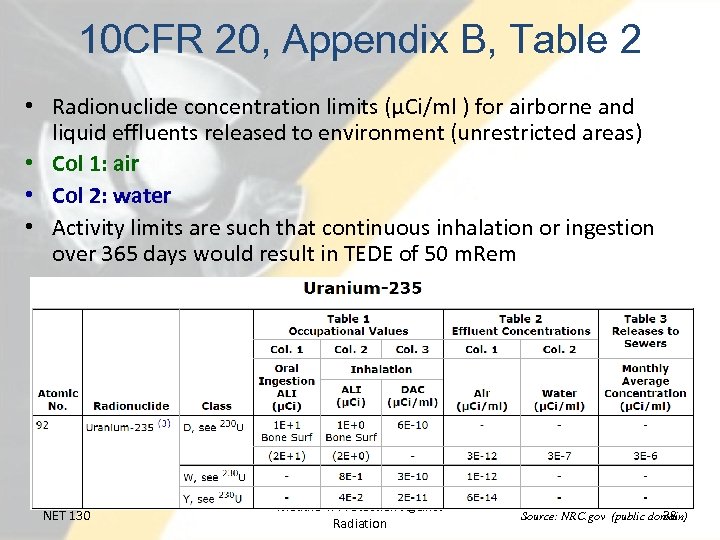 10 CFR 20, Appendix B, Table 2 • Radionuclide concentration limits (µCi/ml ) for airborne and liquid effluents released to environment (unrestricted areas) • Col 1: air • Col 2: water • Activity limits are such that continuous inhalation or ingestion over 365 days would result in TEDE of 50 m. Rem NET 130 Module 4: Protection Against Radiation 38 Source: NRC. gov (public domain)
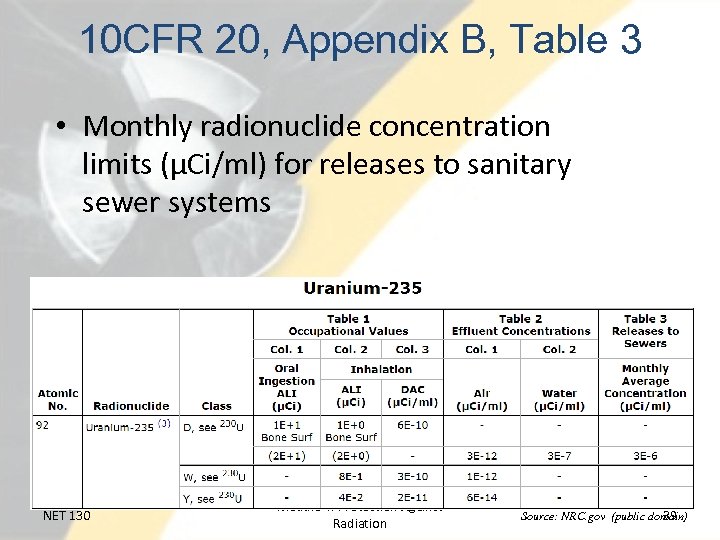 10 CFR 20, Appendix B, Table 3 • Monthly radionuclide concentration limits (µCi/ml) for releases to sanitary sewer systems NET 130 Module 4: Protection Against Radiation 39 Source: NRC. gov (public domain)
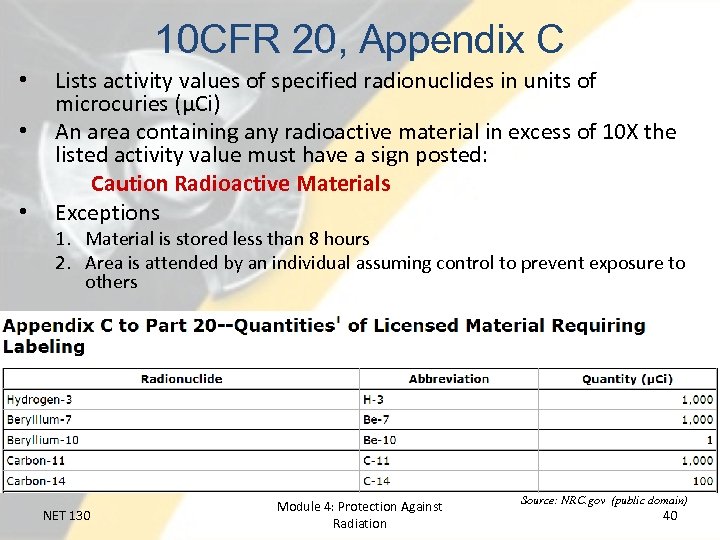 10 CFR 20, Appendix C • • • Lists activity values of specified radionuclides in units of microcuries (µCi) An area containing any radioactive material in excess of 10 X the listed activity value must have a sign posted: Caution Radioactive Materials Exceptions 1. Material is stored less than 8 hours 2. Area is attended by an individual assuming control to prevent exposure to others NET 130 Module 4: Protection Against Radiation Source: NRC. gov (public domain) 40
 10 CFR 20: Notifying the NRC • Certain radiation events must be reported to the NRC within a certain timeframe – Reports of exposure to individuals – Loss of licensed material or other radioactive materials of certain amounts designated below – Etc. . • Depending on the specific risk posed by the event, the notification might have to be: – Immediate (call) – Within 24 hours (call) – Within 30 days (written report) NET 130 Module 4: Protection Against Radiation 41
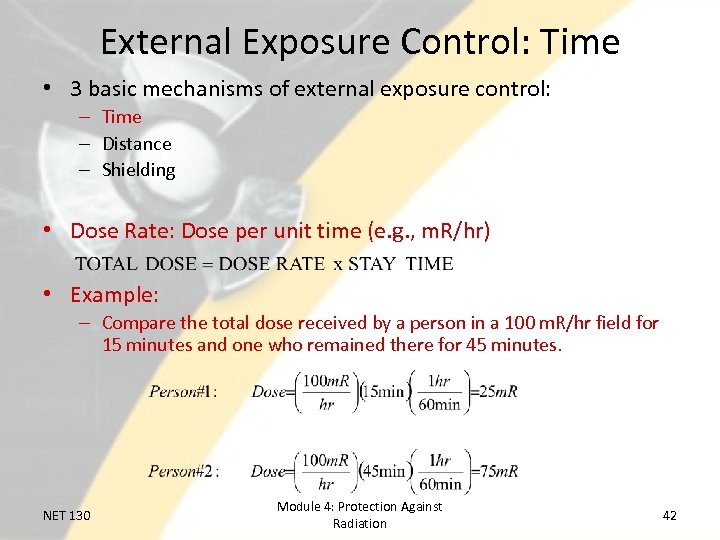 External Exposure Control: Time • 3 basic mechanisms of external exposure control: – Time – Distance – Shielding • Dose Rate: Dose per unit time (e. g. , m. R/hr) • Example: – Compare the total dose received by a person in a 100 m. R/hr field for 15 minutes and one who remained there for 45 minutes. NET 130 Module 4: Protection Against Radiation 42
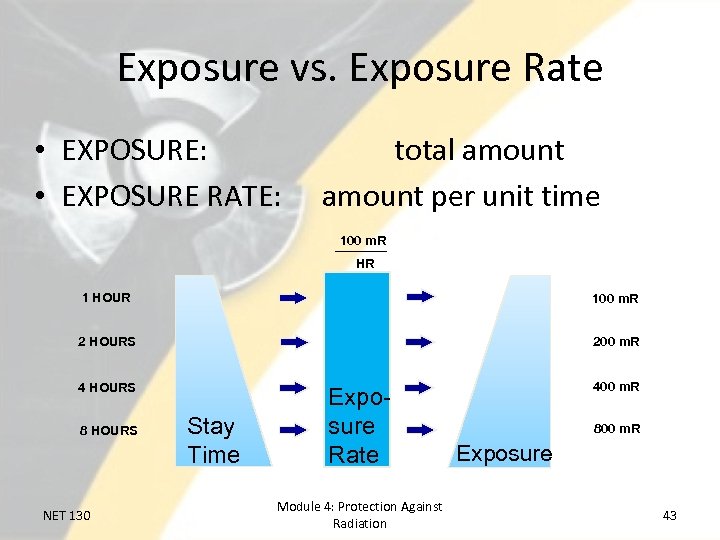 Exposure vs. Exposure Rate • EXPOSURE: • EXPOSURE RATE: total amount per unit time 100 m. R HR 1 HOUR 100 m. R 2 HOURS 200 m. R 4 HOURS 400 m. R 8 HOURS NET 130 Stay Time Exposure Rate Module 4: Protection Against Radiation 800 m. R Exposure 43
 External Exposure Control: Distance • 3 basic mechanisms of external exposure control: – Time – Distance – Shielding • Distance – Radiation beam spreads wider as distance from source increases – Thus penetrating radiation decreases in intensity as distance from source increases – Exposure minimized by maintaining the maximum feasible distance from source – Decrease is function of source’s geometry. Four types: • • NET 130 Point source (simplest) Line source Plane source Tank source Module 4: Protection Against Radiation 44
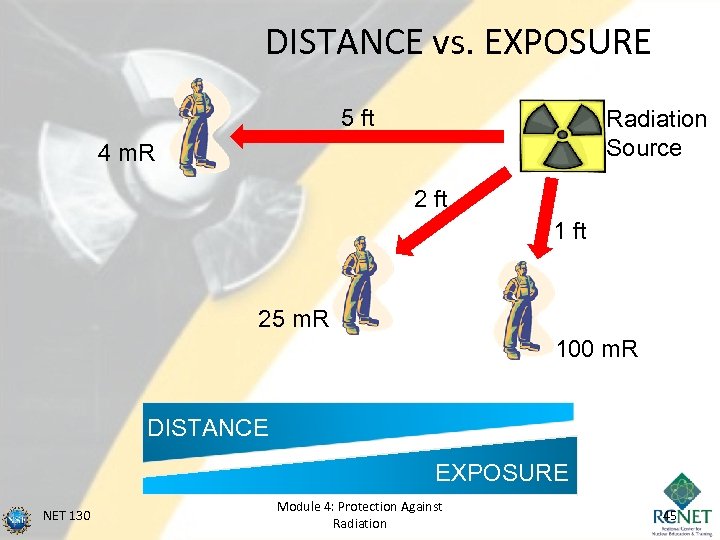 DISTANCE vs. EXPOSURE 5 ft Radiation Source 4 m. R 2 ft 1 ft 25 m. R 100 m. R DISTANCE EXPOSURE NET 130 Module 4: Protection Against Radiation 45
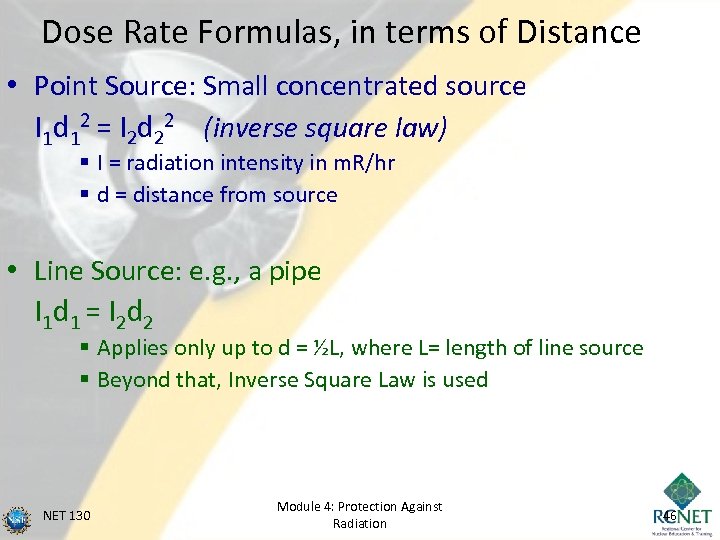 Dose Rate Formulas, in terms of Distance • Point Source: Small concentrated source I 1 d 12 = I 2 d 22 (inverse square law) § I = radiation intensity in m. R/hr § d = distance from source • Line Source: e. g. , a pipe I 1 d 1 = I 2 d 2 § Applies only up to d = ½L, where L= length of line source § Beyond that, Inverse Square Law is used NET 130 Module 4: Protection Against Radiation 46
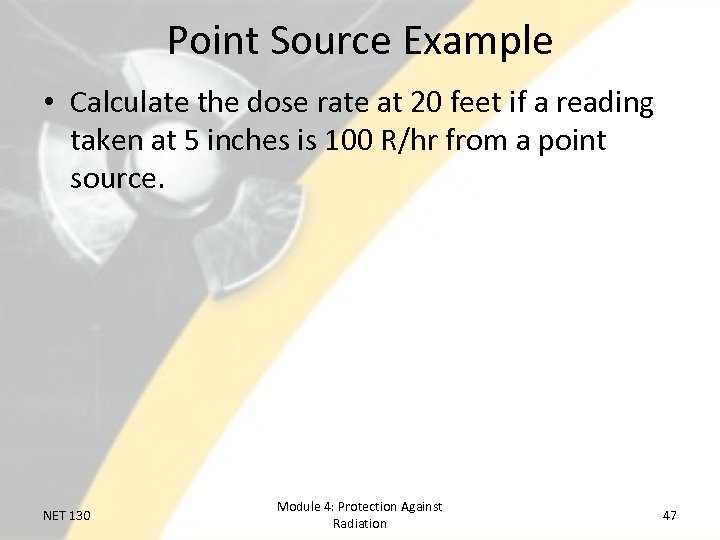 Point Source Example • Calculate the dose rate at 20 feet if a reading taken at 5 inches is 100 R/hr from a point source. NET 130 Module 4: Protection Against Radiation 47
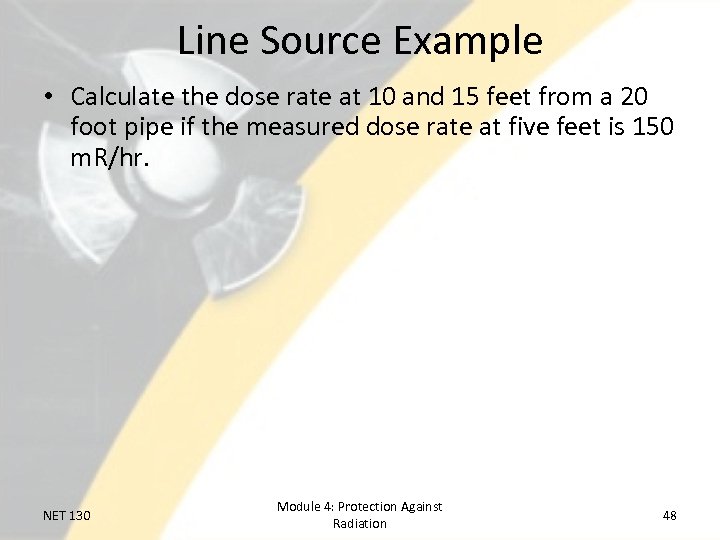 Line Source Example • Calculate the dose rate at 10 and 15 feet from a 20 foot pipe if the measured dose rate at five feet is 150 m. R/hr. NET 130 Module 4: Protection Against Radiation 48
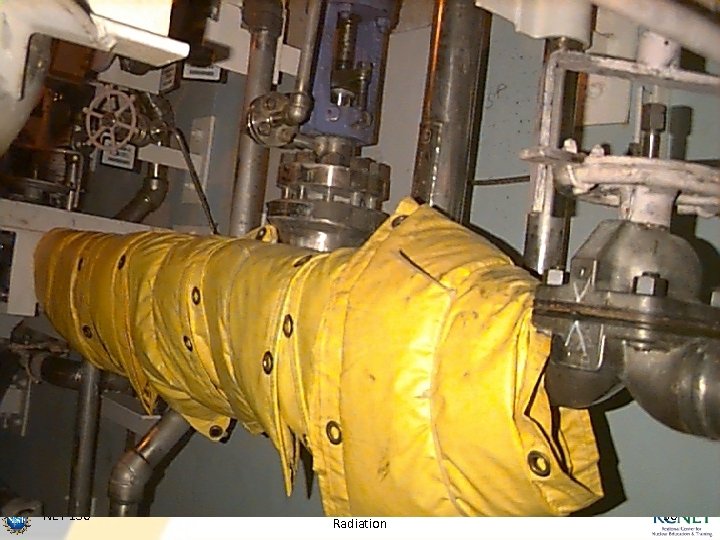
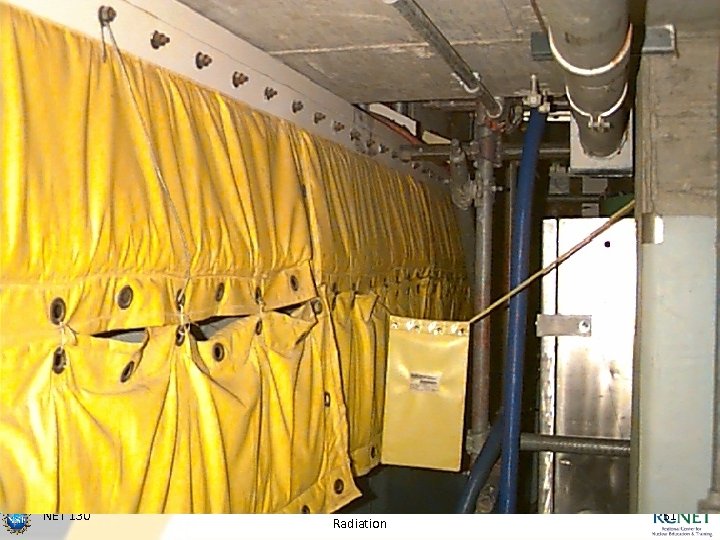
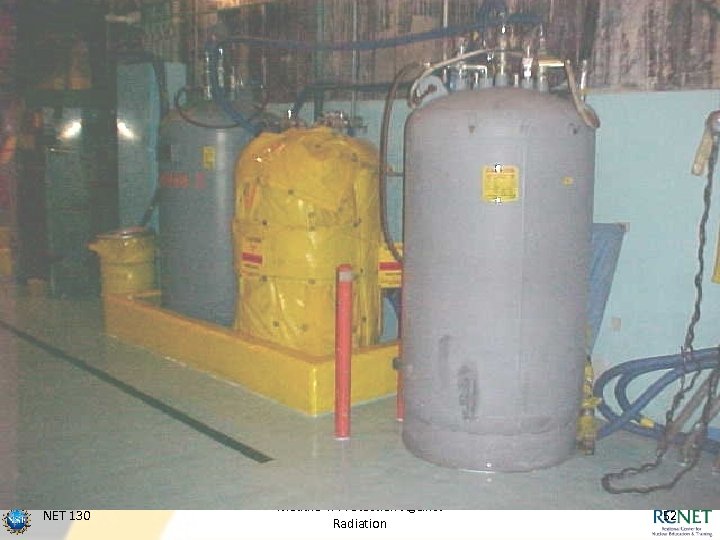
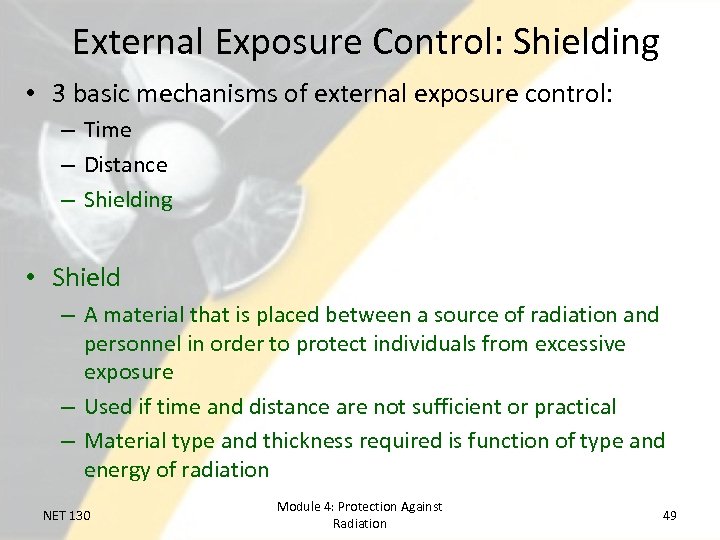 External Exposure Control: Shielding • 3 basic mechanisms of external exposure control: – Time – Distance – Shielding • Shield – A material that is placed between a source of radiation and personnel in order to protect individuals from excessive exposure – Used if time and distance are not sufficient or practical – Material type and thickness required is function of type and energy of radiation NET 130 Module 4: Protection Against Radiation 49
 NET 130 Module 4: Protection Against Radiation 50
 NET 130 Module 4: Protection Against Radiation 51
 NET 130 Module 4: Protection Against Radiation 52
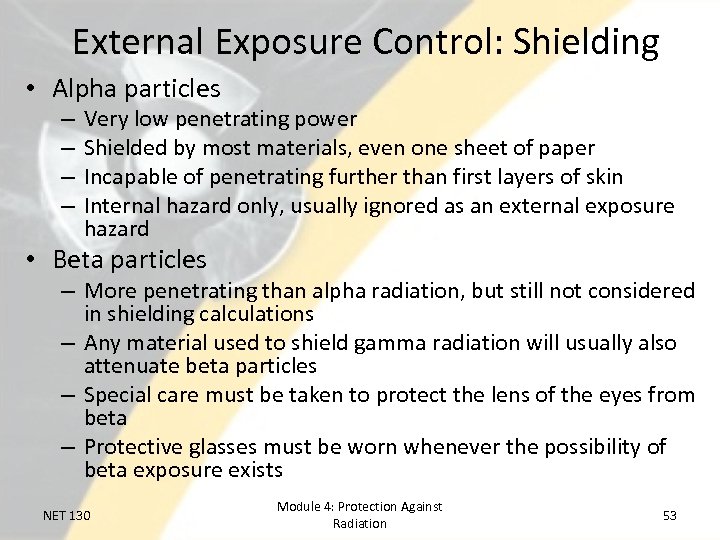 External Exposure Control: Shielding • Alpha particles – – Very low penetrating power Shielded by most materials, even one sheet of paper Incapable of penetrating further than first layers of skin Internal hazard only, usually ignored as an external exposure hazard • Beta particles – More penetrating than alpha radiation, but still not considered in shielding calculations – Any material used to shield gamma radiation will usually also attenuate beta particles – Special care must be taken to protect the lens of the eyes from beta – Protective glasses must be worn whenever the possibility of beta exposure exists NET 130 Module 4: Protection Against Radiation 53
 External Exposure Control: Shielding • Fast and thermal neutrons and gamma radiation – Of most concern in shielding – Greater penetrating power: can affect the whole body – Material’s ability to shield neutrons is function of its total absorption cross section – As neutron energy decreases, scattering and absorption cross sections increase – For shielding thermal neutrons, any material with a high absorption cross section (e. g. boron) is effective NET 130 Module 4: Protection Against Radiation 54
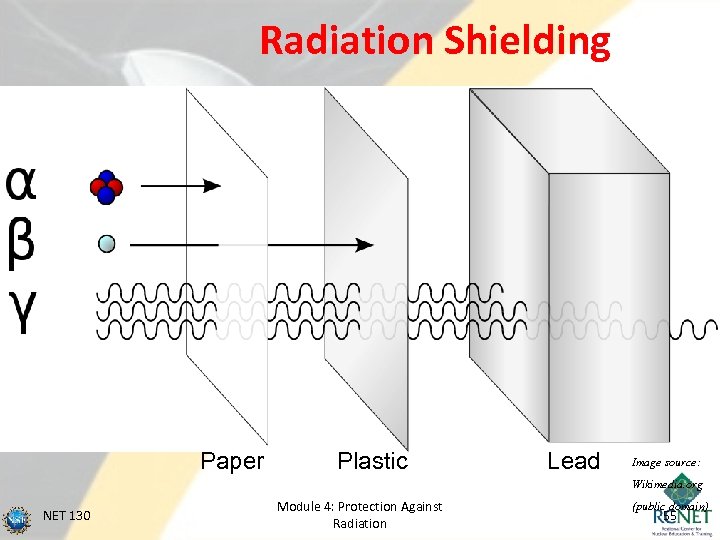 Radiation Shielding Paper Plastic Lead Image source: Wikimedia. org NET 130 Module 4: Protection Against Radiation (public domain) 55
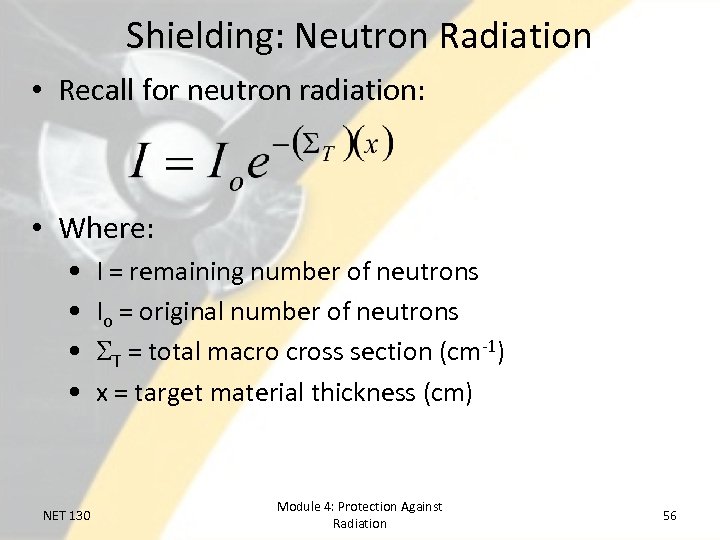 Shielding: Neutron Radiation • Recall for neutron radiation: • Where: • • NET 130 I = remaining number of neutrons Io = original number of neutrons ST = total macro cross section (cm-1) x = target material thickness (cm) Module 4: Protection Against Radiation 56
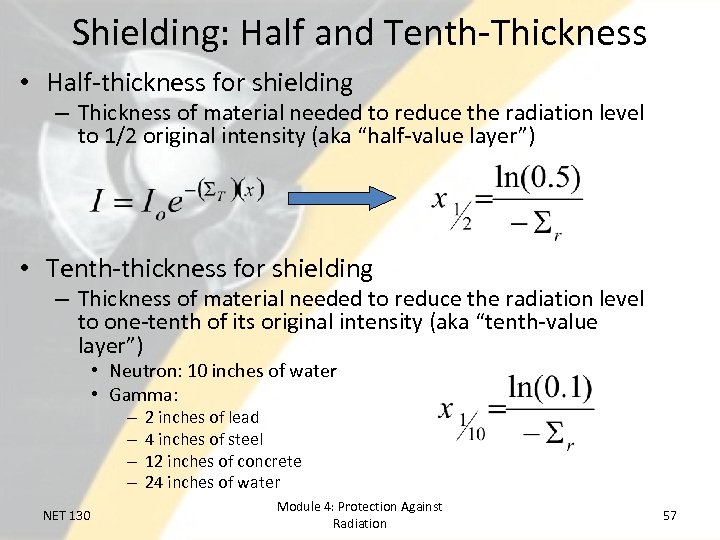 Shielding: Half and Tenth-Thickness • Half-thickness for shielding – Thickness of material needed to reduce the radiation level to 1/2 original intensity (aka “half-value layer”) • Tenth-thickness for shielding – Thickness of material needed to reduce the radiation level to one-tenth of its original intensity (aka “tenth-value layer”) • Neutron: 10 inches of water • Gamma: – – NET 130 2 inches of lead 4 inches of steel 12 inches of concrete 24 inches of water Module 4: Protection Against Radiation 57
 Neutron Shielding Example • Calculate the half and tenth thicknesses of water for fast neutrons NET 130 Module 4: Protection Against Radiation 58
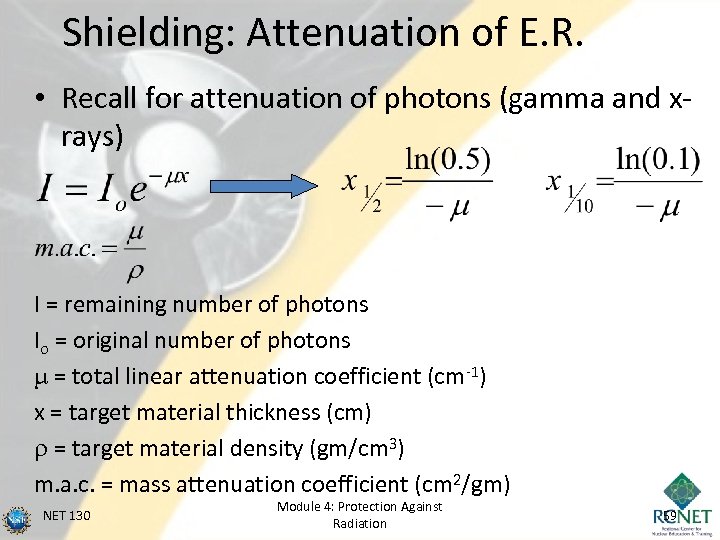 Shielding: Attenuation of E. R. • Recall for attenuation of photons (gamma and xrays) I = remaining number of photons Io = original number of photons m = total linear attenuation coefficient (cm-1) x = target material thickness (cm) r = target material density (gm/cm 3) m. a. c. = mass attenuation coefficient (cm 2/gm) NET 130 Module 4: Protection Against Radiation 59
 Table of Mass Attenuation Coefficients (cm 2/gm) NET 130 Module 4: Protection Against Radiation 60
 ER Shielding Example • Calculate the 1/2 and 1/10 copper shield thickness required for a 3 Me. V gamma beam (r. Cu = 8. 96 g/cm 3) NET 130 Module 4: Protection Against Radiation 61
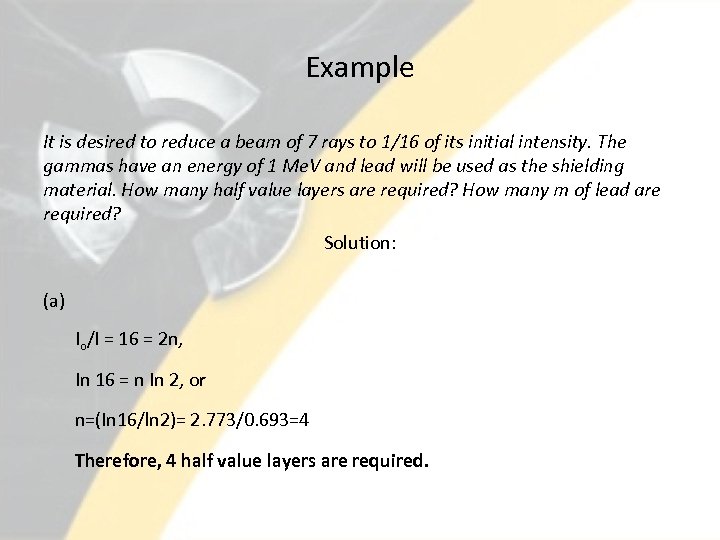 Example It is desired to reduce a beam of 7 rays to 1/16 of its initial intensity. The gammas have an energy of 1 Me. V and lead will be used as the shielding material. How many half value layers are required? How many m of lead are required? Solution: (a) Io/I = 16 = 2 n, In 16 = n In 2, or n=(In 16/ln 2)= 2. 773/0. 693=4 Therefore, 4 half value layers are required.
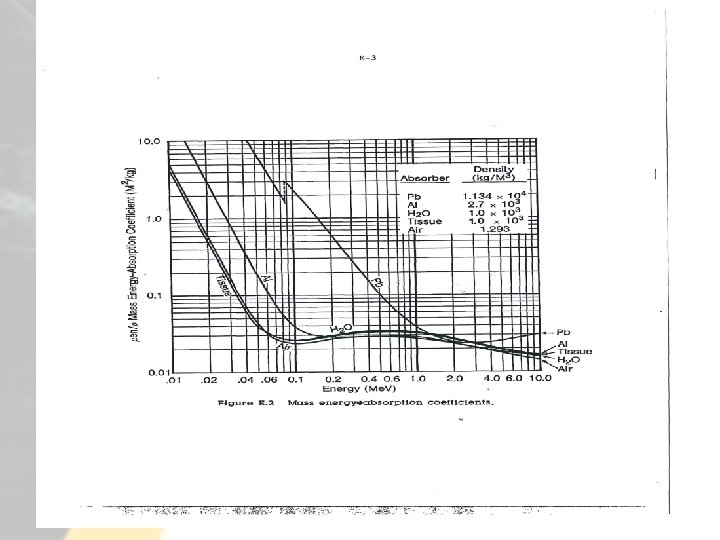
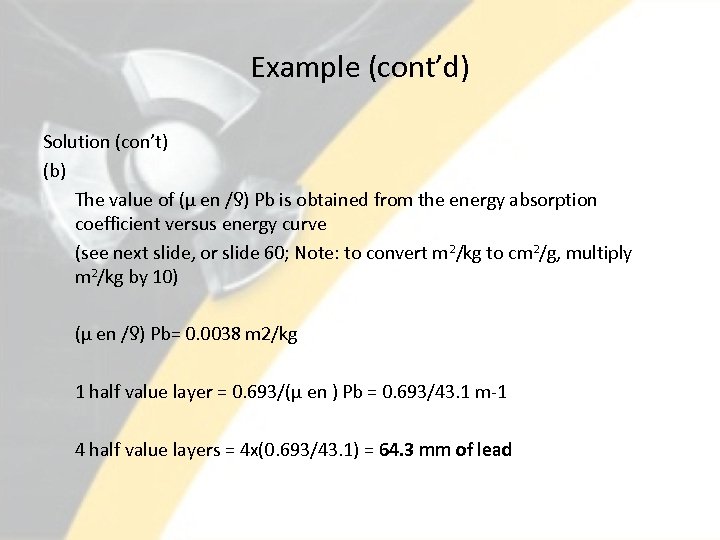 Example (cont’d) Solution (con’t) (b) The value of (µ en /ƍ) Pb is obtained from the energy absorption coefficient versus energy curve (see next slide, or slide 60; Note: to convert m 2/kg to cm 2/g, multiply m 2/kg by 10) (µ en /ƍ) Pb= 0. 0038 m 2/kg 1 half value layer = 0. 693/(µ en ) Pb = 0. 693/43. 1 m-1 4 half value layers = 4 x(0. 693/43. 1) = 64. 3 mm of lead
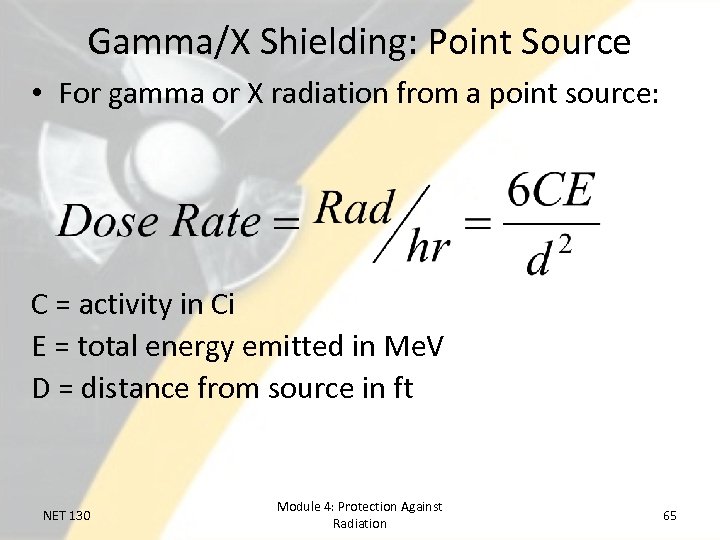 Gamma/X Shielding: Point Source • For gamma or X radiation from a point source: C = activity in Ci E = total energy emitted in Me. V D = distance from source in ft NET 130 Module 4: Protection Against Radiation 65
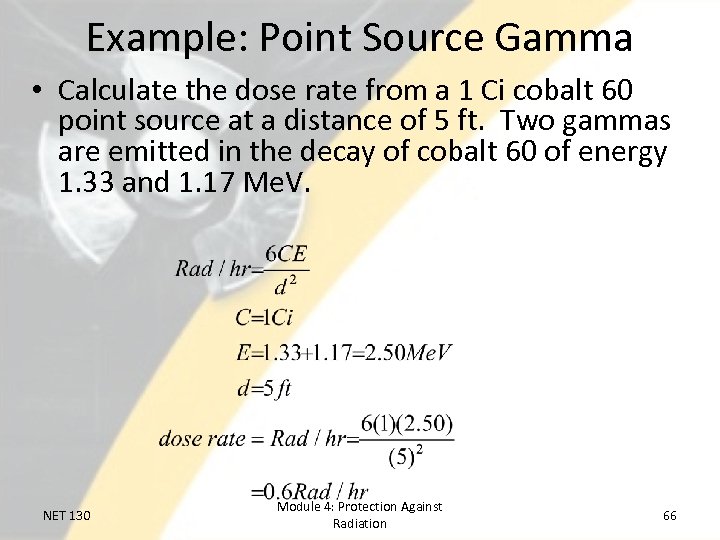 Example: Point Source Gamma • Calculate the dose rate from a 1 Ci cobalt 60 point source at a distance of 5 ft. Two gammas are emitted in the decay of cobalt 60 of energy 1. 33 and 1. 17 Me. V. NET 130 Module 4: Protection Against Radiation 66
 Buildup factor • Any of the common gamma interaction processes may result in secondary photons that have a finite probability of reaching the dose point. • The extent to which such secondary photons add to the fluence or dose at the dose point is usually described through the use of an appropriate buildup factor. • Buildup factors may refer to various quantities of interest, such as photon fluence, photon energy fluence, exposure, or dose, and the values among all are somewhat different.
 Buildup factor • The dose buildup factor is a dimensionless quantity that represents the ratio of total dose (including the dose from secondary photons) at the dose point to primary photon dose at the same point. • The primary photon dose naturally comes from original photons that have penetrated the shielding material without interacting. • Magnitudes of buildup factors vary widely, ranging from a minimum of 1. 0 to very large values, depending on source and shield characteristics.
 Buildup factor • The ratio of the total photons at a point to the number arriving there without being scattered • In the passage of radiation through a medium, the ratio of the total value of a specified radiation quantity at any point to the contribution to that value from radiation reaching the point without having undergone a collision.
 Internal Exposure Control • Time/distance/shielding are ineffective if radioactive materials enter the body • Internal exposures to power plant workers are typically very low • Control methods: prevent radionuclides from entering the body in the first place – Eating, drinking, smoking prohibited in radiation areas – If airborne radioactivity exists, protective breathing apparatus is used – Maximum permissible concentrations (MPCs) for airborne radionuclides • Internal dose approximated by evaluating the time spent in areas with airborne contamination and the type of radiation present. NET 130 Module 4: Protection Against Radiation 70
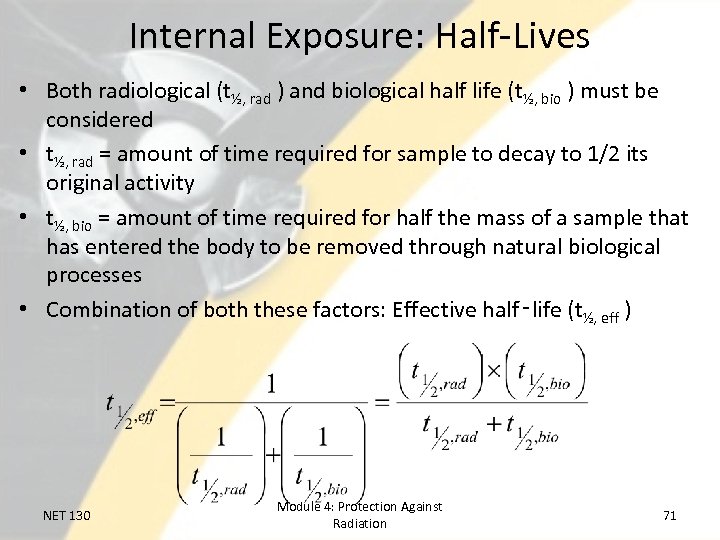 Internal Exposure: Half-Lives • Both radiological (t½, rad ) and biological half life (t½, bio ) must be considered • t½, rad = amount of time required for sample to decay to 1/2 its original activity • t½, bio = amount of time required for half the mass of a sample that has entered the body to be removed through natural biological processes • Combination of both these factors: Effective half‑life (t½, eff ) NET 130 Module 4: Protection Against Radiation 71
 Use of respirators • ALARA analysis – use of respiratory protection Decision on respirator use: – optimal sum of external and internal doses – internal exposure must be evaluated against • the increased external exposure and • related stresses caused by the use of respirators: – Heat stress, reduced visibility, and reduced communication associated NET 130 Module 4: Protection Against Radiation 72
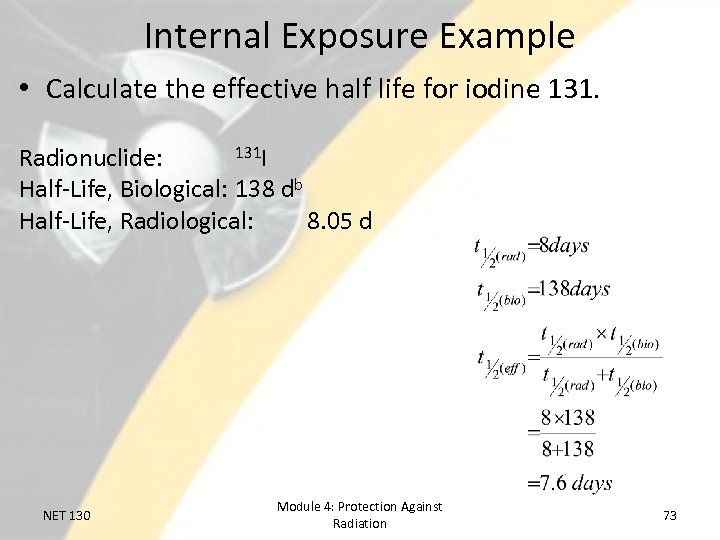 Internal Exposure Example • Calculate the effective half life for iodine 131 I Radionuclide: Half-Life, Biological: 138 db Half-Life, Radiological: 8. 05 d NET 130 Module 4: Protection Against Radiation 73
 10 CFR 20: Federal Exposure Limits • Adult Occupational Exposure Limits: Ø 5 REM / yr TEDE Ø 15 REM / yr LDE (Lens Dose Equivalent: exposure to the lens of the eye) Ø 50 REM / yr CDE Ø 50 REM / yr SDE Ø 50 m. REM / mo ; 500 m. REM total during entire pregnancy (Declared Pregnant Female) NET 130 Module 4: Protection Against Radiation 74
 10 CFR 20: Federal Exposure Limits • Minor Occupational Exposure Limits (10% of adult limits): Ø 500 m. REM / yr TEDE Ø 1. 5 REM / yr LDE (Lens Dose Equivalent: exposure to the lens of the eye) Ø 5 REM / yr CDE Ø 5 REM / yr SDE • General Public Exposure Limits: Ø No more than 100 m. REM / yr TEDE Ø No more than 2 m. REM in any one hour in unrestricted areas. 4: Protection Against Module NET 130 Radiation 75
 Surface Contamination • Radioactive Contamination – Deposition of radioactive material in any place where it is not desired, particularly in any place where it may be harmful to personnel – Two types: Surface and Airborne • Surface Contamination – Dirt that contains radioactive materials – Sources: spills, leaks, or residue from mechanical grinding – Co 60 is isotope of most concern NET 130 Module 4: Protection Against Radiation 76
 Surface Contamination • Fixed contamination – Surface contamination that cannot be easily removed – Removed by filing, grinding, or other heavy-duty method • Loose contamination – – Surface contamination that is relatively easy to remove Spreads easily Greatest surface contamination hazard Detected by using smears • Filter paper is wiped over the surface • Paper is placed in a counting apparatus to determine the amount of radioactivity picked up NET 130 Module 4: Protection Against Radiation 77
 Airborne Contamination • Particulate airborne contamination – Radioactive material either suspended as small particles or entrained as suspended mist in the atmosphere – Can be removed by fine filters • Gaseous airborne contamination – Primary importance: tritium, krypton, xenon, iodine, and argon – Cannot be removed by filtration – Gaseous fission products formed in the fuel elements during power operation – Possible for these gases to be released into the primary coolant – When coolant is vented, gases come out of solution and pass to the atmosphere NET 130 Module 4: Protection Against Radiation 78
 Decontamination • Material with contaminated surface: Radionuclides are removable • Material that has been irradiated: – Material has been made radioactive due to exposure to radiation – Radionuclides are NOT removable • Decontamination – Removal of contamination from undesirable location to more acceptable location – Does not eliminate radioactivity, just moves it to where it can be controlled safely or immobilized and ultimately disposed of – May be required for plant components, tools, equipment, areas of compartments, clothing, or personnel – Alternatives: • Storage for decay • Disposal without decontamination • Restricted use without complete decontamination NET 130 Module 4: Protection Against Radiation 79
 Decontamination: Surface Contamination • Generally loose radioactive material dropped on a surface or spread around by hands or feet • Usually decontaminated by normal cleaning • Cleaning is done from less to more contaminated areas • Isolate area • Contamination carefully and completely removed to avoid spreading • Loose contamination – – Blotting Taping Washing with sudless detergent and citric acid solutions If solvents don’t work, strong chemicals or mechanical means may be required NET 130 Module 4: Protection Against Radiation 80
 Decontamination: Tools • Contaminated tools and equipment – May be used again in contaminated areas – May be temporarily stored in a designated area without decontamination • If tools are reserved for contaminated area use only, must be distinctively marked to indicate they are always considered contaminated • Some cases: taping tool prior to use and stripping off the contaminated tape after use eliminates need for decontamination • Large tools are often wrapped in plastic instead of tape. • Decontamination – Wipe with cloths soaked in detergent – Ultrasonic cleaning (good for irregular or recessed surfaces) – Mechanical decontamination methods (e. g. abrasives) (remove some of the tool's surface) • Cost factor: sometimes cheaper to dispose as radioactive waste and replace NET 130 Module 4: Protection Against Radiation 81
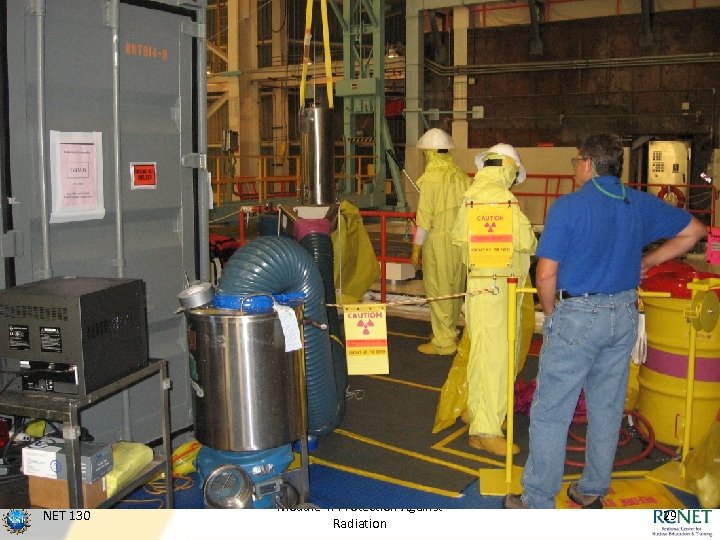
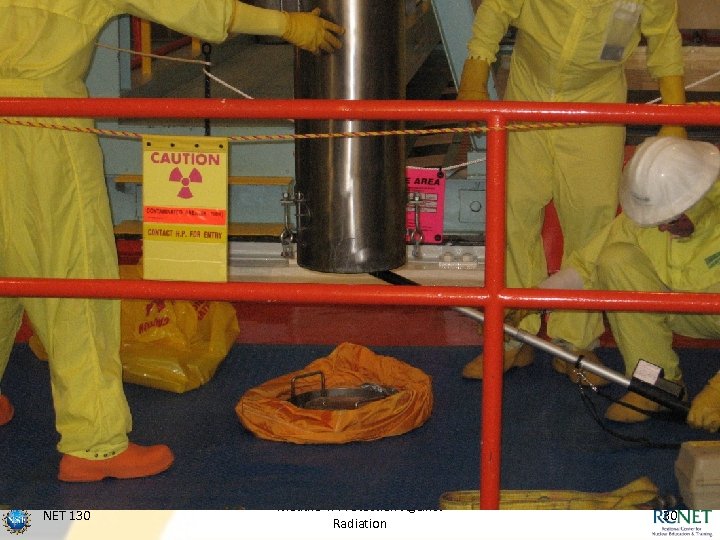
 Anti-Contamination Clothing • Prevent personnel from inadvertently spreading radioactive contamination outside of controlled areas Also keeps the wearer free from contamination • Full set: Designed to protect the worker’s head, neck, body, and extremities • Totally protects skin from alpha particles and partially protects it from low energy beta • Not meant to be a shield against penetrating radiation • Only protects against direct skin contact with radioactive materials • Either laundered or discarded NET 130 Module 4: Protection Against Radiation 82