


 Скачать презентацию Protecting Pastoralists from the Risk of Drought
b58412ec43153b24145e9b147cbb2835.ppt
- Количество слайдов: 18
 Protecting Pastoralists from the Risk of Drought Related Livestock Mortality: Piloting Index-Based Livestock Insurance in Northern Kenya Andrew Mude International Livestock Research Institute
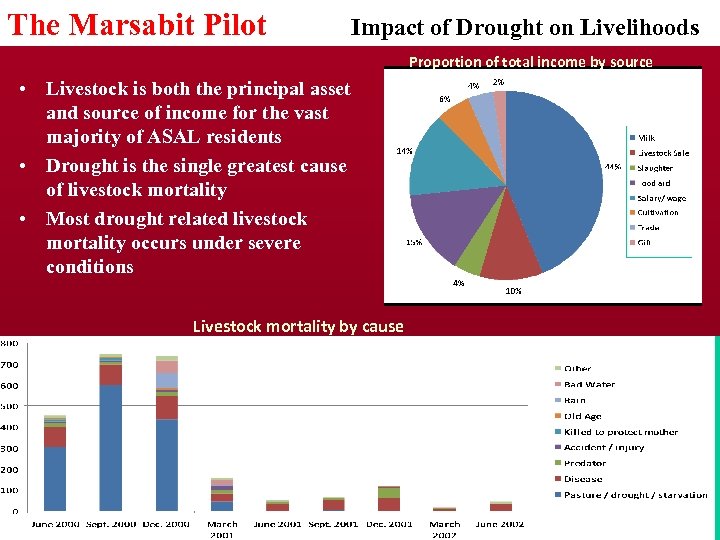 The Marsabit Pilot Impact of Drought on Livelihoods Proportion of total income by source • Livestock is both the principal asset and source of income for the vast majority of ASAL residents • Drought is the single greatest cause of livestock mortality • Most drought related livestock mortality occurs under severe conditions Livestock mortality by cause
 Insurance, DRR and Development • • Such risk imposes considerable economic and welfare costs Sustainable insurance can prevent this by: – Stabilizing expectations & crowding-in investment and accumulation by poor populations – Preventing downward slide of vulnerable populations – Inducing financial deepening by crowding-in credit supply and demand • • But can insurance be sustainably offered in the ASAL? Conventional (individual) insurance unlikely to work, especially in small scale agro-pastoral sector: – Transactions costs – Moral hazard/adverse selection
 Index Based Insurance • • New innovation in insurance avoids problems that make traditional insurance unprofitable for small, remote clients: Policy holders paid based on external “index” that triggers payments to all insured clients • Suited for risks affecting a large number of people simultaneously and for which a suitable index exists. – No transactions costs of measuring individual losses – Preserves effort incentives (no moral hazard) as no single individual can influence index. – Adverse selection does not matter as payouts do not depend on the riskiness of those who buy the insurance – Problem of “basis” risk
 Index Insurance: Challenges ‘Big 5’ Challenges of Sustainable Index Insurance: 1. High quality data (reliable, timely, non-manipulable, long-term) to calculate premium and to determine payouts 2. Minimize uncovered basis risk through product design 3. Innovation incentives for insurance companies to design and market a new product 4. Establish informed effective demand, especially among a clientele with little experience with any insurance, much less a complex index insurance product 5. Low cost mechanism for making insurance available for numerous small and medium scale producers
 Solutions to the “Big 5” Challenges 1. High quality data • Satellite data (remotely sensed vegetation: NDVI) • Long term series of livestock mortality data (ALRMP) 2. Minimize uncovered basis risk • Analysis of household panel data on herd loss (PARIMA + Project) 3. Innovation incentives for insurers • Researchers do product design work, develop awareness materials, help facilitate reinsurance 4. Establish informed effective demand • Simulation games with real information & incentives • WTP 5. Low cost mechanism • Delivery through partners
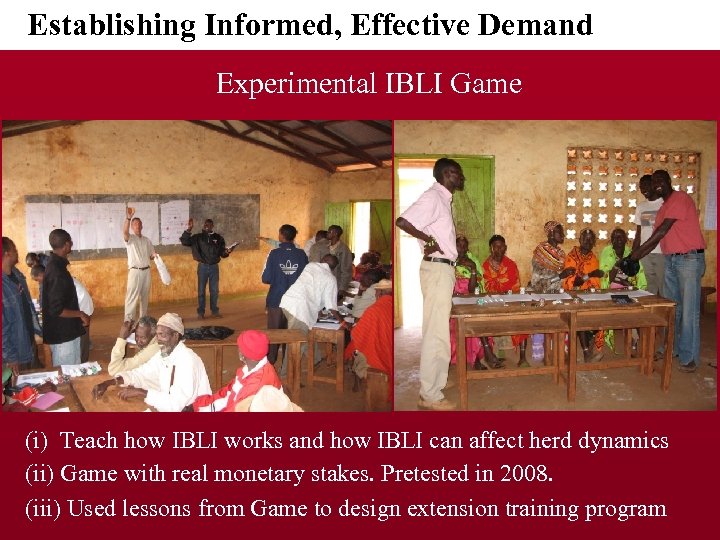 Establishing Informed, Effective Demand Experimental IBLI Game (i) Teach how IBLI works and how IBLI can affect herd dynamics (ii) Game with real monetary stakes. Pretested in 2008. (iii) Used lessons from Game to design extension training program
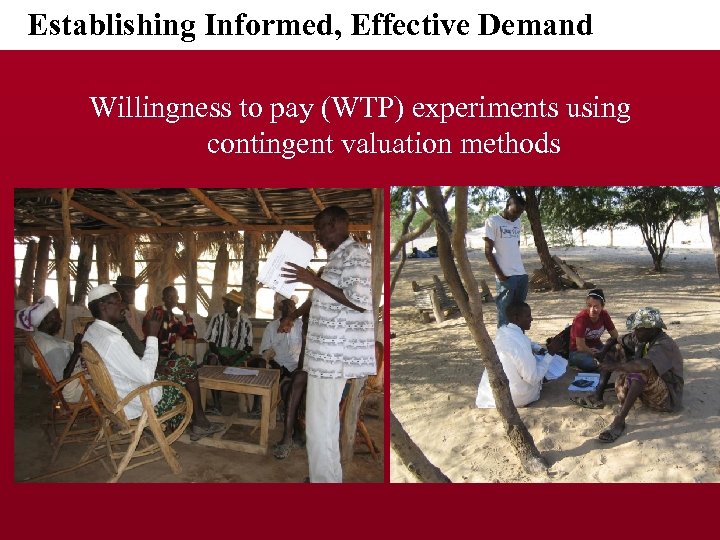 Establishing Informed, Effective Demand Willingness to pay (WTP) experiments using contingent valuation methods
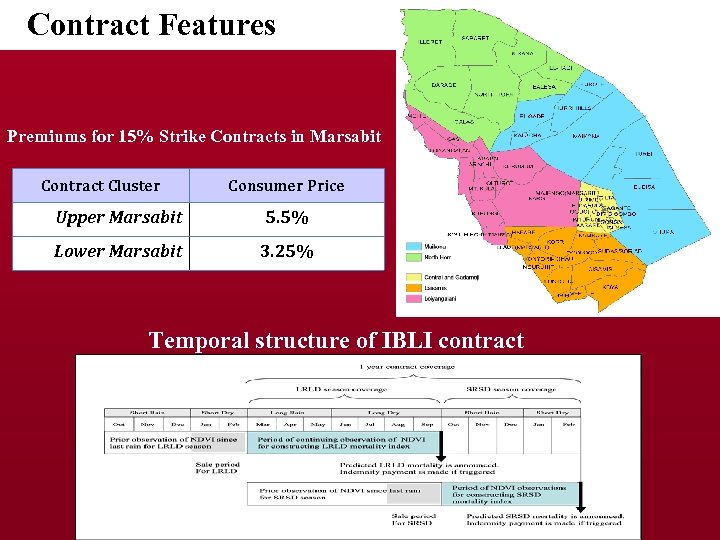 Contract Features Premiums for 15% Strike Contracts in Marsabit Contract Cluster Consumer Price Upper Marsabit 5. 5% Lower Marsabit 3. 25% Temporal structure of IBLI contract
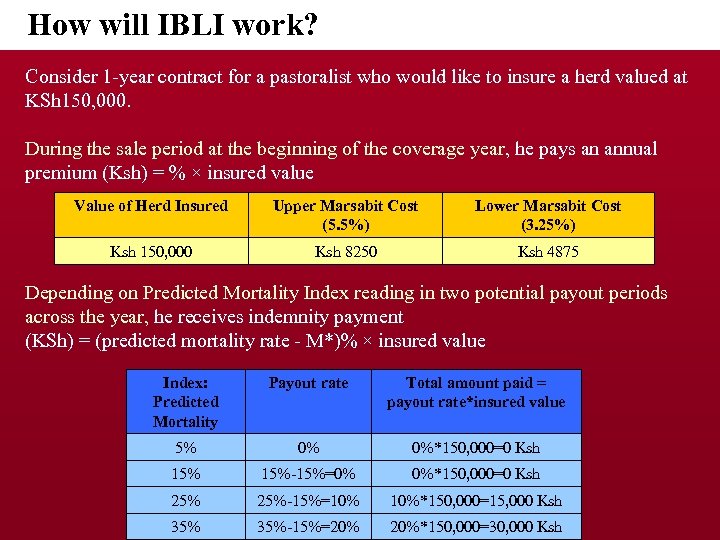 How will IBLI work? Consider 1 -year contract for a pastoralist who would like to insure a herd valued at KSh 150, 000. During the sale period at the beginning of the coverage year, he pays an annual premium (Ksh) = % × insured value Value of Herd Insured Upper Marsabit Cost (5. 5%) Lower Marsabit Cost (3. 25%) Ksh 150, 000 Ksh 8250 Ksh 4875 Depending on Predicted Mortality Index reading in two potential payout periods across the year, he receives indemnity payment (KSh) = (predicted mortality rate - M*)% × insured value Index: Predicted Mortality Payout rate Total amount paid = payout rate*insured value 5% 0% 0%*150, 000=0 Ksh 15%-15%=0% 0%*150, 000=0 Ksh 25%-15%=10% 10%*150, 000=15, 000 Ksh 35%-15%=20% 20%*150, 000=30, 000 Ksh
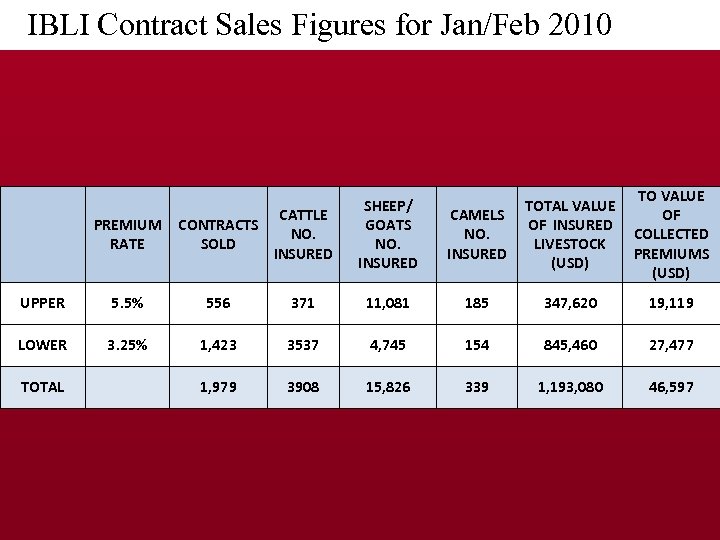 IBLI Contract Sales Figures for Jan/Feb 2010 CAMELS NO. INSURED TOTAL VALUE OF INSURED LIVESTOCK (USD) TO VALUE OF COLLECTED PREMIUMS (USD) PREMIUM RATE CONTRACTS SOLD CATTLE NO. INSURED SHEEP/ GOATS NO. INSURED UPPER 5. 5% 556 371 11, 081 185 347, 620 19, 119 LOWER 3. 25% 1, 423 3537 4, 745 154 845, 460 27, 477 1, 979 3908 15, 826 339 1, 193, 080 46, 597 TOTAL
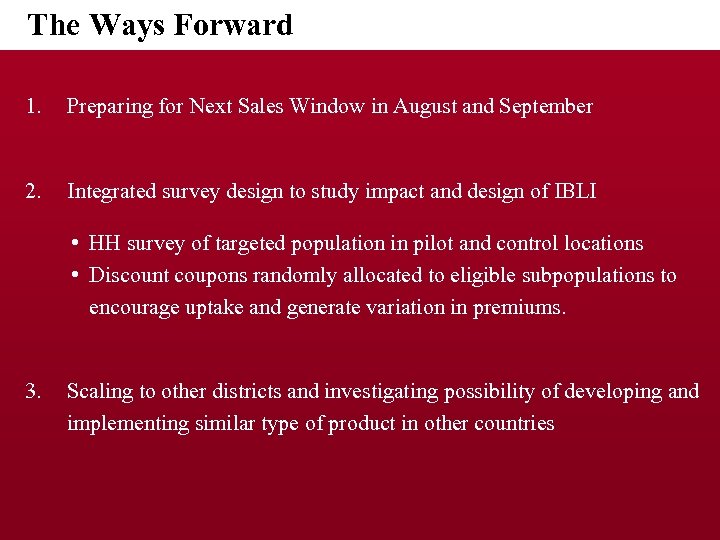 The Ways Forward 1. Preparing for Next Sales Window in August and September 2. Integrated survey design to study impact and design of IBLI • HH survey of targeted population in pilot and control locations • Discount coupons randomly allocated to eligible subpopulations to encourage uptake and generate variation in premiums. 3. Scaling to other districts and investigating possibility of developing and implementing similar type of product in other countries
 Thank you For more information please visit: www. ilri. org/ibli/
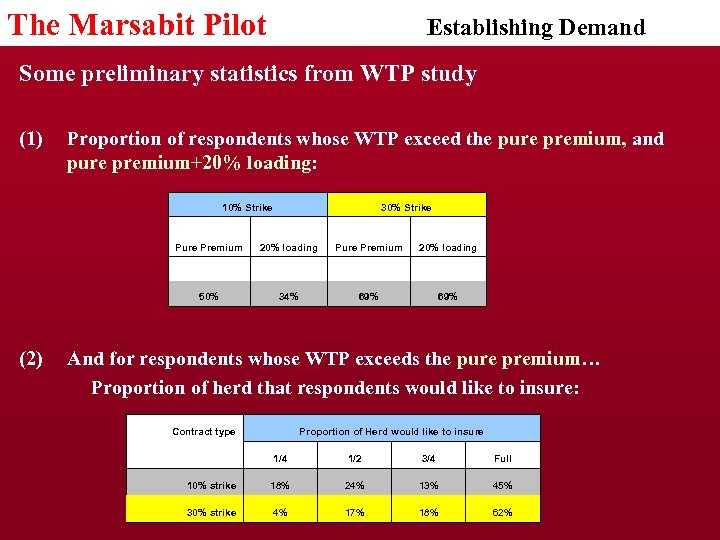 The Marsabit Pilot Establishing Demand Some preliminary statistics from WTP study (1) Proportion of respondents whose WTP exceed the pure premium, and pure premium+20% loading: 10% Strike 30% Strike Pure Premium 20% loading 50% (2) 34% 69% And for respondents whose WTP exceeds the pure premium… Proportion of herd that respondents would like to insure: Contract type Proportion of Herd would like to insure 1/4 1/2 3/4 Full 10% strike 18% 24% 13% 45% 30% strike 4% 17% 18% 62%
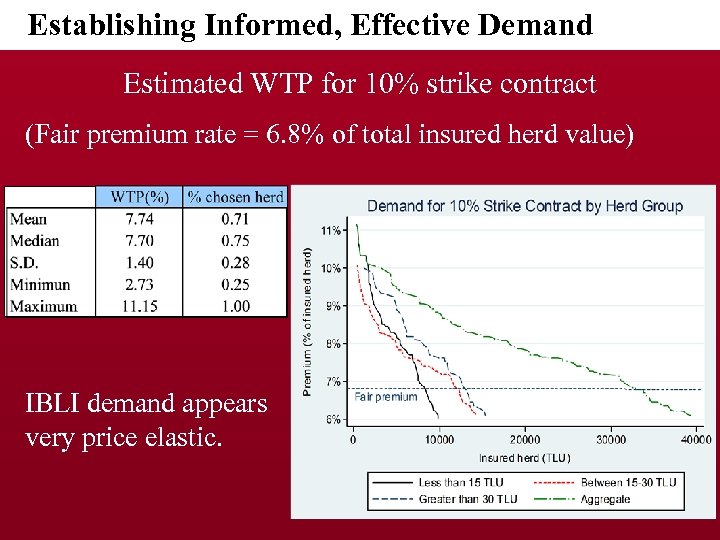 Establishing Informed, Effective Demand Estimated WTP for 10% strike contract (Fair premium rate = 6. 8% of total insured herd value) IBLI demand appears very price elastic.
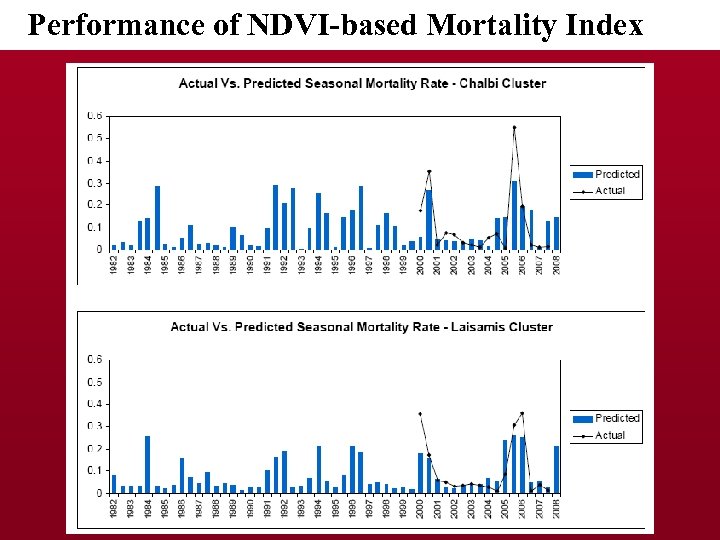 Performance of NDVI-based Mortality Index
 Piloting Index Based Livestock Insurance in Northern Kenya • Why Northern Kenya? – Meets more of the preconditions for a successful pilot – we should start with safest bet. • Pastoral production is a key livelihood facing a risk profile suitable for targeting with an index insurance product • Data availability affords precise contract design • Rich understanding of pastoral economy, seasonal herd dynamics of populations in Marsabit • Strong delivery partners and relationship with other key stakeholders on the ground
 The Marsabit Pilot • Why Marsabit? • Pastoral production is a key livelihood facing a risk profile suitable for targeting with an index insurance product • Data availability affords precise contract design • Rich understanding of pastoral economy, seasonal herd dynamics of populations in Marsabit • Strong delivery partners and relationship with other key stakeholders on the ground