 Скачать презентацию PROTECTING MEDITERRANEAN CULTURAL HERITAGE DURING DISASTERS PROMEDHE Brussels
a08021c6e38b712be19958fc0b8377a2.ppt
- Количество слайдов: 10



PROTECTING MEDITERRANEAN CULTURAL HERITAGE DURING DISASTERS (PROMEDHE) Brussels 20 January 2016
PROMEDHE Project in a nushell Leader: Italian Civil Protection Department (DPC) Partners: Four Mediterranean national Civil Protection authorities • Cyprus Civil Defence (CCD) • National Emergency Management Agency Of Israel (NEMA) • Palestinan Civil Defence (PCD) • Jordan Civil Defence (JCD) One research institute: Centro Studi Villa Montesca Total project cost: 1. 066. 472 EUR EC financial contribution : 799. 584 EUR ( = 75 % of total costs) Project Duration: 24 months - from 1 st January 2016 to 31 st December 2017
Project Context The Mediterranean: a vulnerable region (urbanization, high population density in coastal areas, earthquakes, climate change, droughts, flooding, storms …) with an high presence of cultural heritage (CH) and tourism. Cyprus, Israel, Italy, Jordan, Palestine are very rich in CH, however limited arrangements are in place for safeguarding archaeological and architectural sites and museums in case of natural disasters, including preparedness measures for mass evacuation. The five participating CP Authorities decided to join efforts • to strengthen disaster preparedness capacities for responding to natural and man-made disasters and • to implement common tools and methods to safeguard CH on the basis of existing lessons learned and good practice at regional, European and international levels. Italy already started to develop and test preparedness measures on safeguarding and protecting movable and immovable CH in danger. Since 2005, the Italian CP, as member of the EU CP Mechanism, introduced the safeguarding of CH in the scenario of EU funded field exercises.
PROMEDHE Specific Objectives • Better prepared Civil Protection Authorities in the region, able to operate jointly at national, cross-border and international levels and to partner with the Union Civil Protection Mechanism; • Increased co-operation and shared experience and lessons learned among the beneficiaries in the field of disaster management; • Shared background for need and capacity assessment for the safeguard of cultural heritage; • Set up a pool of experts able to operate in the aftermath of a disaster for assessment and safeguard of cultural heritage; • Elaborated Standard Operating Procedures (SOPs) for the safeguard of cultural heritage at national and regional levels based on national, European and international standards; • Elaborated recommendations for developing assets in the beneficiaries able to operate at national, cross-border and international level
Main areas of intervention 1. RESEARCH AND STUDY: a baseline analysis including lessons learned and good practices on the safeguard of cultural heritage in case of disaster and national stakeholder mapping 2. TECHNICAL ASSISTANCE: 2 capacity-development programmes, based on EU Mechanism courses, covering international cooperation, assessment methodologies and techniques for the safeguard of cultural heritage; 3. MODULES DEVELOPMENT: Asset/team concept and SOPs development at both national and regional levels - based on the Union Civil Protection Mechanism regulatory framework for CP assets - for safeguard of cultural heritage (including basic requirement and procedures for activation, deployment, operations and hand-over). 4. EXERCISE: Simulation exercises to train the experts and testing SOPs also at the regional and international dimensions - through the activation of the Union Civil Protection Mechanism.
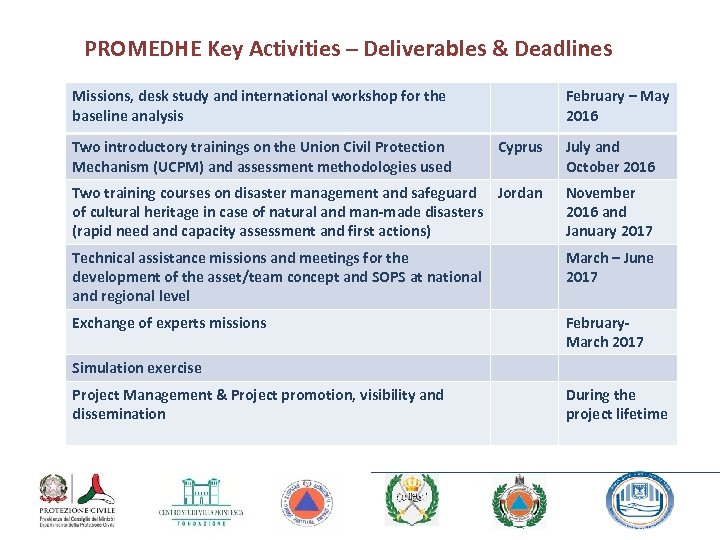
PROMEDHE Key Activities – Deliverables & Deadlines Missions, desk study and international workshop for the baseline analysis Two introductory trainings on the Union Civil Protection Mechanism (UCPM) and assessment methodologies used February – May 2016 Cyprus July and October 2016 Two training courses on disaster management and safeguard Jordan of cultural heritage in case of natural and man-made disasters (rapid need and capacity assessment and first actions) November 2016 and January 2017 Technical assistance missions and meetings for the development of the asset/team concept and SOPS at national and regional level March – June 2017 Exchange of experts missions February. March 2017 Simulation exercise Project Management & Project promotion, visibility and dissemination During the project lifetime
Programme Communication & Visibility All the Project activities will be disseminated among the largest relevant public, civil protection authorities and in coordination with all Consortium partners. It will be done through the following actions: 1. development of programme communication & visibility material 2. set-up/launch of programme website 3. development of programme logo 4. design and diffusion of the project brochure and visibility material 5. promotion of a cultural heritage network 6. publications and press releases 7. Periodical publication of a e-journal 7
FOLLOW UP 1. The developed course curriculum, the materials related to asset/team concept and SOPs, the approach and scenario of the exercise could be used in the framework of further training courses, also of national training courses for civil protection professionals and other experts involved in response operations 2. The developed methodology could be adopted for preparing assets/teams and SOPs in other fields of intervention 3. The pool of experts set up within the PROMEDHE project and the trained experts will be able to design and implement other joint initiatives 4. The five disaster management/civil protection authorities will exert efforts to integrate results into the bilateral relations which will guarantee the continuity of the actions 5. The web-site and the on line tools will be kept online after the formal end of the project 8
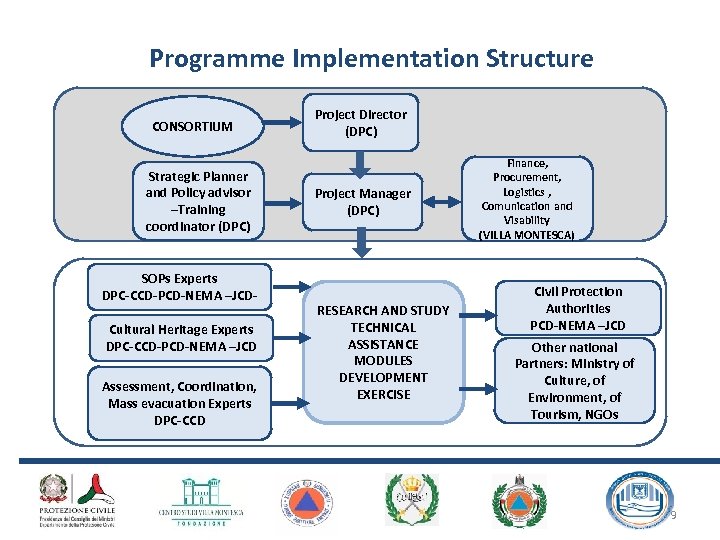
Programme Implementation Structure CONSORTIUM Strategic Planner and Policy advisor –Training coordinator (DPC) SOPs Experts DPC-CCD-PCD-NEMA –JCDCultural Heritage Experts DPC-CCD-PCD-NEMA –JCD Assessment, Coordination, Mass evacuation Experts DPC-CCD Project Director (DPC) Project Manager (DPC) RESEARCH AND STUDY TECHNICAL ASSISTANCE MODULES DEVELOPMENT EXERCISE Finance, Procurement, Logistics , Comunication and Visability (VILLA MONTESCA) Civil Protection Authorities PCD-NEMA –JCD Other national Partners: Ministry of Culture, of Environment, of Tourism, NGOs 9
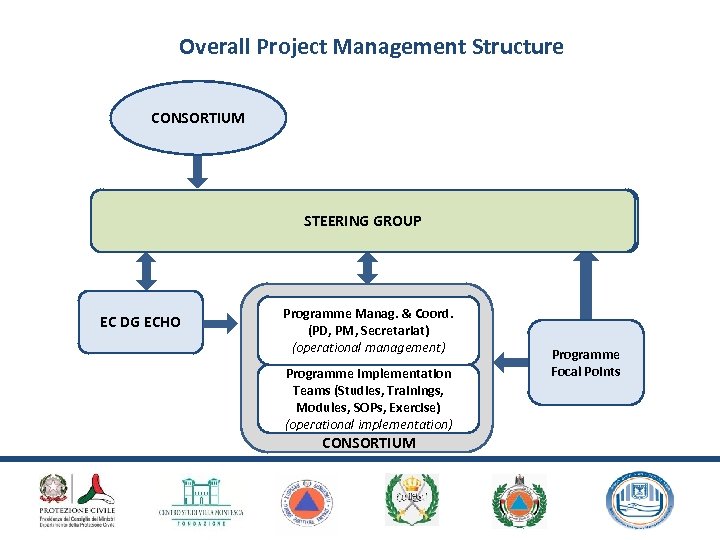
Overall Project Management Structure CONSORTIUM STEERING GROUP EC DG ECHO Programme Manag. & Coord. (PD, PM, Secretariat) (operational management) Programme Implementation Teams (Studies, Trainings, Modules, SOPs, Exercise) (operational implementation) CONSORTIUM Programme Focal Points
Скачать презентацию PROTECTING MEDITERRANEAN CULTURAL HERITAGE DURING DISASTERS PROMEDHE Brussels
a08021c6e38b712be19958fc0b8377a2.ppt