 Скачать презентацию Prostate Cancer Robert R Zaid D O Family
3f47a7acc7598336ae6d8ca1c30d3db4.ppt
- Количество слайдов: 42



Prostate Cancer Robert R. Zaid D. O Family Medicine 6/23/2010

Practice Management Moment • How can you expand your practice using social history?
Prostate Cancer Definition • Relevance – Most common noncutaneous malignancy in men • Incidence – Nearly 200, 000 new cases per year in U. S. • Mortality – 32, 000 deaths in the United States each year – Second most common cause of cancer death in men 2 • Morbidity – Single histologic disease – Ranges • From indolent, clinically irrelevant • To virulent, rapidly lethal phenotype. Small, E. , Cecil Textbook of Medicine, Prostate Cancer, 2004, WB Saunders, an Elsevier imprint Theodorescu, D. , Prostate Cancer: Management of Localized Disease, www. emedicine. com, 20042
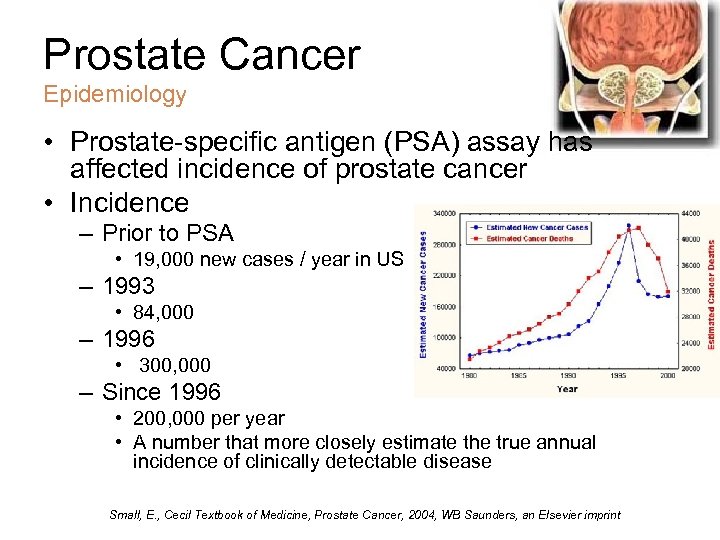
Prostate Cancer Epidemiology • Prostate-specific antigen (PSA) assay has affected incidence of prostate cancer • Incidence – Prior to PSA • 19, 000 new cases / year in US – 1993 • 84, 000 – 1996 • 300, 000 – Since 1996 • 200, 000 per year • A number that more closely estimate the true annual incidence of clinically detectable disease Small, E. , Cecil Textbook of Medicine, Prostate Cancer, 2004, WB Saunders, an Elsevier imprint

Prostate Cancer Epidemiology • Death rate – Declined by about 1% per year since 1990 – Greatest decrease in men younger than age 75 years – Men older than 75 years still account for two thirds of all prostate cancer deaths – Due to • Early detection (screening) • or to improved therapy? Small, E. , Cecil Textbook of Medicine, Prostate Cancer, 2004, WB Saunders, an Elsevier imprint
Prostate Cancer Epidemiology • Risk factors – – • Nutritional factors have protective effect against prostate cancer – – – • Increasing age Family history African-American Dietary factors. Reduced fat intake Soy protein Lycopene Vitamin E Selenium Race – Incidence doubled in African Americans compared to white Americans. • Genetics – Common among relatives with early-onset prostate cancer – Susceptibility locus (early onset prostate cancer) • Chromosome 1, band Q 24 – An abnormality at this locus occurs in less than 10% of prostate cancer patients. Small, E. , Cecil Textbook of Medicine, Prostate Cancer, 2004, WB Saunders, an Elsevier imprint
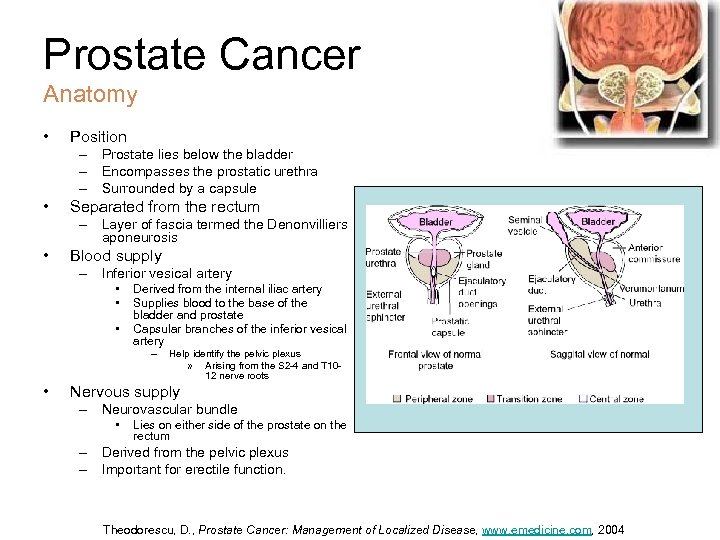
Prostate Cancer Anatomy • Position – Prostate lies below the bladder – Encompasses the prostatic urethra – Surrounded by a capsule • Separated from the rectum – Layer of fascia termed the Denonvilliers aponeurosis • Blood supply – Inferior vesical artery • • • Derived from the internal iliac artery Supplies blood to the base of the bladder and prostate Capsular branches of the inferior vesical artery – • Help identify the pelvic plexus » Arising from the S 2 -4 and T 1012 nerve roots Nervous supply – Neurovascular bundle • Lies on either side of the prostate on the rectum – Derived from the pelvic plexus – Important for erectile function. Theodorescu, D. , Prostate Cancer: Management of Localized Disease, www. emedicine. com, 2004
Prostate Cancer Pathophysiology • Adenocarcinoma – 95% of prostate cancers • Developing in the acini of prostatic ducts • Rare histopathologic types of prostate carcinoma – Occur in approximately 5% of patients – Include • • • Small cell carcinoma Mucinous carcinoma Endometrioid cancer (prostatic ductal carcinoma) Transitional cell cancer Squamous cell carcinoma Basal cell carcinoma Adenoid cystic carcinoma (basaloid) Signet-ring cell carcinoma Neuroendocrine cancer Theodorescu, D. , Prostate Cancer: Management of Localized Disease, www. emedicine. com, 2004
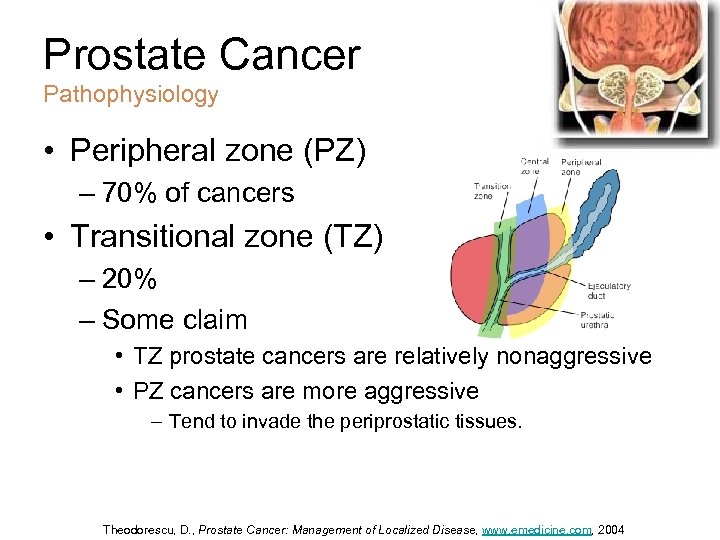
Prostate Cancer Pathophysiology • Peripheral zone (PZ) – 70% of cancers • Transitional zone (TZ) – 20% – Some claim • TZ prostate cancers are relatively nonaggressive • PZ cancers are more aggressive – Tend to invade the periprostatic tissues. Theodorescu, D. , Prostate Cancer: Management of Localized Disease, www. emedicine. com, 2004
Prostate Cancer Clinical Manifestations • Early state (organ confined) – Asymptomatic • Locally advanced – Obstructive voiding symptoms • Hesitancy • Intermittent urinary stream • Decreased force of stream – May have growth into the urethra or bladder neck – Hematuria – Hematospermia • Advanced (spread to the regional pelvic lymph nodes) – Edema of the lower extremities – Pelvic and perineal discomfort Small, E. , Cecil Textbook of Medicine, Prostate Cancer, 2004, WB Saunders, an Elsevier imprint
Prostate Cancer Clinical Manifestations • Metastasis – Most commonly to bone (frequently asymptomatic) • Can cause severe and unremitting pain – Bone metastasis • Can result in pathologic fractures or • Spinal cord compression – Visceral metastases (rare) – Can develop pulmonary, hepatic, pleural, peritoneal, and central nervous system metastases late in the natural history or after hormonal therapies fail. Small, E. , Cecil Textbook of Medicine, Prostate Cancer, 2004, WB Saunders, an Elsevier imprint
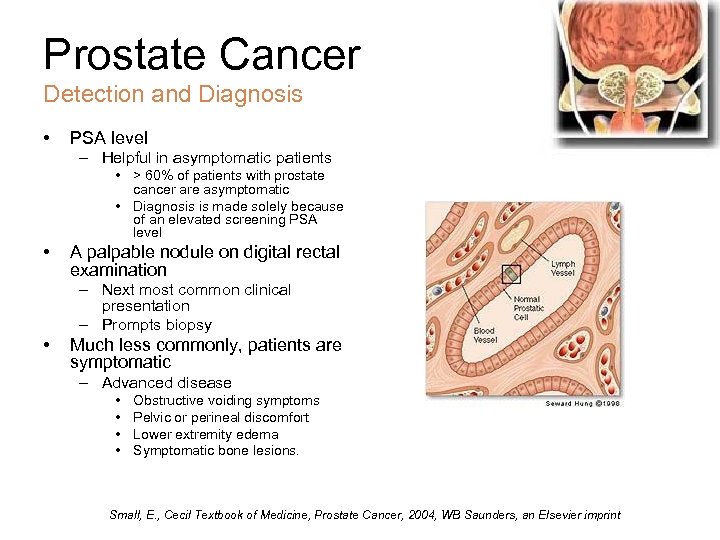
Prostate Cancer Detection and Diagnosis • PSA level – Helpful in asymptomatic patients • > 60% of patients with prostate cancer are asymptomatic • Diagnosis is made solely because of an elevated screening PSA level • A palpable nodule on digital rectal examination – Next most common clinical presentation – Prompts biopsy • Much less commonly, patients are symptomatic – Advanced disease • • Obstructive voiding symptoms Pelvic or perineal discomfort Lower extremity edema Symptomatic bone lesions. Small, E. , Cecil Textbook of Medicine, Prostate Cancer, 2004, WB Saunders, an Elsevier imprint
Prostate Cancer Detection and Diagnosis • Digital rectal examination – Low sensitivity and specificity for diagnosis – Biopsy of a nodule or area of induration • Reveals cancer 50% of the time • Suggests – Prostate biopsy » Should be undertaken in all men with palpable nodules. Small, E. , Cecil Textbook of Medicine, Prostate Cancer, 2004, WB Saunders, an Elsevier imprint
Prostate Cancer Treatment • PSA screening – Early detection • Large number of nonpalpable tumors – Often clinical means of staging are inadequate • Emphasis is being placed on PSA and other predictors of outcome – Careful risk assessment is required to identify patients who are appropriate candidates for definitive local treatment Small, E. , Cecil Textbook of Medicine, Prostate Cancer, 2004, WB Saunders, an Elsevier imprint
Prostate Cancer Detection and Diagnosis • The PSA level – Better sensitivity but a low specificity • Benign prostatic hypertrophy and prostatitis – Cause false-positive PSA elevations – Threshold • Using a PSA threshold of 4 ng/m. L – 70 to 80% of tumors are detected – Cancer rates range from 4 to 9% • Positive predictive value for a single PSA level greater than 10 ng/m. L – > 60% for cancer, • Positive predictive value for a PSA level between 4 and 10 ng/m. L – Only about 30%. Small, E. , Cecil Textbook of Medicine, Prostate Cancer, 2004, WB Saunders, an Elsevier imprint
Prostate Cancer Detection and Diagnosis • PSA Velocity – Better measure of high risk patients – A rate > 0. 75/year increase warrants biopsy American College of Surgeons
Prostate Cancer Recommendations • PSA screening w/ DRE – Yearly after age 50 w/ 10 year life expectancy – May start at 45 w/ close relative w/ prostate cancer <65 – May start at 40 for multiple close relatives w/ prostate cancer <65 – USPSTF, AAFP, ACS? Small, E. , Cecil Textbook of Medicine, Prostate Cancer, 2004, WB Saunders, an Elsevier imprint
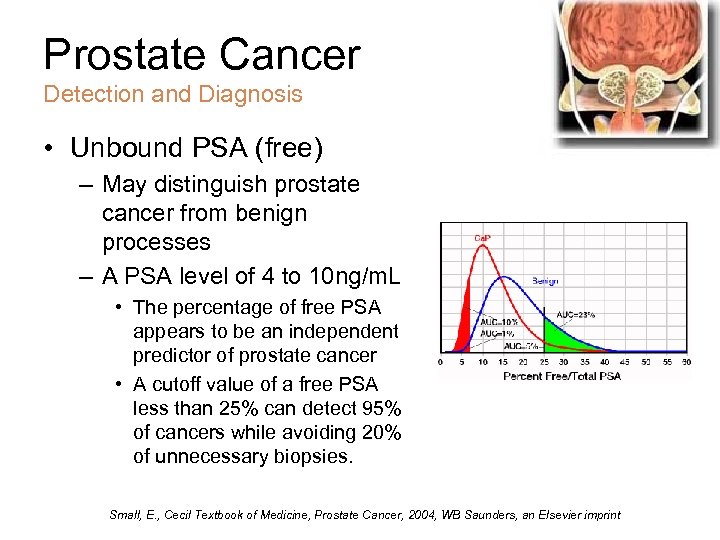
Prostate Cancer Detection and Diagnosis • Unbound PSA (free) – May distinguish prostate cancer from benign processes – A PSA level of 4 to 10 ng/m. L • The percentage of free PSA appears to be an independent predictor of prostate cancer • A cutoff value of a free PSA less than 25% can detect 95% of cancers while avoiding 20% of unnecessary biopsies. Small, E. , Cecil Textbook of Medicine, Prostate Cancer, 2004, WB Saunders, an Elsevier imprint
Prostate Cancer Detection and Diagnosis • Transrectal ultrasound with biopsies – Indicated when • The PSA level is elevated • The percent-free PSA is less than 25%, or • An abnormality is noted on digital rectal examination – Type of biopsy • Sextant biopsies (base, midgland, and apex on each side) – Generally obtained • Seminal vesicles are biopsied in high-risk patients Small, E. , Cecil Textbook of Medicine, Prostate Cancer, 2004, WB Saunders, an Elsevier imprint
Prostate Cancer Detection and Diagnosis • A bone scan – Warranted only • PSA level greater than 10 ng/m. L • Computed Tomography or magnetic resonance imaging – Abdominal and pelvic CT or MRI is usually unrevealing in patients with a PSA level less than 20 ng/m. L. . Small, E. , Cecil Textbook of Medicine, Prostate Cancer, 2004, WB Saunders, an Elsevier imprint
Prostate Cancer Prognosis • • Prognosis correlates with histologic grade and extent (stage) of disease Adenocarcinoma – > 95% of prostate cancers – Multifocality is common • Grading – Ranges from 1 to 5 • Gleason score – Definition • Sum of the two most common histologic patterns seen on each tissue specimen – Ranges • From 2 (1 + 1) • To 10 (5 + 5) – Category • Well-differentiated (Gleason scores 2, 3, or 4) • Intermediate differentiation (Gleason scores 5, 6, or 7) • Poorly differentiated (Gleason scores 8, 9, or 10). Small, E. , Cecil Textbook of Medicine, Prostate Cancer, 2004, WB Saunders, an Elsevier imprint
Prostate Cancer Prognosis • Staging – Definition • Extent of disease determined by – Physical examination – Imaging studies – Pathology Small, E. , Cecil Textbook of Medicine, Prostate Cancer, 2004, WB Saunders, an Elsevier imprint
Prostate Cancer Staging • • Stage T 1 – – • Incidentally noted after – – • Distant metastases – – Predominantly to bone Occasional visceral metastases occur. Palpable tumor Appears to be confined to the prostatic gland (T 2 a if one lobe, T 2 b if two lobes) Stage T 3 – • • Can be microscopic and can be detected only by biopsy or lymphadenectomy, or they can be visible on imaging studies Stage T 2 – – • Transurethral resection for benign hypertrophy (T 1 a and T 1 b) or On biopsy obtained because of an elevated PSA (T 1 c-the most common clinical stage at diagnosis) Nodal metastases – Nonpalpable prostate cancer Detected only on pathologic examination Tumor with extension through the prostatic capsule (T 2 a if focal, T 2 b if seminal vesicles are involved) Stage T 4 – Invasion of adjacent structures • • • Bladder neck External urinary sphincter The rectum The levator muscles The pelvic sidewal Small, E. , Cecil Textbook of Medicine, Prostate Cancer, 2004, WB Saunders, an Elsevier imprint
Prostate Cancer Treatment • PRINCIPLES OF THERAPY – May include • • Watchful waiting Androgen deprivation External beam radiotherapy Retropubic or perineal radical prostatectomy – with or without postoperative radiotherapy to the prostate margins and pelvis • Brachytherapy (either permanent or temporary radioactive seed implants) – with or without external beam radiotherapy to the prostate margins and pelvis. Small, E. , Cecil Textbook of Medicine, Prostate Cancer, 2004, WB Saunders, an Elsevier imprint
Prostate Cancer Treatment • Require individualization – Must take into account • • Patient's comorbidity Life expectancy Likelihood of cure Personal preferences – Based on an understanding of potential morbidity associated with each treatment • A multidisciplinary approach (recommended) – Integrate » Surgery » Radiation therapy » Androgen deprivation » Behavioral therapy Small, E. , Cecil Textbook of Medicine, Prostate Cancer, 2004, WB Saunders, an Elsevier imprint
Prostate Cancer Treatment • Surgery – Traditional – Robotic • Radiation – Brachytherapy – External beam • Cryotherapy • Androgen Deprivation • Watchful waiting Small, E. , Cecil Textbook of Medicine, Prostate Cancer, 2004, WB Saunders, an Elsevier imprint
Prostate Cancer Treatment - LOW/INTERMEDIATE RISK DISEASE • LOW/INTERMEDIATE RISK DISEASE • Randomized trial – Under the age of 75 – Clinical stage T 1 b, T 1 c, or T 2 prostate cancer – Radical prostatectomy • Reduced the relative risk of death by 50% (a 2% absolute risk reduction) • Compared with watchful waiting • Despite a significant reduction in the risk of metastasis, overall mortality was unchanged • Adverse effects on quality of life – More dysfunction and urinary leakage after radical prostatectomy – More urinary obstruction with watchful waiting – Nerve-sparing radical prostatectomy was not routinely performed in this study – Less advanced disease with newer surgical techniques are not known Small, E. , Cecil Textbook of Medicine, Prostate Cancer, 2004, WB Saunders, an Elsevier imprint
Prostate Cancer Treatment - LOW/INTERMEDIATE RISK DISEASE • Nonrandomized data – Suggest that watchful waiting may be judiciously used • Gleason score 2, 3, or 4 tumors with life expectancy of 10 years or less • Watchful waiting is probably not appropriate for young, otherwise healthy men with high-risk features as described earlier (PSA > 10, Gleason sum = 7, or clinical stage T 3 or higher). Small, E. , Cecil Textbook of Medicine, Prostate Cancer, 2004, WB Saunders, an Elsevier imprint
Prostate Cancer Treatment - LOW/INTERMEDIATE RISK DISEASE • Androgen deprivation has not been carefully studied as primary therapy for localized disease – More common approach in some men – To receive some therapy when not suited for or decline prostatectomy or radiation therapy. • Surgery or radiation – – Men with T 1 or T 2 prostate cancer Life expectancy of more than 10 years No significant comorbid illnesses Long-term survival is excellent Small, E. , Cecil Textbook of Medicine, Prostate Cancer, 2004, WB Saunders, an Elsevier imprint
Prostate Cancer Treatment - LOW/INTERMEDIATE RISK DISEASE • T 1 or T 2 tumors – Gleason scores of 7 or less • Have 8 -year survival rates of 85 to 95%. – Gleason scores of 8 to 10 • Have 8 -year survival rates of about 70%. Small, E. , Cecil Textbook of Medicine, Prostate Cancer, 2004, WB Saunders, an Elsevier imprint
Prostate Cancer Treatment - LOW/INTERMEDIATE RISK DISEASE • Nerve-sparing procedures and careful dissection techniques – Decreased postoperative complications • Urinary incontinence (<10%) • Impotence (10 -50%) • Following a radical prostatectomy – PSA should become undetectable – Detectable PSA implies • Presence of cancer cells • Locally or at a metastatic site – Adjuvant postoperative radiotherapy is of unproven benefit unless the PSA remains or becomes detectable. Small, E. , Cecil Textbook of Medicine, Prostate Cancer, 2004, WB Saunders, an Elsevier imprint
Prostate Cancer Treatment - LOW/INTERMEDIATE RISK DISEASE • External beam radiation therapy (EBRT) • Three-dimensional conformal radiation therapy (3 D-CRT) (replacing EBRT) – Higher doses to the target tissue – Less toxicity – Randomized trials are required to assess any clinical benefits • Complications of external radiotherapy – – – Cystitis Proctitis Enteritis Impotence Urinary retention Incontinence (7 -10%) Small, E. , Cecil Textbook of Medicine, Prostate Cancer, 2004, WB Saunders, an Elsevier imprint
Prostate Cancer Treatment - LOW/INTERMEDIATE RISK DISEASE • Brachytherapy – Placement of permanent or temporary radioactive seeds directly into the prostate • Adequate for – Intracapsular disease – No more than minimal transcapsular extension – It can be combined with external beam radiation therapy. Small, E. , Cecil Textbook of Medicine, Prostate Cancer, 2004, WB Saunders, an Elsevier imprint
Prostate Cancer Treatment – High-risk disease • HIGH-RISK DISEASE. – Patients with adverse risk features – (Gleason score 8 to 10, PSA > 10, stage T 3) • Treated with – Aggressive local therapy or – Androgen deprivation • Synergistic with radiation therapy – Trials • 4 months of androgen deprivation with radiation therapy – Improve local control and prolong progression-free survival in patients with intermediate risk features – Long-term androgen deprivation (up to 3 years) » Prolongs local control » Prolongs progression-free survival and overall survival in patients with high-risk features compared with radiation therapy. Small, E. , Cecil Textbook of Medicine, Prostate Cancer, 2004, WB Saunders, an Elsevier imprint
Prostate Cancer Treatment – Recurrent disease • RECURRENT DISEASE – ~50% of men treated with radiation therapy or prostatectomy develop evidence of recurrence – Defined by a climbing PSA level • Local salvage therapy – Selected patients with clear local recurrences • Surgery for patients previously treated with radiation • Radiation for patients previously treated with surgery androgen deprivation • Early hormone therapy – Appears to be better than hormonal salvage therapy in terms of survival. Small, E. , Cecil Textbook of Medicine, Prostate Cancer, 2004, WB Saunders, an Elsevier imprint
Prostate Cancer Treatment – Advanced disease • ADVANCED DISEASE • Microscopic involvement of lymph nodes – Revealed by radical prostatectomy – Immediate androgen deprivation prolongs survival • Should not wait until osseous metastases are detected – Patients at high risk of nodal invasion and who undergo external beam radiation • Benefit from concurrent short-term hormonal therapy. • Newly diagnosed metastatic prostate cancer – Androgen deprivation is the mainstay of treatment • Results in symptomatic improvement and disease regression in approximately 80 to 90% of patients • Androgen deprivation can be achieved by orchiectomy or by medical castration • Luteinizing hormone-releasing hormone (LHRH) agonist (leuprolide acetate, goserelin acetate) – Safer and as effective as estrogen treatment. Small, E. , Cecil Textbook of Medicine, Prostate Cancer, 2004, WB Saunders, an Elsevier imprint
Prostate Cancer Treatment – Advanced disease • Side effects of LHRH agonist – LH and testosterone surge within 72 hours • Transient worsening of signs and symptoms during the first week of therapy – An antiandrogen (flutamide, bicalutamide, or nilutamide) should be given with the first LHRH injection to prevent a tumor flare • Medical castration occurs within 4 weeks • Hormone sensitivity – Duration » 5 to 10 years for node-positive or high-risk localized (or recurrent) prostate cancer » 18 to 24 months in patients with overt metastatic disease – Side effects androgen ablation • • Loss of libido Impotence Hot flashes Weight gain Fatigue Anemia Osteoporosis – Bisphonates reduce bone mineral loss associated with androgen deprivation. Small, E. , Cecil Textbook of Medicine, Prostate Cancer, 2004, WB Saunders, an Elsevier imprint
Prostate Cancer Treatment – Hormone resistant • • HORMONE-RESISTANT PROSTATE CANCER Climbing PSA – First manifestation of resistance to androgen deprivation • In the setting of anorchid levels of testosterone • Therapy – Discontinuation of antiandrogen therapy (flutamide, bicalutamide, nilutamide) while continuing with LHRH agonists • Results in a PSA decline • Can be associated with symptomatic improvement • Can persist for 4 to 24 months or more – Secondary hormonal manipulations • Ketoconazole or • Estrogens – Chemotherapeutic regimens • Mitoxantrone plus corticosteroids or • Estramustine plus a taxane • Monitoring – Serial PSA levels (best) – A decline of 50% or more is probably clinically significant Small, E. , Cecil Textbook of Medicine, Prostate Cancer, 2004, WB Saunders, an Elsevier imprint
Prostate Cancer Treatment – Hormone resistant • PALLIATIVE CARE – Bone pain • Advanced prostate cancer • Analgesics • Glucocorticoids – Anti-inflammatory agents – Can alleviate bone pain – Widespread bony metastases not easily controlled with analgesics or local radiation • Strontium-89 and samarium-153 – Selectively concentrated in bone metastases – Alleviate pain in 70% or more of treated patients. Small, E. , Cecil Textbook of Medicine, Prostate Cancer, 2004, WB Saunders, an Elsevier imprint
Prostate Cancer Prognosis • PROGNOSIS • Gleason – 2 -4 • 10 -year PSA progression-free survival is 70 to 80% • Treated with radiation therapy or surgery – 5 -7 • 50 to 70% – 8 -10 • 15 to 30% • Climbing PSA after radical prostatectomy – Prognostic variables • Time to detectable PSA • Gleason score at the time of prostatectomy • PSA doubling time Small, E. , Cecil Textbook of Medicine, Prostate Cancer, 2004, WB Saunders, an Elsevier imprint

Any questions? Can be found at www. drzaid. com/documents/prostate. ppt
Скачать презентацию Prostate Cancer Robert R Zaid D O Family
3f47a7acc7598336ae6d8ca1c30d3db4.ppt