


 Скачать презентацию Prospects for Flow Measurements at Low Energies Arkadiy
59acb0af3976069b65a2051b4eab6ccf.ppt
- Количество слайдов: 33
 Prospects for Flow Measurements at Low Energies Arkadiy Taranenko National Research Nuclear University MEPh. I (Moscow Engineering Physics Institute) Study of High-Density Nuclear Matter with Hadrons Beams. Weizmann Institute of Science, Israel, March 28 -31, 2017 1 R. Lacey, SUNY Stony Brook
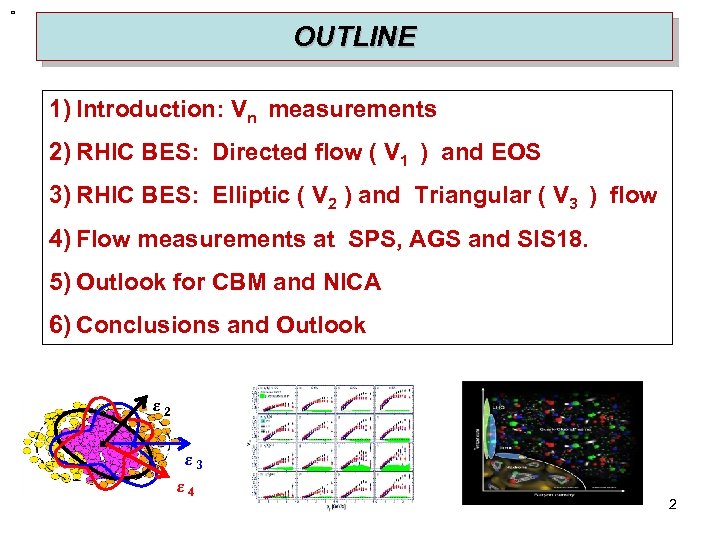 OUTLINE 1) Introduction: Vn measurements 2) RHIC BES: Directed flow ( V 1 ) and EOS 3) RHIC BES: Elliptic ( V 2 ) and Triangular ( V 3 ) flow 4) Flow measurements at SPS, AGS and SIS 18. 5) Outlook for CBM and NICA 6) Conclusions and Outlook ε 2 ε 3 ε 4 2 R. Lacey, SUNY Stony Brook
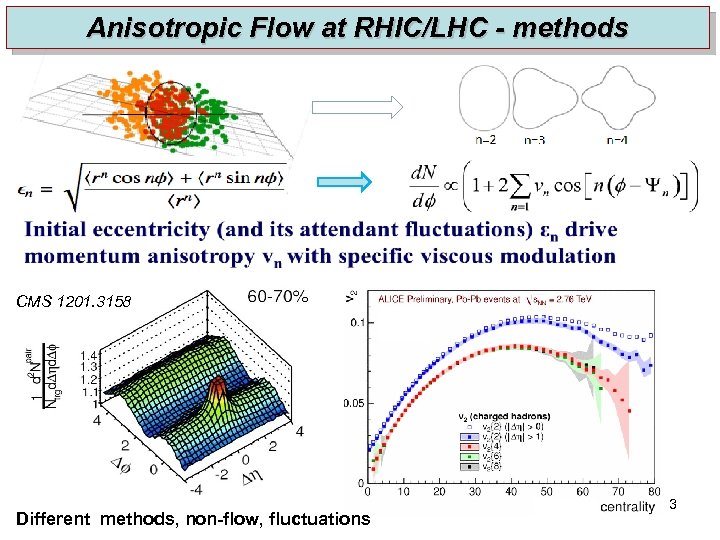 Anisotropic Flow at RHIC/LHC - methods CMS 1201. 3158 Different methods, non-flow, fluctuations 3 R. Lacey, SUNY Stony Brook
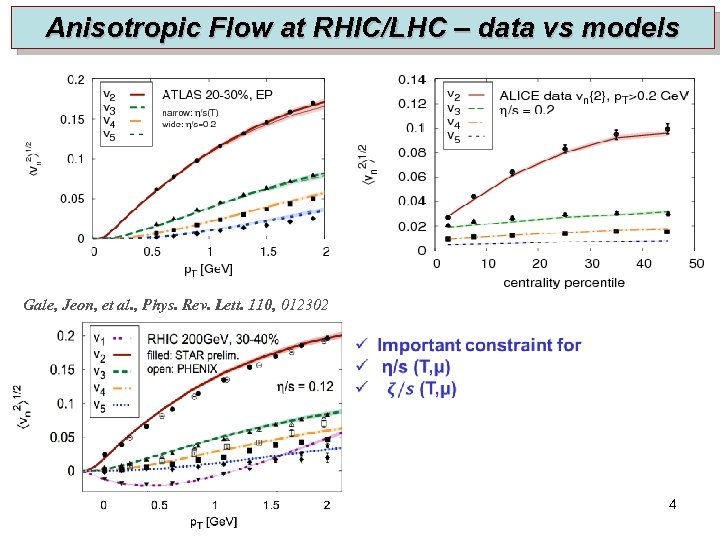 Anisotropic Flow at RHIC/LHC – data vs models Gale, Jeon, et al. , Phys. Rev. Lett. 110, 012302 4 R. Lacey, SUNY Stony Brook
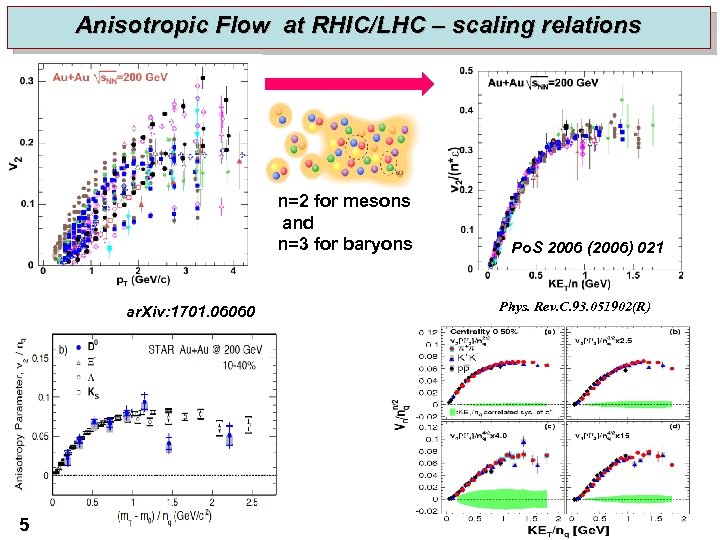 Anisotropic Flow at RHIC/LHC – scaling relations n=2 for mesons and n=3 for baryons ar. Xiv: 1701. 06060 Po. S 2006 (2006) 021 Phys. Rev. C. 93. 051902(R) 5 5 R. Lacey, SUNY Stony Brook
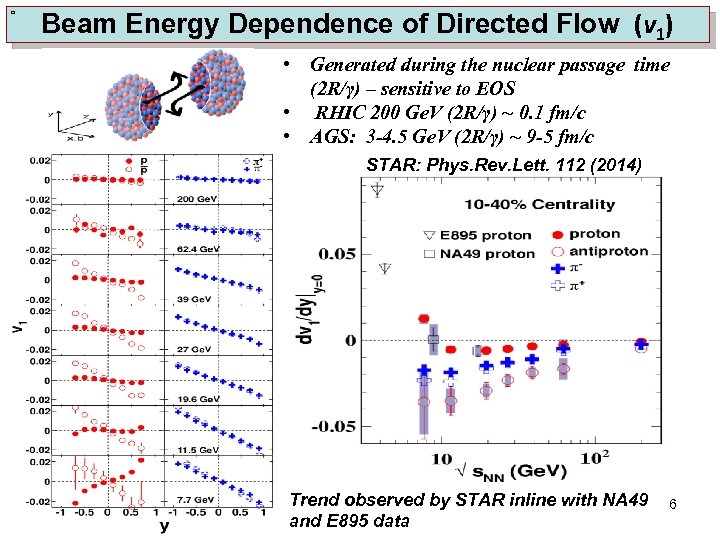 Beam Energy Dependence of Directed Flow (v 1) • Generated during the nuclear passage time (2 R/γ) – sensitive to EOS • RHIC 200 Ge. V (2 R/γ) ~ 0. 1 fm/c • AGS: 3 -4. 5 Ge. V (2 R/γ) ~ 9 -5 fm/c STAR: Phys. Rev. Lett. 112 (2014) Trend observed by STAR inline with NA 49 6 and E 895 data R. Lacey, SUNY Stony Brook
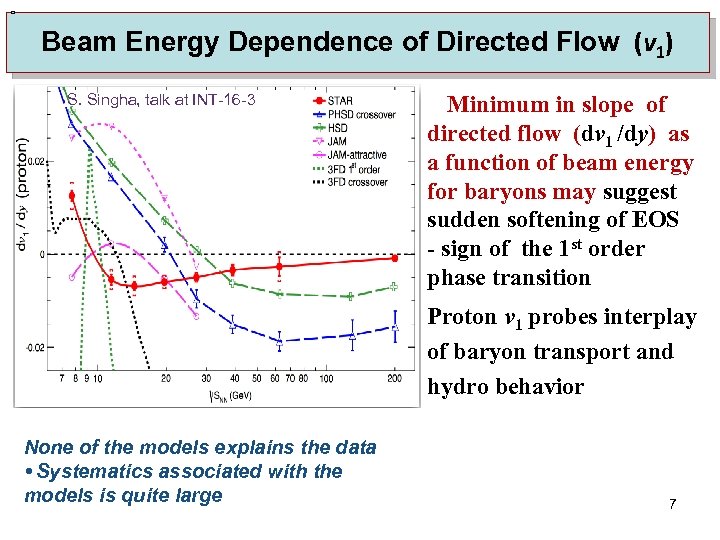 Beam Energy Dependence of Directed Flow (v 1) S. Singha, talk at INT-16 -3 Minimum in slope of directed flow (dv 1 /dy) as a function of beam energy for baryons may suggest sudden softening of EOS - sign of the 1 st order phase transition Proton v 1 probes interplay of baryon transport and hydro behavior None of the models explains the data • Systematics associated with the models is quite large 7 R. Lacey, SUNY Stony Brook
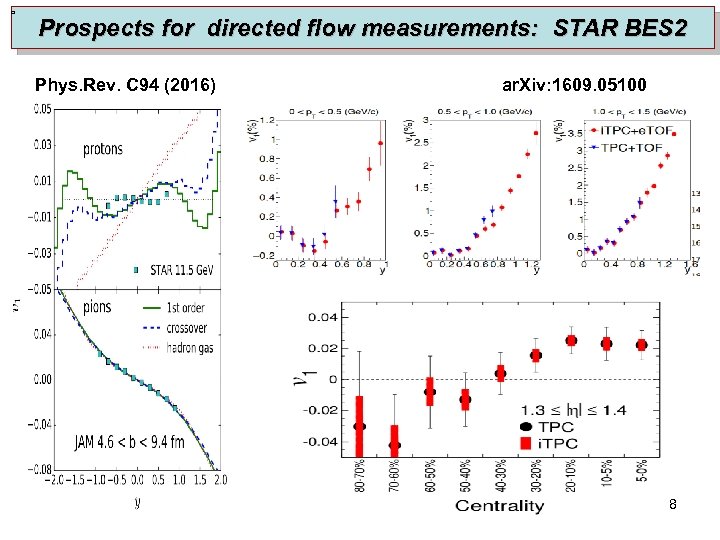 Prospects for directed flow measurements: STAR BES 2 Phys. Rev. C 94 (2016) ar. Xiv: 1609. 05100 8 R. Lacey, SUNY Stony Brook
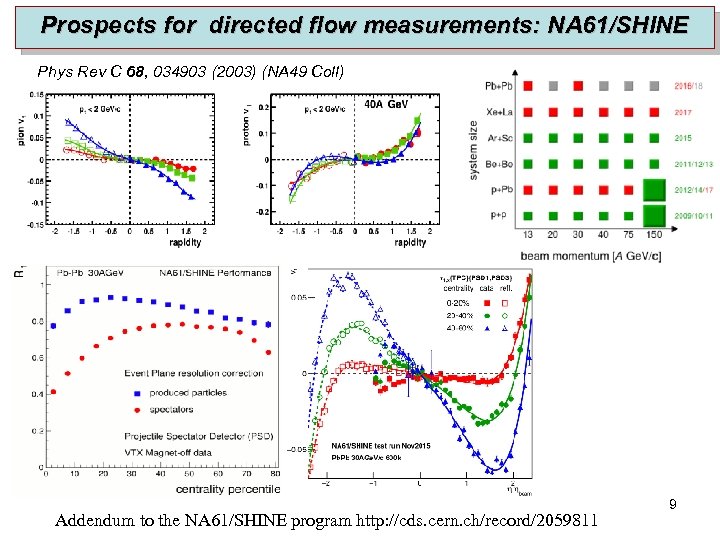 Prospects for directed flow measurements: NA 61/SHINE Phys Rev C 68, 034903 (2003) (NA 49 Coll) 9 Addendum to the NA 61/SHINE program http: //cds. cern. ch/record/2059811 R. Lacey, SUNY Stony Brook
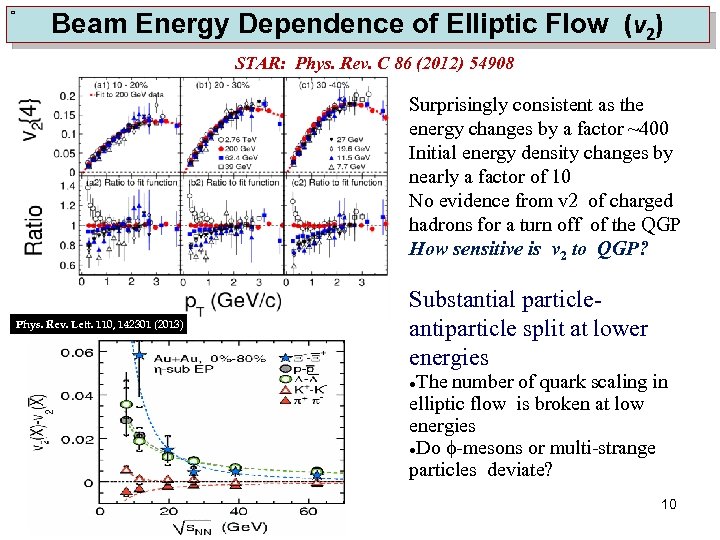 Beam Energy Dependence of Elliptic Flow (v 2) STAR: Phys. Rev. C 86 (2012) 54908 Surprisingly consistent as the energy changes by a factor ~400 Initial energy density changes by nearly a factor of 10 No evidence from v 2 of charged hadrons for a turn off of the QGP How sensitive is v 2 to QGP? Phys. Rev. Lett. 110, 142301 (2013) Substantial particleantiparticle split at lower energies The number of quark scaling in elliptic flow is broken at low energies Do ϕ-mesons or multi-strange particles deviate? 10 R. Lacey, SUNY Stony Brook
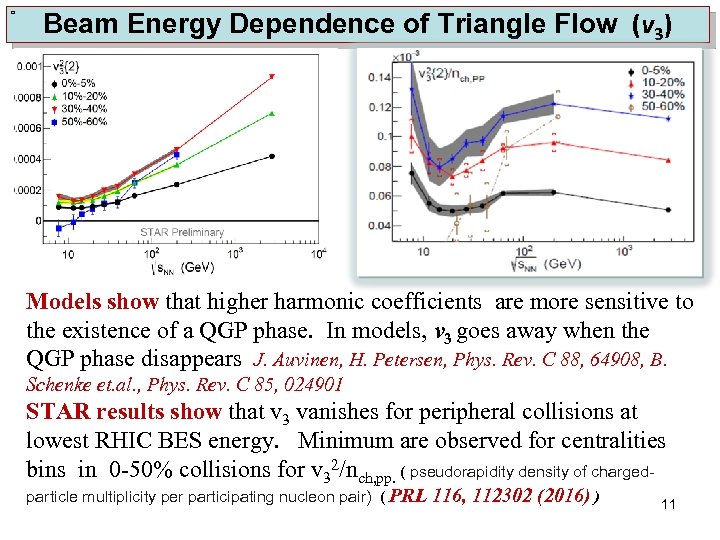 Beam Energy Dependence of Triangle Flow (v 3) Models show that higher harmonic coefficients are more sensitive to the existence of a QGP phase. In models, v 3 goes away when the QGP phase disappears J. Auvinen, H. Petersen, Phys. Rev. C 88, 64908, B. Schenke et. al. , Phys. Rev. C 85, 024901 STAR results show that v 3 vanishes for peripheral collisions at lowest RHIC BES energy. Minimum are observed for centralities bins in 0 -50% collisions for v 32/nch, pp. ( pseudorapidity density of chargedparticle multiplicity per participating nucleon pair) ( PRL 116, 112302 (2016) ) 11 R. Lacey, SUNY Stony Brook
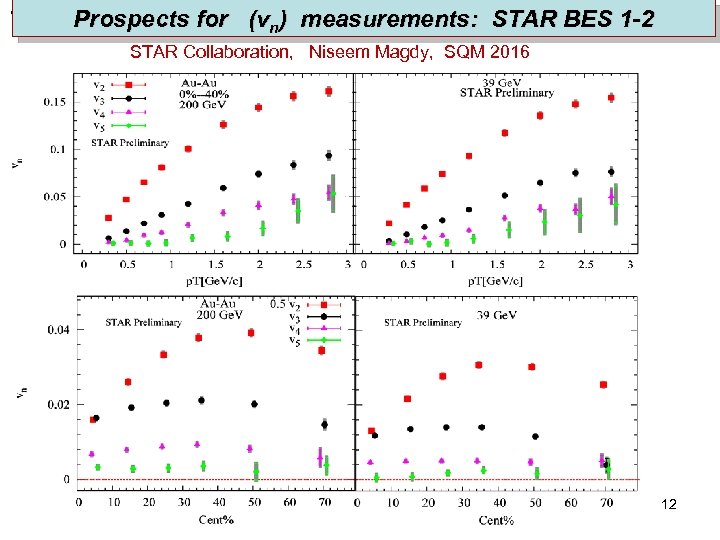 Prospects for (vn) measurements: STAR BES 1 -2 STAR Collaboration, Niseem Magdy, SQM 2016 12 R. Lacey, SUNY Stony Brook
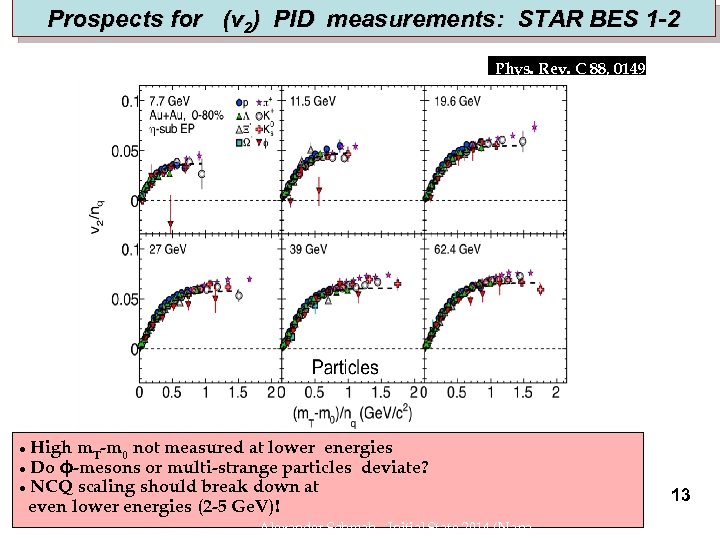 Prospects for (v 2) PID measurements: STAR BES 1 -2 v 2 NCQ Scaling of Particles Phys. Rev. C 88, 014902 (2013) High m. T-m 0 not measured at lower energies Do ϕ-mesons or multi-strange particles deviate? NCQ scaling should break down at December 2014 even lower energies (2 -5 Ge. V)! Alexander Schmah - Initial State 2014/Napa R. Lacey, SUNY 13 13 Stony Brook
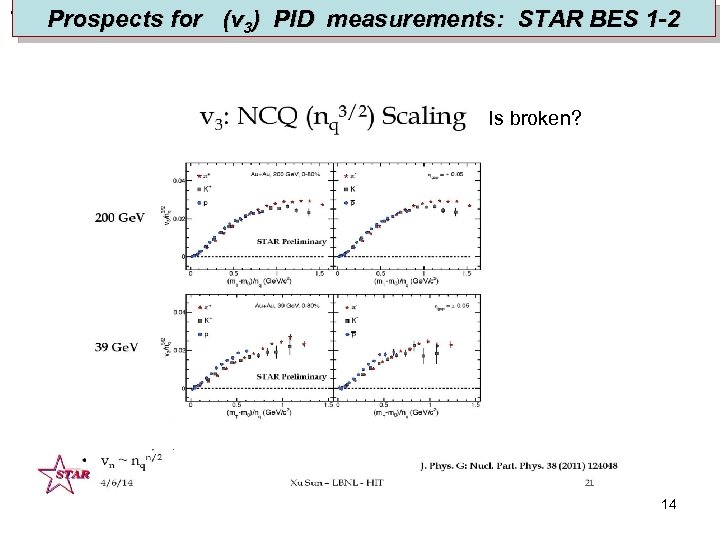 Prospects for (v 3) PID measurements: STAR BES 1 -2 Is broken? 14 R. Lacey, SUNY Stony Brook
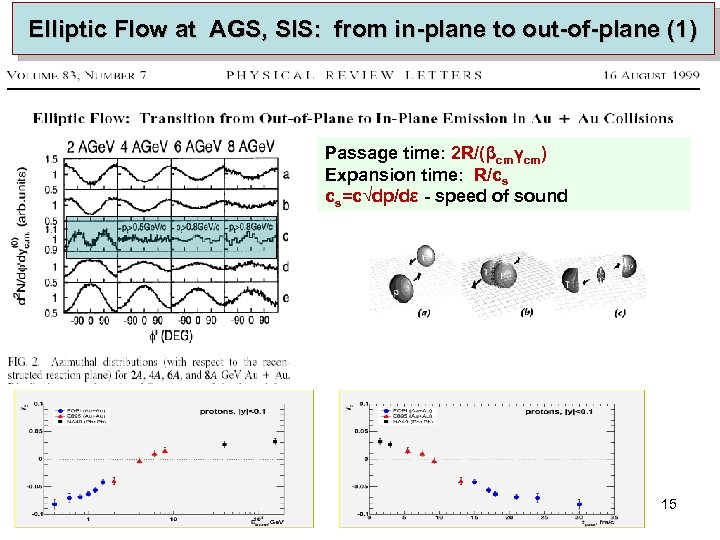 Elliptic Flow at AGS, SIS: from in-plane to out-of-plane (1) Passage time: 2 R/(βcmγcm) Expansion time: R/cs cs=c√dp/dε - speed of sound 15 R. Lacey, SUNY Stony Brook
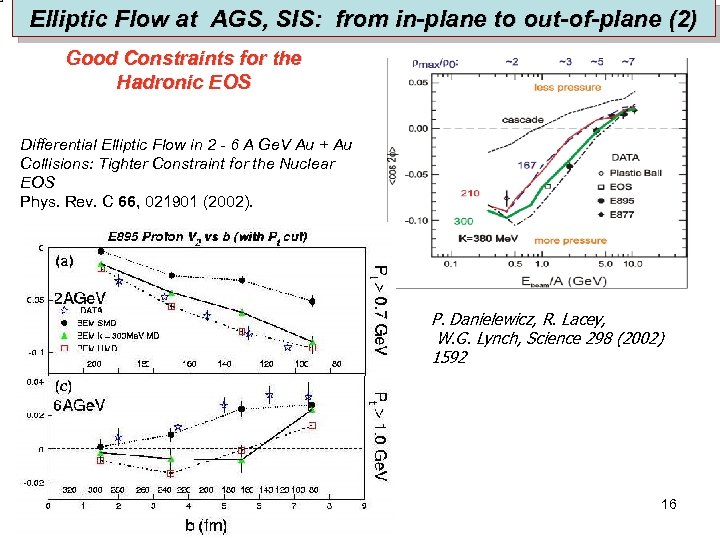 Elliptic Flow at AGS, SIS: from in-plane to out-of-plane (2) Good Constraints for the Hadronic EOS Differential Elliptic Flow in 2 - 6 A Ge. V Au + Au Collisions: Tighter Constraint for the Nuclear EOS Phys. Rev. C 66, 021901 (2002). P. Danielewicz, R. Lacey, W. G. Lynch, Science 298 (2002) 1592 16 R. Lacey, SUNY Stony Brook
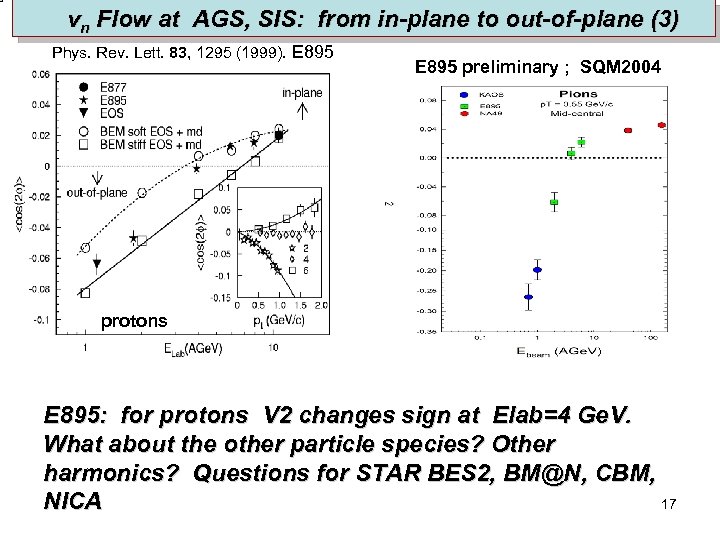 vn Flow at AGS, SIS: from in-plane to out-of-plane (3) Phys. Rev. Lett. 83, 1295 (1999). E 895 preliminary ; SQM 2004 protons E 895: for protons V 2 changes sign at Elab=4 Ge. V. What about the other particle species? Other harmonics? Questions for STAR BES 2, BM@N, CBM, 17 NICA R. Lacey, SUNY Stony Brook
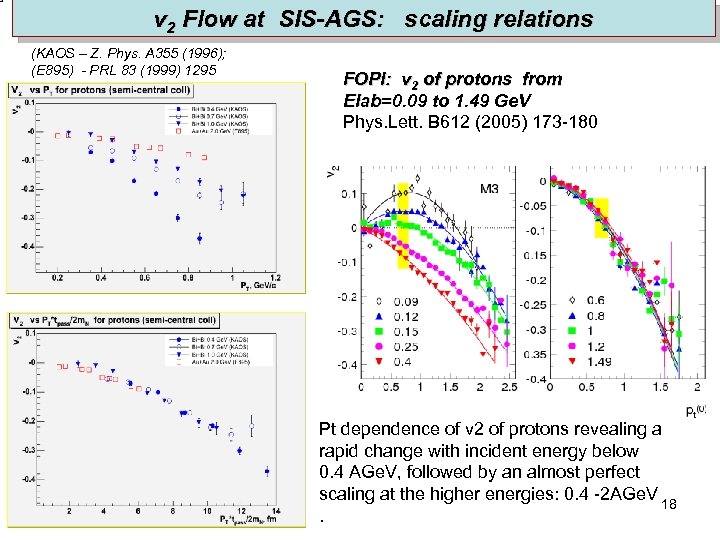 v 2 Flow at SIS-AGS: scaling relations (KAOS – Z. Phys. A 355 (1996); (E 895) - PRL 83 (1999) 1295 FOPI: v 2 of protons from Elab=0. 09 to 1. 49 Ge. V Phys. Lett. B 612 (2005) 173 -180 Pt dependence of v 2 of protons revealing a rapid change with incident energy below 0. 4 AGe. V, followed by an almost perfect scaling at the higher energies: 0. 4 -2 AGe. V 18. R. Lacey, SUNY Stony Brook
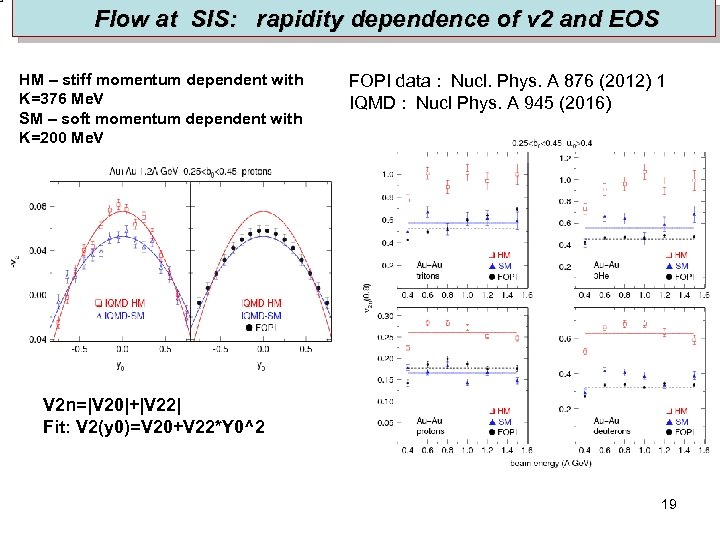 Flow at SIS: rapidity dependence of v 2 and EOS HM – stiff momentum dependent with K=376 Me. V SM – soft momentum dependent with K=200 Me. V FOPI data : Nucl. Phys. A 876 (2012) 1 IQMD : Nucl Phys. A 945 (2016) V 2 n=|V 20|+|V 22| Fit: V 2(y 0)=V 20+V 22*Y 0^2 19 R. Lacey, SUNY Stony Brook
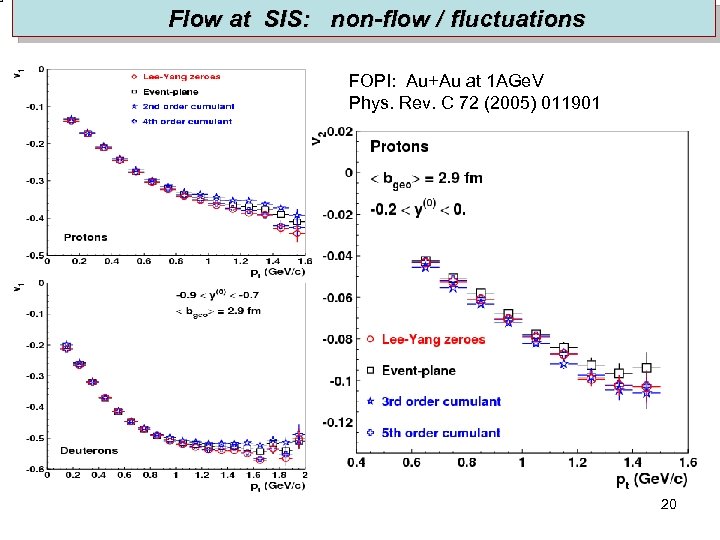 Flow at SIS: non-flow / fluctuations FOPI: Au+Au at 1 AGe. V Phys. Rev. C 72 (2005) 011901 20 R. Lacey, SUNY Stony Brook
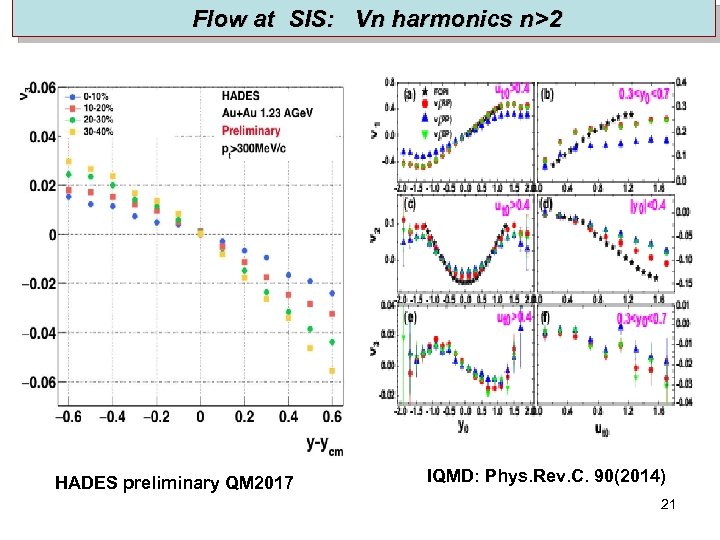 Flow at SIS: Vn harmonics n>2 HADES preliminary QM 2017 IQMD: Phys. Rev. C. 90(2014) 21 R. Lacey, SUNY Stony Brook
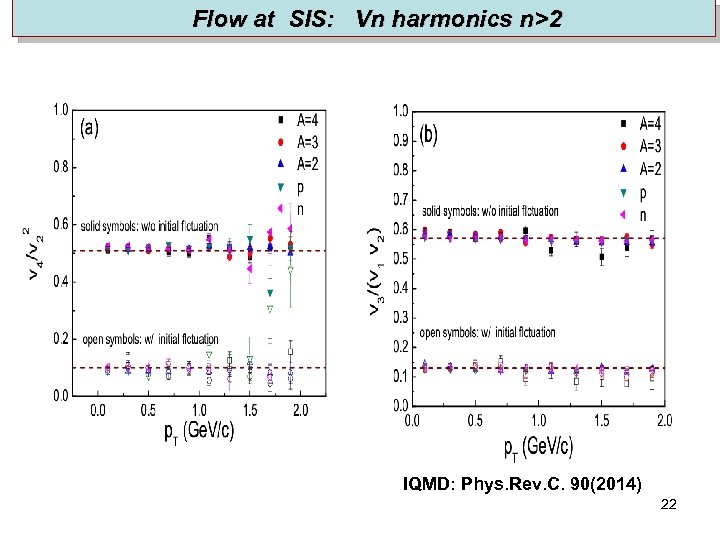 Flow at SIS: Vn harmonics n>2 IQMD: Phys. Rev. C. 90(2014) 22 R. Lacey, SUNY Stony Brook
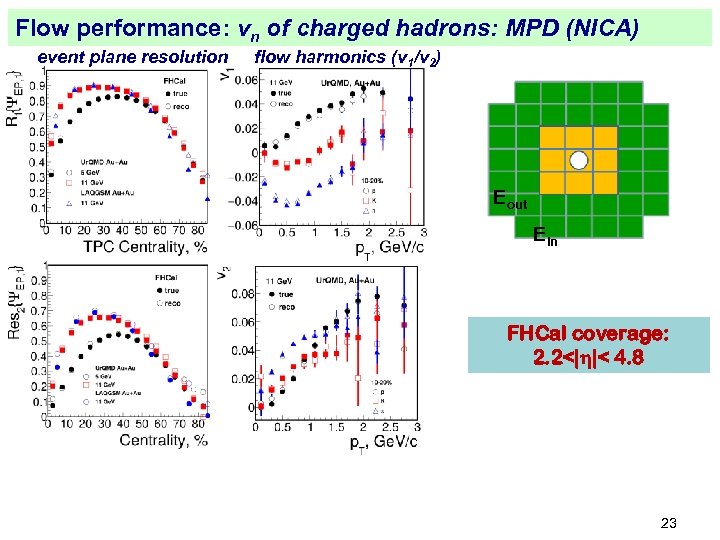 Flow performance: vn of charged hadrons: MPD (NICA) event plane resolution flow harmonics (v 1/v 2) Eout Ein FHCal coverage: 2. 2<|h|< 4. 8 23 R. Lacey, SUNY Stony Brook
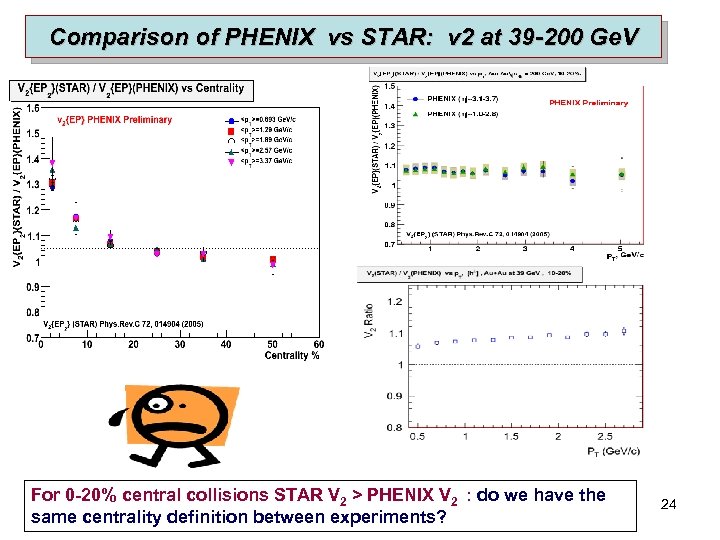 Comparison of PHENIX vs STAR: v 2 at 39 -200 Ge. V For 0 -20% central collisions STAR V 2 > PHENIX V 2 : do we have the 24 same centrality definition between experiments? R. Lacey, SUNY Stony Brook
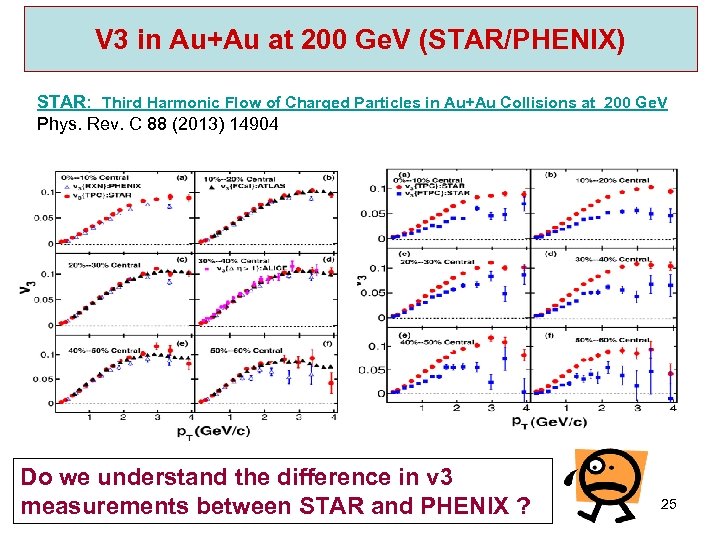 V 3 in Au+Au at 200 Ge. V (STAR/PHENIX) STAR: Third Harmonic Flow of Charged Particles in Au+Au Collisions at 200 Ge. V Phys. Rev. C 88 (2013) 14904 Do we understand the difference in v 3 measurements between STAR and PHENIX ? 25 R. Lacey, SUNY Stony Brook
 Scaling properties of flow and correlations “Change of collective-flow mechanism indicated by scaling analysis of transverse A. Bonasera, L. P. Csernai , Phys. Rev. Lett. 59 (1987) 630 -633 The general features of the collective flow could, in principle, be ex in terms of scale-invariant quantities. way the particular differences In this arising from the different initial conditions, masses, energies, etc. , can be separated from the general fluid-dynamical features. . …. Deviations from such an ideal scaling signal physical processes which lead to a not-scale-invariant flow, like special properties of the equation of state (EOS), potential energy, or phase transitions, dissipation, relativistic effects, etc. “Collective flow in heavy-ion collisions”, W. Reisdorf, H. G. Ritter Ann. Rev. Nucl. Part. Sci. 47 (1997) 663 -709 : There is interest in using observables that are both coalescence and scale-invariant. allow comparison with theories that They are limited to making predictions for single-particle observables. Under certain conditions the evolution in nonviscous hydrodynamics does not depend on the size of the system nor on the incident energy, if distances (such as impact parameters) are rescaled (reduced) in terms of a typical size parameter, such as the nuclear radius. Velocities, momenta and energies are 26 rescaled in terms of the beam velocities, momenta or energies. R. Lacey, SUNY Stony Brook
 The general features of the collective flow could, in principle, be expressed in terms of scale-invariant quantities. In this way the particular differences arising from the different initial conditions, masses, energies, etc. , can be separated from the general fluid-dynamical features. Theoretical fluid-dynamical calculations predicted the collective flow long ago. '' ' If perfect fluid dynamics is applicable under the conditions discussed in Ref. 10, then a scale-invariant representation of the data would eliminate the differences among the results. Deviations from such an ideal scaling signal physical processes which lead to a not-scale-invariant flow, like special properties of the equation of state (EOS), potential energy, or phase transitions, dissipation, relativistic effects, etc. Collective flow in heavy-ion collisions W. Reisdorf, H. G. Ritter (Darmstadt, GSI & LBL, Berkeley). Dec 1997. 47 pp. Published in Ann. Rev. Nucl. Part. Sci. 47 (1997) 663 -709 There is interest in using observables that are both coalescence- (27) and scale-invariant. Coalescence-invariant observables allow comparison with theories that are limited to making predictions for single-particle observables. Under certain conditions (2 the evolution in nonviscous hydrodynamics does not depend on the size of the system nor on the incident energy, if distances (such as impact parameters) are rescaled (reduced) in terms of a typical size parameter, such as the nuclear radius. Velocities, momenta and energies are rescaled in terms of the beam velocities, momenta or energies. Although the scaling conditions appear to be very restrictive, it is still useful to consider flow observables that are scale-invariant and thereby try to remove trivial consequences from size and incident velocity variations. 27 R. Lacey, SUNY Stony Brook
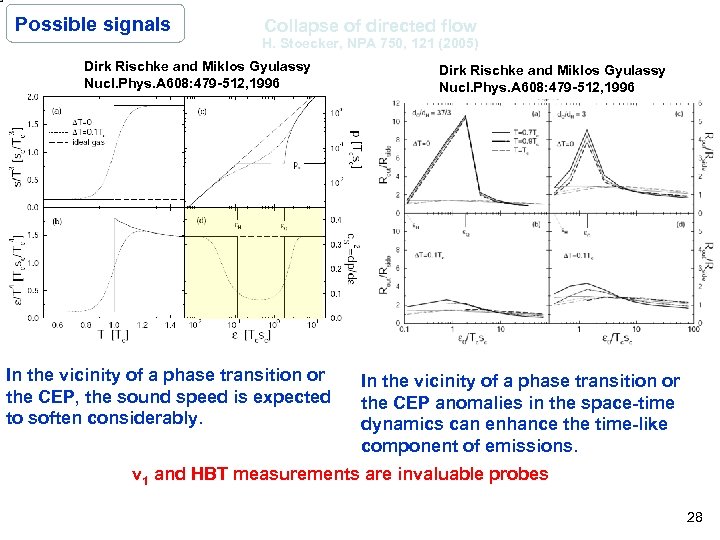 Possible signals Collapse of directed flow H. Stoecker, NPA 750, 121 (2005) Dirk Rischke and Miklos Gyulassy Nucl. Phys. A 608: 479 -512, 1996 In the vicinity of a phase transition or the CEP, the sound speed is expected to soften considerably. Dirk Rischke and Miklos Gyulassy Nucl. Phys. A 608: 479 -512, 1996 In the vicinity of a phase transition or the CEP anomalies in the space-time dynamics can enhance the time-like component of emissions. v 1 and HBT measurements are invaluable probes R. Lacey, SUNY Stony Brook 28
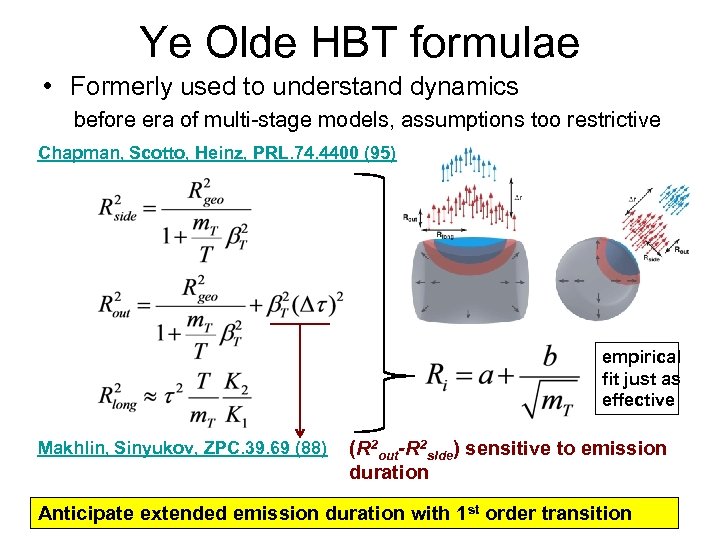 Ye Olde HBT formulae • Formerly used to understand dynamics before era of multi-stage models, assumptions too restrictive Chapman, Scotto, Heinz, PRL. 74. 4400 (95) empirical fit just as effective Makhlin, Sinyukov, ZPC. 39. 69 (88) (R 2 out-R 2 side) sensitive to emission duration Anticipate extended emission duration with 1 st order transition 29 R. Lacey, SUNY Stony Brook
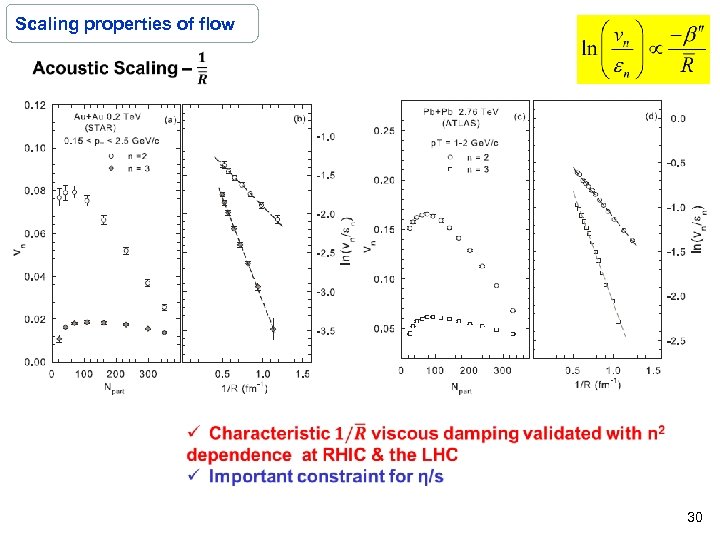 Scaling properties of flow R. Lacey, SUNY Stony Brook 30
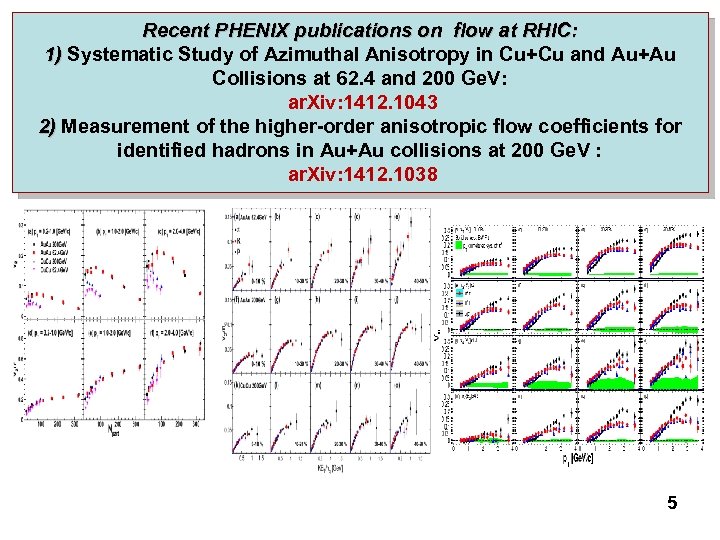 Recent PHENIX publications on flow at RHIC: 1) Systematic Study of Azimuthal Anisotropy in Cu+Cu and Au+Au 1) Collisions at 62. 4 and 200 Ge. V: ar. Xiv: 1412. 1043 2) Measurement of the higher-order anisotropic flow coefficients for 2) identified hadrons in Au+Au collisions at 200 Ge. V : ar. Xiv: 1412. 1038 31 5 R. Lacey, SUNY Stony Brook
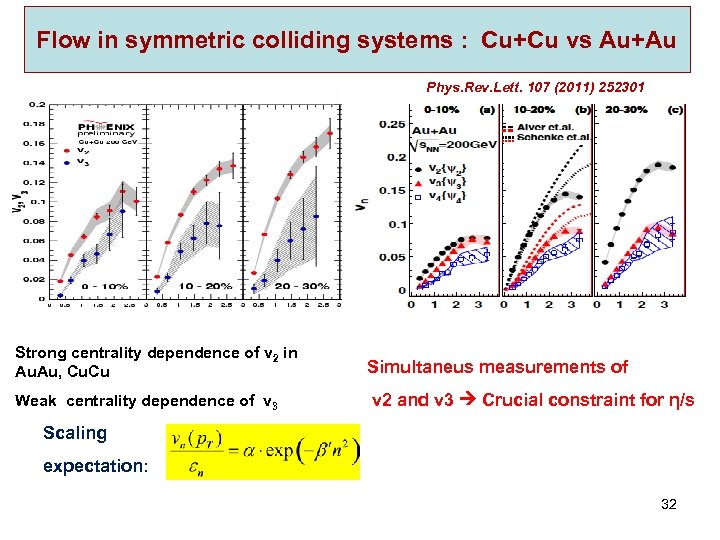 Flow in symmetric colliding systems : Cu+Cu vs Au+Au Phys. Rev. Lett. 107 (2011) 252301 Strong centrality dependence of v 2 in Au. Au, Cu. Cu Simultaneus measurements of Weak centrality dependence of v 3 v 2 and v 3 Crucial constraint for η/s Scaling expectation: 32 R. Lacey, SUNY Stony Brook
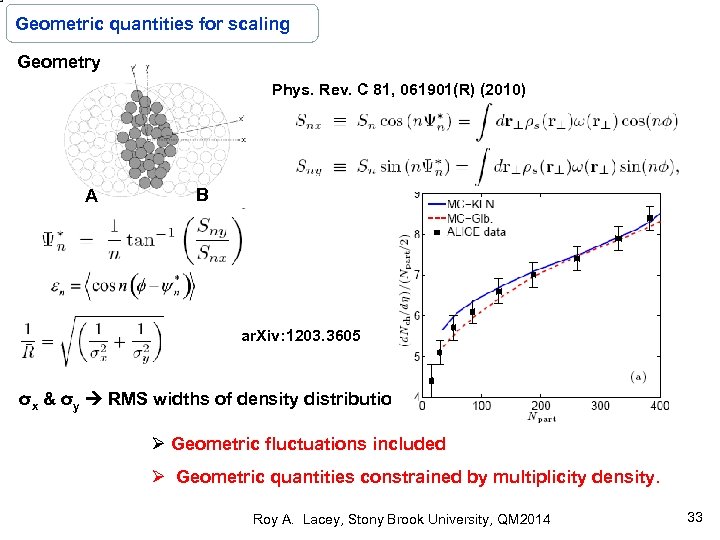 Geometric quantities for scaling Geometry Phys. Rev. C 81, 061901(R) (2010) A B ar. Xiv: 1203. 3605 σx & σy RMS widths of density distribution Ø Geometric fluctuations included Ø Geometric quantities constrained by multiplicity density. Roy A. Lacey, Stony Brook University, QM 2014 R. Lacey, SUNY Stony Brook 33