


 Скачать презентацию Prospects for a very high power CW SRF
fd8364e4206aac322689768c677bd526.ppt
- Количество слайдов: 43
 Prospects for a very high power CW SRF Linac Bob Rimmer, JLab AHIPA 2009 workshop 10/19/09
 Outline • • Challenges in high power CW SRF for protons State of the art Cost drivers and technical risks Choices/optimization The SNS mystery Structure examples Some suggested R&D topics Conclusions
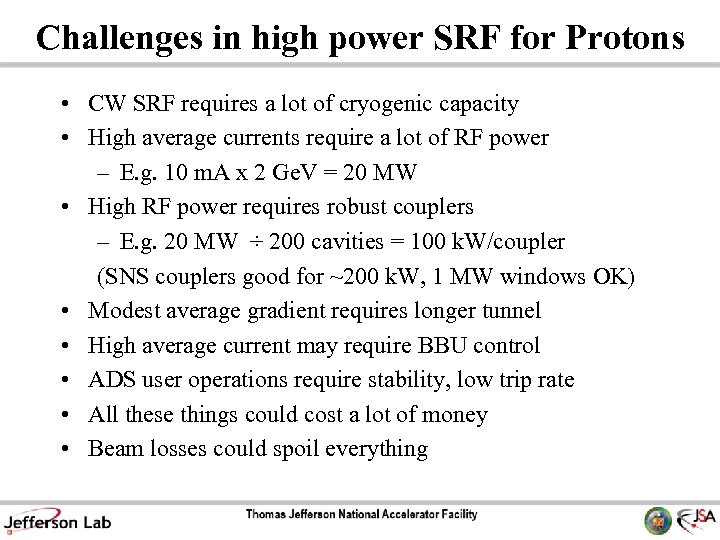 Challenges in high power SRF for Protons • CW SRF requires a lot of cryogenic capacity • High average currents require a lot of RF power – E. g. 10 m. A x 2 Ge. V = 20 MW • High RF power requires robust couplers – E. g. 20 MW ÷ 200 cavities = 100 k. W/coupler (SNS couplers good for ~200 k. W, 1 MW windows OK) • Modest average gradient requires longer tunnel • High average current may require BBU control • ADS user operations require stability, low trip rate • All these things could cost a lot of money • Beam losses could spoil everything
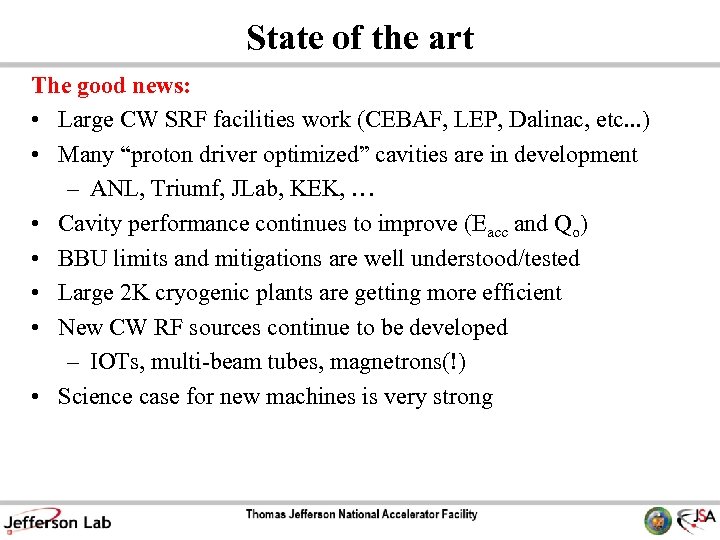 State of the art The good news: • Large CW SRF facilities work (CEBAF, LEP, Dalinac, etc. . . ) • Many “proton driver optimized” cavities are in development – ANL, Triumf, JLab, KEK, … • Cavity performance continues to improve (Eacc and Qo) • BBU limits and mitigations are well understood/tested • Large 2 K cryogenic plants are getting more efficient • New CW RF sources continue to be developed – IOTs, multi-beam tubes, magnetrons(!) • Science case for new machines is very strong
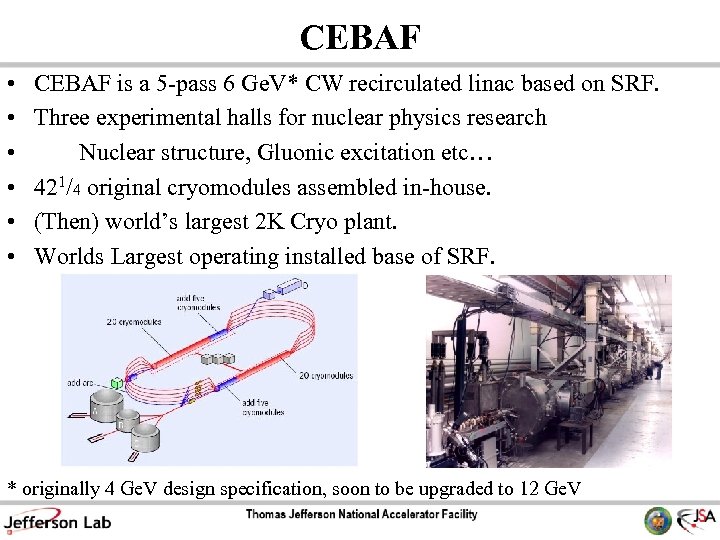 CEBAF • • • CEBAF is a 5 -pass 6 Ge. V* CW recirculated linac based on SRF. Three experimental halls for nuclear physics research Nuclear structure, Gluonic excitation etc… 421/4 original cryomodules assembled in-house. (Then) world’s largest 2 K Cryo plant. Worlds Largest operating installed base of SRF. * originally 4 Ge. V design specification, soon to be upgraded to 12 Ge. V
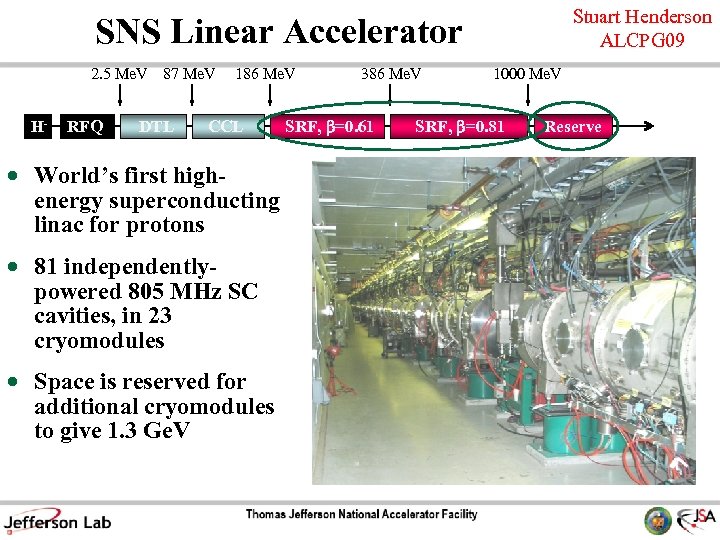 Stuart Henderson ALCPG 09 SNS Linear Accelerator 2. 5 Me. V 87 Me. V H- RFQ DTL 186 Me. V CCL 386 Me. V SRF, =0. 61 1000 Me. V SRF, =0. 81 Reserve · World’s first highenergy superconducting linac for protons · 81 independentlypowered 805 MHz SC cavities, in 23 cryomodules · Space is reserved for additional cryomodules to give 1. 3 Ge. V Medium beta cavity High beta cavity
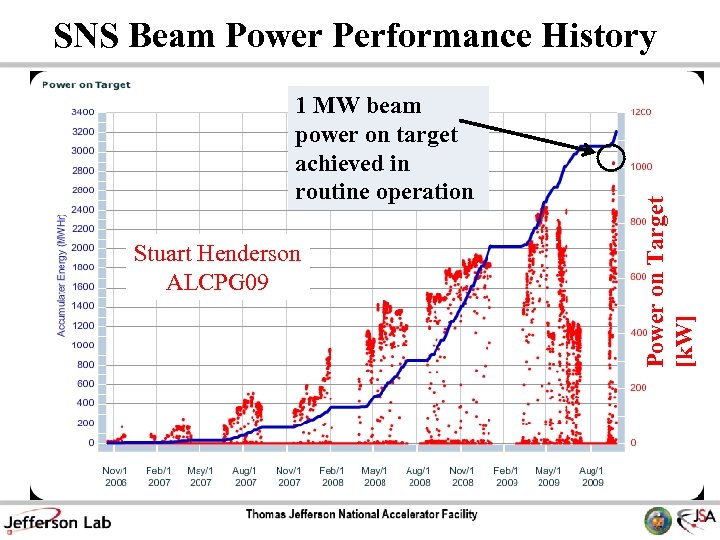 1 MW beam power on target achieved in routine operation Stuart Henderson ALCPG 09 Power on Target [k. W] SNS Beam Power Performance History
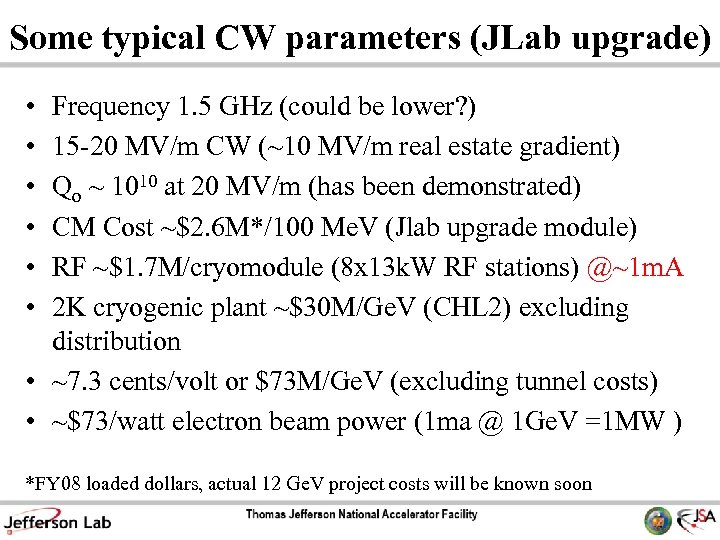 Some typical CW parameters (JLab upgrade) • • • Frequency 1. 5 GHz (could be lower? ) 15 -20 MV/m CW (~10 MV/m real estate gradient) Qo ~ 1010 at 20 MV/m (has been demonstrated) CM Cost ~$2. 6 M*/100 Me. V (Jlab upgrade module) RF ~$1. 7 M/cryomodule (8 x 13 k. W RF stations) @~1 m. A 2 K cryogenic plant ~$30 M/Ge. V (CHL 2) excluding distribution • ~7. 3 cents/volt or $73 M/Ge. V (excluding tunnel costs) • ~$73/watt electron beam power (1 ma @ 1 Ge. V =1 MW ) *FY 08 loaded dollars, actual 12 Ge. V project costs will be known soon
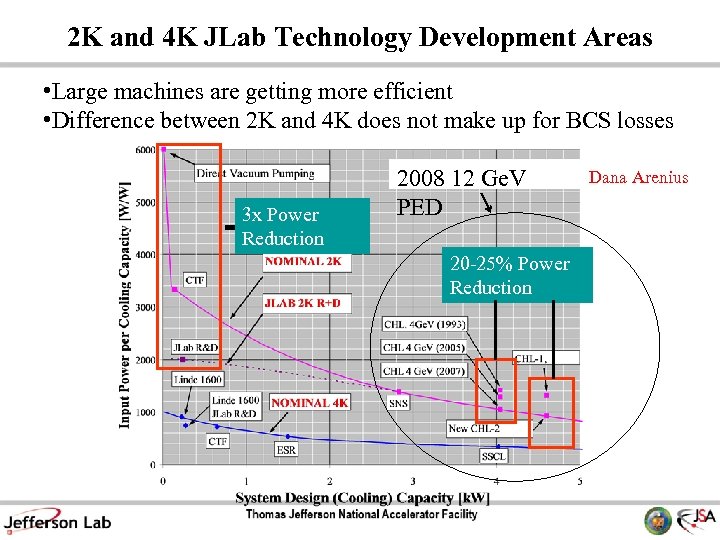 2 K and 4 K JLab Technology Development Areas • Large machines are getting more efficient • Difference between 2 K and 4 K does not make up for BCS losses 3 x Power Reduction 2008 12 Ge. V PED 20 -25% Power Reduction Dana Arenius
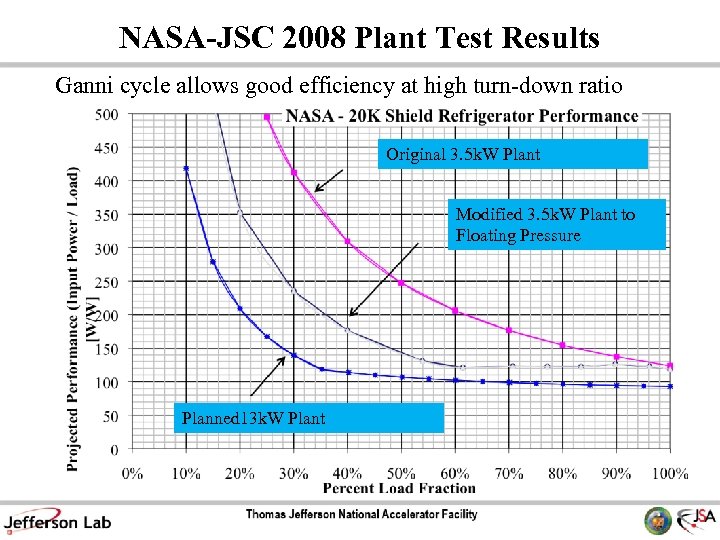 NASA-JSC 2008 Plant Test Results Ganni cycle allows good efficiency at high turn-down ratio Original 3. 5 k. W Plant Modified 3. 5 k. W Plant to Floating Pressure Planned 13 k. W Plant
![Cost drivers & technical risk relative cost [%] 50 • Linac cost drivers: Matthias](https://present5.com/presentation/fd8364e4206aac322689768c677bd526/image-11.jpg "Cost drivers & technical risk relative cost [%] 50 • Linac cost drivers: Matthias") Cost drivers & technical risk relative cost [%] 50 • Linac cost drivers: Matthias Liepe, ERL 2009 Cornell University, Ithaca New York 40 – Cryomodules 100 m. A ERL – RF 30 – Cryogenics 20 – tunnel 10 • Technical risks 0 Tunnel RF power Cryomodules Cryogenic plant – Field emission – BBU – Beam loss (heating & activation)
Cost drivers & technical risk relative cost [%] 50 • Linac cost drivers: Matthias Liepe, ERL 2009 Cornell University, Ithaca New York 40 – Cryomodules 100 m. A ERL – RF 30 – Cryogenics 20 – tunnel 10 • Technical risks 0 Tunnel RF power Cryomodules Cryogenic plant – Field emission – BBU – Beam loss (heating & activation)
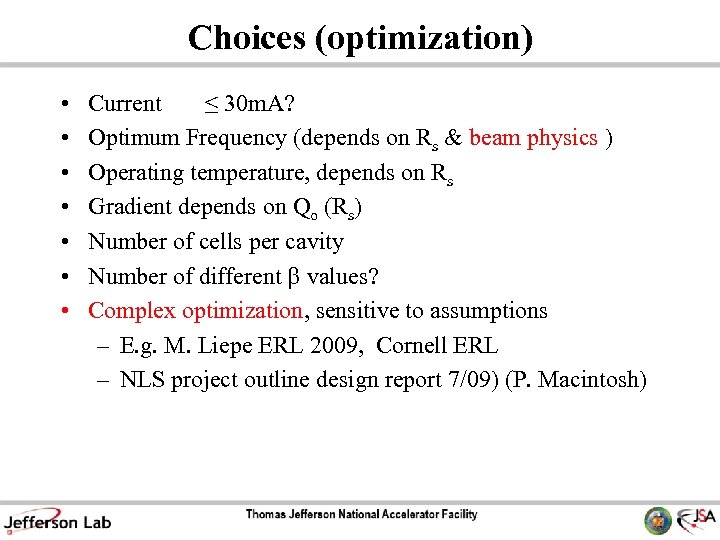 Choices (optimization) • • Current ≤ 30 m. A? Optimum Frequency (depends on Rs & beam physics ) Operating temperature, depends on Rs Gradient depends on Qo (Rs) Number of cells per cavity Number of different b values? Complex optimization, sensitive to assumptions – E. g. M. Liepe ERL 2009, Cornell ERL – NLS project outline design report 7/09) (P. Macintosh)
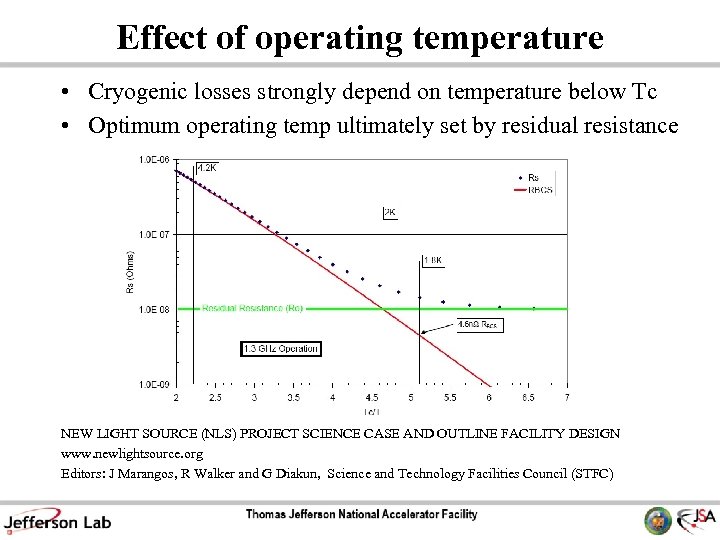 Effect of operating temperature • Cryogenic losses strongly depend on temperature below Tc • Optimum operating temp ultimately set by residual resistance NEW LIGHT SOURCE (NLS) PROJECT SCIENCE CASE AND OUTLINE FACILITY DESIGN www. newlightsource. org Editors: J Marangos, R Walker and G Diakun, Science and Technology Facilities Council (STFC)
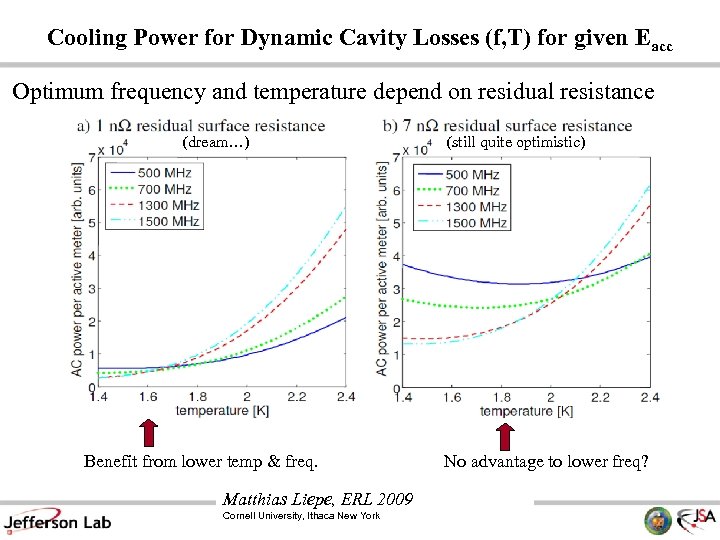 Cooling Power for Dynamic Cavity Losses (f, T) for given Eacc Optimum frequency and temperature depend on residual resistance (dream…) Benefit from lower temp & freq. Matthias Liepe, ERL 2009 Cornell University, Ithaca New York (still quite optimistic) No advantage to lower freq?
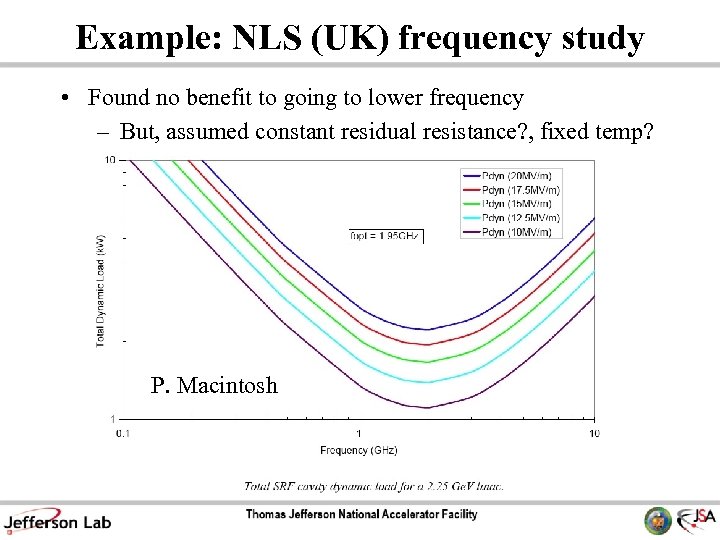 Example: NLS (UK) frequency study • Found no benefit to going to lower frequency – But, assumed constant residual resistance? , fixed temp? P. Macintosh
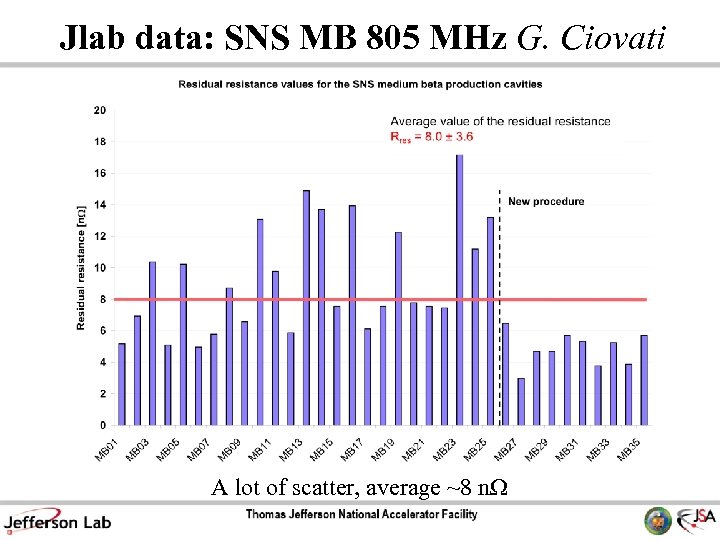 Jlab data: SNS MB 805 MHz G. Ciovati A lot of scatter, average ~8 nΩ
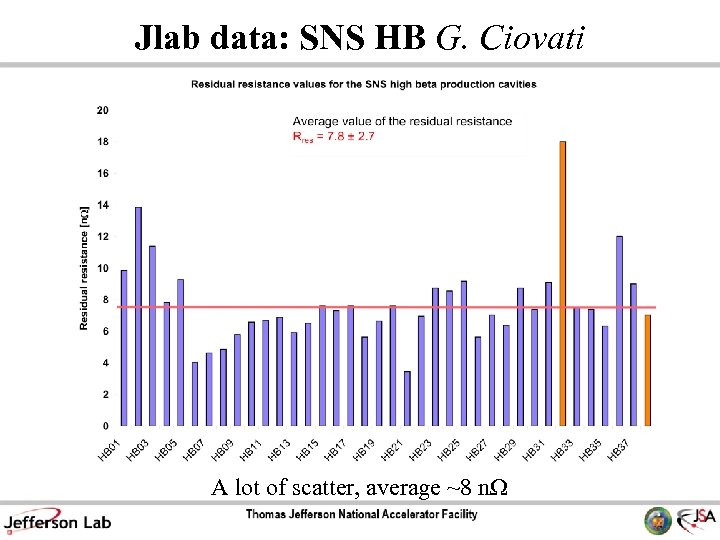 Jlab data: SNS HB G. Ciovati A lot of scatter, average ~8 nΩ
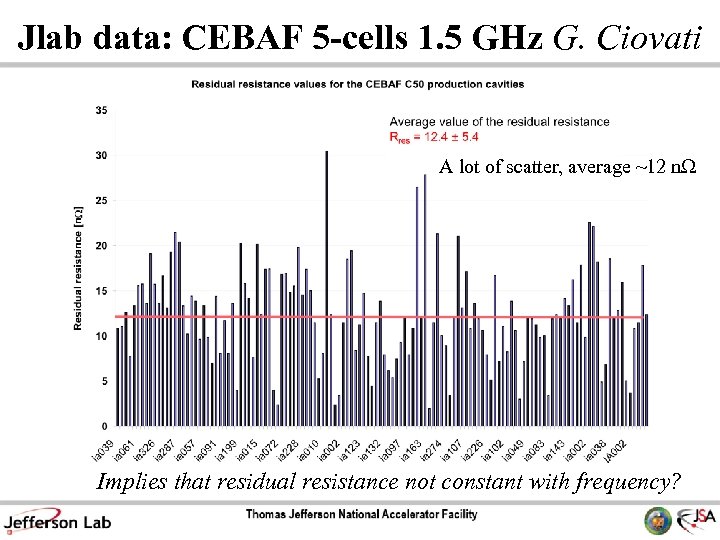 Jlab data: CEBAF 5 -cells 1. 5 GHz G. Ciovati A lot of scatter, average ~12 nΩ Implies that residual resistance not constant with frequency?
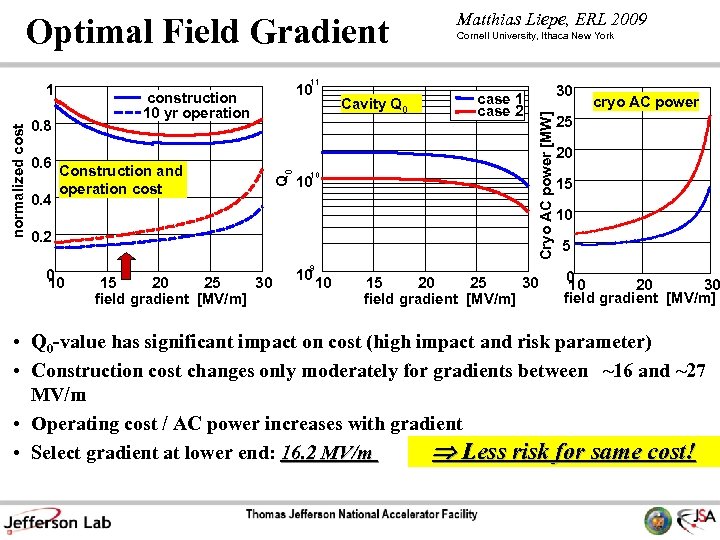 Optimal Field Gradient Cavity Q 0 10 10 0. 2 0 10 case 1 case 2 30 Cryo AC power [MW] Construction and operation cost Q 0 normalized cost 10 construction 10 yr operation 0. 8 0. 4 Cornell University, Ithaca New York 11 1 0. 6 Matthias Liepe, ERL 2009 9 15 20 25 30 field gradient [MV/m] 10 10 15 20 25 30 field gradient [MV/m] cryo AC power 25 20 15 10 5 0 10 20 30 field gradient [MV/m] • Q 0 -value has significant impact on cost (high impact and risk parameter) • Construction cost changes only moderately for gradients between ~16 and ~27 MV/m • Operating cost / AC power increases with gradient Less risk for same cost! • Select gradient at lower end: 16. 2 MV/m
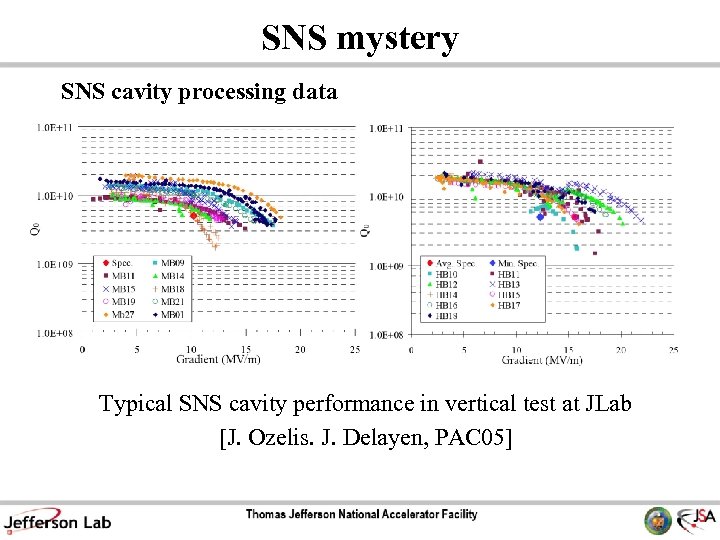 SNS mystery SNS cavity processing data Typical SNS cavity performance in vertical test at JLab [J. Ozelis. J. Delayen, PAC 05]
![SNS cavity data VTA vs CMTF [J. Ozelis. J. Delayen, PAC 05] • Gradient](https://present5.com/presentation/fd8364e4206aac322689768c677bd526/image-21.jpg "SNS cavity data VTA vs CMTF [J. Ozelis. J. Delayen, PAC 05] • Gradient") SNS cavity data VTA vs CMTF [J. Ozelis. J. Delayen, PAC 05] • Gradient at Q 0 = 5 x 10⁹, as measured in the VTA and CMTF, for the medium-β (triangles) and high-β(squares) cavities • Individual cavity tests only • Not all CM’s were tested at JLab
SNS cavity data VTA vs CMTF [J. Ozelis. J. Delayen, PAC 05] • Gradient at Q 0 = 5 x 10⁹, as measured in the VTA and CMTF, for the medium-β (triangles) and high-β(squares) cavities • Individual cavity tests only • Not all CM’s were tested at JLab
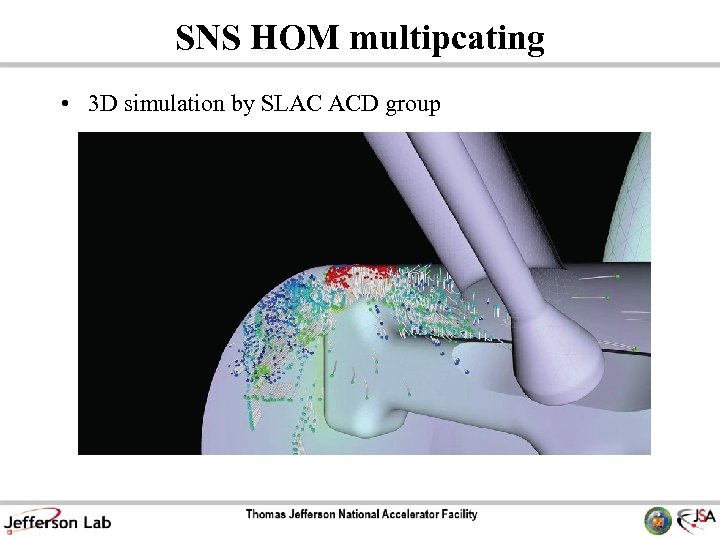
 SNS mystery • • SNS high beta cavities do not reach average spec. Almost all cavities exhibit high electron activity/radiation Many look like early onset field emission Others exhibit signs of multipacting in FPC and HOMs – Radiation does not follow Fowler-Nordheim – Fast radiation monitors see spikes during fill and decay – Diodes detect heating in HOM cans – DC bias on FPC’s helps • Multipacting barrier in cells is also frequently observed • Ensemble average is lower than individual limits due to dark current transport
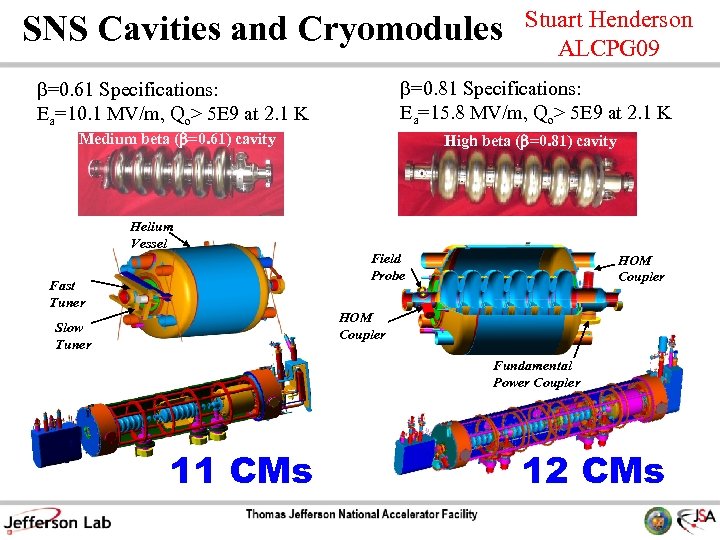 SNS Cavities and Cryomodules b=0. 81 Specifications: Ea=15. 8 MV/m, Qo> 5 E 9 at 2. 1 K b=0. 61 Specifications: Ea=10. 1 MV/m, Qo> 5 E 9 at 2. 1 K Medium beta ( =0. 61) cavity Helium Vessel Fast Tuner Stuart Henderson ALCPG 09 High beta ( =0. 81) cavity Field Probe HOM Coupler Slow Tuner Fundamental Power Coupler 11 CMs 12 CMs
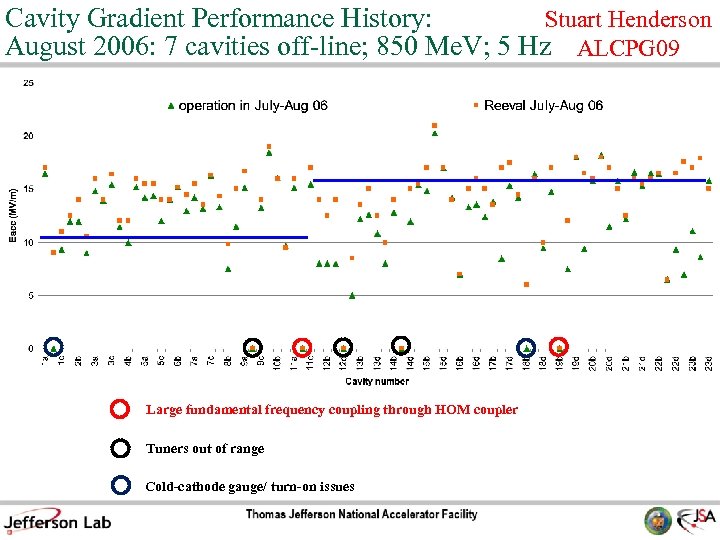 Stuart Henderson Cavity Gradient Performance History: August 2006: 7 cavities off-line; 850 Me. V; 5 Hz ALCPG 09 Large fundamental frequency coupling through HOM coupler Tuners out of range Cold-cathode gauge/ turn-on issues
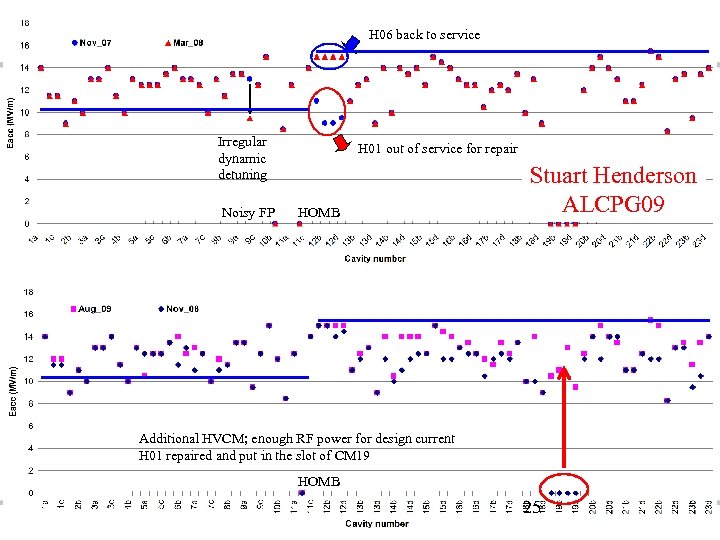 H 06 back to service Irregular dynamic detuning Noisy FP H 01 out of service for repair HOMB Stuart Henderson ALCPG 09 Additional HVCM; enough RF power for design current H 01 repaired and put in the slot of CM 19 HOMB 25
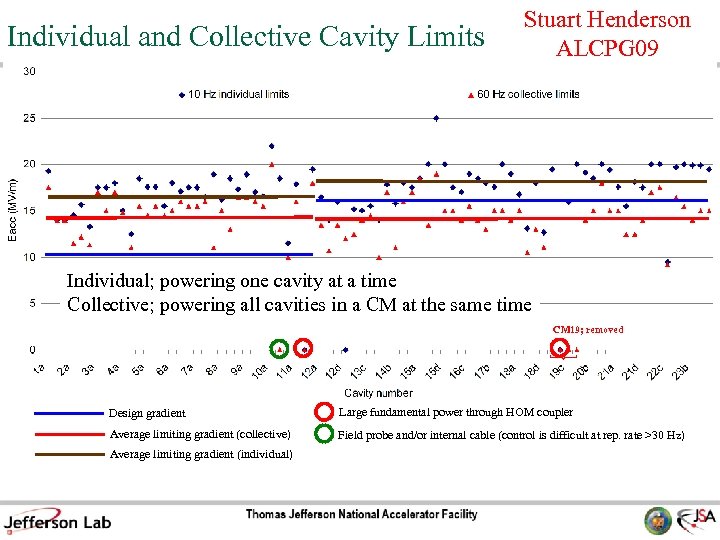 Individual and Collective Cavity Limits Stuart Henderson ALCPG 09 Individual; powering one cavity at a time Collective; powering all cavities in a CM at the same time CM 19; removed Design gradient Large fundamental power through HOM coupler Average limiting gradient (collective) Field probe and/or internal cable (control is difficult at rep. rate >30 Hz) Average limiting gradient (individual)
 SNS mystery • Possible explanations – Inadequate HPR at equator of cavity or in couplers – Multipacting barrier modified by surface condition or geometry – Electrons from multipacting in couplers seeding cells https: //www. slac. stanford. edu/~lge/acd_multipacting_small. mov – Electron cross talk between cavities lowers usable gradient – End group low RRR exacerbates problems • What to do next? – Try EP of SNS cavities with ILC processes – Test cavities with hooks removed – Evaluate alternative designs
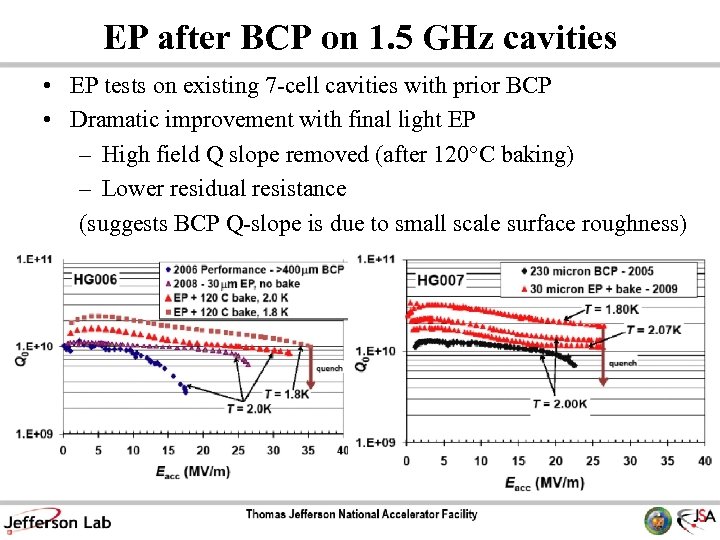 EP after BCP on 1. 5 GHz cavities • EP tests on existing 7 -cell cavities with prior BCP • Dramatic improvement with final light EP – High field Q slope removed (after 120°C baking) – Lower residual resistance (suggests BCP Q-slope is due to small scale surface roughness)
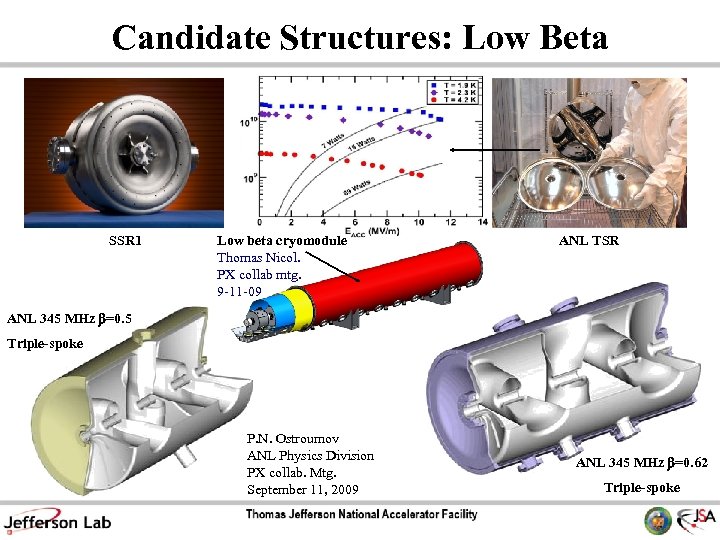 Candidate Structures: Low Beta SSR 1 Low beta cryomodule Thomas Nicol. PX collab mtg. 9 -11 -09 ANL TSR ANL 345 MHz =0. 5 Triple-spoke P. N. Ostroumov ANL Physics Division PX collab. Mtg. September 11, 2009 ANL 345 MHz =0. 62 Triple-spoke
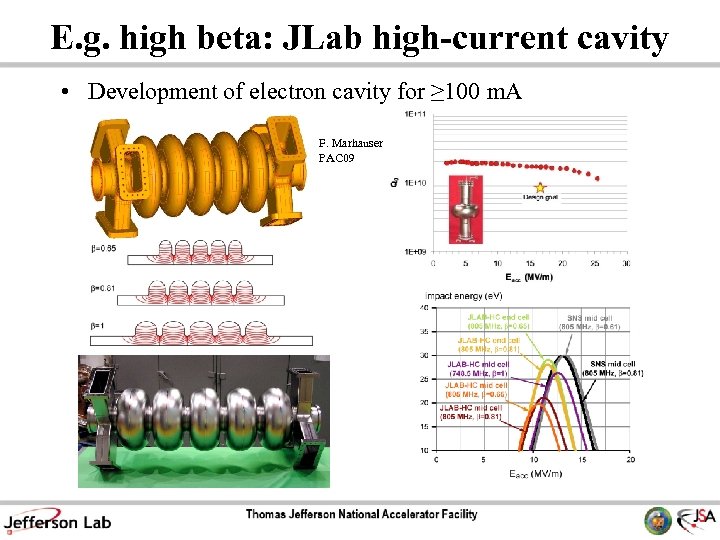 E. g. high beta: JLab high-current cavity • Development of electron cavity for ≥ 100 m. A F. Marhauser PAC 09
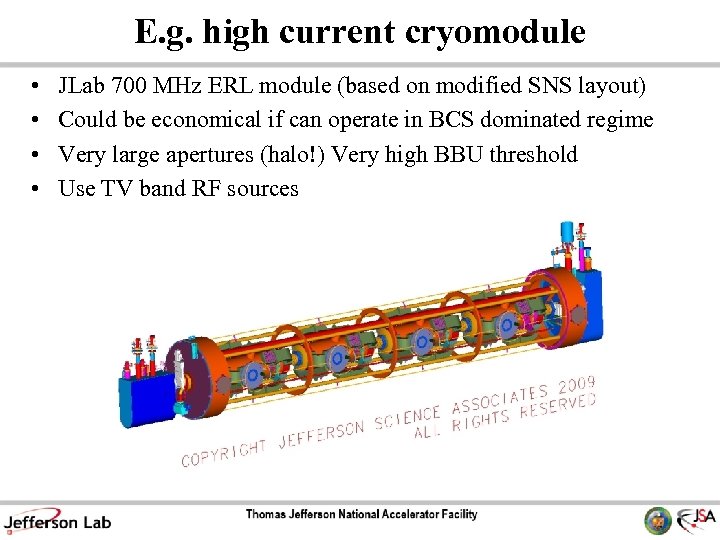 E. g. high current cryomodule • • JLab 700 MHz ERL module (based on modified SNS layout) Could be economical if can operate in BCS dominated regime Very large apertures (halo!) Very high BBU threshold Use TV band RF sources
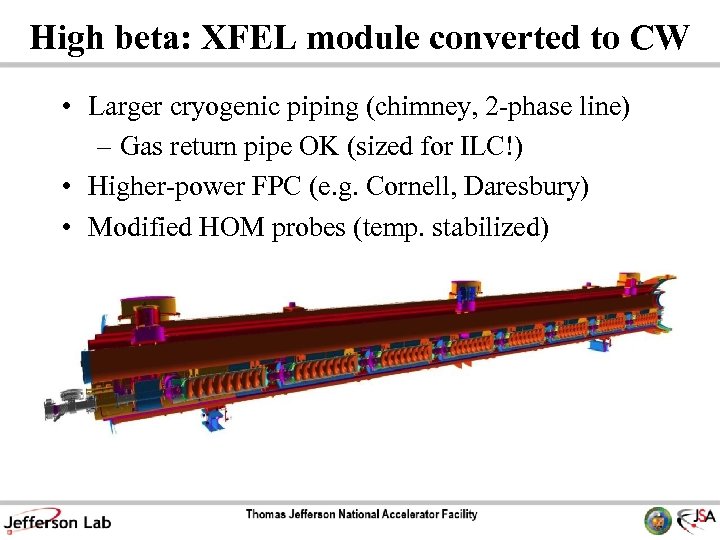 High beta: XFEL module converted to CW • Larger cryogenic piping (chimney, 2 -phase line) – Gas return pipe OK (sized for ILC!) • Higher-power FPC (e. g. Cornell, Daresbury) • Modified HOM probes (temp. stabilized)
 Some suggested R&D topics • Qo (surface resistance, materials, processing, mag shielding) – Elimination of field emission, next generation processing • Microphonics (sources, response (stiffness), feedback, tuners) • Beam optics: Halo and losses • Demonstrate Proton Driver optimized cavities with beam – Coupler power, tuner, HOM spectrum, microphonics • BBU/HOM damping (real couplers and loads) • Fast reset (automated trip recovery << thermal time constant)
 Conclusions • • • Large scale CW SRF is viable for proton drivers Prototype cavities exist for all beta range No show stoppers to running CW Robust high-power couplers must be used Main challenges may be halo / beam loss / trip rate Qo (residual resistance) is significant cost driver – Poorly understood but under active investigation • Cost “optimization” depends strongly on assumptions – Full multi-variable optimization worthwhile using best available world scaling data
 Back up material
 SNS HOM multipcating • 3 D simulation by SLAC ACD group
 The Beam Power Frontier for Protons Courtesy J. Wei · Central challenge at the beam power frontier is controlling beam loss to minimize residual activation · 1 n. A protons at 1 Ge. V, a 1 Watt beam, activates stainless steel to 80 mrem/hr Stuart after 4 at 1 ft Henderson hrs. ALCPG 09
 Storage ring SRF cavites • Cornell CESR 500 MHz cavity, KEK B cavity • High average power delivered to beam • High reliability for user operations
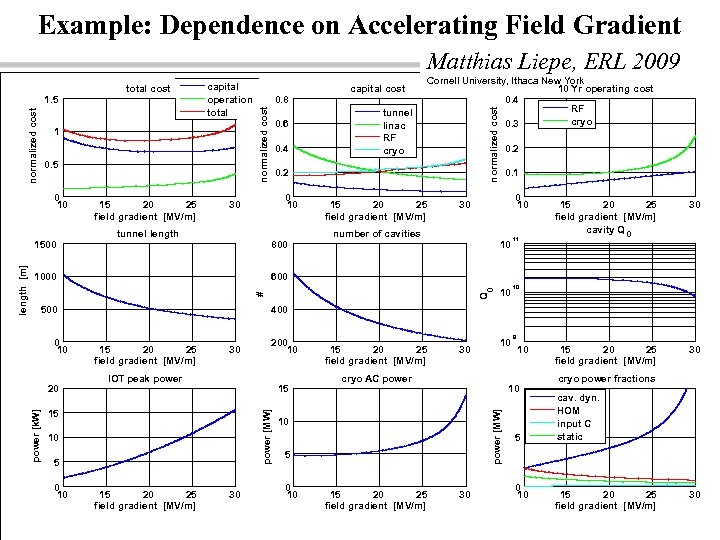 Example: Dependence on Accelerating Field Gradient Matthias Liepe, ERL 2009 0. 5 0. 6 0. 4 0. 2 0 10 30 tunnel length 800 15 20 25 field gradient [MV/m] number of cavities 10 Q 10 30 200 10 IOT peak power 15 10 5 15 20 25 field gradient [MV/m] 30 cryo AC power 11 15 20 25 field gradient [MV/m] cavity Q 0 30 15 20 25 field gradient [MV/m] 30 10 5 15 20 25 field gradient [MV/m] 9 10 10 10 power [MW] 15 20 25 field gradient [MV/m] 15 0 10 400 power [MW] power [k. W] 20 0. 1 600 500 0 10 0. 2 30 # 1000 tunnel linac RF cryo Cornell University, Ithaca New York 10 Yr operating cost 0. 4 RF cryo 0. 3 0 1500 15 20 25 field gradient [MV/m] 0. 8 capital cost normalized cost 1 0 10 length [m] capital operation total normalized cost 1. 5 total cost 30 5 0 10 cryo power fractions cav. dyn. HOM input C static 15 20 25 field gradient [MV/m] Slide 39 30
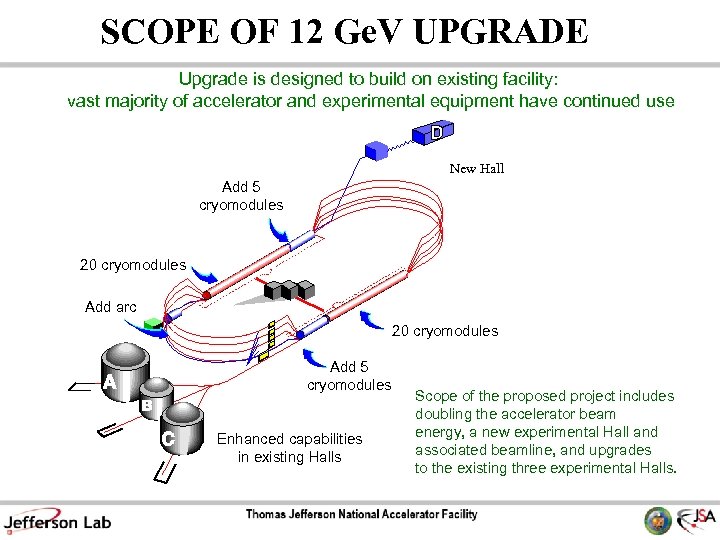 SCOPE OF 12 Ge. V UPGRADE Upgrade is designed to build on existing facility: vast majority of accelerator and experimental equipment have continued use New Hall Add 5 cryomodules 20 cryomodules Add arc 20 cryomodules Add 5 cryomodules Enhanced capabilities in existing Halls Scope of the proposed project includes doubling the accelerator beam energy, a new experimental Hall and associated beamline, and upgrades to the existing three experimental Halls.
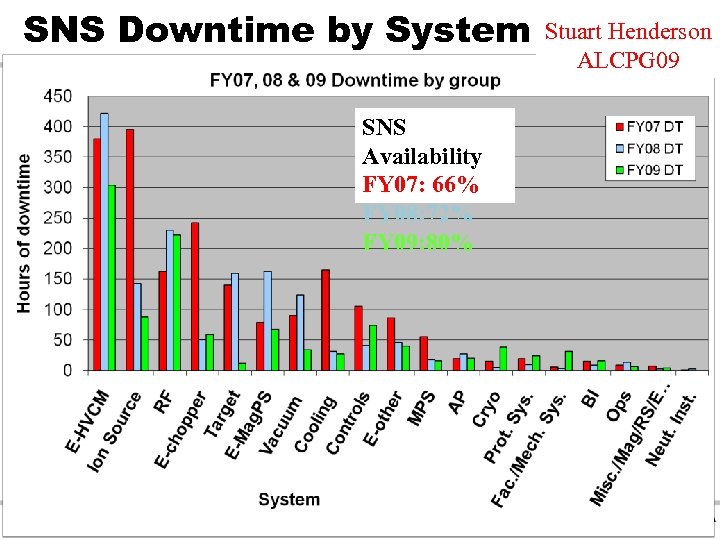 SNS Downtime by System SNS Availability FY 07: 66% FY 08: 72% FY 09: 80% Stuart Henderson ALCPG 09
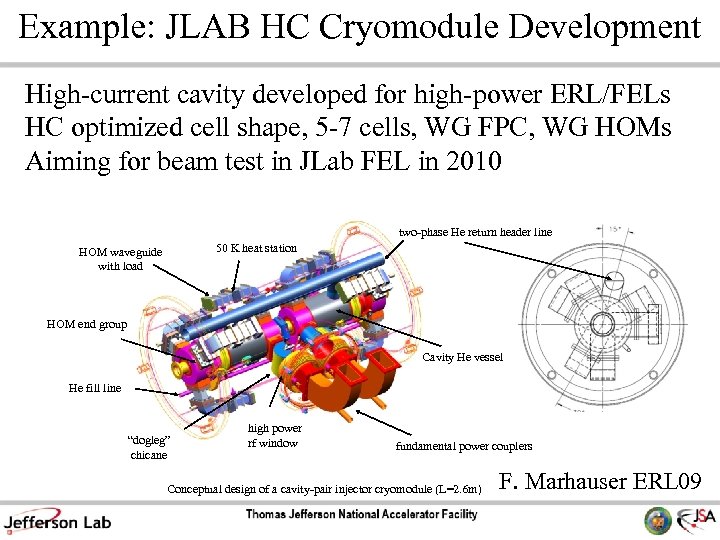 Example: JLAB HC Cryomodule Development High-current cavity developed for high-power ERL/FELs HC optimized cell shape, 5 -7 cells, WG FPC, WG HOMs Aiming for beam test in JLab FEL in 2010 two-phase He return header line 50 K heat station HOM waveguide with load HOM end group Cavity He vessel He fill line “dogleg” chicane high power rf window fundamental power couplers Conceptual design of a cavity-pair injector cryomodule (L=2. 6 m) F. Marhauser ERL 09
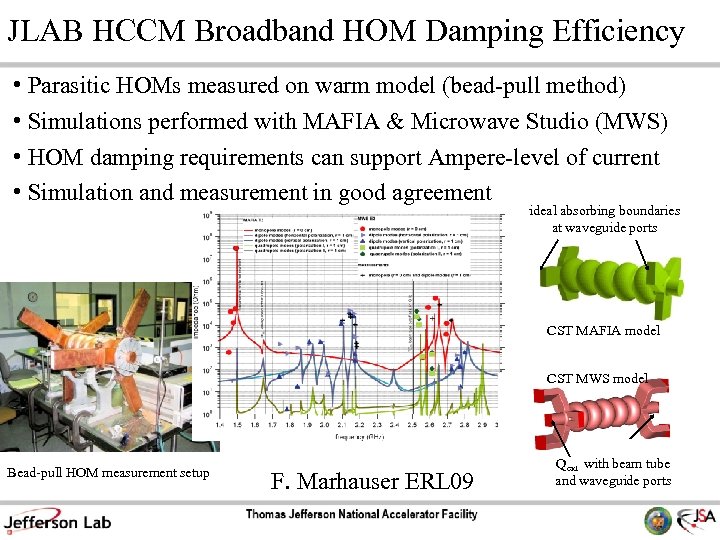 JLAB HCCM Broadband HOM Damping Efficiency • Parasitic HOMs measured on warm model (bead-pull method) • Simulations performed with MAFIA & Microwave Studio (MWS) • HOM damping requirements can support Ampere-level of current • Simulation and measurement in good agreement ideal absorbing boundaries at waveguide ports CST MAFIA model CST MWS model Bead-pull HOM measurement setup F. Marhauser ERL 09 Qext with beam tube and waveguide ports