 Скачать презентацию Proposed Revisions to Ambient Air Monitoring Regulations and
366544e2dff2bcbc735fdd316160ac14.ppt
- Количество слайдов: 12



Proposed Revisions to Ambient Air Monitoring Regulations, and Proposed FY 2007 Air Monitoring Guidance WESTAR Spring Business Meeting March 28, 2006
National Ambient Air Monitoring Strategy (NAAMS) • Draft: http: //www. epa. gov/ttn/amtic/monstratdoc. html • Goal is to optimize air monitoring networks to: • Assess trends, • Characterize multi-pollutant component, • Promote continuous monitoring for real-time data and support health effects research, • Reconcile air quality models. • Remove or reduce network minimums for some pollutants. • Reductions in Photochemical Assessment Monitoring Stations (PAMS). • Initiate NCore multi-pollutant network. • Initiate PM 10 -2. 5 monitoring network. • Guiding document for ANPRM – Revisions to Ambient Air Monitoring Regulations and FY 2007 Grant Guidance. • Assumes level funding.
Revisions to Ambient Air Monitoirng Regulations – Request for Comments • • Use of PM 10 monitors in lieu of PM 10 -2. 5 for applicability. Is MSA > 100, 00 appropriate – other factors such as design value. West v. East – county based definition of MSA, aggregate MSA’s. PM 10 -2. 5 siting requirements – census tract v. block group. PM 10 -2. 5 monitoring plans – public comment process. PM 10 -2. 5 speciation network - # sites, methods, analytes. Reduce requirement for # of FRM’s in severe nonattainment areas so more flexibility to increase speciation monitors (ozone and PM 2. 5). • Revoke minimum requirements for CO, SO 2, NO 2, reduce requirements for Pb in areas not at risk for NAAQS. • Revisions to PAMS monitoring requirements - # monitors, frequency and analytes measured.
EPA’s Requests for Comments (cont’d) Public notice requirement for Annual Network Monitoring Plan – 30 day comment period. – States/Locals demonstrate that networks address sensitive populations. – States/Locals demonstrate how discontinuing monitors will affect data users outside the agency. – Shall EPA comment on monitoring plans after agencies submit to Regional offices. • SPM’s – first 3 years of data from any SPM would be permanently protected from use in nonattainment determinations. – Violating monitors will be required to continue beyond 3 years unless EPA approves termination.

EPA’s Requests for Comments (cont’d) • All FRM, FEM and ARM monitors comply with 40 CFR Part 58 within 2 years of final publication of rule. • Rural PM 10 -2. 5 sites – considering CASTNET and IMPROVE sites, EPA may work with States to establish rural sites. • Requirements, schedule and guidance for proposed 5 -year network assessments. • PM 10 -2. 5 probe siting criteria – probe height for middle scale PM 2. 5 and middle scale PM 10 -2. 5 monitors is different. • Increase in minimum distance between ozone monitors and roadways. • PM 2. 5 field blank reporting. • Certification of air quality data by May 1, rather than July 1 • PM 2. 5, PM 10 -2. 5, PMc filters archived for one year.
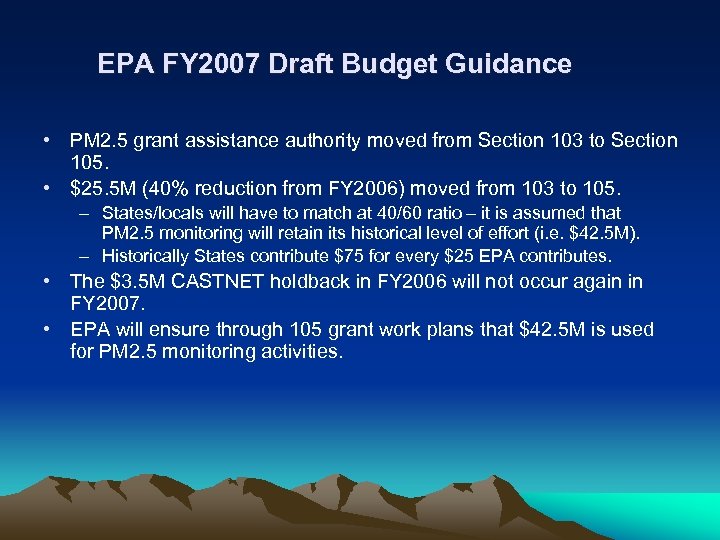
EPA FY 2007 Draft Budget Guidance • PM 2. 5 grant assistance authority moved from Section 103 to Section 105. • $25. 5 M (40% reduction from FY 2006) moved from 103 to 105. – States/locals will have to match at 40/60 ratio – it is assumed that PM 2. 5 monitoring will retain its historical level of effort (i. e. $42. 5 M). – Historically States contribute $75 for every $25 EPA contributes. • The $3. 5 M CASTNET holdback in FY 2006 will not occur again in FY 2007. • EPA will ensure through 105 grant work plans that $42. 5 M is used for PM 2. 5 monitoring activities.

EPA FY 2007 Draft Budget Guidance (cont’d) • No new NCore stations, however States/locals can negotiate NCore start-ups. • Provides operating $ for 35 NCore stations started in FFY 2006. • Increases in PM 2. 5 filter and speciation laboratory costs. • Possible support for ammonia monitoring at some NCore stations (inviting comment). • Continued support for PM 2. 5 continuous speciation stations (inviting comment). • Possible support for daily metals speciation at up to 10 FRM PM 2. 5 sites (inviting comment). • Possible support for supplemental PM 2. 5 speciation sites to support health effects studies (inviting comment). • Possible changes in funding IMPROVE network (inviting comment). • PM 2. 5 (PEP) audit program reduced to $1. 6 M (fewer sites)
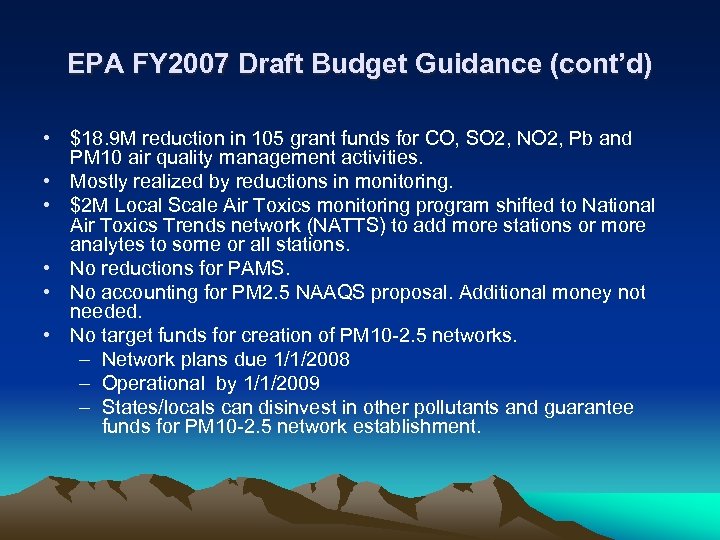
EPA FY 2007 Draft Budget Guidance (cont’d) • $18. 9 M reduction in 105 grant funds for CO, SO 2, NO 2, Pb and PM 10 air quality management activities. • Mostly realized by reductions in monitoring. • $2 M Local Scale Air Toxics monitoring program shifted to National Air Toxics Trends network (NATTS) to add more stations or more analytes to some or all stations. • No reductions for PAMS. • No accounting for PM 2. 5 NAAQS proposal. Additional money not needed. • No target funds for creation of PM 10 -2. 5 networks. – Network plans due 1/1/2008 – Operational by 1/1/2009 – States/locals can disinvest in other pollutants and guarantee funds for PM 10 -2. 5 network establishment.
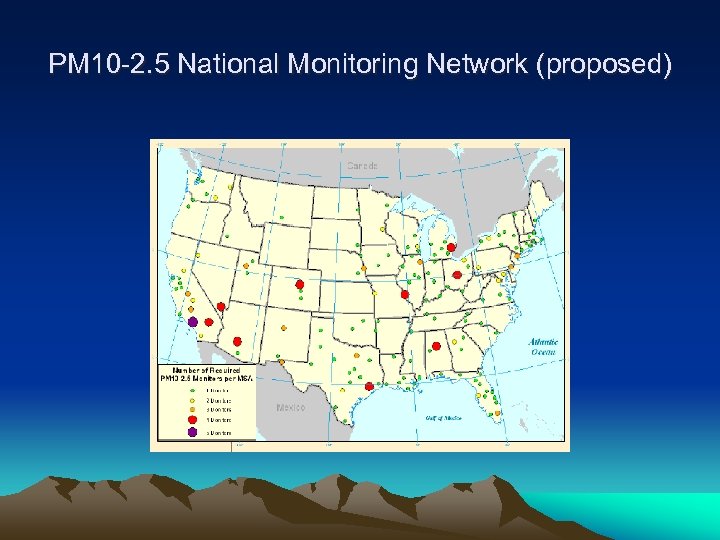
PM 10 -2. 5 National Monitoring Network (proposed)
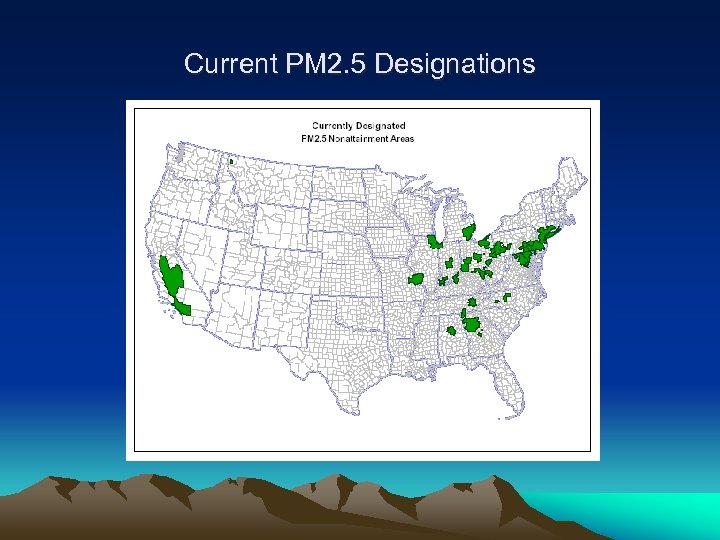
Current PM 2. 5 Designations
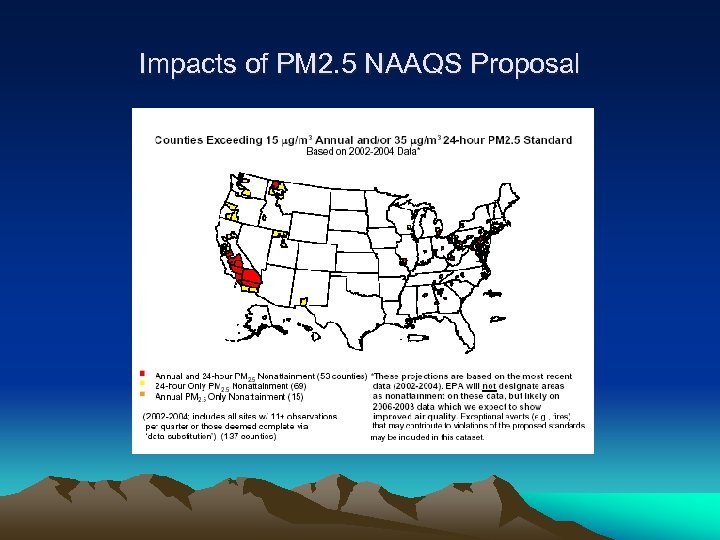
Impacts of PM 2. 5 NAAQS Proposal
STAAPA/ALAPCO ACTIONS on DRAFT GRANT GUIDANCE • Submitted “Impacts of Proposed FY 2007 Budget Cuts on State and Local Air Quality Agencies” to House and Senate Appropriations Committees. – Restore STAG grants to FY 2006 levels ($35. 1 M added). – PM monitoring remain in Section 103. • Held press conference to announce report to public. • Submitted written testimony with budget recommendations to the House Appropriations Subcommittee on Interior, Environment, and Related Agencies. • Urge Senators to sign letter circulating in Senate in support of budget recommendations • Preparing draft comment letter on FY 2007 Grant Guidance. – Circulate to membership for review prior to April 7 deadline.
Скачать презентацию Proposed Revisions to Ambient Air Monitoring Regulations and
366544e2dff2bcbc735fdd316160ac14.ppt