 Скачать презентацию Proposed Companies Bill 2011 4 th October 2011
c56e6ed3f171ca7ef9ccddfad36675be.ppt
- Количество слайдов: 55



Proposed Companies Bill 2011 4 th October 2011 - New Delhi U. K Chaudhary , Senior Advocate Supreme Court of India Presentation By: Manisha Chaudhary Parul Ahuja UKCA Law Chambers www. ukca. in
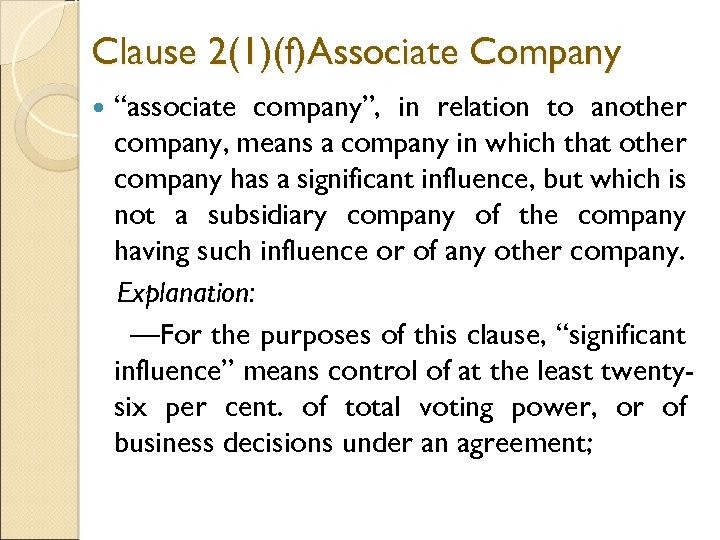
Clause 2(1)(f)Associate Company “associate company”, in relation to another company, means a company in which that other company has a significant influence, but which is not a subsidiary company of the company having such influence or of any other company. Explanation: —For the purposes of this clause, “significant influence” means control of at the least twentysix per cent. of total voting power, or of business decisions under an agreement;
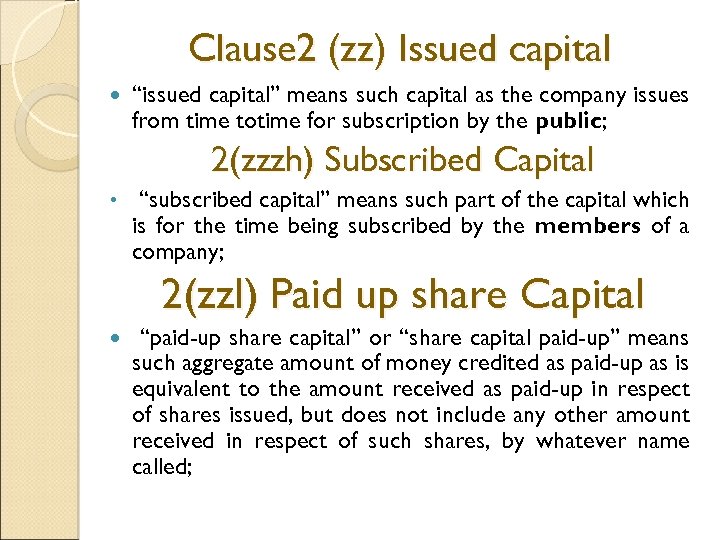
Clause 2 (zz) Issued capital “issued capital” means such capital as the company issues from time totime for subscription by the public; 2(zzzh) Subscribed Capital • “subscribed capital” means such part of the capital which is for the time being subscribed by the members of a company; 2(zzl) Paid up share Capital “paid-up share capital” or “share capital paid-up” means such aggregate amount of money credited as paid-up as is equivalent to the amount received as paid-up in respect of shares issued, but does not include any other amount received in respect of such shares, by whatever name called;
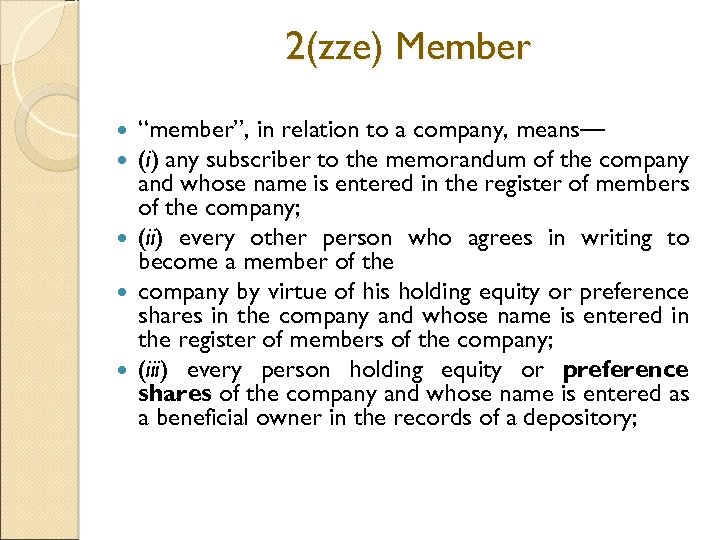
2(zze) Member “member”, in relation to a company, means— (i) any subscriber to the memorandum of the company and whose name is entered in the register of members of the company; (ii) every other person who agrees in writing to become a member of the company by virtue of his holding equity or preference shares in the company and whose name is entered in the register of members of the company; (iii) every person holding equity or preference shares of the company and whose name is entered as a beneficial owner in the records of a depository;
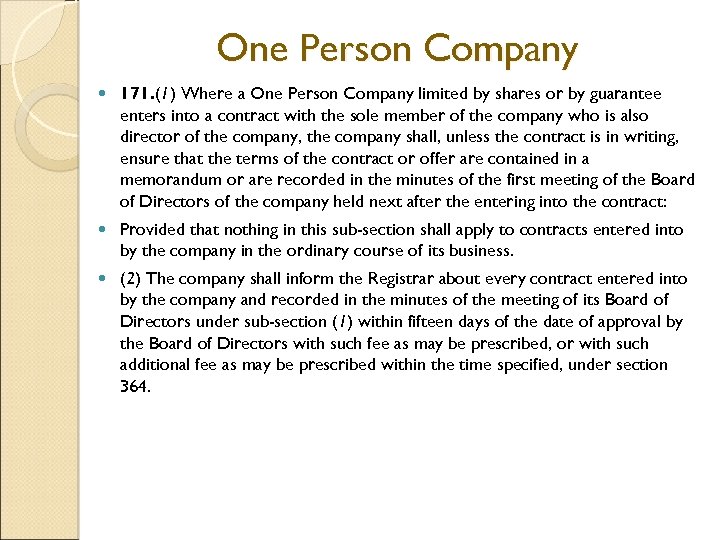
One Person Company 171. (1) Where a One Person Company limited by shares or by guarantee enters into a contract with the sole member of the company who is also director of the company, the company shall, unless the contract is in writing, ensure that the terms of the contract or offer are contained in a memorandum or are recorded in the minutes of the first meeting of the Board of Directors of the company held next after the entering into the contract: Provided that nothing in this sub-section shall apply to contracts entered into by the company in the ordinary course of its business. (2) The company shall inform the Registrar about every contract entered into by the company and recorded in the minutes of the meeting of its Board of Directors under sub-section (1) within fifteen days of the date of approval by the Board of Directors with such fee as may be prescribed, or with such additional fee as may be prescribed within the time specified, under section 364.
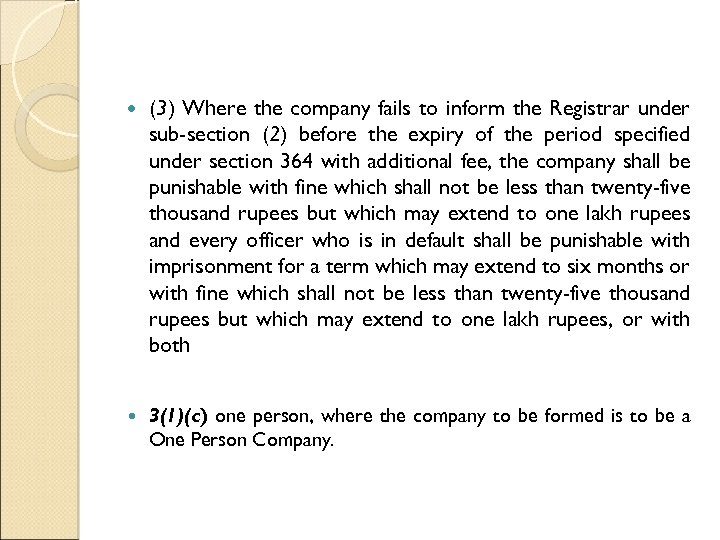
(3) Where the company fails to inform the Registrar under sub-section (2) before the expiry of the period specified under section 364 with additional fee, the company shall be punishable with fine which shall not be less than twenty-five thousand rupees but which may extend to one lakh rupees and every officer who is in default shall be punishable with imprisonment for a term which may extend to six months or with fine which shall not be less than twenty-five thousand rupees but which may extend to one lakh rupees, or with both 3(1)(c) one person, where the company to be formed is to be a One Person Company.

Global Depository Receipts 36 -A company may, after passing a special resolution in its general meeting, issue depository receipts to be dealt with in depository mode in any foreign country in such manner, and subject to such conditions, as may be prescribed.
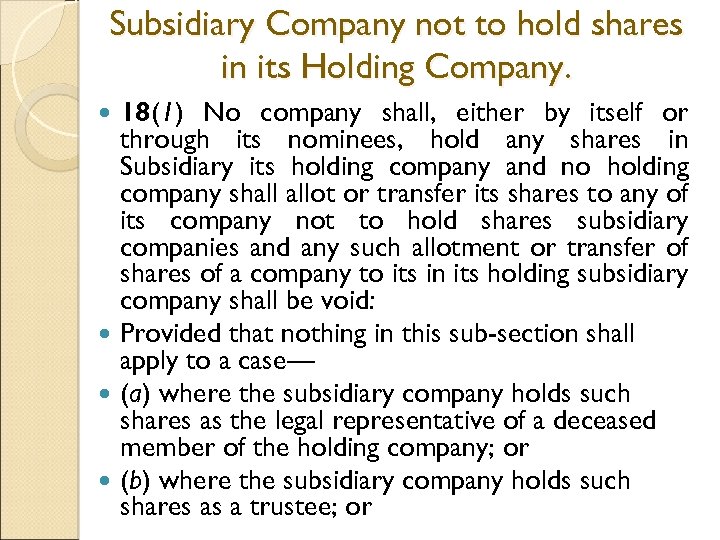
Subsidiary Company not to hold shares in its Holding Company. 18(1) No company shall, either by itself or through its nominees, hold any shares in Subsidiary its holding company and no holding company shall allot or transfer its shares to any of its company not to hold shares subsidiary companies and any such allotment or transfer of shares of a company to its in its holding subsidiary company shall be void: Provided that nothing in this sub-section shall apply to a case— (a) where the subsidiary company holds such shares as the legal representative of a deceased member of the holding company; or (b) where the subsidiary company holds such shares as a trustee; or
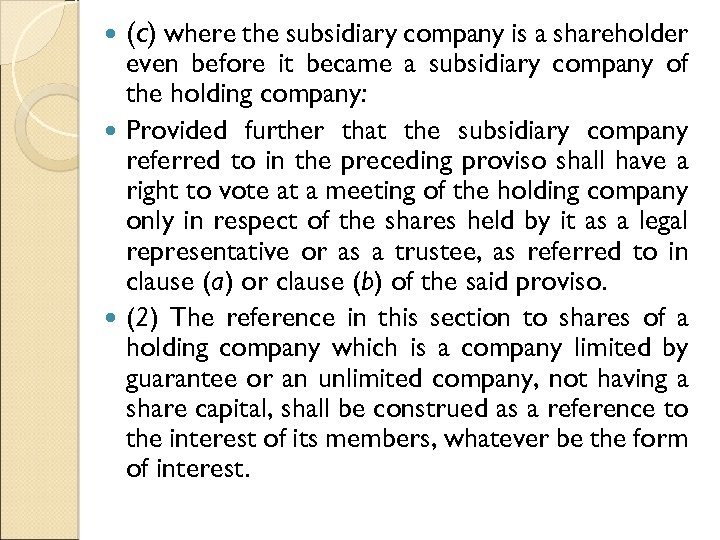
(c) where the subsidiary company is a shareholder even before it became a subsidiary company of the holding company: Provided further that the subsidiary company referred to in the preceding proviso shall have a right to vote at a meeting of the holding company only in respect of the shares held by it as a legal representative or as a trustee, as referred to in clause (a) or clause (b) of the said proviso. (2) The reference in this section to shares of a holding company which is a company limited by guarantee or an unlimited company, not having a share capital, shall be construed as a reference to the interest of its members, whatever be the form of interest.
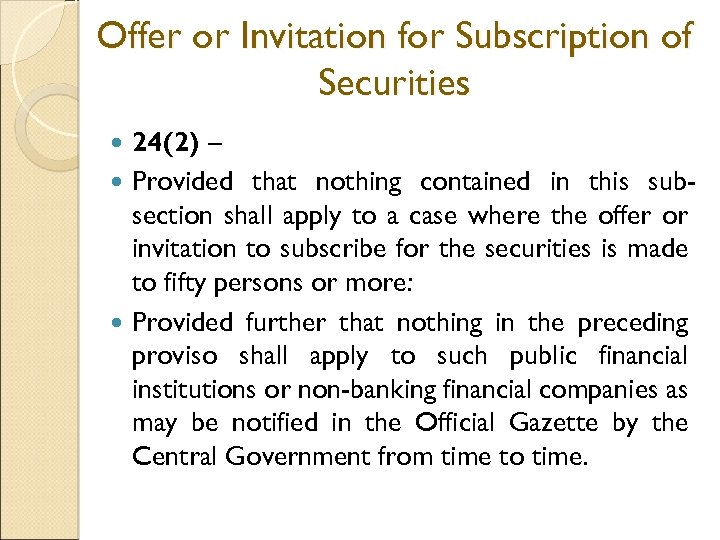
Offer or Invitation for Subscription of Securities 24(2) – Provided that nothing contained in this subsection shall apply to a case where the offer or invitation to subscribe for the securities is made to fifty persons or more: Provided further that nothing in the preceding proviso shall apply to such public financial institutions or non-banking financial companies as may be notified in the Official Gazette by the Central Government from time to time.
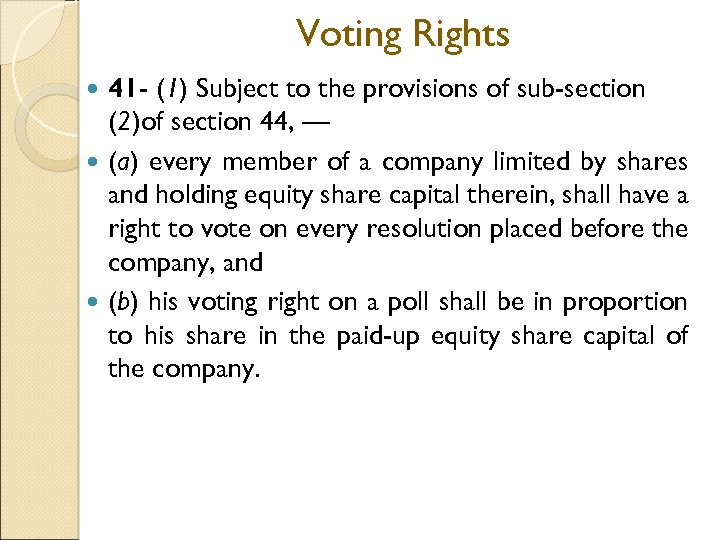
Voting Rights 41 - (1) Subject to the provisions of sub-section (2)of section 44, — (a) every member of a company limited by shares and holding equity share capital therein, shall have a right to vote on every resolution placed before the company, and (b) his voting right on a poll shall be in proportion to his share in the paid-up equity share capital of the company.
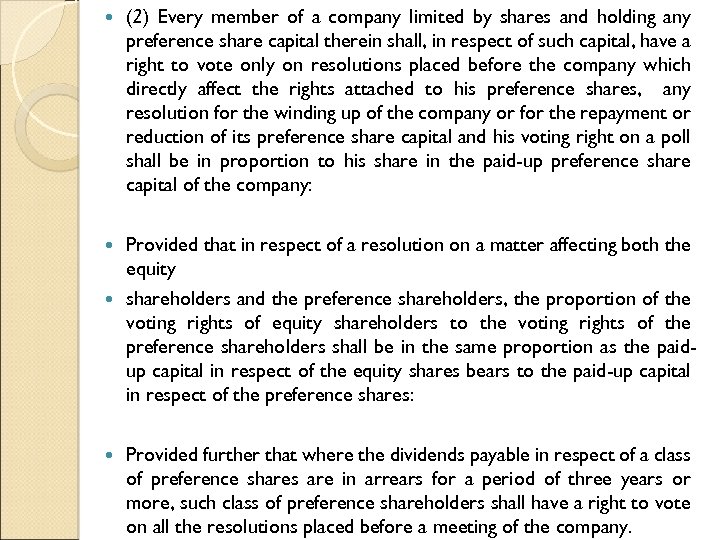
(2) Every member of a company limited by shares and holding any preference share capital therein shall, in respect of such capital, have a right to vote only on resolutions placed before the company which directly affect the rights attached to his preference shares, any resolution for the winding up of the company or for the repayment or reduction of its preference share capital and his voting right on a poll shall be in proportion to his share in the paid-up preference share capital of the company: Provided that in respect of a resolution on a matter affecting both the equity shareholders and the preference shareholders, the proportion of the voting rights of equity shareholders to the voting rights of the preference shareholders shall be in the same proportion as the paidup capital in respect of the equity shares bears to the paid-up capital in respect of the preference shares: Provided further that where the dividends payable in respect of a class of preference shares are in arrears for a period of three years or more, such class of preference shareholders shall have a right to vote on all the resolutions placed before a meeting of the company.
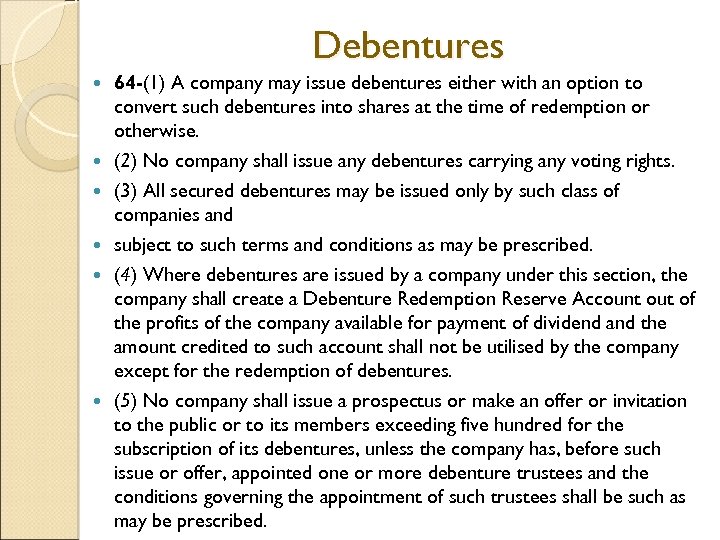
Debentures 64 -(1) A company may issue debentures either with an option to convert such debentures into shares at the time of redemption or otherwise. (2) No company shall issue any debentures carrying any voting rights. (3) All secured debentures may be issued only by such class of companies and subject to such terms and conditions as may be prescribed. (4) Where debentures are issued by a company under this section, the company shall create a Debenture Redemption Reserve Account out of the profits of the company available for payment of dividend and the amount credited to such account shall not be utilised by the company except for the redemption of debentures. (5) No company shall issue a prospectus or make an offer or invitation to the public or to its members exceeding five hundred for the subscription of its debentures, unless the company has, before such issue or offer, appointed one or more debenture trustees and the conditions governing the appointment of such trustees shall be such as may be prescribed.
(6) A debenture trustee shall take steps to protect the interests of the debenture holders and redress their grievances and rules may be made in this behalf. (7) Any provision contained in a trust deed for securing the issue of debentures, or in any contract with the debenture holders secured by a trust deed, shall be void insofar as it would have the effect of exempting a trustee thereof from, or indemnifying him against, any liability for breach of trust, where he fails to show the degree of care and diligence required of him as a trustee, having regard to the provisions of the trust deed conferring on him any power, authority or discretion: Provided that the liability of the debenture trustee shall be subject to such exemptions as may be agreed upon by a majority of debenture holders holding not less than threefourths in value of the total debentures at a meeting held for the purpose. (8) A company shall pay interest and redeem the debentures in accordance with the terms and conditions of their issue. (9) Where at any time the debenture trustee comes to a conclusion that the assets of the company are insufficient or are likely to become insufficient to discharge the principal amount as and when it becomes due, the debenture trustee may file a petition before the Tribunal and the Tribunal may, after hearing the company and any other person interested in the matter, by order, impose such restrictions on the incurring of any further liabilities by the company as the Tribunal may consider necessary in the interests of the debenture holders.
(10) Where a company fails to redeem the debentures on the date of their maturity or fails to pay interest on the debentures when it is due, the Tribunal may, on the application of any or all of the debenture holders, or debenture trustee and, after hearing the parties concerned, direct, by order, the company to redeem the debentures forthwith on payment of principal and interest due thereon. (11) Where any default is made in complying with the order of the Tribunal under this section, every officer of the company who is in default shall be punishable with imprisonment for a term which may extend to three years or with fine which shall not less than two lakh rupees but which may extend to five lakh rupees, or with both. (12) A contract with the company to take up and pay for any debentures of the company may be enforced by a decree for specific performance. (13) The Central Government may prescribe by rules, for securing the issue of debentures, the form of debenture trust deed, the procedure for the debenture holders to inspect the trust deed and to obtain copies thereof and such other matters.
Repayment of Deposits 67 -(1) Where in respect of any deposit accepted by a company before the commencement of this Act, the amount of such deposit or part thereof or any interest due thereon remains unpaid on such commencement or becomes due at any time thereafter, the company shall— (a) file, within a period of three months from such commencement or from the date on which such payments, are due, with the Registrar a statement of all the deposits accepted by the company and sums unpaid on such amount with the interest payable thereon along with the arrangements made for such repayment, notwithstanding anything contained in any other law for the time being in force or under the terms and conditions subject to which the deposit was accepted or any scheme framed under any law; and (b) repay within one year from such commencement or from the date on which such payments are due, whichever is earlier.
(2) The Tribunal may on an application made by the company, after considering the financial condition of the company, the amount of deposit or part thereof and the interest payable thereon and such other matters, allow further time as considered reasonable to the company to repay the deposit. (3) Where a company fails to repay the deposit or part thereof or any interest thereon within the time specified in sub-section (1) or such further time as may be allowed by the Tribunal under sub-section (2), the company shall, in addition to the payment of the amount of deposit or part thereof and the interest due, be or punishable with fine which shall not be less than one crore rupees but which may extend to ten crore rupees and every officer of the company who is in default shall be punishable with imprisonment which may extend to seven years and twentyfive lakh rupees but which may extend to two crore rupees, or with both.
68. (1) Where a company fails to repay the deposit or part thereof or any interest thereon referred to in section 67 within the time specified in sub-section (1) of that section or such further time as may be allowed by the Tribunal under sub-section (2) of that section, and it is proved that the deposits had been accepted with intent to defraud the depositors or for any fraudulent purpose, every officer of the company who was responsible for the acceptance of such deposit shall, without prejudice to the provisions contained in sub-section (3) of that section, be personally responsible, without any limitation of liability, for all or any of the losses or damages that may have been incurred by the depositors. (2) Any suit, proceedings or other action may be taken by any person, group of persons or any association of persons who had incurred any loss as a result of the failure of the company to repay the deposits or part thereof or any interest thereon.
Investor Education and Protection Fund 112. (1)The Central Government shall establish a fund to be called the Investor Education and Protection Fund (hereafter in this section referred to as the Fund). (2)There shall be credited to the Fund – (a)the amount given by the Central Government by way of grants after due appropriation made by Parliament by law in this behalf for being utilised for the purposes of the Fund; (b)donations given to the Fund by the Central Government, State Governments, companies or any other institution for the purposes of the Fund; (c)the amount in the Unpaid Dividend Accounts of companies transferred to the Fund under sub-section (4) of section 111; (d)the amount in the general revenue account of the Central Government which had been transferred to that account under sub-section (5) of section 205 A of the Companies Act, 1956, as it stood immediately before the commencement of the Companies (Amendment) Act, 1999, and remaining unpaid or unclaimed on the commencement of this Act; (e)the amount lying in the Investor Education and Protection Fund under section 205(C) of the Companies Act, 1956;
(f)the interest or other income received out of investments made from the Fund; (g)the amount received under sub-section (4) of section 33; and (h)such other amount as may be prescribed. (3)The Fund shall be utilised for the refund in respect of unclaimed dividends, the application monies due for refund and interest thereon, and promotion of investors’ education, awareness and protection in accordance with such rules as may be prescribed. (4)The Central Government shall constitute, by notification, an authority consisting of a Chairperson, such number of members, not exceeding seven, as the Central Government may appoint and an Administrator who shall be the Chief Executive Officer. (5)The authority shall administer the Fund and maintain separate accounts and other relevant records in relation to the Fund in such form as may be prescribed after consultation with the Comptroller and Auditor-General of India (hereinafter referred to as the Comptroller and Auditor-General). (6)It shall be competent for the authority constituted under sub-section (4) to spend money out of the Fund for carrying out the objects for which the Fund is established.
(7)The accounts of the Fund shall be audited by the Comptroller and Auditor -General at such intervals as may be specified by him and such accounts as certified by the Comptroller and Auditor-General together with the audit report thereon shall be forwarded annually to the Central Government by the authority. (8)The authority shall prepare in such form and at such time for each financial year as may be prescribed its annual report giving a full account of its activities during the financial year and forward a copy thereof to the Central Government and the Central Government shall cause the annual report and the audit report given by the Comptroller and Auditor-General to be laid before each House of Parliament. (9)Any person claiming to be entitled to the amount referred in clauses (c) and (d) of sub-section(1)may apply to the authority for payment of the money claimed.
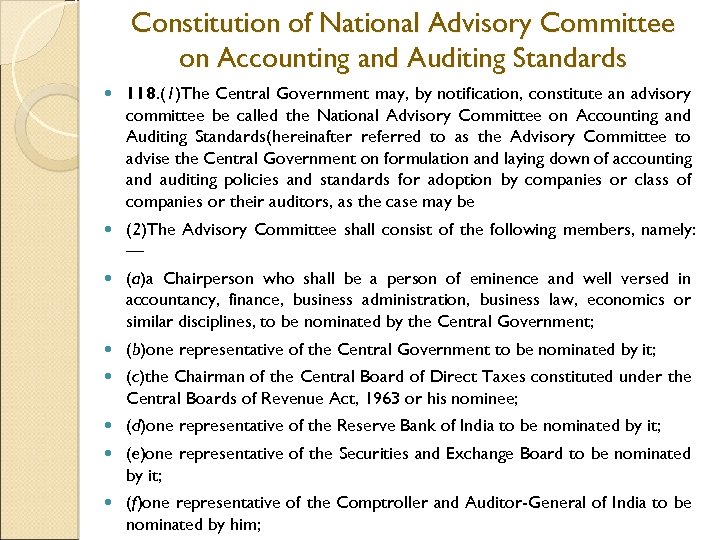
Constitution of National Advisory Committee on Accounting and Auditing Standards 118. (1)The Central Government may, by notification, constitute an advisory committee be called the National Advisory Committee on Accounting and Auditing Standards(hereinafter referred to as the Advisory Committee to advise the Central Government on formulation and laying down of accounting and auditing policies and standards for adoption by companies or class of companies or their auditors, as the case may be (2)The Advisory Committee shall consist of the following members, namely: — (a)a Chairperson who shall be a person of eminence and well versed in accountancy, finance, business administration, business law, economics or similar disciplines, to be nominated by the Central Government; (b)one representative of the Central Government to be nominated by it; (c)the Chairman of the Central Board of Direct Taxes constituted under the Central Boards of Revenue Act, 1963 or his nominee; (d)one representative of the Reserve Bank of India to be nominated by it; (e)one representative of the Securities and Exchange Board to be nominated by it; (f)one representative of the Comptroller and Auditor-General of India to be nominated by him;
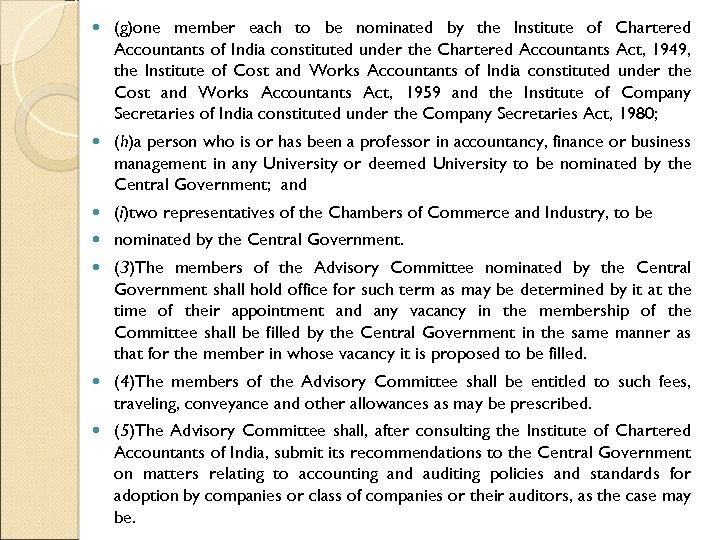
(g)one member each to be nominated by the Institute of Chartered Accountants of India constituted under the Chartered Accountants Act, 1949, the Institute of Cost and Works Accountants of India constituted under the Cost and Works Accountants Act, 1959 and the Institute of Company Secretaries of India constituted under the Company Secretaries Act, 1980; (h)a person who is or has been a professor in accountancy, finance or business management in any University or deemed University to be nominated by the Central Government; and (i)two representatives of the Chambers of Commerce and Industry, to be nominated by the Central Government. (3)The members of the Advisory Committee nominated by the Central Government shall hold office for such term as may be determined by it at the time of their appointment and any vacancy in the membership of the Committee shall be filled by the Central Government in the same manner as that for the member in whose vacancy it is proposed to be filled. (4)The members of the Advisory Committee shall be entitled to such fees, traveling, conveyance and other allowances as may be prescribed. (5)The Advisory Committee shall, after consulting the Institute of Chartered Accountants of India, submit its recommendations to the Central Government on matters relating to accounting and auditing policies and standards for adoption by companies or class of companies or their auditors, as the case may be.
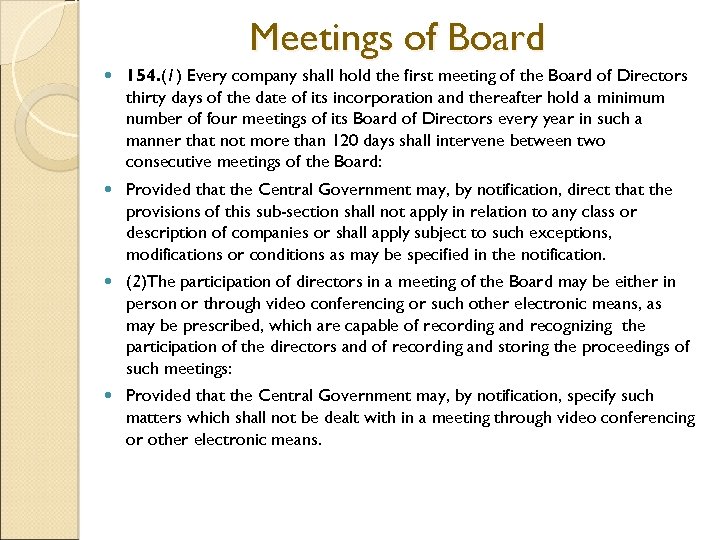
Meetings of Board 154. (1) Every company shall hold the first meeting of the Board of Directors thirty days of the date of its incorporation and thereafter hold a minimum number of four meetings of its Board of Directors every year in such a manner that not more than 120 days shall intervene between two consecutive meetings of the Board: Provided that the Central Government may, by notification, direct that the provisions of this sub-section shall not apply in relation to any class or description of companies or shall apply subject to such exceptions, modifications or conditions as may be specified in the notification. (2)The participation of directors in a meeting of the Board may be either in person or through video conferencing or such other electronic means, as may be prescribed, which are capable of recording and recognizing the participation of the directors and of recording and storing the proceedings of such meetings: Provided that the Central Government may, by notification, specify such matters which shall not be dealt with in a meeting through video conferencing or other electronic means.
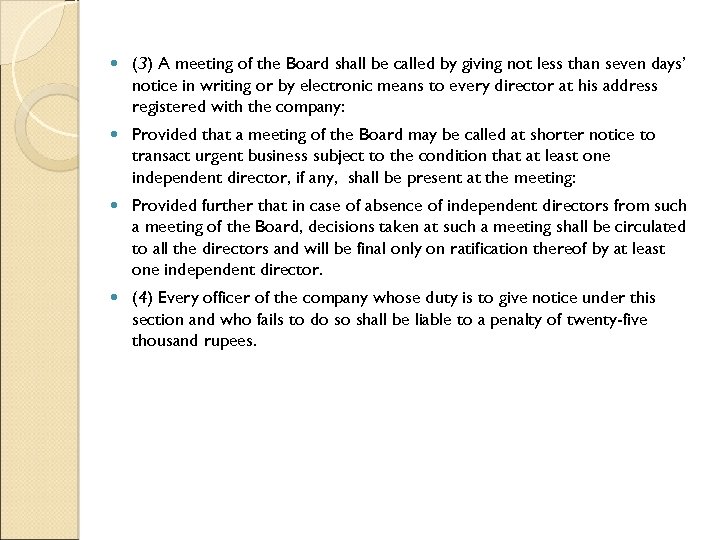
(3) A meeting of the Board shall be called by giving not less than seven days’ notice in writing or by electronic means to every director at his address registered with the company: Provided that a meeting of the Board may be called at shorter notice to transact urgent business subject to the condition that at least one independent director, if any, shall be present at the meeting: Provided further that in case of absence of independent directors from such a meeting of the Board, decisions taken at such a meeting shall be circulated to all the directors and will be final only on ratification thereof by at least one independent director. (4) Every officer of the company whose duty is to give notice under this section and who fails to do so shall be liable to a penalty of twenty-five thousand rupees.
Prohibition-Forward Dealing of Securities 172. (1) No director of a company or any of its key managerial personnel shall buy — (a) a right to call for delivery at a specified price and within a specified time, of a specified number of relevant shares or a specified amount of relevant debentures, (b) a right to make delivery at a specified price and within a specified time, of a specified number of relevant shares or a specified amount of relevant debentures, or (c) a right, as he may elect, to call for delivery at a specified price and within a specified time, or to make delivery at a specified price and within a specified time, of a specified number of relevant shares or a specified amount of relevant debentures. (2) Where a director or any key managerial personnel contravenes the provisions of subsection (1), he shall be punishable with imprisonment for a term which may extend to two years or with fine which shall not be less than twenty-five thousand rupees but which may extend to one lakh rupees, or with both. (3) Where a director or other key managerial personnel acquires any securities in contravention of sub-section (1), he shall, without prejudice to any punishment which maybe imposed under sub-section (2), be liable to surrender the same to the company and the company shall not register the securities so acquired in his name in the register, and if they are in dematerialized form, it shall inform the depository not to record such acquisition. Explanation. —For the purposes of this section, relevant shares and relevant debentures mean shares and debentures of the company in which the concerned person is a wholetime director or other key managerial person or shares and debentures of its holding and subsidiary companies
Freezing of Assets 191. (1) Where it appears to the Tribunal, on a reference made to it by Government or in connection with any inquiry or investigation into the affairs of a company under sections 180 and 183 or on any complaint made by any person in this behalf that the removal, transfer or disposal of funds, assets, properties of the company is likely to take place in a manner that is prejudicial to the interests of the company or its shareholders or creditors or in public interest, it may by order direct that such transfer, removal or disposals hall not take place during such period not exceeding three years as may be specified in the order or may take place subject to such conditions and restrictions as the Tribunal may deem fit. (2) In case of any removal, transfer or disposal of funds, assets, properties of the company in contravention of the order of the Tribunal under sub-section (1), the company shall be punishable with fine which shall not be less than one lakh rupees but which may extend to twenty-five lakh rupees and every officer who is in default shall be punishable with imprisonment for a term which may extend to three years or with fine which shall not be less than twenty-five thousand rupees but which may extend to five lakh rupees, or with both.
Imposition of Restriction upon Securities 192. (1) Where it appears to the Tribunal, in connection with any investigation under section 187 or on a complaint made by any person in this behalf, that there is good reason to find out the relevant facts about any securities issued or to be issued by a company and the Tribunal is of the opinion that such facts cannot be found out unless certain restrictions, as it may deem fit, are imposed, the Tribunal may, by order, direct that the securities shall be subject to such restrictions as it may deem fit for such period not exceeding three years as may be specified in the order. (2) Where securities in any company are issued or transferred or acted upon in contravention of an order of the Tribunal under sub-section (1), the company shall be punishable with fine which shall not be less than one lakh rupees but which may extend to twenty-five lakh rupees and every officer who is in default shall be punishable with imprisonment for a term which may extend to six months or with fine which shall not be less than twenty-five thousand rupees but which may extend to five lakh rupees, or with both.
No Suit or Proceeding Till Submission of Final Report 194. No suit or other proceeding shall lie in any court, tribunal or other authority in respect of any action initiated by the Central Government for making an investigation under this Chapter or for the appointment of an inspector there under and no proceedings of an inspector shall be called in question or stayed by any court, tribunal or other authority on any ground whatsoever until the conclusion of the investigation and the submission of a report by the inspector. Legal Advisors and Bankers not to Disclose 198. Nothing in this Chapter shall require the disclosure to the Tribunal or to the Central Government or to the Registrar or to an inspector appointed by the Central not to Government— (a) by a legal adviser, of any privileged communication made to him in that capacity, except as respects the name and address of his client; or (b) by the bankers of any company, body corporate, or other person, of any information as to the affairs of any of their customers, other than such company, body corporate, or person
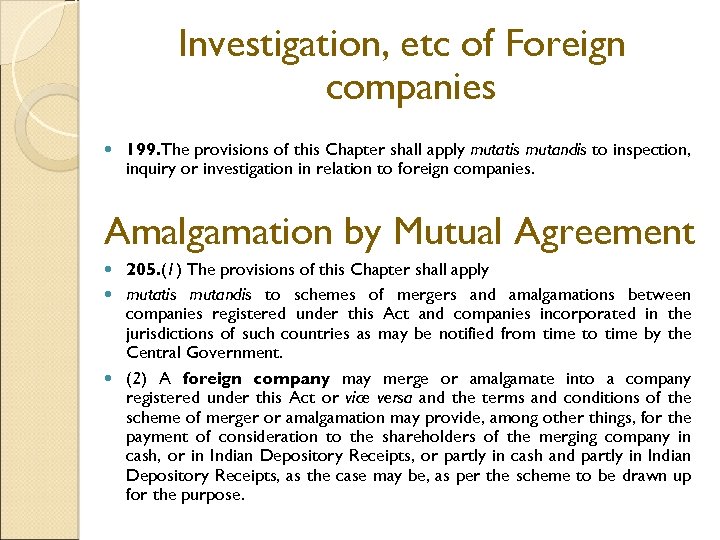
Investigation, etc of Foreign companies 199. The provisions of this Chapter shall apply mutatis mutandis to inspection, inquiry or investigation in relation to foreign companies. Amalgamation by Mutual Agreement 205. (1) The provisions of this Chapter shall apply mutatis mutandis to schemes of mergers and amalgamations between companies registered under this Act and companies incorporated in the jurisdictions of such countries as may be notified from time to time by the Central Government. (2) A foreign company may merge or amalgamate into a company registered under this Act or vice versa and the terms and conditions of the scheme of merger or amalgamation may provide, among other things, for the payment of consideration to the shareholders of the merging company in cash, or in Indian Depository Receipts, or partly in cash and partly in Indian Depository Receipts, as the case may be, as per the scheme to be drawn up for the purpose.

Relief for Oppression and Mismanagement 212. (1) Any member of a company who complains that— (a) the affairs of the company have been or are being conducted in a manner prejudicial to public interest or in a manner prejudicial or oppressive to him or any other member or members; or (b) the material change, not being a change brought about by, or in the interests of, any creditors, including debenture holders or any class of shareholders of the company, has taken place in the management or control of the company, whether by an alteration in the Board of Directors, or manager, or in the ownership of the company’s shares, or if it has no share capital, in its membership, or in any other manner whatsoever, and that by reason of such change, it is likely that the affairs of the company will be conducted in a manner prejudicial to its interests or its members or any class of members , may apply to the Tribunal, provided such member has a right to apply under section 215 for an order under this Chapter. 215 -(Proviso) Provided that the Tribunal may, on an application made to it in this behalf, waive all or any of the requirements specified in clause (a) or clause (b) so as to enable the members to apply under section 212. Explanation. —For the purposes of this sub-section, where any share or shares are held by two or more persons jointly, they shall be counted only as one member. (2) Where members of a company are entitled to make an application under sub-section (1), any one or more of them having obtained the consent in writing of the rest, may make the application on behalf, and for the benefit, of all of them.
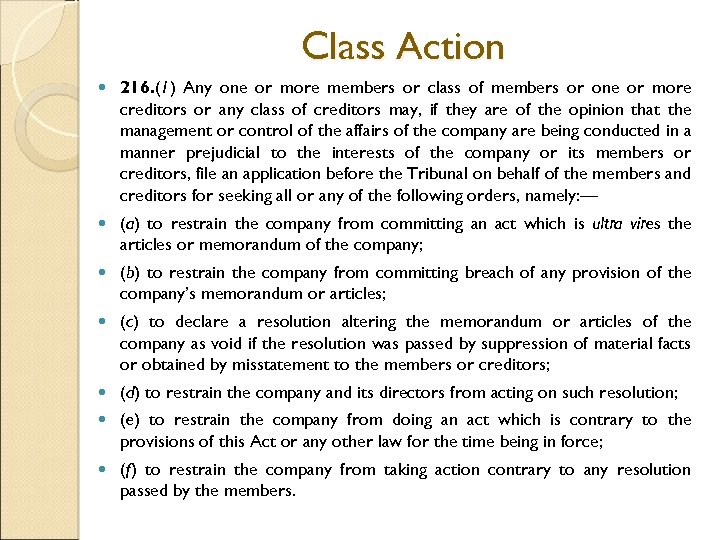
Class Action 216. (1) Any one or more members or class of members or one or more creditors or any class of creditors may, if they are of the opinion that the management or control of the affairs of the company are being conducted in a manner prejudicial to the interests of the company or its members or creditors, file an application before the Tribunal on behalf of the members and creditors for seeking all or any of the following orders, namely: — (a) to restrain the company from committing an act which is ultra vires the articles or memorandum of the company; (b) to restrain the company from committing breach of any provision of the company’s memorandum or articles; (c) to declare a resolution altering the memorandum or articles of the company as void if the resolution was passed by suppression of material facts or obtained by misstatement to the members or creditors; (d) to restrain the company and its directors from acting on such resolution; (e) to restrain the company from doing an act which is contrary to the provisions of this Act or any other law for the time being in force; (f) to restrain the company from taking action contrary to any resolution passed by the members.
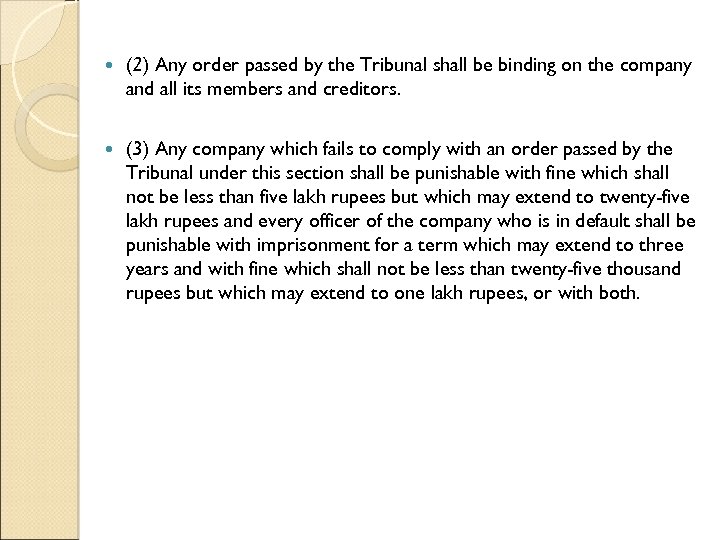
(2) Any order passed by the Tribunal shall be binding on the company and all its members and creditors. (3) Any company which fails to comply with an order passed by the Tribunal under this section shall be punishable with fine which shall not be less than five lakh rupees but which may extend to twenty-five lakh rupees and every officer of the company who is in default shall be punishable with imprisonment for a term which may extend to three years and with fine which shall not be less than twenty-five thousand rupees but which may extend to one lakh rupees, or with both.
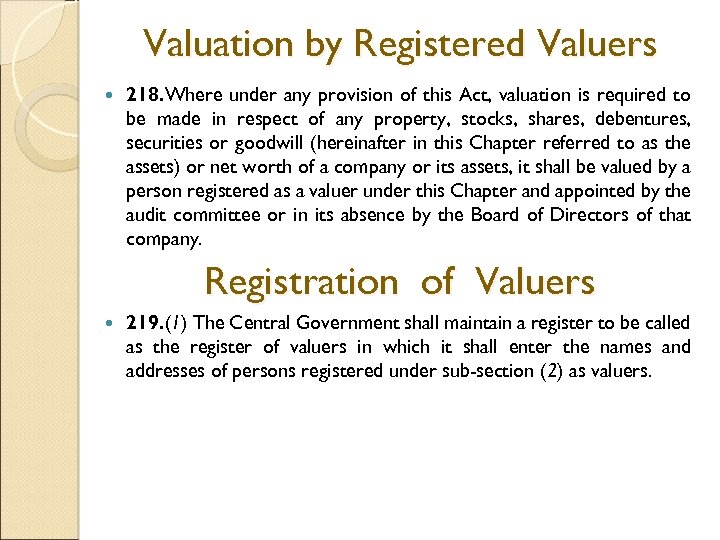
Valuation by Registered Valuers 218. Where under any provision of this Act, valuation is required to be made in respect of any property, stocks, shares, debentures, securities or goodwill (hereinafter in this Chapter referred to as the assets) or net worth of a company or its assets, it shall be valued by a person registered as a valuer under this Chapter and appointed by the audit committee or in its absence by the Board of Directors of that company. Registration of Valuers 219. (1) The Central Government shall maintain a register to be called as the register of valuers in which it shall enter the names and addresses of persons registered under sub-section (2) as valuers.
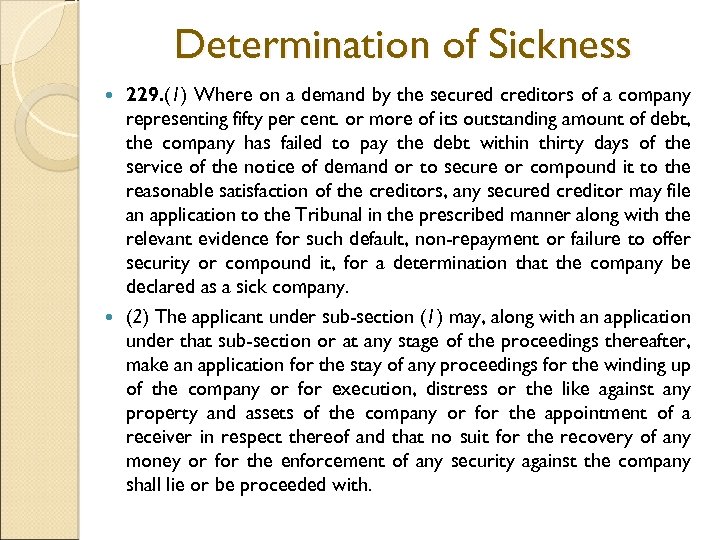
Determination of Sickness 229. (1) Where on a demand by the secured creditors of a company representing fifty per cent. or more of its outstanding amount of debt, the company has failed to pay the debt within thirty days of the service of the notice of demand or to secure or compound it to the reasonable satisfaction of the creditors, any secured creditor may file an application to the Tribunal in the prescribed manner along with the relevant evidence for such default, non-repayment or failure to offer security or compound it, for a determination that the company be declared as a sick company. (2) The applicant under sub-section (1) may, along with an application under that sub-section or at any stage of the proceedings thereafter, make an application for the stay of any proceedings for the winding up of the company or for execution, distress or the like against any property and assets of the company or for the appointment of a receiver in respect thereof and that no suit for the recovery of any money or for the enforcement of any security against the company shall lie or be proceeded with.
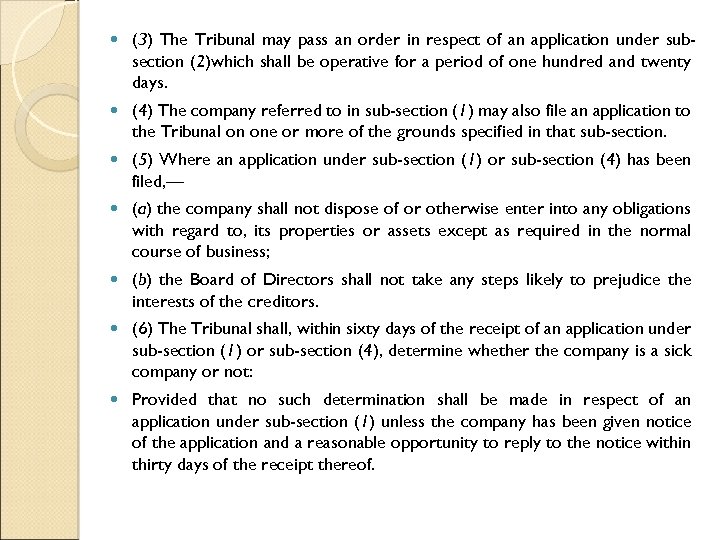
(3) The Tribunal may pass an order in respect of an application under subsection (2)which shall be operative for a period of one hundred and twenty days. (4) The company referred to in sub-section (1) may also file an application to the Tribunal on one or more of the grounds specified in that sub-section. (5) Where an application under sub-section (1) or sub-section (4) has been filed, — (a) the company shall not dispose of or otherwise enter into any obligations with regard to, its properties or assets except as required in the normal course of business; (b) the Board of Directors shall not take any steps likely to prejudice the interests of the creditors. (6) The Tribunal shall, within sixty days of the receipt of an application under sub-section (1) or sub-section (4), determine whether the company is a sick company or not: Provided that no such determination shall be made in respect of an application under sub-section (1) unless the company has been given notice of the application and a reasonable opportunity to reply to the notice within thirty days of the receipt thereof.

Bar of Jurisdiction 243. No appeal shall lie in any court or other authority and no civil court shall have any jurisdiction in respect of any matter in respect of which the Tribunal or the Appellate Tribunal is empowered by or under this Chapter and no injunction shall be granted by any court or other authority in respect of any action taken or proposed to be taken in pursuance of any power conferred by or under this Chapter.
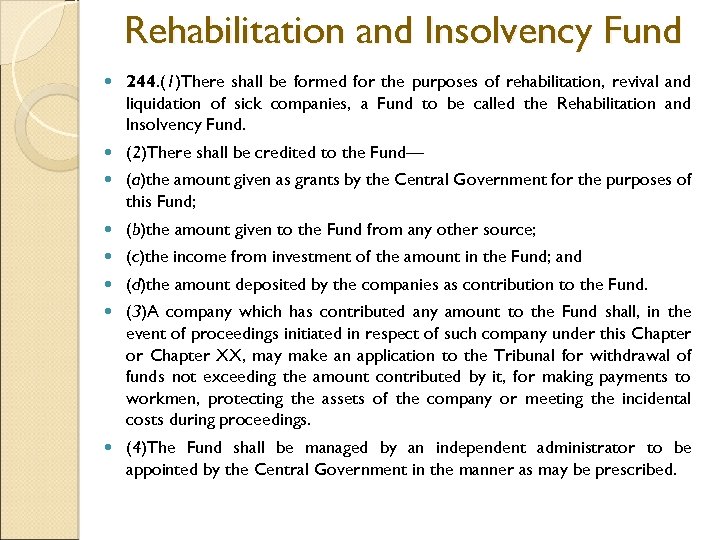
Rehabilitation and Insolvency Fund 244. (1)There shall be formed for the purposes of rehabilitation, revival and liquidation of sick companies, a Fund to be called the Rehabilitation and Insolvency Fund. (2)There shall be credited to the Fund— (a)the amount given as grants by the Central Government for the purposes of this Fund; (b)the amount given to the Fund from any other source; (c)the income from investment of the amount in the Fund; and (d)the amount deposited by the companies as contribution to the Fund. (3)A company which has contributed any amount to the Fund shall, in the event of proceedings initiated in respect of such company under this Chapter or Chapter XX, may make an application to the Tribunal for withdrawal of funds not exceeding the amount contributed by it, for making payments to workmen, protecting the assets of the company or meeting the incidental costs during proceedings. (4)The Fund shall be managed by an independent administrator to be appointed by the Central Government in the manner as may be prescribed.
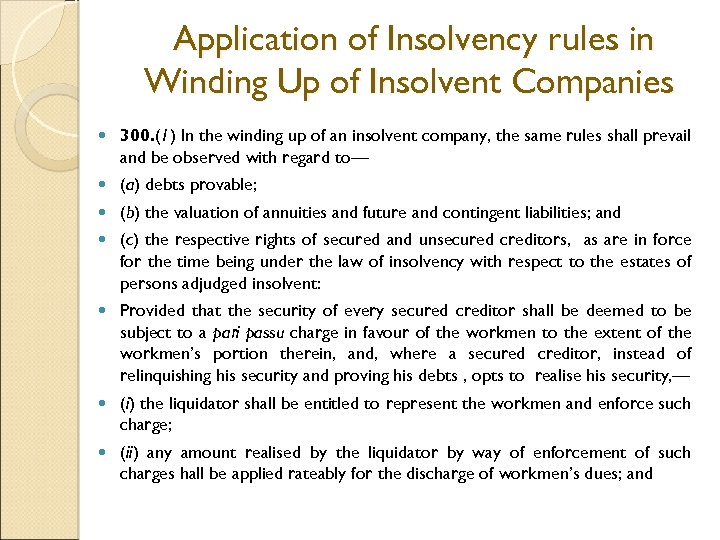
Application of Insolvency rules in Winding Up of Insolvent Companies 300. (1) In the winding up of an insolvent company, the same rules shall prevail and be observed with regard to— (a) debts provable; (b) the valuation of annuities and future and contingent liabilities; and (c) the respective rights of secured and unsecured creditors, as are in force for the time being under the law of insolvency with respect to the estates of persons adjudged insolvent: Provided that the security of every secured creditor shall be deemed to be subject to a pari passu charge in favour of the workmen to the extent of the workmen’s portion therein, and, where a secured creditor, instead of relinquishing his security and proving his debts , opts to realise his security, — (i) the liquidator shall be entitled to represent the workmen and enforce such charge; (ii) any amount realised by the liquidator by way of enforcement of such charges hall be applied rateably for the discharge of workmen’s dues; and
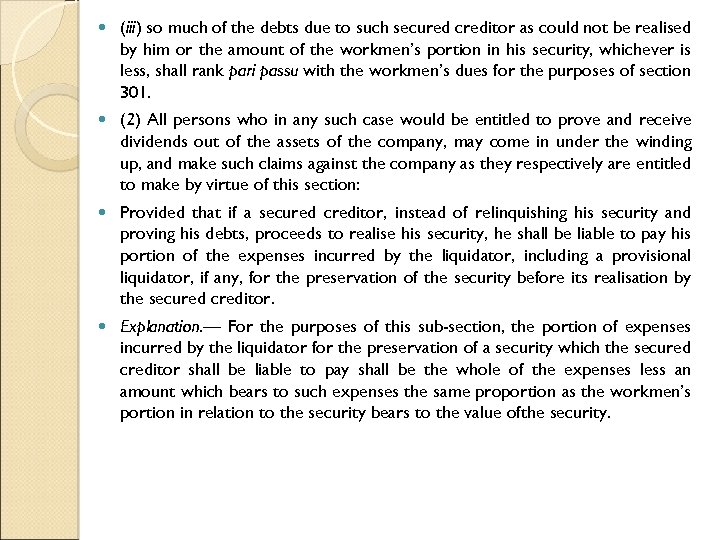
(iii) so much of the debts due to such secured creditor as could not be realised by him or the amount of the workmen’s portion in his security, whichever is less, shall rank pari passu with the workmen’s dues for the purposes of section 301. (2) All persons who in any such case would be entitled to prove and receive dividends out of the assets of the company, may come in under the winding up, and make such claims against the company as they respectively are entitled to make by virtue of this section: Provided that if a secured creditor, instead of relinquishing his security and proving his debts, proceeds to realise his security, he shall be liable to pay his portion of the expenses incurred by the liquidator, including a provisional liquidator, if any, for the preservation of the security before its realisation by the secured creditor. Explanation. — For the purposes of this sub-section, the portion of expenses incurred by the liquidator for the preservation of a security which the secured creditor shall be liable to pay shall be the whole of the expenses less an amount which bears to such expenses the same proportion as the workmen’s portion in relation to the security bears to the value ofthe security.
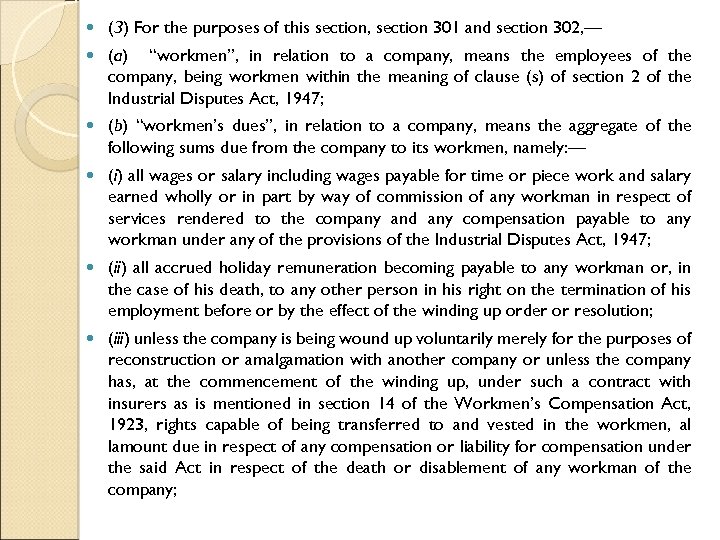
(3) For the purposes of this section, section 301 and section 302, — (a) “workmen’’, in relation to a company, means the employees of the company, being workmen within the meaning of clause (s) of section 2 of the Industrial Disputes Act, 1947; (b) “workmen’s dues’’, in relation to a company, means the aggregate of the following sums due from the company to its workmen, namely: — (i) all wages or salary including wages payable for time or piece work and salary earned wholly or in part by way of commission of any workman in respect of services rendered to the company and any compensation payable to any workman under any of the provisions of the Industrial Disputes Act, 1947; (ii) all accrued holiday remuneration becoming payable to any workman or, in the case of his death, to any other person in his right on the termination of his employment before or by the effect of the winding up order or resolution; (iii) unless the company is being wound up voluntarily merely for the purposes of reconstruction or amalgamation with another company or unless the company has, at the commencement of the winding up, under such a contract with insurers as is mentioned in section 14 of the Workmen’s Compensation Act, 1923, rights capable of being transferred to and vested in the workmen, al lamount due in respect of any compensation or liability for compensation under the said Act in respect of the death or disablement of any workman of the company;
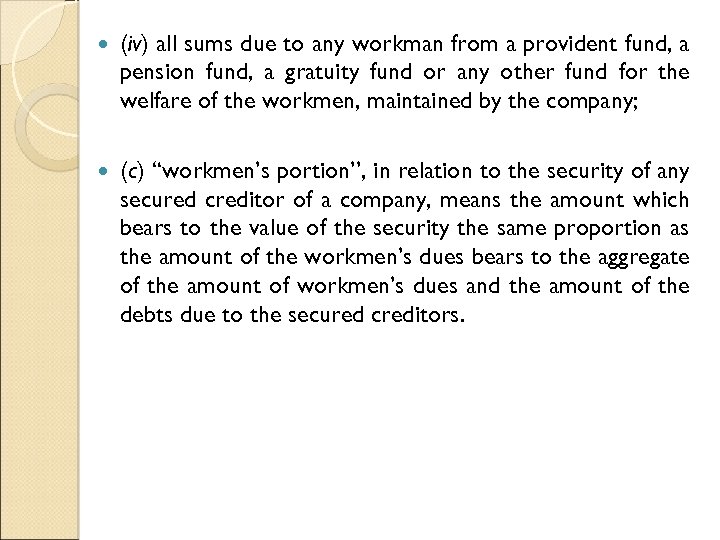
(iv) all sums due to any workman from a provident fund, a pension fund, a gratuity fund or any other fund for the welfare of the workmen, maintained by the company; (c) “workmen’s portion’’, in relation to the security of any secured creditor of a company, means the amount which bears to the value of the security the same proportion as the amount of the workmen’s dues bears to the aggregate of the amount of workmen’s dues and the amount of the debts due to the secured creditors.
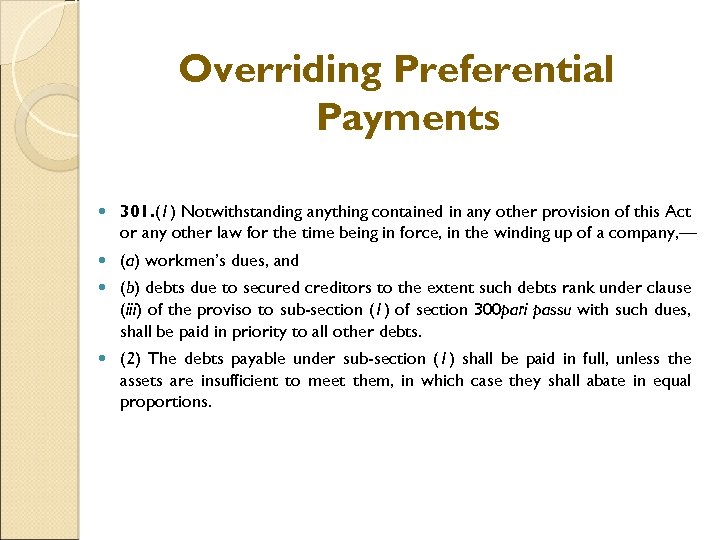
Overriding Preferential Payments 301. (1) Notwithstanding anything contained in any other provision of this Act or any other law for the time being in force, in the winding up of a company, — (a) workmen’s dues, and (b) debts due to secured creditors to the extent such debts rank under clause (iii) of the proviso to sub-section (1) of section 300 pari passu with such dues, shall be paid in priority to all other debts. (2) The debts payable under sub-section (1) shall be paid in full, unless the assets are insufficient to meet them, in which case they shall abate in equal proportions.
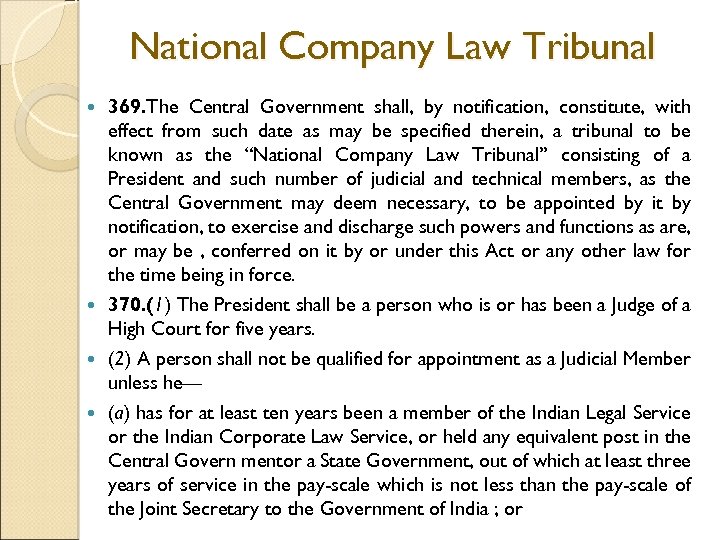
National Company Law Tribunal 369. The Central Government shall, by notification, constitute, with effect from such date as may be specified therein, a tribunal to be known as the “National Company Law Tribunal” consisting of a President and such number of judicial and technical members, as the Central Government may deem necessary, to be appointed by it by notification, to exercise and discharge such powers and functions as are, or may be , conferred on it by or under this Act or any other law for the time being in force. 370. (1) The President shall be a person who is or has been a Judge of a High Court for five years. (2) A person shall not be qualified for appointment as a Judicial Member unless he— (a) has for at least ten years been a member of the Indian Legal Service or the Indian Corporate Law Service, or held any equivalent post in the Central Govern mentor a State Government, out of which at least three years of service in the pay-scale which is not less than the pay-scale of the Joint Secretary to the Government of India ; or
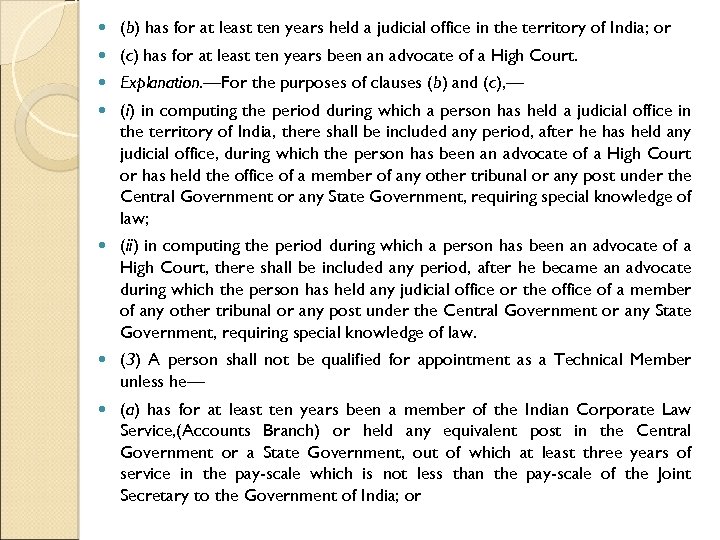
(b) has for at least ten years held a judicial office in the territory of India; or (c) has for at least ten years been an advocate of a High Court. Explanation. —For the purposes of clauses (b) and (c), — (i) in computing the period during which a person has held a judicial office in the territory of India, there shall be included any period, after he has held any judicial office, during which the person has been an advocate of a High Court or has held the office of a member of any other tribunal or any post under the Central Government or any State Government, requiring special knowledge of law; (ii) in computing the period during which a person has been an advocate of a High Court, there shall be included any period, after he became an advocate during which the person has held any judicial office or the office of a member of any other tribunal or any post under the Central Government or any State Government, requiring special knowledge of law. (3) A person shall not be qualified for appointment as a Technical Member unless he— (a) has for at least ten years been a member of the Indian Corporate Law Service, (Accounts Branch) or held any equivalent post in the Central Government or a State Government, out of which at least three years of service in the pay-scale which is not less than the pay-scale of the Joint Secretary to the Government of India; or
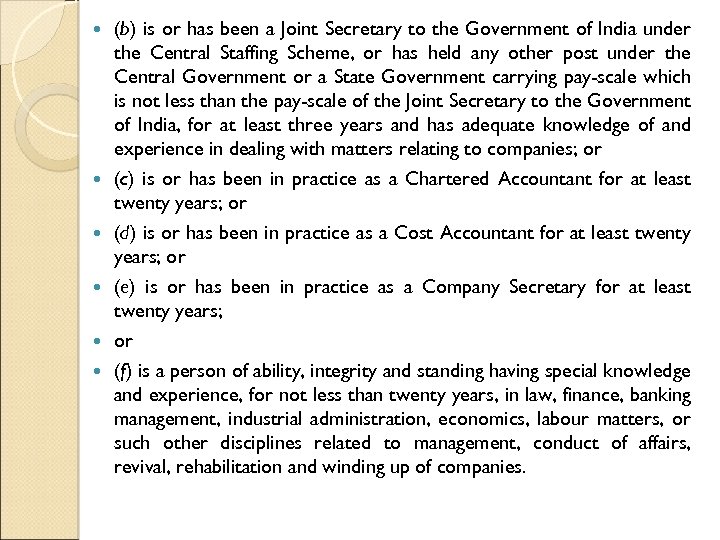
(b) is or has been a Joint Secretary to the Government of India under the Central Staffing Scheme, or has held any other post under the Central Government or a State Government carrying pay-scale which is not less than the pay-scale of the Joint Secretary to the Government of India, for at least three years and has adequate knowledge of and experience in dealing with matters relating to companies; or (c) is or has been in practice as a Chartered Accountant for at least twenty years; or (d) is or has been in practice as a Cost Accountant for at least twenty years; or (e) is or has been in practice as a Company Secretary for at least twenty years; or (f) is a person of ability, integrity and standing having special knowledge and experience, for not less than twenty years, in law, finance, banking management, industrial administration, economics, labour matters, or such other disciplines related to management, conduct of affairs, revival, rehabilitation and winding up of companies.
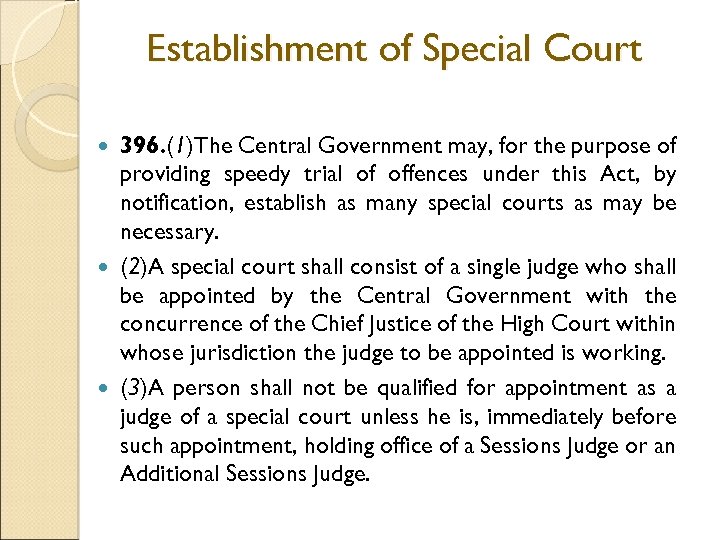
Establishment of Special Court 396. (1)The Central Government may, for the purpose of providing speedy trial of offences under this Act, by notification, establish as many special courts as may be necessary. (2)A special court shall consist of a single judge who shall be appointed by the Central Government with the concurrence of the Chief Justice of the High Court within whose jurisdiction the judge to be appointed is working. (3)A person shall not be qualified for appointment as a judge of a special court unless he is, immediately before such appointment, holding office of a Sessions Judge or an Additional Sessions Judge.
Corporate Social Responsibility Companies Bill will contain provision requiring corporations to disclose to their shareholders whether they have made a 2% contribution to CSR and if not, their reasons for not making the said contribution. Thus, while the disclosure to corporate shareholders may be made mandatory, the actual implementation of the prescribed percentage will not.

Initial Public offer The draft companies Bill , 2011 calls for new provisions to check stock Market trading via initial public offer(IPO) funds. It also suggests that in case there is any deviation from the prospects goals, the investors and minority shareholders must be given right to exit. This means prior nod of Stock Exchange will be must before filling of prospectus.

Equity Shares with Differential Rights The companies may be allowed to issue equity shares with differential rights. Public Deposits The bill suggest that only bigger companies, with net worth of minimum Rs. 500 crore and a turnover of Rs. 1000 crore can accept deposits from the public.

Auditors The auditors firm can be appointed for a maximum for eight years(i. e. two consecutive terms of four years each) and after that there has to be mandatory cooling of four Years. Independent Directors Immunity guidelines stating that an independent director can be nominated on the Board for maximum of two consecutive years(each term of Five years) and after that there has to be cooling off period of three years. It also states that Independent Directors cannot get stock options as part of their remuneration.
Related Party Transactions It states that Directors cannot vote for these or any other transactions where related parties are concerned. Also, there is a proviso for not allowing directors to take loans from companies. It also suggests stricter disclosures for change in promoter stake.
Wages a priority Pending workmen wages will get priority over other creditors-even the secured ones. However, the clause applies for only wages pending over 2 years. Investor Grievance All stakeholders will now be able to move to registrar of Companies(ROC) with investor grievance. And appeals from National Company Law Tribunal will now go to Appellate tribunal and not supreme Court.

Investment Companies It allows the Co. to have up to two layers of Investment Companies but provides relaxation in certain conditions such as for overseas acquisitions.

Thank You For Copies Contact: manisha. chaudhary@ukca. in manishachaudhary@hotmail. com or log on to: www. ukca. in
Скачать презентацию Proposed Companies Bill 2011 4 th October 2011
c56e6ed3f171ca7ef9ccddfad36675be.ppt