 Скачать презентацию Proposed 2018 Mars Astrobiology Explorer-Cacher MAX-C Mission Sept
3576aa0654f0fd44e43d42c611288c88.ppt
- Количество слайдов: 52



Proposed 2018 Mars Astrobiology Explorer-Cacher (MAX-C) Mission Sept. 10, 2009 Presented by Scott Mc. Lennan on behalf of the MEPAG Mid -Range Rover Science Analysis Group (MRR-SAG) Correspondence authors: Lisa Pratt 1, Dave Beaty 2, or Joy Crisp 2 (prattl@indiana. edu, David. Beaty@jpl. nasa. gov, Joy. A. Crisp@jpl. nasa. gov). 1 Indiana University, 2 Jet Propulsion Laboratory, California Institute of Technology Pre-decisional – for Planning and Discussion Purposes Only 1
Abstract The MEPAG MRR-SAG has developed a concept for a Mars mission called Mars Astrobiology Explorer-Cacher (MAX-C), which would: 1. Have an in situ scientific exploration capability necessary to respond to discoveries by prior landers or orbital mapping missions. 2. Collect, document, and cache samples for potential return to Earth by a future mission. 3. Between its in situ functionality and its potential sample return-related functionality, be a key stepping stone to seeking the signs of life on Mars. Pre-decisional – for Planning and Discussion Purposes Only 2
Science Priorities Pre-decisional – for Planning and Discussion Purposes Only 3
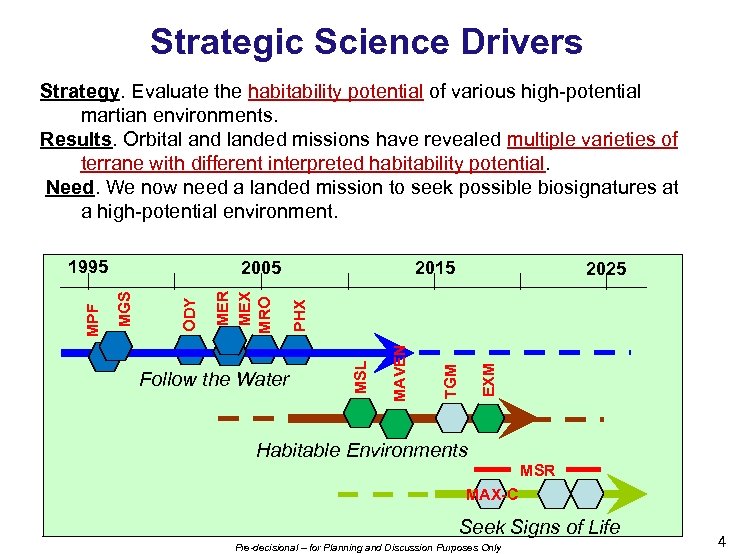
Strategic Science Drivers Strategy. Evaluate the habitability potential of various high-potential martian environments. Results. Orbital and landed missions have revealed multiple varieties of terrane with different interpreted habitability potential. Need. We now need a landed mission to seek possible biosignatures at a high-potential environment. 2025 EXM TGM MAVEN MSL Follow the Water 2015 PHX MER MEX MRO ODY 2005 MGS MPF 1995 Habitable Environments MSR MAX-C Seek Signs of Life Pre-decisional – for Planning and Discussion Purposes Only 4
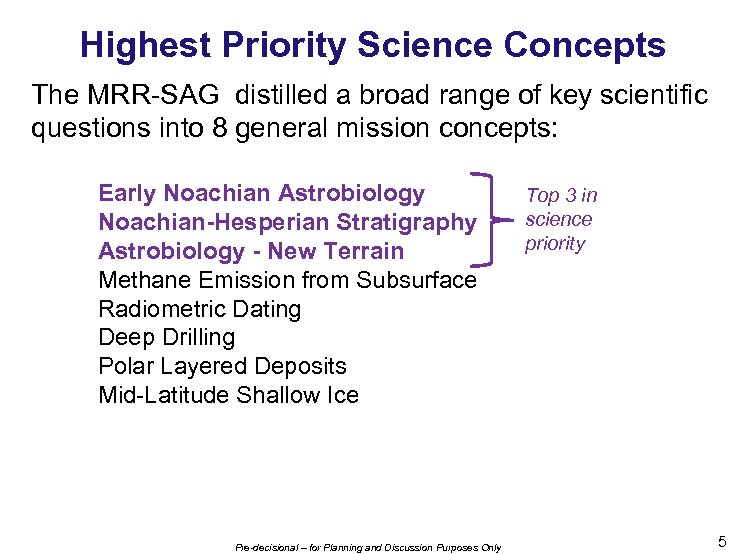
Highest Priority Science Concepts The MRR-SAG distilled a broad range of key scientific questions into 8 general mission concepts: Early Noachian Astrobiology Noachian-Hesperian Stratigraphy Astrobiology - New Terrain Methane Emission from Subsurface Radiometric Dating Deep Drilling Polar Layered Deposits Mid-Latitude Shallow Ice Pre-decisional – for Planning and Discussion Purposes Only Top 3 in science priority 5
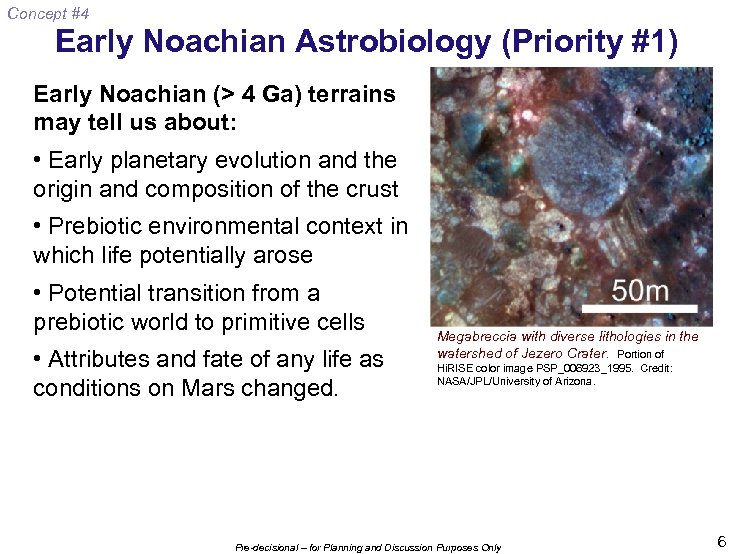
Concept #4 Early Noachian Astrobiology (Priority #1) Early Noachian (> 4 Ga) terrains may tell us about: • Early planetary evolution and the origin and composition of the crust • Prebiotic environmental context in which life potentially arose • Potential transition from a prebiotic world to primitive cells • Attributes and fate of any life as conditions on Mars changed. Megabreccia with diverse lithologies in the watershed of Jezero Crater. Portion of Hi. RISE color image PSP_006923_1995. Credit: NASA/JPL/University of Arizona. Pre-decisional – for Planning and Discussion Purposes Only 6
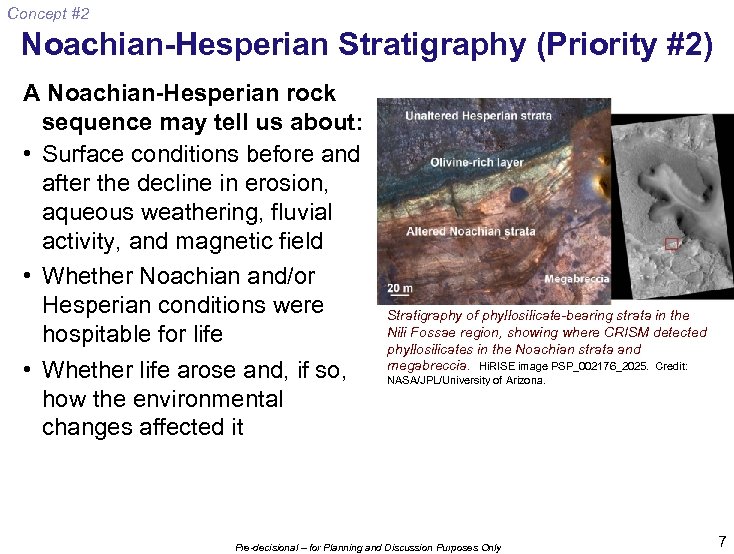
Concept #2 Noachian-Hesperian Stratigraphy (Priority #2) A Noachian-Hesperian rock sequence may tell us about: • Surface conditions before and after the decline in erosion, aqueous weathering, fluvial activity, and magnetic field • Whether Noachian and/or Hesperian conditions were hospitable for life • Whether life arose and, if so, how the environmental changes affected it Stratigraphy of phyllosilicate-bearing strata in the Nili Fossae region, showing where CRISM detected phyllosilicates in the Noachian strata and megabreccia. Hi. RISE image PSP_002176_2025. Credit: NASA/JPL/University of Arizona. Pre-decisional – for Planning and Discussion Purposes Only 7
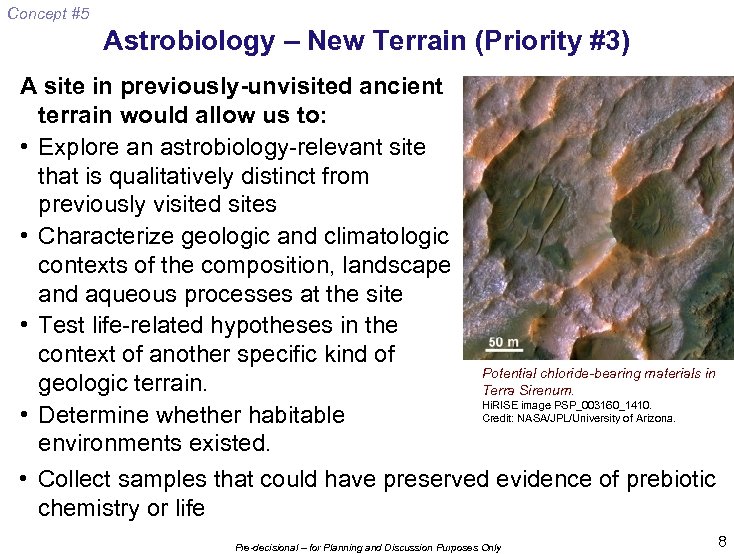
Concept #5 Astrobiology – New Terrain (Priority #3) A site in previously-unvisited ancient terrain would allow us to: • Explore an astrobiology-relevant site that is qualitatively distinct from previously visited sites • Characterize geologic and climatologic contexts of the composition, landscape and aqueous processes at the site • Test life-related hypotheses in the context of another specific kind of Potential chloride-bearing materials in geologic terrain. Terra Sirenum. Hi. RISE image PSP_003160_1410. Credit: NASA/JPL/University of Arizona. • Determine whether habitable environments existed. • Collect samples that could have preserved evidence of prebiotic chemistry or life Pre-decisional – for Planning and Discussion Purposes Only 8
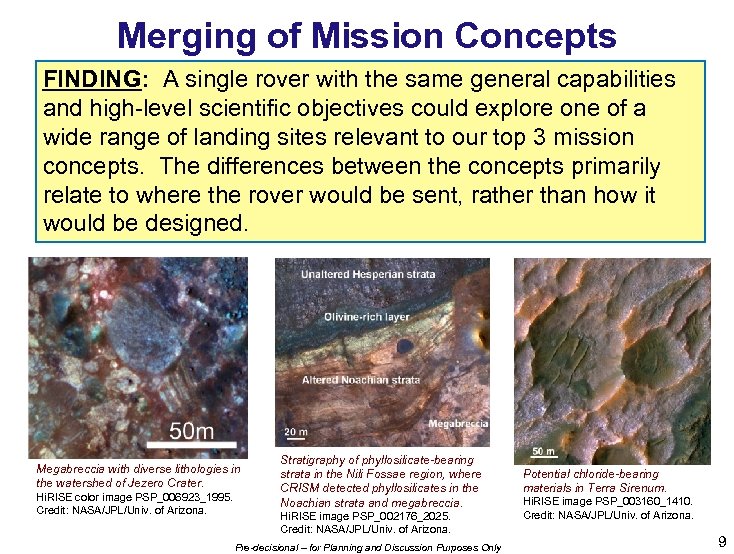
Merging of Mission Concepts FINDING: A single rover with the same general capabilities and high-level scientific objectives could explore one of a wide range of landing sites relevant to our top 3 mission concepts. The differences between the concepts primarily relate to where the rover would be sent, rather than how it would be designed. Megabreccia with diverse lithologies in the watershed of Jezero Crater. Hi. RISE color image PSP_006923_1995. Credit: NASA/JPL/Univ. of Arizona. Stratigraphy of phyllosilicate-bearing strata in the Nili Fossae region, where CRISM detected phyllosilicates in the Noachian strata and megabreccia. Hi. RISE image PSP_002176_2025. Credit: NASA/JPL/Univ. of Arizona. Pre-decisional – for Planning and Discussion Purposes Only Potential chloride-bearing materials in Terra Sirenum. Hi. RISE image PSP_003160_1410. Credit: NASA/JPL/Univ. of Arizona. 9
Proposed in situ Scientific Objectives for the MAX-C Mission Concept At a site interpreted to represent high habitability potential, and with high preservation potential for physical and chemical biosignatures: • evaluate paleo-environmental conditions • characterize the potential for the preservation of biosignatures • access multiple sequences of geological units in a search for possible evidence of ancient life and/or pre-biotic chemistry Pre-decisional – for Planning and Discussion Purposes Only 10
Highest-Priority Possible Secondary Scientific Objectives Landed Atmospheric Science Determine the relationships governing surface/atmosphere interaction through exchange of volatiles (including trace gases), sediment transport, and small-scale atmospheric flows. Paleomagnetics Determine the history of the early Martian magnetic field and its possible connection to climate change, global tectonics, and planetary thermal history. #1 priority of these secondary objectives, with very low mass implications, is monitoring of atmospheric pressure. Pre-decisional – for Planning and Discussion Purposes Only 11
Implementation Strategy to Achieve the Scientific Objectives Pre-decisional – for Planning and Discussion Purposes Only 12
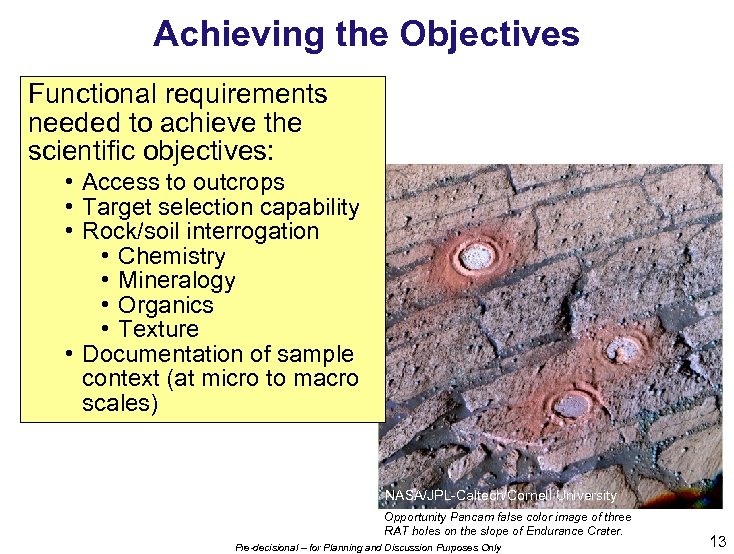
Achieving the Objectives Functional requirements needed to achieve the scientific objectives: • Access to outcrops • Target selection capability • Rock/soil interrogation • Chemistry • Mineralogy • Organics • Texture • Documentation of sample context (at micro to macro scales) NASA/JPL-Caltech/Cornell University Opportunity Pancam false color image of three RAT holes on the slope of Endurance Crater. Pre-decisional – for Planning and Discussion Purposes Only 13
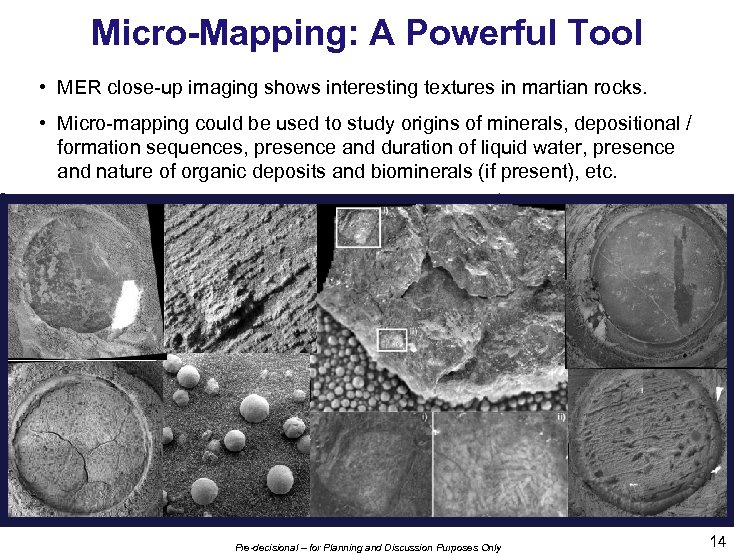
Micro-Mapping: A Powerful Tool • MER close-up imaging shows interesting textures in martian rocks. • Micro-mapping could be used to study origins of minerals, depositional / formation sequences, presence and duration of liquid water, presence and nature of organic deposits and biominerals (if present), etc. Pre-decisional – for Planning and Discussion Purposes Only 14
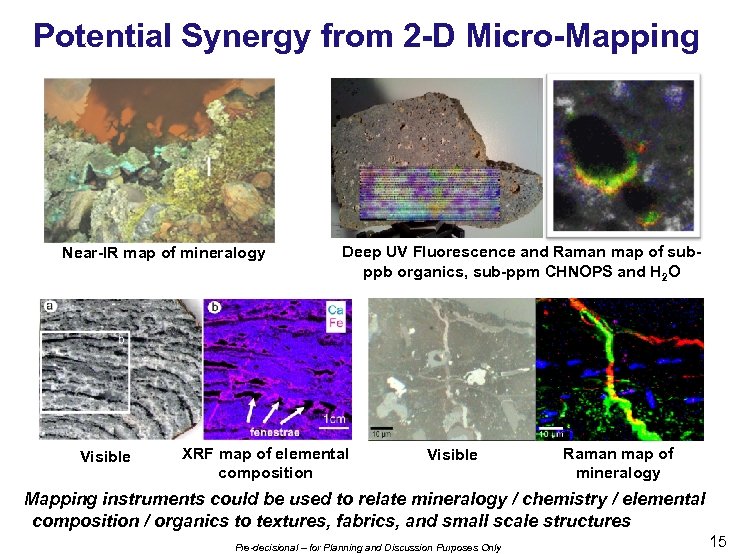
Potential Synergy from 2 -D Micro-Mapping Near-IR map of mineralogy Visible Deep UV Fluorescence and Raman map of subppb organics, sub-ppm CHNOPS and H 2 O XRF map of elemental composition Visible Raman map of mineralogy Mapping instruments could be used to relate mineralogy / chemistry / elemental composition / organics to textures, fabrics, and small scale structures Pre-decisional – for Planning and Discussion Purposes Only 15
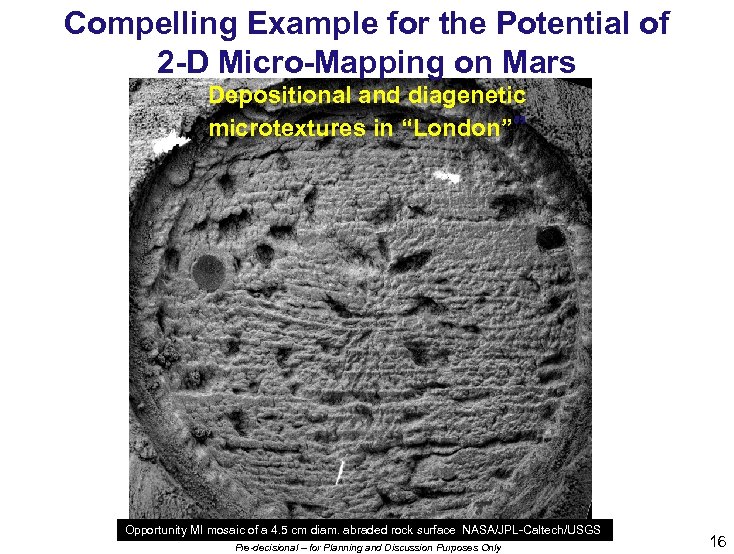
Compelling Example for the Potential of 2 -D Micro-Mapping on Mars Depositional and diagenetic microtextures in “London”” XRF map of elemental composition Visible Opportunity MI mosaic of a 4. 5 cm diam. abraded rock surface NASA/JPL-Caltech/USGS Pre-decisional – for Planning and Discussion Purposes Only 16
Implications of Investigation Strategy Using arm-mounted tools to generate multiple, coregistered, micro-scale data sets could offer several key advantages: • No sample delivery to instruments • Greatly improved scale of focus—critical for recognizing candidate biosignatures on Earth • Multiple data from same features would enable powerful interpretation capability. Some implications: 1. 2. 3. 4. High data volumes Valuable in follow-up to any major MSL discoveries Complementary to Exo. Mars Avoids loss of spatial relationships when samples are powdered for analyses 5. Context documentation is critical for correct interpretations 6. Requires a flat abraded surface Pre-decisional – for Planning and Discussion Purposes Only 17
Potential Contribution to Possible Future Return of Samples to Earth Pre-decisional – for Planning and Discussion Purposes Only 18
Antecedent: ND-SAG Analysis Two key findings related to the concept of sample suites FINDING. Potential future sample return would have its greatest value if the samples are organized into suites that represent the diversity of the products of various planetary processes. • Similarities and differences between samples in a suite could be as important as the absolute characterization of a single sample • The minimum number for a suite: 5 -8 samples. • Examples: Sampling several rock layers in a stratigraphic sequence, sampling along a hydrothermal alteration gradient, sampling both “ordinary” regolith and local variations in an area. FINDING. The collection of suites of rocks would require mobility, the capability to assess the range of variation, and the ability to select samples that span the variation. Pre-decisional – for Planning and Discussion Purposes Only 19
Antecedent: ND-SAG Analysis Science Priorities Evaluated 1. Sample types we are interested in collecting 2. Sample size(s) 3. Number of samples (and overall mass) 4. Sample packaging 5. Sample acquisition system 6. Sample integrity 7. Temperature 8. Sample selectivity, documentation of sample context 9. Issues associated with MSL/Exo. Mars cache 10. Implications regarding site selection a) b) 1 vs 2 sites Planning for surface operations 11. Planetary Protection Issues Critical Science Planning Issues for MAX-C Pre-decisional – for Planning and Discussion Purposes Only 20
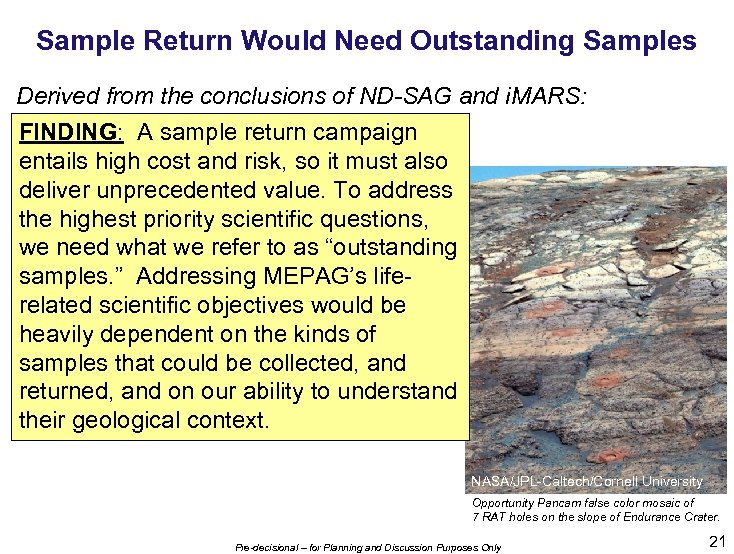
Sample Return Would Need Outstanding Samples Derived from the conclusions of ND-SAG and i. MARS: FINDING: A sample return campaign entails high cost and risk, so it must also deliver unprecedented value. To address the highest priority scientific questions, we need what we refer to as “outstanding samples. ” Addressing MEPAG’s liferelated scientific objectives would be heavily dependent on the kinds of samples that could be collected, and returned, and on our ability to understand their geological context. NASA/JPL-Caltech/Cornell University Opportunity Pancam false color mosaic of 7 RAT holes on the slope of Endurance Crater. Pre-decisional – for Planning and Discussion Purposes Only 21
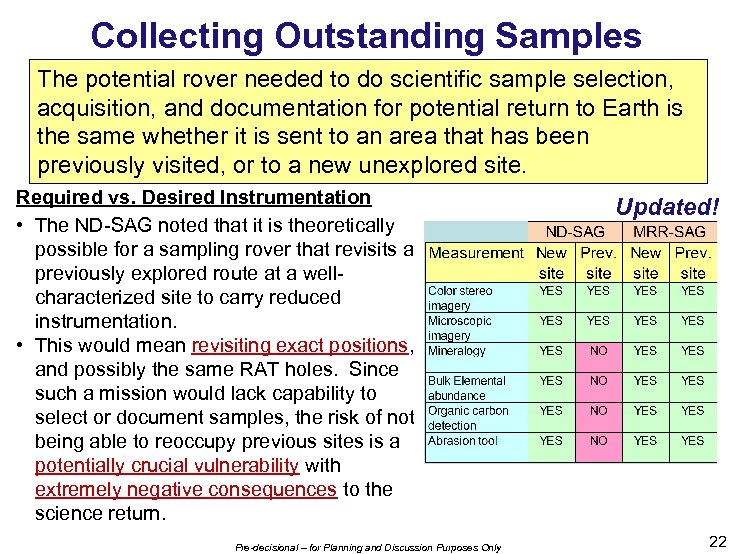
Collecting Outstanding Samples The potential rover needed to do scientific sample selection, acquisition, and documentation for potential return to Earth is the same whether it is sent to an area that has been previously visited, or to a new unexplored site. Required vs. Desired Instrumentation • The ND-SAG noted that it is theoretically possible for a sampling rover that revisits a previously explored route at a wellcharacterized site to carry reduced instrumentation. • This would mean revisiting exact positions, and possibly the same RAT holes. Since such a mission would lack capability to select or document samples, the risk of not being able to reoccupy previous sites is a potentially crucial vulnerability with extremely negative consequences to the science return. Pre-decisional – for Planning and Discussion Purposes Only Updated! 22
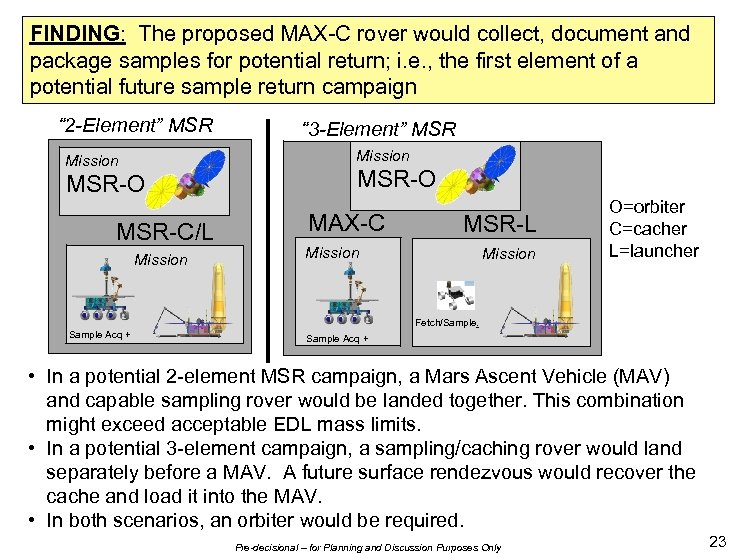
FINDING: The proposed MAX-C rover would collect, document and package samples for potential return; i. e. , the first element of a potential future sample return campaign “ 2 -Element” MSR “ 3 -Element” MSR Mission MSR-O MSR-C/L Mission MSR-O MAX-C MSR-L Mission O=orbiter C=cacher L=launcher Fetch/Sample Acq + • In a potential 2 -element MSR campaign, a Mars Ascent Vehicle (MAV) and capable sampling rover would be landed together. This combination might exceed acceptable EDL mass limits. • In a potential 3 -element campaign, a sampling/caching rover would land separately before a MAV. A future surface rendezvous would recover the cache and load it into the MAV. • In both scenarios, an orbiter would be required. Pre-decisional – for Planning and Discussion Purposes Only 23
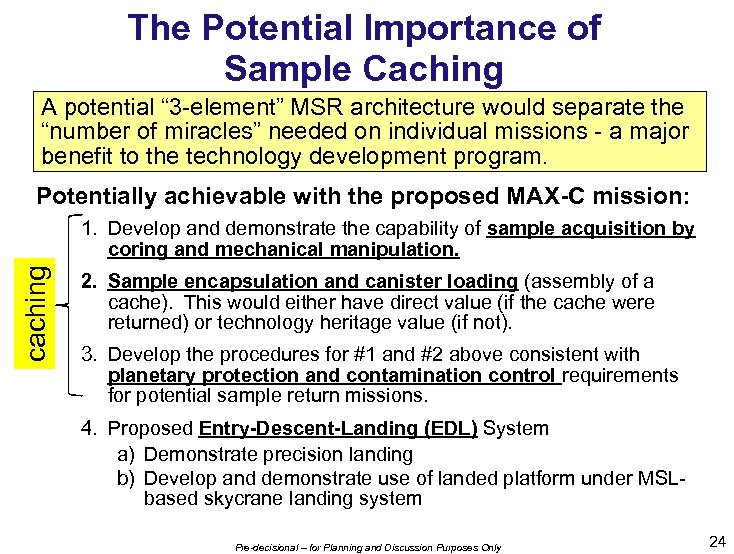
The Potential Importance of Sample Caching A potential “ 3 -element” MSR architecture would separate the “number of miracles” needed on individual missions - a major benefit to the technology development program. Potentially achievable with the proposed MAX-C mission: caching 1. Develop and demonstrate the capability of sample acquisition by coring and mechanical manipulation. 2. Sample encapsulation and canister loading (assembly of a cache). This would either have direct value (if the cache were returned) or technology heritage value (if not). 3. Develop the procedures for #1 and #2 above consistent with planetary protection and contamination control requirements for potential sample return missions. 4. Proposed Entry-Descent-Landing (EDL) System a) Demonstrate precision landing b) Develop and demonstrate use of landed platform under MSLbased skycrane landing system Pre-decisional – for Planning and Discussion Purposes Only 24
Relationship Between in situ Science and Potential Sample Return • The kinds of rocks that would need to be interrogated to achieve the proposed in situ objectives are a class of samples of crucial interest for potential sample return. • The instruments needed to achieve the proposed in situ objectives are the same instruments needed to select samples for potential return to Earth, and to document their context. FINDING: Because of these compelling commonalities, it makes sense to merge these two purposes into one mission. • Samples in addition to those described above are necessary to support other sample return-related objectives (e. g. , igneous petrology/geochemistry, geochronology, etc. ). Pre-decisional – for Planning and Discussion Purposes Only 25
Proposed MAX-C Objectives Primary Science Objectives: At a site interpreted to represent high habitability potential, and with high preservation potential for physical and chemical biosignatures: • evaluate paleo-environmental conditions • characterize the potential for the preservation of biosignatures • access multiple sequences of geological units in a search for possible evidence of ancient life and/or pre-biotic chemistry Samples necessary to achieve the scientific objectives of the proposed future sample return mission would be collected, documented, and packaged in a manner suitable for potential return to Earth. Secondary Science Objective: Address need for long-term atmospheric pressure data from the martian surface. Pre-decisional – for Planning and Discussion Purposes Only 26
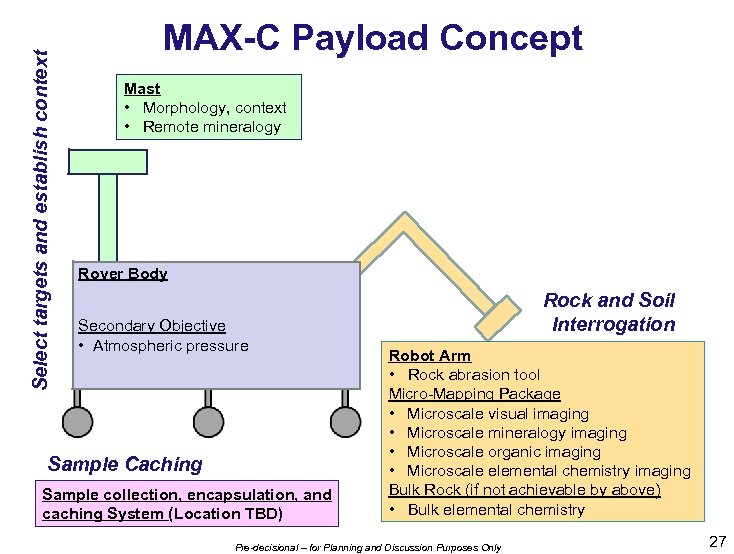
Select targets and establish context MAX-C Payload Concept Mast • Morphology, context • Remote mineralogy Rover Body Secondary Objective • Atmospheric pressure Sample Caching Sample collection, encapsulation, and caching System (Location TBD) Rock and Soil Interrogation Robot Arm • Rock abrasion tool Micro-Mapping Package • Microscale visual imaging • Microscale mineralogy imaging • Microscale organic imaging • Microscale elemental chemistry imaging Bulk Rock (if not achievable by above) • Bulk elemental chemistry Pre-decisional – for Planning and Discussion Purposes Only 27
MAX-C Mission Concept: Landing Site Issues Pre-decisional – for Planning and Discussion Purposes Only 28
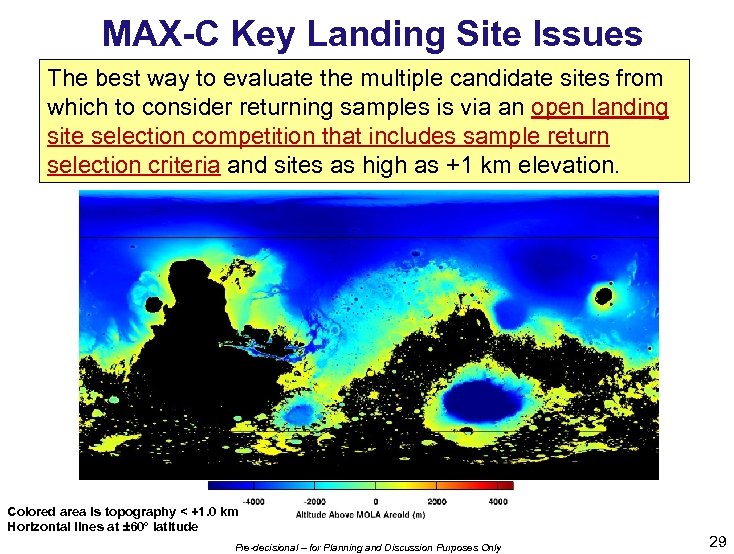
MAX-C Key Landing Site Issues The best way to evaluate the multiple candidate sites from which to consider returning samples is via an open landing site selection competition that includes sample return selection criteria and sites as high as +1 km elevation. Colored area is topography < +1. 0 km Horizontal lines at ± 60º latitude Pre-decisional – for Planning and Discussion Purposes Only 29
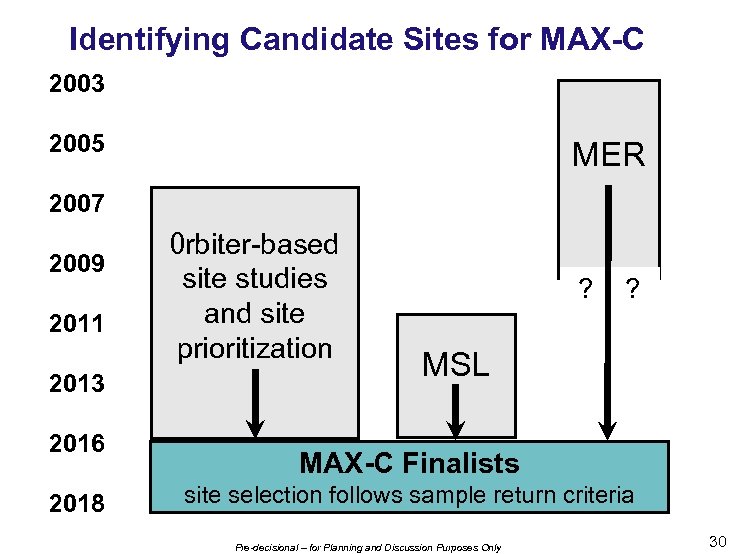
Identifying Candidate Sites for MAX-C 2003 2005 MER 2007 2009 2011 2013 2016 2018 Orbiter-based site studies and site prioritization ? ? MSL MAX-C Finalists site selection follows sample return criteria Pre-decisional – for Planning and Discussion Purposes Only 30
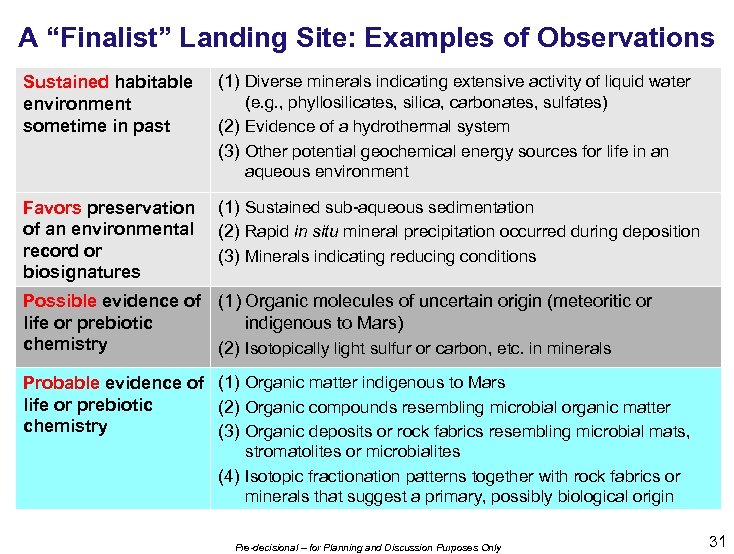
A “Finalist” Landing Site: Examples of Observations Sustained habitable environment sometime in past (1) Diverse minerals indicating extensive activity of liquid water (e. g. , phyllosilicates, silica, carbonates, sulfates) (2) Evidence of a hydrothermal system (3) Other potential geochemical energy sources for life in an aqueous environment Favors preservation of an environmental record or biosignatures (1) Sustained sub-aqueous sedimentation (2) Rapid in situ mineral precipitation occurred during deposition (3) Minerals indicating reducing conditions Possible evidence of (1) Organic molecules of uncertain origin (meteoritic or life or prebiotic indigenous to Mars) chemistry (2) Isotopically light sulfur or carbon, etc. in minerals Probable evidence of (1) Organic matter indigenous to Mars life or prebiotic (2) Organic compounds resembling microbial organic matter chemistry (3) Organic deposits or rock fabrics resembling microbial mats, stromatolites or microbialites (4) Isotopic fractionation patterns together with rock fabrics or minerals that suggest a primary, possibly biological origin Pre-decisional – for Planning and Discussion Purposes Only 31
MAX-C Mission Concept: Engineering Studies (Chris Salvo) Pre-decisional – for Planning and Discussion Purposes Only 32
Status of Implementation Studies • The engineering team has begun conceptual studies (including a full Team X study) to respond to the in situ measurement and sample caching objectives. • The system architecture and infrastructure hardware from Mars Science Laboratory (MSL) form the basis for the studies: – Cruise and EDL portions could be a direct clone of MSL (skycrane landing system). – Rover design likely to be based largely on MSL components, but would entail a new system design tailored to the specific payload. – In the process of assessing straw-man instrument suites and supporting hardware (e. g. coring tool, robotic arm, etc. ). Pre-decisional – for Planning and Discussion Purposes Only 33
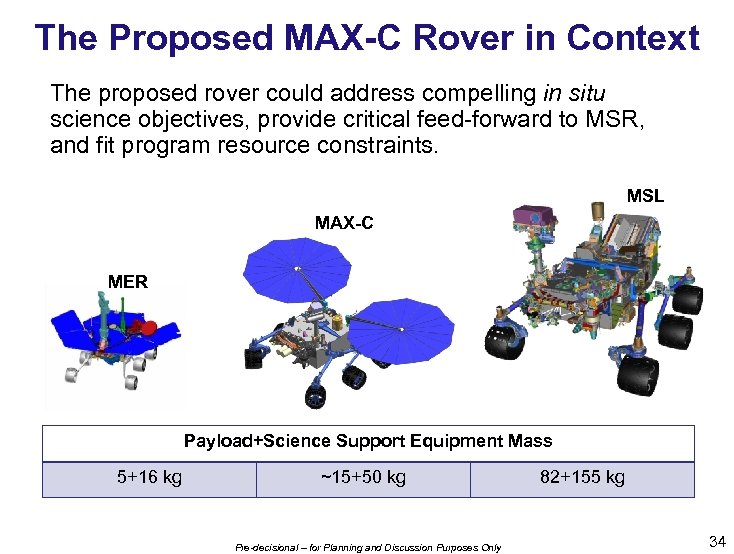
The Proposed MAX-C Rover in Context The proposed rover could address compelling in situ science objectives, provide critical feed-forward to MSR, and fit program resource constraints. MSL MAX-C MER Payload+Science Support Equipment Mass 5+16 kg ~15+50 kg Pre-decisional – for Planning and Discussion Purposes Only 82+155 kg 34
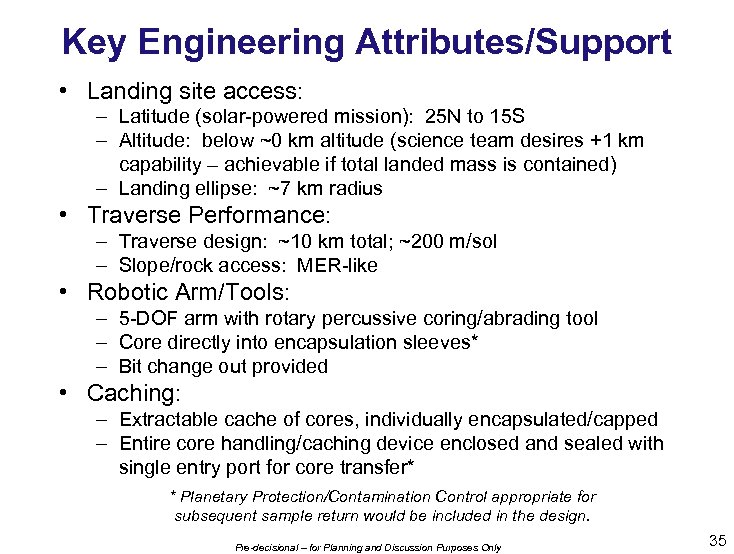
Key Engineering Attributes/Support • Landing site access: – Latitude (solar-powered mission): 25 N to 15 S – Altitude: below ~0 km altitude (science team desires +1 km capability – achievable if total landed mass is contained) – Landing ellipse: ~7 km radius • Traverse Performance: – Traverse design: ~10 km total; ~200 m/sol – Slope/rock access: MER-like • Robotic Arm/Tools: – 5 -DOF arm with rotary percussive coring/abrading tool – Core directly into encapsulation sleeves* – Bit change out provided • Caching: – Extractable cache of cores, individually encapsulated/capped – Entire core handling/caching device enclosed and sealed with single entry port for core transfer* * Planetary Protection/Contamination Control appropriate for subsequent sample return would be included in the design. Pre-decisional – for Planning and Discussion Purposes Only 35
Development Risk and Cost • Cruise and EDL inheritance would minimize cost/risk: – Clone of MSL cruise stage, entry body, and sky-crane landing system. – Huge inheritance from MSL in both flight design and test hardware. • Proposed rover system would be medium risk and medium cost: – New intermediate scale of rover would be a new mechanical and thermal development, based on MSL and MER. – High engineering component heritage from MSL. – Some key new instruments. – Technical challenges: Coring/caching system, fast rover navigation algorithms/hardware, hybrid distributed motor control. • Planetary Protection and Contamination Control would drive an increment of cost and risk (medium). – Technical challenges: Bio-cleaning, cataloguing, and transport modeling. • The MRR-SAG’s cost estimate is in the range of $1. 5 -2. 0 B (RY$ for launch in 2018). Pre-decisional – for Planning and Discussion Purposes Only 36
MAX-C Concept: Summary (Scott Mc. Lennan) Pre-decisional – for Planning and Discussion Purposes Only 37
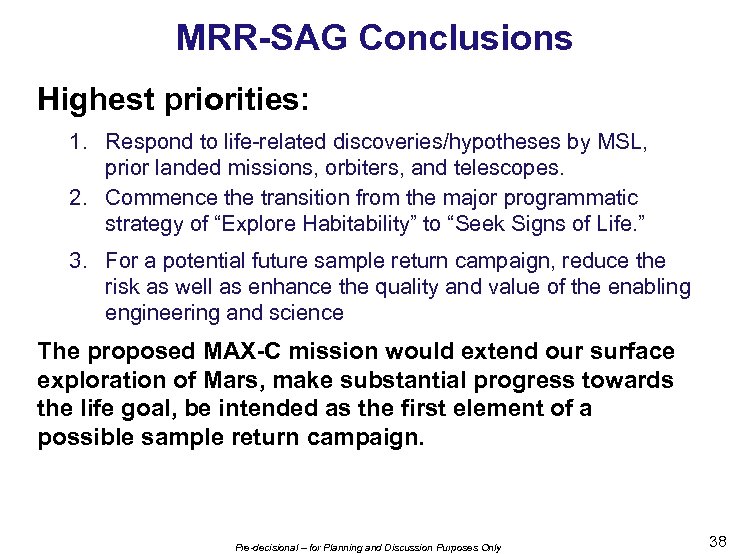
MRR-SAG Conclusions Highest priorities: 1. Respond to life-related discoveries/hypotheses by MSL, prior landed missions, orbiters, and telescopes. 2. Commence the transition from the major programmatic strategy of “Explore Habitability” to “Seek Signs of Life. ” 3. For a potential future sample return campaign, reduce the risk as well as enhance the quality and value of the enabling engineering and science The proposed MAX-C mission would extend our surface exploration of Mars, make substantial progress towards the life goal, be intended as the first element of a possible sample return campaign. Pre-decisional – for Planning and Discussion Purposes Only 38
Backup Slides Pre-decisional – for Planning and Discussion Purposes Only 39
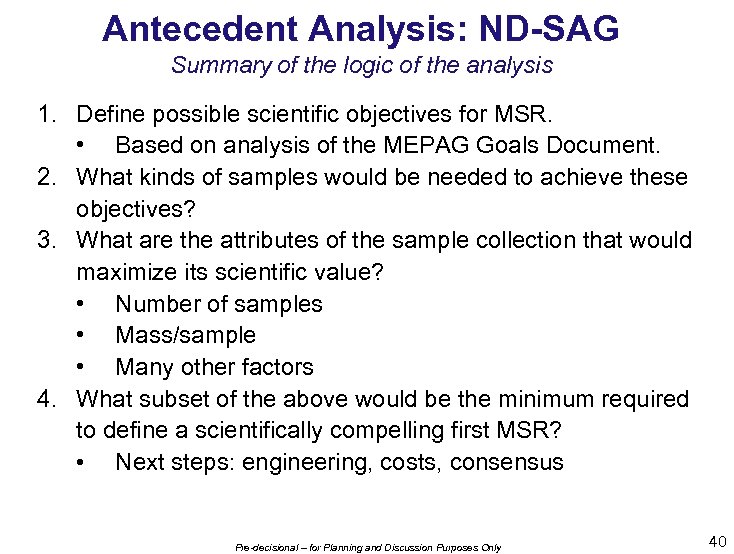
Antecedent Analysis: ND-SAG Summary of the logic of the analysis 1. Define possible scientific objectives for MSR. • Based on analysis of the MEPAG Goals Document. 2. What kinds of samples would be needed to achieve these objectives? 3. What are the attributes of the sample collection that would maximize its scientific value? • Number of samples • Mass/sample • Many other factors 4. What subset of the above would be the minimum required to define a scientifically compelling first MSR? • Next steps: engineering, costs, consensus Pre-decisional – for Planning and Discussion Purposes Only 40
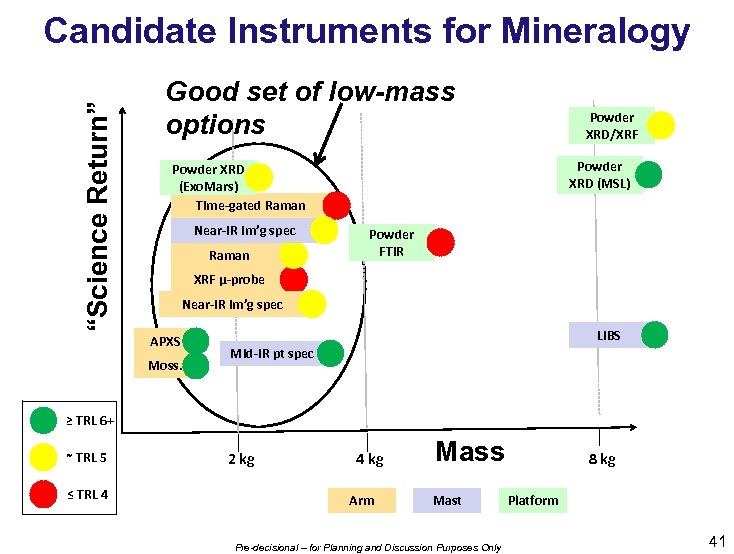
“Science Return” Candidate Instruments for Mineralogy Good set of low-mass options Powder XRD/XRF Powder XRD (MSL) Powder XRD (Exo. Mars) Time-gated Raman Near-IR im’g spec Raman Powder FTIR XRF µ-probe Near-IR im’g spec APXS Moss. LIBS Mid-IR pt spec ≥ TRL 6+ ~ TRL 5 ≤ TRL 4 2 kg 4 kg Arm Mass Mast Pre-decisional – for Planning and Discussion Purposes Only 8 kg Platform 41
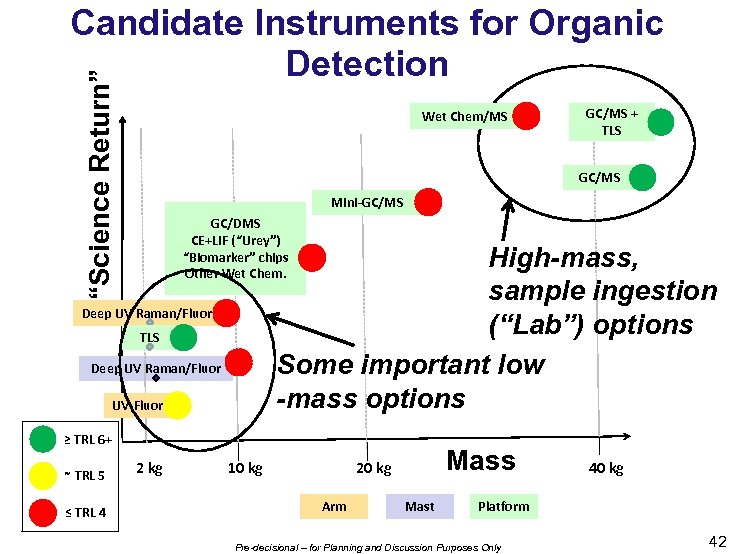
“Science Return” Candidate Instruments for Organic Detection Wet Chem/MS GC/MS Mini-GC/MS GC/DMS CE+LIF (“Urey”) “Biomarker” chips Other Wet Chem. High-mass, sample ingestion (“Lab”) options Some important low -mass options Deep UV Raman/Fluor TLS Deep UV Raman/Fluor UV-Fluor ≥ TRL 6+ ~ TRL 5 ≤ TRL 4 GC/MS + TLS 2 kg 10 kg Mass 20 kg Arm Mast 40 kg Platform Pre-decisional – for Planning and Discussion Purposes Only 42
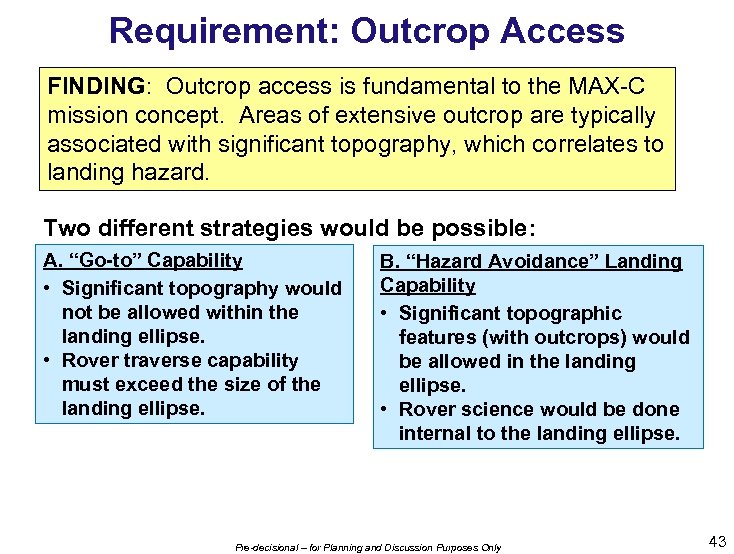
Requirement: Outcrop Access FINDING: Outcrop access is fundamental to the MAX-C mission concept. Areas of extensive outcrop are typically associated with significant topography, which correlates to landing hazard. Two different strategies would be possible: A. “Go-to” Capability • Significant topography would not be allowed within the landing ellipse. • Rover traverse capability must exceed the size of the landing ellipse. B. “Hazard Avoidance” Landing Capability • Significant topographic features (with outcrops) would be allowed in the landing ellipse. • Rover science would be done internal to the landing ellipse. Pre-decisional – for Planning and Discussion Purposes Only 43
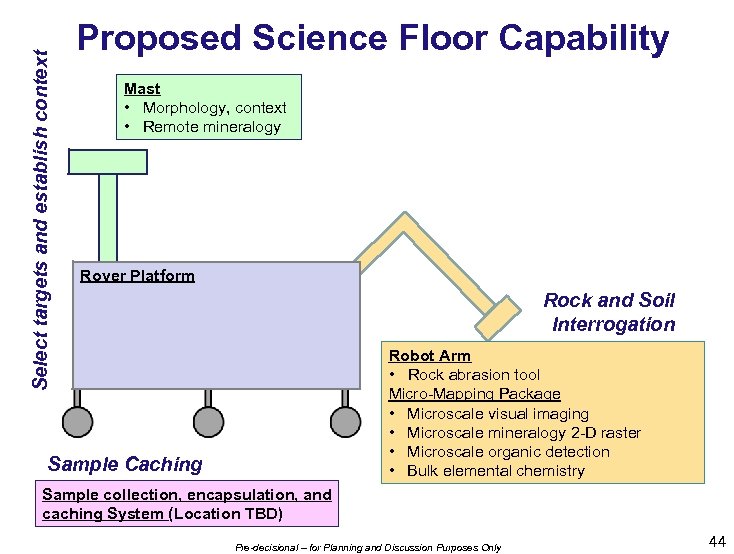
Select targets and establish context Proposed Science Floor Capability Mast • Morphology, context • Remote mineralogy Rover Platform Rock and Soil Interrogation Robot Arm • Rock abrasion tool Micro-Mapping Package • Microscale visual imaging • Microscale mineralogy 2 -D raster • Microscale organic detection • Bulk elemental chemistry Sample Caching Sample collection, encapsulation, and caching System (Location TBD) Pre-decisional – for Planning and Discussion Purposes Only 44
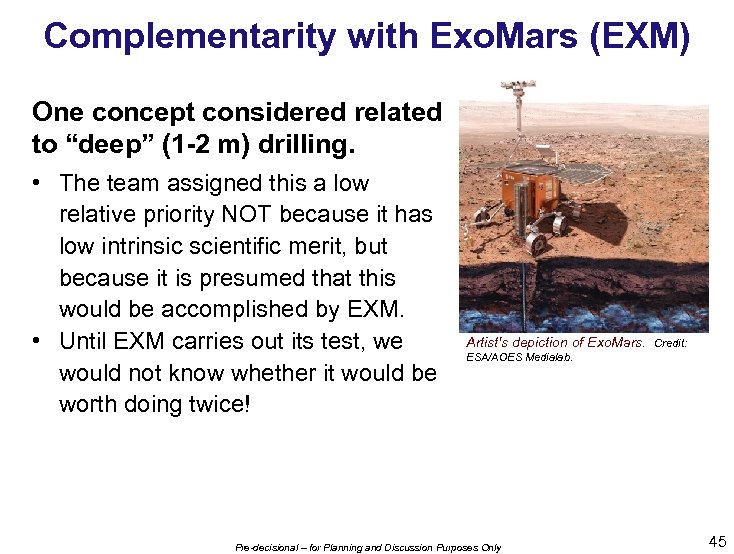
Complementarity with Exo. Mars (EXM) One concept considered related to “deep” (1 -2 m) drilling. • The team assigned this a low relative priority NOT because it has low intrinsic scientific merit, but because it is presumed that this would be accomplished by EXM. • Until EXM carries out its test, we would not know whether it would be worth doing twice! Artist's depiction of Exo. Mars. Credit: ESA/AOES Medialab. Pre-decisional – for Planning and Discussion Purposes Only 45
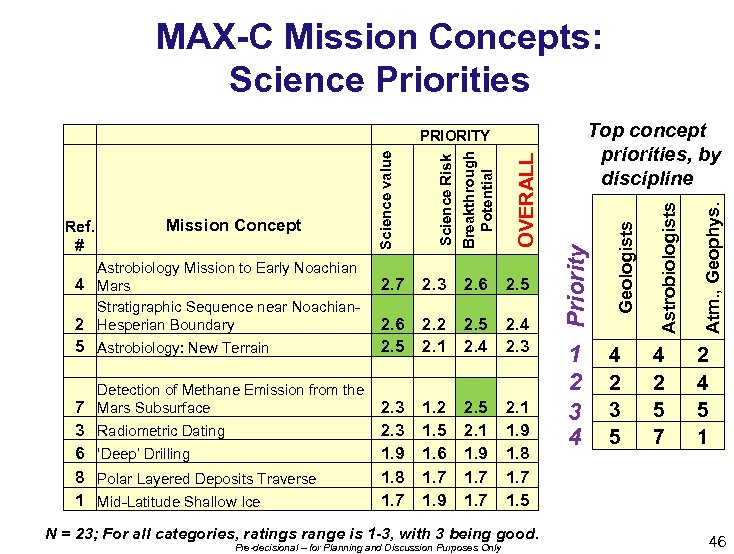
MAX-C Mission Concepts: Science Priorities 5 Astrobiology: New Terrain 2. 5 2. 6 2. 5 2. 2 2. 1 2. 5 2. 4 2. 3 1. 2 1. 5 1. 6 1. 7 1. 9 2. 5 2. 1 1. 9 1. 7 2. 1 1. 9 1. 8 1. 7 1. 5 Detection of Methane Emission from the 7 Mars Subsurface 2. 3 3 6 8 1 Radiometric Dating ‘Deep’ Drilling Polar Layered Deposits Traverse Mid-Latitude Shallow Ice 2. 3 1. 9 1. 8 1. 7 N = 23; For all categories, ratings range is 1 -3, with 3 being good. Pre-decisional – for Planning and Discussion Purposes Only 1 2 3 4 4 2 3 5 4 2 5 7 Atm. , Geophys. 2. 6 Astrobiologists 2. 3 Geologists 2. 7 Priority Astrobiology Mission to Early Noachian 4 Mars Stratigraphic Sequence near Noachian 2 Hesperian Boundary OVERALL Mission Concept Breakthrough Potential Ref. # Top concept priorities, by discipline PRIORITY Science Risk Science value 2 4 5 1 46
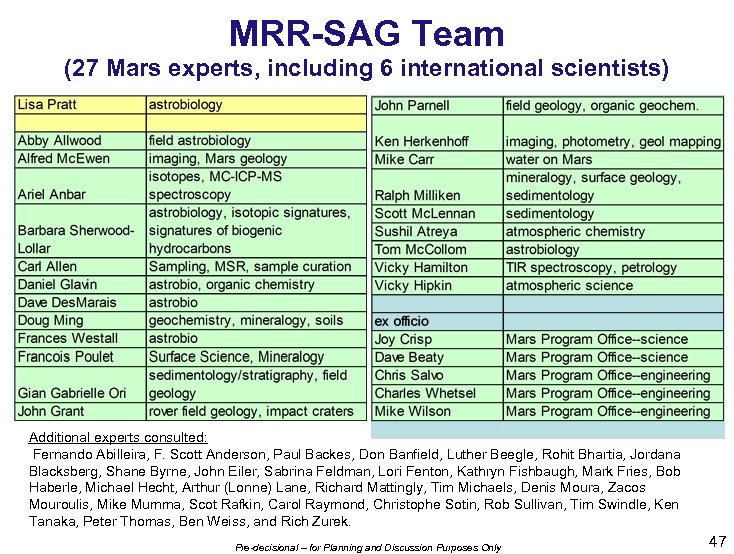
MRR-SAG Team (27 Mars experts, including 6 international scientists) Additional experts consulted: Fernando Abilleira, F. Scott Anderson, Paul Backes, Don Banfield, Luther Beegle, Rohit Bhartia, Jordana Blacksberg, Shane Byrne, John Eiler, Sabrina Feldman, Lori Fenton, Kathryn Fishbaugh, Mark Fries, Bob Haberle, Michael Hecht, Arthur (Lonne) Lane, Richard Mattingly, Tim Michaels, Denis Moura, Zacos Mouroulis, Mike Mumma, Scot Rafkin, Carol Raymond, Christophe Sotin, Rob Sullivan, Tim Swindle, Ken Tanaka, Peter Thomas, Ben Weiss, and Rich Zurek. Pre-decisional – for Planning and Discussion Purposes Only 47
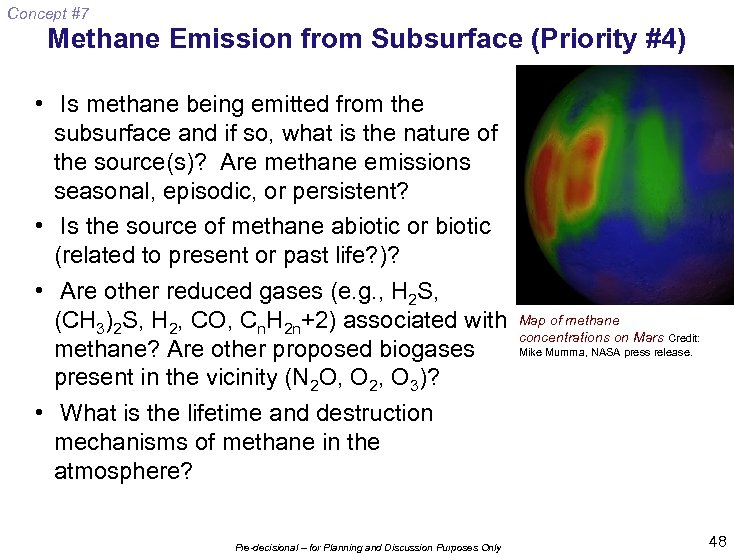
Concept #7 Methane Emission from Subsurface (Priority #4) • Is methane being emitted from the subsurface and if so, what is the nature of the source(s)? Are methane emissions seasonal, episodic, or persistent? • Is the source of methane abiotic or biotic (related to present or past life? )? • Are other reduced gases (e. g. , H 2 S, (CH 3)2 S, H 2, CO, Cn. H 2 n+2) associated with Map of methane concentrations on Mars Credit: Mike Mumma, NASA press release. methane? Are other proposed biogases present in the vicinity (N 2 O, O 2, O 3)? • What is the lifetime and destruction mechanisms of methane in the atmosphere? Pre-decisional – for Planning and Discussion Purposes Only 48
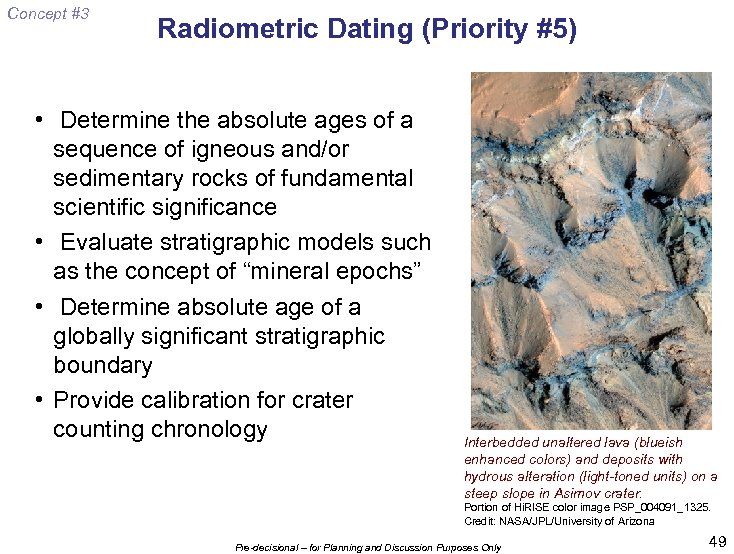
Concept #3 Radiometric Dating (Priority #5) • Determine the absolute ages of a sequence of igneous and/or sedimentary rocks of fundamental scientific significance • Evaluate stratigraphic models such as the concept of “mineral epochs” • Determine absolute age of a globally significant stratigraphic boundary • Provide calibration for crater counting chronology Interbedded unaltered lava (blueish enhanced colors) and deposits with hydrous alteration (light-toned units) on a steep slope in Asimov crater. Portion of Hi. RISE color image PSP_004091_1325. Credit: NASA/JPL/University of Arizona Pre-decisional – for Planning and Discussion Purposes Only 49
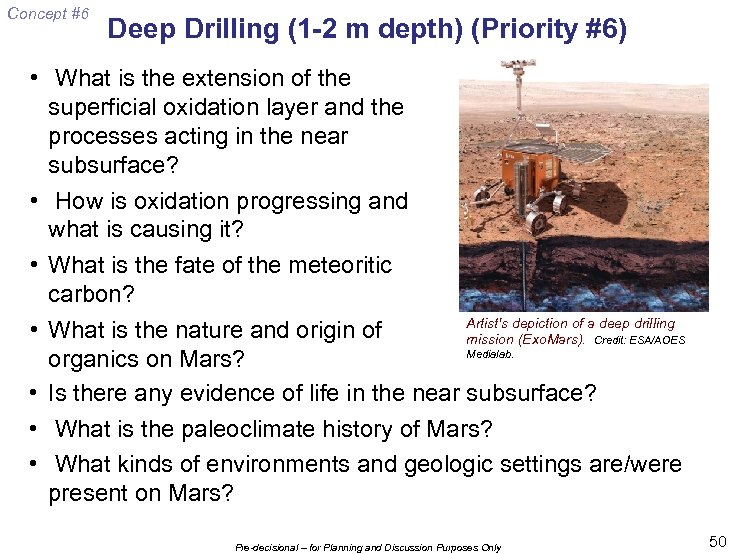
Concept #6 Deep Drilling (1 -2 m depth) (Priority #6) • What is the extension of the superficial oxidation layer and the processes acting in the near subsurface? • How is oxidation progressing and what is causing it? • What is the fate of the meteoritic carbon? Artist's depiction of a deep drilling • What is the nature and origin of mission (Exo. Mars). Credit: ESA/AOES Medialab. organics on Mars? • Is there any evidence of life in the near subsurface? • What is the paleoclimate history of Mars? • What kinds of environments and geologic settings are/were present on Mars? Pre-decisional – for Planning and Discussion Purposes Only 50
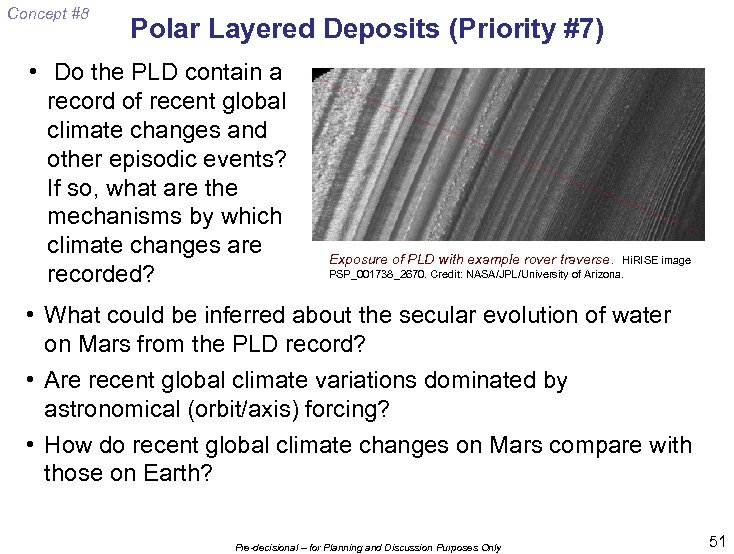
Concept #8 Polar Layered Deposits (Priority #7) • Do the PLD contain a record of recent global climate changes and other episodic events? If so, what are the mechanisms by which climate changes are Exposure of PLD with example rover traverse. Hi. RISE image PSP_001738_2670. Credit: NASA/JPL/University of Arizona. recorded? • What could be inferred about the secular evolution of water on Mars from the PLD record? • Are recent global climate variations dominated by astronomical (orbit/axis) forcing? • How do recent global climate changes on Mars compare with those on Earth? Pre-decisional – for Planning and Discussion Purposes Only 51
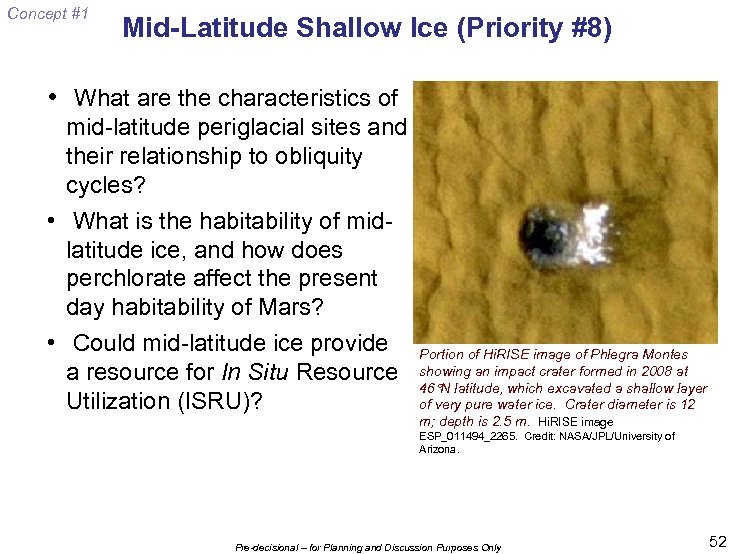
Concept #1 Mid-Latitude Shallow Ice (Priority #8) • What are the characteristics of mid-latitude periglacial sites and their relationship to obliquity cycles? • What is the habitability of midlatitude ice, and how does perchlorate affect the present day habitability of Mars? • Could mid-latitude ice provide Portion of Hi. RISE image of Phlegra Montes a resource for In Situ Resource showing an impact crater formed in 2008 at 46 N latitude, which excavated a shallow layer Utilization (ISRU)? of very pure water ice. Crater diameter is 12 m; depth is 2. 5 m. Hi. RISE image ESP_011494_2265. Credit: NASA/JPL/University of Arizona. Pre-decisional – for Planning and Discussion Purposes Only 52
Скачать презентацию Proposed 2018 Mars Astrobiology Explorer-Cacher MAX-C Mission Sept
3576aa0654f0fd44e43d42c611288c88.ppt