


 Скачать презентацию Proposal of Adaptation of Legacy C C Software to
d5ad483062f962678a624fd7bd3f6adc.ppt
- Количество слайдов: 27
 Proposal of Adaptation of Legacy C/C++ Software to Grid Services Bartosz Baliś, Marian Bubak, Michał Węgiel, Roland Wismüller Institute of Computer Science, AGH Kraków ACC CYFRONET AGH Technical University Munich CGW 2003 Institute of Computer Science AGH
 Outline § Migration to grid services technology and challenges involved § Grid environment requirements § The state of the art § The proposed architecture and its components § Scenarios: initialization, method invocation and destruction § Security, scalability and other aspects characteristic of grid computing § Project status and future work CGW 2003 Institute of Computer Science AGH
 Motivation and challenges § Legacy software • typically represents large-scale corporate investments that cannot be discarded • high-quality and validated programs § Cost-effective migration to grid services technology • without re-design, re-development and redeployment of the existing software • tool-supported, semi-automated process • universal and systematic methodology CGW 2003 Institute of Computer Science AGH
 Grid requirements § Grid service • web service that provides a set of well-defined interfaces and that follows specific conventions § Extensions introduced by Open Grid Services Infrastructure • lifetime management (factories, explicit and softstate destruction) • dynamic and stateful service instances (methods and attributes) • reliable and secure invocation (authentication and authorization) CGW 2003 Institute of Computer Science AGH
 The state of the art § Related work is present both in scientific and commercial settings § Lack of comprehensive solutions § Existing approaches • • concentrate on web services technology fail to satisfy grid services requirements omit architectural considerations introduce numerous limitations (inflexibility, insecurity etc. ) CGW 2003 Institute of Computer Science AGH
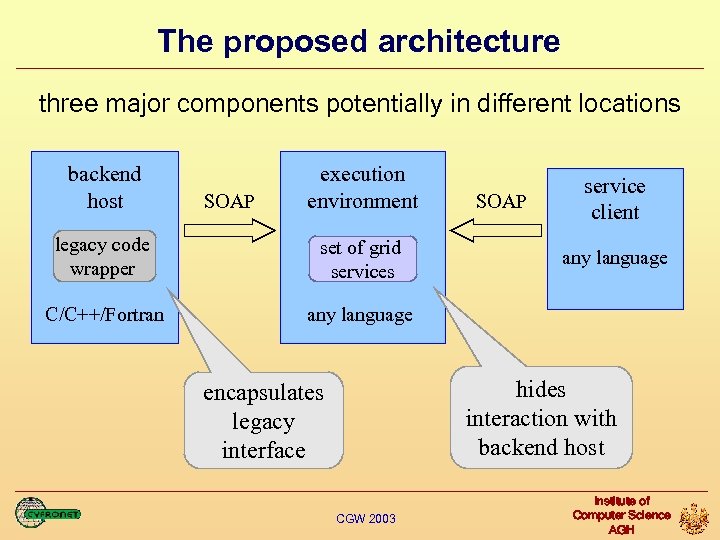 The proposed architecture three major components potentially in different locations backend host SOAP execution environment legacy code wrapper set of grid services C/C++/Fortran SOAP service client any language hides interaction with backend host encapsulates legacy interface CGW 2003 Institute of Computer Science AGH
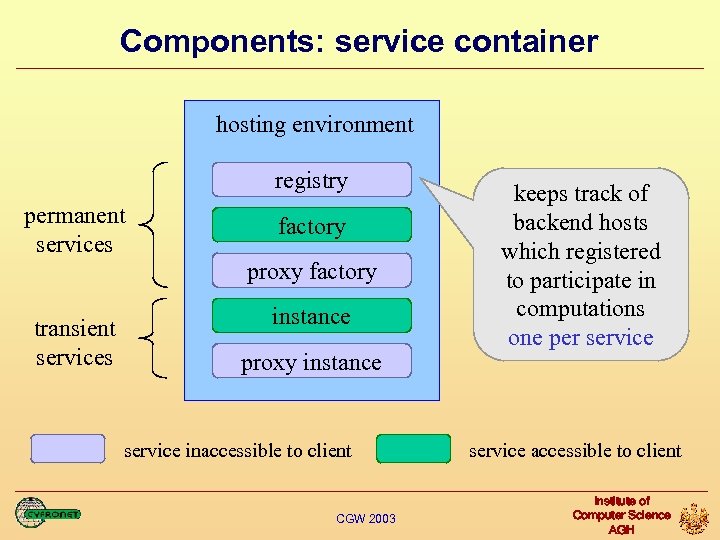 Components: service container hosting environment registry permanent services factory proxy factory transient services instance proxy instance service inaccessible to client CGW 2003 keeps track of backend hosts which registered to participate in computations one per service accessible to client Institute of Computer Science AGH
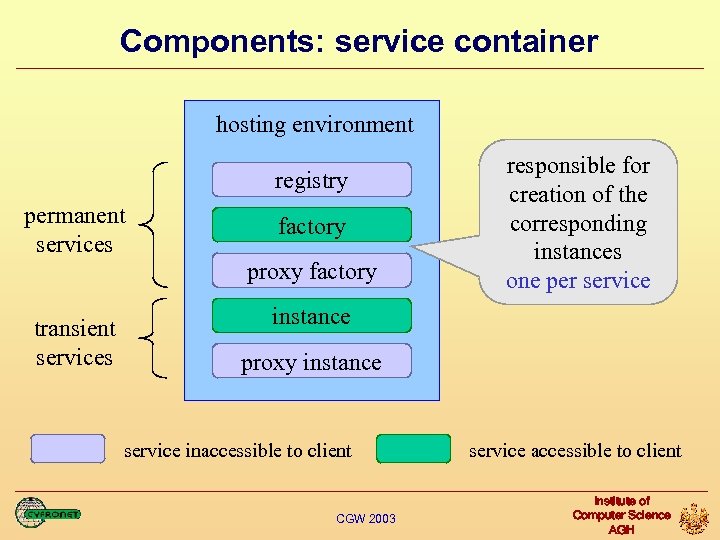 Components: service container hosting environment registry permanent services factory proxy factory transient services responsible for creation of the corresponding instances one per service instance proxy instance service inaccessible to client CGW 2003 service accessible to client Institute of Computer Science AGH
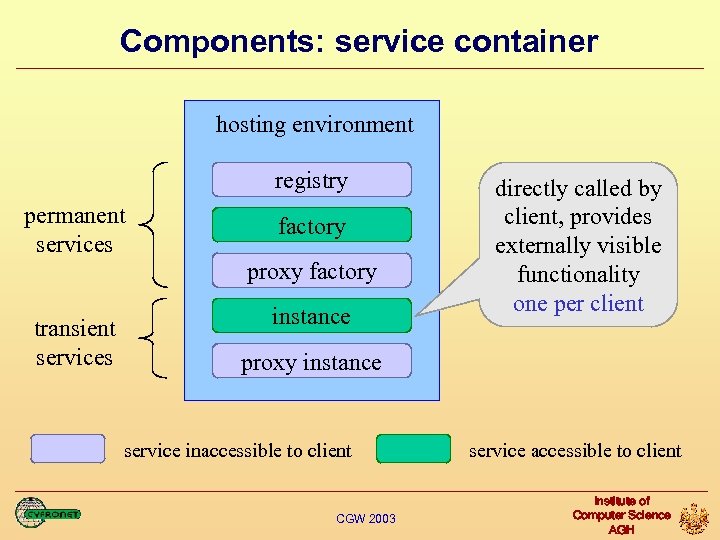 Components: service container hosting environment registry permanent services factory proxy factory transient services instance directly called by client, provides externally visible functionality one per client proxy instance service inaccessible to client CGW 2003 service accessible to client Institute of Computer Science AGH
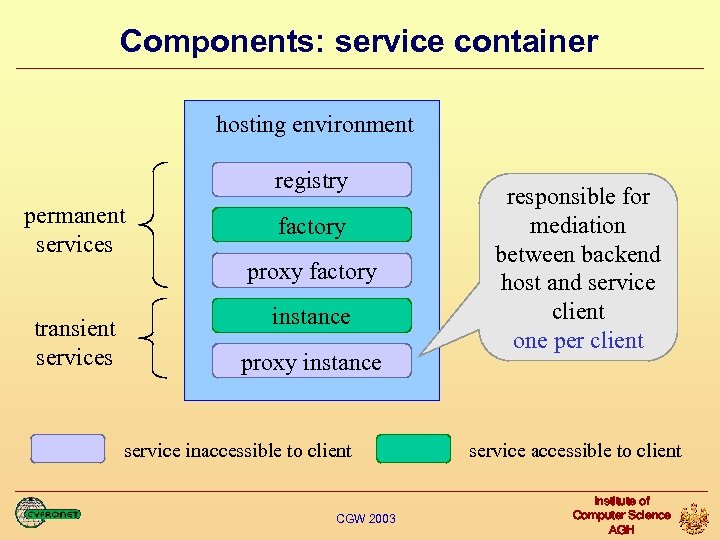 Components: service container hosting environment registry permanent services factory proxy factory transient services instance proxy instance service inaccessible to client CGW 2003 responsible for mediation between backend host and service client one per client service accessible to client Institute of Computer Science AGH
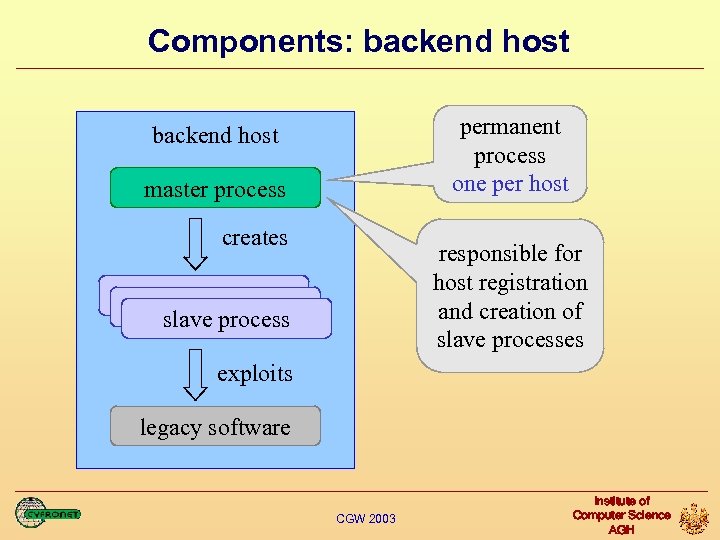 Components: backend host permanent process one per host backend host master process creates responsible for host registration and creation of slave processes slave process exploits legacy software CGW 2003 Institute of Computer Science AGH
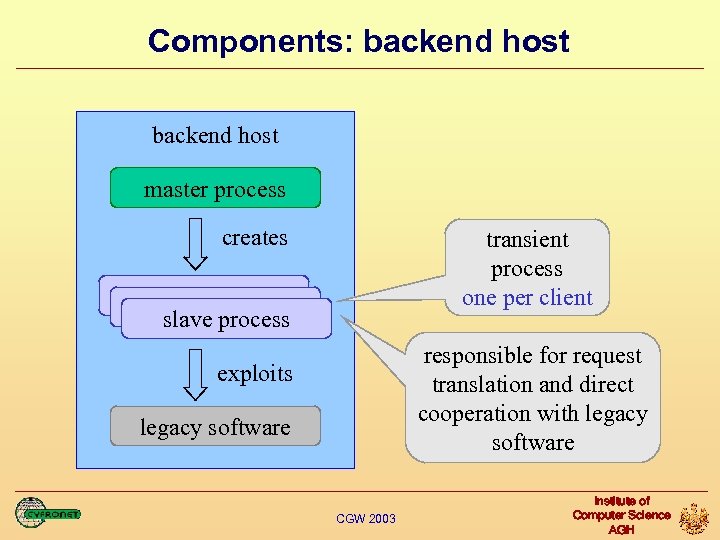 Components: backend host master process creates transient process one per client slave process responsible for request translation and direct cooperation with legacy software exploits legacy software CGW 2003 Institute of Computer Science AGH
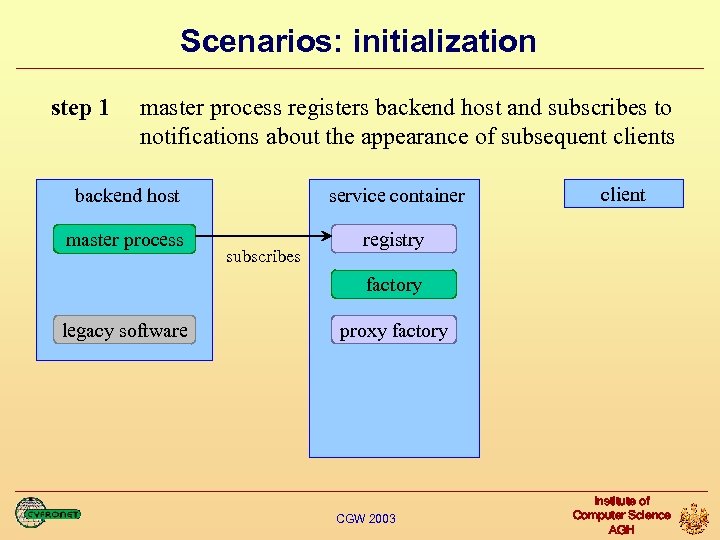 Scenarios: initialization step 1 master process registers backend host and subscribes to notifications about the appearance of subsequent clients backend host service container master process client registry subscribes factory legacy software proxy factory CGW 2003 Institute of Computer Science AGH
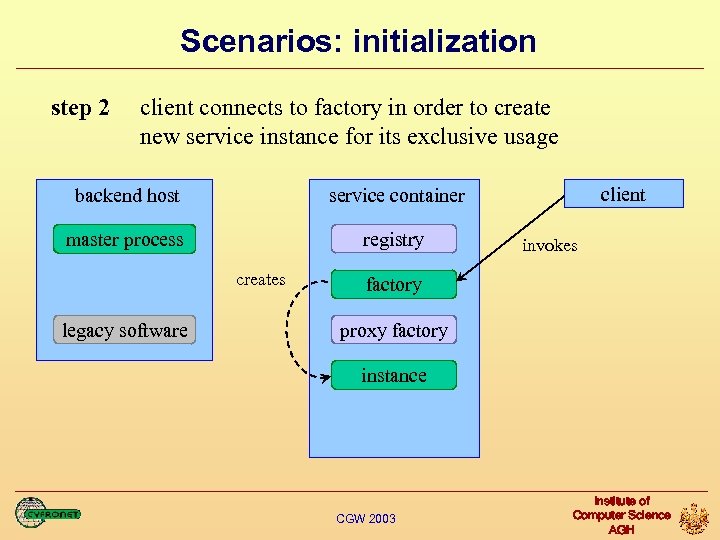 Scenarios: initialization step 2 client connects to factory in order to create new service instance for its exclusive usage backend host master process registry client service container creates legacy software invokes factory proxy factory instance CGW 2003 Institute of Computer Science AGH
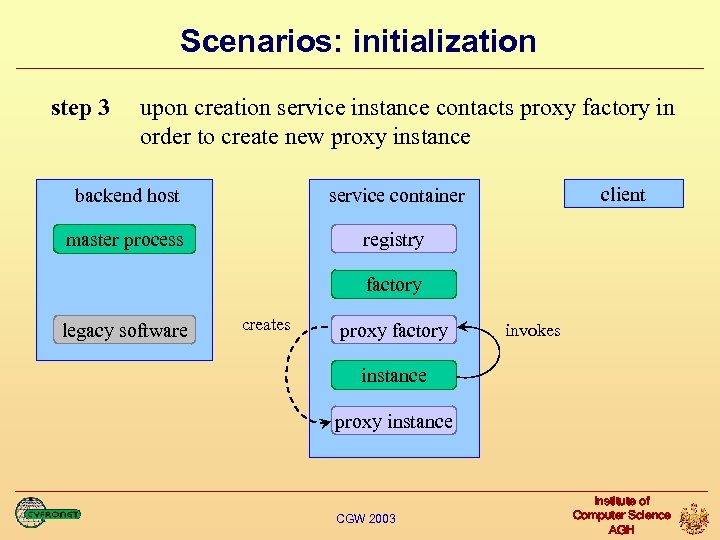 Scenarios: initialization step 3 upon creation service instance contacts proxy factory in order to create new proxy instance backend host master process client service container registry factory legacy software creates proxy factory invokes instance proxy instance CGW 2003 Institute of Computer Science AGH
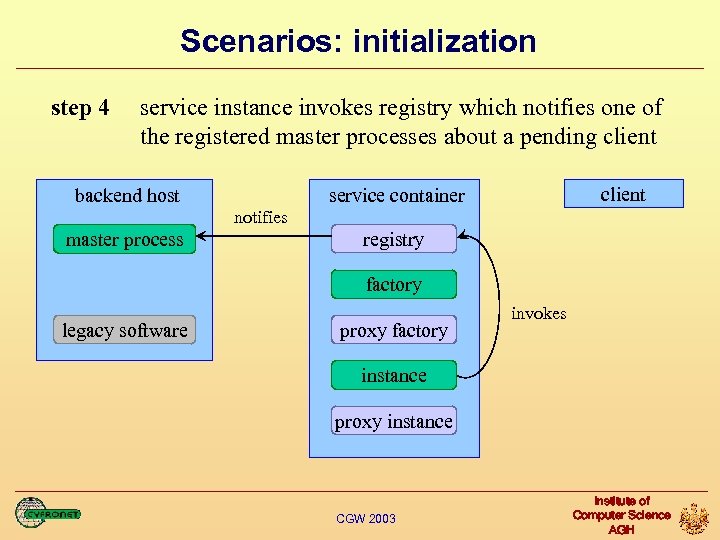 Scenarios: initialization step 4 service instance invokes registry which notifies one of the registered master processes about a pending client backend host client service container notifies master process registry factory legacy software proxy factory invokes instance proxy instance CGW 2003 Institute of Computer Science AGH
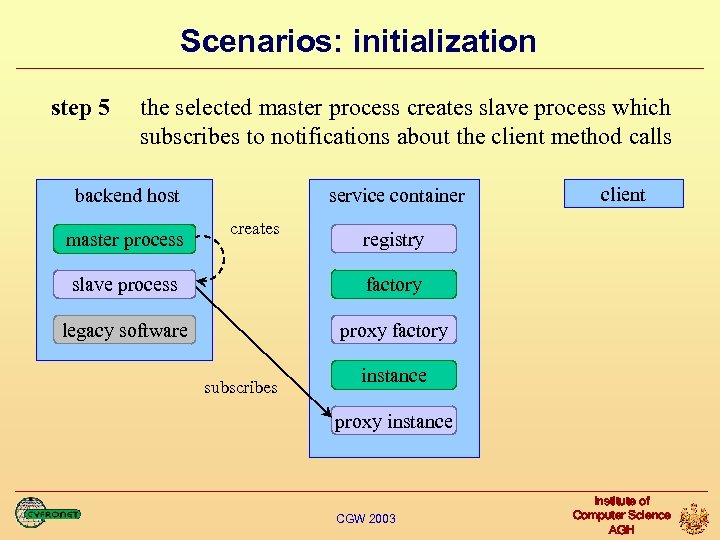 Scenarios: initialization step 5 the selected master process creates slave process which subscribes to notifications about the client method calls backend host master process service container creates client registry slave process factory legacy software proxy factory subscribes instance proxy instance CGW 2003 Institute of Computer Science AGH
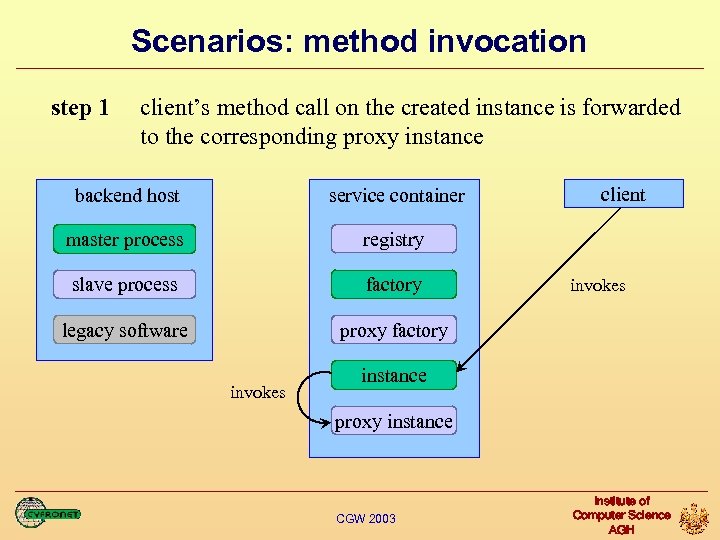 Scenarios: method invocation step 1 client’s method call on the created instance is forwarded to the corresponding proxy instance backend host service container master process registry slave process factory legacy software client proxy factory invokes instance proxy instance CGW 2003 Institute of Computer Science AGH
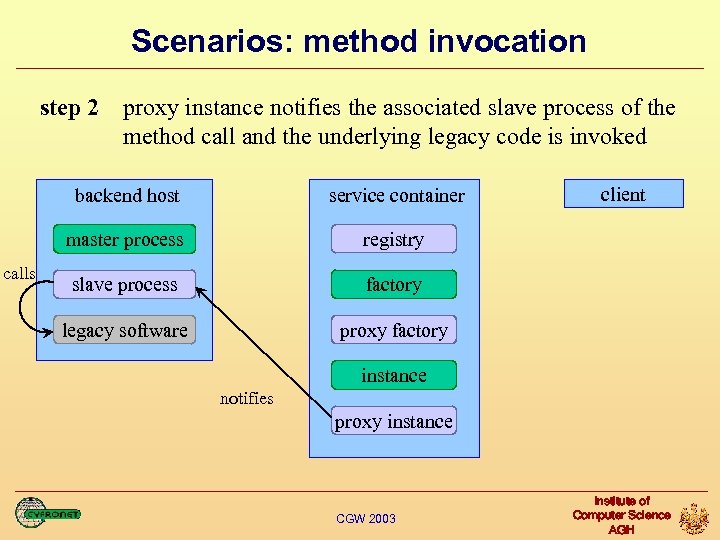 Scenarios: method invocation step 2 proxy instance notifies the associated slave process of the method call and the underlying legacy code is invoked backend host master process calls service container registry slave process factory legacy software client proxy factory instance notifies proxy instance CGW 2003 Institute of Computer Science AGH
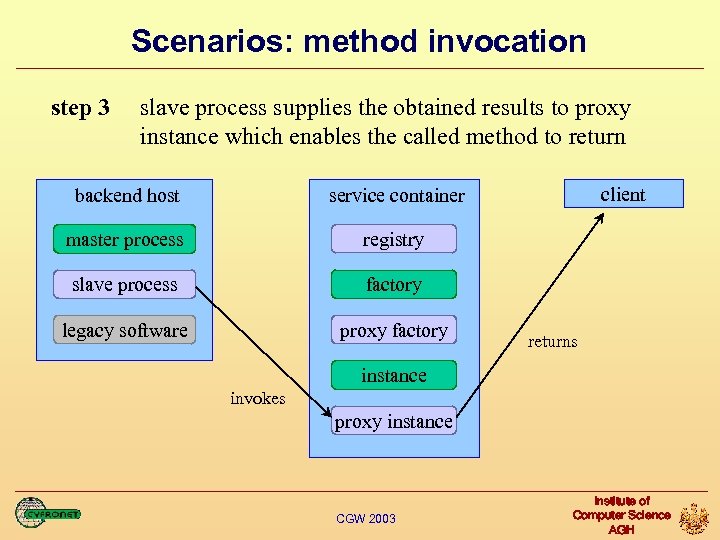 Scenarios: method invocation step 3 slave process supplies the obtained results to proxy instance which enables the called method to return backend host master process registry slave process factory legacy software proxy factory client service container returns instance invokes proxy instance CGW 2003 Institute of Computer Science AGH
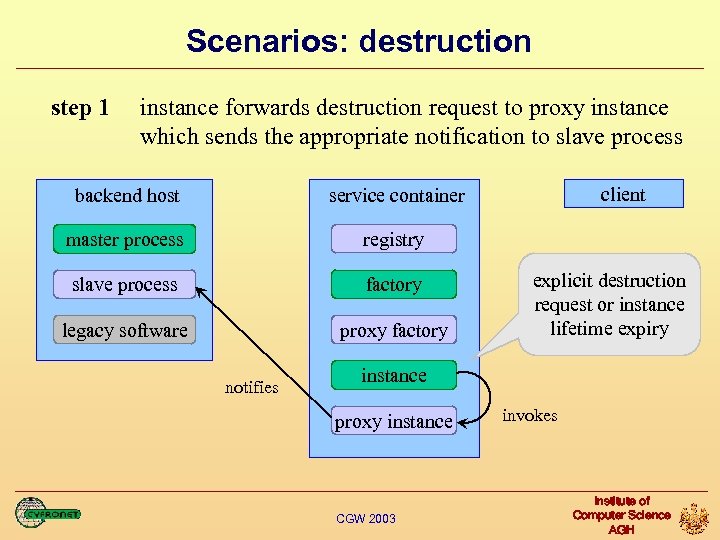 Scenarios: destruction step 1 instance forwards destruction request to proxy instance which sends the appropriate notification to slave process backend host master process registry slave process factory legacy software proxy factory client service container notifies explicit destruction request or instance lifetime expiry instance proxy instance CGW 2003 invokes Institute of Computer Science AGH
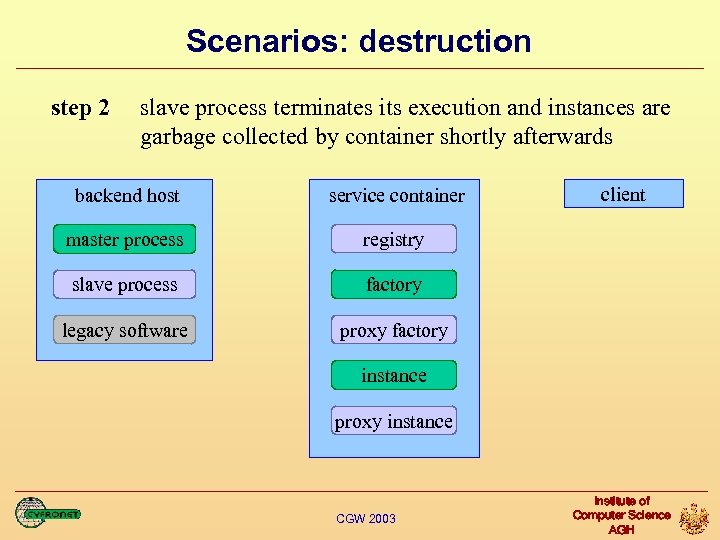 Scenarios: destruction step 2 slave process terminates its execution and instances are garbage collected by container shortly afterwards backend host service container master process registry slave process factory legacy software client proxy factory instance proxy instance CGW 2003 Institute of Computer Science AGH
 Security § Authentication • X. 509 certificates: identity can be assigned both to users and hosts § Authorization • for external services (accessible to users) • based on user certificates • access granted to clients eligible to use a particular service • for internal services (inaccessible to users) • based on host certificates • access granted to machines eligible to register in the context of a particular service CGW 2003 Institute of Computer Science AGH
 Scalability § Actual processing is delegated to backend hosts § Service instances residing in the container do not consume excessive resources § Backend hosts volunteer to accept tasks only when their load is reasonable (automatic load balancing) • high responsiveness to temporal peaks in utilization (on demand computing) • support for resource reservation (quality of service) CGW 2003 Institute of Computer Science AGH
 Other features § No modifications of legacy code are required § Programs and libraries can remain where they were initially installed § No open ports on backend hosts are introduced since they act as service clients § Central administration: all services belonging to one VO can be hosted and managed in one place § Independence of particular hosting environment implementation CGW 2003 Institute of Computer Science AGH
 Other features § Flexible and dynamic configuration • processes are not bound to backend hosts • they can change their locations even during execution (job migration) § Delegated control • no need to check which host is ready and most suitable for a task at the specified point in time • robustness in case of configuration change or component failure • finer-grained participation policy CGW 2003 Institute of Computer Science AGH
 Project status and future work § As a proof of concept the presented solution was partially implemented • project: adaptation of OCM-G grid application monitoring system to grid services • used tools: g. SOAP package, Globus Toolkit 3. 0 § Future work • more test cases • performance measurement • development of tools faciliatating the usage of the proposed framework CGW 2003 Institute of Computer Science AGH