


 Скачать презентацию Proposal for a New Macedonian Undergraduate Teaching Institution
63af64427268d738f57c3e01e29b4cfd.ppt
- Количество слайдов: 10
 Proposal for a New Macedonian Undergraduate Teaching Institution for Information Science and Technology International Advisory Board Peter Bock, The George Washington University (Chair) Antonio Sanchez, Texas Christian University Fridolin Piwonka, Bosch Management Support Alice Armstrong, Shippensburg University Aleksandar Stefanovski, The George Washington University (Secretary to the Board) Zoran Jolevski, Macedonian Ambassador to the United States (Consultant to the Board) Linda Fahlberg-Stojanovska, University of St. Kliment Ohridski (Consultant to the Board)
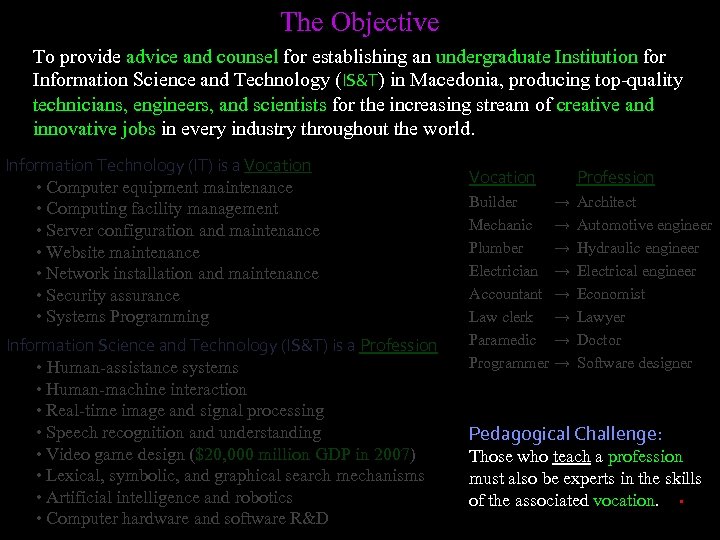 The Objective To provide advice and counsel for establishing an undergraduate Institution for Information Science and Technology (IS&T) in Macedonia, producing top-quality technicians, engineers, and scientists for the increasing stream of creative and innovative jobs in every industry throughout the world. Information Technology (IT) is a Vocation • Computer equipment maintenance • Computing facility management • Server configuration and maintenance • Website maintenance • Network installation and maintenance • Security assurance • Systems Programming Information Science and Technology (IS&T) is a Profession • Human-assistance systems • Human-machine interaction • Real-time image and signal processing • Speech recognition and understanding • Video game design ($20, 000 million GDP in 2007) • Lexical, symbolic, and graphical search mechanisms • Artificial intelligence and robotics • Computer hardware and software R&D Vocation Builder Mechanic Plumber Electrician Accountant Law clerk Paramedic Programmer Profession → → → → Architect Automotive engineer Hydraulic engineer Electrical engineer Economist Lawyer Doctor Software designer Pedagogical Challenge: Those who teach a profession must also be experts in the skills of the associated vocation. •
 The Problem Degrees Granted in Computer Science Median Number of Students per Department New Declared Majors in Computer Science Median Number of Students per Department [www. cra. org]
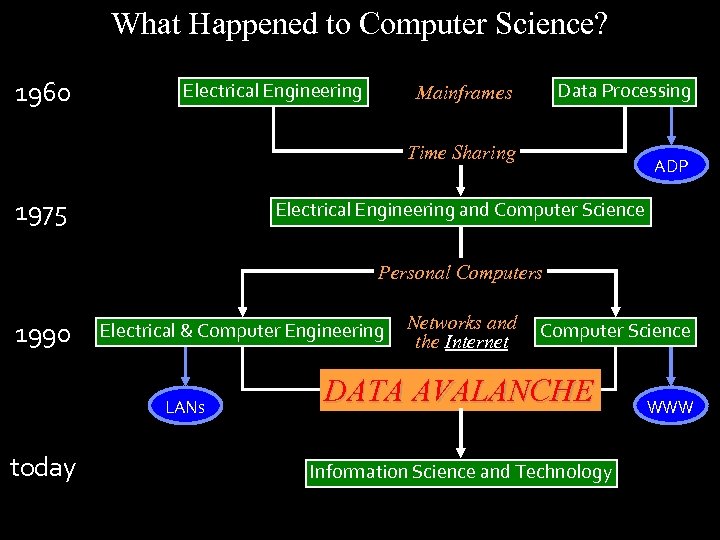 What Happened to Computer Science? 1960 Electrical Engineering Data Processing Mainframes Time Sharing 1975 ADP Electrical Engineering and Computer Science Personal Computers 1990 Electrical & Computer Engineering LANs today Networks and the Internet Computer Science DATA AVALANCHE Information Science and Technology WWW
 Performance Criteria From the Macedonian Government Design and establish a top-quality undergraduate teaching Institution in IS&T Comply with Macedonian laws, the Bologna Protocols (EU), and (eventually) ABET (USA) All courses taught in English Offer 3 degree programs • Associate Degree in IT • Diploma in IS&T • Bachelors Degree in IS&T 2 years → vocational degree in IT 3 years → conventional European Baccalaureate 4 years → allows admission to international MS programs Produce graduates with high potential for successful careers • IT technicians • IS&T engineers and scientists • IS&T graduate students Recruit highly talented teachers in all fields • Half from Macedonia • Half from English-speaking countries (e. g. , USA, Canada, UK) Partnerships with major international universities •
 Performance Criteria From the International Advisory Board Priorities: The student is the customer The teacher is the provider Industry is the consumer Principles: Demand intellectual rigor Enforce academic freedom Resolve internal politics Create a campus with well-integrated facilities • Attractive campus in an interesting environment near a lively community • Green and clean campus (minimal carbon footprint) • State-of-the-art classrooms, offices, and common spaces≈ • Student-faculty interaction inside and outside the classroom • Student Council with a real role in academic matters • Extra-curricular activities (sports, debate, theatre, music, film, . . . ) Provide students with a rich and exciting interdisciplinary educational program • Small classes (≈15) • Low student-to-faculty ratio (≈10) • Team projects in every feasible course (industrial model) • Campus job for every student (part of curriculum) • Work-study programs with industries • Three-component curriculum of the interdisciplinary IS&T degree program core → science and math courses major → IS&T courses minor → humanities and social sciences • Relevant laboratories in several major application domains •
 Possible Relevant State-of-the-Art Laboratories • Mountain region, river canyon, lake shore, . . . • Radio and television station • Botanical garden • Video game development laboratory • Ecological monitoring system • Electronic book technology (Kindles) • Automated movie generation • Knowledge-sharing systems laboratory • Automobile driving simulator • Vehicle user-control systems • Cognitive science laboratory • Highway navigation and control systems • Speech understanding laboratory • Wizard-of-Oz laboratory • Smart Home for the elderly and/or disabled • Biomedical instrumentation laboratory • Intelligent prosthetics laboratory • AI and robotics laboratory
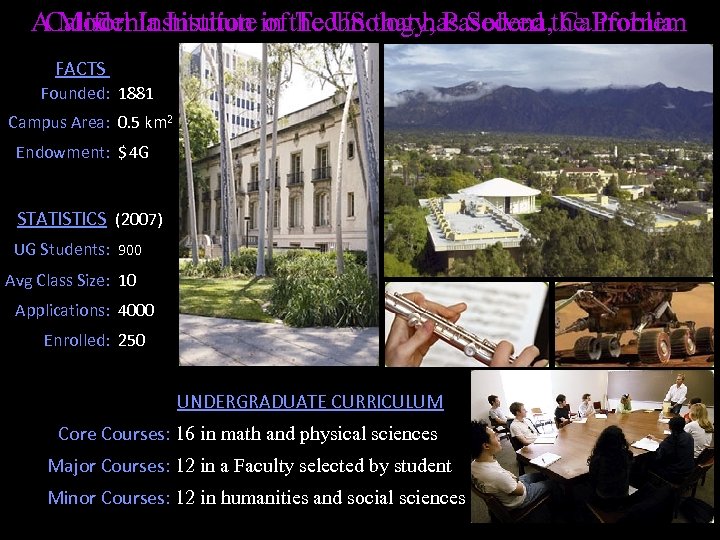 California Institute of Technology, Pasedena, California A Model Institution in the US that has Solved the Problem FACTS Founded: 1881 Campus Area: 0. 5 km 2 Endowment: $ 4 G STATISTICS (2007) UG Students: 900 Avg Class Size: 10 Applications: 4000 Enrolled: 250 UNDERGRADUATE CURRICULUM Core Courses: 16 in math and physical sciences Major Courses: 12 in a Faculty selected by student Minor Courses: 12 in humanities and social sciences
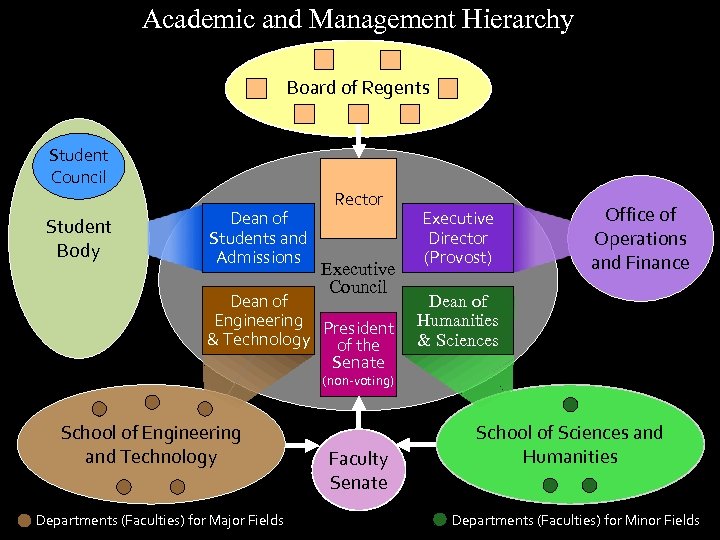 Academic and Management Hierarchy Board of Regents Student Council Student Body Dean of Students and Admissions Rector Executive Council Dean of Engineering President & Technology of the Senate Executive Director (Provost) Office of Operations and Finance Dean of Humanities & Sciences (non-voting) School of Engineering and Technology Departments (Faculties) for Major Fields Faculty Senate School of Sciences and Humanities Departments (Faculties) for Minor Fields
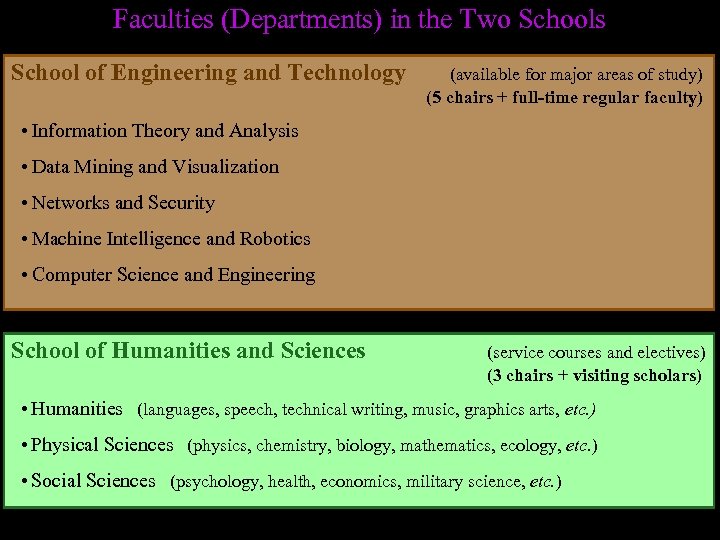 Faculties (Departments) in the Two Schools School of Engineering and Technology (available for major areas of study) (5 chairs + full-time regular faculty) • Information Theory and Analysis • Data Mining and Visualization • Networks and Security • Machine Intelligence and Robotics • Computer Science and Engineering School of Humanities and Sciences (service courses and electives) (3 chairs + visiting scholars) • Humanities (languages, speech, technical writing, music, graphics arts, etc. ) • Physical Sciences (physics, chemistry, biology, mathematics, ecology, etc. ) • Social Sciences (psychology, health, economics, military science, etc. )