


 Скачать презентацию Proposal for a Coastal Zone Community of Practice
530daa030679fa471fcfdb62e963a6e7.ppt
- Количество слайдов: 24
 Proposal for a Coastal Zone Community of Practice GEO User Interface Committee Meeting Geneva, Switzerland, 16 December 2005 Paul M. Di. Giacomo NASA/Jet Propulsion Laboratory Liana Talaue-Mc. Manus University of Miami w/Jimmy Adegoke, Robert Christian, Franciscus Colijn, Tom Malone, Hans-Peter Plag, and many others!
 Why a Coastal Zone Co. P? • The CZ is a complex area where inputs from land, sea, air, and people converge; an area of remarkably high productivity; an area where ecosystem goods/services are concentrated; and a center of human activity for millennia. • Upward of 25% of the global population resides in the coastal zone, with a population density about 2. 5 times higher than the global average. • Thus, changes in the physical and ecological states of terrestrial & marine systems have disproportional impacts on coastal ecosystems and human populations. • In this context, CZs are experiencing unprecedented alteration, including becoming more susceptible to natural hazards, more costly to live in, and less able to support living resources. • The social and economic costs of uninformed decisions are increasing accordingly, and there is a compelling need to ensure that the data and information needs of those that use, depend on, manage and study coastal systems are met in a timely and sustained manner.
 Illustrations of Coastal Zone Drivers/Concerns DMSP-OLS nightime lights: coastal development and urbanization
 Illustrations of Coastal Zone Drivers/Concerns DMSP-OLS nightime lights: coastal development and urbanization ASTER image: New Orleans before/after Hurricane Katrina
 Coastal Zone Co. P Objectives To meet the needs of user communities in coastal zones, we thus propose a GEO Coastal Zone Community of Practice, with the following objectives: • Engage both data providers and users in the specification of requirements for in situ and remote observations and modelling needed to provide data and information at rates and in forms needed by users, especially decision makers, in both public and private sectors - this Coastal Zone Co. P will provide a dedicated support mechanism! • Evaluate current and projected observation capabilities in terms of the extent to which they meet these requirements, identifying gaps, redundancies and activities that need to be strengthened; • Establish a framework to integrate observations, both in situ and remote, particularly across boundaries, as time-space scales of variability differ dramatically between the terrestrial side and the marine side of the coastal zone; • Stimulate collaboration among institutions within and across communities of practice to coordinate the delivery of coastal-related GEOSS targets aimed at realizing benefits; • Liaise with the User Interface Working Group, GEO, and other Co. Ps on matters relating to coastal environmental issues, and on cross-cutting issues of interest to the Coastal Co. P.
 • This Coastal Zone Co. P would leverage/expand upon the Coastal Theme of the Integrated Global Observing Strategy (IGOS) • IGOS is a strategic planning process, consisting of 14 members that represent data providers and users, whose goal is to develop and implement a strategy to improve Earth observing capacity for decision-making • The IGOS Coastal Theme is strongly user-driven and cross-cutting, with a focus on coastal populations & ecosystems at risk
 Coastal Zone Co. P Focal Issues and GEO Societal Benefit Areas
 Coastal Zone User Communities
 Coastal Zone User Communities
 Leveraging and expanding upon the IGOS Coastal Theme Providers and Users, all of these spheres will be well represented + Organized grass-roots community based organizations and other NGOs
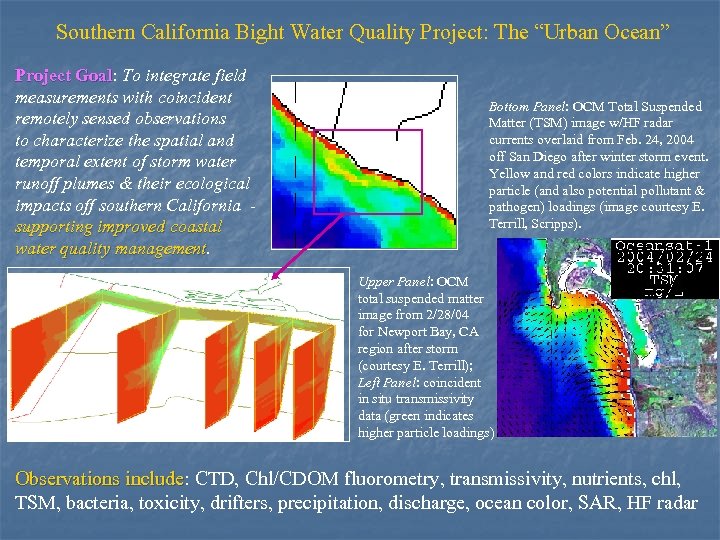 Southern California Bight Water Quality Project: The “Urban Ocean” Project Goal: To integrate field Goal measurements with coincident remotely sensed observations to characterize the spatial and temporal extent of storm water runoff plumes & their ecological impacts off southern California supporting improved coastal water quality management Bottom Panel: OCM Total Suspended Matter (TSM) image w/HF radar currents overlaid from Feb. 24, 2004 off San Diego after winter storm event. Yellow and red colors indicate higher particle (and also potential pollutant & pathogen) loadings (image courtesy E. Terrill, Scripps). Upper Panel: OCM total suspended matter image from 2/28/04 for Newport Bay, CA region after storm (courtesy E. Terrill); Left Panel: coincident in situ transmissivity data (green indicates higher particle loadings) Observations include: CTD, Chl/CDOM fluorometry, transmissivity, nutrients, chl, include TSM, bacteria, toxicity, drifters, precipitation, discharge, ocean color, SAR, HF radar
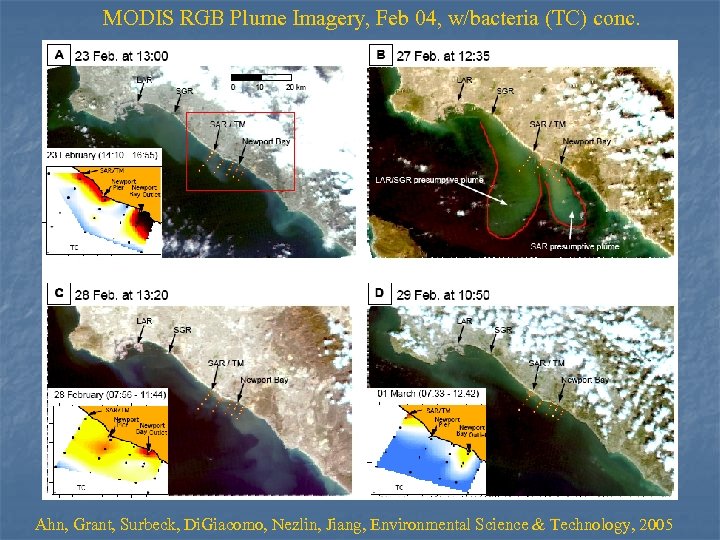 MODIS RGB Plume Imagery, Feb 04, w/bacteria (TC) conc. Ahn, Grant, Surbeck, Di. Giacomo, Nezlin, Jiang, Environmental Science & Technology, 2005
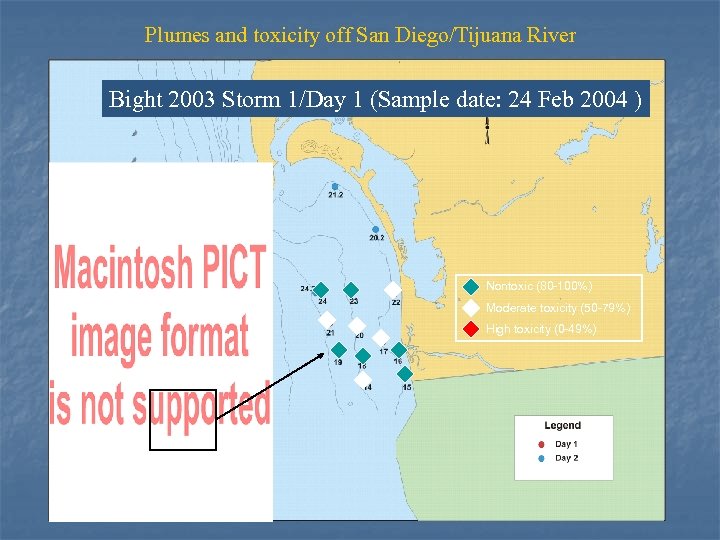 Plumes and toxicity off San Diego/Tijuana River Bight 2003 Storm 1/Day 1 (Sample date: 24 Feb 2004 ) Nontoxic (80 -100%) Moderate toxicity (50 -79%) High toxicity (0 -49%)
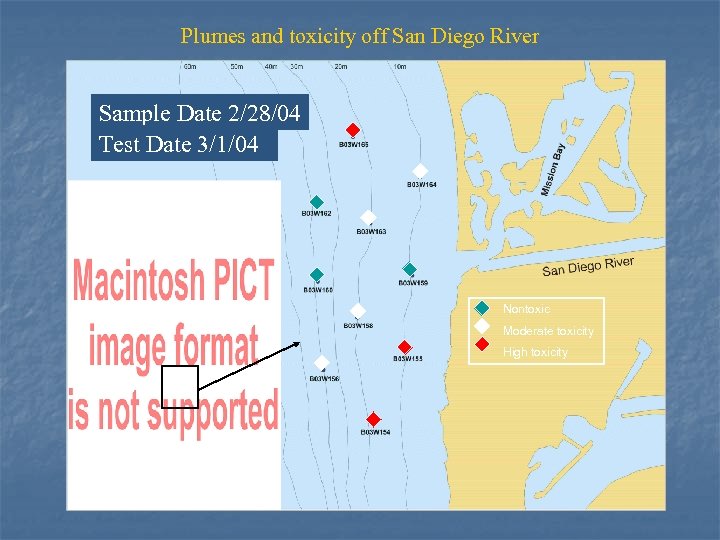 Plumes and toxicity off San Diego River Sample Date 2/28/04 Test Date 3/1/04 Nontoxic Moderate toxicity High toxicity
 Justification and Benefits of the Coastal Zone Co. P • The Coastal Zone Co. P shall strengthen the linkage between data providers and users across the land-sea interface, facilitating integration of in situ and space-based observations along with coupled models for coastal research, management and other user-driven applications - provides dedicated, focused coastal user support. • It shall stimulate building of long-term coastal data sets, as well as assist in the design and implementation of the coastal components of the Global Ocean Observing and the Global Terrestrial Observing Systems. • It shall identify, coordinate and link priorities for research and development efforts to facilitate and improve the operational elements of observing systems and other programs and activities in support of multiple GEOSS targets. • Most importantly, it shall stimulate integrated coastal management by coordinating delivery of key GEOSS targets and thereby enable improved products and services for a broad range of coastal users. • Finally, it shall provide cross-cutting links with other coastal activities, Co. Ps and the GEOSS effort to understand the Earth system sufficiently to realize societal benefits.
 Working Methods: Initial Approach • Since a “user-driven” system begins with users and their requirements for data and Information, the Coastal Zone Co. P will (among other methods) employ a regional approach to engage users and potential users that take advantage of GOOS Regional Alliances (GRAs) that are being established to design and implement the coastal module of GOOS. • GRAs have been established to represent user groups within each participating nation in the development of a global system and to engage them in the establishment of regional observing systems that are customized to satisfy their needs in each region. • The Coastal Zone Co. P will work with each GRA to help identify, engage and support user groups in their region in order to more effectively manage and mitigate impacts of human development and natural hazards on coastal ecosystems and the susceptibility of coastal human populations to natural disasters.
 GOOS Regional Alliances (black) & National GOOS Programmes (red)
 Working Methods: Initial Approach (con’t) • The Coastal Zone Co. P will also leverage existing and planned initiatives of the IGOS Coastal Theme and its partners, e. g. , UNEP, to identify, work with, and support users. • UNEP is presently responsible for implementing one part of the U. N. “Flash Appeal” on strengthening environmental data management for tsunamis early warning systems, working with environmental and disaster managers in Indonesia, Sri Lanka, and the Maldives to link their efforts and facilitate improved knowledge, tools and capabilities towards integrated coastal zone management This is an ideal effort to leverage and build on. • Additionally, workshops and web-based materials, including survey questionnaires that our user communities can respond to, will be developed and used in order to ensure a broad coastal community user base from which to define needs and requirements.
 Plan of Activities to contribute to GEOSS Implementation: Coordination Mode => 2006 -2008: Activity 1: Identify user requirements and facilitate collection, development and integration of priority space-based observations, in situ measurements and models towards improved coastal environmental assessments, monitoring, and prediction in support of delivery of key GEOSS targets. Activity 2: Identify, link and coordinate development and implementation of prototype efforts and pilot project opportunities that focus on addressing and mitigating the impacts of coastal development, urbanization and hazards on human and ecosystem health, particularly water quality (e. g. , linkages with IGOS Water Theme and UNEP). For example, promote development of an integrated Coastal Data Assimilation System (CODAS) with operational nowcasting & forecasting (short & long term) capabilities to support users vis-à-vis coastal hazards, water quality, and other concerns; These efforts specifically track with GEO targets #46, 66, 2, 19, 41, 61, 108, 111, 116, 119, 122, 161, 163, 164, 165, 192, 193, 199, 203, 220, 222, 226 & 238 and others.
 Plan of Activities to contribute to GEOSS Implementation ( con’t): Capacity Building Mode => 2006 and beyond: Activity 3: Facilitate and coordinate development of standardized user interface (e. g, GIS) and decision support tools for coastal management, particularly the development of an Integrated Coastal Decision Support System (ICo. DSS). Activity 4: Facilitate capacity building in developing nations, particularly through partnership pairings with developed nations, towards addressing priority user needs. These efforts specifically track with GEO targets #5, 10, 15, 17, 19, 24, 51, 56, 62, 76, 85, 86, 97, 101, 102, 103, 105, 117, 157, 181, 183, 194, 204, 216, 222, 223 & 238 et al.
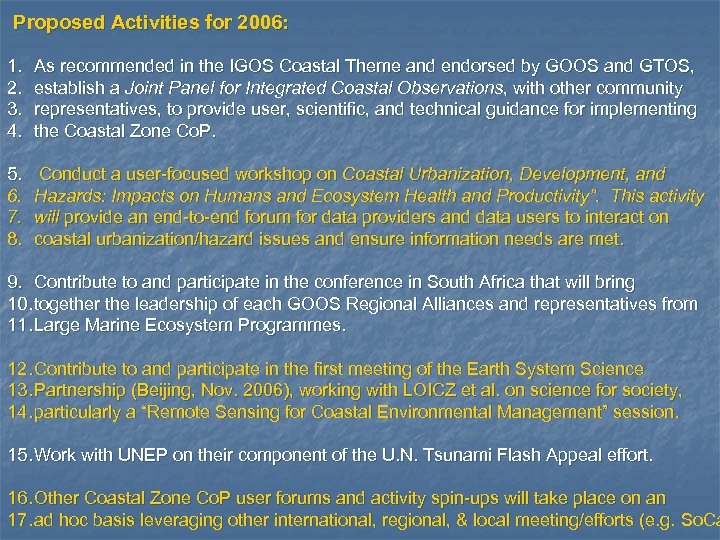 Proposed Activities for 2006: 1. 2. 3. 4. As recommended in the IGOS Coastal Theme and endorsed by GOOS and GTOS, establish a Joint Panel for Integrated Coastal Observations, with other community representatives, to provide user, scientific, and technical guidance for implementing the Coastal Zone Co. P. 5. 6. 7. 8. Conduct a user-focused workshop on Coastal Urbanization, Development, and Hazards: Impacts on Humans and Ecosystem Health and Productivity”. This activity will provide an end-to-end forum for data providers and data users to interact on coastal urbanization/hazard issues and ensure information needs are met. 9. Contribute to and participate in the conference in South Africa that will bring 10. together the leadership of each GOOS Regional Alliances and representatives from 11. Large Marine Ecosystem Programmes. 12. Contribute to and participate in the first meeting of the Earth System Science 13. Partnership (Beijing, Nov. 2006), working with LOICZ et al. on science for society, 14. particularly a “Remote Sensing for Coastal Environmental Management” session. 15. Work with UNEP on their component of the U. N. Tsunami Flash Appeal effort. 16. Other Coastal Zone Co. P user forums and activity spin-ups will take place on an 17. ad hoc basis leveraging other international, regional, & local meeting/efforts (e. g. So. Ca
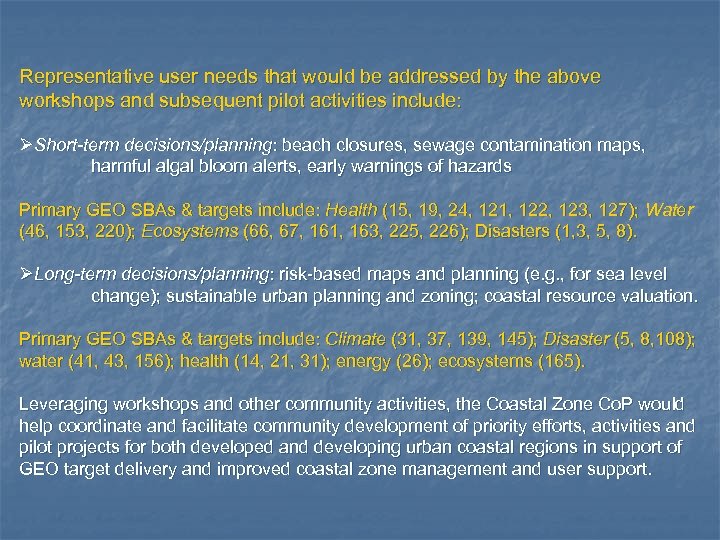 Representative user needs that would be addressed by the above workshops and subsequent pilot activities include: ØShort-term decisions/planning: beach closures, sewage contamination maps, harmful algal bloom alerts, early warnings of hazards Primary GEO SBAs & targets include: Health (15, 19, 24, 121, 122, 123, 127); Water (46, 153, 220); Ecosystems (66, 67, 161, 163, 225, 226); Disasters (1, 3, 5, 8). ØLong-term decisions/planning: risk-based maps and planning (e. g. , for sea level change); sustainable urban planning and zoning; coastal resource valuation. Primary GEO SBAs & targets include: Climate (31, 37, 139, 145); Disaster (5, 8, 108); water (41, 43, 156); health (14, 21, 31); energy (26); ecosystems (165). Leveraging workshops and other community activities, the Coastal Zone Co. P would help coordinate and facilitate community development of priority efforts, activities and pilot projects for both developed and developing urban coastal regions in support of GEO target delivery and improved coastal zone management and user support.
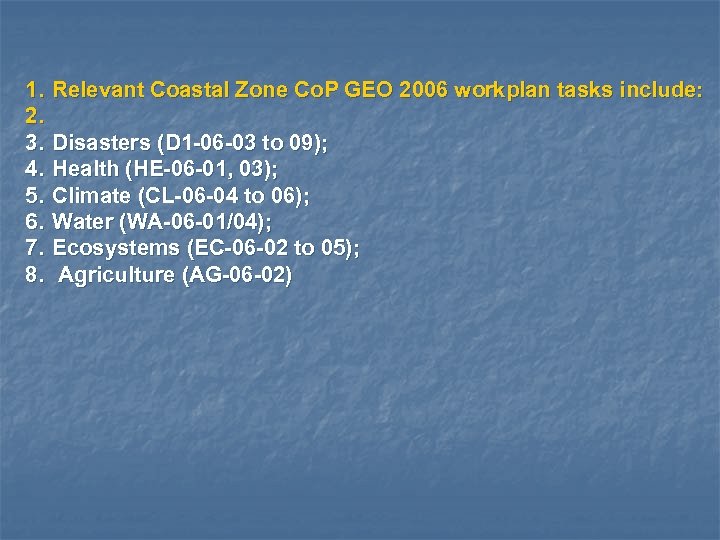 1. 2. 3. 4. 5. 6. 7. 8. Relevant Coastal Zone Co. P GEO 2006 workplan tasks include: Disasters (D 1 -06 -03 to 09); Health (HE-06 -01, 03); Climate (CL-06 -04 to 06); Water (WA-06 -01/04); Ecosystems (EC-06 -02 to 05); Agriculture (AG-06 -02)
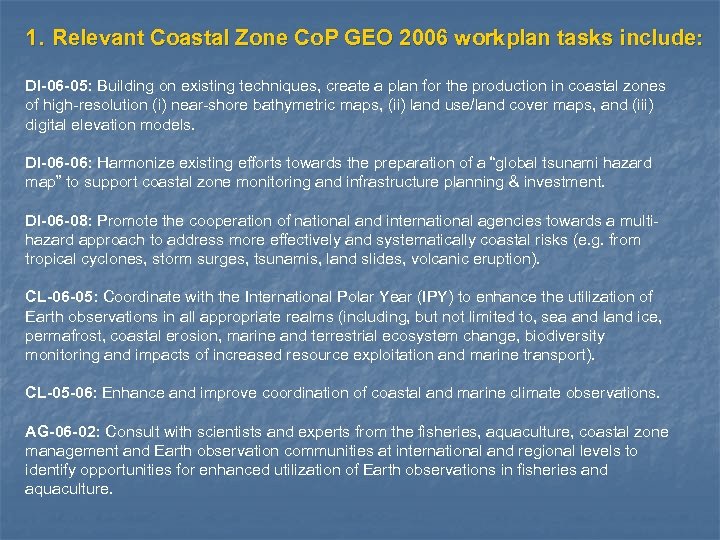 1. Relevant Coastal Zone Co. P GEO 2006 workplan tasks include: DI-06 -05: Building on existing techniques, create a plan for the production in coastal zones of high-resolution (i) near-shore bathymetric maps, (ii) land use/land cover maps, and (iii) digital elevation models. DI-06 -06: Harmonize existing efforts towards the preparation of a “global tsunami hazard map” to support coastal zone monitoring and infrastructure planning & investment. DI-06 -08: Promote the cooperation of national and international agencies towards a multihazard approach to address more effectively and systematically coastal risks (e. g. from tropical cyclones, storm surges, tsunamis, land slides, volcanic eruption). CL-06 -05: Coordinate with the International Polar Year (IPY) to enhance the utilization of Earth observations in all appropriate realms (including, but not limited to, sea and land ice, permafrost, coastal erosion, marine and terrestrial ecosystem change, biodiversity monitoring and impacts of increased resource exploitation and marine transport). CL-05 -06: Enhance and improve coordination of coastal and marine climate observations. AG-06 -02: Consult with scientists and experts from the fisheries, aquaculture, coastal zone management and Earth observation communities at international and regional levels to identify opportunities for enhanced utilization of Earth observations in fisheries and aquaculture.