


 Скачать презентацию Proportional Counters CCDs and Polarimeters Joe Hill USRA CRESST
7847089eda62803cbbf30da853e3bb66.ppt
- Количество слайдов: 48
 Proportional Counters, CCDs and Polarimeters Joe Hill USRA/CRESST NASA Goddard Spaceflight Center
 Outline Ø The Ideal Detector Ø X-ray Astronomy Early History Ø Proportional Counters Ø CCDs Ø Polarimeters
 What characteristics would an ideal X-ray detector have? Ø High spatial resolution Ø Large (effective) area Ø Good temporal resolution Ø Good energy resolution Ø Unit quantum efficiency (QE) Ø Large Bandwidth Ø (typically around 0. 1 -15 ke. V) Fraser, X-ray Detectors in Astronomy
 What characteristics would an ideal X-ray detector have? Ø Stable on timescales of years Ø Negligible internal background Ø Immune to radiation damage Ø Requires no consumables Ø Simple, rugged and cheap Ø Light weight Ø Low power Ø Low output data rate Ø No moving parts Fraser, X-ray Detectors in Astronomy
 The battle of signal versus noise… Ø Detectable signal is always limited by the statistical variation in the background Ø Intrinsic detector background Ø Interactions between the detector and space environment Ø Diffuse X-ray Background=Q. . jd Jd=diffuse background flux (ph/cm 2/s/ke. V/sr) Q=quantum efficiency (counts/photon) =Field of view
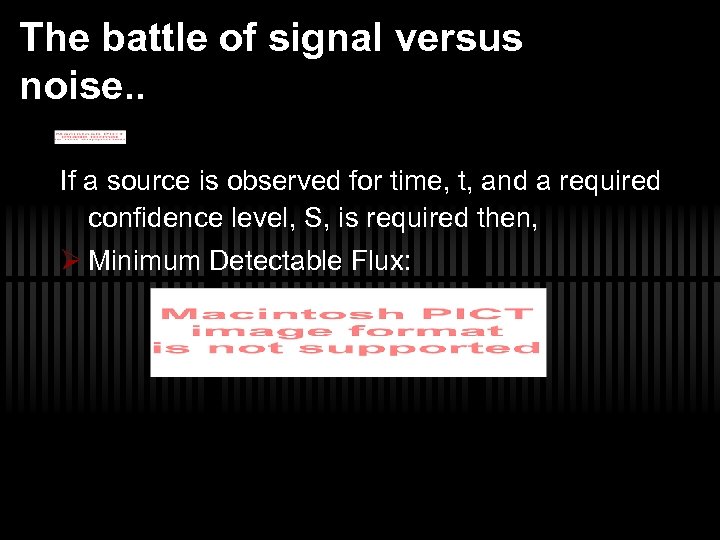 The battle of signal versus noise. . If a source is observed for time, t, and a required confidence level, S, is required then, Ø Minimum Detectable Flux:
 Proportional Counters Ø Workhorses of X-ray astronomy for >10 years Ø 1962 -1970: Rockets and Balloons Ø 1962 Sco X-1 and diffuse X-ray sky background discovered by Giacconi sounding rocket Ø Limited by atmosphere (balloons) and duration (rockets) Ø 1970 -> Satellite era Ø Ø Uhuru: First dedicated X-ray Satellite e. g. Ariel V, EXOSAT e. g. Ginga e. g. XTE
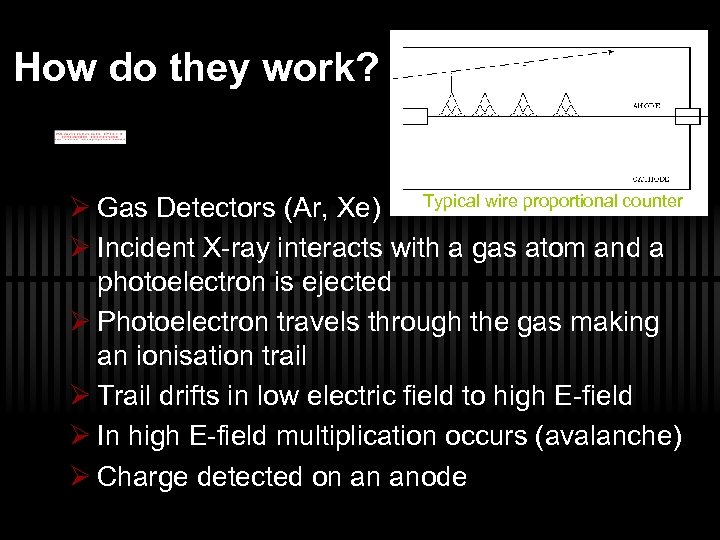 How do they work? Ø Gas Detectors (Ar, Xe) Typical wire proportional counter Ø Incident X-ray interacts with a gas atom and a photoelectron is ejected Ø Photoelectron travels through the gas making an ionisation trail Ø Trail drifts in low electric field to high E-field Ø In high E-field multiplication occurs (avalanche) Ø Charge detected on an anode
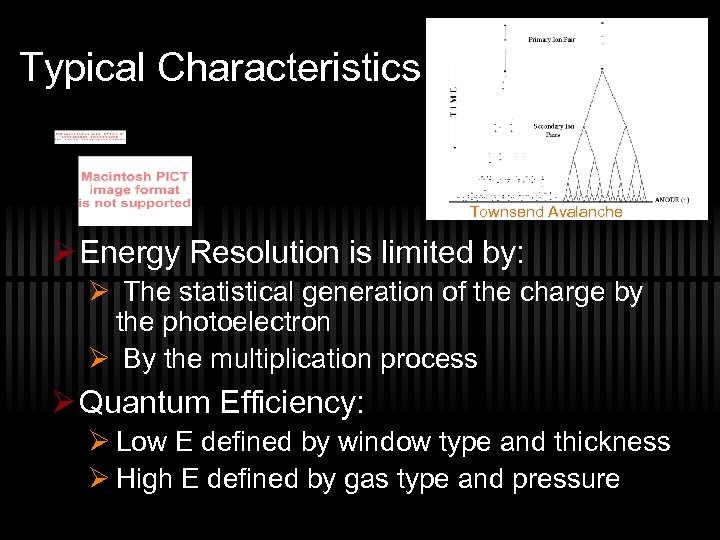 Typical Characteristics Townsend Avalanche Ø Energy Resolution is limited by: Ø The statistical generation of the charge by the photoelectron Ø By the multiplication process Ø Quantum Efficiency: Ø Low E defined by window type and thickness Ø High E defined by gas type and pressure
 Typical Characteristics Ø Position sensitivity Ø Non-imaging case: Ø Limited by source confusion to 1/1000 Crab Ø Imaging case: track length, diffusion, detector depth, readout elements Ø Timing Resolution Ø Limited by the anode-cathode spacing and the ion mobility: ~ µsec Ø Timing variations:
 Background rejection techniques Ø Energy Selection Ø Reject events with E outside of band pass Ø Rise-time discrimination Ø Rise time of an X-ray event can be characterised. The rise-time of a charged particle interactions have a different characteristic. Ø Anti-coincidence Ø Use a sub-divided gas cell with a shield of plastic scintillator Ø Co-incident pulses indicate extended source of ionisation
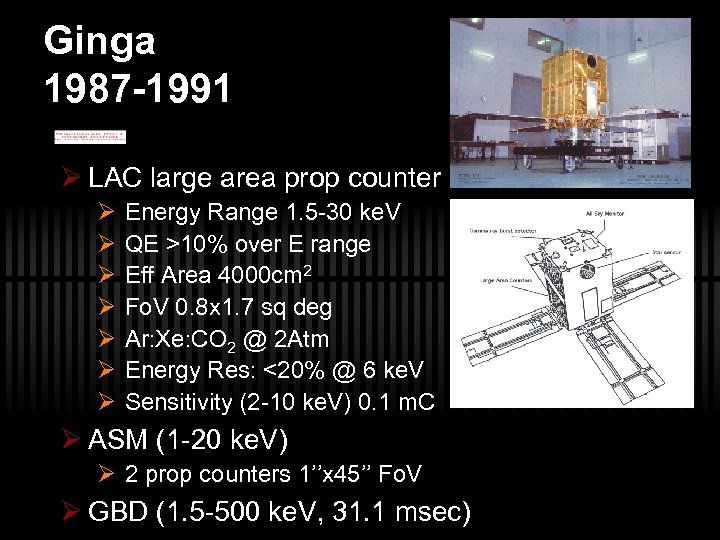 Ginga 1987 -1991 Ø LAC large area prop counter Ø Ø Ø Ø Energy Range 1. 5 -30 ke. V QE >10% over E range Eff Area 4000 cm 2 Fo. V 0. 8 x 1. 7 sq deg Ar: Xe: CO 2 @ 2 Atm Energy Res: <20% @ 6 ke. V Sensitivity (2 -10 ke. V) 0. 1 m. C Ø ASM (1 -20 ke. V) Ø 2 prop counters 1’’x 45’’ Fo. V Ø GBD (1. 5 -500 ke. V, 31. 1 msec)
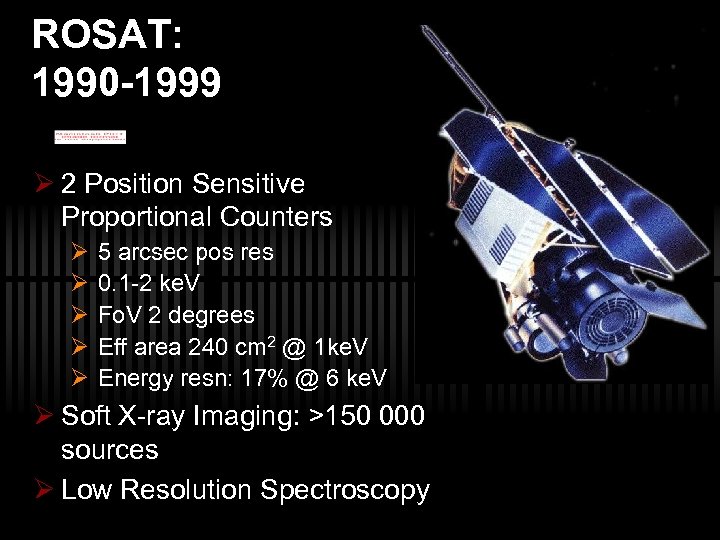 ROSAT: 1990 -1999 Ø 2 Position Sensitive Proportional Counters Ø Ø Ø 5 arcsec pos res 0. 1 -2 ke. V Fo. V 2 degrees Eff area 240 cm 2 @ 1 ke. V Energy resn: 17% @ 6 ke. V Ø Soft X-ray Imaging: >150 000 sources Ø Low Resolution Spectroscopy
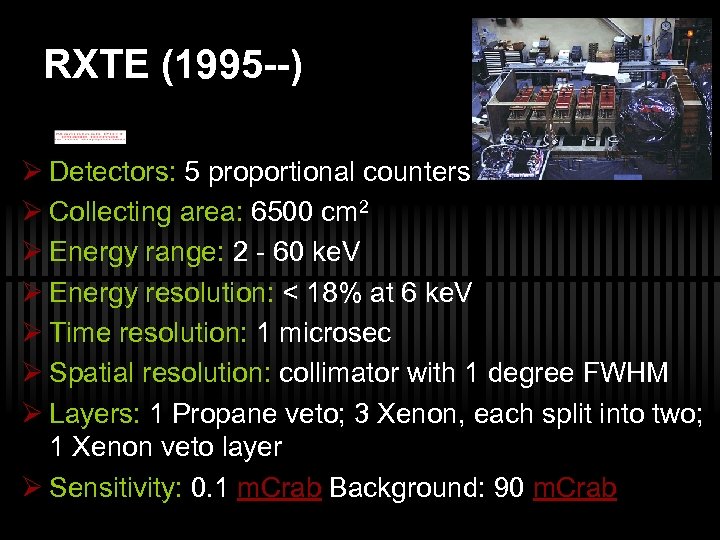 RXTE (1995 --) Ø Detectors: 5 proportional counters Ø Collecting area: 6500 cm 2 Ø Energy range: 2 - 60 ke. V Ø Energy resolution: < 18% at 6 ke. V Ø Time resolution: 1 microsec Ø Spatial resolution: collimator with 1 degree FWHM Ø Layers: 1 Propane veto; 3 Xenon, each split into two; 1 Xenon veto layer Ø Sensitivity: 0. 1 m. Crab Background: 90 m. Crab
 Calibration and Analysis Issues Ø Gain drift Ø Gas contamination Ø Gas leak Ø Cracking Ø Loss of counter e. g. micrometeoroid Ø Permanent change in instrument sensitivity Ø Background veto Ø Variation in sensitivity Ø Insufficient energy resolution for detailed studies of source spectra
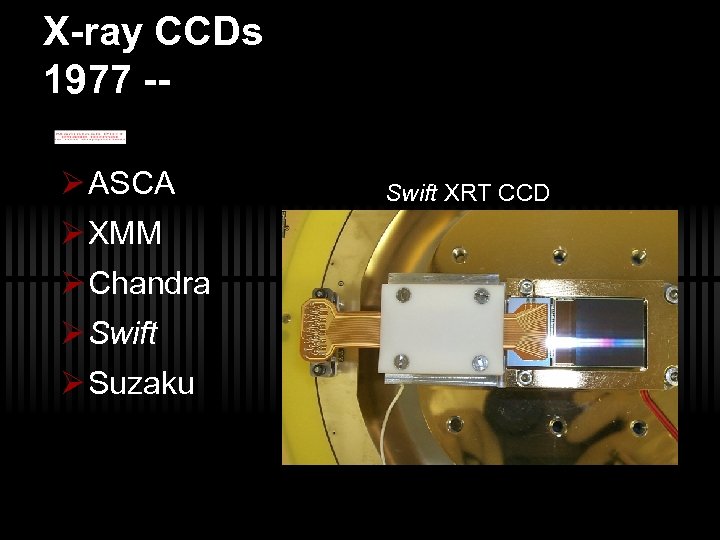 X-ray CCDs 1977 -Ø ASCA Ø XMM Ø Chandra Ø Swift Ø Suzaku Swift XRT CCD
 CCD Operation - charge transfer Ø 2 -phase CCD Ø 3 Phase CCD
 CCD Operation Ø Cooling (<-90 ºC) Ø To prevent dark current Ø To freeze traps Ø Bias Maps Ø To minimise variations in background over the detector Ø Hot Pixel Maps Ø To account for damage in the detector
 CCD Bandpass Ø Low E response Ø Electrodes Ø Optical blocking Ø High E response Ø Si thickness
 CCD Modes Photodiode Mode Ø Provides highest resolution timing - ~usec Ø Spectroscopy - Fluxes < pile-up Windowed Timing Mode Ø Timing Resolution - ~ msec Ø Spectroscopy Ø 1 -d position Photon-counting Mode (Nominal) Ø Low resolution timing – ~ sec Ø Spectroscopy Ø 2 -D position
 CCD Characteristics for Data Analysis Ø Quantum Efficiency Ø Background Ø Energy resolution Ø CTI Ø Hotpixels
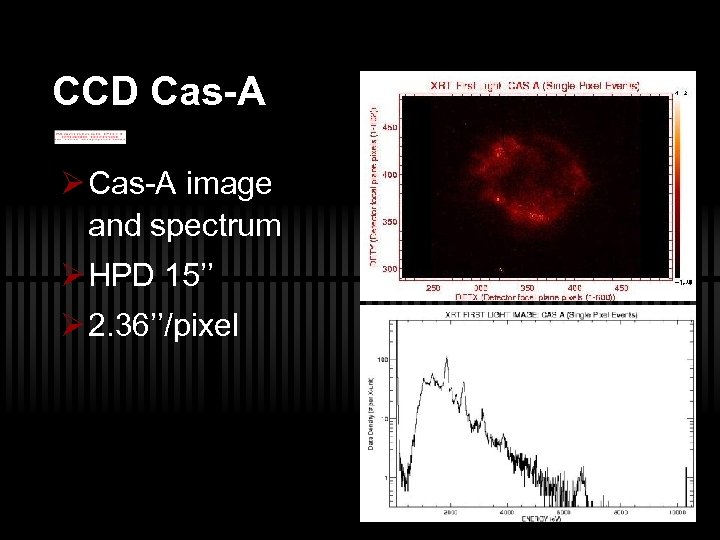 CCD Cas-A Ø Cas-A image and spectrum Ø HPD 15’’ Ø 2. 36’’/pixel
 ASCA 1993 -2001 Ø First Obs to use X-ray CCDs Ø i. e. Imaging+broad bandpass+good spectral resolution+large eff. area Ø 0. 4 -10 ke. V Ø 4 telescopes w/ 120 nested mirrors, 3’ HPD Ø 2 proportional counters Ø 2 CCDs Ø Effective Area: 1300 cm 2 @ 1 ke. V Ø Energy resolution 2% at 6 ke. V
 XMM - EPIC MOS 1999 -Ø 3 Telescopes Ø Pos Res 15’’ Ø 2 EPIC 1 PN camaras Ø Ø 0. 1 -15 ke. V ~1000 cm 2 @ 1 ke. V E resn: 2 -5 % Fo. V 33’ Ø Large collecting area Ø High resolution spectroscopy with RGS Ø 0. 1 -0. 5% 0. 35 -2. 5 ke. V
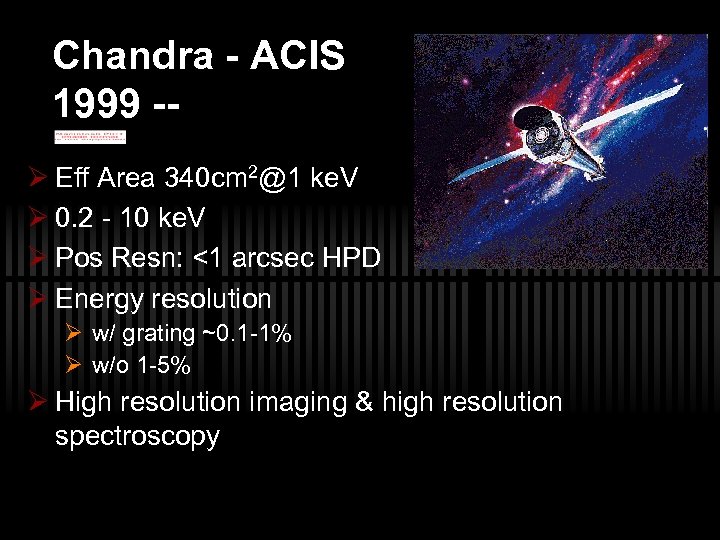 Chandra - ACIS 1999 -Ø Eff Area 340 cm 2@1 ke. V Ø 0. 2 - 10 ke. V Ø Pos Resn: <1 arcsec HPD Ø Energy resolution Ø w/ grating ~0. 1 -1% Ø w/o 1 -5% Ø High resolution imaging & high resolution spectroscopy
 Swift XRT 2004 -Ø Measure positions of GRBs to <5’’ in <100 seconds Ø 0. 3 -10 ke. V Ø 18’’ HPD Ø 125 cm 2 @ 1. 5 ke. V Ø Automated operation
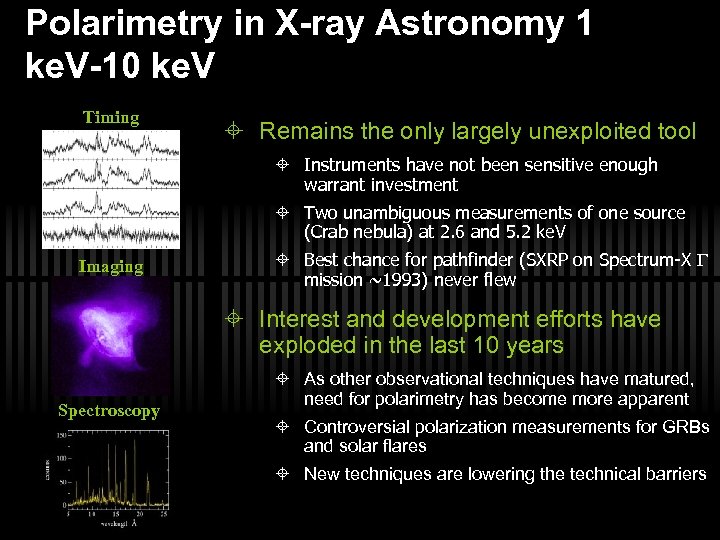 Polarimetry in X-ray Astronomy 1 ke. V-10 ke. V Timing Remains the only largely unexploited tool Instruments have not been sensitive enough warrant investment Two unambiguous measurements of one source (Crab nebula) at 2. 6 and 5. 2 ke. V Imaging Best chance for pathfinder (SXRP on Spectrum-X mission ~1993) never flew Interest and development efforts have exploded in the last 10 years Spectroscopy As other observational techniques have matured, need for polarimetry has become more apparent Controversial polarization measurements for GRBs and solar flares New techniques are lowering the technical barriers
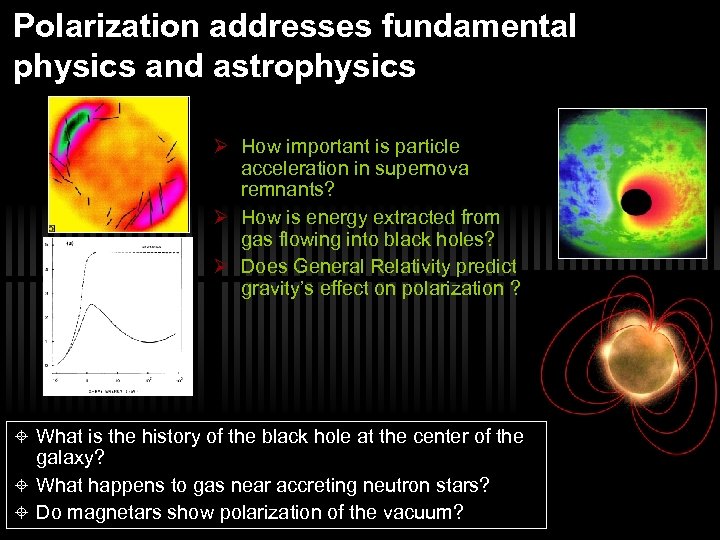 Polarization addresses fundamental physics and astrophysics Ø How important is particle acceleration in supernova remnants? Ø How is energy extracted from gas flowing into black holes? Ø Does General Relativity predict gravity’s effect on polarization ? What is the history of the black hole at the center of the galaxy? What happens to gas near accreting neutron stars? Do magnetars show polarization of the vacuum?
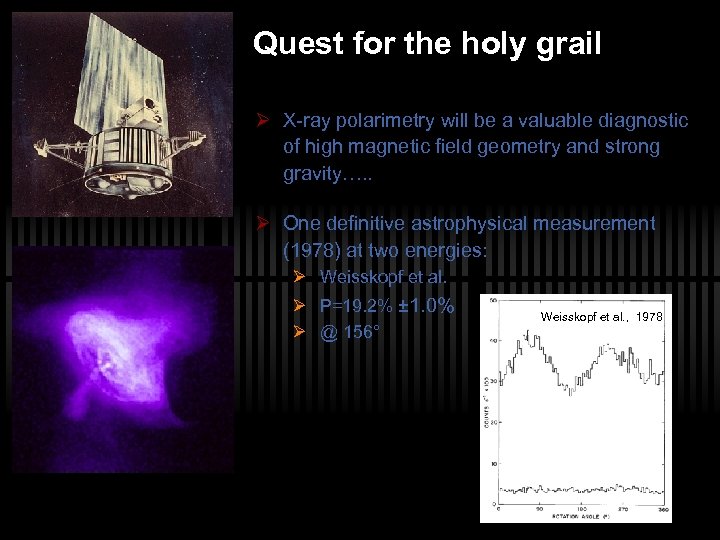 Quest for the holy grail Ø X-ray polarimetry will be a valuable diagnostic of high magnetic field geometry and strong gravity…. . Ø One definitive astrophysical measurement (1978) at two energies: Ø Weisskopf et al. Ø P=19. 2% ± 1. 0% Ø @ 156° Weisskopf et al. , 1978
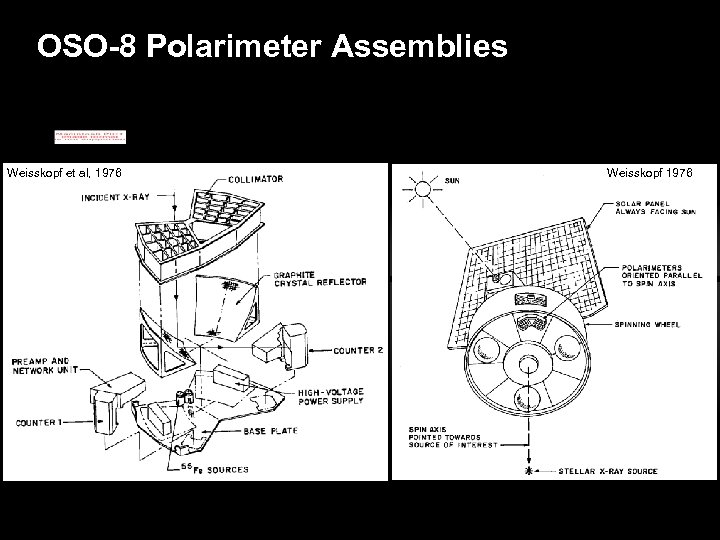 OSO-8 Polarimeter Assemblies Weisskopf et al, 1976 Weisskopf 1976
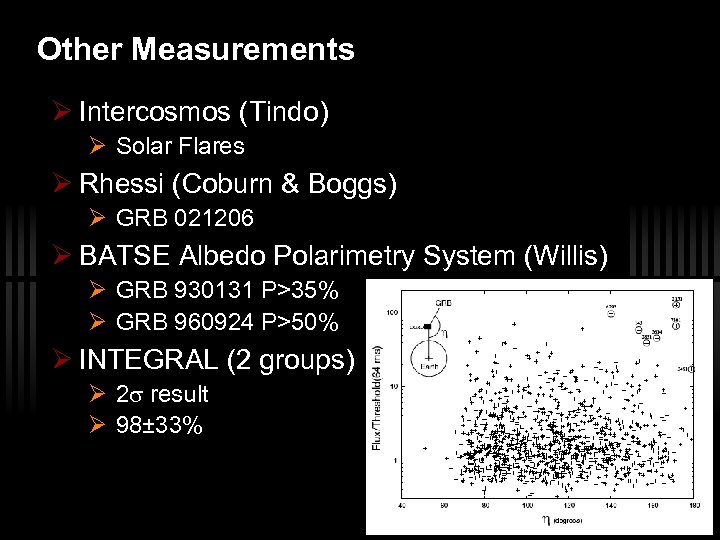 Other Measurements Ø Intercosmos (Tindo) Ø Solar Flares Ø Rhessi (Coburn & Boggs) Ø GRB 021206 Ø BATSE Albedo Polarimetry System (Willis) Ø GRB 930131 P>35% Ø GRB 960924 P>50% Ø INTEGRAL (2 groups) Ø 2 result Ø 98± 33% Willis et al. 2005
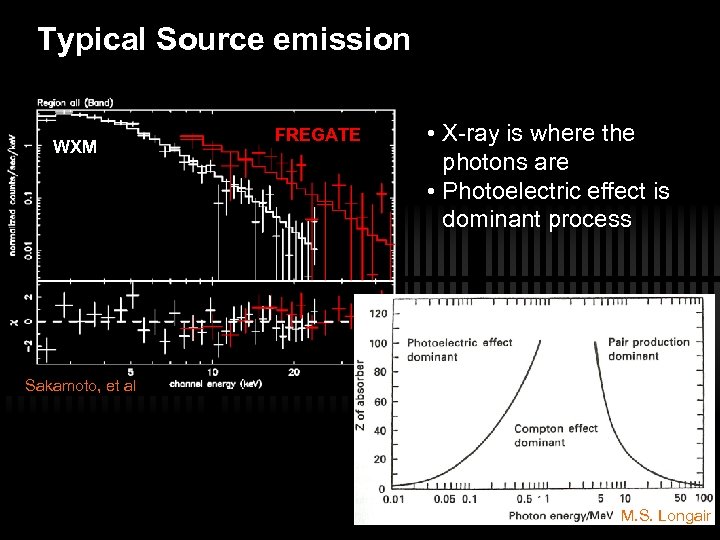 Typical Source emission WXM FREGATE • X-ray is where the photons are • Photoelectric effect is dominant process Sakamoto, et al M. S. Longair
 The Photoelectric Effect Ø The photoelectron is ejected with a sin 2 cos 2 distribution aligned with the E-field of the incident Xray Ø The photoelectron looses its energy with elastic and inelastic collisions creating small charge clouds
 Polarimeter Figure of Merit • Polarimeter Minimum Detectable Polarization (apparent polarization arising from statistical fluctuations in unpolarized data): • Polarimeter Figure of Merit (in the signal dominated case): but, systematics are important! Challenge: High modulation AND high QE
 Small Pixel CCD Polarimeters
 Polarimeter Requirements • Challenge: both good modulation and high QE • Ideal polarimeter is an electron track imager: • resolution elements < mean free path • Can only begin to approach this in a gas detector
 Micropattern Gas Polarimeter Ø X-ray interacts in the gas Ø K-shell photoelectron ejected Ø Photoelectron creates electron cloud Ø Electron cloud drifts to cathode Ø Electron multiplication occurs between cathode and anode Ø Charge collected at the pixel readout
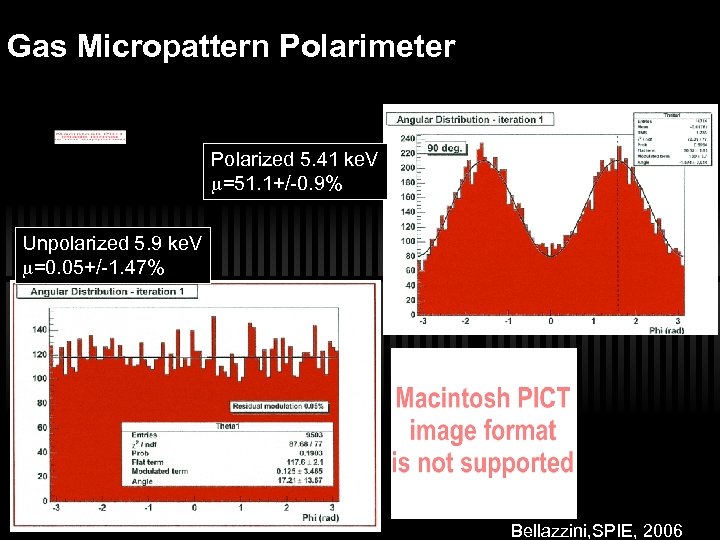 Gas Micropattern Polarimeter Polarized 5. 41 ke. V =51. 1+/-0. 9% Unpolarized 5. 9 ke. V =0. 05+/-1. 47% Bellazzini, SPIE, 2006
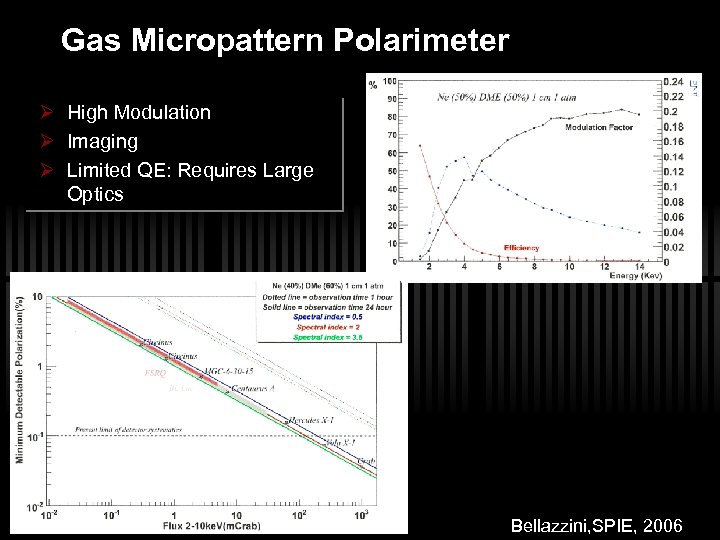 Gas Micropattern Polarimeter Ø High Modulation Ø Imaging Ø Limited QE: Requires Large Optics Bellazzini, SPIE, 2006
 A Time-Projection Chamber (TPC) X-ray polarimeter
 Time-Projection Chamber Polarimeter Charge pulses arriving at the strips z x y
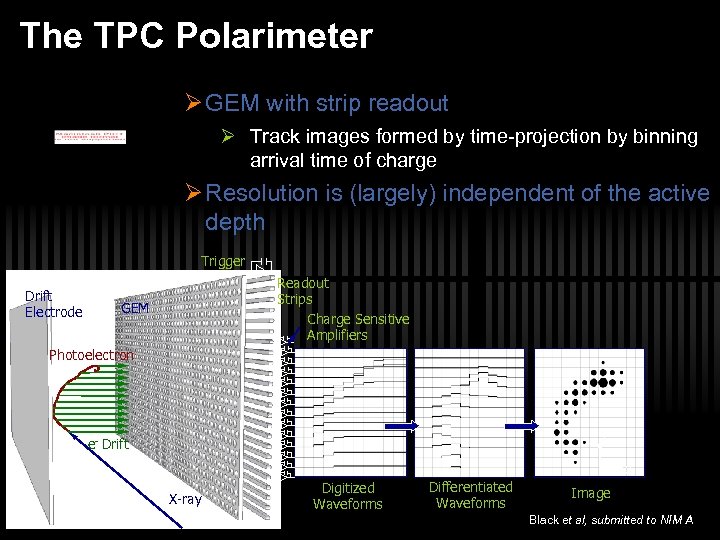 The TPC Polarimeter Ø GEM with strip readout Ø Track images formed by time-projection by binning arrival time of charge Ø Resolution is (largely) independent of the active depth Trigger Drift Electrode Readout Strips Charge Sensitive Amplifiers GEM Photoelectron y y e- Drift x x z X-ray Digitized Waveforms Differentiated Waveforms Image Black et al, submitted to NIM A
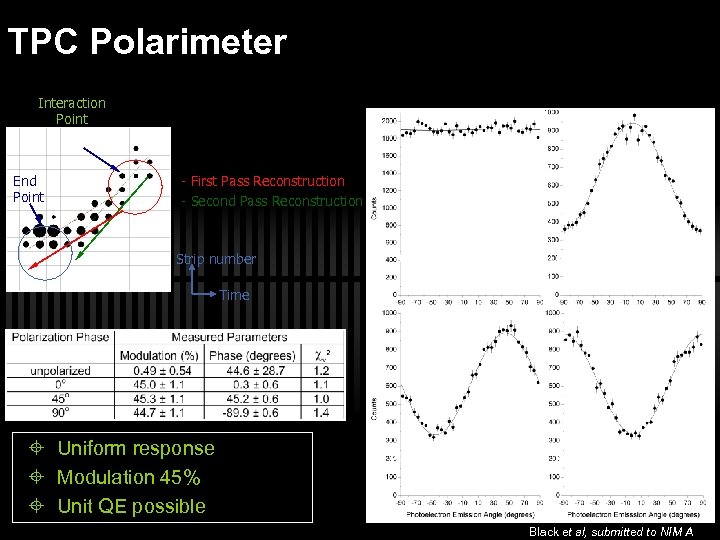 TPC Polarimeter Interaction Point End Point - First Pass Reconstruction - Second Pass Reconstruction Strip number unpolarized 5. 9 ke. V polarized 6. 4 ke. V at 0 o polarized 6. 4 ke. V at 45 o polarized 6. 4 ke. V at 90 o Time Uniform response Modulation 45% Unit QE possible Black et al, submitted to NIM A
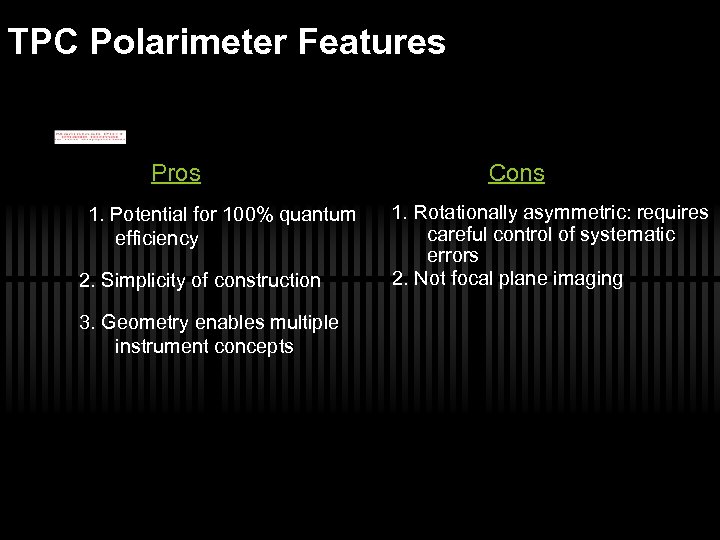 TPC Polarimeter Features Pros 1. Potential for 100% quantum efficiency 2. Simplicity of construction 3. Geometry enables multiple instrument concepts Cons 1. Rotationally asymmetric: requires careful control of systematic errors 2. Not focal plane imaging
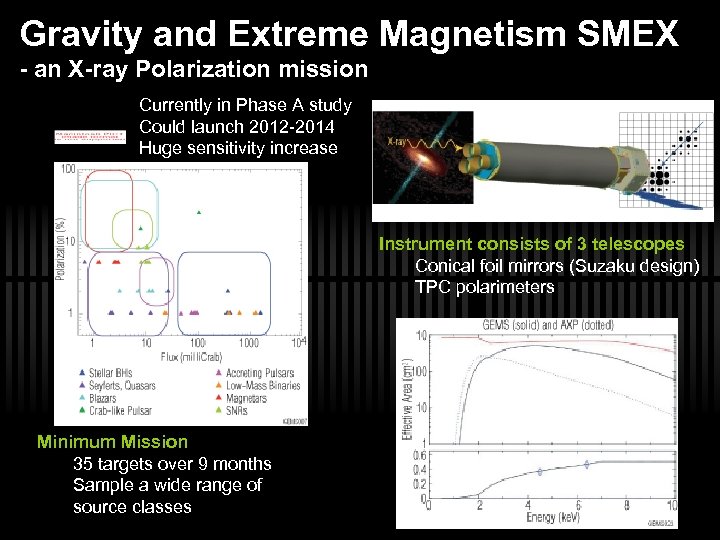 Gravity and Extreme Magnetism SMEX - an X-ray Polarization mission Currently in Phase A study Could launch 2012 -2014 Huge sensitivity increase Instrument consists of 3 telescopes Conical foil mirrors (Suzaku design) TPC polarimeters Minimum Mission 35 targets over 9 months Sample a wide range of source classes
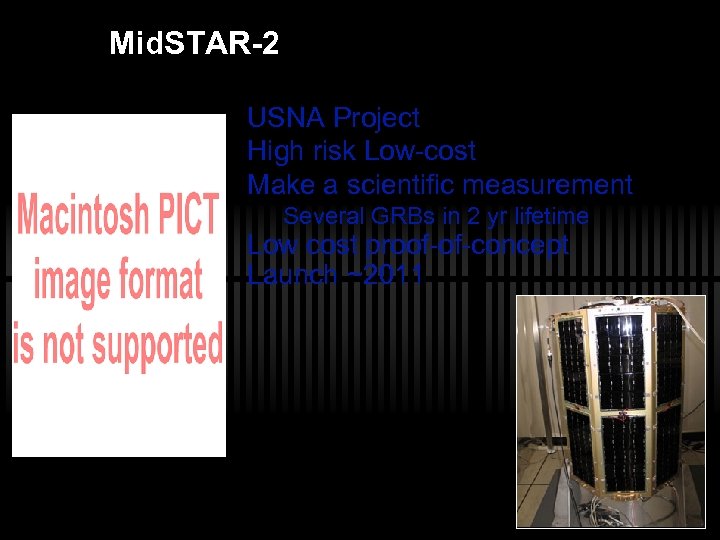 Mid. STAR-2 USNA Project High risk Low-cost Make a scientific measurement Several GRBs in 2 yr lifetime Low cost proof-of-concept Launch ~2011
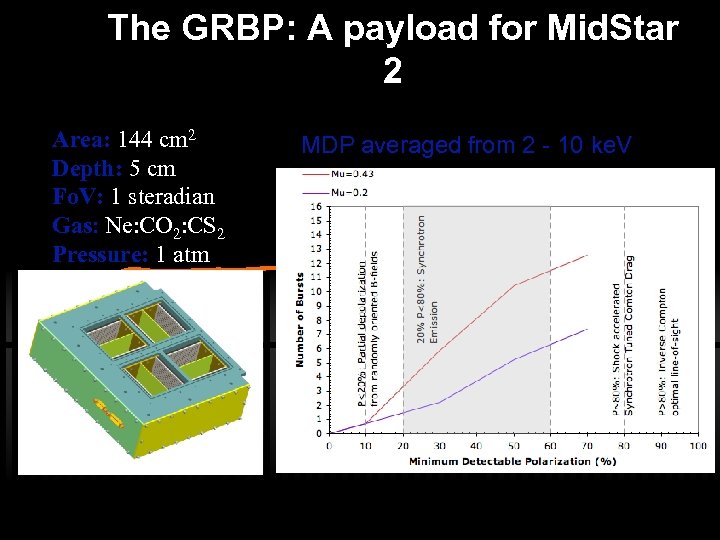 The GRBP: A payload for Mid. Star 2 Area: 144 cm 2 Depth: 5 cm Fo. V: 1 steradian Gas: Ne: CO 2: CS 2 Pressure: 1 atm MDP averaged from 2 - 10 ke. V
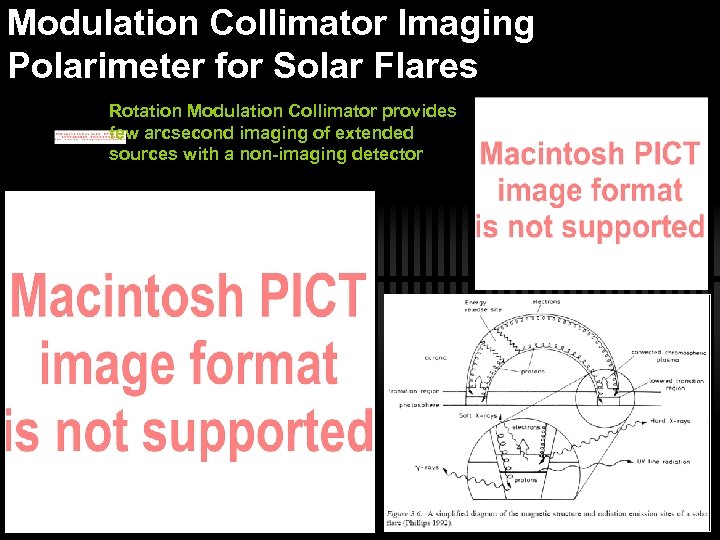 Modulation Collimator Imaging Polarimeter for Solar Flares Rotation Modulation Collimator provides few arcsecond imaging of extended sources with a non-imaging detector 3 liter TPC polarimeter Dennis et al