


 Скачать презентацию PRONOUN AND NUMERAL OUTLINE 1 2 3
7 Pronoun and Numeral.ppt
- Количество слайдов: 59
 PRONOUN AND NUMERAL
 OUTLINE: 1. 2. 3. 4. 5. 6. Pronoun as a part of speech. Classification of pronouns. Pronouns vs. content & function words Numeral. Classification of numerals. Pronominal nature of numerals.
 PRONOUN AS A PART OF SPEECH
 PART OF SPEECH? A part of speech – based on the meaning Determiner Pronominal adjective Foreign linguistics Pronominal noun Pronominal adverb
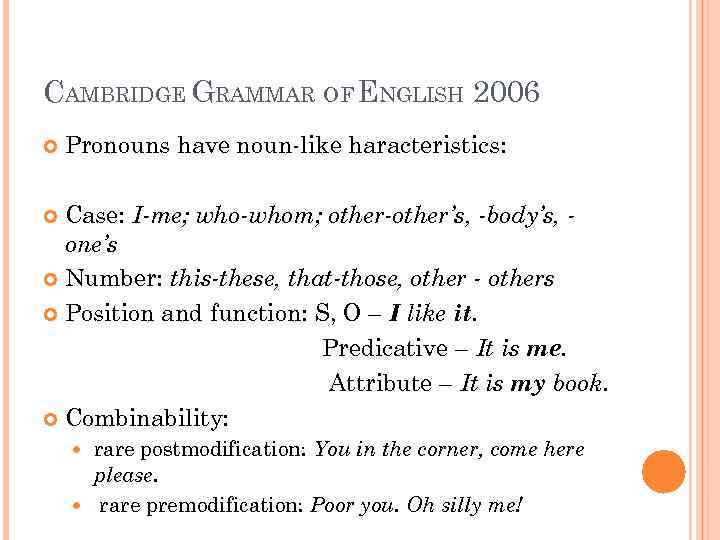 CAMBRIDGE GRAMMAR OF ENGLISH 2006 Pronouns have noun-like haracteristics: Case: I-me; who-whom; other-other’s, -body’s, one’s Number: this-these, that-those, other - others Position and function: S, O – I like it. Predicative – It is me. Attribute – It is my book. Combinability: rare postmodification: You in the corner, come here please. rare premodification: Poor you. Oh silly me!
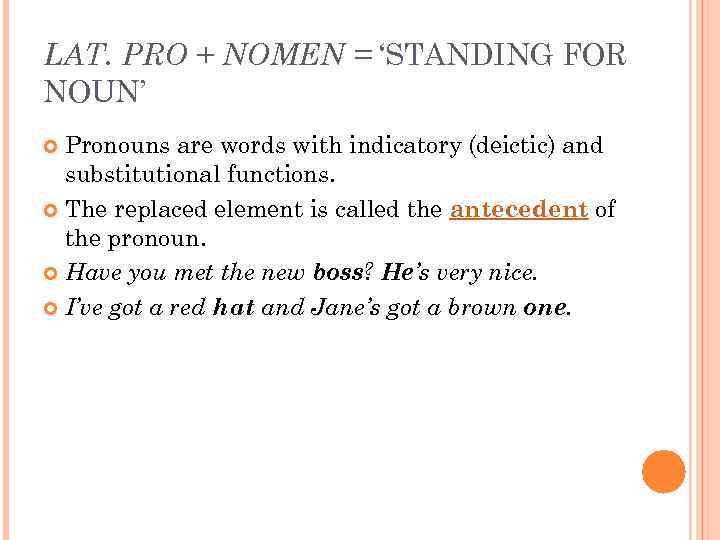 LAT. PRO + NOMEN = ‘STANDING FOR NOUN’ Pronouns are words with indicatory (deictic) and substitutional functions. The replaced element is called the antecedent of the pronoun. Have you met the new boss? He’s very nice. I’ve got a red hat and Jane’s got a brown one.
 SPECIFIC OF ENGLISH Cataphoric reference (forward): She was walking along a tree-lined suburban road, unaware of what was about to befall her. Gillian Dawson had never been aware of the people around her.
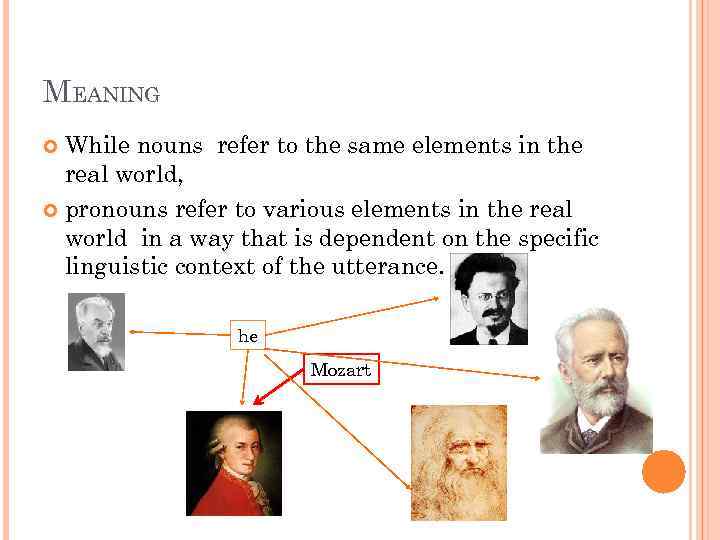 MEANING While nouns refer to the same elements in the real world, pronouns refer to various elements in the real world in a way that is dependent on the specific linguistic context of the utterance. he Mozart
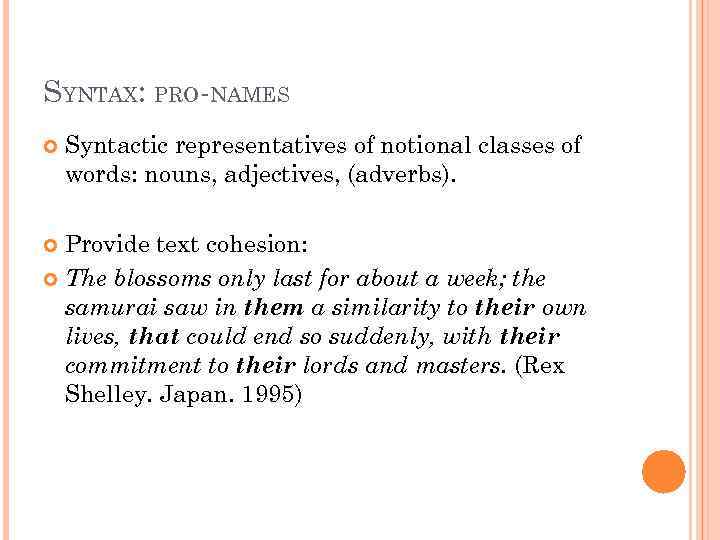 SYNTAX: PRO-NAMES Syntactic representatives of notional classes of words: nouns, adjectives, (adverbs). Provide text cohesion: The blossoms only last for about a week; the samurai saw in them a similarity to their own lives, that could end so suddenly, with their commitment to their lords and masters. (Rex Shelley. Japan. 1995)
 NARROW UNDERSTANDING Based on grammatical criterion: Pronouns include only variable personal pronouns (I / me…) + who/whom.
 BROAD UNDERSTANDING Based only on semantic criterion (O. Jespersen) Ignoring morphological and syntactical criteria + Pronominal adverbs: then, there, when, so…
 CLASSIFICATION OF PRONOUNS
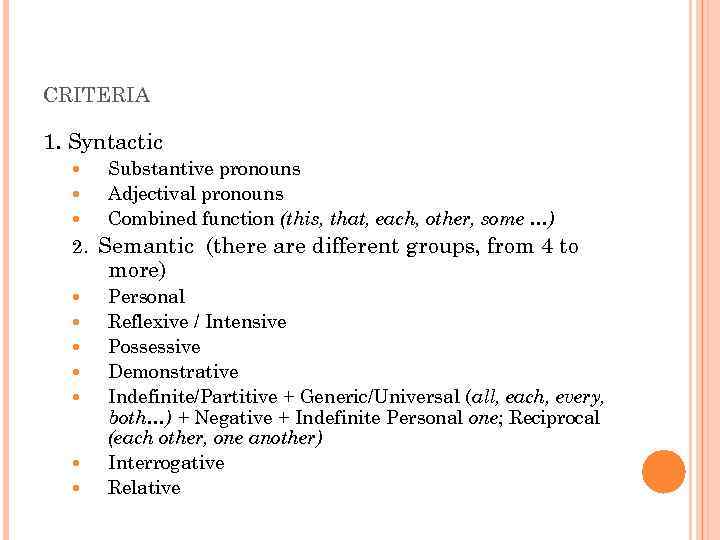 CRITERIA 1. Syntactic Substantive pronouns Adjectival pronouns Combined function (this, that, each, other, some …) 2. Semantic (there are different groups, from 4 to more) Personal Reflexive / Intensive Possessive Demonstrative Indefinite/Partitive + Generic/Universal (all, each, every, both…) + Negative + Indefinite Personal one; Reciprocal (each other, one another) Interrogative Relative
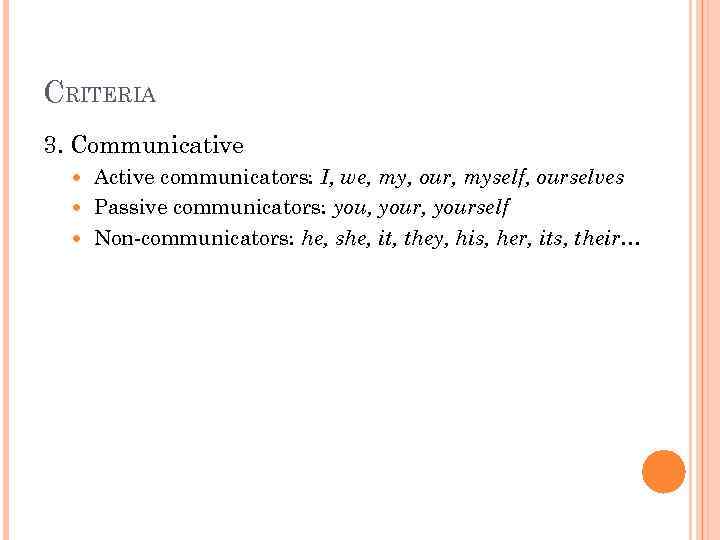 CRITERIA 3. Communicative Active communicators: I, we, my, our, myself, ourselves Passive communicators: you, yourself Non-communicators: he, she, it, they, his, her, its, their…
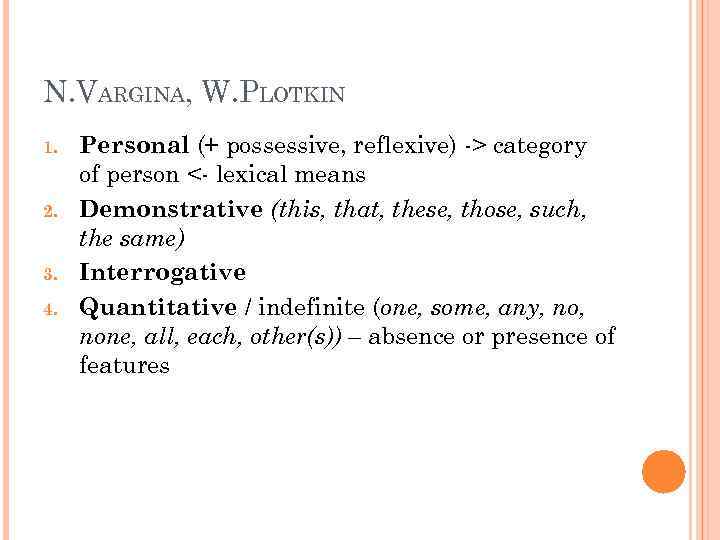 N. VARGINA, W. PLOTKIN 1. 2. 3. 4. Personal (+ possessive, reflexive) -> category of person <- lexical means Demonstrative (this, that, these, those, such, the same) Interrogative Quantitative / indefinite (one, some, any, none, all, each, other(s)) – absence or presence of features
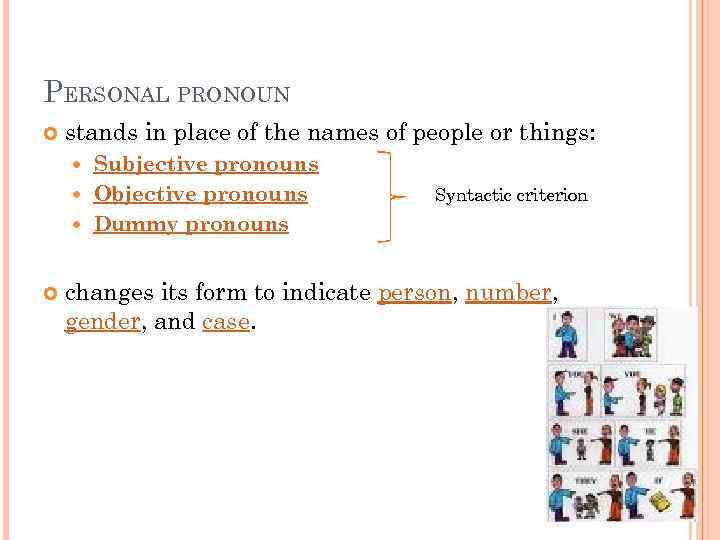 PERSONAL PRONOUN stands in place of the names of people or things: Subjective pronouns Objective pronouns Dummy pronouns Syntactic criterion changes its form to indicate person, number, gender, and case.
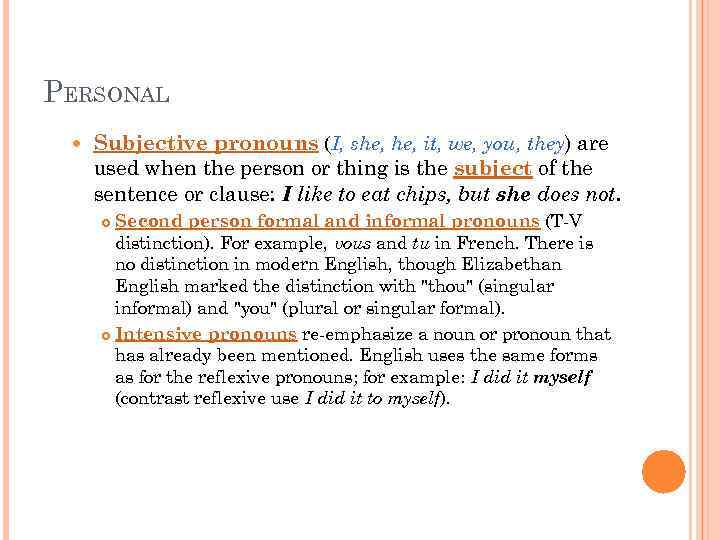 PERSONAL Subjective pronouns (I, she, it, we, you, they) are used when the person or thing is the subject of the sentence or clause: I like to eat chips, but she does not. Second person formal and informal pronouns (T-V distinction). For example, vous and tu in French. There is no distinction in modern English, though Elizabethan English marked the distinction with "thou" (singular informal) and "you" (plural or singular formal). Intensive pronouns re-emphasize a noun or pronoun that has already been mentioned. English uses the same forms as for the reflexive pronouns; for example: I did it myself (contrast reflexive use I did it to myself).
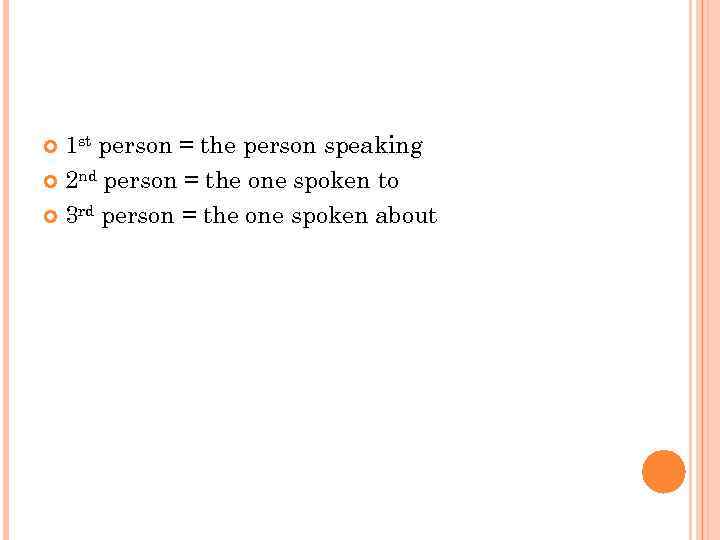 1 st person = the person speaking 2 nd person = the one spoken to 3 rd person = the one spoken about
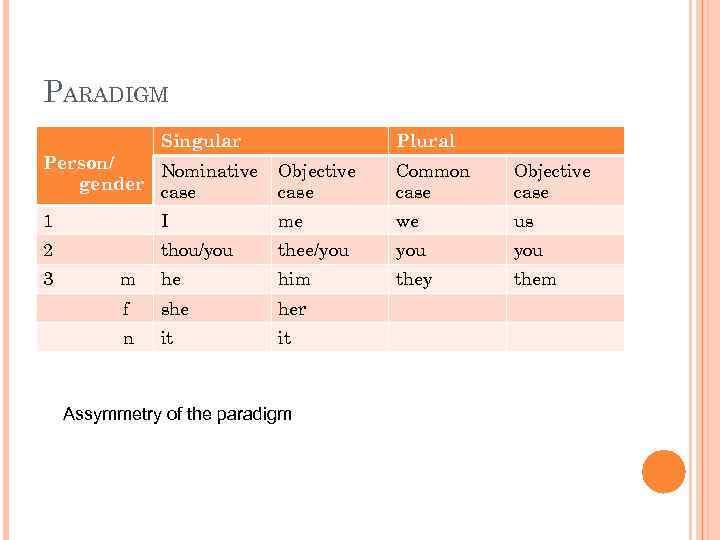 PARADIGM Singular Plural Person/ Nominative gender case Objective case Common case Objective case 1 I me we us 2 thou/you thee/you you m he him they them f she her n it it 3 Assymmetry of the paradigm
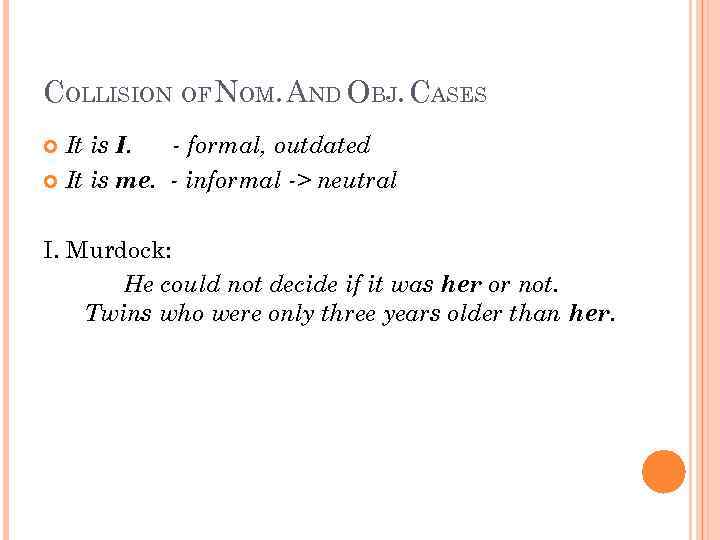 COLLISION OF NOM. AND OBJ. CASES It is I. - formal, outdated It is me. - informal -> neutral I. Murdock: He could not decide if it was her or not. Twins who were only three years older than her.
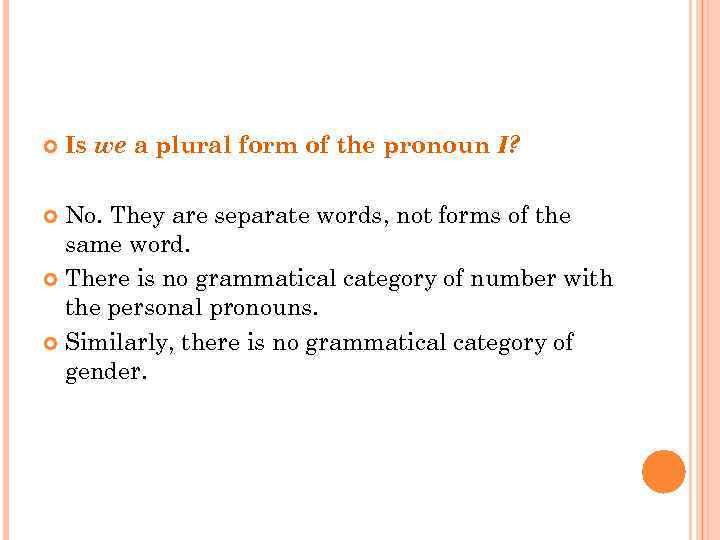 Is we a plural form of the pronoun I? No. They are separate words, not forms of the same word. There is no grammatical category of number with the personal pronouns. Similarly, there is no grammatical category of gender.
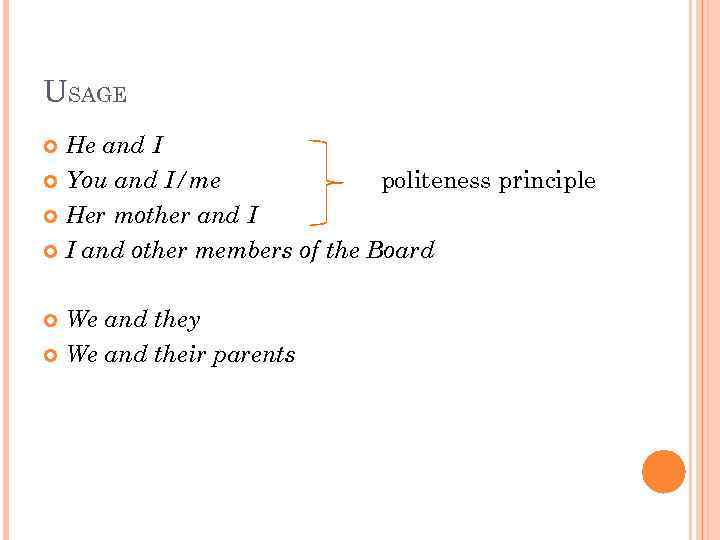 USAGE He and I You and I/me politeness principle Her mother and I I and other members of the Board We and they We and their parents
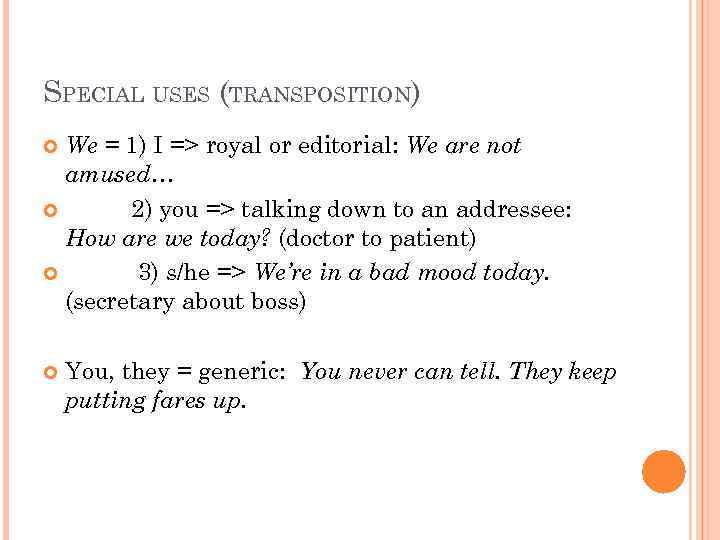 SPECIAL USES (TRANSPOSITION) We = 1) I => royal or editorial: We are not amused… 2) you => talking down to an addressee: How are we today? (doctor to patient) 3) s/he => We’re in a bad mood today. (secretary about boss) You, they = generic: You never can tell. They keep putting fares up.
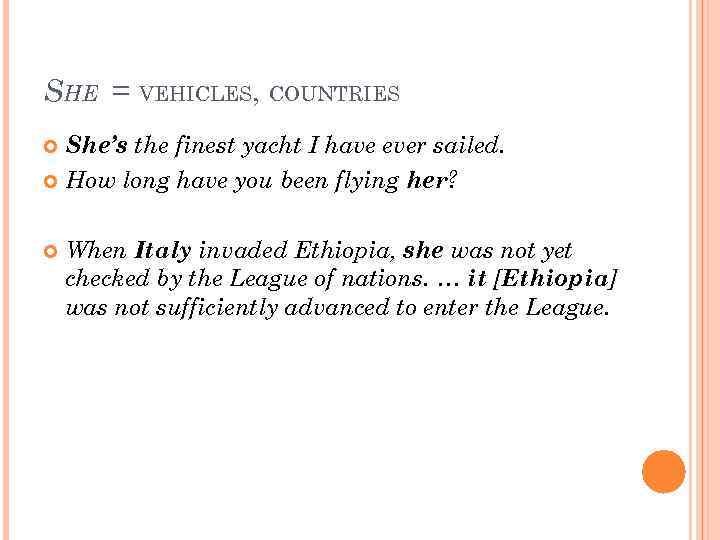 SHE = VEHICLES, COUNTRIES She’s the finest yacht I have ever sailed. How long have you been flying her? When Italy invaded Ethiopia, she was not yet checked by the League of nations. … it [Ethiopia] was not sufficiently advanced to enter the League.
 PERSONAL Objective pronouns (me, her, him, it, us, you, and them) are used when the person or thing is the object of the sentence or clause: John likes me but not her. Direct and indirect object pronouns. English uses the same forms for both; for example: Mary loves him (direct object); Mary sent him a letter (indirect object). Reflexive pronouns are used when a person or thing acts on itself: John cut himself. Reciprocal pronouns refer to a reciprocal relationship: They do not like each other.
 PERSONAL Dummy / empty pronouns, formal, or structural pronouns are used when grammatical rules require a noun (or pronoun), but none is semantically required: It is raining. Anticipatory it = a preparatory subject or object of a senetence: It’s been nice to meet you. He made it very difficult to like him and his sister.
 REFLEXIVE PRONOUNS reflexive pronoun (myself, yourself, herself, himself, itself, ourselves, yourselves, and themselves) refers back to the subject of the clause or sentence. can also act as an intensive pronoun. After the party, I asked myself why I had faxed invitations to everyone in my office building. Diabetics give themselves insulin shots several times a day.
 GRAMMATICAL VARIABILITY -self -- -selves
 INTENSIVE PRONOUNS An intensive pronoun is a pronoun used to emphasize its antecedent. Intensive pronouns are identical in form to reflexive pronouns. The Prime Minister himself said that he would lower taxes.
 POSSESSIVE PRONOUNS Possessive pronouns (mine, thy, hers, his, its, ours, yours, and theirs) are used to indicate possession or ownership. Foreign linguistics: the possessive pronouns are only those that act syntactically as nouns (Russian linguist. : absolute possessive): Those clothes are mine. possessive adjectives (or possessive determiners): my, her, his, its, our, your, their. For example, I lost my wallet. They are not strictly speaking pronouns because they do not substitute for a noun or noun phrase, and as such, some grammarians classify these terms in a separate lexical category called determiners (they have a syntactic role close to that of adjectives, always qualifying a noun).
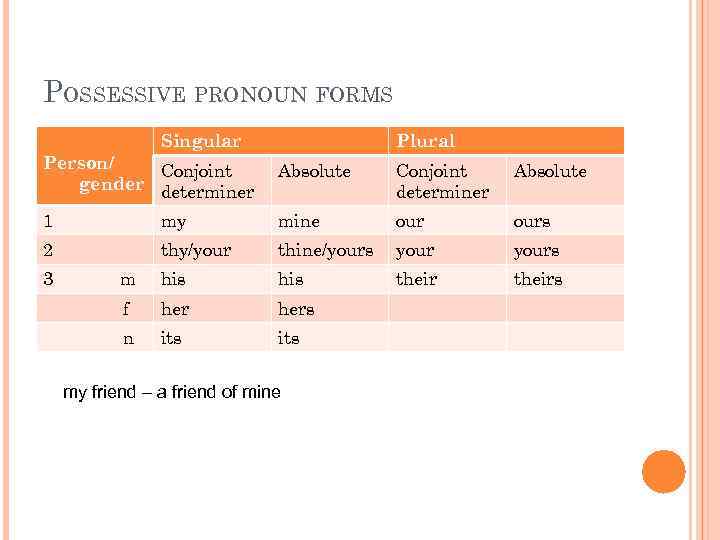 POSSESSIVE PRONOUN FORMS Singular Plural Person/ Conjoint gender determiner Absolute Conjoint determiner Absolute 1 my mine ours 2 thy/your thine/yours m his theirs f hers n its 3 my friend – a friend of mine
 DEMONSTRATIVE PRONOUNS Demonstrative pronouns distinguish the particular objects or people that are referred to from other possible candidates: I shall take these. This must not continue. this – these that – those Demonstrative adjectives. a) Distance in space: Hello, this is Clair. Who’s that speaking? b) Distance in time: Ladies and gentlemen, this is Stirling Moss, that was. c) Attitude: Here is that awful Jones and those ugly children of his.
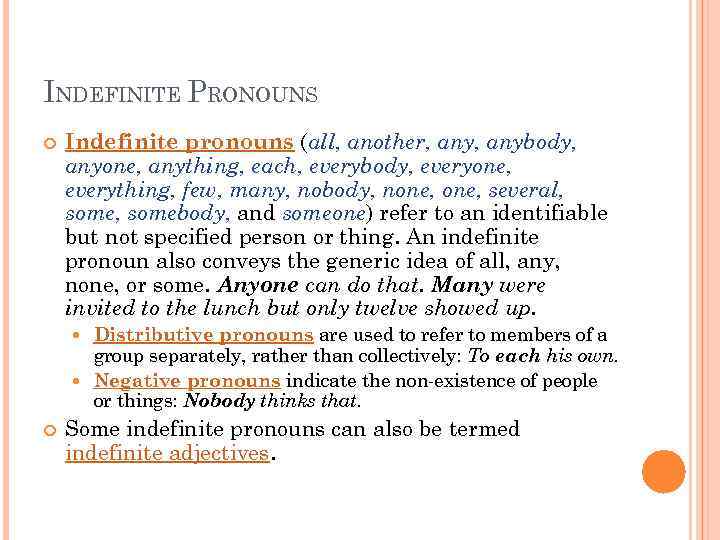 INDEFINITE PRONOUNS Indefinite pronouns (all, another, anybody, anyone, anything, each, everybody, everyone, everything, few, many, nobody, none, several, somebody, and someone) refer to an identifiable but not specified person or thing. An indefinite pronoun also conveys the generic idea of all, any, none, or some. Anyone can do that. Many were invited to the lunch but only twelve showed up. Distributive pronouns are used to refer to members of a group separately, rather than collectively: To each his own. Negative pronouns indicate the non-existence of people or things: Nobody thinks that. Some indefinite pronouns can also be termed indefinite adjectives.
 -BODY VS. -ONE In database evidence, someone is more than twice as common as somebody. (P. Peters, 2004)
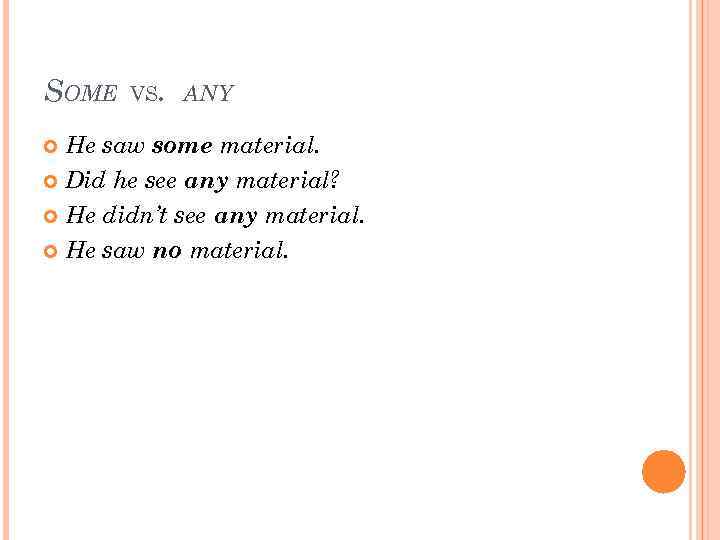 SOME VS. ANY He saw some material. Did he see any material? He didn’t see any material. He saw no material.
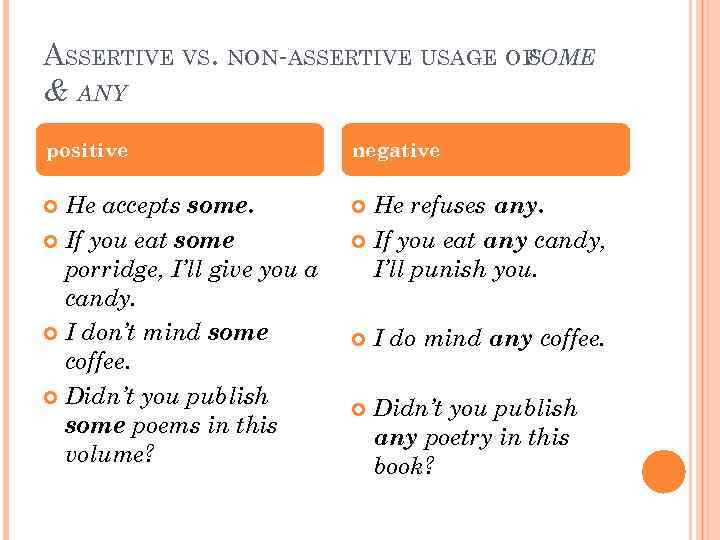 ASSERTIVE VS. NON-ASSERTIVE USAGE OF SOME & ANY positive negative He accepts some. If you eat some porridge, I’ll give you a candy. I don’t mind some coffee. Didn’t you publish some poems in this volume? He refuses any. If you eat any candy, I’ll punish you. I do mind any coffee. Didn’t you publish any poetry in this book?
 RELATIVE PRONOUNS Relative pronouns (who, whom, that, which, whose; whoever, whomever, and whichever) are used to link one phrase or clause to another phrase or clause: People who smoke should quit now. who and whoever refer to the subject of a clause: whom and whomever refer to the objects of a verb, a verbal or a preposition: You may invite whomever you like to the party. whose refers both to people and things: The soldier whose arm was raised in salute had disappeared. We were sideswiped by a truck whose brakes had failed.
 INTERROGATIVE PRONOUNS Interrogative pronouns (who, whom, which, what, whoever, whomever, whichever, and whatever, whose) are used to ask questions: Who is calling? Who were the first men in the moon? "which" or "what" can also be termed an interrogative adjective, and "who, " "whom, " or "which" can also be used as a relative pronoun. Cf. Who is that? (interrogative) - I know who that is. (relative). Interrogative whose is limited to people: Whose computer lost its mouse?
 "who, " "whom, " and occasionally "which“ refer to people, and "which" and "what" used to refer to things and to animals. whom do you wish to speak? What did she say? To
 PRONOUNS VS. CONTENT & FUNCTION WORDS
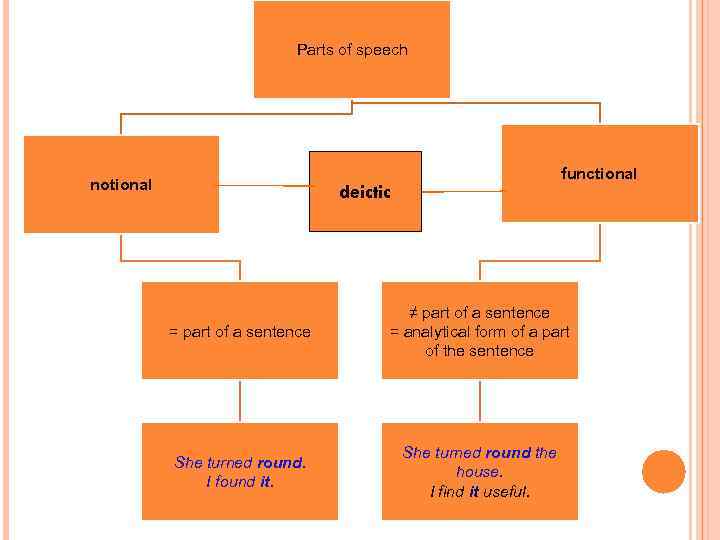 Parts of speech notional functional deictic = part of a sentence ≠ part of a sentence = analytical form of a part of the sentence She turned round. I found it. She turned round the house. I find it useful.
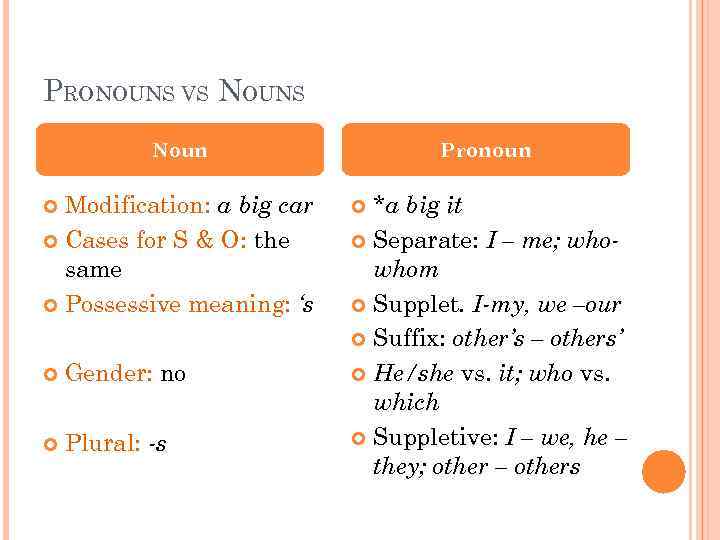 PRONOUNS VS NOUNS Noun Modification: a big car Cases for S & O: the same Possessive meaning: ‘s Gender: no Plural: -s Pronoun *a big it Separate: I – me; whowhom Supplet. I-my, we –our Suffix: other’s – others’ He/she vs. it; who vs. which Suppletive: I – we, he – they; other – others
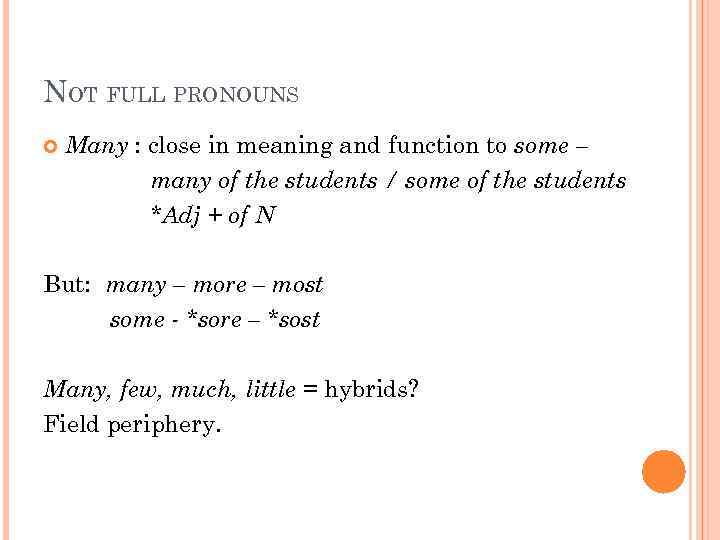 NOT FULL PRONOUNS Many : close in meaning and function to some – many of the students / some of the students *Adj + of N But: many – more – most some - *sore – *sost Many, few, much, little = hybrids? Field periphery.
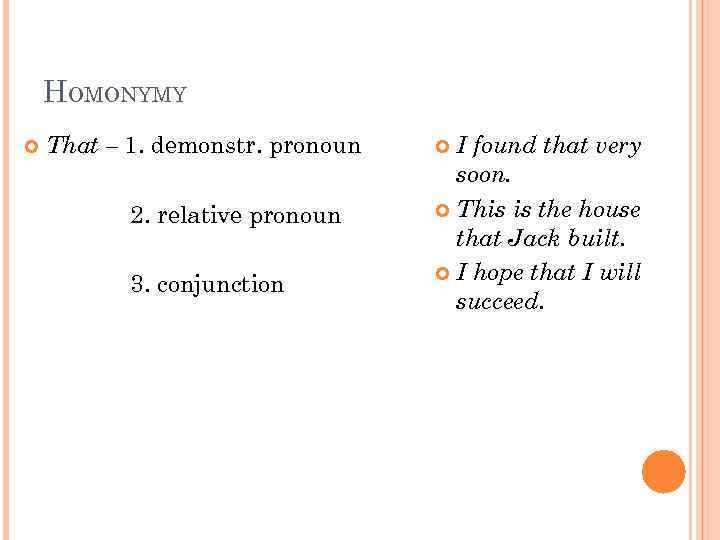 HOMONYMY That – 1. demonstr. pronoun 2. relative pronoun 3. conjunction I found that very soon. This is the house that Jack built. I hope that I will succeed.
 NUMERAL
 DEFINITION Class of words consisting primarily of adjectives (six months, double fault, threefold problem) as well as substantives (a dozen eggs), indefinite pronouns (all, both, many, few), and adverbials (He called twice already. ). (H. Bussmann) A part of speech with the categorial meaning of a definite number, order or repetition rate, particular syntactic functioning and specific models of form and word building. (O. Akhmanova)
 SEMANTICS Designate number and numerical order
 MORPHOLOGY Word building: specific forms of composition (twenty-five; two hundred and five) suffixes: -teen, -ty, -th Forms: invariable Cf. a dozen – dozens, a hundred - hundreds (N) many, much – more – most (Adj) little – less – least few – fewer - fewest
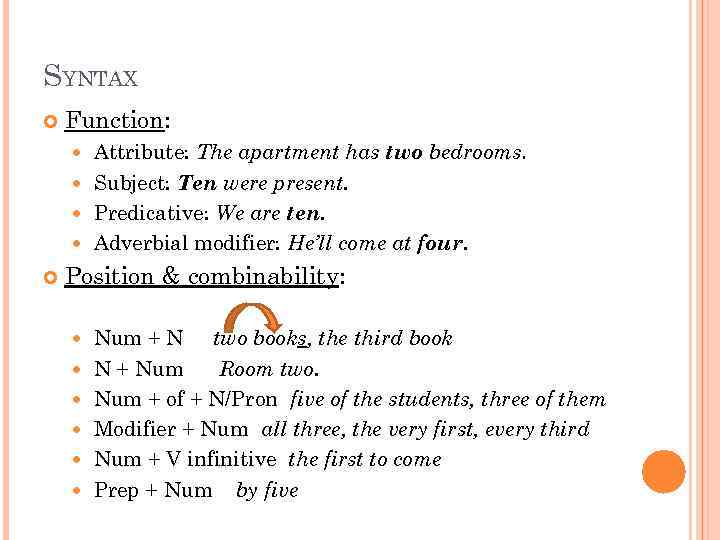 SYNTAX Function: Attribute: The apartment has two bedrooms. Subject: Ten were present. Predicative: We are ten. Adverbial modifier: He’ll come at four. Position & combinability: Num + N two books, the third book N + Num Room two. Num + of + N/Pron five of the students, three of them Modifier + Num all three, the very first, every third Num + V infinitive the first to come Prep + Num by five
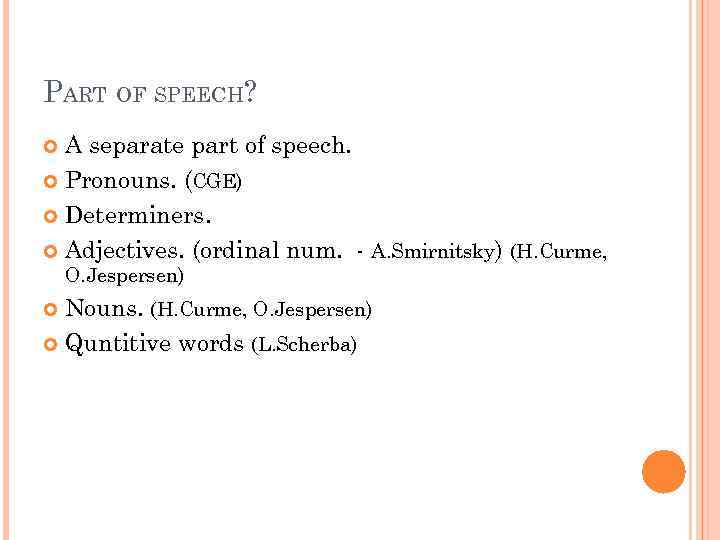 PART OF SPEECH? A separate part of speech. Pronouns. (CGE) Determiners. Adjectives. (ordinal num. - A. Smirnitsky) (H. Curme, O. Jespersen) Nouns. (H. Curme, O. Jespersen) Quntitive words (L. Scherba)
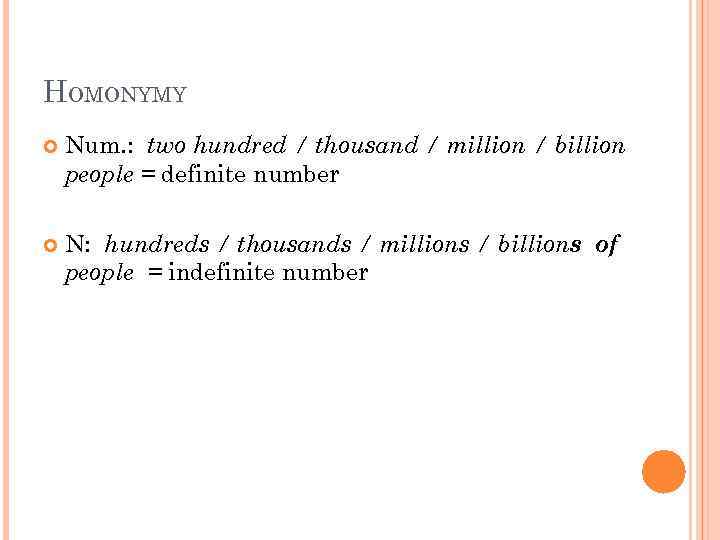 HOMONYMY Num. : two hundred / thousand / million / billion people = definite number N: hundreds / thousands / millions / billions of people = indefinite number
 CLASSIFICATION OF NUMERALS
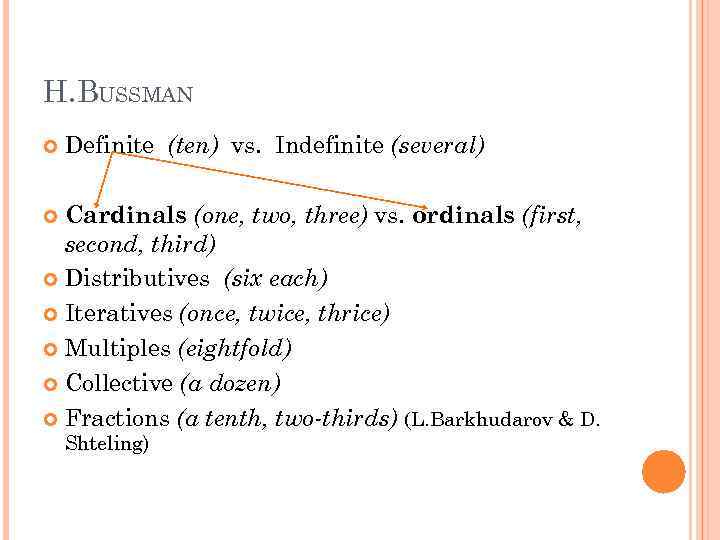 H. BUSSMAN Definite (ten) vs. Indefinite (several) Cardinals (one, two, three) vs. ordinals (first, second, third) Distributives (six each) Iteratives (once, twice, thrice) Multiples (eightfold) Collective (a dozen) Fractions (a tenth, two-thirds) (L. Barkhudarov & D. Shteling)
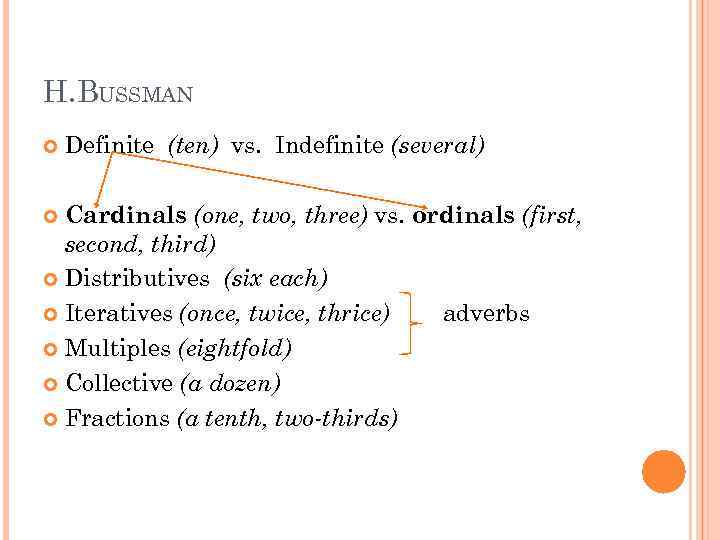 H. BUSSMAN Definite (ten) vs. Indefinite (several) Cardinals (one, two, three) vs. ordinals (first, second, third) Distributives (six each) Iteratives (once, twice, thrice) adverbs Multiples (eightfold) Collective (a dozen) Fractions (a tenth, two-thirds)
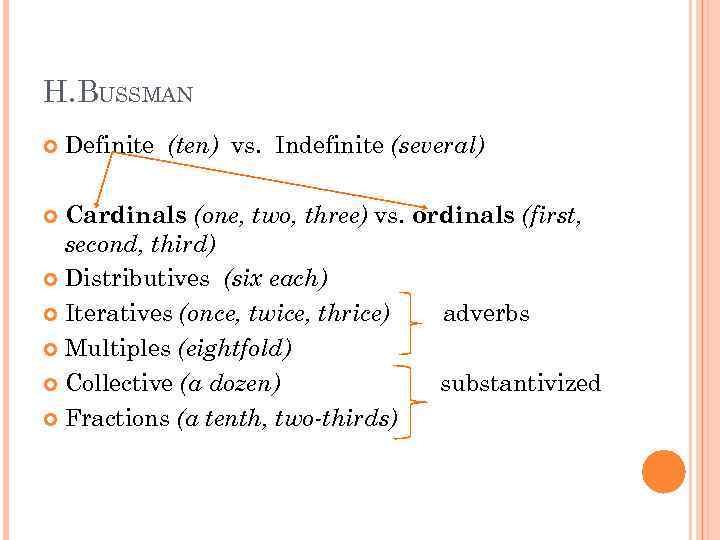 H. BUSSMAN Definite (ten) vs. Indefinite (several) Cardinals (one, two, three) vs. ordinals (first, second, third) Distributives (six each) Iteratives (once, twice, thrice) adverbs Multiples (eightfold) Collective (a dozen) substantivized Fractions (a tenth, two-thirds)
 PRONOMINAL NATURE OF NUMERALS
 NUMERALS ~QUANTIFICATIVE PRONOUNS In common: - Anaphoric (Give me ten/some. ) and non-anaphoric (Give me ten/some pieces. ) use - Position of a determiner - Partitive phrase: two/some of them Difference: - Left modifier: each two, the very first - Predicative: Two and two is four. - Article / possessive pronoun: the first step, his first step; a second cup; the two
 LITERATURE Ахманова О. С. Словарь лингвистических терминов. – М. : Сов. Энциклопедия, 1966. Блох М. Я. Теоретическая грамматика АЯ. – М. , 1983. Вейхман Г. А. Новое в грамматике современного АЯ. М. : Астрель, 2002. Есперсен О. Философия грамматики. - М. : УРСС, 2002. Иванова И. П. , Бурлакова В. В. , Почепцов Г. Г. Теоретическая грамматика современного АЯ. – М. , 1981. Ильиш Б. А. Строй современного английского языка. – Л. , 1971. Плоткин В. Я. Строй английского языка. – М. : ВШ, 1989 Смирницкий А. И. Морфология АЯ. – М. , 1959. Щерба Л. В. О частях речи в русском языке. // Избр. работы по русскому языку, 1957.
 LITERATURE Bussman H. Routledge Dictionary of Language and Linguistics. 1996. CGE = Carter R. , Mc. Carthy M. Cambridge Grammar of English. – CUP, 2006 Crystal D. The Cambridge Encyclopedia of the English Language. – CUP, 1995 Curme G. A grammar of the English Language. Boston, 1935. Peters Pam. The Cambridge guide to English usage. – CUP, 2004.