 Скачать презентацию PROMOTING SUSTAINABLE BUSINESS LINKAGES Unctad s approach Fulvia Farinelli
b923d4ed1348822c1948109bae4d2712.ppt
- Количество слайдов: 17



PROMOTING SUSTAINABLE BUSINESS LINKAGES Unctad’s approach Fulvia Farinelli UNCTAD, Division on Investment and Enterprise Development “
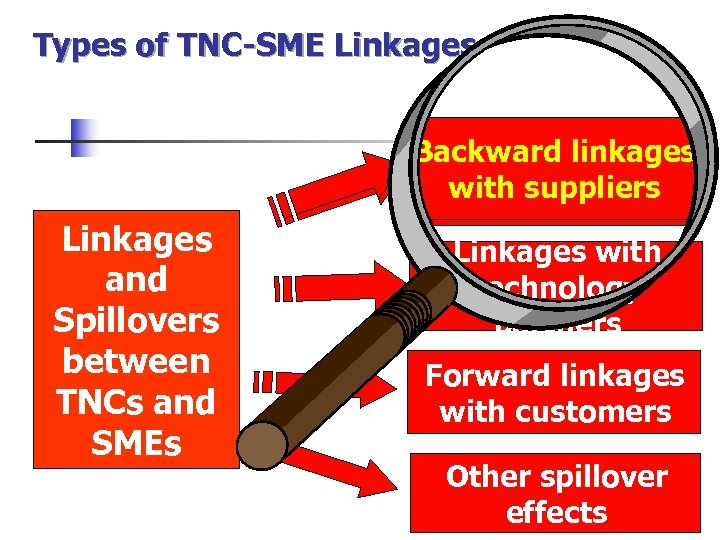
Types of TNC-SME Linkages Backward linkages with suppliers Linkages and Spillovers between TNCs and SMEs Linkages with technology partners Forward linkages with customers Other spillover effects 2
Main objectives of backward linkage promotion programmes 1. 2. 3. 4. Generate additional economic activity Stimulate improvements in the products and services of local suppliers (domestic sales to TNCs perform the role of exports in terms of building local competitiveness). Giving local suppliers a foothold in international markets with products meeting international production and quality standards. Attract FDI by offering a local supplier base capable of offering quicker delivery times, reduced transportation and inventory costs. 3
According to internal surveys: n n n A variety of initiatives to promote linkages exists. From purely donors-driven and governmentdriven programmes, to public-private sector partnerships. There also purely private sector-driven programmes, e. g. totally independent supplier development programmes carried out by TNCs in their own self-interest and within corporate social responsibility programmes. 4
Success stories n n n Successful policies promoting linkages can be found in Ireland, Jordan, Malaysia, Mozambique, Thailand, Singapore and South Africa. Large TNCs - Toyota, Unilever, FIAT, Anglo. American, Dymler. Chrysler, Volkswagen, INTEL, IBM and Tata implement their own supplier developing programmes. Many donors and international organization are active in linkages building. Among others, DFID (the Business Challenge Fund), IFC, ITC, UNDP, UNIDO, USAID, the World Bank, GTZ, UNCTAD. 5
Main lesson learned from successful cases 1. 2. The establishment of sustainable linkages does not happen automatically, as a direct consequence of the presence of TNCs, but requires the participation and collaboration of all interested stakeholders (i. e. TNCs, local suppliers, government). Only if a conducive policy environment is set up, specific linkages promotion programmes have a chance to be transformed from isolated cases, to sustainable and inclusive mechanisms to build the local productive capacity. 6
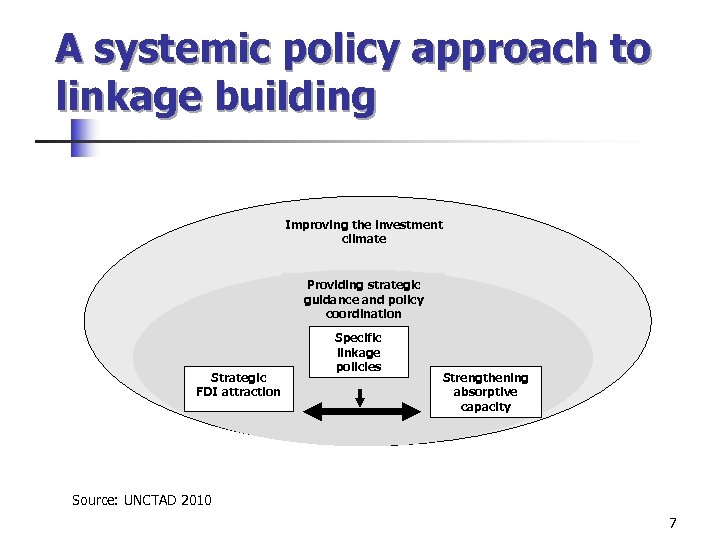
A systemic policy approach to linkage building Improving the investment climate Providing strategic guidance and policy coordination Strategic FDI attraction Specific linkage policies Strengthening absorptive capacity Source: UNCTAD 2010 7
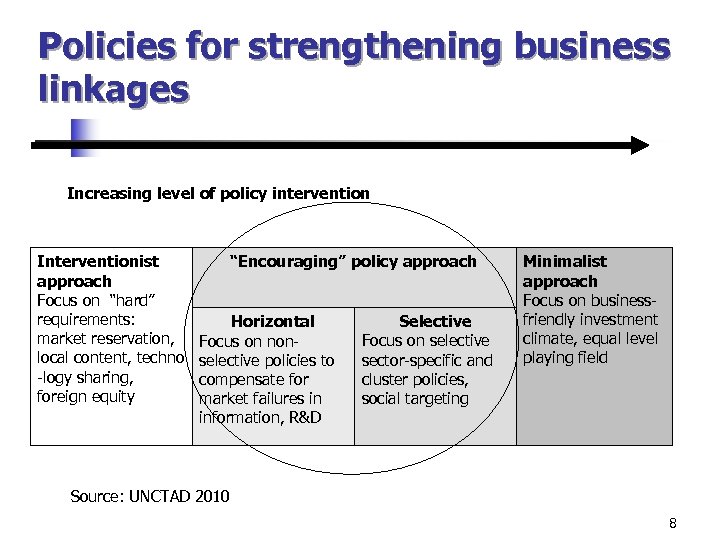
Policies for strengthening business linkages Increasing level of policy intervention Interventionist approach Focus on “hard” requirements: market reservation, local content, techno -logy sharing, foreign equity “Encouraging” policy approach Horizontal Focus on nonselective policies to compensate for market failures in information, R&D Selective Focus on selective sector-specific and cluster policies, social targeting Minimalist approach Focus on businessfriendly investment climate, equal level playing field Source: UNCTAD 2010 8
UNCTAD‘s main mechanisms to deliver results Ø Ø Ø Research Intergovernmental discussions Technical assistance 9
Main outputs n World Investement Report, 2001 n Video titled “Promoting Business Linkages in Malayisia„ 2002 n Publication “Roster of Good Practices in the Promotion of Business Linkages„ 2004 n Issue note on “Enhancing SMEs through business linkages: from policy formulation to policy implementation„ 2005 n Publication “Deepening Development through Business Linkages„ 2006 n Publication “Promoting business linkages from a policy perspective: the case of India, Malaysia, Mexico, South Africa and Uganda„ 2009 n Publication on “Integrating Developing Countries‘ SMEs into Global Value Chains„ 2010 10
Current technical assistance projects n n n n Brazil Uganda Vietnam Argentina Zambia Mozambique Tanzania Peru 11
All are « ENGAGING THE PRIVATE SECTOR » n Business Linkage Programme, Uganda Ø Ø n Supported by UNCTAD and its local EMPRETEC centre, SIDA and the Uganda Investment Authority (UIA) e. g. linkages partnership with Uganda Breweries, Toyota, MTN Projecto Vínculos, Brazil Ø Ø Supported by UNCTAD, GTZ, Ethos Institute, Fundacao Dom Cabral, SEBRAE e. g. linkage partnership with Philips, BASF, and Petrobas under the National Mobilization Programme for the Oil and Natural Gas Industry 12
UNCTAD’s role: n n n Sensitization of TNCs Challenge, suggest, innovate for more linkages Deepening of linkages where successful Horizontal, vertical extension of linkages Global benchmarking Stimulating a conducive policy environment 13
UNCTAD Business Linkage programme perspective Approach: n From “input driven” (upgrading capacity of SME's in general) n To “output driven” (meeting needs of TNCs’ affiliates) 14
Partnering with TNCs affiliates Explore linkages opportunities that are beneficial to both TNCs and their potential suppliers § Define potential candidates for linkages § Agree requirements in quantity, price, specifications, etc. § Align business processes, information flows § Joint implementation of suppliers upgrading programme § 15
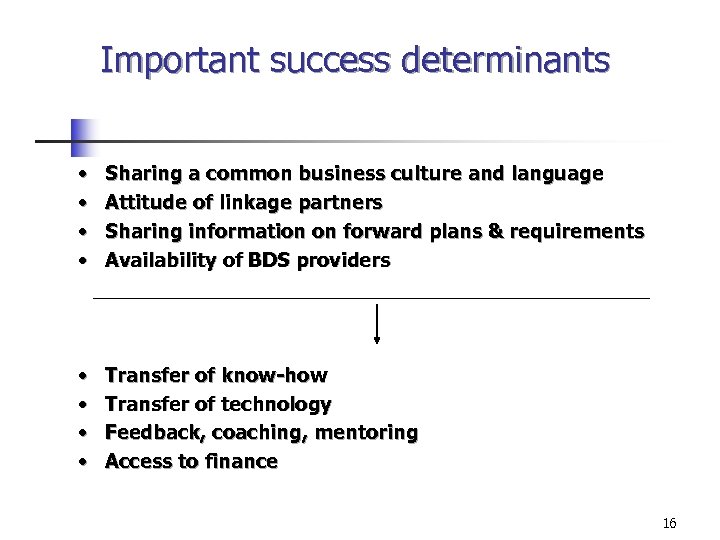
Important success determinants • • Sharing a common business culture and language Attitude of linkage partners Sharing information on forward plans & requirements Availability of BDS providers • • Transfer of know-how Transfer of technology Feedback, coaching, mentoring Access to finance 16
THANK YOU! fulvia. farinelli@unctad. org 17
Скачать презентацию PROMOTING SUSTAINABLE BUSINESS LINKAGES Unctad s approach Fulvia Farinelli
b923d4ed1348822c1948109bae4d2712.ppt