


 Скачать презентацию Promoting Application Security within Federal Government App Sec
24042da77af17a03a67c7499bf63ec94.ppt
- Количество слайдов: 25
 Promoting Application Security within Federal Government App. Sec DC Dr. Sarbari Gupta, CISSP, CISA Founder/President Electrosoft sarbari@electrosoft-inc. com 703 -437 -9451 ext 12 November 13, 2009 The OWASP Foundation http: //www. owasp. org 1
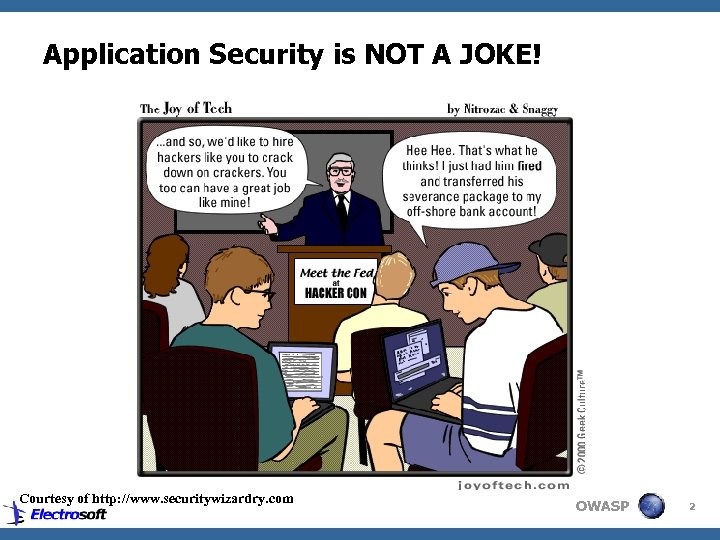 Application Security is NOT A JOKE! Courtesy of http: //www. securitywizardry. com OWASP 2
 Problem Statement < Federal government takes information system security and assurance very seriously < Focus areas for Federal security efforts include: 4 Platform Security 4 Network Security 4 Perimeter Security 4 Personnel Security 4 Physical Security 4 Acquisition Security, and so on … < HOWEVER, APPLICATION SECURITY HAS RECEIVED MEAGER ATTENTION!! OWASP 3
 Agenda
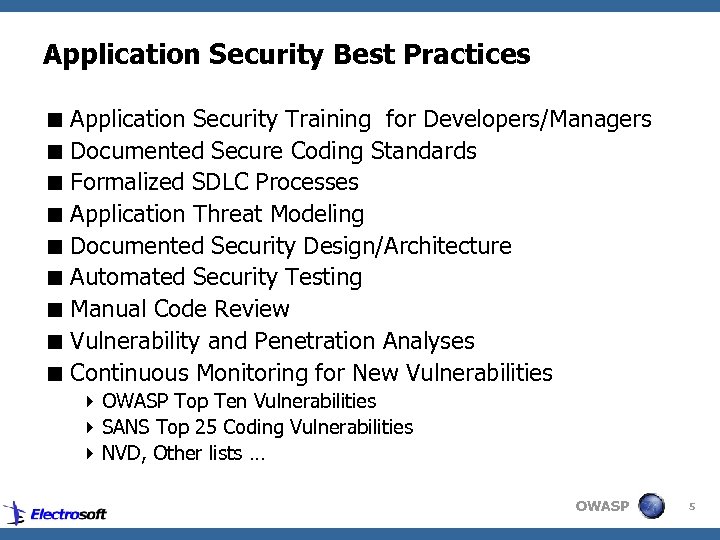 Application Security Best Practices < Application Security Training for Developers/Managers < Documented Secure Coding Standards < Formalized SDLC Processes < Application Threat Modeling < Documented Security Design/Architecture < Automated Security Testing < Manual Code Review < Vulnerability and Penetration Analyses < Continuous Monitoring for New Vulnerabilities 4 OWASP Top Ten Vulnerabilities 4 SANS Top 25 Coding Vulnerabilities 4 NVD, Other lists … OWASP 5
 Agenda
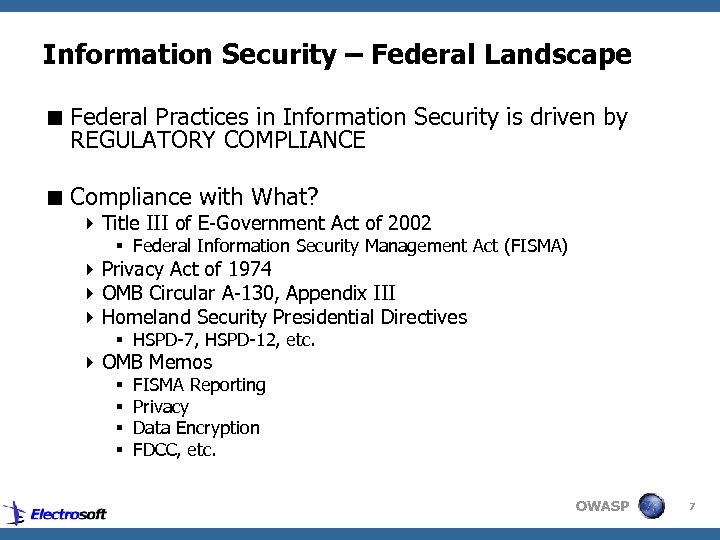 Information Security – Federal Landscape < Federal Practices in Information Security is driven by REGULATORY COMPLIANCE < Compliance with What? 4 Title III of E-Government Act of 2002 § Federal Information Security Management Act (FISMA) 4 Privacy Act of 1974 4 OMB Circular A-130, Appendix III 4 Homeland Security Presidential Directives § HSPD-7, HSPD-12, etc. 4 OMB Memos § § FISMA Reporting Privacy Data Encryption FDCC, etc. OWASP 7
 FISMA Documentation
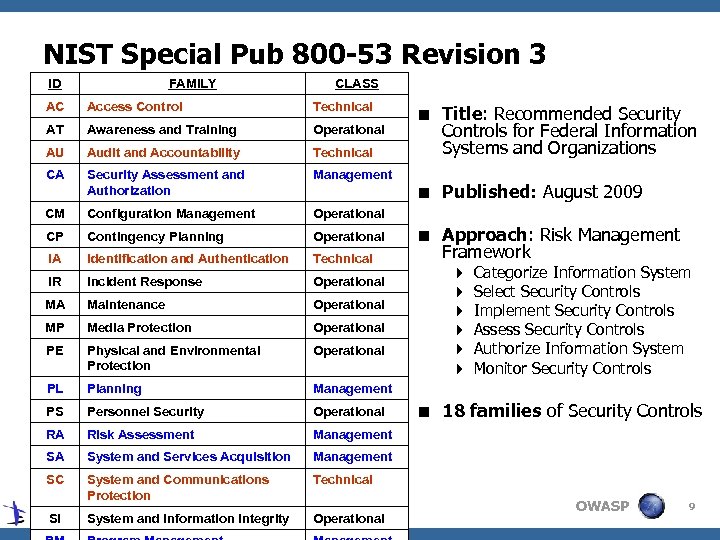 NIST Special Pub 800 -53 Revision 3 ID FAMILY CLASS AC Access Control Technical AT Awareness and Training Operational AU Audit and Accountability Technical CA Security Assessment and Authorization Management CM Configuration Management Operational CP Contingency Planning Operational IA Identification and Authentication Technical IR Incident Response Operational MA Maintenance Operational MP Media Protection Operational PE Physical and Environmental Protection Operational PL Planning Management PS Personnel Security Operational RA Risk Assessment Management SA System and Services Acquisition Management SC System and Communications Protection Technical SI System and Information Integrity Operational < Title: Recommended Security Controls for Federal Information Systems and Organizations < Published: August 2009 < Approach: Risk Management Framework 4 4 4 Categorize Information System Select Security Controls Implement Security Controls Assess Security Controls Authorize Information System Monitor Security Controls < 18 families of Security Controls OWASP 9
 Agenda
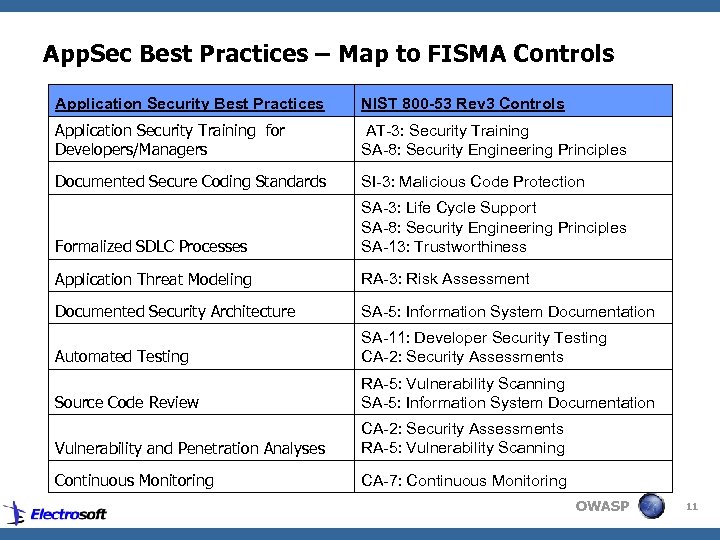 App. Sec Best Practices – Map to FISMA Controls Application Security Best Practices NIST 800 -53 Rev 3 Controls Application Security Training for Developers/Managers AT-3: Security Training SA-8: Security Engineering Principles Documented Secure Coding Standards SI-3: Malicious Code Protection Formalized SDLC Processes SA-3: Life Cycle Support SA-8: Security Engineering Principles SA-13: Trustworthiness Application Threat Modeling RA-3: Risk Assessment Documented Security Architecture SA-5: Information System Documentation Automated Testing SA-11: Developer Security Testing CA-2: Security Assessments Source Code Review RA-5: Vulnerability Scanning SA-5: Information System Documentation Vulnerability and Penetration Analyses CA-2: Security Assessments RA-5: Vulnerability Scanning Continuous Monitoring CA-7: Continuous Monitoring OWASP 11
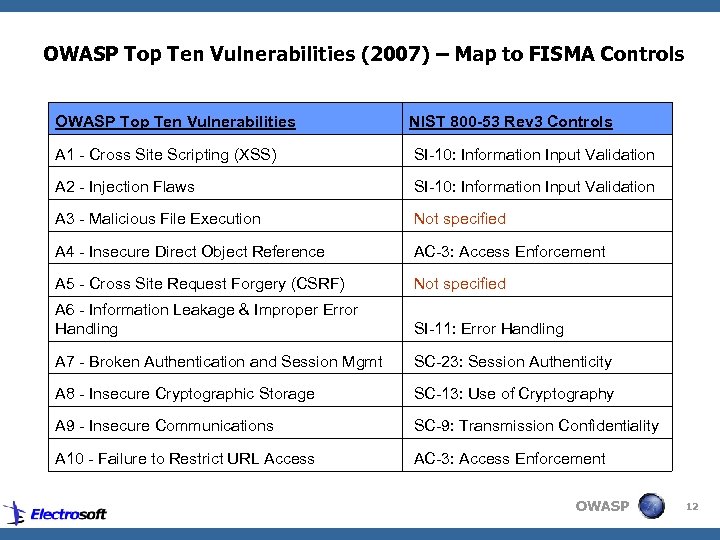 OWASP Top Ten Vulnerabilities (2007) – Map to FISMA Controls OWASP Top Ten Vulnerabilities NIST 800 -53 Rev 3 Controls A 1 - Cross Site Scripting (XSS) SI-10: Information Input Validation A 2 - Injection Flaws SI-10: Information Input Validation A 3 - Malicious File Execution Not specified A 4 - Insecure Direct Object Reference AC-3: Access Enforcement A 5 - Cross Site Request Forgery (CSRF) Not specified A 6 - Information Leakage & Improper Error Handling SI-11: Error Handling A 7 - Broken Authentication and Session Mgmt SC-23: Session Authenticity A 8 - Insecure Cryptographic Storage SC-13: Use of Cryptography A 9 - Insecure Communications SC-9: Transmission Confidentiality A 10 - Failure to Restrict URL Access AC-3: Access Enforcement OWASP 12
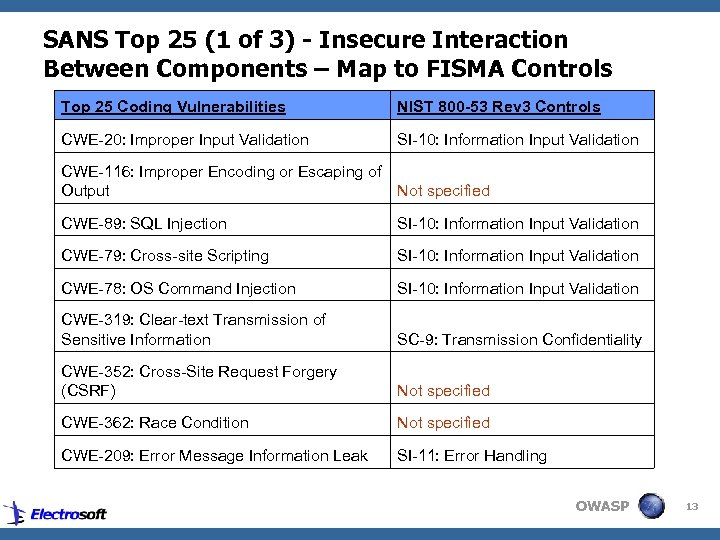 SANS Top 25 (1 of 3) - Insecure Interaction Between Components – Map to FISMA Controls Top 25 Coding Vulnerabilities NIST 800 -53 Rev 3 Controls CWE-20: Improper Input Validation SI-10: Information Input Validation CWE-116: Improper Encoding or Escaping of Output Not specified CWE-89: SQL Injection SI-10: Information Input Validation CWE-79: Cross-site Scripting SI-10: Information Input Validation CWE-78: OS Command Injection SI-10: Information Input Validation CWE-319: Clear-text Transmission of Sensitive Information SC-9: Transmission Confidentiality CWE-352: Cross-Site Request Forgery (CSRF) Not specified CWE-362: Race Condition Not specified CWE-209: Error Message Information Leak SI-11: Error Handling OWASP 13
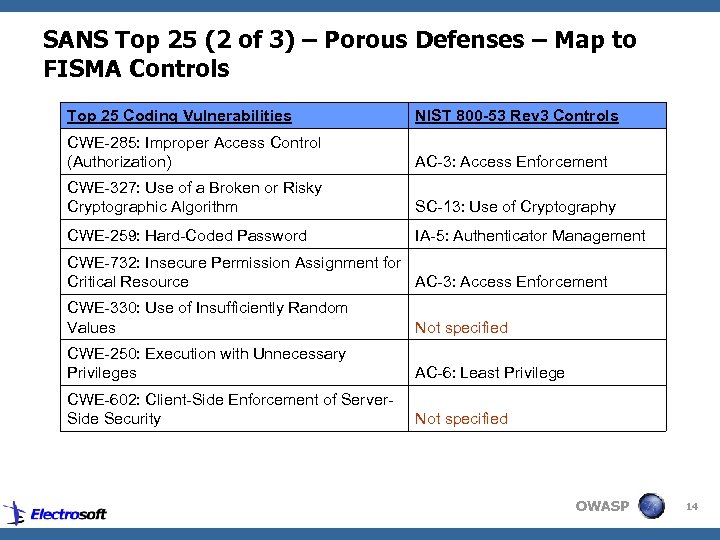 SANS Top 25 (2 of 3) – Porous Defenses – Map to FISMA Controls Top 25 Coding Vulnerabilities NIST 800 -53 Rev 3 Controls CWE-285: Improper Access Control (Authorization) AC-3: Access Enforcement CWE-327: Use of a Broken or Risky Cryptographic Algorithm SC-13: Use of Cryptography CWE-259: Hard-Coded Password IA-5: Authenticator Management CWE-732: Insecure Permission Assignment for Critical Resource AC-3: Access Enforcement CWE-330: Use of Insufficiently Random Values Not specified CWE-250: Execution with Unnecessary Privileges AC-6: Least Privilege CWE-602: Client-Side Enforcement of Server. Side Security Not specified OWASP 14
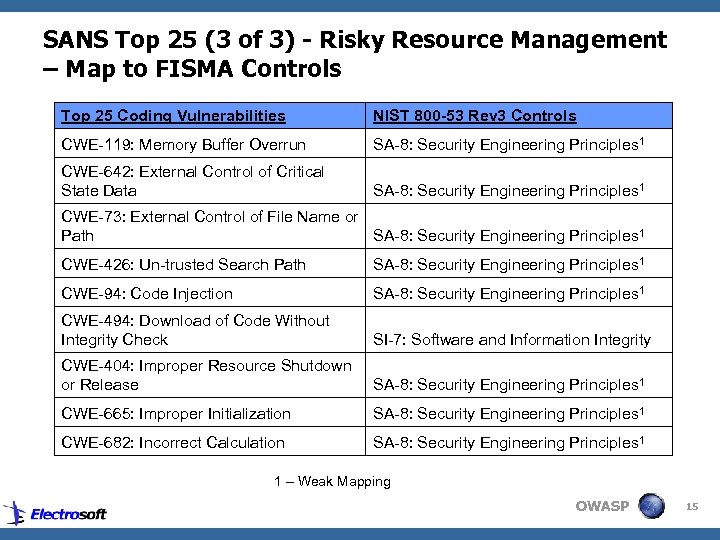 SANS Top 25 (3 of 3) - Risky Resource Management – Map to FISMA Controls Top 25 Coding Vulnerabilities NIST 800 -53 Rev 3 Controls CWE-119: Memory Buffer Overrun SA-8: Security Engineering Principles 1 CWE-642: External Control of Critical State Data SA-8: Security Engineering Principles 1 CWE-73: External Control of File Name or Path SA-8: Security Engineering Principles 1 CWE-426: Un-trusted Search Path SA-8: Security Engineering Principles 1 CWE-94: Code Injection SA-8: Security Engineering Principles 1 CWE-494: Download of Code Without Integrity Check SI-7: Software and Information Integrity CWE-404: Improper Resource Shutdown or Release SA-8: Security Engineering Principles 1 CWE-665: Improper Initialization SA-8: Security Engineering Principles 1 CWE-682: Incorrect Calculation SA-8: Security Engineering Principles 1 1 – Weak Mapping OWASP 15
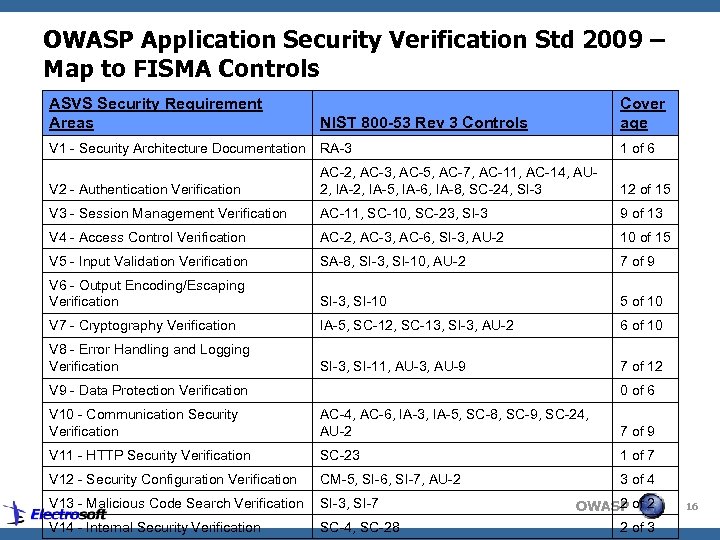 OWASP Application Security Verification Std 2009 – Map to FISMA Controls ASVS Security Requirement Areas NIST 800 -53 Rev 3 Controls Cover age V 1 - Security Architecture Documentation RA-3 1 of 6 V 2 - Authentication Verification AC-2, AC-3, AC-5, AC-7, AC-11, AC-14, AU 2, IA-5, IA-6, IA-8, SC-24, SI-3 12 of 15 V 3 - Session Management Verification AC-11, SC-10, SC-23, SI-3 9 of 13 V 4 - Access Control Verification AC-2, AC-3, AC-6, SI-3, AU-2 10 of 15 V 5 - Input Validation Verification SA-8, SI-3, SI-10, AU-2 7 of 9 V 6 - Output Encoding/Escaping Verification SI-3, SI-10 5 of 10 V 7 - Cryptography Verification IA-5, SC-12, SC-13, SI-3, AU-2 6 of 10 V 8 - Error Handling and Logging Verification SI-3, SI-11, AU-3, AU-9 7 of 12 V 9 - Data Protection Verification 0 of 6 V 10 - Communication Security Verification AC-4, AC-6, IA-3, IA-5, SC-8, SC-9, SC-24, AU-2 7 of 9 V 11 - HTTP Security Verification SC-23 1 of 7 V 12 - Security Configuration Verification CM-5, SI-6, SI-7, AU-2 3 of 4 V 13 - Malicious Code Search Verification SI-3, SI-7 V 14 - Internal Security Verification SC-4, SC-28 2 of 2 OWASP 2 of 3 16
 Agenda
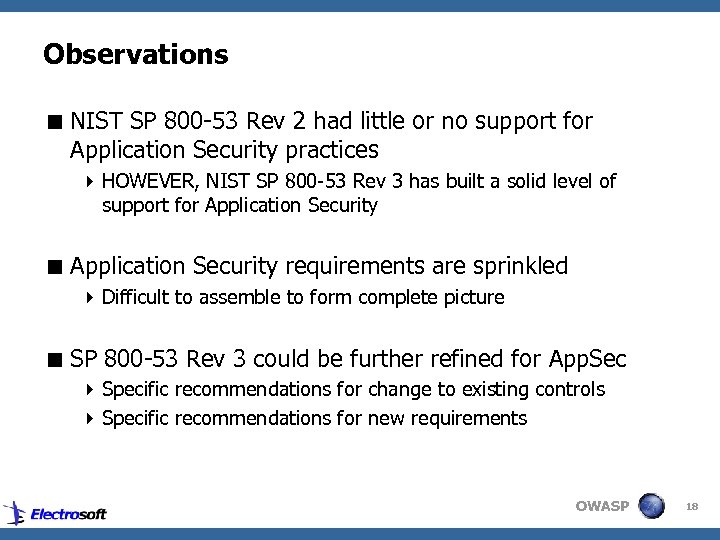 Observations < NIST SP 800 -53 Rev 2 had little or no support for Application Security practices 4 HOWEVER, NIST SP 800 -53 Rev 3 has built a solid level of support for Application Security < Application Security requirements are sprinkled 4 Difficult to assemble to form complete picture < SP 800 -53 Rev 3 could be further refined for App. Sec 4 Specific recommendations for change to existing controls 4 Specific recommendations for new requirements OWASP 18
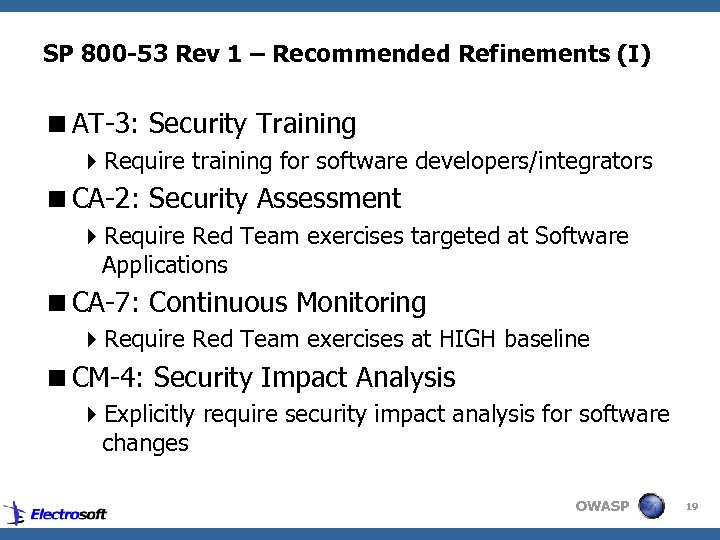 SP 800 -53 Rev 1 – Recommended Refinements (I)
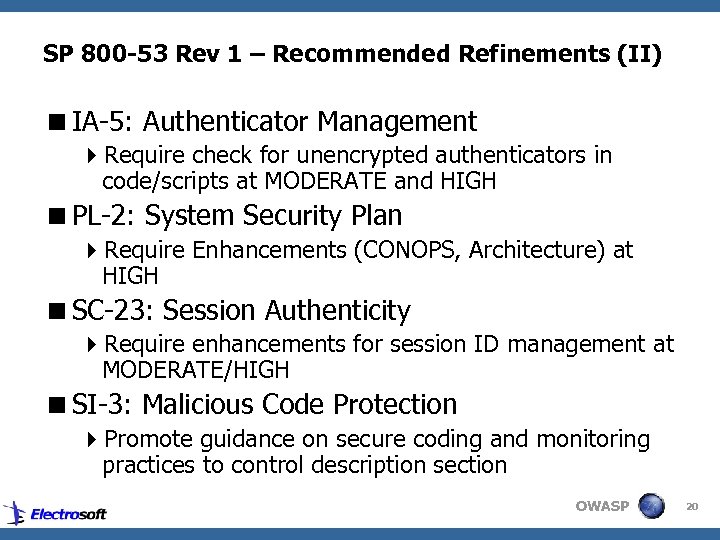 SP 800 -53 Rev 1 – Recommended Refinements (II)
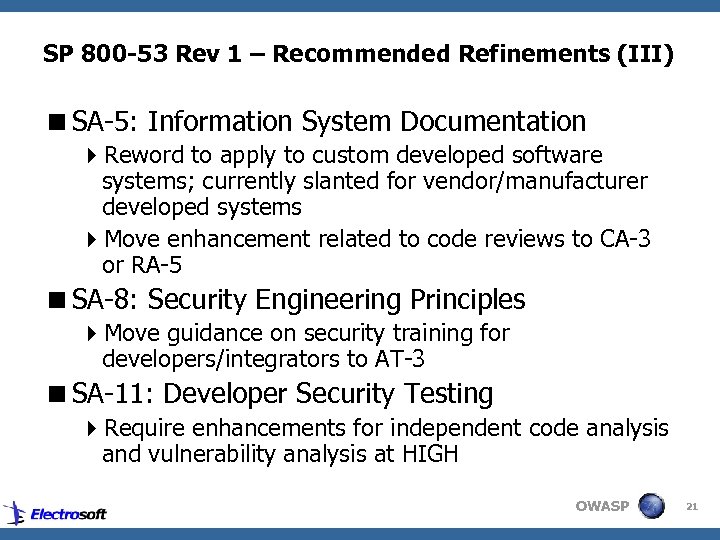 SP 800 -53 Rev 1 – Recommended Refinements (III)
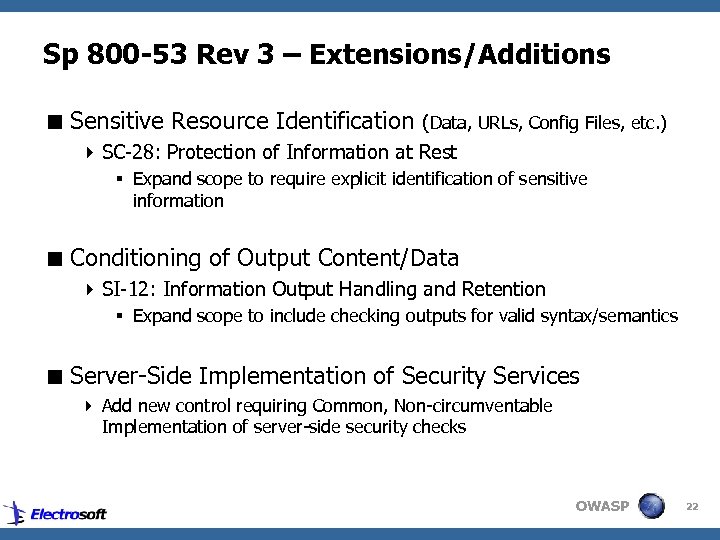 Sp 800 -53 Rev 3 – Extensions/Additions < Sensitive Resource Identification (Data, URLs, Config Files, etc. ) 4 SC-28: Protection of Information at Rest § Expand scope to require explicit identification of sensitive information < Conditioning of Output Content/Data 4 SI-12: Information Output Handling and Retention § Expand scope to include checking outputs for valid syntax/semantics < Server-Side Implementation of Security Services 4 Add new control requiring Common, Non-circumventable Implementation of server-side security checks OWASP 22
 Agenda
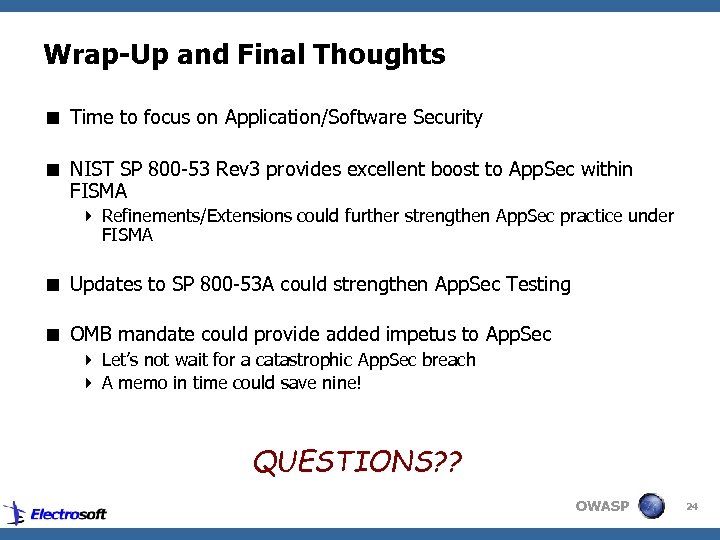 Wrap-Up and Final Thoughts < Time to focus on Application/Software Security < NIST SP 800 -53 Rev 3 provides excellent boost to App. Sec within FISMA 4 Refinements/Extensions could further strengthen App. Sec practice under FISMA < Updates to SP 800 -53 A could strengthen App. Sec Testing < OMB mandate could provide added impetus to App. Sec 4 Let’s not wait for a catastrophic App. Sec breach 4 A memo in time could save nine! QUESTIONS? ? OWASP 24
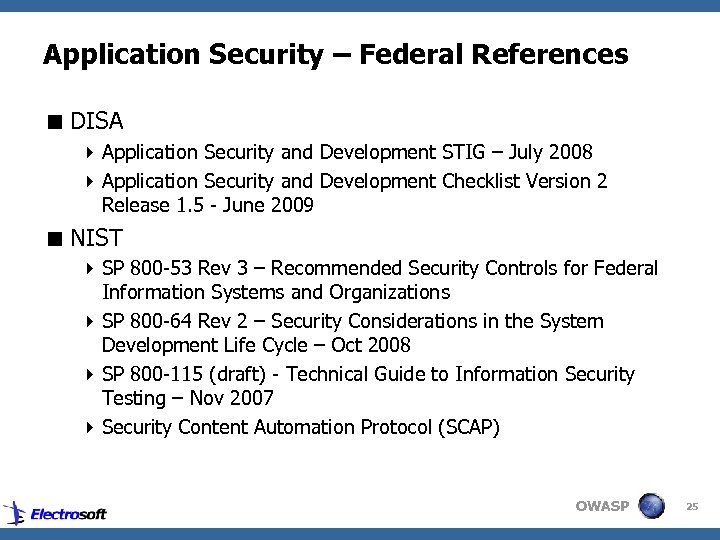 Application Security – Federal References < DISA 4 Application Security and Development STIG – July 2008 4 Application Security and Development Checklist Version 2 Release 1. 5 - June 2009 < NIST 4 SP 800 -53 Rev 3 – Recommended Security Controls for Federal Information Systems and Organizations 4 SP 800 -64 Rev 2 – Security Considerations in the System Development Life Cycle – Oct 2008 4 SP 800 -115 (draft) - Technical Guide to Information Security Testing – Nov 2007 4 Security Content Automation Protocol (SCAP) OWASP 25