 Скачать презентацию Promising Practices to Create Brighter Futures for Young
beade5f45d1a65156e13de9189ae3439.ppt
- Количество слайдов: 56



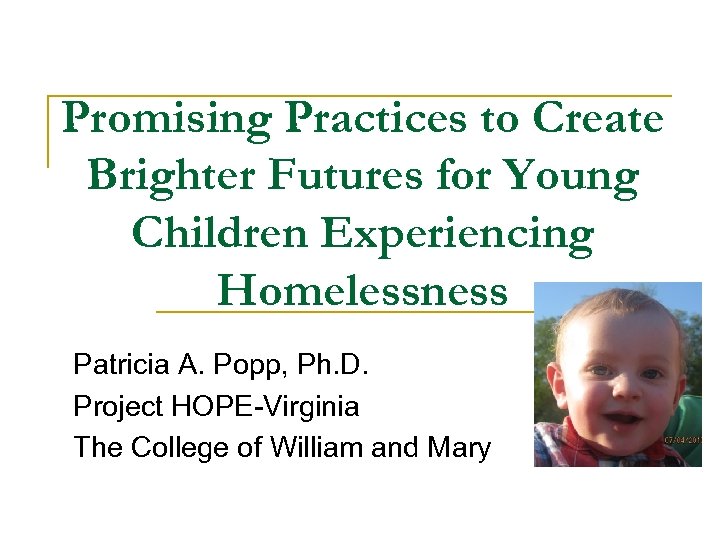
Promising Practices to Create Brighter Futures for Young Children Experiencing Homelessness Patricia A. Popp, Ph. D. Project HOPE-Virginia The College of William and Mary
Agenda n Current Legislation q q q n n Mc. Kinney-Vento Head Start IDEA – Part C and Part B, Section 619 “Sneak Peak” proposed language Application scenarios Resources Questions
Mc. Kinney-Vento Homeless Assistance Act: ESEA, Title X, Part C “(f) FUNCTIONS OF THE OFFICE OF COORDINATOR- The Coordinator for Education of Homeless Children and Youths established in each State shall-(1) gather reliable, valid, and comprehensive information on the nature and extent of the problems homeless children and youths have in gaining access to public preschool programs and to public elementary schools and secondary schools, the difficulties in identifying the special needs of such children and youths, any progress made by the State educational agency and local educational agencies in the State in addressing such problems and difficulties, and the success of the programs under this subtitle in allowing homeless children and youths to enroll in, attend, and succeed in, school; ” (Section 722(f)(1)) n i
Mc. Kinney-Vento Homeless Assistance Act: ESEA, Title X, Part C “Each local educational agency liaison for homeless children and youths…shall ensure that…homeless families, children and youths receive educational services for which such families children and youths are eligible, including Head Start. ” Mc. Kinney-Vento Homeless Assistance Act Subtitle B, Sec. 722 (g)(6)(A)(iii)
To find your liaison, visit: www. wm. edu/hope C: UserspxpoppDesktopW&M School of Education - Project HOPE - Virginia. mht
Who is Homeless under EHCY? Mc. Kinney-Vento Homeless Assistance Act - ESEA, Title X, Part C n Same definition referenced in n q q IDEA 2004 Child Nutrition Act Head Start Act Higher Education Act
Definition of Homeless Children Under Mc. Kinney-Vento EHCY: Individuals who lack a fixed, regular, and adequate nighttime residence n n n n Sharing housing of others due to loss of housing Living in motels, hotels, trailer parks, or camping grounds due to lack of alternative accommodations Living in emergency or transitional shelters Abandoned in hospitals Awaiting foster care placement Living in cars, parks, public spaces, abandoned buildings, substandard housing Migratory children who qualify as homeless Unaccompanied youth

IS THIS HOMELESS?
Children Experiencing Homelessness 2 million people experience homelessness annually n Approximately half are children n n Families with young children are the fastest growing subgroup experiencing homelessness.
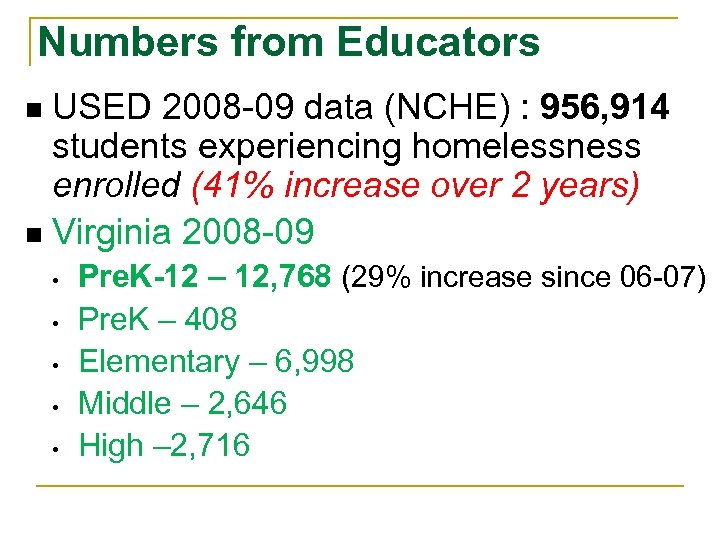
Numbers from Educators USED 2008 -09 data (NCHE) : 956, 914 students experiencing homelessness enrolled (41% increase over 2 years) n Virginia 2008 -09 n • • • Pre. K-12 – 12, 768 (29% increase since 06 -07) Pre. K – 408 Elementary – 6, 998 Middle – 2, 646 High – 2, 716
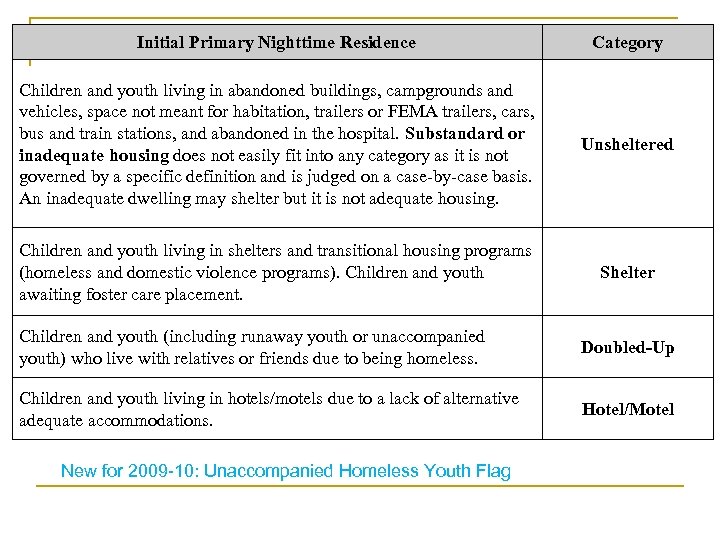
Initial Primary Nighttime Residence Category Children and youth living in abandoned buildings, campgrounds and vehicles, space not meant for habitation, trailers or FEMA trailers, cars, bus and train stations, and abandoned in the hospital. Substandard or inadequate housing does not easily fit into any category as it is not governed by a specific definition and is judged on a case-by-case basis. An inadequate dwelling may shelter but it is not adequate housing. Unsheltered Children and youth living in shelters and transitional housing programs (homeless and domestic violence programs). Children and youth awaiting foster care placement. Shelter Children and youth (including runaway youth or unaccompanied youth) who live with relatives or friends due to being homeless. Doubled-Up Children and youth living in hotels/motels due to a lack of alternative adequate accommodations. Hotel/Motel New for 2009 -10: Unaccompanied Homeless Youth Flag
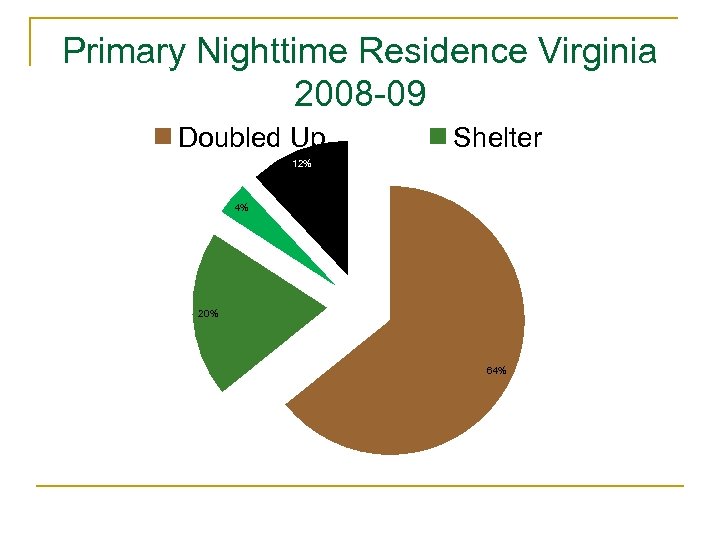
Primary Nighttime Residence Virginia 2008 -09 Doubled Up Shelter 12% 4% 20% 64%
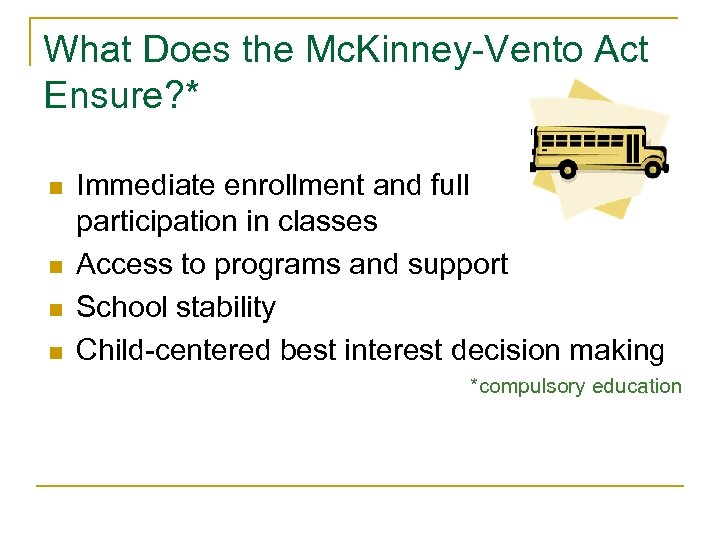
What Does the Mc. Kinney-Vento Act Ensure? * n n Immediate enrollment and full participation in classes Access to programs and support School stability Child-centered best interest decision making *compulsory education
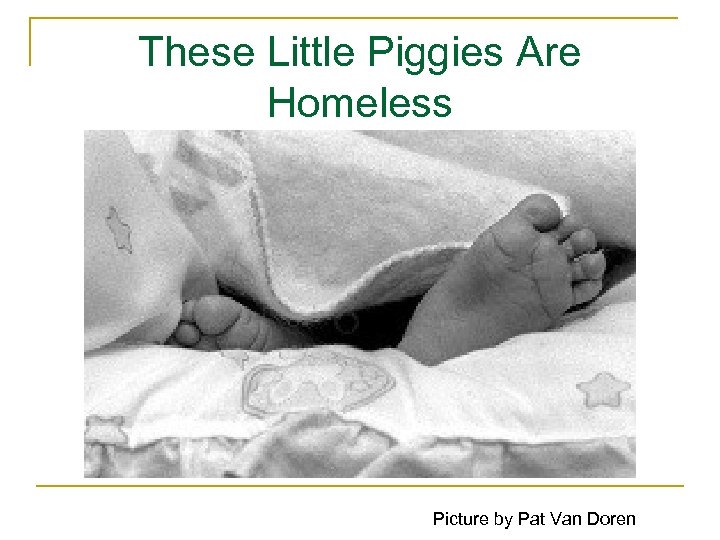
These Little Piggies Are Homeless Picture by Pat Van Doren
Virginia’s Homeless Programs 2008 -09 Program Year n n n A Report to the House Appropriations and Senate Finance Committees, VDHCD http: //www. dhcd. virginia. gov/Homelessnessto. Home ownership/PDFs/Virginia_Homeless_Report. pdf Child Care for Homeless Children Program (VDSS) q n Of 452 served, 45% were 0 -4 years old Child Services Coordinators q Served 5350 children
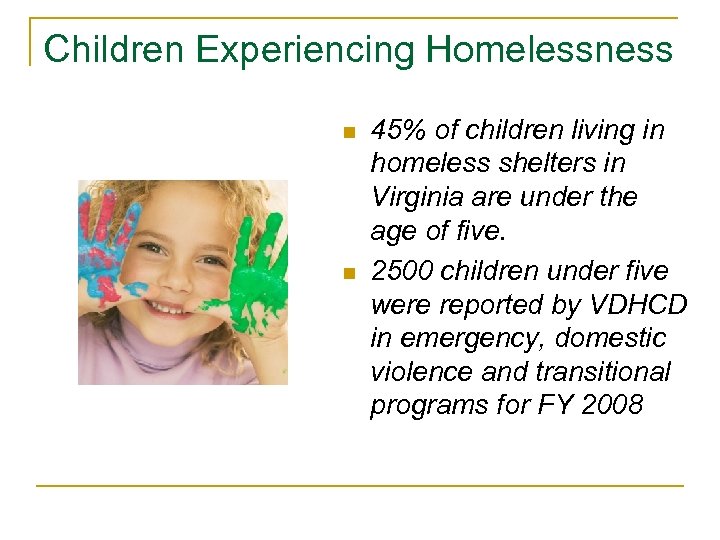
Children Experiencing Homelessness n n 45% of children living in homeless shelters in Virginia are under the age of five. 2500 children under five were reported by VDHCD in emergency, domestic violence and transitional programs for FY 2008
Risk Factors for Young Children Who Are Homeless n n n Inadequate or unstable housing Inconsistent and inadequate health care Inadequate nutrition Adolescent mothers Disrupted or limited family support Emotional stress or depression
Effects of Preschool on Homeless Young Children n The more months that homeless children had attended preschool, the better they performed on Early Screening Inventory. (Koblinsky and Taylor, 1991) n As little as three months of Head Start or publicly funded preschool exhibited more age -appropriate performance on developmental tasks than children who did not have this opportunity. (Molnar, et al, 1991)
Proposed: Educational Success for Children and Youth Without Homes Act n n H. R. 5285 and S. 2800 New Section on School Readiness q q n Preschool programs administered, funded or overseen by SEA or LEA to comply with MV Other state-funded preschool programs not under SEA or LEA should develop, review, revise policies that are barriers Separate bill proposed for children in care
Improving Head Start for School Readiness Act of 2007 q Greater emphasis on serving children experiencing homelessness: q See details on handout prepared by Barbara Duffield, Policy Director for the National Association for the Education of Homeless Children and Youth (NAEHCY)
![Head Start State Collaboration Office “ The state receiving the [HSSCO] grant shall…ensure that](https://present5.com/presentation/beade5f45d1a65156e13de9189ae3439/image-23.jpg "Head Start State Collaboration Office “ The state receiving the [HSSCO] grant shall…ensure that")
Head Start State Collaboration Office “ The state receiving the [HSSCO] grant shall…ensure that the collaboration described …involves coordination of Head Start services with …services for homeless children. ” Head Start Act Section 640(a)(5)(c )
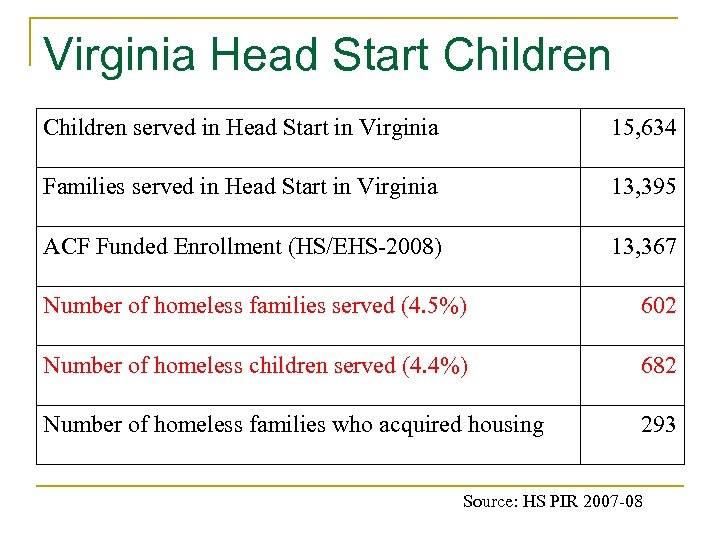
Virginia Head Start Children served in Head Start in Virginia 15, 634 Families served in Head Start in Virginia 13, 395 ACF Funded Enrollment (HS/EHS-2008) 13, 367 Number of homeless families served (4. 5%) 602 Number of homeless children served (4. 4%) 682 Number of homeless families who acquired housing 293 Source: HS PIR 2007 -08
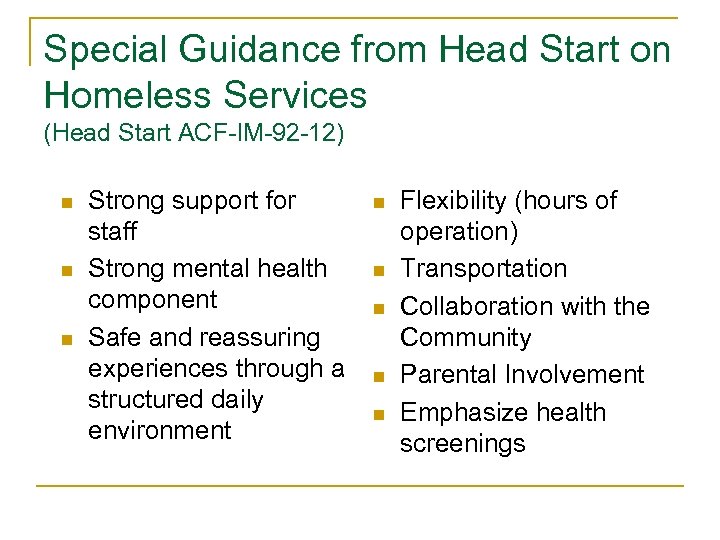
Special Guidance from Head Start on Homeless Services (Head Start ACF-IM-92 -12) n n n Strong support for staff Strong mental health component Safe and reassuring experiences through a structured daily environment n n n Flexibility (hours of operation) Transportation Collaboration with the Community Parental Involvement Emphasize health screenings
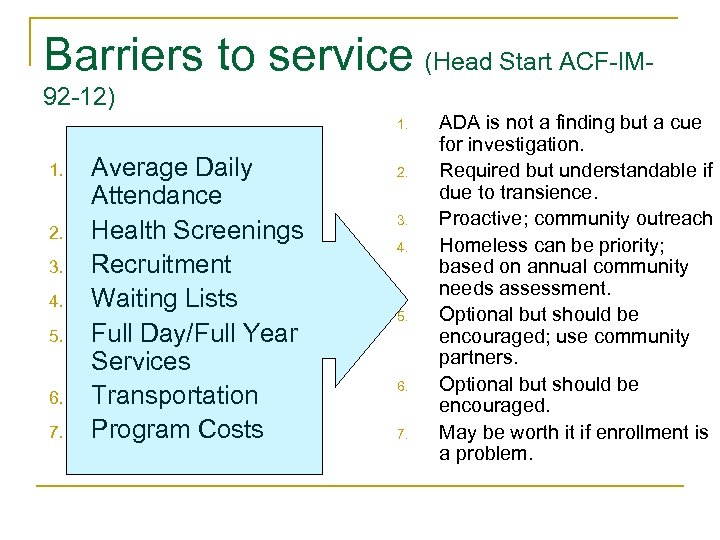
Barriers to service (Head Start ACF-IM 92 -12) 1. 2. 3. 4. 5. 6. 7. Average Daily Attendance Health Screenings Recruitment Waiting Lists Full Day/Full Year Services Transportation Program Costs 2. 3. 4. 5. 6. 7. ADA is not a finding but a cue for investigation. Required but understandable if due to transience. Proactive; community outreach Homeless can be priority; based on annual community needs assessment. Optional but should be encouraged; use community partners. Optional but should be encouraged. May be worth it if enrollment is a problem.
SCENARIO #1
Homeless & Special Needs n Children in homeless situations experience some form of developmental delay at 4 times the rate of housed peers
Individuals with Disabilities Education Act (IDEA) Parts B & C
Barriers to Special Education Caused by Homelessness n n n Not being identified as needing special education Difficulty with diagnosis due to mobility and other stressors Lack of timely assessment, diagnosis, or service provision Lack of service continuity due to mobility Lack of timely or efficient record transfers Lack of parent or surrogate for UHY
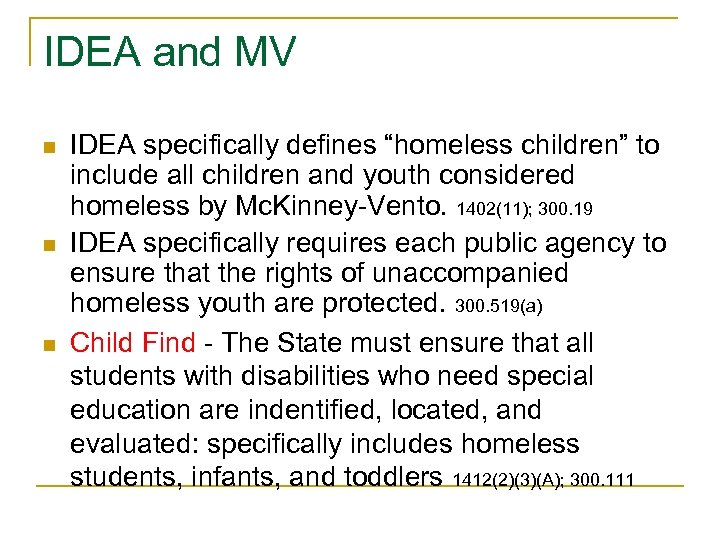
IDEA and MV n n n IDEA specifically defines “homeless children” to include all children and youth considered homeless by Mc. Kinney-Vento. 1402(11); 300. 19 IDEA specifically requires each public agency to ensure that the rights of unaccompanied homeless youth are protected. 300. 519(a) Child Find - The State must ensure that all students with disabilities who need special education are indentified, located, and evaluated: specifically includes homeless students, infants, and toddlers 1412(2)(3)(A); 300. 111
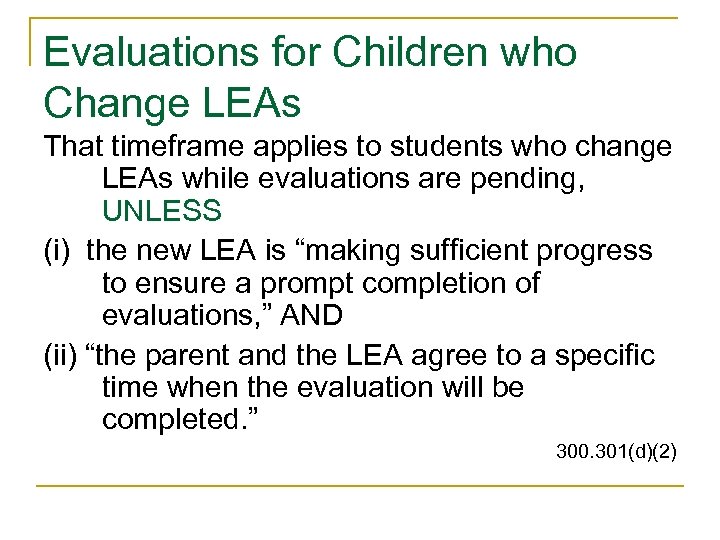
Evaluations for Children who Change LEAs That timeframe applies to students who change LEAs while evaluations are pending, UNLESS (i) the new LEA is “making sufficient progress to ensure a prompt completion of evaluations, ” AND (ii) “the parent and the LEA agree to a specific time when the evaluation will be completed. ” 300. 301(d)(2)
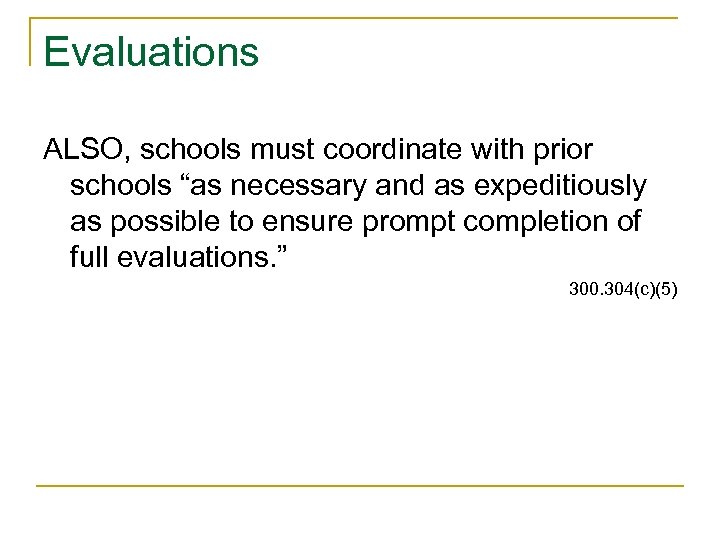
Evaluations ALSO, schools must coordinate with prior schools “as necessary and as expeditiously as possible to ensure prompt completion of full evaluations. ” 300. 304(c)(5)
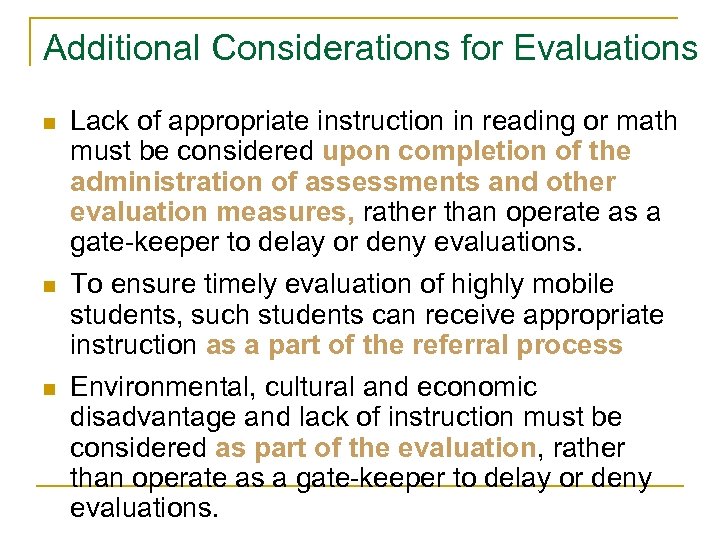
Additional Considerations for Evaluations n Lack of appropriate instruction in reading or math must be considered upon completion of the administration of assessments and other evaluation measures, rather than operate as a gate-keeper to delay or deny evaluations. n To ensure timely evaluation of highly mobile students, such students can receive appropriate instruction as a part of the referral process n Environmental, cultural and economic disadvantage and lack of instruction must be considered as part of the evaluation, rather than operate as a gate-keeper to delay or deny evaluations.
How are IEPs implemented when a child changes LEAs? n If the IEP is current, the new LEA must immediately provide appropriate services, including services comparable to the IEP from the previous LEA. 1414(d)(2)(C)(i); 300. 323(e) n What does “appropriate services” mean? “Services comparable to those described” in the previous IEP, n In consultation with parents. 1414(d)(2)(C)(i); 300. 323(e)
How are IEPs implemented when a child changes LEAs? The new LEA must promptly obtain the child’s records from the previous school, and the previous school must promptly respond to records requests. § The new LEA can either adopt the old IEP, or develop a new one. 1414(d)(2)(C); 300. 323(e), (g)
Who can be a “parent” for special education purposes? n n n Biological or adoptive parent Foster parent Guardian Person who is acting in the place of a parent and with whom the child is living; can be a non-relative Person legally responsible for the child 1401(23); 300. 30(a)(4)
What if a student doesn’t have any of those people? The LEA must assign a “surrogate parent” within 30 days, if: n no “parent” can be identified, n no “parent” can be located, n the student is a ward of the State (with no qualifying foster parent), or n the student is an unaccompanied youth under Mc. Kinney-Vento.
Who can be a surrogate? n n Surrogate parents can’t be employees of SEAs, LEAs, or other agencies involved in the education and care of the child, and can’t have any conflicting interests. They must have knowledge and skills necessary to be a good surrogate. 1415(b)(2); 300. 519
BUT for unaccompanied youth, the following people can be temporary surrogates: n Staff of emergency shelters, transitional shelters, independent living programs, and street outreach programs; n State, LEA, or agency staff involved in the education or care of the child. 300. 519
SCENARIO #3
The Littlest Ones: IDEA, Part C n n Provides appropriate services to infants and toddlers under age 3 who need early intervention services due to developmental delay or a diagnosed physical or mental condition with a high probability of resulting in developmental delay and their families Administered by the Infant and Toddler Connection of Virginia q n Department of Behavioral Health and, Developmental Services Interagency Coordinating Council
The Process n n Preliminary screenings can indicate if an evaluation is needed Parents refer their children for evaluations and assessments “Primary referral sources” also can refer for evaluations (schools, child welfare, health care providers, shelters, social service agencies …) Proposed regs: evaluations and IFSP must be completed within 45 days of obtaining parental consent
Can Part C programs expedite the evaluation process or provide services before the evaluations are finished? n n Yes Part C can expedite evaluations for homeless children - Ask parents about upcoming moves - Ask parents if an evaluation has been initiated at another school or with a provider elsewhere - Obtain a copy of prior evaluation, obtain consent n Part C services can be provided while completing evaluations (parental consent, service coordinator, interim IFSP)
How can IDEA Part B staff and Part C agencies and school districts serve homeless children, youth, infants, and toddlers better? n n n Implement procedures to expedite evaluations Ensure all understand the law and importance of continuous services for homeless children with disabilities Develop expedited surrogate parent appoint procedures for children not with their parents Ensure that IDEA Part B, Part C, and homeless education staff know one another Form an advisory committee Work across districts where homeless families move back and forth
SCENARIO #4
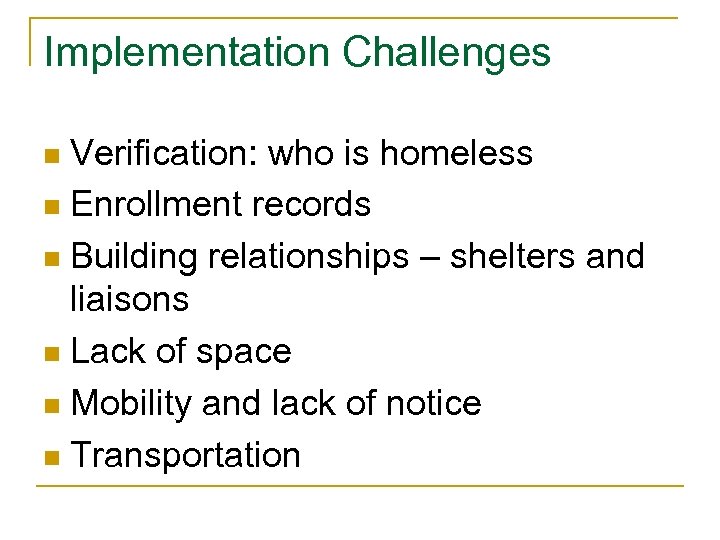
Implementation Challenges Verification: who is homeless n Enrollment records n Building relationships – shelters and liaisons n Lack of space n Mobility and lack of notice n Transportation n
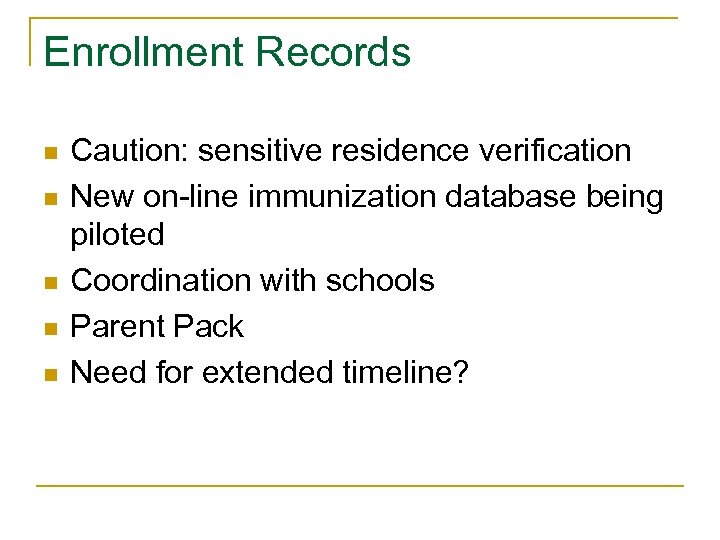
Enrollment Records n n n Caution: sensitive residence verification New on-line immunization database being piloted Coordination with schools Parent Pack Need for extended timeline?
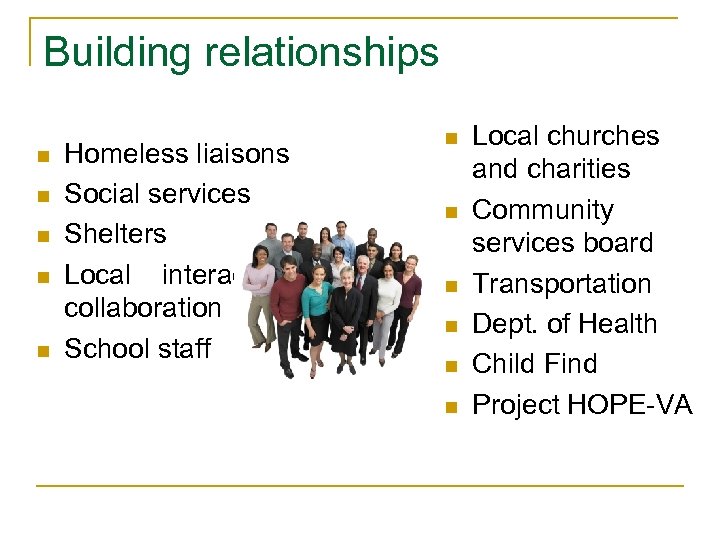
Building relationships n n n Homeless liaisons Social services Shelters Local interagency collaboration School staff n n n Local churches and charities Community services board Transportation Dept. of Health Child Find Project HOPE-VA
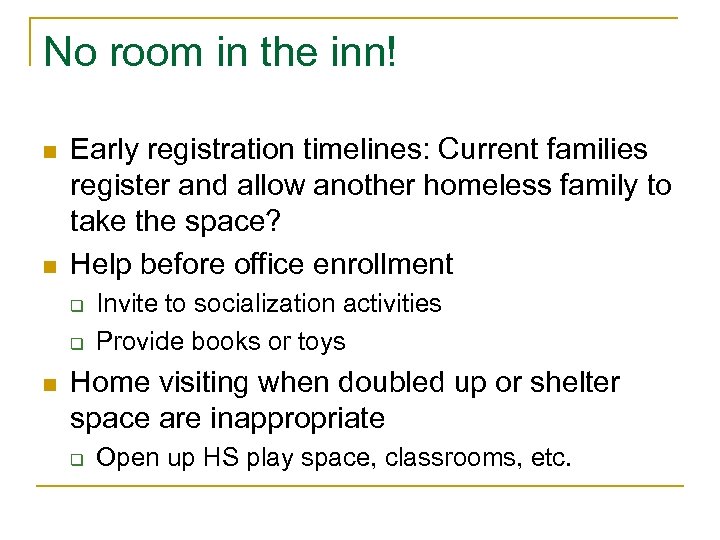
No room in the inn! n n Early registration timelines: Current families register and allow another homeless family to take the space? Help before office enrollment q q n Invite to socialization activities Provide books or toys Home visiting when doubled up or shelter space are inappropriate q Open up HS play space, classrooms, etc.
Mobility and lack of notice n n n Building trust Other contacts on file – release of information Trust Emphasize mobility, transition rather than “homeless” Fear to share what basics are not available
Transportation n n Lack is a significant barrier to participation If parent has a car, reimburse for mileage or use gas cards Explore coordination with schools: preschool, ECSE programs Public transportation – bus/metro tickets/passes School of origin for stability: feasibility worksheet
Thanks for all you do! n . . HMSE_PICS. mpg
National Resources n n n National Center for Homeless Education: www. serve. org/nche_ibt Council for Exceptional Children: www. cec. sped. org National Association for the Education of Homeless Children and Youth: www. naehcy. org National Association of State Directors of Special Education: www. nasdse. org National Disability Rights Network: www. napas. org Parent Training and Information Centers: www. taalliance. org/centers/index. htm
Helpful Websites n n Project HOPE-VA: www. wm. edu/hope HUD Virginia Resources - http: //www. hud. gov/local/index. cfm? state=va&top ic=homeless NLCHP - www. nlchp. org United States Department of Education q q Mc. Kinney-Vento: www. ed. gov/programs/homeless/index. html Office of Special Education Programs: www. ed. gov/offices/OSERS/OSEP
Contact Information Patricia A. Popp, Ph. D. State Coordinator Project HOPE-Virginia The College of William and Mary P. O. Box 8795 Williamsburg, Virginia 23187 pxpopp@wm. edu 757 -221 -4002
Скачать презентацию Promising Practices to Create Brighter Futures for Young
beade5f45d1a65156e13de9189ae3439.ppt