


 Скачать презентацию Prolotherapy Regenerative Injection Therapy in Chronic Pain
eb39f19acf9fd5df3149d02765a5c994.ppt
- Количество слайдов: 1
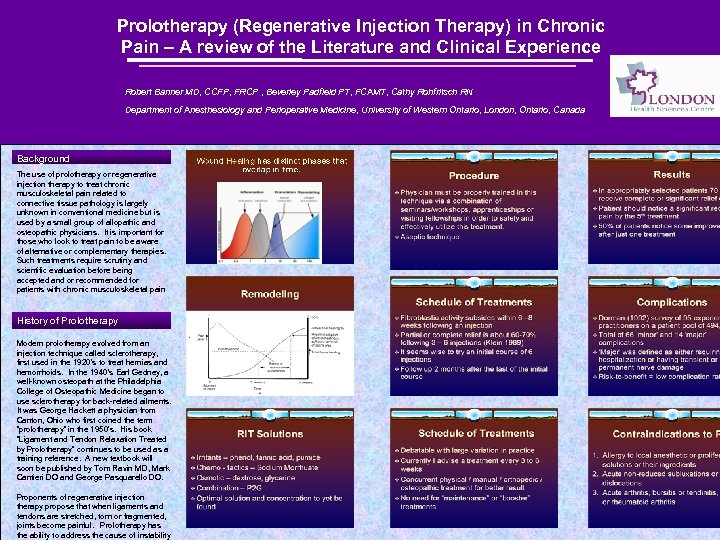 Prolotherapy (Regenerative Injection Therapy) in Chronic Pain – A review of the Literature and Clinical Experience Robert Banner MD, CCFP, FRCP , Beverley Padfield PT, FCAMT, Cathy Rohfritsch RN Department of Anesthesiology and Perioperative Medicine, University of Western Ontario, London, Ontario, Canada Background The use of prolotherapy or regenerative injection therapy to treat chronic musculoskeletal pain related to connective tissue pathology is largely unknown in conventional medicine but is used by a small group of allopathic and osteopathic physicians. It is important for those who look to treat pain to be aware of alternative or complementary therapies. Such treatments require scrutiny and scientific evaluation before being accepted and or recommended for patients with chronic musculoskeletal pain History of Prolotherapy Modern prolotherapy evolved from an injection technique called sclerotherapy, first used in the 1920’s to treat hernias and hemorrhoids. In the 1940’s Earl Gedney, a well-known osteopath at the Philadelphia College of Osteopathic Medicine began to use sclerotherapy for back-related ailments. It was George Hackett a physician from Canton, Ohio who first coined the term “prolotherapy” in the 1950’s. His book “Ligament and Tendon Relaxation Treated by Prolotherapy” continues to be used as a training reference. A new textbook will soon be published by Tom Ravin MD, Mark Cantieri DO and George Pasquarello DO. Proponents of regenerative injection therapy propose that when ligaments and tendons are stretched, torn or fragmented, joints become painful. Prolotherapy has the ability to address the cause of instability