


 Скачать презентацию Prolonging safe Driving for Older Drivers Dr Charles
b46b7663d9285137f431388ab57aa444.ppt
- Количество слайдов: 23
 Prolonging safe Driving for Older Drivers Dr Charles Musselwhite Senior Research Fellow Centre for Transport and Society University of the West of England
 General Road Accident Statistics • Road Traffic Deaths in GB 3, 221 (Df. T, 2004) • Reported Casualties in GB 280, 840 (Df. T, 2004) • Road Traffic Deaths 8 per 100, 000 population (13 in Netherlands and 21 in France) • Road Traffic Deaths 1. 1 per 100 million KM driven per year (1. 3 in Netherlands and 2. 3 in France). • Over past 25 years, although traffic is increasing (+27%), deaths are decreasing (-33%). • 55% of cars travel over 70 mph on motorways • 69% of cars travel over speed limit in built up areas.
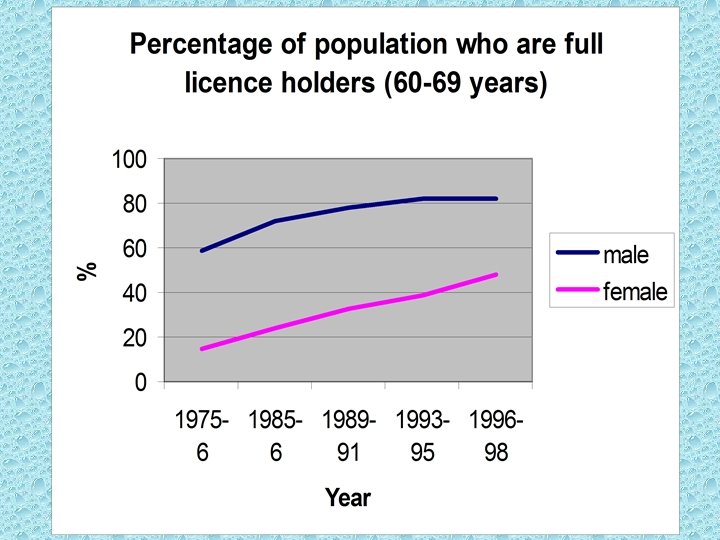
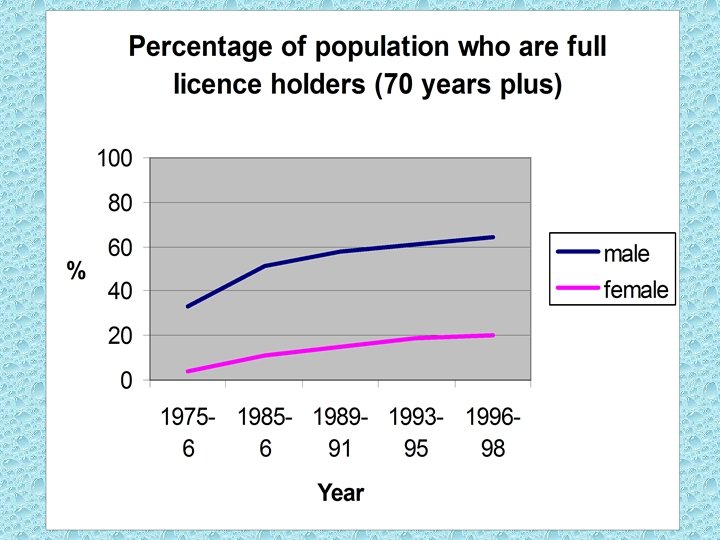
 Older People Statistics • Population of older people in UK is increasing in number and in % of overall age groups. • At present 20% of UK population is over 60 • Estimated that this is likely to be 30% by 2031 • More active age group than ever before & therefore mobile • 200% increase in male drivers over 65 and 600% increase in female drivers over 65 in past 30 years • 80 -89 year old age group 44% of men and 11% of women hold a full driving licence • Estimated that this will rise to 65% of men and 35% of women over the next 15 years
 Giving Up the Driving Task • Why prolong driving? • Control over environment • Increasing level of services moving out of town centres and residential zones • Driving increases self-confidence, mastery and self-esteem and feelings of autonomy, protection and prestige (Ellaway, et al. , 2003). • Giving up driving is associated with an increase in depressive symptoms (Ra et al)
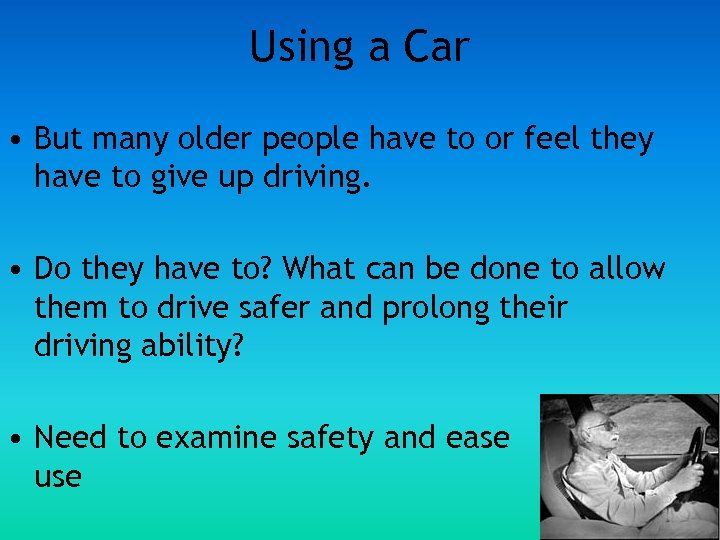 Using a Car • But many older people have to or feel they have to give up driving. • Do they have to? What can be done to allow them to drive safer and prolong their driving ability? • Need to examine safety and ease use of
 Giving Up the Driving Task • Self-diagnosis – Awareness • Family Pressure • Doctors
 How Safe are Older Drivers? • Risk of being killed or suffering serious injury is between 2 and 5 times greater than that of a younger person (Df. T, 1998) • Based on all severities 60 years + age group do not have any more accidents than 30 -59 year olds and have less than 17 -29 year olds. • But…over 60 s drive less miles, so taking into account miles driven, there is a slight increase for over 60 s age group, which increases for 70+ age group and again for over 80 s age group.
 Types of Accident • Occurs by an additional external factor such as navigating a novel route or being distacted by the radio, passengers or something unusual on the roadside. • 60 -99 year old age group more likely to have accidents at junctions (DOT, 1991; Df. T, 1998; Hakaimes-Blomqvist, 1988) • Particularly junctions with no traffic control (Maycock et al. , 1991)
 Driving Behaviour of Older Drivers • Schlag (1993) – compared 60 -82 year olds with 4050 year olds and found older drivers: – Were slower on motorways – Took longer and were more hesitant at lane changing on motorways resulting in late risky merging – Drove in a more uniform style with less acceleration and braking on country roads – Made more incorrect actions on inner-city roads – Approached junctions slower
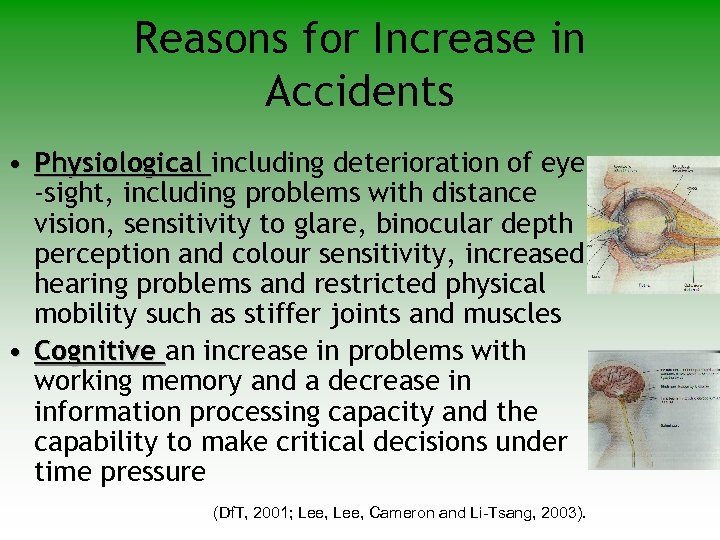 Reasons for Increase in Accidents • Physiological including deterioration of eye -sight, including problems with distance vision, sensitivity to glare, binocular depth perception and colour sensitivity, increased hearing problems and restricted physical mobility such as stiffer joints and muscles • Cognitive an increase in problems with working memory and a decrease in information processing capacity and the capability to make critical decisions under time pressure (Df. T, 2001; Lee, Cameron and Li-Tsang, 2003).
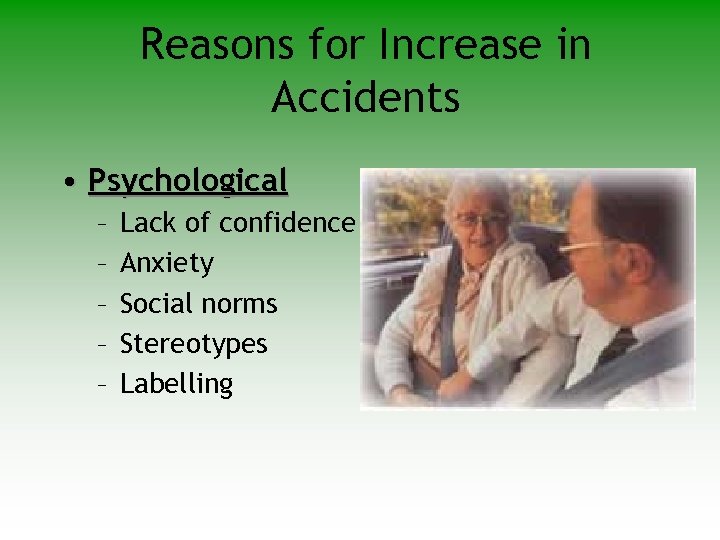 Reasons for Increase in Accidents • Psychological – – – Lack of confidence Anxiety Social norms Stereotypes Labelling
 Is Technology the Answer? • Can technology help prolong safe driving behaviour amongst older adults? • Previous research into technology and car driving tends to treat drivers as a homogenous group. • Therefore older driver needs and attitudes ignored
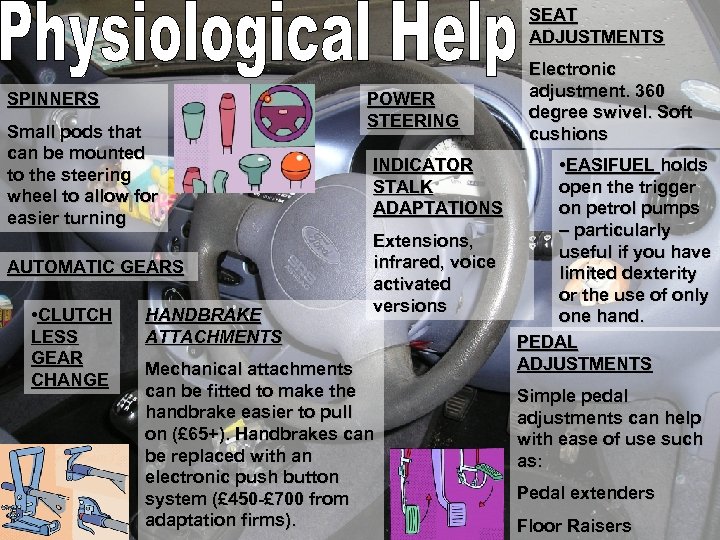 SEAT ADJUSTMENTS SPINNERS Small pods that can be mounted to the steering wheel to allow for easier turning AUTOMATIC GEARS • CLUTCH LESS GEAR CHANGE HANDBRAKE ATTACHMENTS POWER STEERING INDICATOR STALK ADAPTATIONS Extensions, infrared, voice activated versions Mechanical attachments can be fitted to make the handbrake easier to pull on (£ 65+). Handbrakes can be replaced with an electronic push button system (£ 450 -£ 700 from adaptation firms). Electronic adjustment. 360 degree swivel. Soft cushions • EASIFUEL holds open the trigger on petrol pumps – particularly useful if you have limited dexterity or the use of only one hand. PEDAL ADJUSTMENTS Simple pedal adjustments can help with ease of use such as: Pedal extenders Floor Raisers
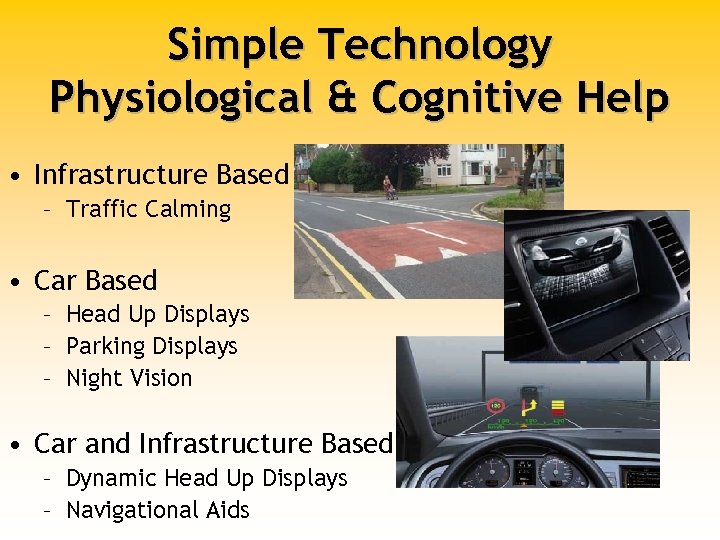 Simple Technology Physiological & Cognitive Help • Infrastructure Based – Traffic Calming • Car Based – Head Up Displays – Parking Displays – Night Vision • Car and Infrastructure Based – Dynamic Head Up Displays – Navigational Aids
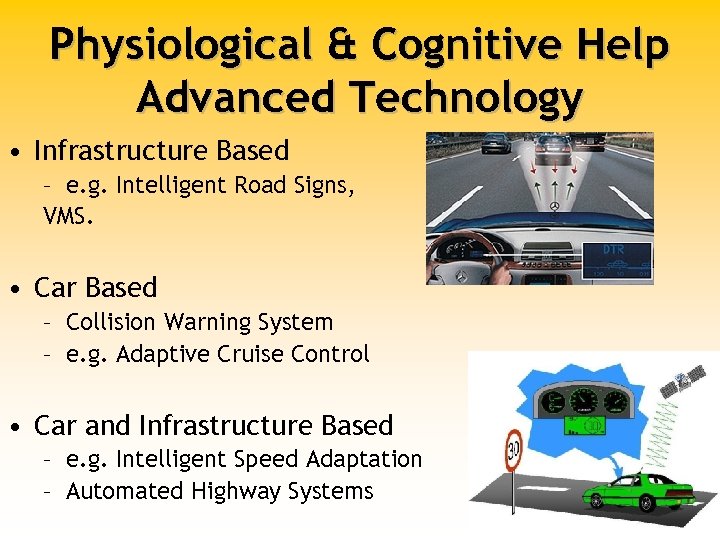 Physiological & Cognitive Help Advanced Technology • Infrastructure Based – e. g. Intelligent Road Signs, VMS. • Car Based – Collision Warning System – e. g. Adaptive Cruise Control • Car and Infrastructure Based – e. g. Intelligent Speed Adaptation – Automated Highway Systems
 Prolonging Safe Driving Project To critically examine whether new technology advances in Advanced Control and Safety Systems have the capacity to aid driver safety and prolong driving for older drivers in the United Kingdom • 20 to 30 participants • Emergent semi structured interviews to address needs – Abstraction – Apprenticing – Scenario Modelling • Focus Groups to develop technology – Introduce and discuss technologies • Electronic Delphi Technique
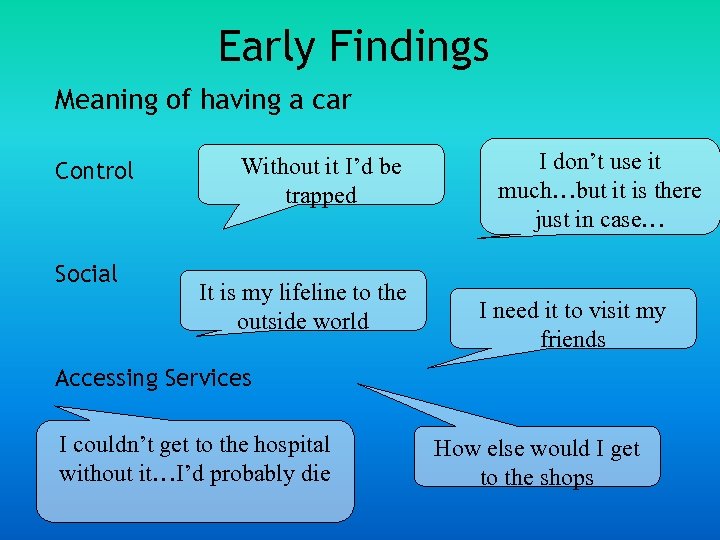 Early Findings Meaning of having a car Control Social Without it I’d be trapped It is my lifeline to the outside world I don’t use it much…but it is there just in case… I need it to visit my friends Accessing Services I couldn’t get to the hospital without it…I’d probably die How else would I get to the shops
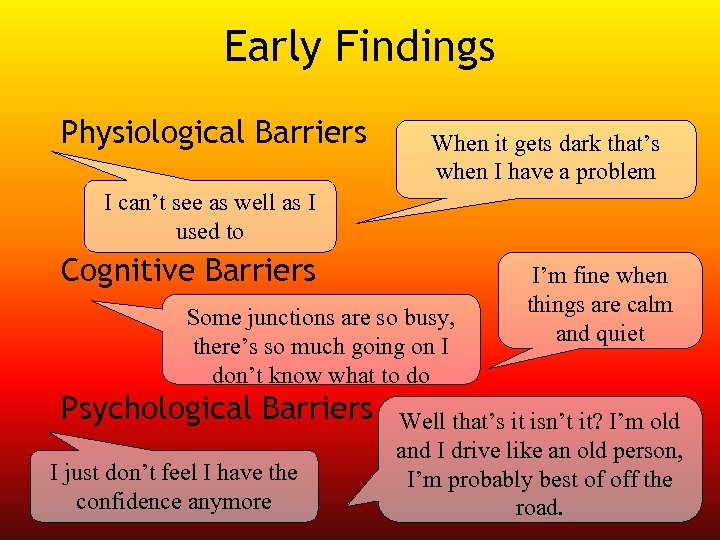 Early Findings Physiological Barriers When it gets dark that’s when I have a problem I can’t see as well as I used to Cognitive Barriers Some junctions are so busy, there’s so much going on I don’t know what to do Psychological Barriers I just don’t feel I have the confidence anymore I’m fine when things are calm and quiet Well that’s it isn’t it? I’m old and I drive like an old person, I’m probably best of off the road.
 • BBSRC and EPSRC Research Council Funding • 13 awards given in 3 areas • Life at home • Ageing muscles, tissues and cells • Getting out and about (Prof. Richard Neale, Glamorgan; Dr. Greg Marsden, Leeds; Mike Bradley, Middlesex) • Developing Capacity in Ageing Research – Access to a Mentor • Associate Member to Centre for Research on Ageing, Southampton University – Access to Workshops • 23 rd January 2006 - EDe. AN Workshop on ethics • 22 nd February 2006 – Design for older people • 27 th October 2006 (to be held at University of Leeds, UK) – Transport and Older People
 References Df. T (2001). Older Drivers: A literature review. London: Department for Transport. Accessed online at http: //www. dft. gov. uk/stellent/groups/dft_rdsafety/documents/page/dft_rdsafety_504602. hcsp. Last accessed 8 th March 2005. Ellaway, A. , Macintyre, S. , Hiscock, R. and Kearns, A. (2003). In the driving seat: psychosocial benefits from private motor vehicle transport compared to public transport. Transportation Research Part F. 6: 217 -231. Howarth, I. (1993). Effective Design: ensuring human factors in design procedures, In A. H. Parker and S. Franzen (eds. ). Driving Future Vehicles, pp 311 -320, London: Taylor and Francis. Lee, H. C. , Lee, A. H. , Cameron, D. , Li-Tsang, C. (2003). Using a driving simulator to identify older drivers at inflated risk of motor vehicle crashes. Journal of Safety Research. 34(4): 453 -459. Monterde i Bort, H. (2004). Factorial structure of recklessness: To what extent are older drivers different? Journal of Safety Research. 35(3): 329 -335 Musselwhite, C. B. A. (2004). Driver Attitudes, Behaviour and Speed Management Strategies. University of Southampton, Ph. D thesis. Oxley, P. and Mitchell, K. (1995). Elderly and disabled drivers telematics (EDDIT) DRIVE II Project V 2031 Rumar, K. (1986). Age and Road User Behaviour. 4 th Nordic Congress of Traffic Medicine. Van Wolffelar, P. , Brouwer, W. and Rothengatter, T. (1990). Divided Attention in RTI tasks for Elderly Drivers. EC DRIVE programme, Project V 1006, Deliverable 2, Traffic Research Centre, University of Groningen.
 Thanks for Listening Further information Dr Charles Musselwhite Senior Research Fellow Centre for Transport and Society University of West of England Charles. Musselwhite@uwe. ac. uk 0117 32 83010 www. transport. uwe. ac. uk www. sparc. ac. uk www. ricability. org. uk/index. htm