 Скачать презентацию Project X Sergei Nagaitsev Fermilab Feb 15 2010
7134f2755c21ac267fc4a38fef08b59f.ppt
- Количество слайдов: 28



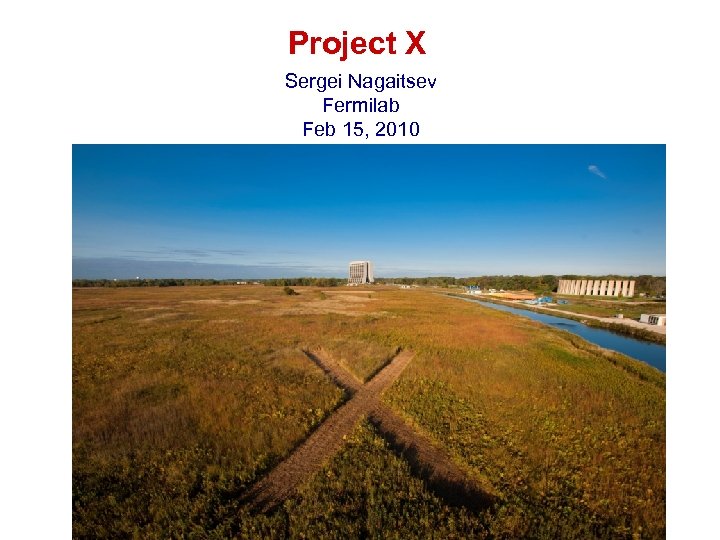
Project X Sergei Nagaitsev Fermilab Feb 15, 2010
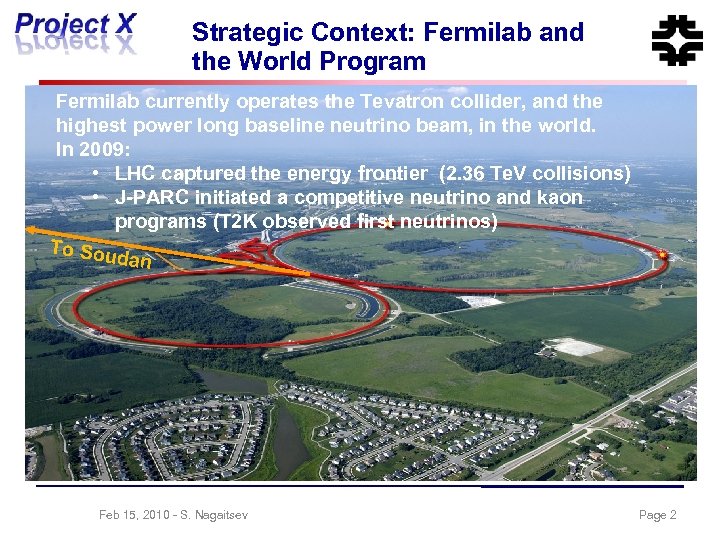
Strategic Context: Fermilab and the World Program Fermilab currently operates the Tevatron collider, and the highest power long baseline neutrino beam, in the world. In 2009: • LHC captured the energy frontier (2. 36 Te. V collisions) • J-PARC initiated a competitive neutrino and kaon programs (T 2 K observed first neutrinos) To Sou dan Feb 15, 2010 - S. Nagaitsev Page 2
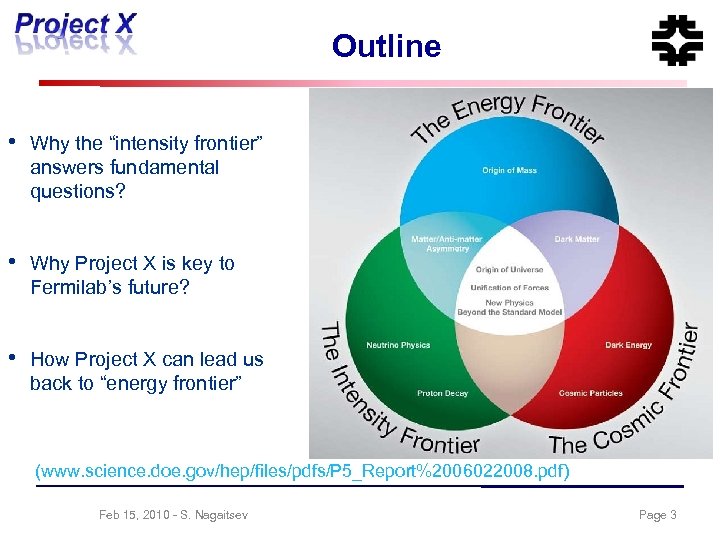
Outline • Why the “intensity frontier” answers fundamental questions? • Why Project X is key to Fermilab’s future? • How Project X can lead us back to “energy frontier” (www. science. doe. gov/hep/files/pdfs/P 5_Report%2006022008. pdf) Feb 15, 2010 - S. Nagaitsev Page 3
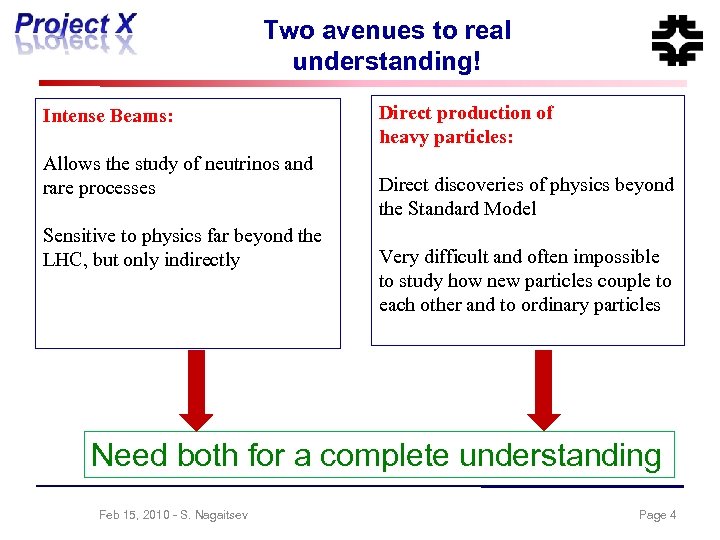
Two avenues to real understanding! Intense Beams: Allows the study of neutrinos and rare processes Sensitive to physics far beyond the LHC, but only indirectly Direct production of heavy particles: Direct discoveries of physics beyond the Standard Model Very difficult and often impossible to study how new particles couple to each other and to ordinary particles Need both for a complete understanding Feb 15, 2010 - S. Nagaitsev Page 4
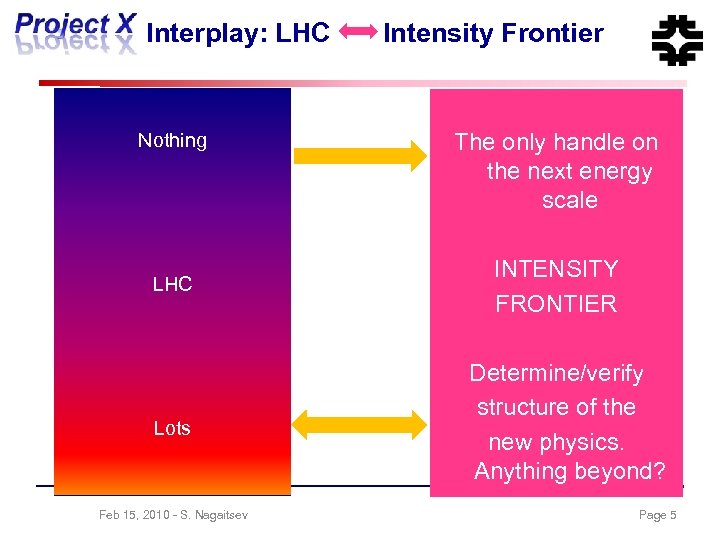
Interplay: LHC Nothing LHC Lots Feb 15, 2010 - S. Nagaitsev Intensity Frontier The only handle on the next energy scale INTENSITY FRONTIER Determine/verify structure of the new physics. Anything beyond? Page 5
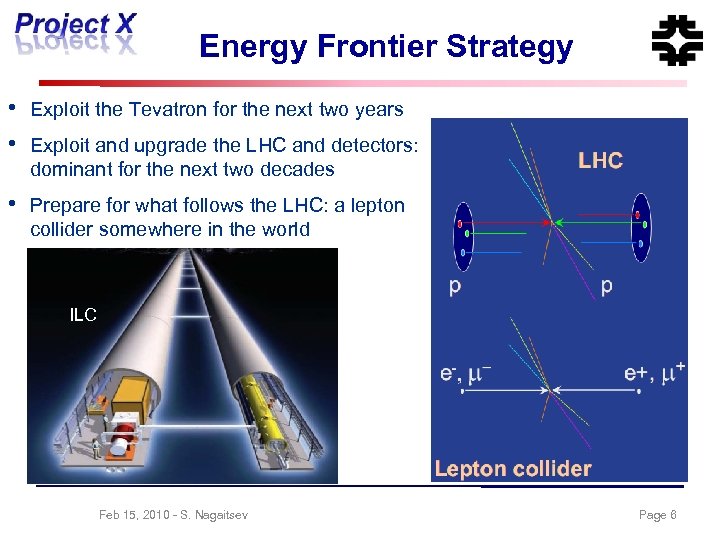
Energy Frontier Strategy • • Exploit the Tevatron for the next two years • Prepare for what follows the LHC: a lepton collider somewhere in the world Exploit and upgrade the LHC and detectors: dominant for the next two decades ILC Feb 15, 2010 - S. Nagaitsev Page 6
Intensity Frontier • Accelerator based programs – Driven by intense beams of protons for neutrinos, muon, kaon decays (US and Japan, CERN in the future) – Collider factories: Tau-charm and Beauty factories (Japan, China, Italy, Russia); LHCb at CERN • Non accelerator based programs – Driven by large numbers: reactor based neutrino experiments, proton decay, neutrinoless double-beta decay. Feb 15, 2010 - S. Nagaitsev Page 7
Intensity frontier in ~2012 • J-PARC operational at up to 750 k. W beam power at 30 -50 Ge. V in support of the T 2 K long baseline (295 km) neutrino experiment • NOn. A long baseline (810 km) neutrino experiment initiates operations at up to 700 k. W beam power at 120 Ge. V at Fermilab • Complete design of a very long baseline (1300 km) neutrino beamline at Fermilab, and an associated multi-MW proton source • • Complete conceptual design of a J-PARC multi-MW upgrade Next round of neutrino experiments indicate whether the mixing parameter sin 22 q 13 is greater than or less than ~0. 02 Feb 15, 2010 - S. Nagaitsev Page 8
Intensity is key for neutrinos § Only weak interactions: very small cross sections >> hard to study § Need large flux of particles and massive detectors § Complementary to LHC: measure neutrino parameters (new symmetries? ), neutrino masses, matter-antimatter symmetry violation and surprises. Feb 15, 2010 - S. Nagaitsev Page 9
The physics of neutrinos § The most abundant constituents of matter by far, but the least understood The Neutrino Revolution (1998 -- …. ) Neutrinos have nonzero masses § First and only confirmed physics beyond the Standard Model seen in any laboratory experiment § Points to physics at a new high-energy scale “Most important discovery in a quarter century” Steven Weinberg Feb 15, 2010 - S. Nagaitsev 10
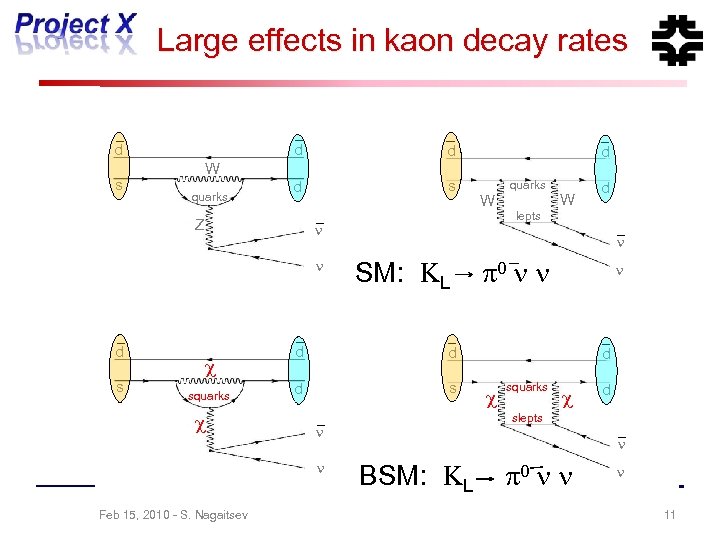
Large effects in kaon decay rates d d s W quarks d d s Z s quarks W n n d d c squarks c d lepts n SM: KL d d s p 0 n n n d d c squarks c d slepts n n Feb 15, 2010 - S. Nagaitsev W n BSM: KL p 0 n n n 11
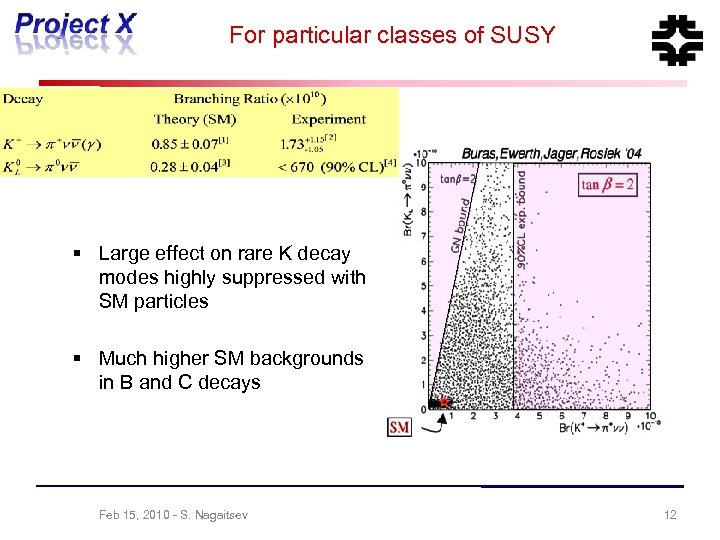
For particular classes of SUSY § Large effect on rare K decay modes highly suppressed with SM particles § Much higher SM backgrounds in B and C decays Feb 15, 2010 - S. Nagaitsev 12
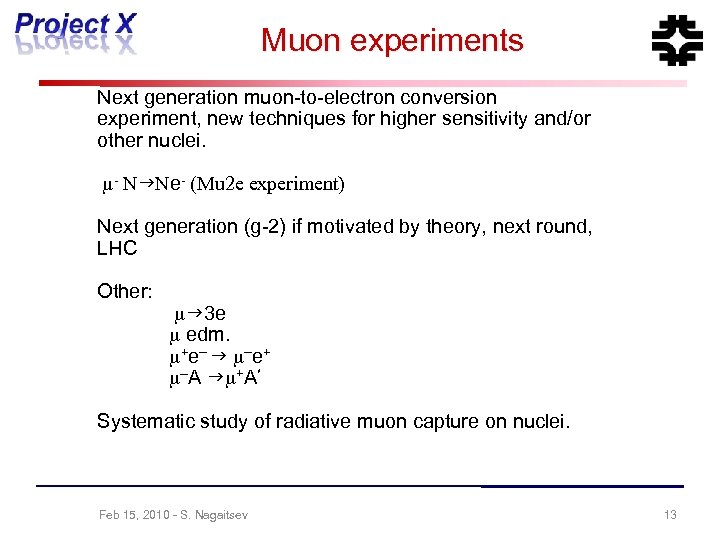
Muon experiments Next generation muon-to-electron conversion experiment, new techniques for higher sensitivity and/or other nuclei. µ- Ng. Ne- (Mu 2 e experiment) Next generation (g-2) if motivated by theory, next round, LHC Other: mg 3 e m edm. m+ e- g m- e+ m-A gm+A’ Systematic study of radiative muon capture on nuclei. Feb 15, 2010 - S. Nagaitsev 13
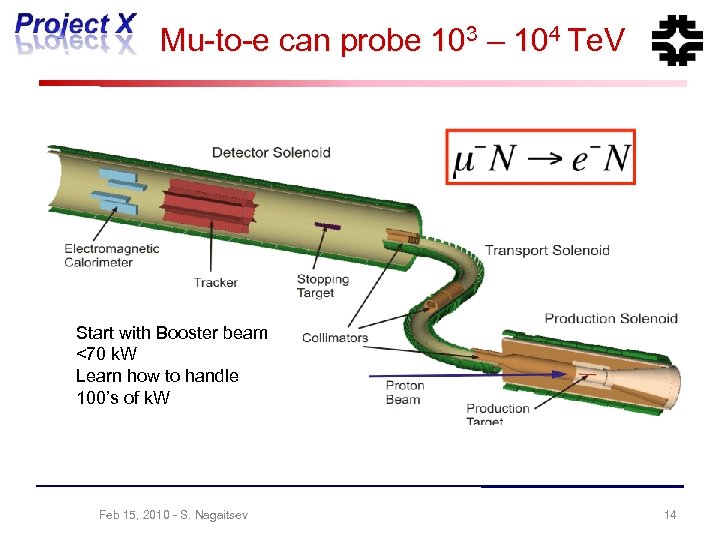
Mu-to-e can probe 103 – 104 Te. V Start with Booster beam <70 k. W Learn how to handle 100’s of k. W Feb 15, 2010 - S. Nagaitsev 14
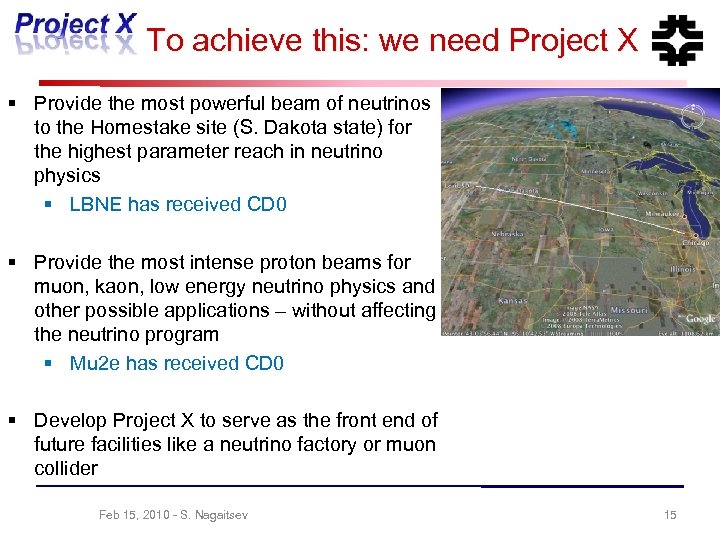
To achieve this: we need Project X § Provide the most powerful beam of neutrinos to the Homestake site (S. Dakota state) for the highest parameter reach in neutrino physics § LBNE has received CD 0 § Provide the most intense proton beams for muon, kaon, low energy neutrino physics and other possible applications – without affecting the neutrino program § Mu 2 e has received CD 0 § Develop Project X to serve as the front end of future facilities like a neutrino factory or muon collider Feb 15, 2010 - S. Nagaitsev 15
Project X: the promise 1. Neutrino program with Main Injector: 2 MW at 60 -120 Ge. V 2. Concurrent with 1: 100 s of k. W’s of beam for muon and kaon rare decay experiments 3. A self-consistent upgrade path to muon collider or/and neutrino factory • Project X documents can be found at: http: //projectx. fnal. gov/ Feb 15, 2010 - S. Nagaitsev Page 16
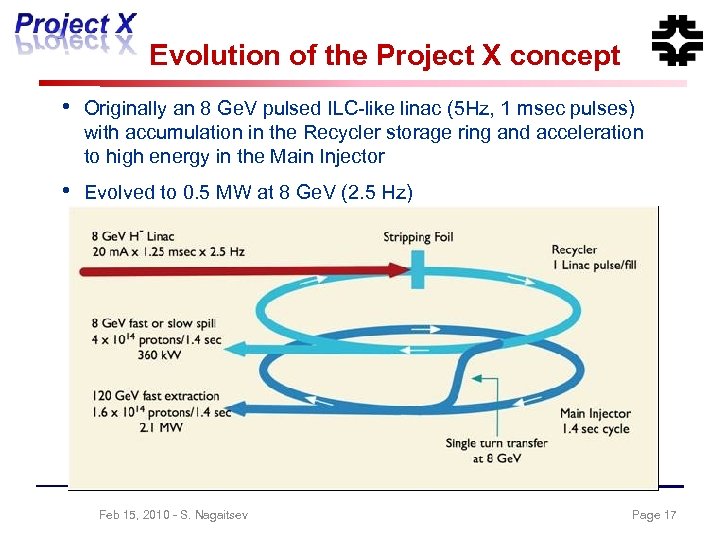
Evolution of the Project X concept • Originally an 8 Ge. V pulsed ILC-like linac (5 Hz, 1 msec pulses) with accumulation in the Recycler storage ring and acceleration to high energy in the Main Injector • Evolved to 0. 5 MW at 8 Ge. V (2. 5 Hz) Feb 15, 2010 - S. Nagaitsev Page 17
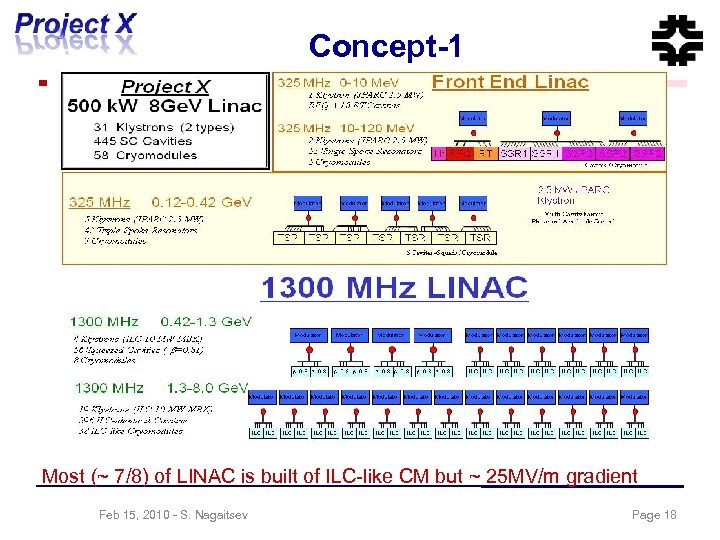
Concept-1 Most (~ 7/8) of LINAC is built of ILC-like CM but ~ 25 MV/m gradient Feb 15, 2010 - S. Nagaitsev Page 18
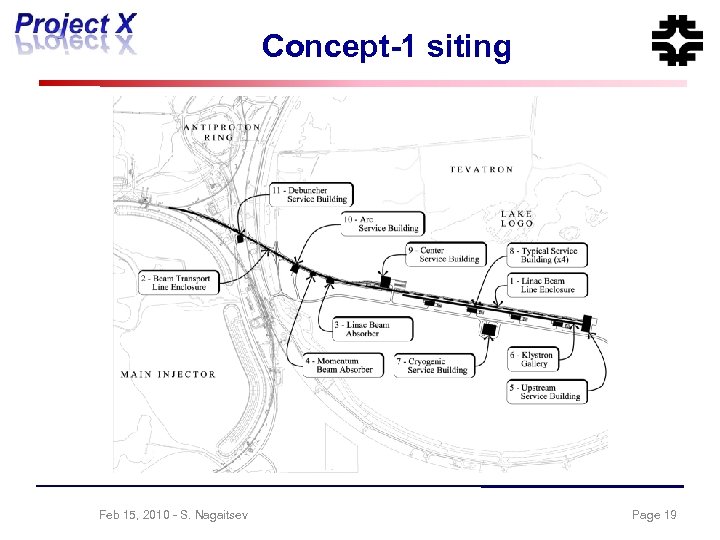
Concept-1 siting Feb 15, 2010 - S. Nagaitsev Page 19
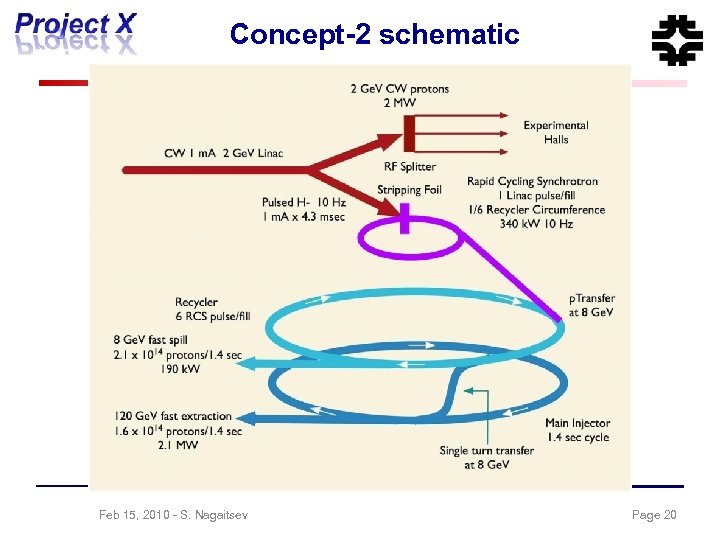
Concept-2 schematic Feb 15, 2010 - S. Nagaitsev Page 20
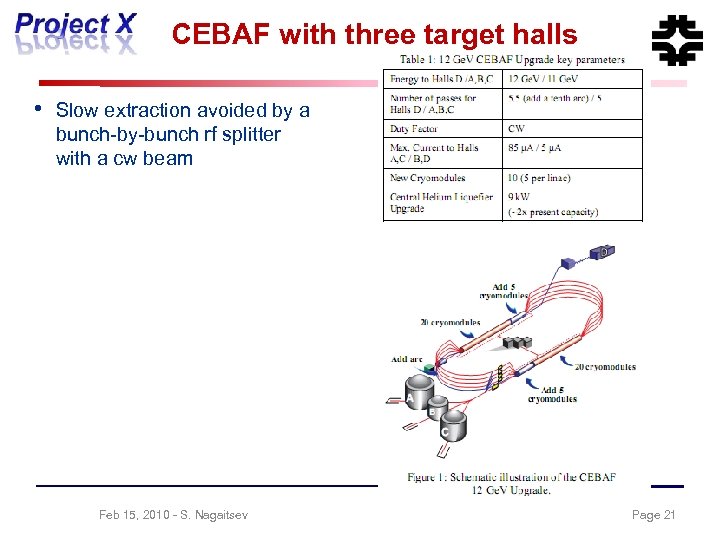
CEBAF with three target halls • Slow extraction avoided by a bunch-by-bunch rf splitter with a cw beam Feb 15, 2010 - S. Nagaitsev Page 21
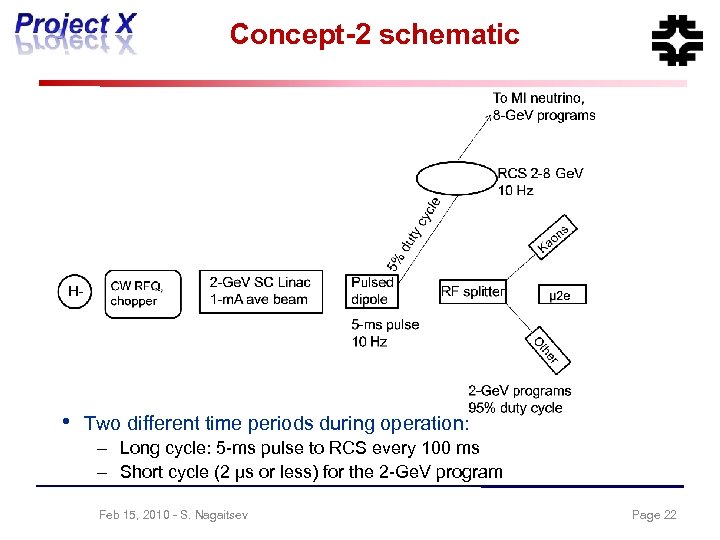
Concept-2 schematic • Two different time periods during operation: – Long cycle: 5 -ms pulse to RCS every 100 ms – Short cycle (2 µs or less) for the 2 -Ge. V program Feb 15, 2010 - S. Nagaitsev Page 22
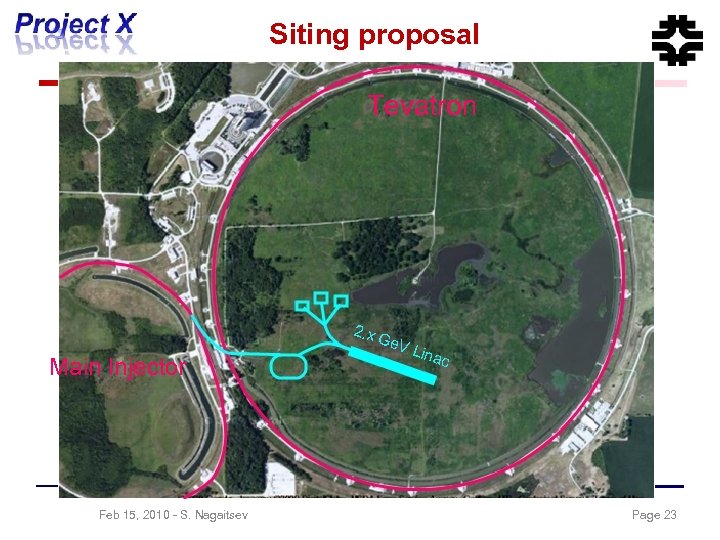
Siting proposal Tevatron 2. x Main Injector Feb 15, 2010 - S. Nagaitsev Ge. V Lina c Page 23
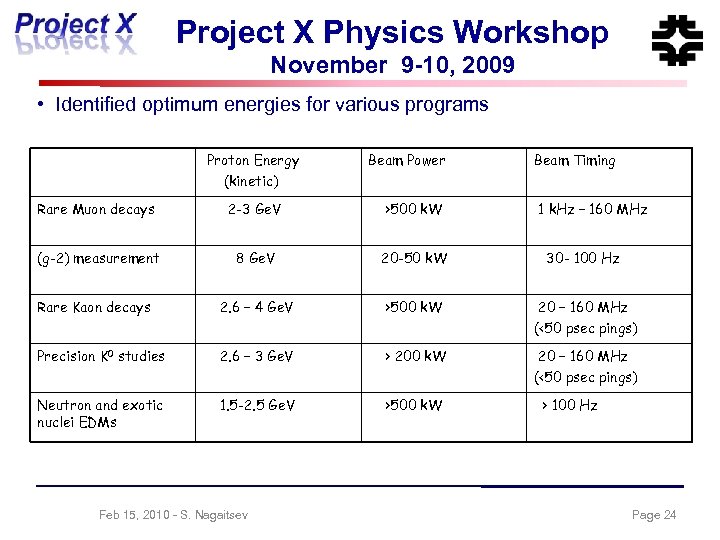
Project X Physics Workshop November 9 -10, 2009 • Identified optimum energies for various programs Proton Energy Beam Power Beam Timing (kinetic) Rare Muon decays 2 -3 Ge. V >500 k. W (g-2) measurement 8 Ge. V 20 -50 k. W 30 - 100 Hz 2. 6 – 4 Ge. V >500 k. W 20 – 160 MHz Rare Kaon decays 1 k. Hz – 160 MHz (<50 psec pings) Precision K 0 studies 2. 6 – 3 Ge. V > 200 k. W 20 – 160 MHz (<50 psec pings) Neutron and exotic nuclei EDMs 1. 5 -2. 5 Ge. V Feb 15, 2010 - S. Nagaitsev >500 k. W > 100 Hz Page 24
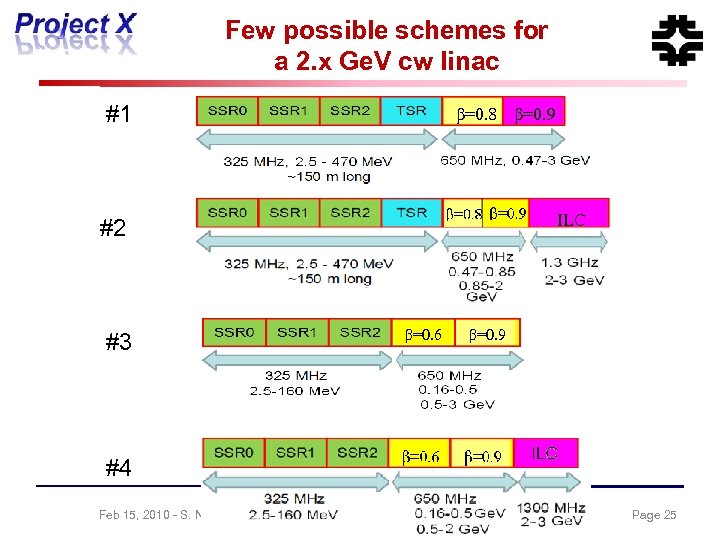
Few possible schemes for a 2. x Ge. V cw linac #1 β=0. 8 β=0. 9 #2 #3 β=0. 6 β=0. 9 #4 Feb 15, 2010 - S. Nagaitsev Page 25
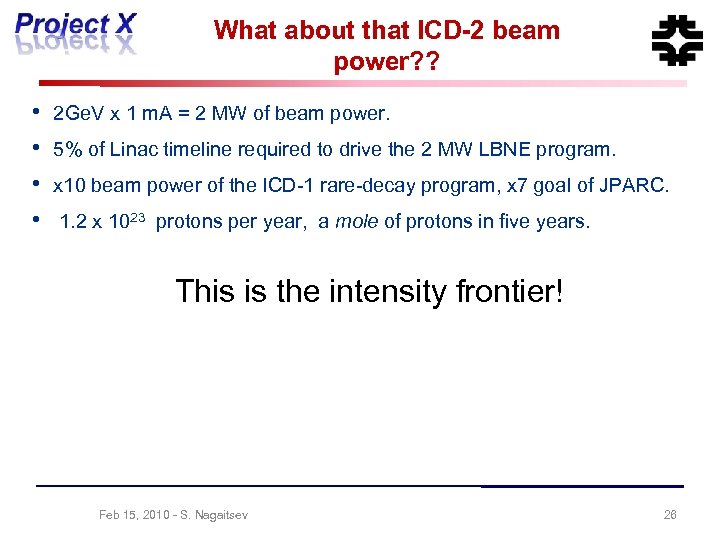
What about that ICD-2 beam power? ? • • 2 Ge. V x 1 m. A = 2 MW of beam power. 5% of Linac timeline required to drive the 2 MW LBNE program. x 10 beam power of the ICD-1 rare-decay program, x 7 goal of JPARC. 1. 2 x 10²³ protons per year, a mole of protons in five years. This is the intensity frontier! Feb 15, 2010 - S. Nagaitsev 26
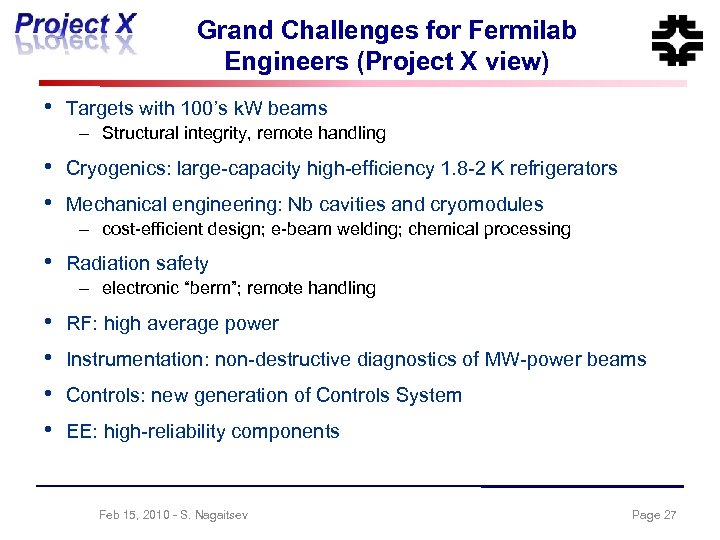
Grand Challenges for Fermilab Engineers (Project X view) • Targets with 100’s k. W beams – Structural integrity, remote handling • • Cryogenics: large-capacity high-efficiency 1. 8 -2 K refrigerators Mechanical engineering: Nb cavities and cryomodules – cost-efficient design; e-beam welding; chemical processing • Radiation safety – electronic “berm”; remote handling • • RF: high average power Instrumentation: non-destructive diagnostics of MW-power beams Controls: new generation of Controls System EE: high-reliability components Feb 15, 2010 - S. Nagaitsev Page 27
Summary § A new concept for Project X beam delivery has emerged. – Not another rendition of AGS or JPARC – Avoids complications of slow extraction § Variable chopper + Super Conducting CW linac + an rf splitter totally new approach to the rare decay programs. § Would maintain the vitality of the domestic US program by creating many physics opportunities; more than 1000 users § Would develop and exercise the technologies to position the US to host a global facility at the energy frontier (or contribute to one elsewhere) § Attract major international participation Feb 15, 2010 - S. Nagaitsev 28
Скачать презентацию Project X Sergei Nagaitsev Fermilab Feb 15 2010
7134f2755c21ac267fc4a38fef08b59f.ppt