


 Скачать презентацию Project volcano Ira Norkina Sofia Ivannikova Tamara Volodina
angl_1.pptx
- Количество слайдов: 25
 Project “volcano” Ira Norkina, Sofia Ivannikova, Tamara Volodina, Masha NIkolaenko Form 10 a Medical gymnasium № 33
 Plan • General characteristics of volcanoes • Etna • Rules of conduct • Questions
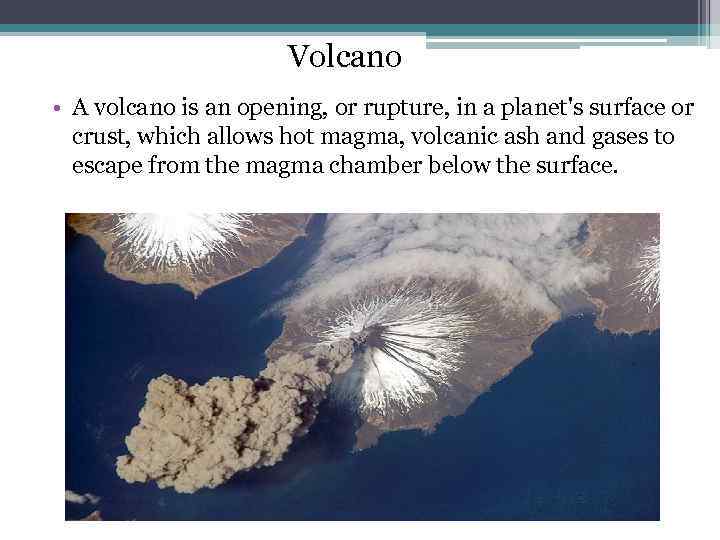 Volcano • A volcano is an opening, or rupture, in a planet's surface or crust, which allows hot magma, volcanic ash and gases to escape from the magma chamber below the surface.
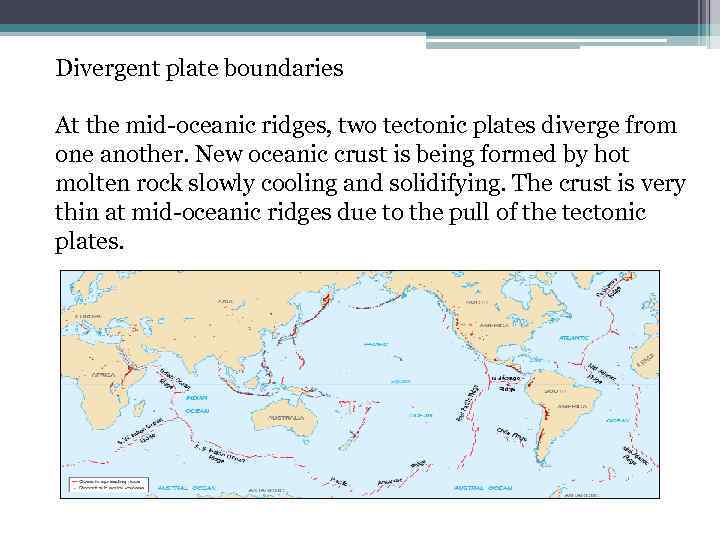 Divergent plate boundaries At the mid-oceanic ridges, two tectonic plates diverge from one another. New oceanic crust is being formed by hot molten rock slowly cooling and solidifying. The crust is very thin at mid-oceanic ridges due to the pull of the tectonic plates.
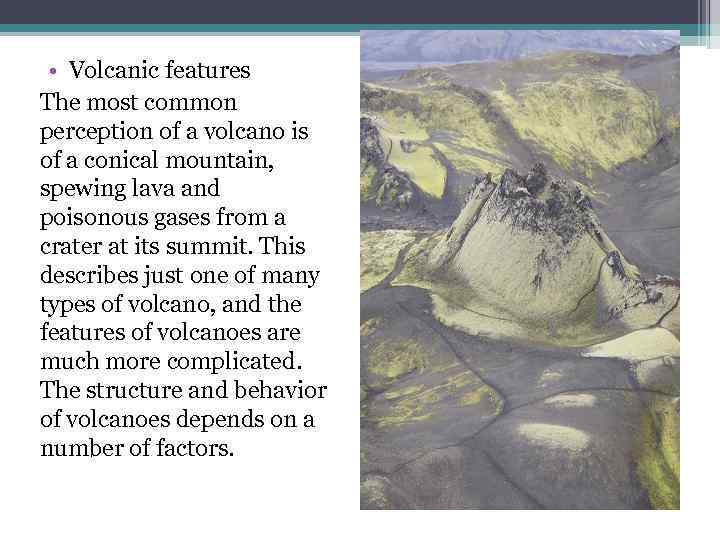 • Volcanic features The most common perception of a volcano is of a conical mountain, spewing lava and poisonous gases from a crater at its summit. This describes just one of many types of volcano, and the features of volcanoes are much more complicated. The structure and behavior of volcanoes depends on a number of factors.
 • Fissure vents • Volcanic fissure vents are flat, linear cracks through which lava emerges. • Shield volcanoes, so named for their broad, shield-like profiles, are formed by the eruption of low-viscosity lava that can flow a great distance from a vent. They generally do not explode catastrophically. • Lava domes are built by slow eruptions of highly viscous lavas. They are sometimes formed within the crater of a previous volcanic eruption (as in Mount Saint Helens), but can also form independently, as in the case of Lassen Peak. Like stratovolcanoes, they can produce violent, explosive eruptions, but their lavas generally do not flow far from the originating vent.
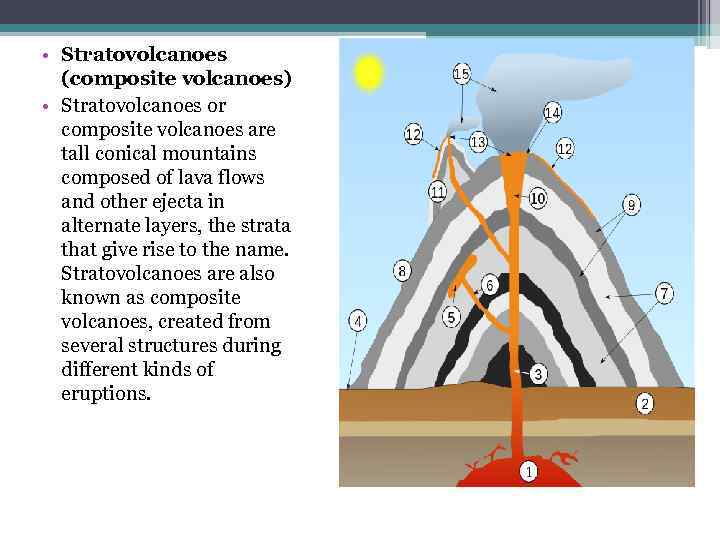 • Stratovolcanoes (composite volcanoes) • Stratovolcanoes or composite volcanoes are tall conical mountains composed of lava flows and other ejecta in alternate layers, the strata that give rise to the name. Stratovolcanoes are also known as composite volcanoes, created from several structures during different kinds of eruptions.
 • Supervolcanoes • A supervolcano is a large volcano that usually has a large caldera and can potentially produce devastation on an enormous, sometimes continental, scale. Such eruptions would be able to cause severe cooling of global temperatures for many years afterwards because of the huge volumes of sulfur and ash erupted. They are the most dangerous type of volcano. Examples include Yellowstone Caldera in Yellowstone National Park and Valles Caldera in New Mexico (both western United States), Lake Taupo in New Zealand, Lake Toba in Sumatra. • Submarine volcanoes are common features on the ocean floor. Some are active and, in shallow water, disclose their presence by blasting steam and rocky debris high above the surface of the sea. Many others lie at such great depths that the tremendous weight of the water above them prevents the explosive release of steam and gases, although they can be detected by hydrophones and discoloration of water because of volcanic gases. Pumice rafts may also appear.
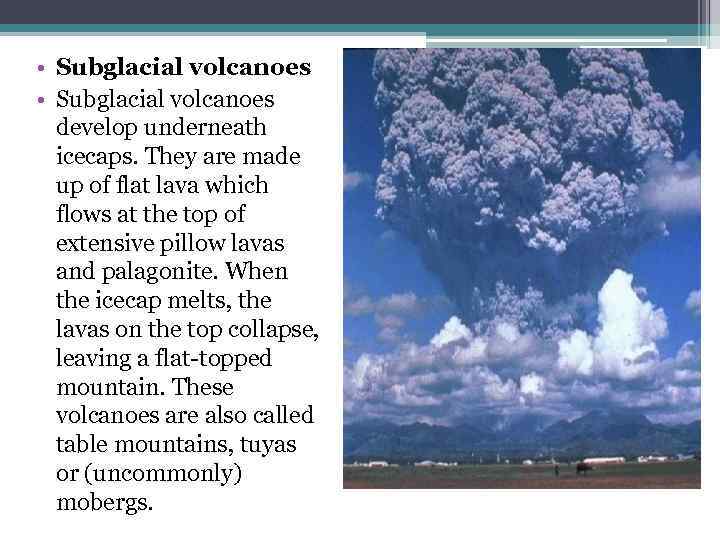 • Subglacial volcanoes develop underneath icecaps. They are made up of flat lava which flows at the top of extensive pillow lavas and palagonite. When the icecap melts, the lavas on the top collapse, leaving a flat-topped mountain. These volcanoes are also called table mountains, tuyas or (uncommonly) mobergs.
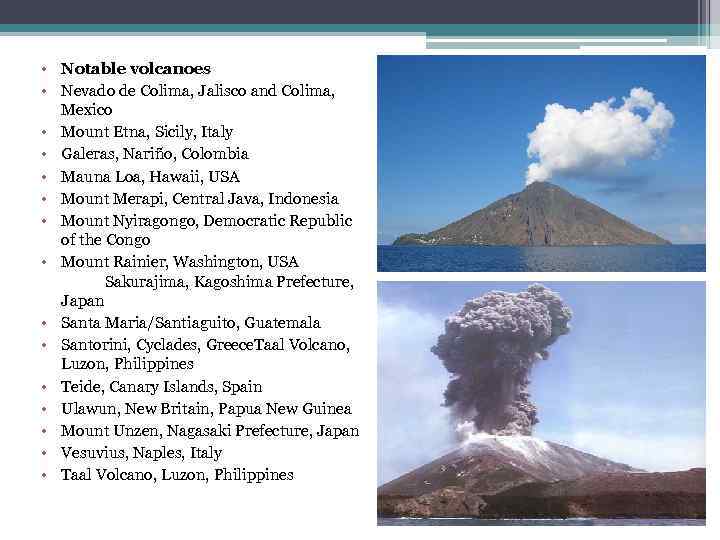 • Notable volcanoes • Nevado de Colima, Jalisco and Colima, Mexico • Mount Etna, Sicily, Italy • Galeras, Nariño, Colombia • Mauna Loa, Hawaii, USA • Mount Merapi, Central Java, Indonesia • Mount Nyiragongo, Democratic Republic of the Congo • Mount Rainier, Washington, USA Sakurajima, Kagoshima Prefecture, Japan • Santa Maria/Santiaguito, Guatemala • Santorini, Cyclades, Greece. Taal Volcano, Luzon, Philippines • Teide, Canary Islands, Spain • Ulawun, New Britain, Papua New Guinea • Mount Unzen, Nagasaki Prefecture, Japan • Vesuvius, Naples, Italy • Taal Volcano, Luzon, Philippines
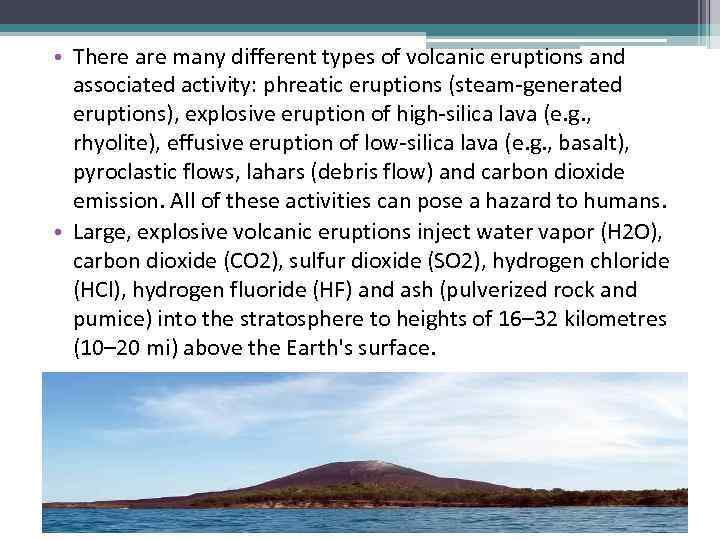 • There are many different types of volcanic eruptions and associated activity: phreatic eruptions (steam-generated eruptions), explosive eruption of high-silica lava (e. g. , rhyolite), effusive eruption of low-silica lava (e. g. , basalt), pyroclastic flows, lahars (debris flow) and carbon dioxide emission. All of these activities can pose a hazard to humans. • Large, explosive volcanic eruptions inject water vapor (H 2 O), carbon dioxide (CO 2), sulfur dioxide (SO 2), hydrogen chloride (HCl), hydrogen fluoride (HF) and ash (pulverized rock and pumice) into the stratosphere to heights of 16– 32 kilometres (10– 20 mi) above the Earth's surface.
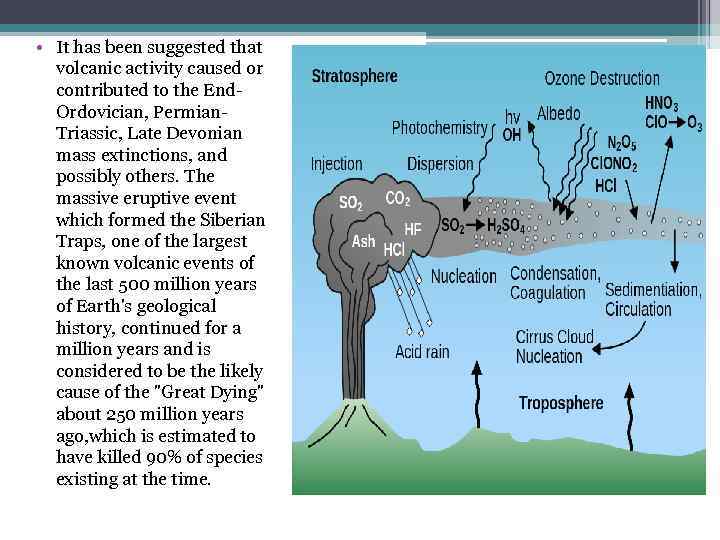 • It has been suggested that volcanic activity caused or contributed to the End. Ordovician, Permian. Triassic, Late Devonian mass extinctions, and possibly others. The massive eruptive event which formed the Siberian Traps, one of the largest known volcanic events of the last 500 million years of Earth's geological history, continued for a million years and is considered to be the likely cause of the "Great Dying" about 250 million years ago, which is estimated to have killed 90% of species existing at the time.
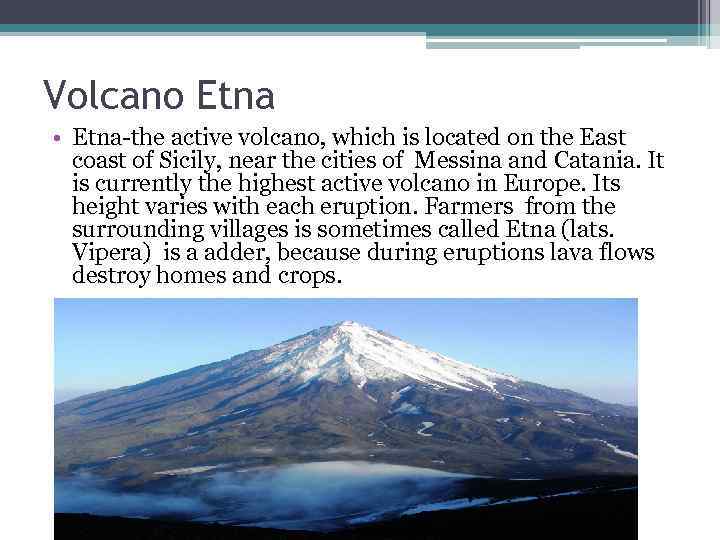 Volcano Etna • Etna-the active volcano, which is located on the East coast of Sicily, near the cities of Messina and Catania. It is currently the highest active volcano in Europe. Its height varies with each eruption. Farmers from the surrounding villages is sometimes called Etna (lats. Vipera) is a adder, because during eruptions lava flows destroy homes and crops.
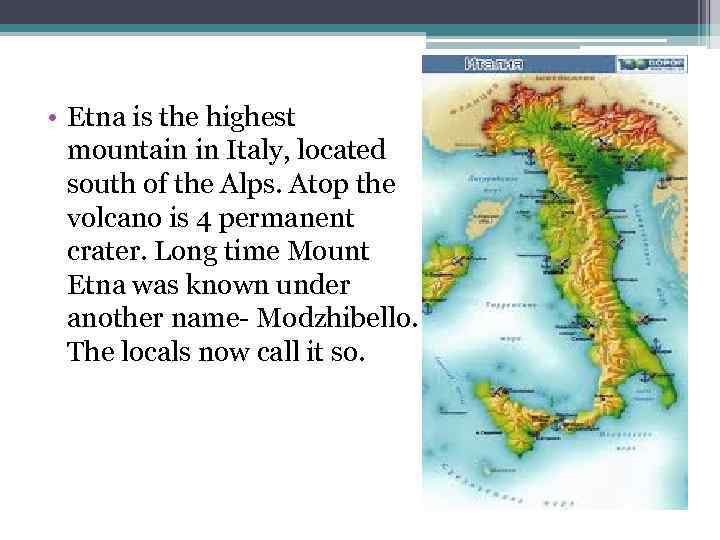 • Etna is the highest mountain in Italy, located south of the Alps. Atop the volcano is 4 permanent crater. Long time Mount Etna was known under another name- Modzhibello. The locals now call it so.
 • In 1614 was the longest eruption-it lasted 10 years. In 1983, the eruption lasted 131 days. Scientists have been trying to change the direction of the lava flow, using the method of the local explosion. But they were not very successful. Etna -the most active volcano in Italy. He surpasses his closest "competitor"-the volcano Vesuvius in more than 2 times.
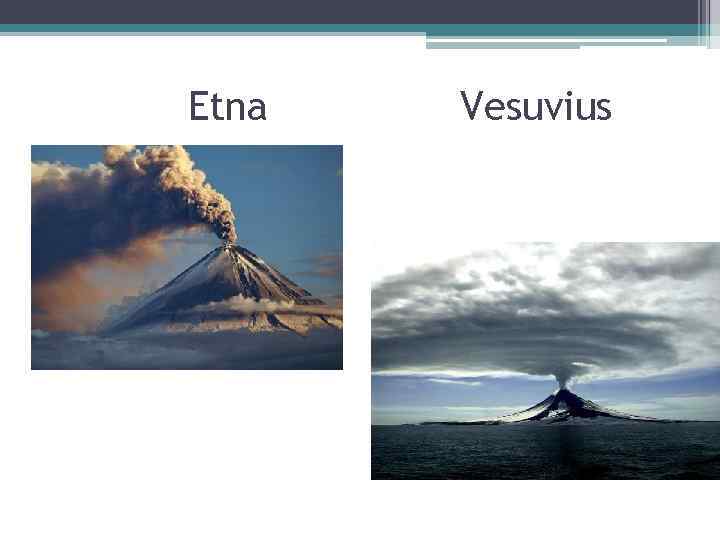 Etna Vesuvius
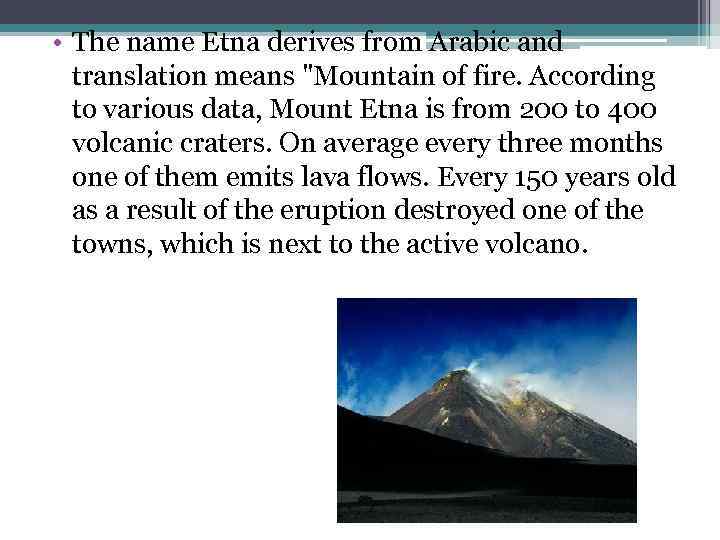 • The name Etna derives from Arabic and translation means "Mountain of fire. According to various data, Mount Etna is from 200 to 400 volcanic craters. On average every three months one of them emits lava flows. Every 150 years old as a result of the eruption destroyed one of the towns, which is next to the active volcano.
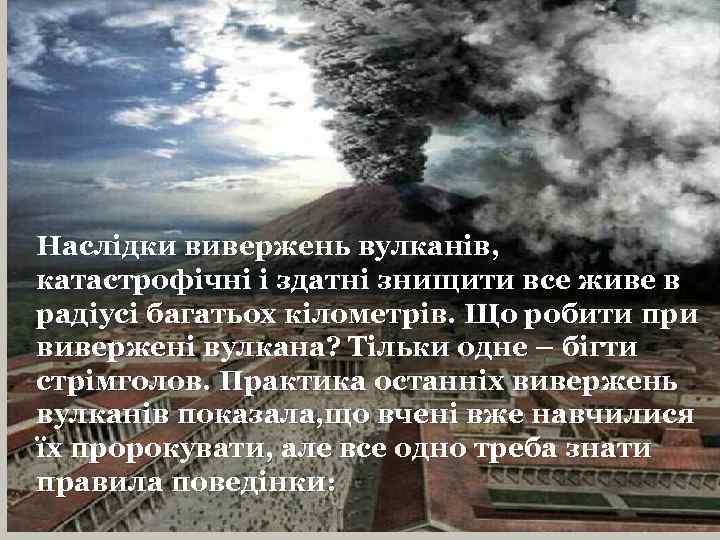 Наслідки вивержень вулканів, катастрофічні і здатні знищити все живе в радіусі багатьох кілометрів. Що робити при вивержені вулкана? Тільки одне – бігти стрімголов. Практика останніх вивержень вулканів показала, що вчені вже навчилися їх пророкувати, але все одно треба знати правила поведінки:
 Правила поведінки при вивержені вулкана: q Якщо втеча не допоможе (середня швидкість потоку розжареної магми близько 40 кілометрів на годину), то моментально шукайте укриття, не підвального типу. Закрийте всі щілини в будинку, при першій же можливості очистіть дах будинку від попелу. Добре мати вогнегасники у будинку, або декілька галонів води.
 q Одягніться у кілька шарів щільного, бажано незаймистого одягу, він захистить вас від кислоти, яку у величезних кількостях діоксид сірки буде утворювати. q Тікати від потоків лави потрібно найкоротшим шляхом, тобто перпендикулярно напрямку їх руху.
 q. Після виверження не поспішайте повертатися в свій будинок. Сигналом повинні послужити повідомлення служб з НС. q- Після виверження вулкана, приготуйтесь провести кілька днів, або тиждень у будинку. Не відкривайте вікна настільки довго, наскільки це можливо.
 Вище описані прості, базові правила поведінки при виверженні вулкана. В кожному випадку слід без паніки приймати зважені рішення. Пам’ятайте метушня тільки погіршить ситуацію.
 І не слухайте тих, хто буде переконувати вас, що цей вулкан ось вже як тисячу років "не працює". Будь-який сплячий вулкан може раптово прокинутися, просто про це зазвичай вже нікому розповісти.
 Vocabulary • • • • Surface–поверхнево Ridge-хребет Slide-слайд Arise-Встань Emits-видає Surpasses-перевершує Aerosols-аерозолі Minor-незначні Eruption-виверження Plumes-пір'я Landform-ландшафт Currently –в даний час Stratovolcanoes-стратовулкани Include-включати Varies-змінюється Pressure-тиск
 Questions 1. Where volcanoes are generally found? 2. What type of volcanism falls under the umbrella? 3. Is crust thin? 4. What is the most common perception of a volcano? 5. Do Alps locates at Italy? 6. What types of volcano eruption do you know? 7. Where the volcano Etna is situated? 8. Where volcanoes can form ? 9. Which threats can be from volcanoes? 10. The word volcano is derived from what? 11. How many active volcanoes are now? 12. Hа какие 4 состава делится лава? 13. Яка середня швидкість потоку розжареної магми? 14. Розкажіть правила поведінки при вивержені вулкана? 15. Що робити після виверження?