


 Скачать презентацию Project Scheduling Presentation Association for the Advancement of
d73c2d9f24995a9b69a7c8e7978ddbd3.ppt
- Количество слайдов: 35
 Project Scheduling Presentation Association for the Advancement of Cost Engineering International (AACEi) North Florida Section March 19 th, 2009 Section Meeting By John P. Orr, PSP Scheduling and Cost Engineering on Overseas Projects: Earned Value and Performance Intensity Progress Measurement March 19, 2009
 Scheduling & Cost Engineering on Overseas Projects I. Earned Value and Performance Intensity Progress Measurement II. Tools for Monitoring and Controlling Project Objectives: (Cost / Quality / Time) III. Claims Avoidance & Resolution Present / Refute Claims: Sword / Shield 2
 Importance of Scheduling • Convert the Work Plan into a Map – “The scheduling process forces people to quantify their effort in discrete terms and to place activities in proper relationship to each other. ” • Establish a Baseline Against Which Progress is Measured • Monitor and Control Projects • Goal: To Provide Accurate Information to Decision-Makers 3
 Who Sets Scheduling Standards? • PMBOK – Project Management Institute Body of Knowledge • PMI – College of Scheduling – Scheduling Excellence Initiative (SEI) Best Practices and Guidelines (being developed) • • AACE International – Recommended Practices CMAA – Scheduling Committee Guidelines AGC – The Associated General Contractors US Army Corps of Engineers – Impact Evaluation Guide (Productivity) 4
 Who Sets the Standards? • No Single Body is Authoritative • Training: – – Collegiate Corporate Software Providers Books • No Consistency in the Universities as to how CPM Scheduling is Taught • Schedulers Use a Variety of Techniques • No Single Standard for Certification of Schedulers 5
 US Dept of State – Overseas Building Operations • Provide Facilities for Diplomatic and Consular missions overseas • As of January 2009, OBO has opened 65 new facilities with an additional 31 under design or construction • Point position overseas in the field: The OBO Project Director (PD) 6
 OBO Project Director Responsibilities • Project Controls – Project Objectives (Cost/Quality/Time) – Primary Contact with Contractor & Subs – Interface with Embassy (Post) stakeholders – Interface with Stateside stakeholders • Project Status & Completion Projections 7
 OBO Project Scheduling Requirements • Project Execution Schedule (PES) • Contractor-prepared & updated – Initial PES, Baseline PES & Updates – Cost-loaded – Tied to Monthly Payment Requisition 8
 What does a PD Face? • His Approval Binds the USG to the Schedule • Implied Duties: – Cooperate – Coordinate – Not Delay, Hinder or Interfere • Submittal Reviews (duration, stacking) • Manpower – Post Access / Clearances • Government-Furnished Material Deliveries 9
 What Else Does a PD Face? • Other Legal Issues – – – – – Ownership of Float Right to Finish Early Acceleration (Directed / Constructive) Front-end Loading Improper Use of Lag Factors No Damage for Delay Clauses Concurrent, Excusable, Compensable Delay Schedule Pacing Schedule Impossibility 10
 What Else Does a PD Face? • Loss of Productivity – Disruptions – Delays – Overtime – Change Orders – Acceleration • Changed Working Conditions – Loss of Productivity & Increased Labor Costs 11
 What does a PD Use? • Primavera Project Planner (P 3 ver 3. 1) – Very Flexible Tool – Allows for Creative Scheduling – Allows Hidden Lag Factors and Multiple Logic Options • ADM: You saw the logic • PDM: Less Activities, More Options for Logic – Possibility of “Schedule Embezzlement” • Remember: It Only Looks Like a Gantt Chart! 12
 Overseas Construction Scaffolding: Rome-style 13
 Scaffolding: Rome-style 14
 Scaffolding: Tbilisi-style 15
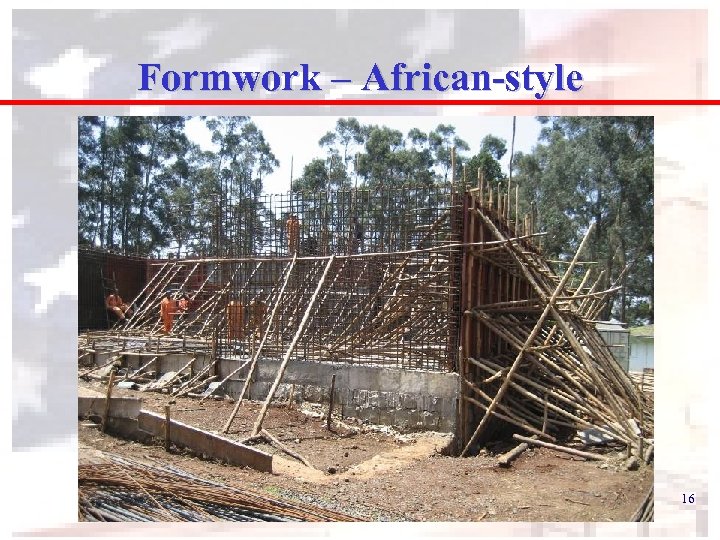 Formwork – African-style 16
 Unfamiliar Construction 17
 Unfamiliar Food 18
 Unfamiliar Altitude (for Floridians) 2, 440 M (9, 700 feet above sea level) 19
 Unfamiliar Level of Labor Intensity 20
 Overseas Issue #1: Timeliness Project Execution Schedule (PES) turn-around: • Field updating process • • Focus/Emphasis on Payment Requisition Data sent Stateside for Primavera (P 3) updating • • • Payment data does not include Actual Start/Finish dates Cycle return to field NOT timely Formal schedule submittal received back in field well past data date. Information no longer current Project Director without timely information cannot provide current, accurate projections with a high degree of confidence 21
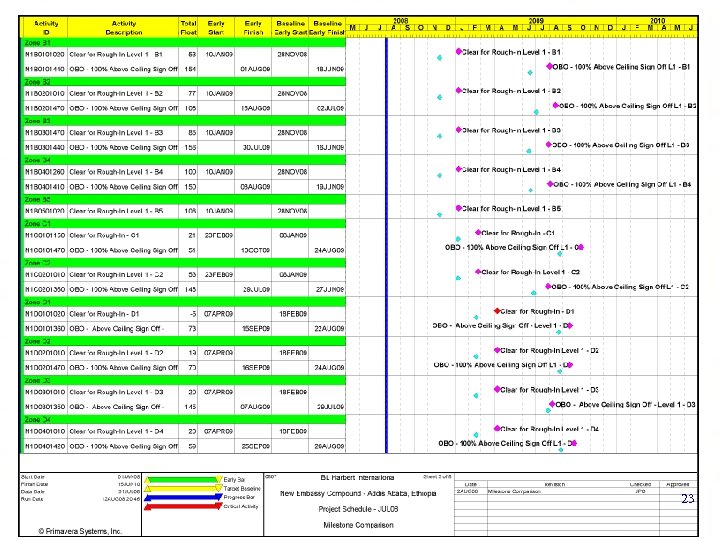
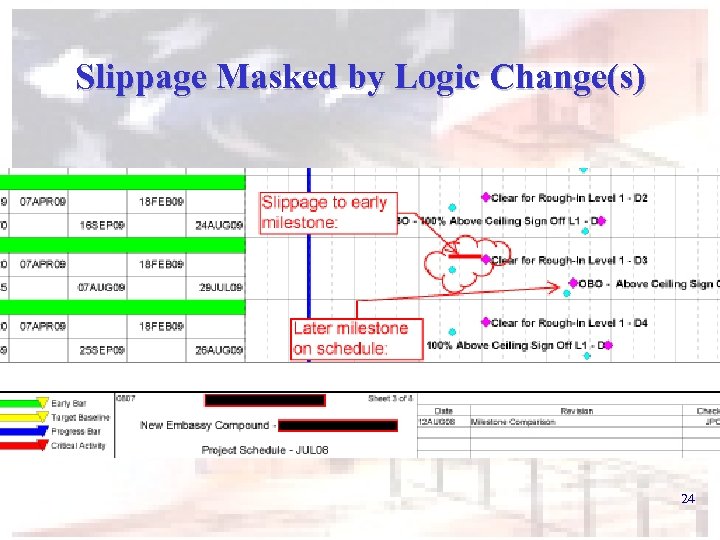
 Issue #2: “Schedule Embezzlement” Relationship logic changes, or changes to lag factors, constraints and other “unseen” items: • • Masks poor progress Can “stack” trades in concurrent work Constraints modify CPM calculations Date tables and bar charts do not indicate changes Comparison to Target (prior) schedule requires P 3 schedule analysis or “Digger” software, not always available in the field. 22
 23
23
 Slippage Masked by Logic Change(s) 24
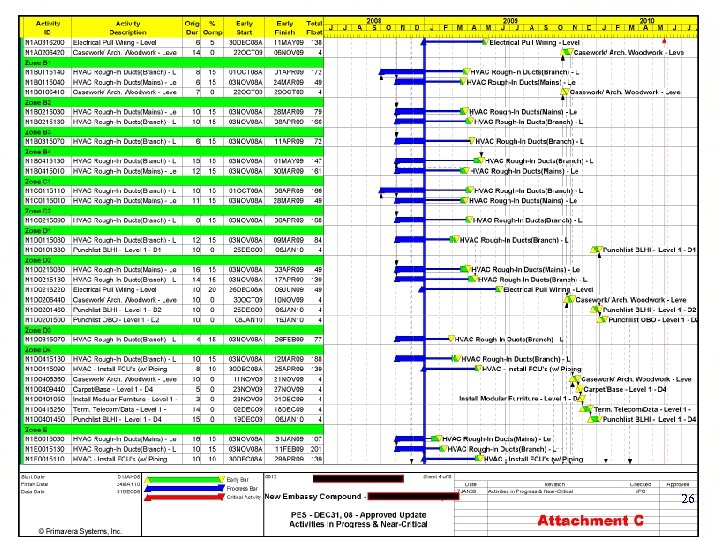
 Issue #3: Out-of-Sequence Work • Schedule does not reflect actual sequence – Disruptions – Delivery Delays – Resource Limitations / Availability – Change Orders – Changed Working Conditions • Inaccurate Schedule Projections – Immediate & Intermediate dates inaccurate – Limited credibility and usefulness 25
 26
26
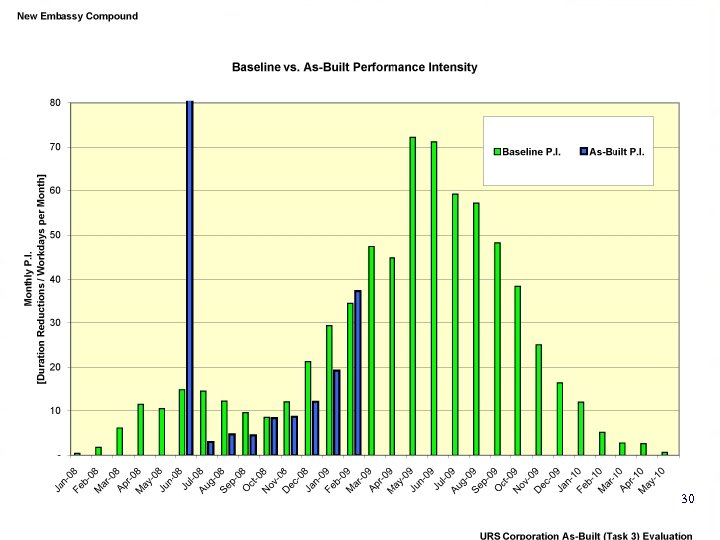
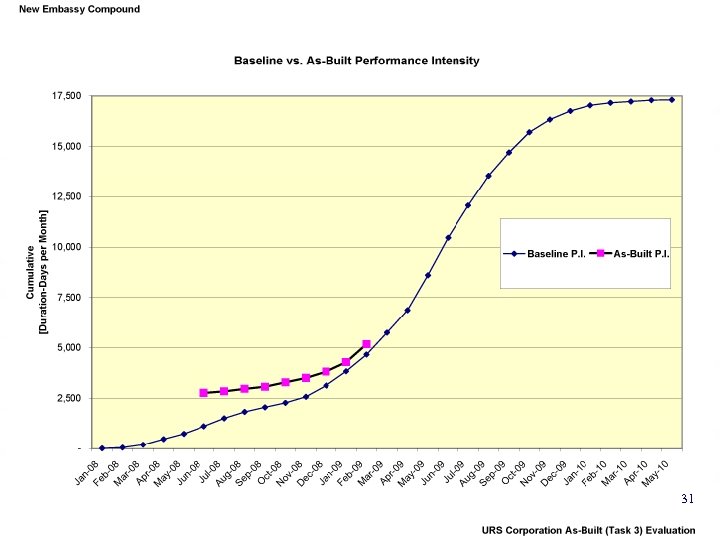
 Introduction to “Momentology” • A measurable rate of Performance Intensity – The Elusive “Miles-per-Hour” – Maintaining the emphasis of the Project Schedule on the time-related aspects of project management – Schedule performance measurement must reconcile the rate of work placement with that rate’s relationship to time-based goals • Earned Value does not accomplish this “The concept of the critical path was all-important to the Scheduler, while it was of dubious value or interest to the Project Manager. ” 27
 The “Duration-Day” • The Duration-Day = is the amount of work performance required to reduce a schedule’s remaining duration by one day. • Also known as a “Crew-Day” • Project Performance = Aggregate Duration-Days 28
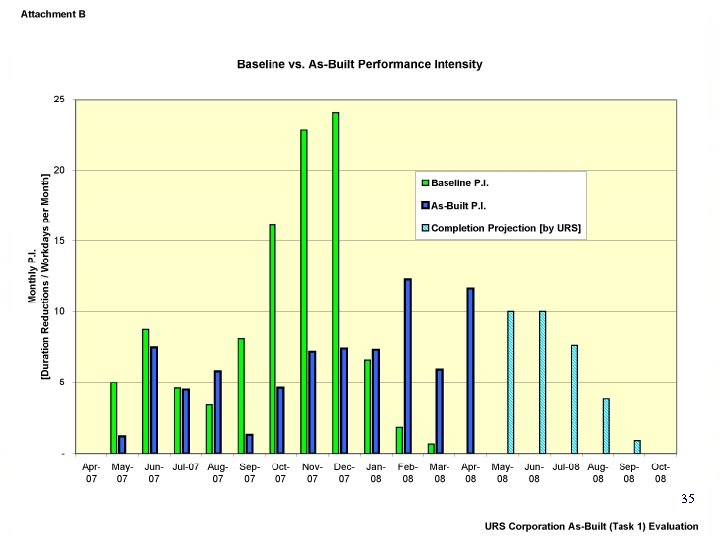
 Performance Intensity Work Performance / Time Consumption • Add all Original Duration-Days for all (typically construction) activities in the schedule • Divide by the number of workdays required for their performance This is the basic formula for Performance Intensity (P. I. ) 29
 30
30
 31
31
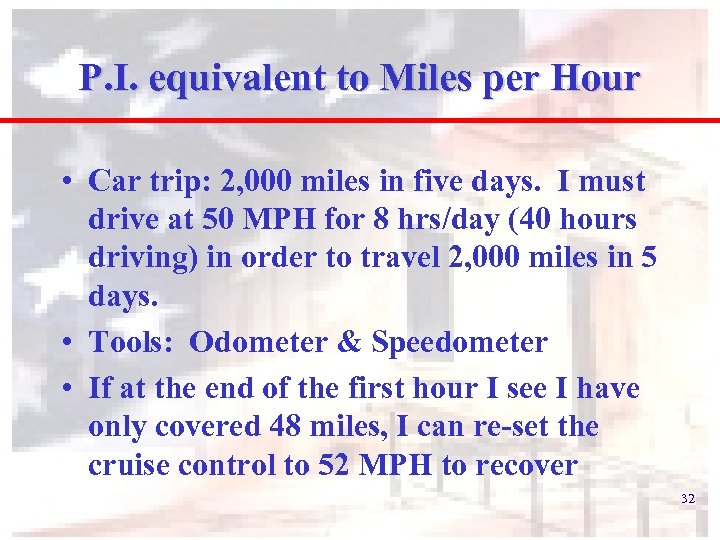 P. I. equivalent to Miles per Hour • Car trip: 2, 000 miles in five days. I must drive at 50 MPH for 8 hrs/day (40 hours driving) in order to travel 2, 000 miles in 5 days. • Tools: Odometer & Speedometer • If at the end of the first hour I see I have only covered 48 miles, I can re-set the cruise control to 52 MPH to recover 32
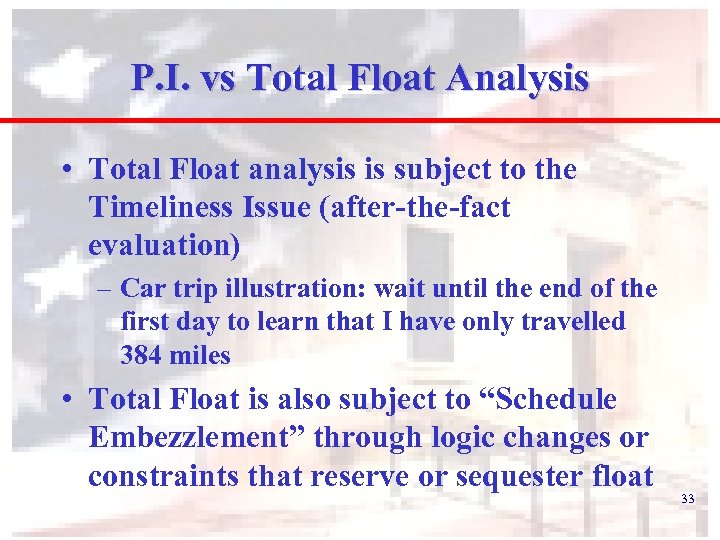 P. I. vs Total Float Analysis • Total Float analysis is subject to the Timeliness Issue (after-the-fact evaluation) – Car trip illustration: wait until the end of the first day to learn that I have only travelled 384 miles • Total Float is also subject to “Schedule Embezzlement” through logic changes or constraints that reserve or sequester float 33
 P. I. vs Earned Value • Earned Value is also subject to the Timeliness Issue • A resource-interpolation method, Earned Value is also performed after-the-fact. – Car trip illustration: wait for a gas fill-up in order to check gallons of fuel consumed against miles-per-gallon estimates 34
 35
35