


 Скачать презентацию Project R E A C H The
f0d98356266672ad8f108b28e96d9e5f.ppt
- Количество слайдов: 14
 “Project R. E. A. C. H. ” The Johns Hopkins Health System’s incumbent worker career acceleration program by Pamela Paulk Vice President for Human Resources The Johns Hopkins Hospital Johns Hopkins Health System Presentation to the National Association of State Workforce Board Chairs/NGA Washington, DC (February 26, 2006)
 Project REACH is sponsored by the: President’s High Growth Job Training Initiative U. S. Department of Labor Business Relations Group and Johns Hopkins Health System Baltimore, Maryland
 Project REACH • Resources and Education for the Advancement of Careers at Hopkins • 18 month grant with 12 month extension (June ’ 04 – Dec ’ 06) • $3 m of US Do. L funds, $3. 3 m JHHS match • Main focus – to take existing incumbent worker program to scale and create a replicable model
 Project REACH’s 5 training types 1. Retention and growth of at-risk workers 2. GED and diploma preparation program 3. Retraining of employees in declining jobs for emerging jobs 4. High-potential worker assessment and skills training program 5. Upgrade training of incumbent workers into critical skills shortage positions
 Project REACH’s key features • intensive individual assessments • 16 hours paid salary release time for participants in training • full-time Career Coaches • broad executive and supervisory support • organizational culture supports learning and promotion from within
 Training courses • Skills enhancement ) • Accelerated GED ) in-house and HCDI • Business skills training ) • Lab Tech 1 (Pathology) (MCAT) • Clinical Associate (Caroline Center) • Patient Service Coordinator 2 (MCAT) • Radiology Tech (CCBC-Essex) • Occupational Therapy Assistant (CCBCCatonsville) • Digital film clerk (in-house) (continued…. )
 Training courses – Ladders in Nursing Careers (B-CCC, CCBCEssex, Villa Julie, Harford County CC, Excelsior, Coppin State) – Respiratory Therapist (CCBC-Essex) – Medical Lab Technician (CCBC-Essex) – Medical Technologist (Weber State Utah, Univ. of Maryland at Baltimore) – Medical Coding (web-based, through MC Strategies and Univ. Alabama at Birmingham) – Customized Pharmacy Technician (with BCCC) – Customized Surgical Technician (with CCBC)
 Training courses • first “Anesthesiology Technology” course in MD (and only 3 rd in country) started with CCBC, to nationally accredited curriculum • estimated drop-out rate so far in all programs: 20/724 = 2. 8%
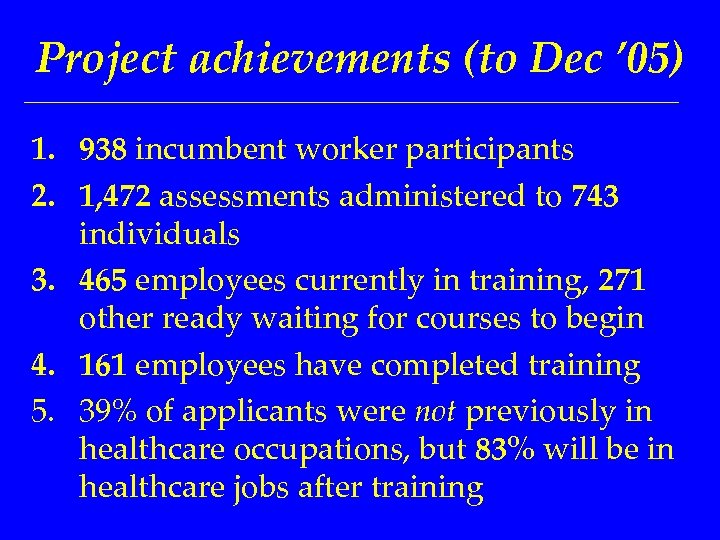 Project achievements (to Dec ’ 05) 1. 938 incumbent worker participants 2. 1, 472 assessments administered to 743 individuals 3. 465 employees currently in training, 271 other ready waiting for courses to begin 4. 161 employees have completed training 5. 39% of applicants were not previously in healthcare occupations, but 83% will be in healthcare jobs after training
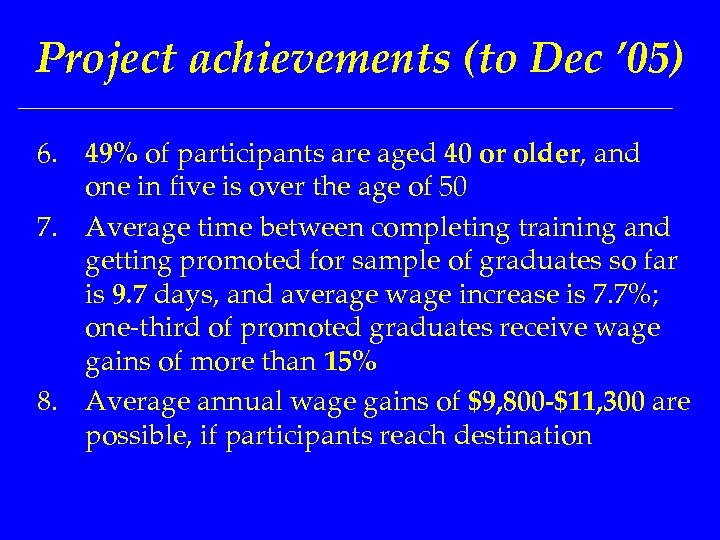 Project achievements (to Dec ’ 05) 6. 49% of participants are aged 40 or older, and one in five is over the age of 50 7. Average time between completing training and getting promoted for sample of graduates so far is 9. 7 days, and average wage increase is 7. 7%; one-third of promoted graduates receive wage gains of more than 15% 8. Average annual wage gains of $9, 800 -$11, 300 are possible, if participants reach destination
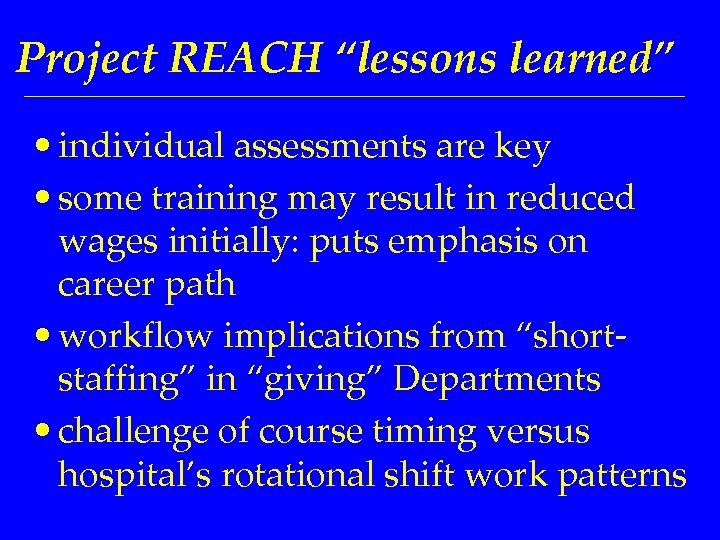 Project REACH “lessons learned” • individual assessments are key • some training may result in reduced wages initially: puts emphasis on career path • workflow implications from “shortstaffing” in “giving” Departments • challenge of course timing versus hospital’s rotational shift work patterns
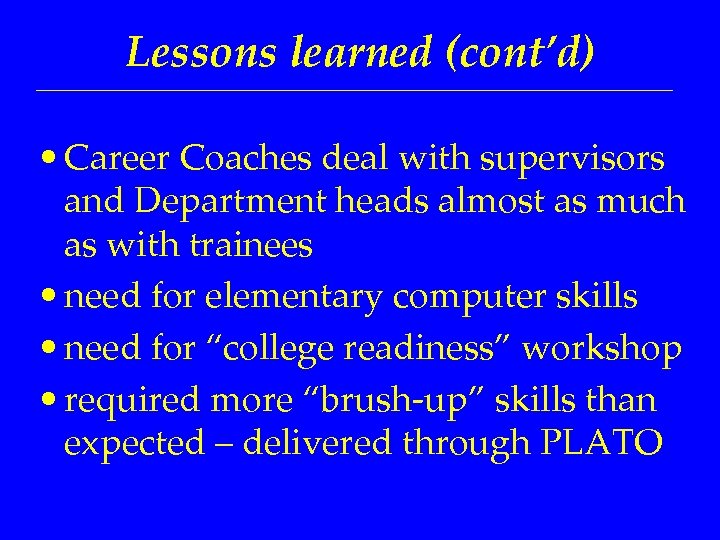 Lessons learned (cont’d) • Career Coaches deal with supervisors and Department heads almost as much as with trainees • need for elementary computer skills • need for “college readiness” workshop • required more “brush-up” skills than expected – delivered through PLATO
 Still to come on Project REACH… • more precise analysis of all-around costs • evaluation of Career Coach activities/impacts • relation of training outcomes to trainee characteristics, assessment scores, providers • more healthcareer ladder/lattice mapping • development of expansion/dissemination materials and vehicles
 Project REACH contact info: Yariela Kerr-Donovan Grant Manager, Project REACH Human Resources Department The Johns Hopkins Hospital 550 N. Broadway, Suite 401 Baltimore, MD 21205 Tel: 410/502 -2200 Fax: 410/502 -2964 E-mail: ykerrdo 1@jhmi. edu Website: www. hopkinsmedicine. org/jhhr/reach Chris Thompson Institute for Policy Studies Johns Hopkins University Wyman park Bldg, 5 th floor 3400 North Charles Baltimore, MD 21218 Tel: 410/516 -8740 Fax: 410/516 -8233 E-mail: chris. thompson@jhu. edu Gina King Business Relations Group U. S. Dept. of Labor Employment and Training Administration Frances Perkins Building 200 Constitution Ave. NW, Rm. N 4641 Washington DC, 20210 (202/693 -3949, businessrelations@dol. gov) (http: //www. doleta. gov/BRG/Job. Train. Initiati ve/)