


 Скачать презентацию Project Portfolio Management An Overview of Project Portfolio
10396de2d7779da592512e0eceae3a5d.ppt
- Количество слайдов: 57
 Project Portfolio Management An Overview of Project Portfolio Management presented by: Harvey A. Levine The Project Knowledge Group Copyright Harvey A. Levine, March 2006
 Project Portfolio Management n Project Portfolio Management (PPM) is NOT Project Management n Project Portfolio Management is a significant advance over traditional PM methods, (which focuses primarily on project execution).
 Project Portfolio Management n What are we trying to fix? n PPM addresses a common problem where scarce resources (money, people, facilities) are allocated to the wrong projects.
 Project Portfolio Management n What’s different? n PPM, therefore, goes beyond the art of "managing projects right" and focuses on "doing the right projects".
 Project Portfolio Management n The objective of PPM is to create the mix of projects most likely to support the achievement of the organization's goals, aligned with the preferred strategies, and within the organization's resource (people and funding) constraints.
 Project Portfolio Management n This presentation: n n Shows how PPM bridges the gap between the projects and operations sides of the enterprise Discusses organizational issues to place PPM at the hub of an integrated process. Reviews the components of the project selection and prioritization process. Discusses issues for managing the project portfolio and maintaining a portfolio aimed at realizing the maximum benefits.
 Project Portfolio Management n n n Project Portfolio Life Span (PPLS) consists of the following phased components: 1. Identification of needs and opportunities 2. Selection of best combinations of projects (the portfolios) 3. Planning and execution of the projects (project management) 4. Product launch (acceptance and use of deliverables) 5. Realization of benefits
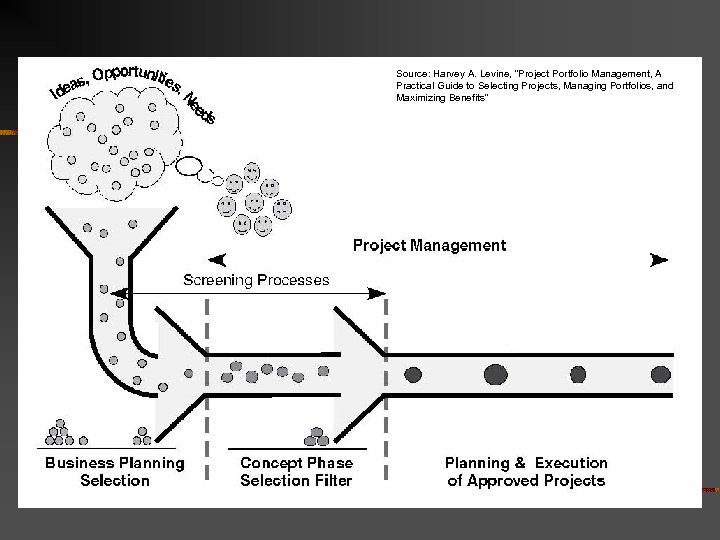 Source: Harvey A. Levine, “Project Portfolio Management, A Practical Guide to Selecting Projects, Managing Portfolios, and Maximizing Benefits”
 Project Portfolio Management Practices and Organizational Roles
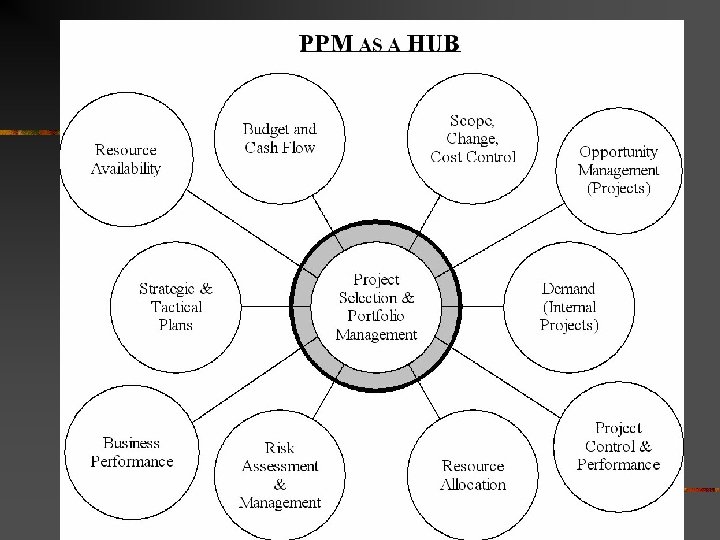
 Project Portfolio Management n Project Portfolio Management is a set of business practices that brings the world of projects into tight integration with other business operations. PPM brings projects into harmony with the strategies, resources, and executive oversight of the enterprise. PPM provides the structure and processes for project portfolio governance.
 Project Portfolio Management n Organizing n Bridges for PPM the Gap between Projects Management and Operations Management
 Project Portfolio Management n Organizing n for PPM Bridges the Gap between Projects Management and Operations Management n Project Management: Schedule/Time, Project Cost, Performance, Stakeholder Satisfaction, Scope/Change Control
 Project Portfolio Management n Organizing n for PPM Bridges the Gap between Projects Management and Operations Management n Operations Management: Objectives, Goals, Strategies, Project Selection & Mix, Cash Flow, ROI
 Project Portfolio Management n Organizing n for PPM Bridges the Gap between Projects Management and Operations Management PM: Schedule/Time, Project Cost, Performance, Stakeholder Satisfaction, Scope/Change Control n OP: Objectives, Goals, Strategies, Project Selection & Mix, Cash Flow, ROI n Different people, different goals, different rewards, different languages n
 Project Portfolio Management n Organizing for PPM n Key involved parties (in addition to the PMO) are senior managers or their designees n May include CEO, COO, CFO, CIO, Strategic Planners, VP-Operations, etc. n The Challenge: How do we get these different disciplines involved and on the same track? n And … How do we communicate with them?
 Project Portfolio Management n Organizing for PPM n Calls for establishment of a PPM Governance Council, with representatives of aforementioned management areas. n Governance Council works in conjunction with (and is supported by) the Project Management Office (PMO). n Decisions (project selection & de-selection) are made by the Governance Council
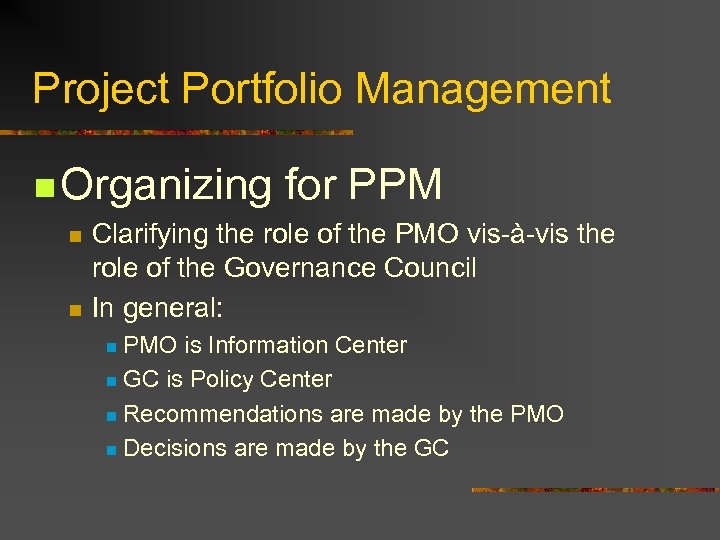 Project Portfolio Management n Organizing n n for PPM Clarifying the role of the PMO vis-à-vis the role of the Governance Council In general: PMO is Information Center n GC is Policy Center n Recommendations are made by the PMO n Decisions are made by the GC n
 Project Portfolio Management The Major Functions of Project Portfolio Management
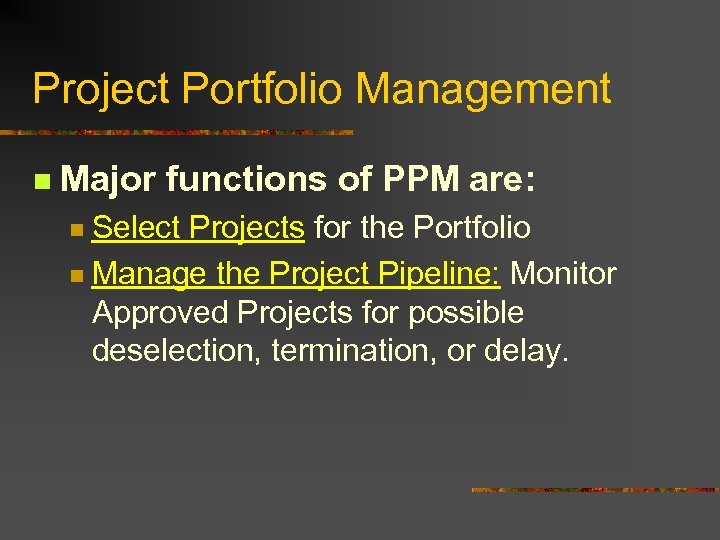 Project Portfolio Management n Major functions of PPM are: Select Projects for the Portfolio n Manage the Project Pipeline: Monitor Approved Projects for possible deselection, termination, or delay. n
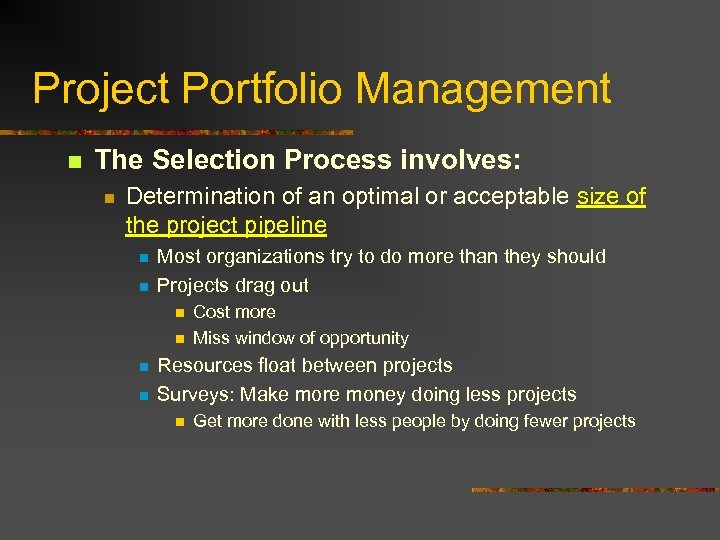 Project Portfolio Management n The Selection Process involves: n Determination of an optimal or acceptable size of the project pipeline n n Most organizations try to do more than they should Projects drag out n n Cost more Miss window of opportunity Resources float between projects Surveys: Make more money doing less projects n Get more done with less people by doing fewer projects
 Project Portfolio Management n The Selection Process involves: n Ranking potential projects by value & benefits Financial Models n Alignment with strategies n Risk/Reward n Various scoring models n Check Lists n
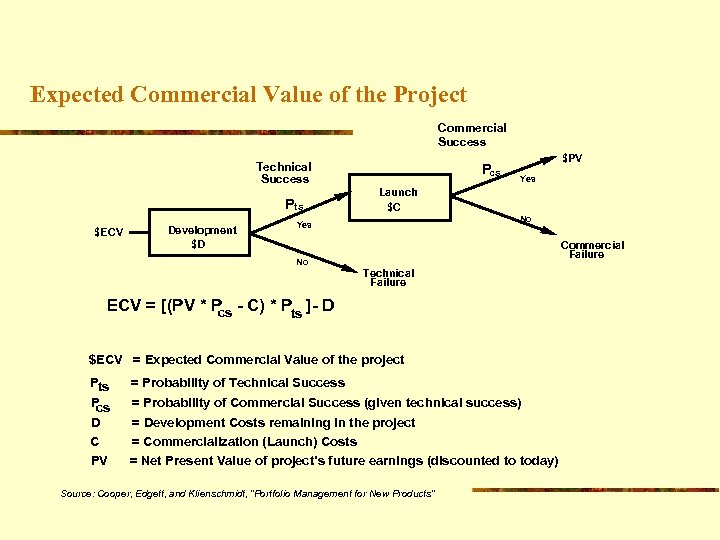 Expected Commercial Value of the Project Commercial Success Technical Success Pts $ECV Development $D Pcs $PV Yes Launch $C No Yes Commercial Failure No Technical Failure ECV = [(PV * P - C) * Pts ]- D cs $ECV = Expected Commercial Value of the project Pts P cs = Probability of Technical Success D C PV = Development Costs remaining in the project = Commercialization (Launch) Costs = Net Present Value of project’s future earnings (discounted to today) = Probability of Commercial Success (given technical success) Source: Cooper, Edgett, and Klienschmidt, “Portfolio Management for New Products”
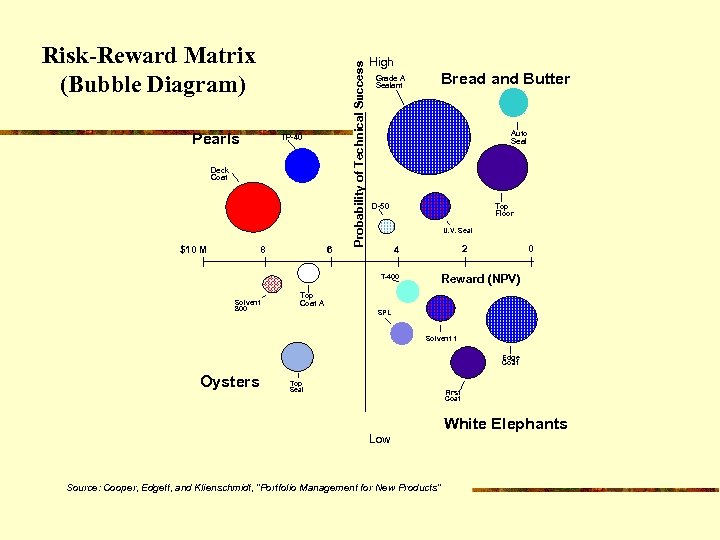 Pearls TP-40 Deck Coat $10 M 8 6 Probability of Technical Success Risk-Reward Matrix (Bubble Diagram) High Bread and Butter Grade A Sealant Auto Seal D-50 Top Floor U. V. Seal 2 4 Reward (NPV) T-400 Solvent 800 0 Top Coat A SPL Solvent 1 Edge Coat Oysters Top Seal First Coat Low Source: Cooper, Edgett, and Klienschmidt, “Portfolio Management for New Products” White Elephants
 Project Portfolio Management n The Selection Process involves: n Appraisal of risk n Risk Assessment is a major component of the selection process n Risk Identification
 Project Portfolio Management n The Selection Process involves: n Appraisal of risk n Risk Identification n Potential for Risk
 Project Portfolio Management n The Selection Process involves: n Appraisal of risk n Risk Identification n Potential for Risk n Impact of Risk
 Project Portfolio Management n The Selection Process involves: n Appraisal of risk n Risk Identification n Potential for Risk n Impact of Risk n Risk Mitigation Options
 Project Portfolio Management n The Selection Process involves: n Appraisal of risk n Risk Assessment is a major component of the selection process n n n Risk Identification Potential for Risk Impact of Risk Mitigation Options This is NOT Monte Carlo type process
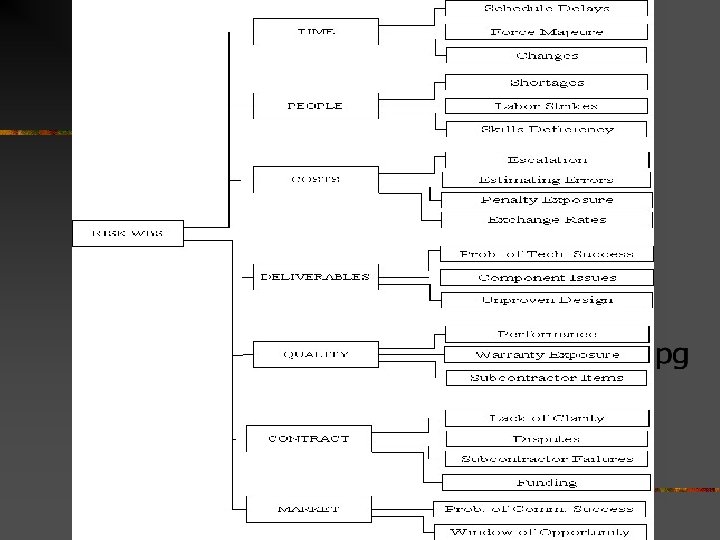
 Project Portfolio Management n The Selection Process involves: n Identification of risk n Using a WBS for Risk n n A checklist An organizer
 Project Portfolio Management n The Selection Process involves: n Inventory of resource availability and allocation This is a carryover from traditional PM capabilities n With a couple of complications: n
 Project Portfolio Management n The Selection Process involves: n Inventory of resource availability and allocation n Availability: n In-house n Supplemental
 Project Portfolio Management n The Selection Process involves: n Inventory of resource availability and allocation Availability: n In-house n Supplemental n Allocation n Committed Resources n Softbooking n
 Project Portfolio Management n The Selection Process involves: n Inventory of resource availability and allocation n Availability: n In-house n Supplemental Allocation n Committed Resources n Softbooking Your software must support this expanded resource planning
 Project Portfolio Management n The Selection Process involves: n Alignment of projects with strategic plans The Strategic Plan sets the parameters for project selection n Identifies areas of Needs and Opportunities n Sets ranges for resources, budgets, etc. n Identifies Objectives and Initiatives n Sets a Risk posture n All of these impact on project prioritization and selection n
 Project Portfolio Management n The Selection Process involves: n Alignment of projects with strategic plans Build a WBS for strategies n Create program buckets n Size the buckets n Link Projects to Program/Strategic Buckets n

 Project Portfolio Management n The Selection Process involves: n Balancing: Balancing different types of projects by purpose and benefit n Balancing opportunity, benefits and risk n
 Project Portfolio Management n The Selection Process involves: n Balancing different types of projects by purpose and benefit Maintenance & Utility Projects n Growth & Enhancement Projects n Transformation Projects n
 Project Portfolio Management n Example of three portfolios n Maintenance & Utility Projects (30%) Incl. mandated projects – needed to stay in business n May not exhibit best benefit/risk numbers, but must do anyway n Usually lowest risk n
 Project Portfolio Management n Example of three portfolios n Growth & Enhancement Projects (60%) New products & capabilities, consistent with current business focus n Main portion of portfolio, requiring greatest attention n Medium risk n
 Project Portfolio Management n Example of three portfolios n Transformation Projects (10%) New product or service line (expanded or new market) n Breaking new ground n High risk n Monumental reward if successful n Generally not more than 10% of the resources n
 Project Portfolio Management n The Selection Process involves: n n n n Ranking potential projects by value & benefits Appraisal of risk Inventory of resource availability and allocation Determination of an optimal or acceptable size of the project pipeline Alignment of projects with strategic plans Balancing different types of projects by purpose and benefit Balancing opportunity, benefits and risk
 Project Portfolio Management n The process of Managing the Pipeline involves: n Periodic measurement of project status and performance [how are we doin’? ] Schedule n Cost n Resources n Scope n
 Project Portfolio Management n The process of Managing the Pipeline involves: n Evaluation of project status and performance against critical parameters [is this OK? ] Earned Value Analysis n Milestone Analysis n Dashboard Charts n n Set Criteria Set Tolerances Display Green/Yellow/Red
 Project Portfolio Management n The process of Managing the Pipeline involves: n Reporting items outside of targets/limits/thresholds [what’s not OK? ] What’s not OK? n What are the consequences? n What can we do about it? n Who’s going to do it? n
 Project Portfolio Management n The process of Managing the Pipeline involves: n Applying stage gate techniques for continuation or termination decisions [phased approvals] n Set milestones (phases) n Set criteria for milestones n Test against criteria n Make Go/No Go decisions
 Project Portfolio Management n The process of Managing the Pipeline involves: n Applying stage gate techniques for continuation or termination decisions [phased approvals] n n n Set milestones (phases) Set criteria for milestones Test against criteria Make Go/No Go decisions It’s OK to terminate a project *** Cultural Change ***
 Project Portfolio Management n The process of Managing the Pipeline involves: n n Applying stage gate techniques for continuation or termination decisions [phased approvals] It’s OK to terminate (or delay) a project n n Money down the drain Missed window of opportunity Better use of resources No longer aligned with strategies
 Project Portfolio Management n PPM n n n Requires integration of: Project Management, Operations Management, Financial Management, and Marketing Project Management and Strategic Planning Benefits Analysis, Risk Analysis and all above items
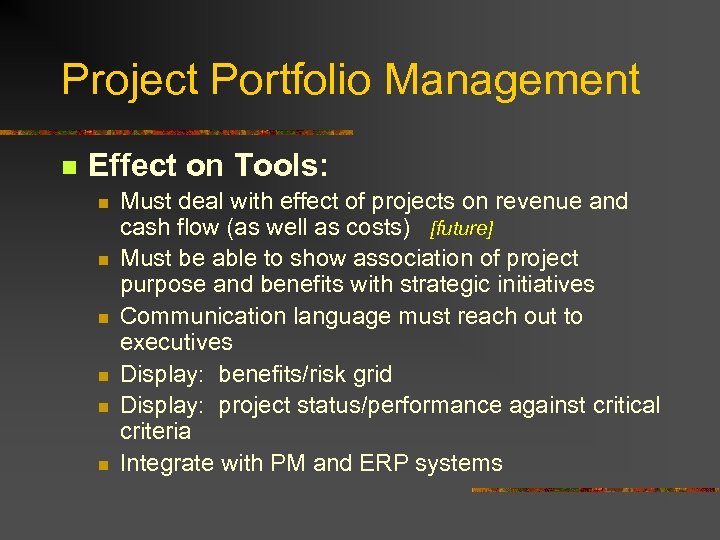 Project Portfolio Management n Effect on Tools: n n n Must deal with effect of projects on revenue and cash flow (as well as costs) [future] Must be able to show association of project purpose and benefits with strategic initiatives Communication language must reach out to executives Display: benefits/risk grid Display: project status/performance against critical criteria Integrate with PM and ERP systems
 Project Portfolio Management A Review of the Organizational Roles in PPM: The PMO and the Governance Council
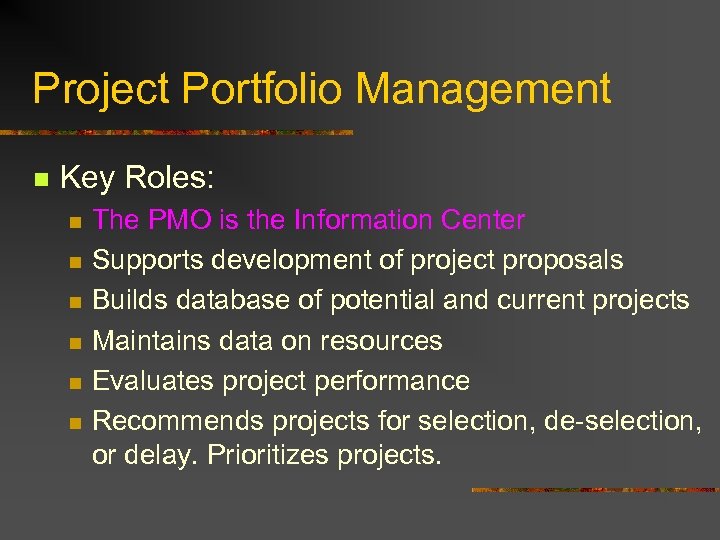 Project Portfolio Management n Key Roles: n n n The PMO is the Information Center Supports development of project proposals Builds database of potential and current projects Maintains data on resources Evaluates project performance Recommends projects for selection, de-selection, or delay. Prioritizes projects.
 Project Portfolio Management n Key Roles: n n n The Governance Council is the policy center Reviews and probes data and recommendations Interprets strategic plans and initiatives Provides enterprise budget and resource parameters Responsible for the final selection decisions
 Project Portfolio Management n n n The PMO and the GC collectively execute the practices of PPM. The specific degree of responsibility sharing within these two groups is negotiable. The GC can be an active leader in the process, or “rubber-stamp” the recommendations of the PMO.
 Project Portfolio Management halevine@earthlink. net n http: //home. earthlink. net/~halevine/ n I’ll take your questions now