


 Скачать презентацию Project Planning Economic Evaluation José Onofre Montesa Andrés
a5b6e14358539854990d709ecff17bdf.ppt
- Количество слайдов: 30
 Project Planning: Economic Evaluation. José Onofre Montesa Andrés Universidad Politécnica de Valencia Escuela Superior de Informática Aplicada 2003 -2004 Gpi. I-2 F Project Planning: Economic Evaluation.
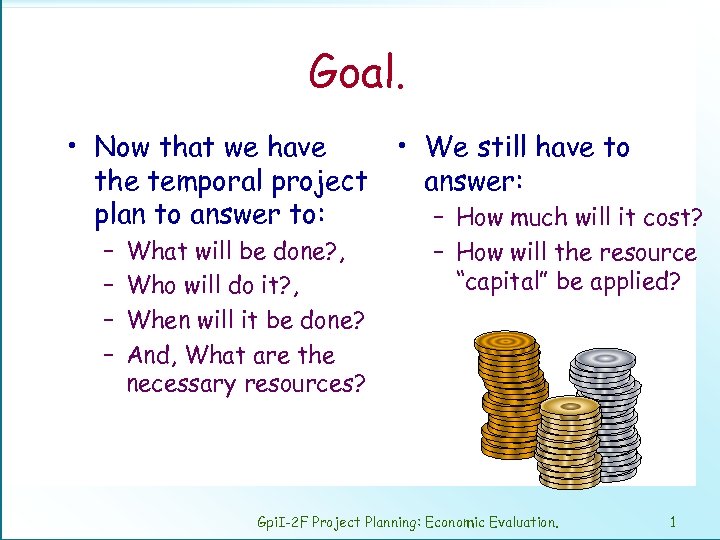 Goal. • Now that we have the temporal project plan to answer to: – – What will be done? , Who will do it? , When will it be done? And, What are the necessary resources? • We still have to answer: – How much will it cost? – How will the resource “capital” be applied? Gpi. I-2 F Project Planning: Economic Evaluation. 1
 Why? • Money is important in the enterprise world. • Our projects live in this context. • Enterprises have a lot of projects, and the cost is an important criteria. Gpi. I-2 F Project Planning: Economic Evaluation. 2
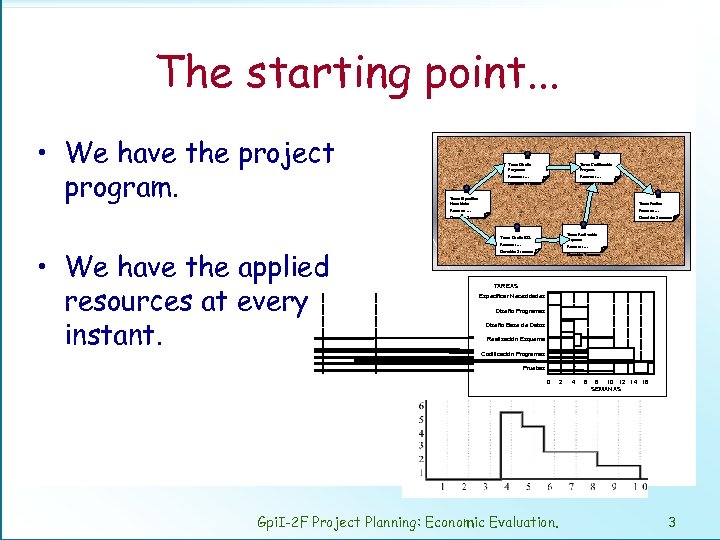 The starting point. . . • We have the project program. Tarea: Diseño Programas Tarea: Codificación Program. Recursos: … Duración: 4 semanas Duración: 7 semanas Tarea: Especifica Necesidades Tarea: Pruebas Recursos: … Duración: 2 semanas Tarea: Realización Esquema Tarea: Diseño B. D. • We have the applied resources at every instant. Recursos: … Duración: 2 semanas Duración: 1 semanas TAREAS Especificar Necesidades Diseño Programas Diseño Base de Datos Realización Esquema Codificación Programas Pruebas 0 2 Gpi. I-2 F Project Planning: Economic Evaluation. 4 6 8 10 12 14 16 SEMANAS 3
 Steps when creating the economical study. • Cash-flow calculation: – – Unitary valuation of each resource, Calculating the payment flow, Calculating the income flow, Obtaining the cash-flow. • Financial study: – Total volume of found to assign, – Cash-flow present value. Gpi. I-2 F Project Planning: Economic Evaluation. 4
 The costs from the project point of view. • Directs: – The ones that can be clearly assigned to the project. For instance: • Worked hours, consumed office materials. . . • Indirects: – It’s not easy to evaluate the added value to the project, they are usually fixed in the enterprise. For instance: • Electricity, telephone. . . Gpi. I-2 F Project Planning: Economic Evaluation. 5
 Unitary cost valuation of every resource. • It must be applied all the project cost. • Direct cost are easier to assign. • Indirect cost are assigned as weigh up of direct cost. • In this way we have an assigned cost of developers and not only they direct cost. Gpi. I-2 F Project Planning: Economic Evaluation. 6
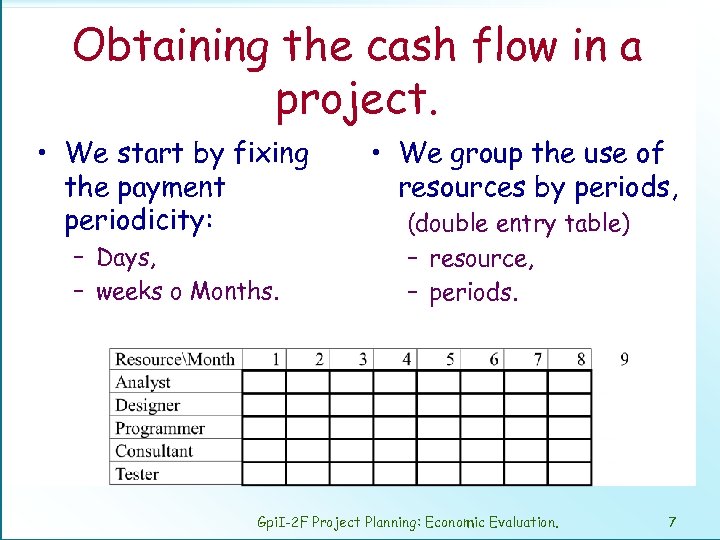 Obtaining the cash flow in a project. • We start by fixing the payment periodicity: – Days, – weeks o Months. • We group the use of resources by periods, (double entry table) – resource, – periods. Gpi. I-2 F Project Planning: Economic Evaluation. 7
 Calculating the payment flow. • Sequence the project payment: – Per resource consumption. – Per each period. Project Gpi. I-2 F Project Planning: Economic Evaluation. 8
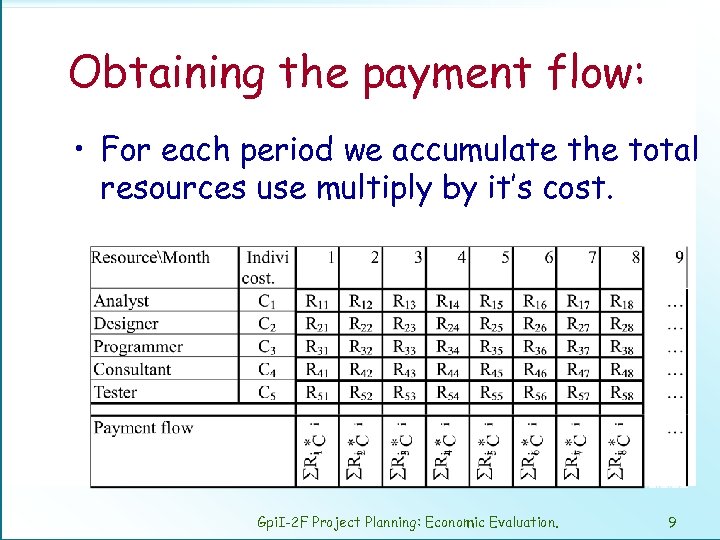 Obtaining the payment flow: • For each period we accumulate the total resources use multiply by it’s cost. Gpi. I-2 F Project Planning: Economic Evaluation. 9
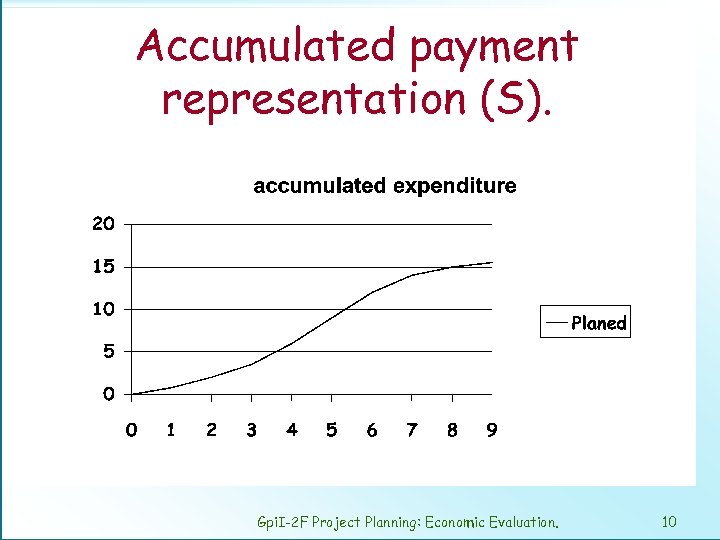 Accumulated payment representation (S). Gpi. I-2 F Project Planning: Economic Evaluation. 10
 Calculating the income flow. • Set of received incomes by the project development enterprise. Project Gpi. I-2 F Project Planning: Economic Evaluation. 11
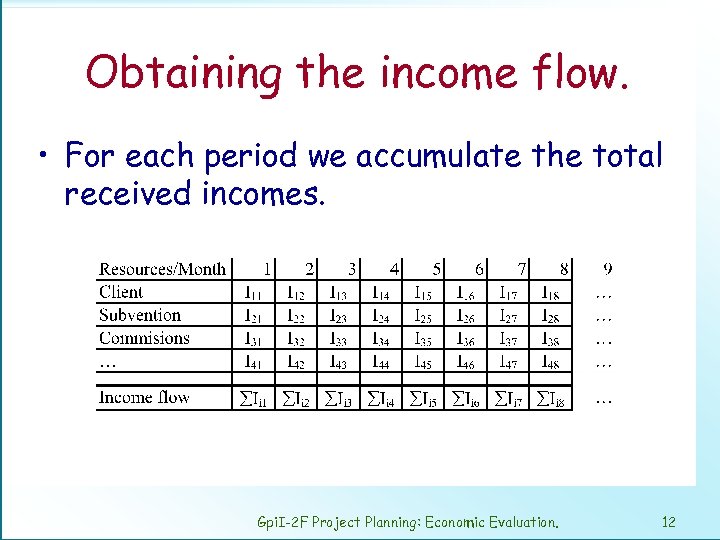 Obtaining the income flow. • For each period we accumulate the total received incomes. Gpi. I-2 F Project Planning: Economic Evaluation. 12
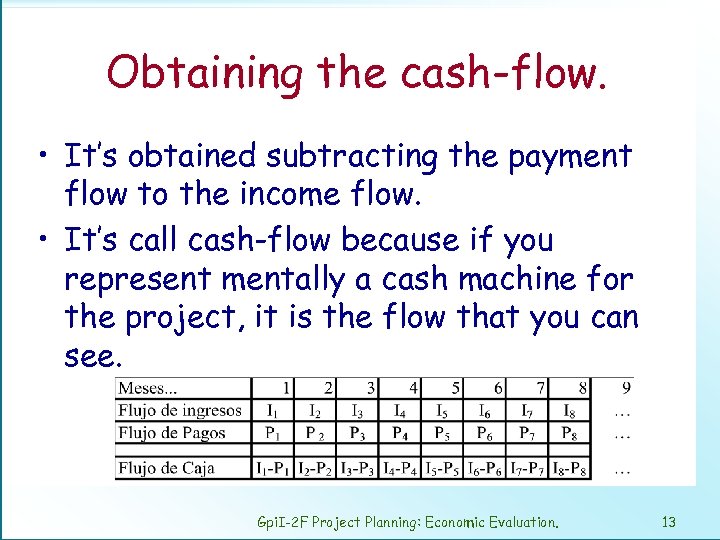 Obtaining the cash-flow. • It’s obtained subtracting the payment flow to the income flow. • It’s call cash-flow because if you represent mentally a cash machine for the project, it is the flow that you can see. Gpi. I-2 F Project Planning: Economic Evaluation. 13
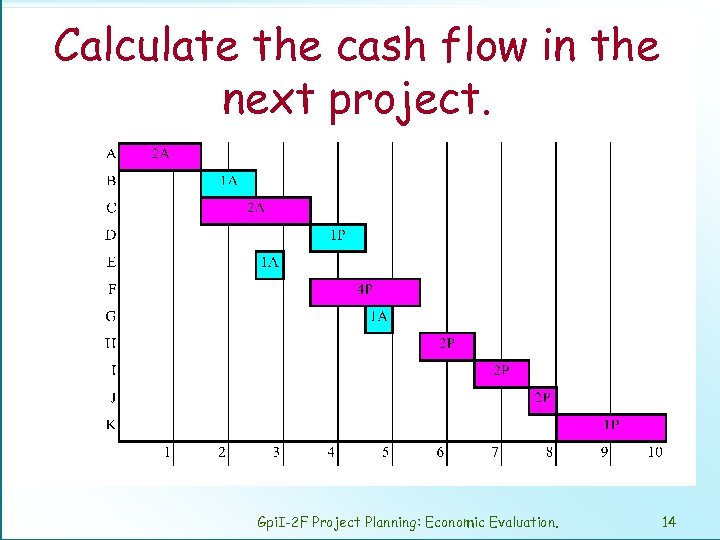 Calculate the cash flow in the next project. Gpi. I-2 F Project Planning: Economic Evaluation. 14
 Taking into account: • Analysts costs is: – 400 Euros period. • Programmers cost is: – 200 Euros period. • The developer enterprise will receive 10. 000 Euros at the end of task J. Gpi. I-2 F Project Planning: Economic Evaluation. 15
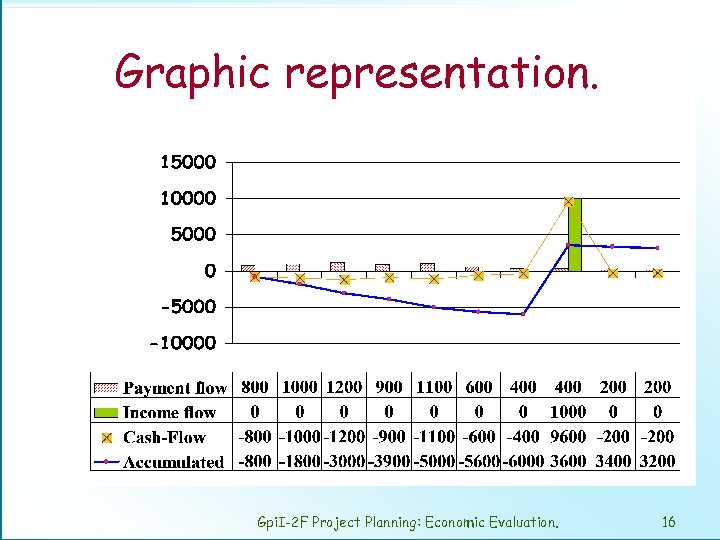 Graphic representation. Gpi. I-2 F Project Planning: Economic Evaluation. 16
 Financial study : • Money isn’t easy to get in the enterprise, • It’s always compared with the opportunity cost. • This leads us to have to observe the project from two points of view: – Total volume of funds to assign, – Updated cash flow. Gpi. I-2 F Project Planning: Economic Evaluation. 17
 Total volume of funds to assign. • All projects are taken into account in the financial activity of the enterprise: – They are capital expense, return and – some needs in order to afford the payments. • We must show the foreseen payments to be inserted in the enterprise reality. Gpi. I-2 F Project Planning: Economic Evaluation. 18
 Total volume of funds to assign, Example: • We have a clear business, – We must paid 20. 000 euros each week during one year, – We will obtain 4. 000 euros at the end of the year, – There are no risk. • The business seems clear to everyone. • Do you think that it’s possible? – It´s hard to achieve Gpi. I-2 F Project Planning: Economic Evaluation. 19
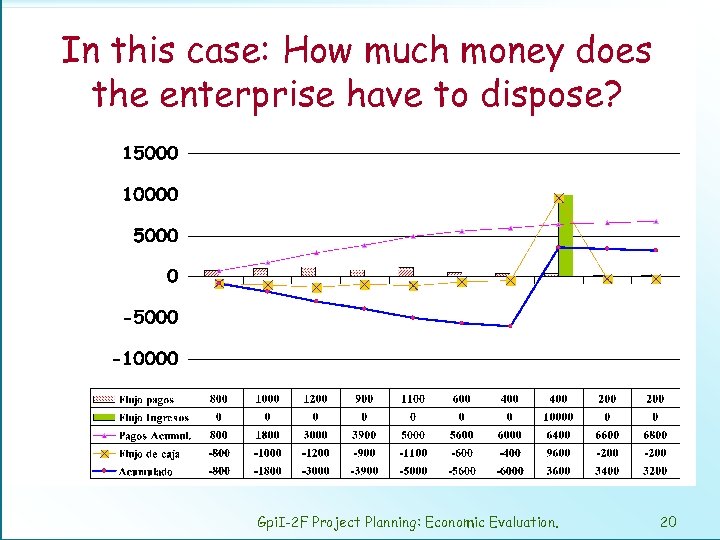 In this case: How much money does the enterprise have to dispose? Gpi. I-2 F Project Planning: Economic Evaluation. 20
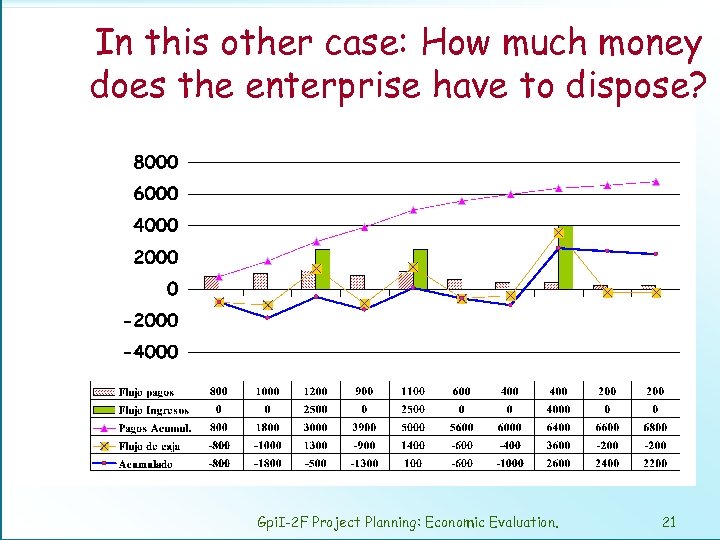 In this other case: How much money does the enterprise have to dispose? Gpi. I-2 F Project Planning: Economic Evaluation. 21
 We will do the same job, but, which is the best option? • How much capital can we use in order to afford the project? • Are euros equals: in one month and the next? • What about the risk? Gpi. I-2 F Project Planning: Economic Evaluation. 22
 Updated cash flow. • In order to compare the profitability all the projects need to have the same conditions. • Several methods are used: – Net Present Value: NPV – Return On Investment: ROI – Internal Rate of Return: IRR • We will use the NPV. Gpi. I-2 F Project Planning: Economic Evaluation. 23
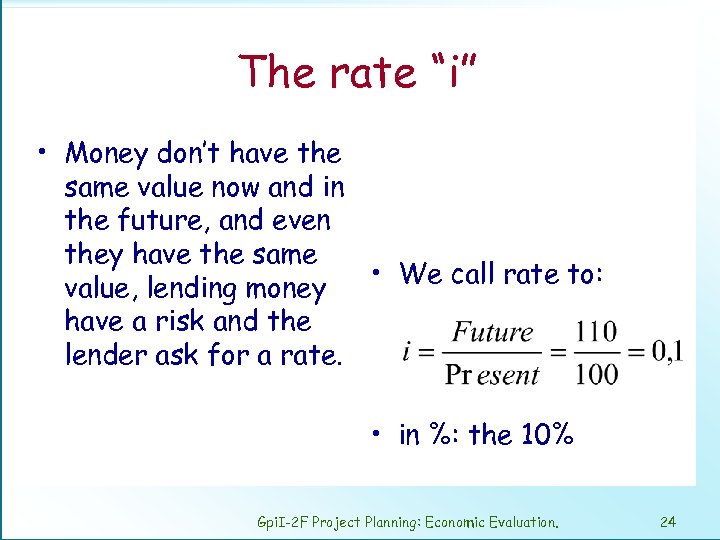 The rate “i” • Money don’t have the same value now and in the future, and even they have the same • We call rate to: value, lending money have a risk and the lender ask for a rate. • in %: the 10% Gpi. I-2 F Project Planning: Economic Evaluation. 24
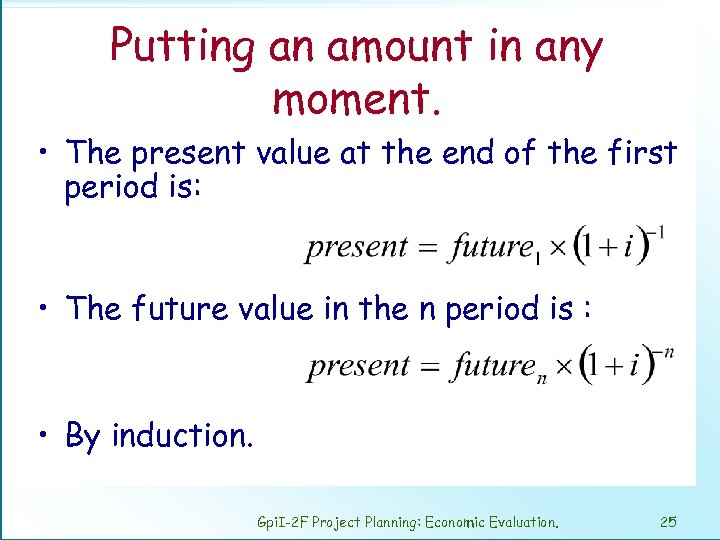 Putting an amount in any moment. • The present value at the end of the first period is: • The future value in the n period is : • By induction. Gpi. I-2 F Project Planning: Economic Evaluation. 25
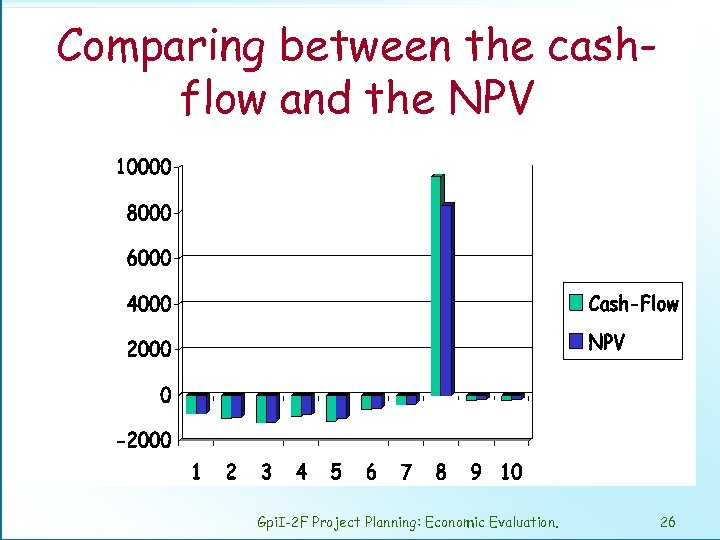 Comparing between the cashflow and the NPV Gpi. I-2 F Project Planning: Economic Evaluation. 26
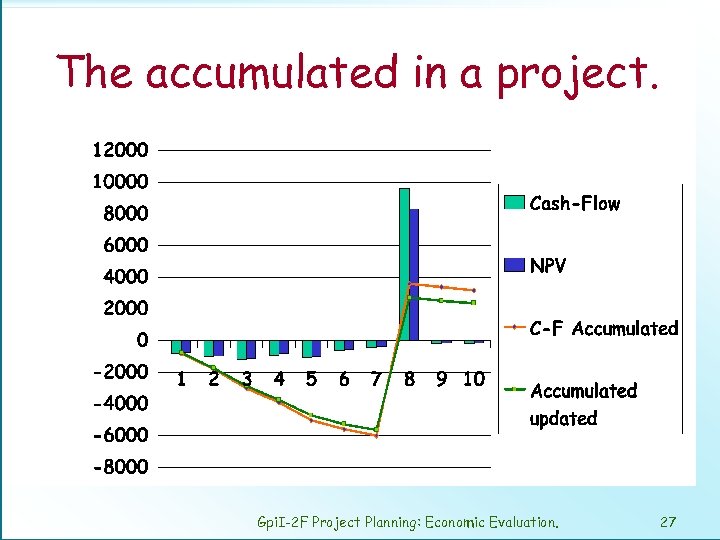 The accumulated in a project. Gpi. I-2 F Project Planning: Economic Evaluation. 27
 The effects of delays in a project • Supposing there is a delay in the project: – How does it affect the cash-flow? – How does it affect to the updated cashflow? – How does it affect the updated accumulated cash-flow? Gpi. I-2 F Project Planning: Economic Evaluation. 28
 Bibliography • Romero, C. Tecnicas de Gestión de Empresas. CEPADE / Mundi. Prensa, 1993. (Capítulo 2: Evaluzación financiera de proyectos de inversión). • De. Marco, Tom. Controlling Software Projects. Prentice Hall, 1982. • Page-Jones, Meilir. Practical Project Management, Dorset House, 1985. • Shtub, A. , Bard, J. F. , Globerson, S. , PROJECT MANAGEMENT, Engineering, Technology and Implementation, Prentice Hall International, 1994. (Capítulos 2 y 3: Engineering Economic Analysis; Project Screening and Selectión) • Uriegas Torres, Carlos. Análisis Económico de Sistemas en la Ingeniería, Limusa, 1987 Gpi. I-2 F Project Planning: Economic Evaluation. 29