


 Скачать презентацию Project Planning and Control Main issues How
0e274b53ce141026eb66f1dcd5597d72.ppt
- Количество слайдов: 19
 Project Planning and Control Main issues: § How to plan a project? § How to control it?
 System’s view of project control § Irregular variables: cannot be controlled (e. g. experience of the user) § Goal variables: things one wants to achieve (e. g. minimize downtime, lowest cost) § Control variables: things that can be varied (e. g. project staffing, tools to be used) § Distribution of variables over categories is not rigid (staffing may be irregular, cost can be a control variable, etc) § You have to know the category of each variable SE, Cost planning and control, Hans van Vliet, © 2008 2
 System’s view of project control, conditions § Goals of the system are known § Sufficient control variety § Information on state, input and output of the system § Conceptual control model: knowledge of how and extent to which variables depend on and influence each other SE, Cost planning and control, Hans van Vliet, © 2008 3
 Classes of project characteristics § Product, process, and resource characteristics § Interested in degree of certainty § Product certainty: § Clear requirements, known upfront: product certainty is high § User requirements change frequently: product certainty is low § Process certainty: § E. g. , much knowledge about effect of control actions: high § E. g. , use of unknown tools: low § Resource certainty: § Depends on availability of appropriately qualified personnel SE, Cost planning and control, Hans van Vliet, © 2008 4
 Archetypical control situations § Realization problem: all certainties are high § Ideal situation, just make sure work gets done § Allocation problem: resource certainty low, others high § Major issue: controlling capacity § Design problem: product certainty high, others low § How to design the project (milestones, personnel, assign responsibilities, etc) § Exploration problem: all certainties low § Major issue: get commitment of all people involved SE, Cost planning and control, Hans van Vliet, © 2008 5
 Control situation: realization § Primary goal in control: § Optimize resource usage, efficiency and schedule § Coordination/management style: § Standardization, hierarchy, separation style § Development strategy: § Waterfall § Cost estimation: § Models, guard process SE, Cost planning and control, Hans van Vliet, © 2008 6
 Control situation: allocation § Primary goal in control: § Acquisition, training personnel § Coordination/management style: § Standardization of product and process § Development strategy: § Waterfall § Cost estimation: § Models, sensitivity analysis SE, Cost planning and control, Hans van Vliet, © 2008 7
 Control situation: design § Primary goal in control: § Control of process § Coordination/management style: § Standardization of process § Development strategy: § Incremental § Cost estimation: § Expert, sensitivity analysis SE, Cost planning and control, Hans van Vliet, © 2008 8
 Control situation: exploration § Primary goal in control: § Maximize results, lower risks § Coordination/management style: § Mutual adjustment, commitment, relation style § Development strategy: § Incremental, prototyping, agile § Cost estimation: § Agile, risk analysis, provide guidance SE, Cost planning and control, Hans van Vliet, © 2008 9
 Risk management § Risk management is project management for adults § In software development, we tend to ignore risks: § We’ll solve the problem on time § Requirements will be stable § No one will leave the project §… SE, Cost planning and control, Hans van Vliet, © 2008 10
 Top ten risk factors § Personnel shortfall § Unrealistic schedule/budget § Wrong functionality § Wrong user interface § Goldplating § Requirements volatility § Bad external components § Bad external tasks § Real-time shortfalls § Capability shortfalls SE, Cost planning and control, Hans van Vliet, © 2008 11
 Risk management strategy 1. Identify risk factors 2. Determine risk exposure (probability * effect) 3. Develop strategies to mitigate risks § Avoid, transfer, or accept 4. Handle risks SE, Cost planning and control, Hans van Vliet, © 2008 12
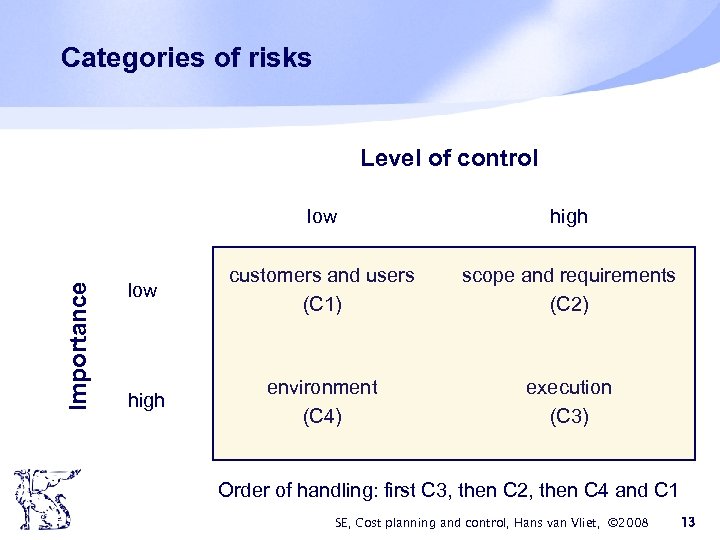 Categories of risks Level of control Importance low high low customers and users (C 1) scope and requirements (C 2) high environment (C 4) execution (C 3) Order of handling: first C 3, then C 2, then C 4 and C 1 SE, Cost planning and control, Hans van Vliet, © 2008 13
 Techniques for project planning and control § Work breakdown structure (WBS) § PERT chart § Gantt chart § Agile planning and control SE, Cost planning and control, Hans van Vliet, © 2008 14
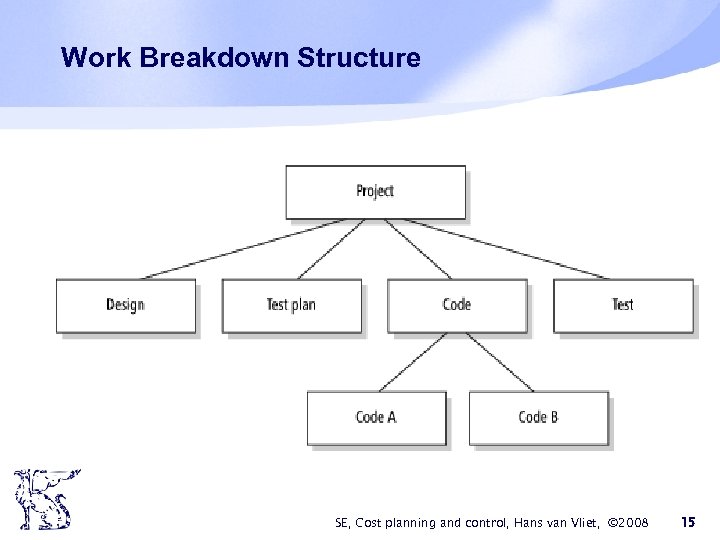 Work Breakdown Structure SE, Cost planning and control, Hans van Vliet, © 2008 15
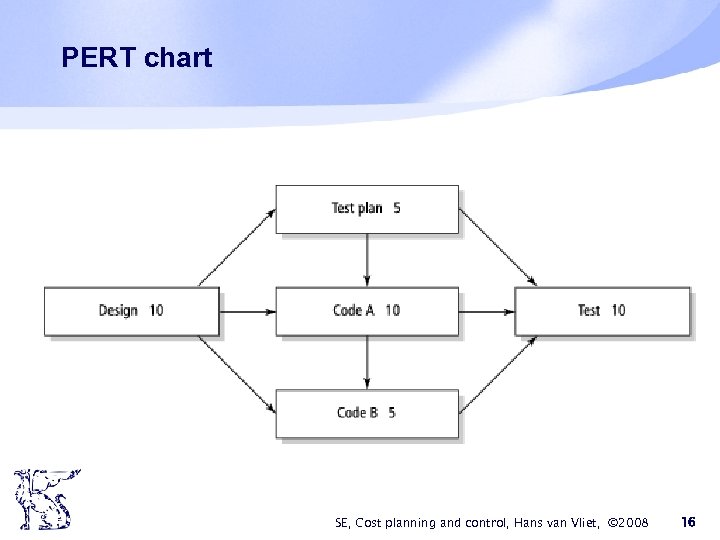 PERT chart SE, Cost planning and control, Hans van Vliet, © 2008 16
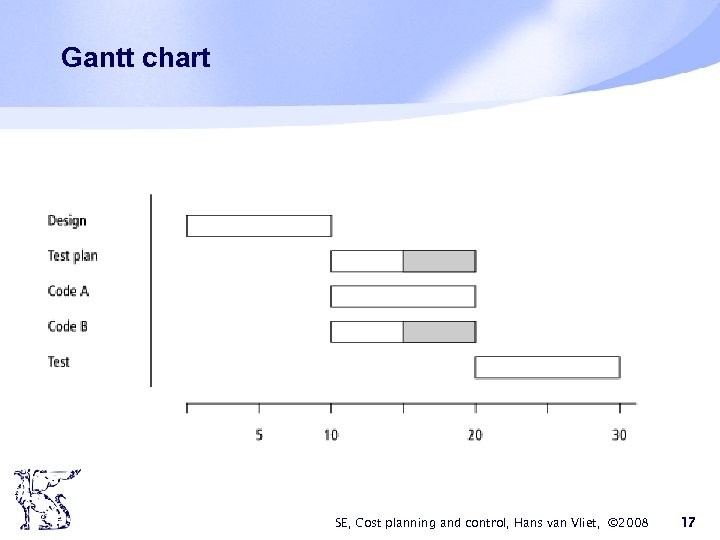 Gantt chart SE, Cost planning and control, Hans van Vliet, © 2008 17
 Why task-oriented planning is problematic § Activities never finish early § Parkinson’s law: work fills the time available § Lateness is passed down the schedule § If either design or coding is late, subsequent testing will be late § Tasks are not independent § If design takes more time, so will implementation SE, Cost planning and control, Hans van Vliet, © 2008 18
 Agile planning factors § Estimate value of features § e. g. the Mo. SCo. W way § Cost of implementing features § Cost of doing it now versus cost of doing it later § New knowledge acquired § First do features that bring a lot of new knowledge § Risk removed by implementing feature § First high-value-low risk features, then low risk-low value features § Avoid high value-high risk features SE, Cost planning and control, Hans van Vliet, © 2008 19