


 Скачать презентацию Project on the Indian Ocean Prepared Nashkin Igor
Project on.ppt
- Количество слайдов: 9
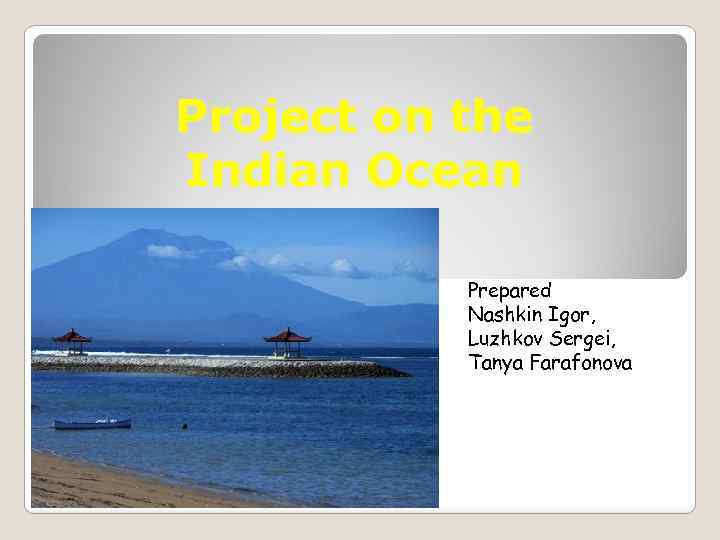 Project on the Indian Ocean Prepared Nashkin Igor, Luzhkov Sergei, Tanya Farafonova
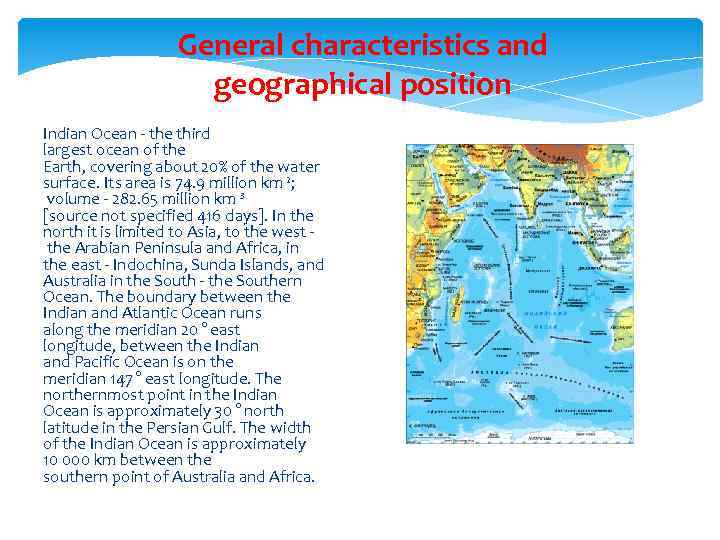 General characteristics and geographical position Indian Ocean - the third largest ocean of the Earth, covering about 20% of the water surface. Its area is 74. 9 million km ²; volume - 282. 65 million km ³ [source not specified 416 days]. In the north it is limited to Asia, to the west the Arabian Peninsula and Africa, in the east - Indochina, Sunda Islands, and Australia in the South - the Southern Ocean. The boundary between the Indian and Atlantic Ocean runs along the meridian 20 ° east longitude, between the Indian and Pacific Ocean is on the meridian 147 ° east longitude. The northernmost point in the Indian Ocean is approximately 30 ° north latitude in the Persian Gulf. The width of the Indian Ocean is approximately 10 000 km between the southern point of Australia and Africa.
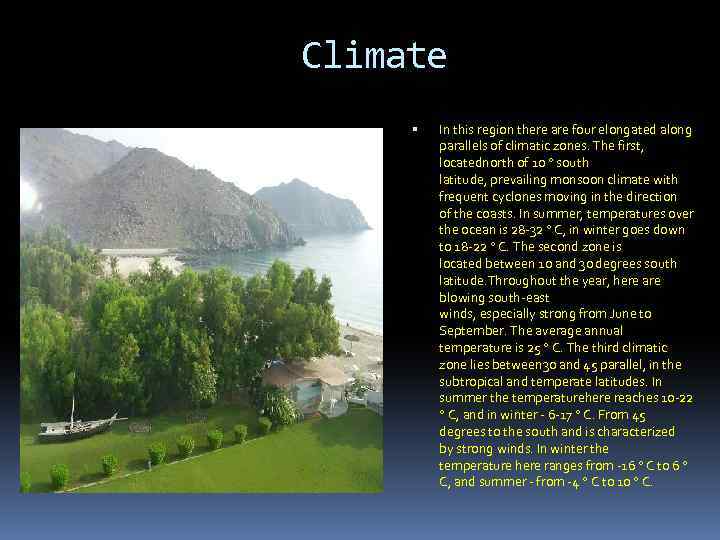 Climate In this region there are four elongated along parallels of climatic zones. The first, locatednorth of 10 ° south latitude, prevailing monsoon climate with frequent cyclones moving in the direction of the coasts. In summer, temperatures over the ocean is 28 -32 ° C, in winter goes down to 18 -22 ° C. The second zone is located between 10 and 30 degrees south latitude. Throughout the year, here are blowing south-east winds, especially strong from June to September. The average annual temperature is 25 ° C. The third climatic zone lies between 30 and 45 parallel, in the subtropical and temperate latitudes. In summer the temperaturehere reaches 10 -22 ° C, and in winter - 6 -17 ° C. From 45 degrees to the south and is characterized by strong winds. In winter the temperature here ranges from -16 ° C to 6 ° C, and summer - from -4 ° C to 10 ° C.
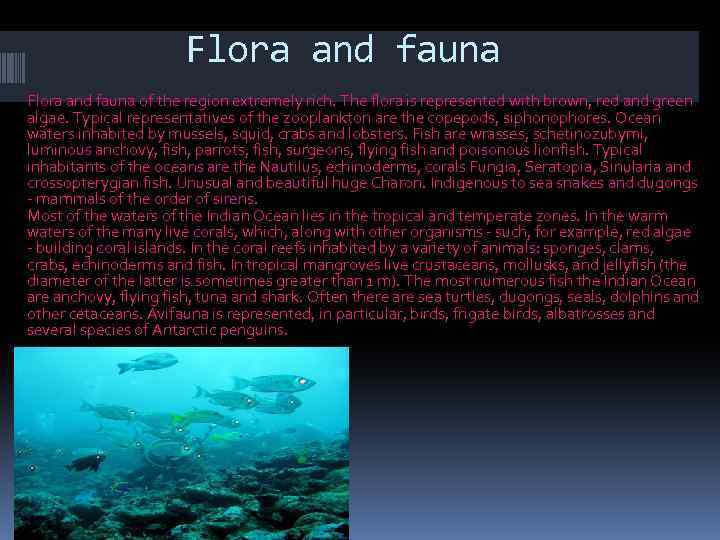 Flora and fauna of the region extremely rich. The flora is represented with brown, red and green algae. Typical representatives of the zooplankton are the copepods, siphonophores. Ocean waters inhabited by mussels, squid, crabs and lobsters. Fish are wrasses, schetinozubymi, luminous anchovy, fish, parrots, fish, surgeons, flying fish and poisonous lionfish. Typical inhabitants of the oceans are the Nautilus, echinoderms, corals Fungia, Seratopia, Sinularia and crossopterygian fish. Unusual and beautiful huge Charon. Indigenous to sea snakes and dugongs - mammals of the order of sirens. Most of the waters of the Indian Ocean lies in the tropical and temperate zones. In the warm waters of the many live corals, which, along with other organisms - such, for example, red algae - building coral islands. In the coral reefs inhabited by a variety of animals: sponges, clams, crabs, echinoderms and fish. In tropical mangroves live crustaceans, mollusks, and jellyfish (the diameter of the latter is sometimes greater than 1 m). The most numerous fish the Indian Ocean are anchovy, flying fish, tuna and shark. Often there are sea turtles, dugongs, seals, dolphins and other cetaceans. Avifauna is represented, in particular, birds, frigate birds, albatrosses and several species of Antarctic penguins.
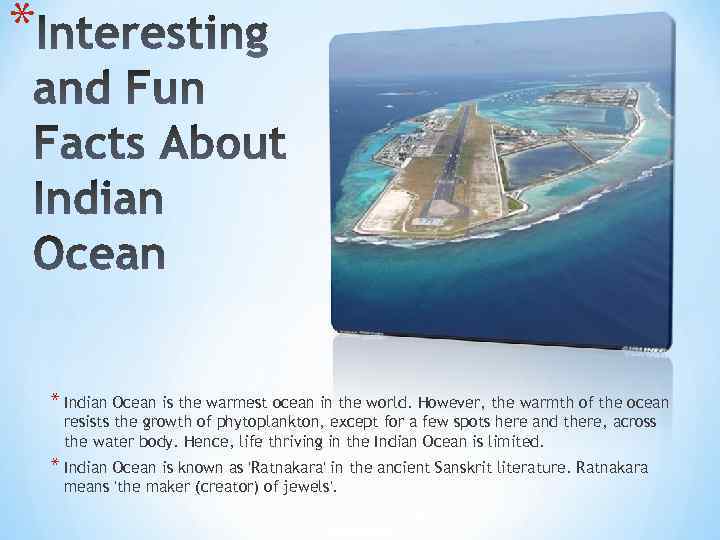 * * Indian Ocean is the warmest ocean in the world. However, the warmth of the ocean resists the growth of phytoplankton, except for a few spots here and there, across the water body. Hence, life thriving in the Indian Ocean is limited. * Indian Ocean is known as 'Ratnakara' in the ancient Sanskrit literature. Ratnakara means 'the maker (creator) of jewels'.
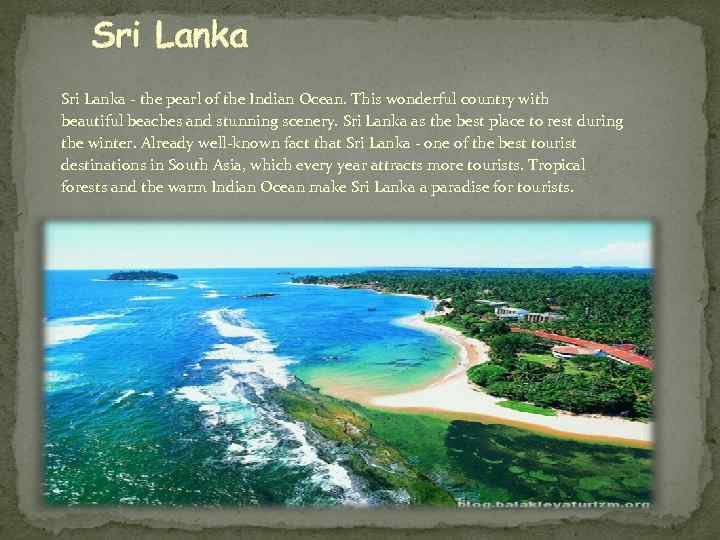 Sri Lanka - the pearl of the Indian Ocean. This wonderful country with beautiful beaches and stunning scenery. Sri Lanka as the best place to rest during the winter. Already well-known fact that Sri Lanka - one of the best tourist destinations in South Asia, which every year attracts more tourists. Tropical forests and the warm Indian Ocean make Sri Lanka a paradise for tourists.
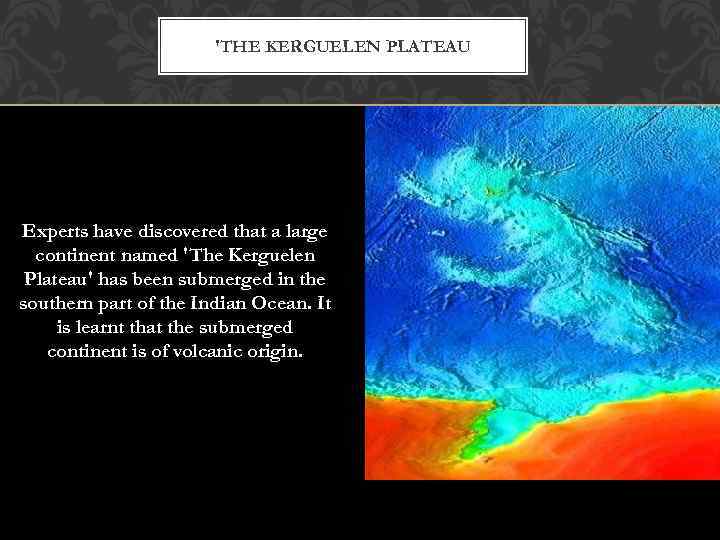 'THE KERGUELEN PLATEAU Experts have discovered that a large continent named 'The Kerguelen Plateau' has been submerged in the southern part of the Indian Ocean. It is learnt that the submerged continent is of volcanic origin.
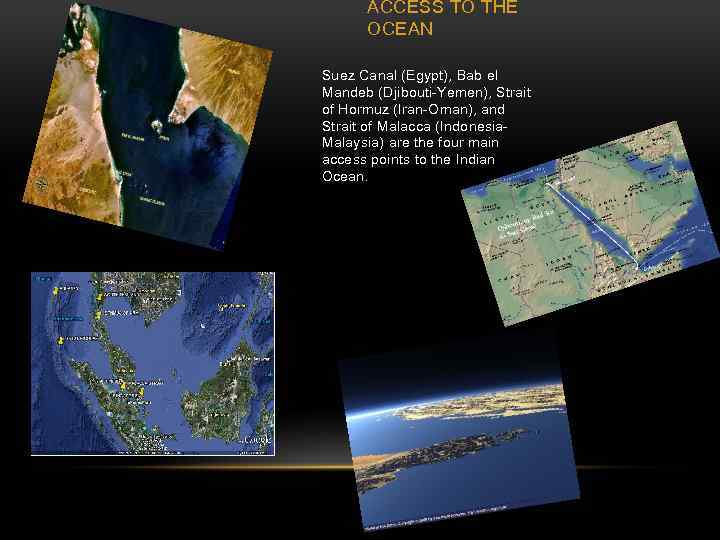 ACCESS TO THE OCEAN Suez Canal (Egypt), Bab el Mandeb (Djibouti-Yemen), Strait of Hormuz (Iran-Oman), and Strait of Malacca (Indonesia. Malaysia) are the four main access points to the Indian Ocean.
 THANK’S FOR YOUR ATTENTION