


 Скачать презентацию Project Management What is Project Management like It
371bdbb23a27627bf582b919cec1f974.ppt
- Количество слайдов: 37
 Project Management What is Project Management like? It is like conducting an orchestra where each musician belongs to a different labor union. Project management IS for Management 1
 Why study project management? 4 Look @ achievements in the past few months – Getting elected, Eaton's reopens, renaming to Asper School, New U of M logo, Olympics down under, Defending Napster…. 4 Your career edge over the competition – demonstrate ability to contribute/deliver projects 4 Trend over the past 30 years – fill the void of diminished middle management – transition from a technically oriented project manager to one skilled in all aspects of the business 4 Confidence to get involved in projects – allows you access/exposure to senior management Project management 2 IS for Management
 Project Management 4 What is a project? – A sequence of unique, complex, and connected activities having one goal or purpose and that must be completed for a customer by a specific time, within budget, and according to specification. – Is pursuing a university degree a project? • Yes, but no need to lead a “team” of people - the challenge in project management Project management 3 IS for Management
 Project Management 4 What is Project management? – A method and a set of techniques based on accepted principles of management used for planning, estimating, and controlling work activities to reach a desired end result on time, within budget and according to specification. Project management 4 IS for Management
 Project Management Distinct attributes 4 there is beginning and an end – while it is intended to have an end, it is sometimes difficult to determine when that really happens because of our increasingly complex world Examples? Inadequate systems, elections 4 encompass multiple functional areas of an organization (e. g. 4 4 ERP deployment) usually not anything the “team” has done before well-defined time constraint well-defined cost constraint well-defined performance constraint/goal Project management 5 IS for Management
 Project Management Trends in project management 4 multiple release strategies 4 project schedule compression 4 management of team line changes 4 increasing complexity – global competition AND customer focus – knowledge explosion 4 increasing risk, “temporary” with inadequate support compared to formal areas of organization 4 increasing business value by integration with strategic plan of organization vs adhoc projects Project management 6 IS for Management
 Project Management 4 Project manager skills (two areas) – pure technical knowledge of project specifications – people/organization management • leadership, teamwork, politics, managing (ensuring realistic versus excessive) customer expectations • negotiation, motivation skills, communication skills • ability to understand financial/strategic implication of decisions, understand relationships between tasks • innovative, problem solving, risk assessment aptitude Project management 7 IS for Management
 Project Management 4 Project manager job functions and tasks – – Project planning - planning reduces uncertainty Managing the project - schedule and deploy resources Lead the project team, motivating, evaluating Building client partnerships, work jointly with client to define project goals and results – Targeting solutions to the business priorities and direction Project management 8 IS for Management
 Projects, programs, parameters 4 Program versus Projects – program could be a collection of projects – e. g. , NASA Space Program 4 Project Parameters – – – cost time scope resources Who controls the resources? (next slide) Project management 9 IS for Management
 Project Management Five phases - the project management life cycle 4 Scoping the Project - Identify problems, opportunities, 4 4 goals, resources, success criteria, risks, and obstacles Develop a Detailed Plan - identify, estimate duration, and resource the activities, prepare proposal Launch the Plan - recruit and organize team, schedule and document work Monitor/Control Progress - establish progress reporting, change control tools, monitor progress, amend plan Closing - obtain client acceptance, install deliverables, complete documentation, post-implementation report, issue final project report. Project management 10 IS for Management
 Project management Step 1 - Scope the Project 4 Five components in a project statement – Problem and opportunity - a statement of fact – Project goal - what the project will address – Project objectives - what the project includes – Success criteria - business value; quantitative business outcome – Assumptions, risks, objectives - what will hinder the project in achieving its goals Project management 11 IS for Management
 Project management Joint Project Planning (JPP) sessions 4 Essential in generating project statement and developing a suitable detailed plan 4 Attendees include representation from anyone who may be affected by the project 4 Agenda includes establishing deliverables success criteria, project activity/tasks, task duration estimates, identification of critical path, resource scheduling, consensus on the project plan. Project management 12 IS for Management
 Project management lifecycle Obtaining senior management approval 4 Project team must be able to answer questions on: – importance of the problem/ opportunity to the organization – project’s impact on organization critical success factors – acceptability of return on investment – level of risk versus the business value – demonstrating clear relationships between goal statement to problem/opportunity to objectives to success criteria – ability of senior management to mitigate identified risk Project management 13 IS for Management
 Project management lifecycle Step 2 - Develop a detailed plan 4 Identify project activities (work breakdown structures) – break-down tasks by: “design-build-test-implement”, functional, or geographic area – should have clearly defined start and end 4 Estimate activity duration (focus on early activities) – consider comparability to similar, historical projects or expert advice – use Delphi technique where expert is not available (group polls each member for estimates, with gradual consensus over several iterations) – 3 point techniques identifies optimistic, pessimistic and likely estimates Project management 14 IS for Management
 Project management lifecycle Step 2 - Develop a detailed plan (continued) 4 Determine resource requirements – be sure to schedule activities based on available resources – consider leveling resources (see Slide 15) – at some point, adding more resources provides no incremental benefit – more to coordinate – more to communicate Project management 15 IS for Management
 Project management lifecycle Step 2 - Develop a detailed plan (continued) 4 Dependencies of activity B and Activity A: – Finish to start: complete A before starting B • e. g. , finish creating table structure before final query/form – Start to start: begin B only after A begins • e. g. , begin issuing reports after data entry starts – Start to finish: end B only after A has started • e. g. , shut off old system once new system is working – Finish to finish: end B only once A has also ended • e. g. , testing can be finished only after development work is completed. Project management 16 IS for Management
 Project management lifecycle Step 2 - Develop a detailed plan (continued) 4 Scheduling concepts: – – ES: earliest start date for an activity LF: latest finish date for an activity Critical path: the longest (time) path in the project Slack (aka Float) in an activity: • free float: can delay start-date w/o impact on project • total float: can delay end-date w/o impact on project 4 Once detailed plan done, you may find you need more resources or time; consider reorganizing activities. 4 Prepare detailed project proposal for senior mgmt approval Project management 17 IS for Management
 Project management lifecycle Step 3 - Implement the plan 4 Recruit and organize the project team – Project manager: leader of the project – Core team: will be there from beginning to end – Contracted team: only there for selected activities/tasks 4 Leveling project resources utilization – necessary to prevent wild fluctuation in staff levels – can be done by adjusting any of: activity start/end dates, sequencing activities schedules, using float 4 Scheduling and documenting work – describes/reports work done / to do (e. g. , Gantt chart) Project management 18 IS for Management
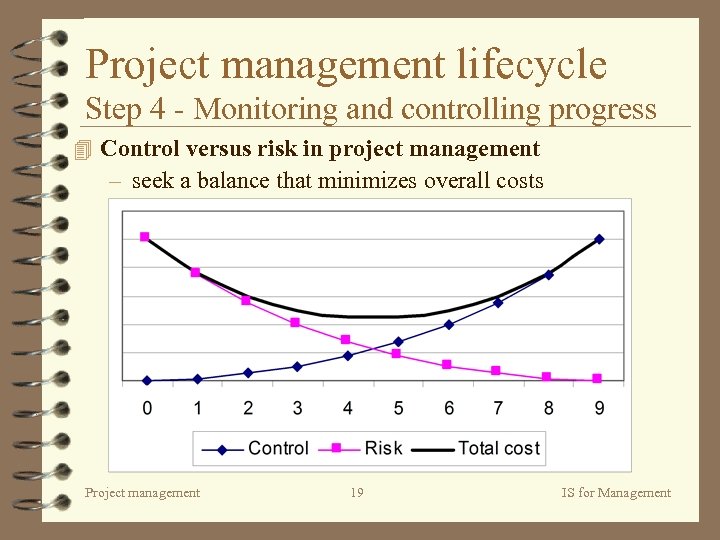 Project management lifecycle Step 4 - Monitoring and controlling progress 4 Control versus risk in project management – seek a balance that minimizes overall costs Project management 19 IS for Management
 Project management lifecycle Step 4 - Monitoring and controlling progress 4 Purpose, contents and frequency of reports – current period, cumulative and/or exception reports 4 Graphical tools – Gantt charts, milestone charts, cost/budget 4 Reporting detail – team members and project manager need detail – senior managers prefer graphical exception reports 4 Conduct regular status review meetings – weekly for team, bi-weekly for other stakeholders 4 Change control - formalize it. – measure and report impact of changes on project Project management 20 IS for Management
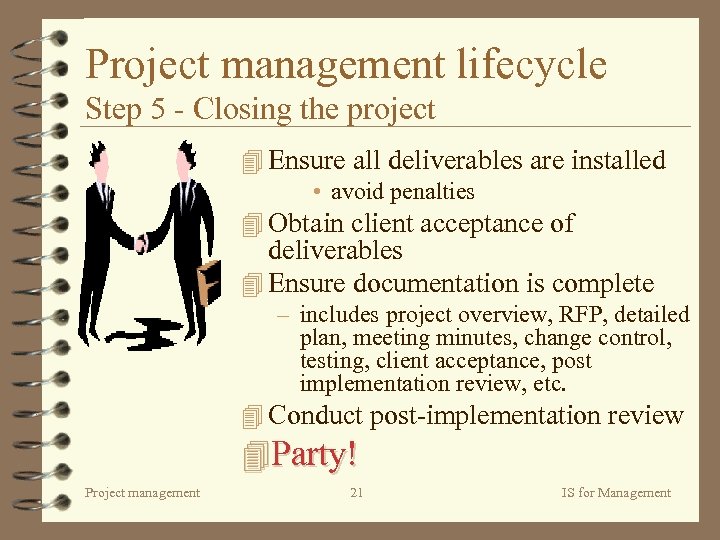 Project management lifecycle Step 5 - Closing the project 4 Ensure all deliverables are installed • avoid penalties 4 Obtain client acceptance of deliverables 4 Ensure documentation is complete – includes project overview, RFP, detailed plan, meeting minutes, change control, testing, client acceptance, post implementation review, etc. 4 Conduct post-implementation review 4 Party! Project management 21 IS for Management
 Project management lifecycle Objectives for the post-implementation review 4 Was project goal achieved? 4 Was the project done on time, on budget, in accordance with specifications? 4 Was client satisfied with the project results? 4 Was the business value realized? 4 And most importantly: What were the lessons learned for the benefit of future projects? Project management 22 IS for Management
 Who really controls the project resources? 4 The project manager controls – resource utilization – work schedules 4 The client management controls – cost / funding – resource level availability 4 The client users controls – scope – quality – delivery date Project management 23 IS for Management
 Project management creeps Changes are inevitable 4 Scope creep (initiated by customer) – increase in scope may be due to competitive demands. – the project manager must respond by documenting the alternatives and consequences of each that will result from the change of scope. 4 Hope creep (please. . . no bad news!) – project manager say everything is OK and “hopes” that the work catches up to schedule by the next reporting period. Project management 24 IS for Management
 Project management creeps Changes are inevitable 4 Effort creep - Are we (almost) there yet? – Project is always 90% complete despite of more work done 4 Feature creep (initiated by provider, NOT customer) – to add “sizzle” to steak – consequence is a feature that is not called for • therefore no support for customer • therefore not documented • therefore probably not tested • therefore FORGET IT. Project management 25 IS for Management
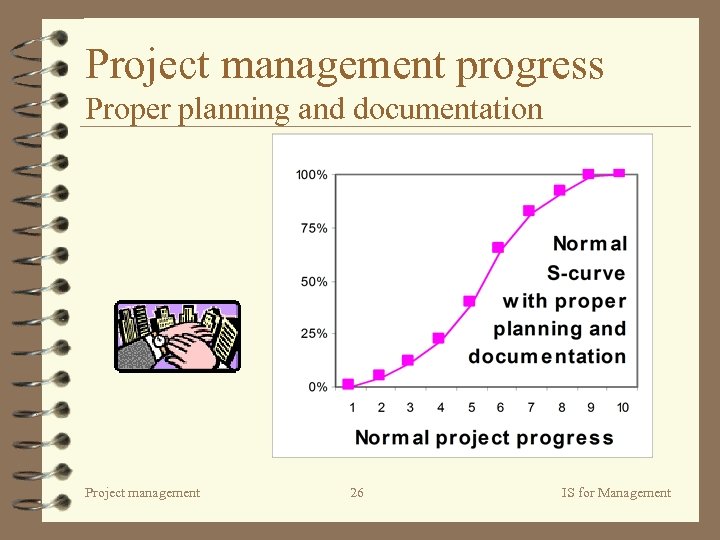 Project management progress Proper planning and documentation Project management 26 IS for Management
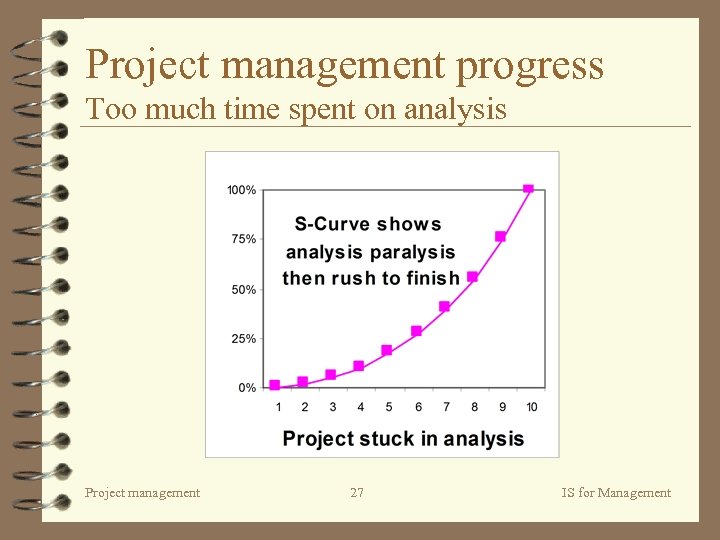 Project management progress Too much time spent on analysis Project management 27 IS for Management
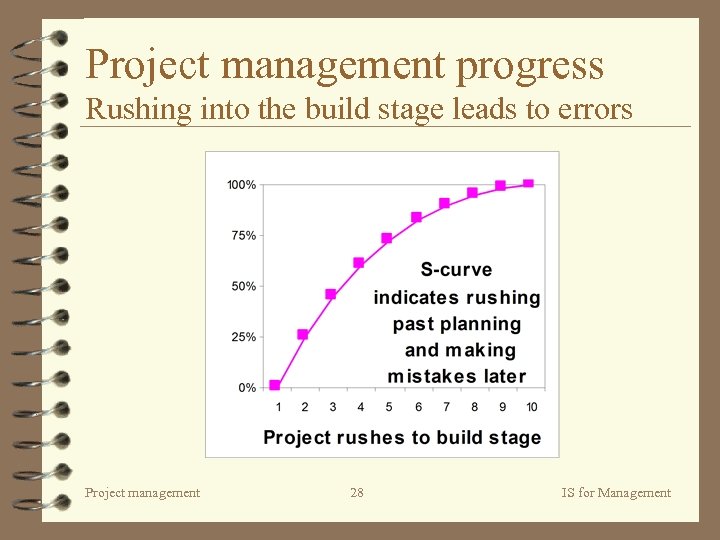 Project management progress Rushing into the build stage leads to errors Project management 28 IS for Management
 Project management Causes of project failure. 4 Customer’s objectives not clarified 4 project no longer a priority; no one seems to be in charge 4 schedule is too optimistic 4 project plan is not used to manage the project 4 sufficient resources have not been committed 4 project statistics are not monitored against plan 4 no formal communications plan is in place 4 the project has lost sight of its original goals 4 there is no change management process in place Project management 29 IS for Management
 Project management Reading materials from the Web 4 An Enhanced Framework for the Management of Information Technology Projects - public sector view from our federal government CIO incorporating the Capability Maturity Model from the Software Engineering Institute of Carnegie Mellon University (also used in Department of Defence, US). http: //www. cio-dpi. gc. ca/emf/Publications/Publication 1/emf_technology_projects_e. html 4 Fast, Cheap and Under control - a successful international/global migration of … email. http: //www. cio. com/archive/080100_fast_content. html 4 Chapters 1, 2 and 3 from "A Guide to the Project Management Body of Knowledge” from the Project Management Institute. (Requires registration, it is free) http: //www. pmi. org/ Project management 30 IS for Management
 Assigned Reading: An Enhanced Framework for the Management of Information Technology Projects 4 Enhanced framework is designed to ensure government IT projects – meet the needs of government – deliver all expected benefits – completed on time, within budget, full functionality 4 Industry statistics from the US show – 28% of IT projects are cancelled – 53% end up costing 189% of budget, delivering only 42% functionality – 26% completed on time (up from only 9% 10 yrs ago) – these stats predict cost overruns in govt > $1 billion Project management 31 IS for Management
 Assigned Reading: An Enhanced Framework for the Management of Information Technology Projects The framework 4 Governance - management oversight to be established 4 Review - monitor status of projects 4 Facilitation - development of best practice knowledge 4 Professional development - skills transfer of framework to government IT project managers 4 Pathfinder projects - monitor current project practices to leverage lessons learned to subsequent projects 4 Communications - collaborative linking of knowledge 4 Management of Change - assist the shift in attitudes and culture required in addressing needs of public service Project management 32 IS for Management
 Assigned Reading: An Enhanced Framework for the Management of Information Technology Projects Risk and major management principles 4 Full business case analysis performed (4. 2. 1) – should demonstrate net benefits of the investment 4 Clear accountabilities are established (4. 2. 2) – multiple stakeholders and key officials must understand roles 4 Development of project management discipline (4. 2. 3) – avail professional project managers to smaller departments 4 Risk management approach (4. 2. 4) – adopt proven methods; divide projects in chewable chunks – contracted gating or off-ramps to abandon poor performing projects, without significant penalty Project management 33 IS for Management
 Assigned Reading: Fast, Cheap and Under control Case study: R. R. Donnelley 4 34, 000 employees 18, 000 email users, 200 facilities, 4 continents, multiple platforms 4 Sought and achieved: executive sponsorship and funding, mandated to execute quick decisions 4 Frequent, detailed and strict adherence to “script” 4 Building a temporary “project email infrastructure” 4 Politics of training: value to let them make mistakes 4 Prioritization, logistics, amnesty = Success Project management 34 IS for Management
 Assigned Reading: Chapters 1, 2 and 3 from "A Guide to the Project Management Body of Knowledge (PMBOK)” 4 The concepts described are “generally accepted” 4 PMBOK definition of project – a temporary endeavor undertaken to create a unique product or service 4 PMBOK definition of project management – the application of knowledge, skills, tools, and techniques to project activities in order to meet or exceed stakeholder needs and expectations 4 Project management knowledge areas include – integration, scope, time, cost, and quality, HR, communications, risk, and procurement Project management 35 IS for Management
 Assigned Reading: Chapters 1, 2 and 3 from "A Guide to the Project Management Body of Knowledge (PMBOK)” Organization structure impact on projects 4 Functional organization – traditional hierarchy; one superior – some staff are involved in projects 4 Project organization – all staff are assigned to projects – project managers enjoy independence and authority 4 Matrix organization – represents a hybrid of both functional and project organizations – strong matrix organizations empower project managers Project management processes 4 see project management lifecycle slides #7 Project management 36 IS for Management
 Assigned Reading: Chapters 1, 2 and 3 from "A Guide to the Project Management Body of Knowledge (PMBOK)” 4 Project life cycle characteristics – cost and staffing are low at the start, higher towards the end, and drop rapidly as it draws to a close. – Probability of successful conclusion best at later stages – Cost of changes to a project become higher as it progresses – in software development: prototyping is the trend due to demands for shorter development cycle time Project management 37 IS for Management