


 Скачать презентацию Project Management Concepts and Applications January — 2014
PM Concepts_Slide pack.pptx
- Количество слайдов: 162
 Project Management Concepts and Applications January - 2014
 Bridge Game 2
 Key Outcomes Upon completion of this course participants will be able to: § Appreciate the benefits of using a sound project management approach to manage projects § Understand the overall framework of projects and project management § Have a good understanding of the language and key terms and concepts in project management § Have an appreciation of industry best practice project management tools, techniques and methodologies 3
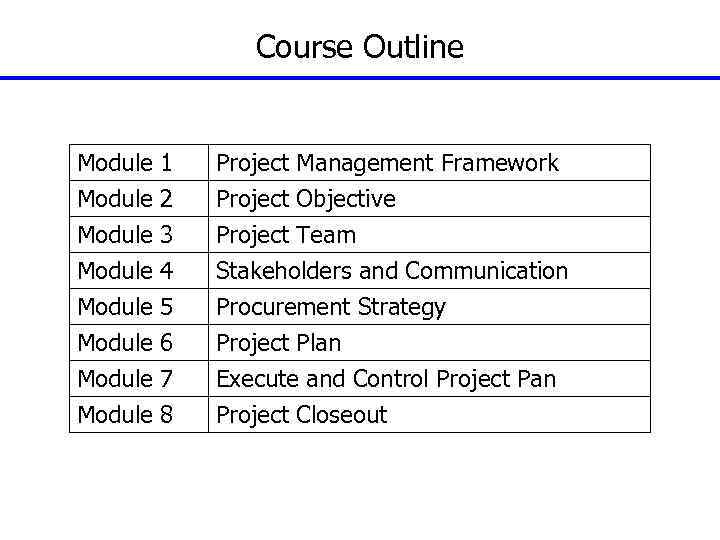 Course Outline Module 1 Module 2 Module 3 Module 4 Project Management Framework Project Objective Project Team Stakeholders and Communication Module 5 Module 6 Module 7 Module 8 Procurement Strategy Project Plan Execute and Control Project Pan Project Closeout 4
 Module 1 Project Management Framework 5
 Project: Definition A temporary endeavour undertaken to create a unique product, service or result. § Temporary – definite beginning and end § Unique Products, Services or Results § Progressive elaboration – developing in steps, and continuing by increments 6
 Projects: Examples § Developing a new product or service § Effecting a change in structure, staffing or style of an organisation § Designing a new transportation vehicle § Developing or acquiring a new or modified information system § Constructing a building or facility § Implementing a new business procedure or process § Responding to a contract solicitation 7
 What is Project Management? • Project Management is the application of • skills, knowledge, tools and techniques to meet the needs and expectations of stakeholders for a project. The purpose of project management is prediction and prevention, NOT recognition and reaction 8
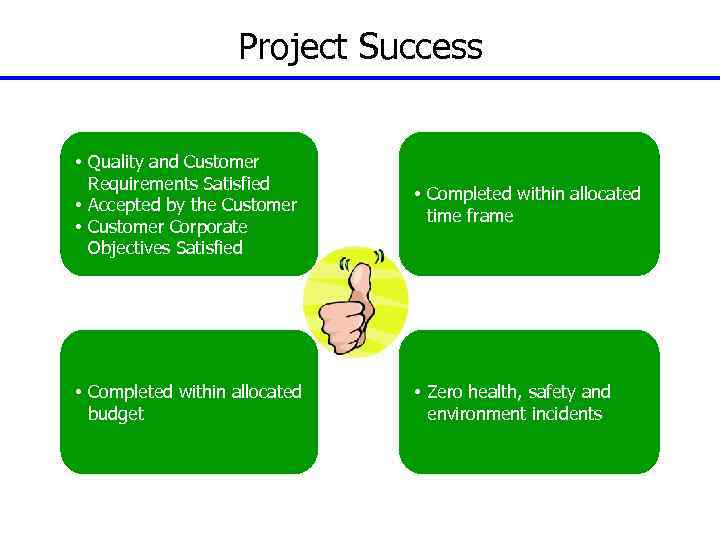 Project Success • Quality and Customer Requirements Satisfied • Accepted by the Customer • Customer Corporate Objectives Satisfied • Completed within allocated time frame • Completed within allocated budget • Zero health, safety and environment incidents 9
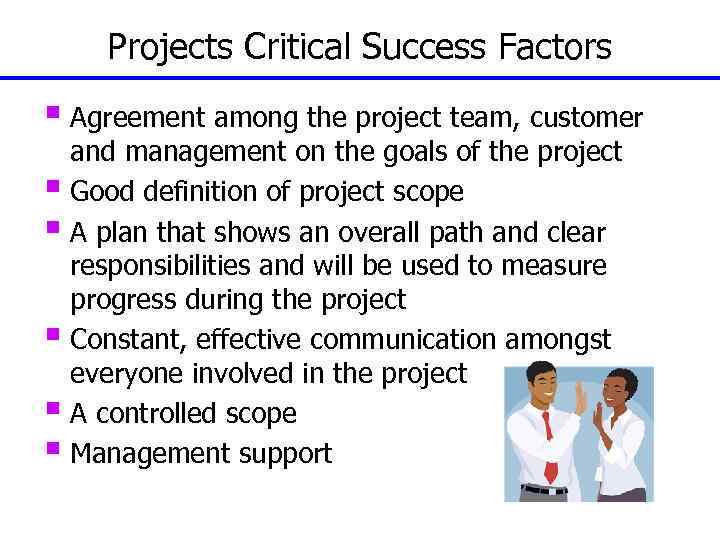 Projects Critical Success Factors § Agreement among the project team, customer and management on the goals of the project § Good definition of project scope § A plan that shows an overall path and clear responsibilities and will be used to measure progress during the project § Constant, effective communication amongst everyone involved in the project § A controlled scope § Management support 10
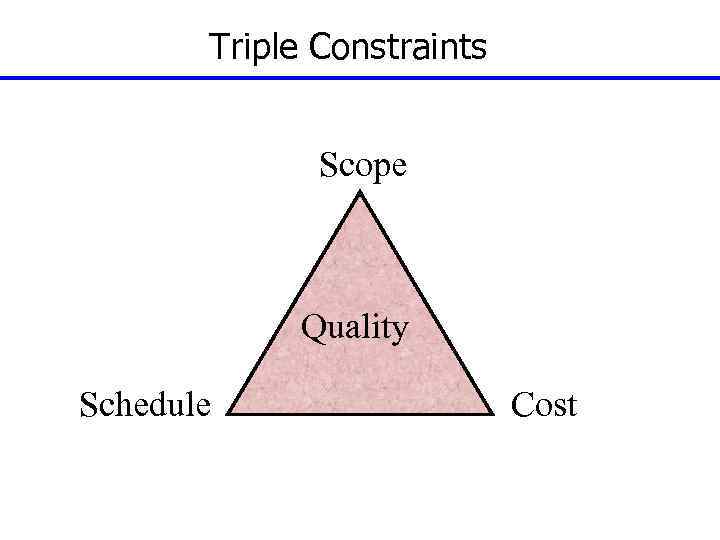 Triple Constraints Scope Quality Schedule Cost 11
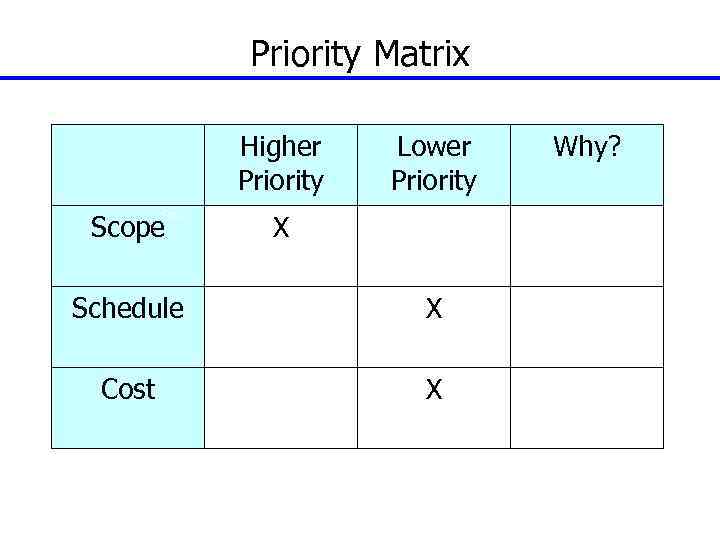 Priority Matrix Higher Priority Cost Scope Lower Priority Why? X Schedule X Cost X 12
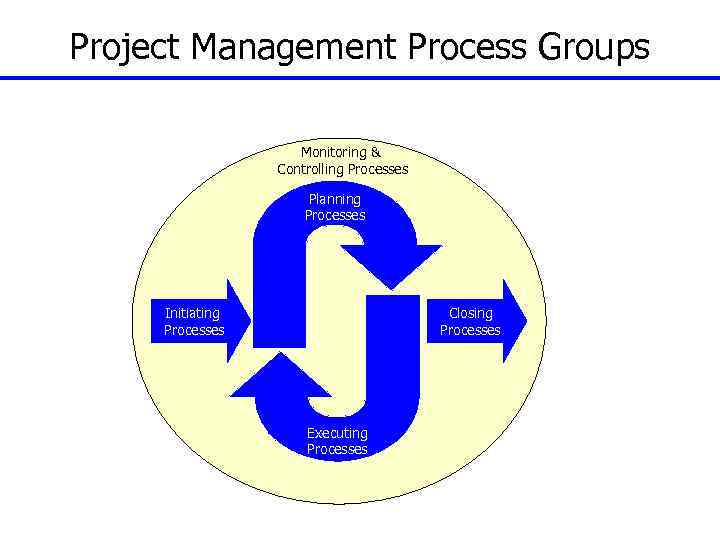 Project Management Process Groups Monitoring & Controlling Processes Planning Processes Initiating Processes Closing Processes Executing Processes 13
 Project Management Process Group and Knowledge Area Mapping (from PMBOK, 5 th Edition) Project Management Process Groups Knowledge Areas Initiating Process Group Planning Process Group Executing Process Group Monitoring & Controlling Process Group 4. Project Integration Management 5. Project Scope Management 5. 1 Plan Scope Management 5. 2 Collect Requirements 5. 3 Define Scope 5. 4 Create WBS 5. 5 Validate Scope 5. 6 Control Scope 6. Project Time Management 6. 1 Plan Schedule Management 6. 2 Define Activities 6. 3 Sequence Activities 6. 4 Estimate Activity Resources 6. 5 Estimate Activity Durations 6. 6 Develop Schedule Closing Process Group 6. 7 Control Schedule 7. 4 Control Costs 4. 1 Develop Project Charter Cost 4. 2 Develop Project Management Plan 4. 3 Direct and Manage Project Work 4. 4 Monitor and Control Project Work 4. 5 Perform Integrated Change Control 7. Project Cost Management 7. 1 Plan Cost Management 7. 2 Estimate Costs 7. 3 Determine Budget 8. Project Quality Management 8. 1 Plan Quality Management 8. 2 Perform Quality Assurance 9. Project Human Resource Management 9. 1 Plan Human Resource Management 9. 2 Acquire Project Team 9. 3 Develop Project Team 9. 4 Manage Project Team 10. Project 10. 1 Plan Communications Management 10. 2 Manage Communications 11. Project Risk 11. 1 Plan Risk Management 11. 2 Identify Risks 11. 3 Perform Qualitative Risk Analysis 11. 4 Perform Quantitative Risk Analysis 11. 5 Plan Risk Responses 12. Project Procurement 12. 1 Plan Procurement Management 12. 2 Conduct Procurements 12. 3 Control Procurements 13. 2 Plan Stakeholder Management 13. 3 Manage Stakeholder Engagement 13. 4 Control Stakeholder Engagement 4. 6 Close Project or Phase Communications Management 13. Project Stakeholder Management 13. 1 Identify Stakeholders 8. 3 Control Quality 10. 3 Control Communications 11. 6 Control Risks 12. 4 Close Procurements 14
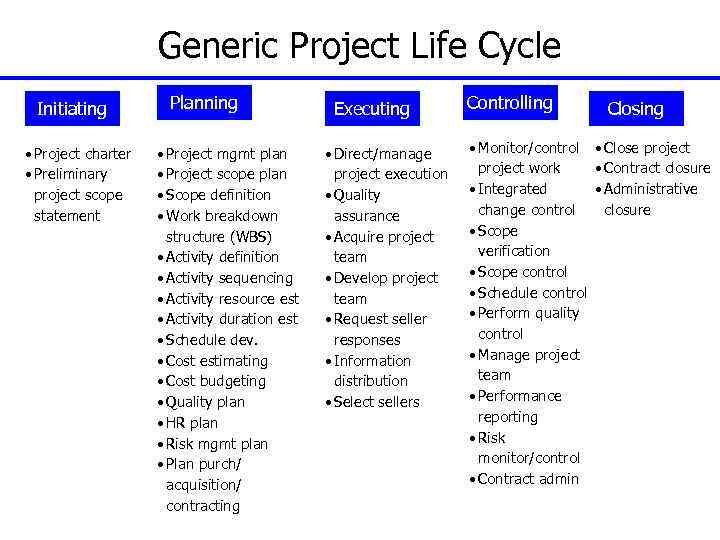 Generic Project Life Cycle Initiating • Project charter • Preliminary project scope statement Planning • Project mgmt plan • Project scope plan • Scope definition • Work breakdown structure (WBS) • Activity definition • Activity sequencing • Activity resource est • Activity duration est • Schedule dev. • Cost estimating • Cost budgeting • Quality plan • HR plan • Risk mgmt plan • Plan purch/ acquisition/ contracting Executing • Direct/manage project execution • Quality assurance • Acquire project team • Develop project team • Request seller responses • Information distribution • Select sellers Controlling Closing • Monitor/control • Close project work • Contract closure • Integrated • Administrative change control closure • Scope verification • Scope control • Schedule control • Perform quality control • Manage project team • Performance reporting • Risk monitor/control • Contract admin 15
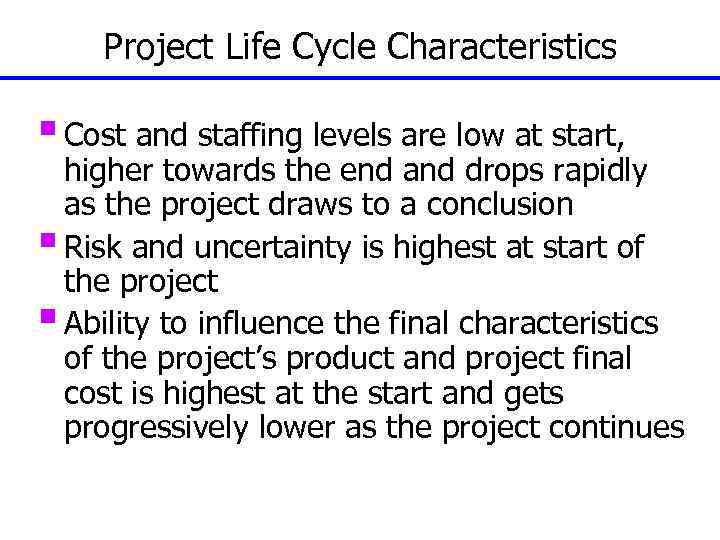 Project Life Cycle Characteristics § Cost and staffing levels are low at start, higher towards the end and drops rapidly as the project draws to a conclusion § Risk and uncertainty is highest at start of the project § Ability to influence the final characteristics of the project’s product and project final cost is highest at the start and gets progressively lower as the project continues 16
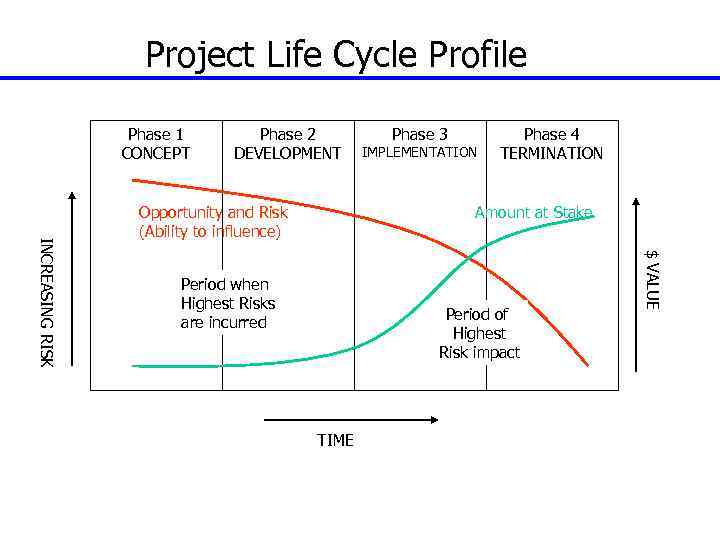 Project Life Cycle Profile Phase 1 CONCEPT Phase 2 DEVELOPMENT IMPLEMENTATION Phase 4 TERMINATION Amount at Stake Period when Highest Risks are incurred Period of Highest Risk impact $ VALUE INCREASING RISK Opportunity and Risk (Ability to influence) Phase 3 TIME 17
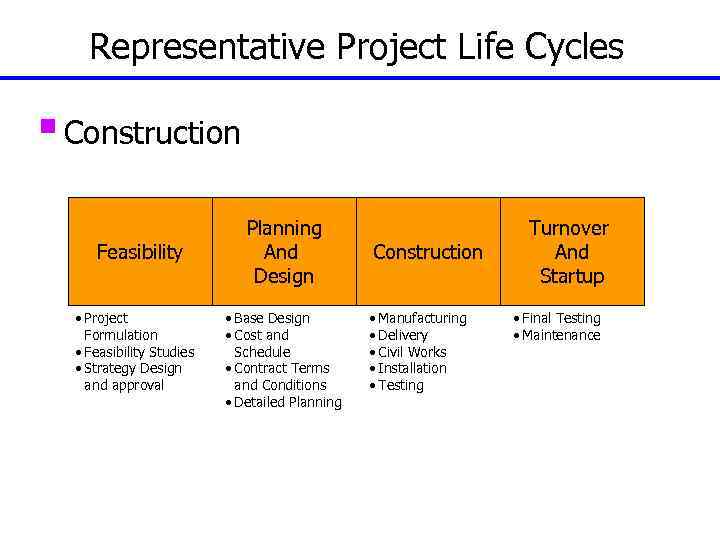 Representative Project Life Cycles § Construction Feasibility • Project Formulation • Feasibility Studies • Strategy Design and approval Planning And Design • Base Design • Cost and Schedule • Contract Terms and Conditions • Detailed Planning Construction • Manufacturing • Delivery • Civil Works • Installation • Testing Turnover And Startup • Final Testing • Maintenance 18
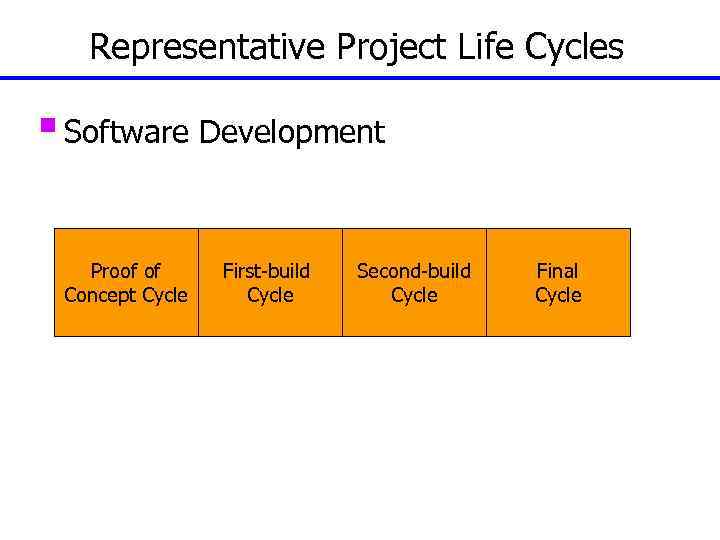 Representative Project Life Cycles § Software Development Proof of Concept Cycle First-build Cycle Second-build Cycle Final Cycle 19
 20
20
 21
21
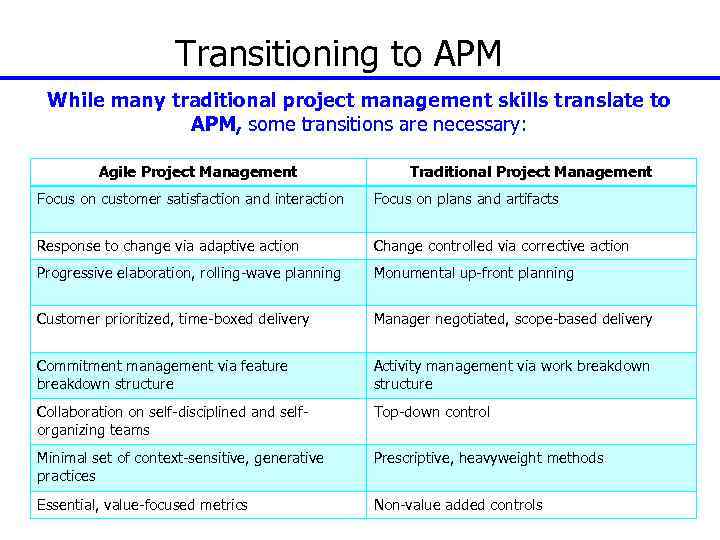 Transitioning to APM While many traditional project management skills translate to APM, some transitions are necessary: Agile Project Management Traditional Project Management Focus on customer satisfaction and interaction Focus on plans and artifacts Response to change via adaptive action Change controlled via corrective action Progressive elaboration, rolling-wave planning Monumental up-front planning Customer prioritized, time-boxed delivery Manager negotiated, scope-based delivery Commitment management via feature breakdown structure Activity management via work breakdown structure Collaboration on self-disciplined and selforganizing teams Top-down control Minimal set of context-sensitive, generative practices Prescriptive, heavyweight methods Essential, value-focused metrics Non-value added controls 22
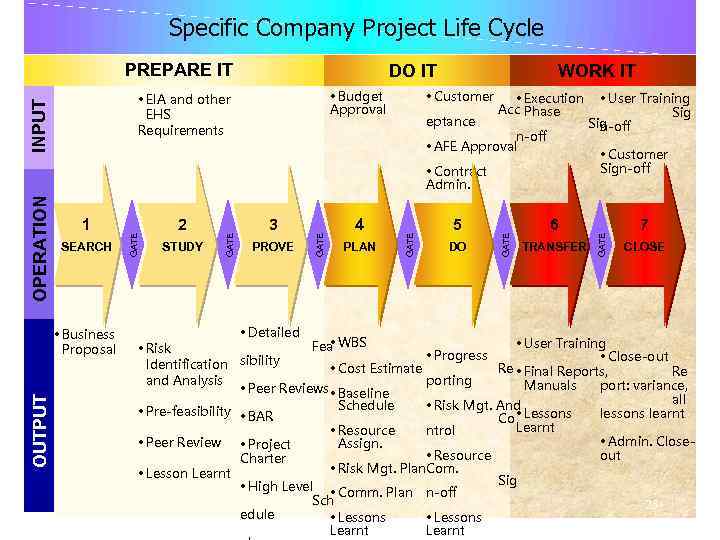 Specific Company Project Life Cycle DO IT • Budget Approval INPUT • EIA and other EHS Requirements WORK IT • Customer eptance • Execution Acc Phase n-off • AFE Approval • Customer Sign-off OUTPUT • Business Proposal • Detailed PLAN 5 DO GATE SEARCH PROVE 4 GATE STUDY 1 3 GATE 2 GATE SEARCH GATE OPERATION • Contract Admin. 1 • User Training Sig n-off 6 TRANSFER GATE PREPARE IT 7 CLOSE • • User Training Fea WBS • Risk • Progress • Close-out Identification sibility Re • Final Reports, • Cost Estimate Re and Analysis porting port: variance, Manuals • Peer Reviews • Baseline all • Risk Mgt. And Schedule • Pre-feasibility • BAR lessons learnt Co • Lessons Learnt • Resource ntrol • Admin. Close • Peer Review • Project Assign. out • Resource Charter • Risk Mgt. Plan. Com. • Lesson Learnt Sig • High Level • Comm. Plan n-off Sch 23 edule • Lessons Learnt
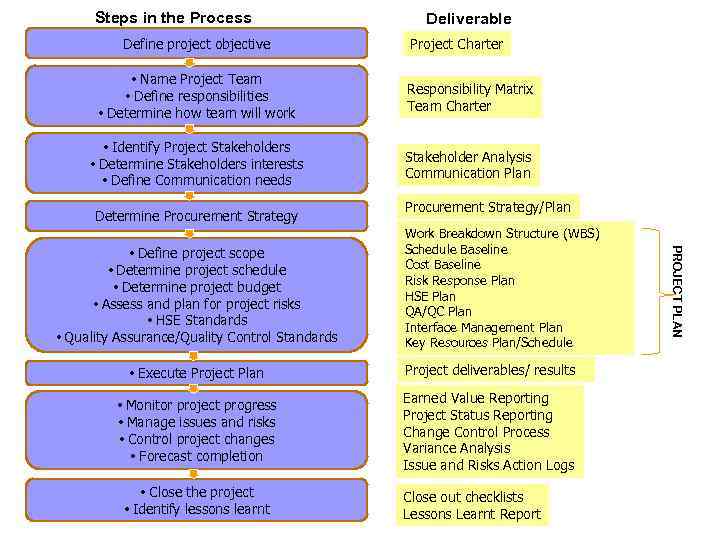 Steps in the Process Define project objective Deliverable Project Charter • Name Project Team • Define responsibilities • Determine how team will work Responsibility Matrix Team Charter • Identify Project Stakeholders • Determine Stakeholders interests • Define Communication needs Stakeholder Analysis Communication Plan Determine Procurement Strategy Work Breakdown Structure (WBS) Schedule Baseline Cost Baseline Risk Response Plan HSE Plan QA/QC Plan Interface Management Plan Key Resources Plan/Schedule • Execute Project Plan Project deliverables/ results • Monitor project progress • Manage issues and risks • Control project changes • Forecast completion PROJECT PLAN • Define project scope • Determine project schedule • Determine project budget • Assess and plan for project risks • HSE Standards • Quality Assurance/Quality Control Standards Procurement Strategy/Plan Earned Value Reporting Project Status Reporting Change Control Process Variance Analysis Issue and Risks Action Logs • Close the project • Identify lessons learnt Close out checklists Lessons Learnt Report 24
 Module 2 Project Objective 25
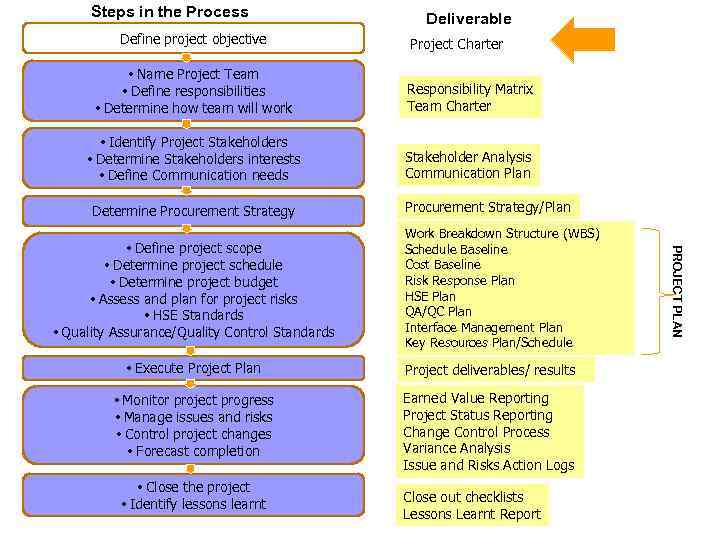 Steps in the Process Define project objective Deliverable Project Charter • Name Project Team • Define responsibilities • Determine how team will work Responsibility Matrix Team Charter • Identify Project Stakeholders • Determine Stakeholders interests • Define Communication needs Stakeholder Analysis Communication Plan Determine Procurement Strategy Work Breakdown Structure (WBS) Schedule Baseline Cost Baseline Risk Response Plan HSE Plan QA/QC Plan Interface Management Plan Key Resources Plan/Schedule • Execute Project Plan Project deliverables/ results • Monitor project progress • Manage issues and risks • Control project changes • Forecast completion PROJECT PLAN • Define project scope • Determine project schedule • Determine project budget • Assess and plan for project risks • HSE Standards • Quality Assurance/Quality Control Standards Procurement Strategy/Plan Earned Value Reporting Project Status Reporting Change Control Process Variance Analysis Issue and Risks Action Logs • Close the project • Identify lessons learnt Close out checklists Lessons Learnt Report 26
 27
27
 Project Objective § Project Charter Ø Ø Ø Is sent out by the Project Sponsor The document that formally authorises a project Provides the project manager with the authority to apply organisational resources to project activities 28
 Project Charter § Should provide the following info: Ø Ø Ø Project purpose or justification Measurable project objectives and related success criteria High level requirements/deliverables Assumptions and constraints High level project description and boundaries (in scope; out of scope) High level risks Summary milestone schedule Summary budget Stakeholder list Project approval requirements (i. e. what constitutes project success, who decides the project is successful, and who signs off on the project Assigned project manager, responsibility, and authority level, and Name and authority of the sponsor or other person(s) authorising the project charter 29
 Exercise 1: Project Charter § Use the information provided in the handout to prepare a Project Charter for the House Renovation Project 30
 Module 3 Project Team 31
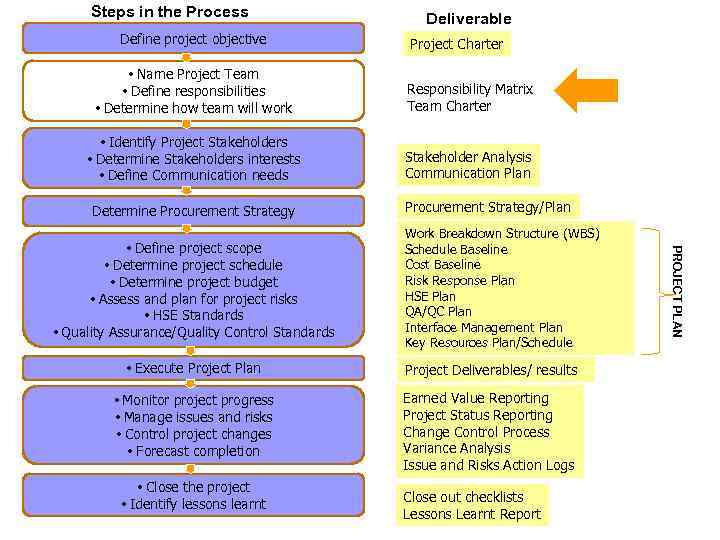 Steps in the Process Define project objective Deliverable Project Charter • Name Project Team • Define responsibilities • Determine how team will work Responsibility Matrix Team Charter • Identify Project Stakeholders • Determine Stakeholders interests • Define Communication needs Stakeholder Analysis Communication Plan Determine Procurement Strategy Work Breakdown Structure (WBS) Schedule Baseline Cost Baseline Risk Response Plan HSE Plan QA/QC Plan Interface Management Plan Key Resources Plan/Schedule • Execute Project Plan Project Deliverables/ results • Monitor project progress • Manage issues and risks • Control project changes • Forecast completion PROJECT PLAN • Define project scope • Determine project schedule • Determine project budget • Assess and plan for project risks • HSE Standards • Quality Assurance/Quality Control Standards Procurement Strategy/Plan Earned Value Reporting Project Status Reporting Change Control Process Variance Analysis Issue and Risks Action Logs • Close the project • Identify lessons learnt Close out checklists Lessons Learnt Report 32
 Responsibility Matrix § The responsibility matrix will document precisely the § § responsibility of each group or individual in the project. The purpose of the Responsibility Matrix is to clearly define the responsibilities of team members and principal stakeholders in accomplishing the activities of the project. The Responsibility Matrix is organised by Work Breakdown Structure (WBS) elements and used to determine what resources are needed on a project.
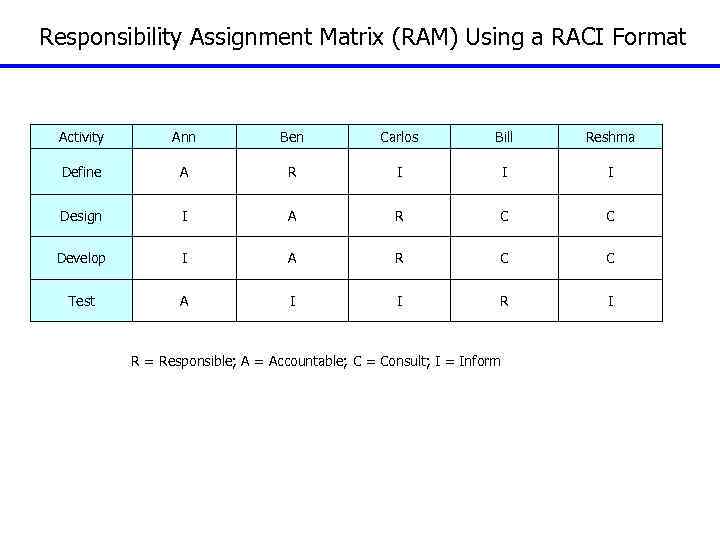 Responsibility Assignment Matrix (RAM) Using a RACI Format Activity Ann Ben Carlos Bill Reshma Define A R I I I Design I A R C C Develop I A R C C Test A I I R = Responsible; A = Accountable; C = Consult; I = Inform 34
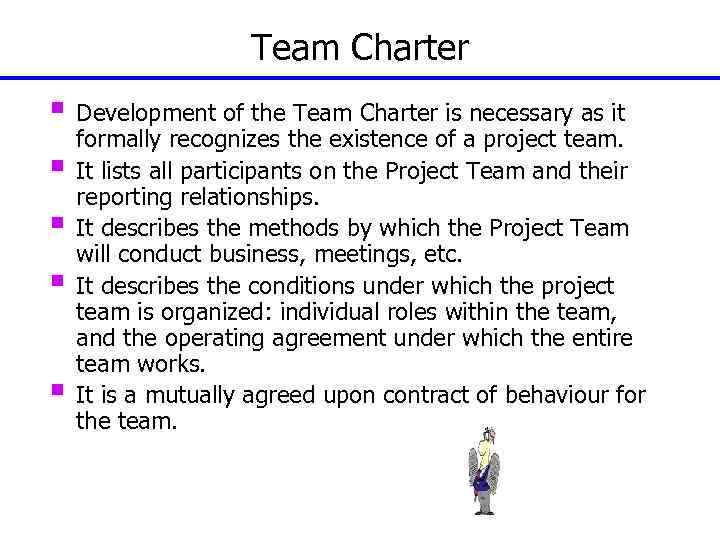 Team Charter § Development of the Team Charter is necessary as it § § formally recognizes the existence of a project team. It lists all participants on the Project Team and their reporting relationships. It describes the methods by which the Project Team will conduct business, meetings, etc. It describes the conditions under which the project team is organized: individual roles within the team, and the operating agreement under which the entire team works. It is a mutually agreed upon contract of behaviour for the team.
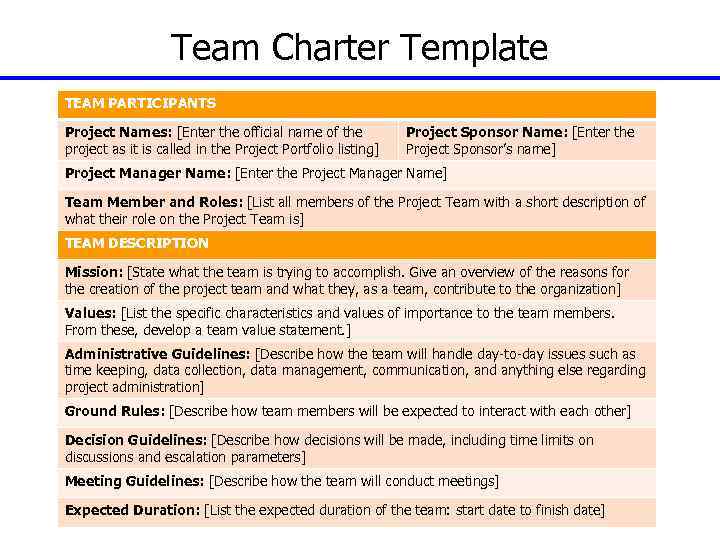 Team Charter Template TEAM PARTICIPANTS Project Names: [Enter the official name of the project as it is called in the Project Portfolio listing] Project Sponsor Name: [Enter the Project Sponsor’s name] Project Manager Name: [Enter the Project Manager Name] Team Member and Roles: [List all members of the Project Team with a short description of what their role on the Project Team is] TEAM DESCRIPTION Mission: [State what the team is trying to accomplish. Give an overview of the reasons for the creation of the project team and what they, as a team, contribute to the organization] Values: [List the specific characteristics and values of importance to the team members. From these, develop a team value statement. ] Administrative Guidelines: [Describe how the team will handle day-to-day issues such as time keeping, data collection, data management, communication, and anything else regarding project administration] Ground Rules: [Describe how team members will be expected to interact with each other] Decision Guidelines: [Describe how decisions will be made, including time limits on discussions and escalation parameters] Meeting Guidelines: [Describe how the team will conduct meetings] Expected Duration: [List the expected duration of the team: start date to finish date]
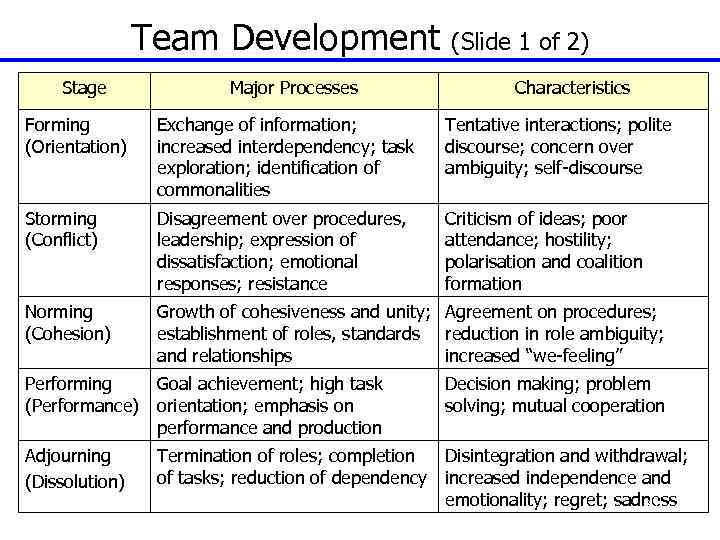 Team Development (Slide 1 of 2) Stage Major Processes Characteristics Forming (Orientation) Exchange of information; increased interdependency; task exploration; identification of commonalities Tentative interactions; polite discourse; concern over ambiguity; self-discourse Storming (Conflict) Disagreement over procedures, leadership; expression of dissatisfaction; emotional responses; resistance Criticism of ideas; poor attendance; hostility; polarisation and coalition formation Norming (Cohesion) Growth of cohesiveness and unity; Agreement on procedures; establishment of roles, standards reduction in role ambiguity; and relationships increased “we-feeling” Performing (Performance) Goal achievement; high task orientation; emphasis on performance and production Decision making; problem solving; mutual cooperation Adjourning (Dissolution) Termination of roles; completion of tasks; reduction of dependency Disintegration and withdrawal; increased independence and emotionality; regret; sadness 37
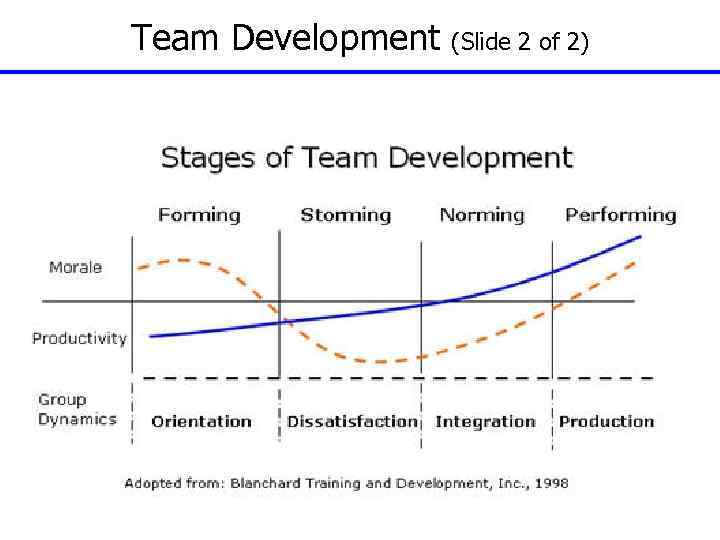 Team Development (Slide 2 of 2) 38
 Module 4 Stakeholders and Communication 39
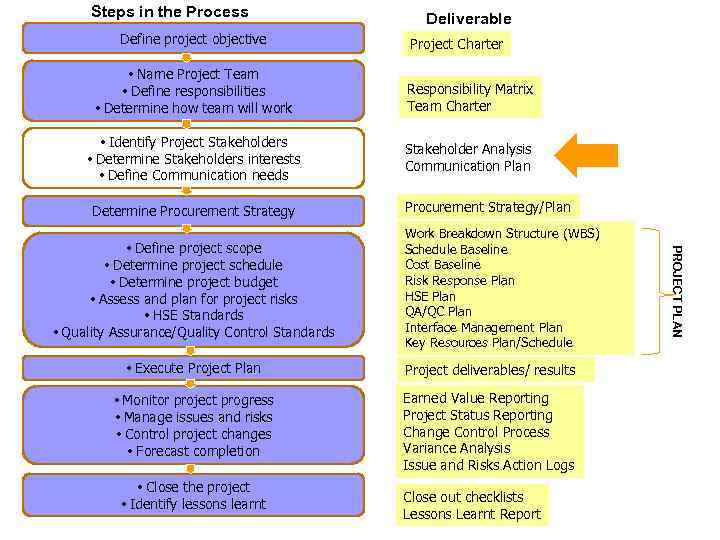 Steps in the Process Define project objective Deliverable Project Charter • Name Project Team • Define responsibilities • Determine how team will work Responsibility Matrix Team Charter • Identify Project Stakeholders • Determine Stakeholders interests • Define Communication needs Stakeholder Analysis Communication Plan Determine Procurement Strategy Work Breakdown Structure (WBS) Schedule Baseline Cost Baseline Risk Response Plan HSE Plan QA/QC Plan Interface Management Plan Key Resources Plan/Schedule • Execute Project Plan Project deliverables/ results • Monitor project progress • Manage issues and risks • Control project changes • Forecast completion PROJECT PLAN • Define project scope • Determine project schedule • Determine project budget • Assess and plan for project risks • HSE Standards • Quality Assurance/Quality Control Standards Procurement Strategy/Plan Earned Value Reporting Project Status Reporting Change Control Process Variance Analysis Issue and Risks Action Logs • Close the project • Identify lessons learnt Close out checklists Lessons Learnt Report 40
 Project Stakeholders Individuals and organisations that are actively involved in the project, or whose interests may be positively or negatively affected as a result of project execution or project completion; they may also exert influence over the project and its results. 41
 Project Stakeholders § Key stakeholders on every project: Ø Ø Project manager – responsible for project results Customer – individual/organisation that will use the project’s product Project team members – the group that is performing the work of the project Project Sponsor or Champion – provides financial resources, supports the project 42
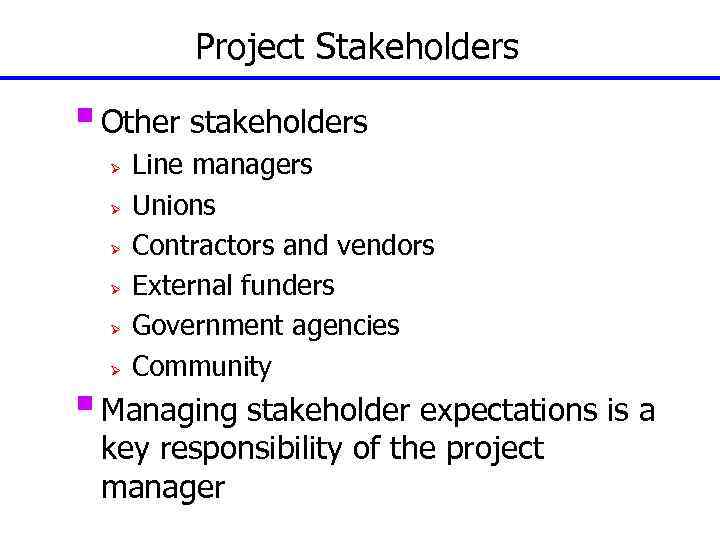 Project Stakeholders § Other stakeholders Ø Ø Ø Line managers Unions Contractors and vendors External funders Government agencies Community § Managing stakeholder expectations is a key responsibility of the project manager 43
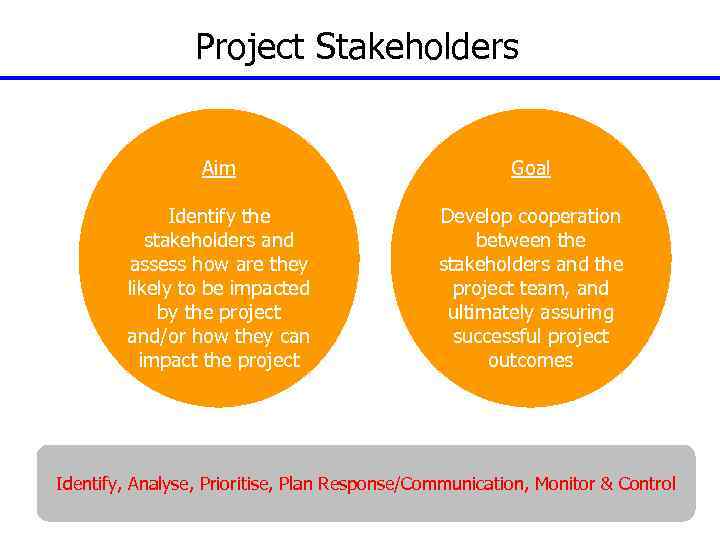 Project Stakeholders Aim Goal Identify the stakeholders and assess how are they likely to be impacted by the project and/or how they can impact the project Develop cooperation between the stakeholders and the project team, and ultimately assuring successful project outcomes Identify, Analyse, Prioritise, Plan Response/Communication, Monitor & Control 44
 Power/Interest Matrix § Classifies stakeholders in relation to their power and the extent to which they are likely to show interest in the actions of the organisation § Can be used to indicate the nature of the relationship which should be adopted with each group 45
 Stakeholder Interests § What are their expectations and what benefits do § § § they seek What resources will they commit (or avoid committing) to the project Do they have other interests that might conflict with the project How do they regard other stakeholders on the list 46
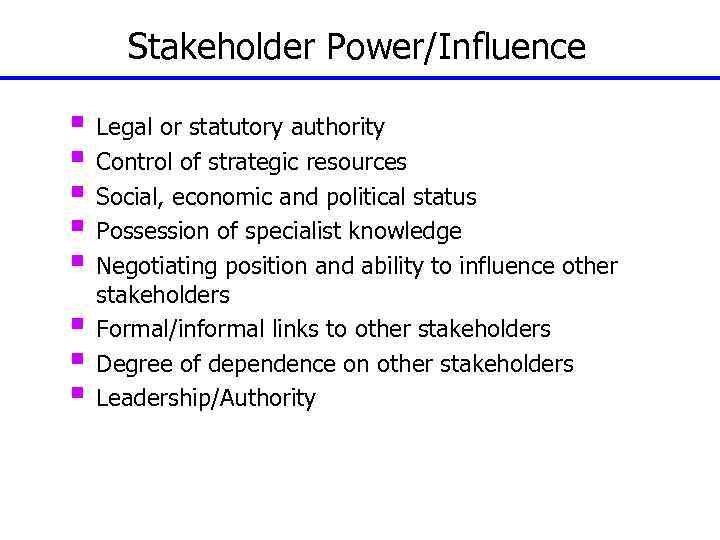 Stakeholder Power/Influence § Legal or statutory authority § Control of strategic resources § Social, economic and political status § Possession of specialist knowledge § Negotiating position and ability to influence other § § § stakeholders Formal/informal links to other stakeholders Degree of dependence on other stakeholders Leadership/Authority 47
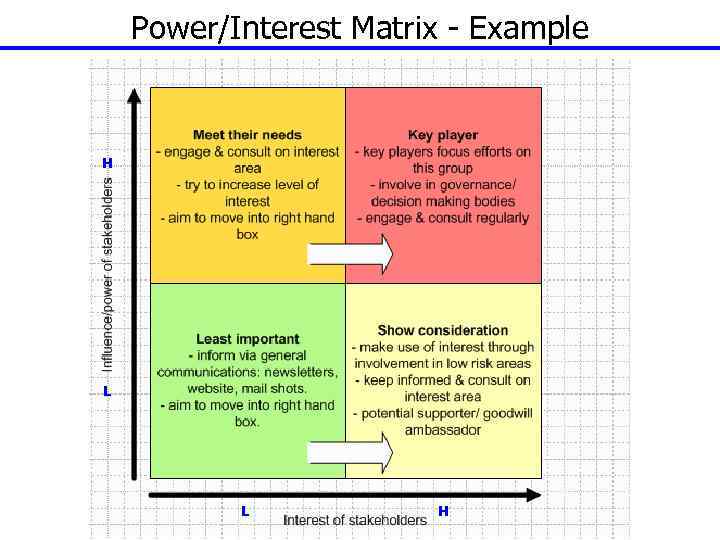 Power/Interest Matrix - Example H L L H 48
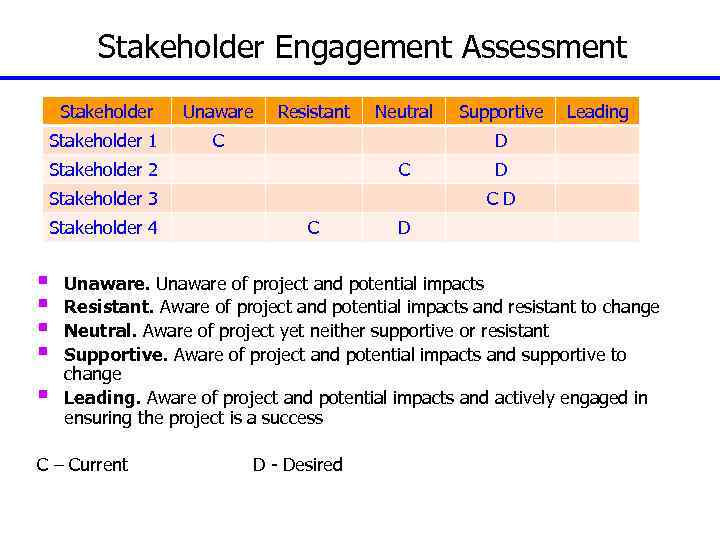 Stakeholder Engagement Assessment Stakeholder Unaware Stakeholder 1 Resistant Neutral C C Stakeholder 3 § § § Leading D Stakeholder 2 Stakeholder 4 Supportive D C D Unaware of project and potential impacts Resistant. Aware of project and potential impacts and resistant to change Neutral. Aware of project yet neither supportive or resistant Supportive. Aware of project and potential impacts and supportive to change Leading. Aware of project and potential impacts and actively engaged in ensuring the project is a success C – Current D - Desired 49
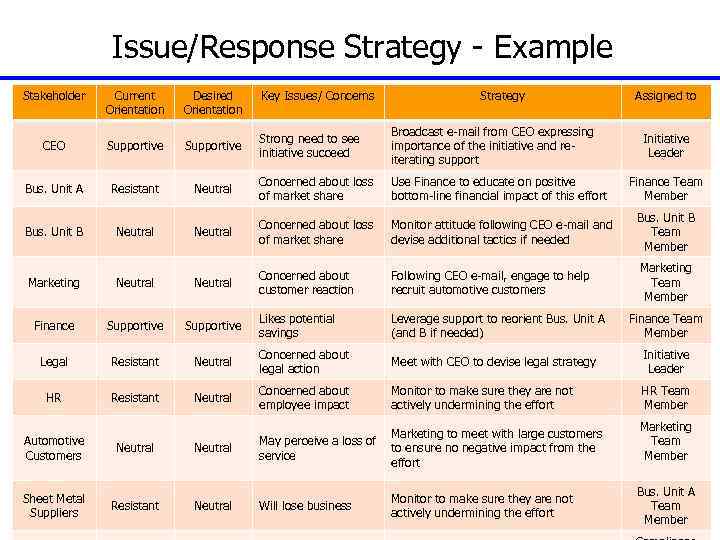 Issue/Response Strategy - Example Stakeholder Current Orientation Desired Orientation Key Issues/ Concerns Strategy Strong need to see initiative succeed Broadcast e-mail from CEO expressing importance of the initiative and reiterating support Assigned to Initiative Leader CEO Supportive Bus. Unit A Resistant Neutral Concerned about loss of market share Use Finance to educate on positive bottom-line financial impact of this effort Monitor attitude following CEO e-mail and devise additional tactics if needed Bus. Unit B Team Member Marketing Team Member Finance Team Member Bus. Unit B Neutral Concerned about loss of market share Marketing Neutral Concerned about customer reaction Following CEO e-mail, engage to help recruit automotive customers Finance Supportive Likes potential savings Leverage support to reorient Bus. Unit A (and B if needed) Legal Resistant Neutral Concerned about legal action Meet with CEO to devise legal strategy Initiative Leader HR Resistant Neutral Concerned about employee impact Monitor to make sure they are not actively undermining the effort HR Team Member Neutral Marketing to meet with large customers May perceive a loss of to ensure no negative impact from the service effort Automotive Customers Sheet Metal Suppliers Neutral Resistant Neutral Will lose business Monitor to make sure they are not actively undermining the effort Finance Team Member Marketing Team Member Bus. Unit A Team 50 Member
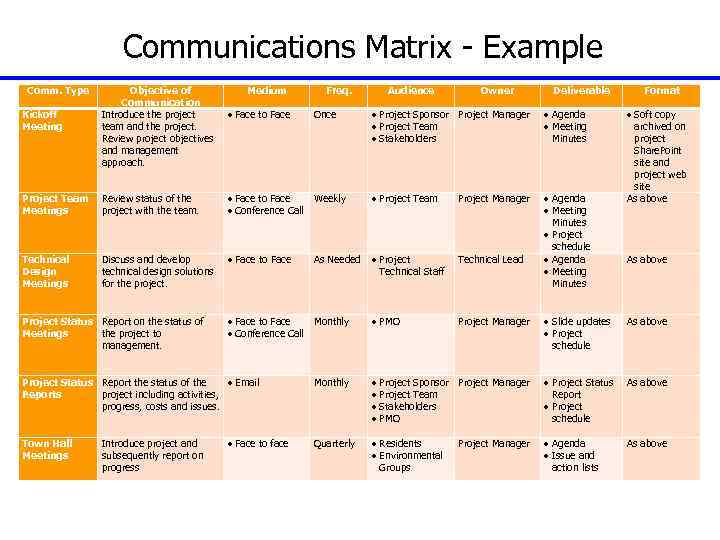 Communications Matrix - Example Comm. Type Kickoff Meeting Objective of Communication Introduce the project team and the project. Review project objectives and management approach. Medium Face to Face Freq. Once Audience Owner Project Sponsor Project Manager Project Team Stakeholders Agenda Meeting Minutes Project schedule Agenda Meeting Minutes Project Team Meetings Review status of the project with the team. Face to Face Weekly Conference Call Project Team Project Manager Technical Design Meetings Discuss and develop technical design solutions for the project. Face to Face Project Technical Staff Technical Lead PMO Project Manager Project Status Report on the status of Meetings the project to management. Face to Face Monthly Conference Call Project Status Report the status of the Email Reports project including activities, progress, costs and issues. Town Hall Meetings Introduce project and subsequently report on progress As Needed Face to face Deliverable Format Soft copy archived on project Share. Point site and project web site As above Slide updates Project schedule As above Monthly Project Sponsor Project Manager Project Team Stakeholders PMO Project Status Report Project schedule As above Quarterly Residents Environmental Groups Agenda Issue and action lists As above Project Manager 51
 Exercise 2: Stakeholders § Identify the key and other stakeholders in the House § § Renovation Project Carry out a Stakeholder Analysis Outline a high level Communication Plan for the Project, as applicable 52
 Module 5 Procurement Strategy 53
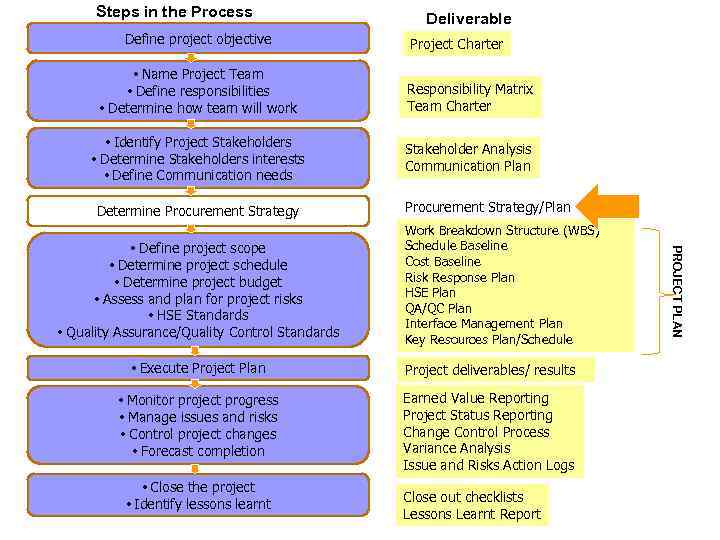 Steps in the Process Define project objective Deliverable Project Charter • Name Project Team • Define responsibilities • Determine how team will work Responsibility Matrix Team Charter • Identify Project Stakeholders • Determine Stakeholders interests • Define Communication needs Stakeholder Analysis Communication Plan Determine Procurement Strategy Work Breakdown Structure (WBS) Schedule Baseline Cost Baseline Risk Response Plan HSE Plan QA/QC Plan Interface Management Plan Key Resources Plan/Schedule • Execute Project Plan Project deliverables/ results • Monitor project progress • Manage issues and risks • Control project changes • Forecast completion PROJECT PLAN • Define project scope • Determine project schedule • Determine project budget • Assess and plan for project risks • HSE Standards • Quality Assurance/Quality Control Standards Procurement Strategy/Plan Earned Value Reporting Project Status Reporting Change Control Process Variance Analysis Issue and Risks Action Logs • Close the project • Identify lessons learnt Close out checklists Lessons Learnt Report 54
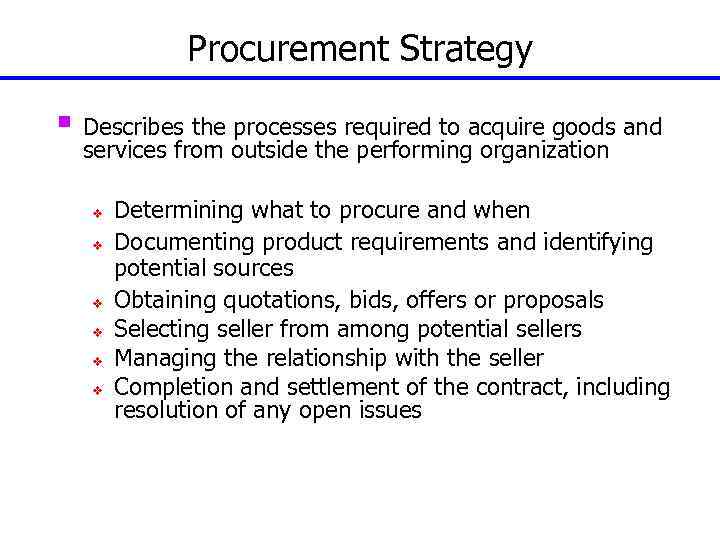 Procurement Strategy § Describes the processes required to acquire goods and services from outside the performing organization v v v Determining what to procure and when Documenting product requirements and identifying potential sources Obtaining quotations, bids, offers or proposals Selecting seller from among potential sellers Managing the relationship with the seller Completion and settlement of the contract, including resolution of any open issues
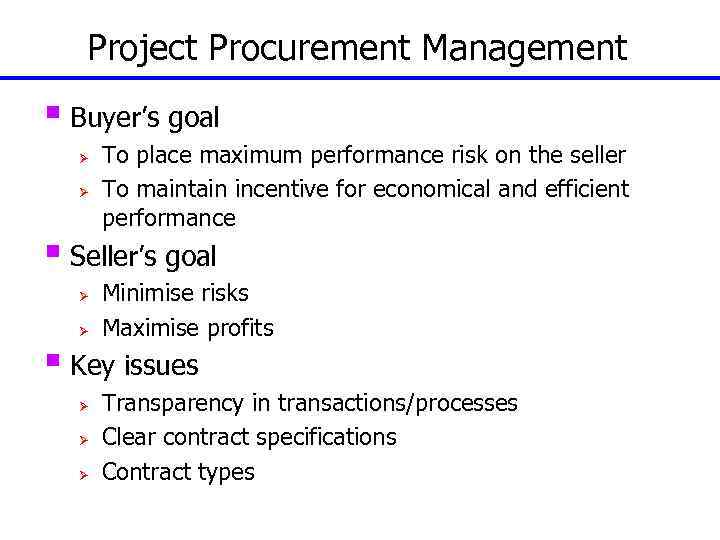 Project Procurement Management § Buyer’s goal Ø Ø To place maximum performance risk on the seller To maintain incentive for economical and efficient performance § Seller’s goal Ø Ø Minimise risks Maximise profits § Key issues Ø Ø Ø Transparency in transactions/processes Clear contract specifications Contract types
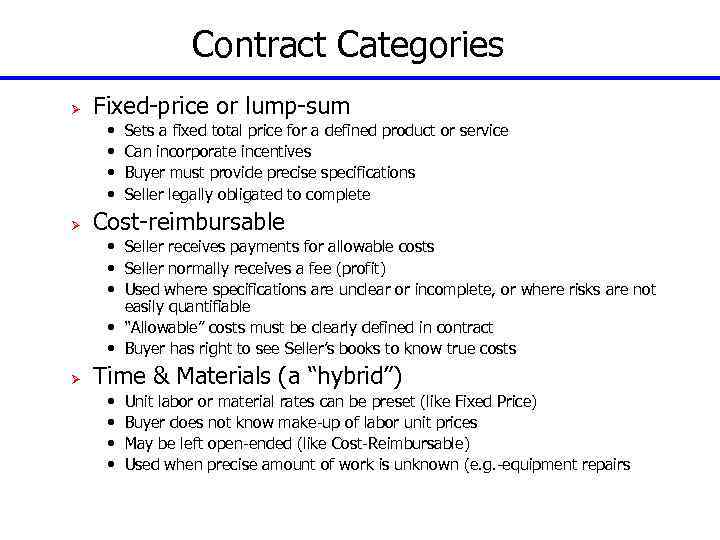 Contract Categories Ø Fixed-price or lump-sum • • Ø Sets a fixed total price for a defined product or service Can incorporate incentives Buyer must provide precise specifications Seller legally obligated to complete Cost-reimbursable • Seller receives payments for allowable costs • Seller normally receives a fee (profit) • Used where specifications are unclear or incomplete, or where risks are not easily quantifiable • “Allowable” costs must be clearly defined in contract • Buyer has right to see Seller’s books to know true costs Ø Time & Materials (a “hybrid”) • • Unit labor or material rates can be preset (like Fixed Price) Buyer does not know make-up of labor unit prices May be left open-ended (like Cost-Reimbursable) Used when precise amount of work is unknown (e. g. -equipment repairs
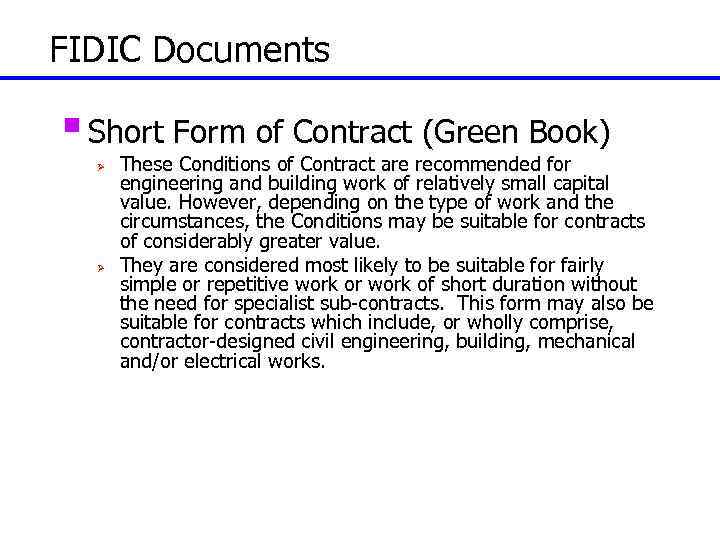 FIDIC Documents § Short Form of Contract (Green Book) Ø Ø These Conditions of Contract are recommended for engineering and building work of relatively small capital value. However, depending on the type of work and the circumstances, the Conditions may be suitable for contracts of considerably greater value. They are considered most likely to be suitable for fairly simple or repetitive work or work of short duration without the need for specialist sub-contracts. This form may also be suitable for contracts which include, or wholly comprise, contractor-designed civil engineering, building, mechanical and/or electrical works.
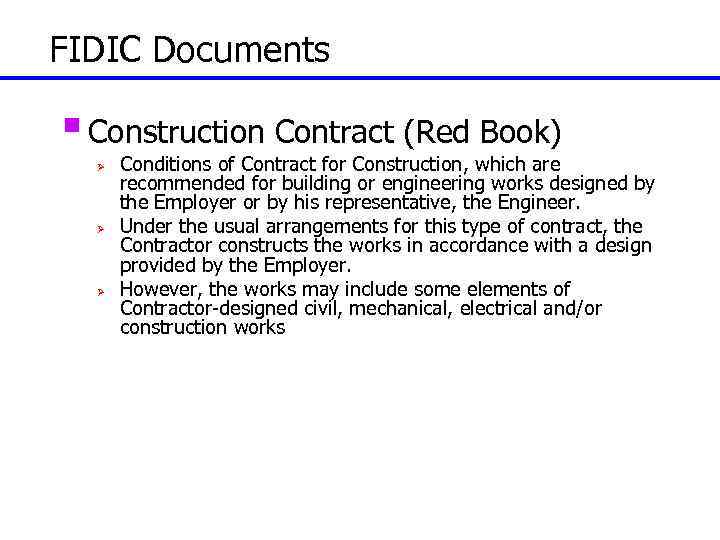 FIDIC Documents § Construction Contract (Red Book) Ø Ø Ø Conditions of Contract for Construction, which are recommended for building or engineering works designed by the Employer or by his representative, the Engineer. Under the usual arrangements for this type of contract, the Contractor constructs the works in accordance with a design provided by the Employer. However, the works may include some elements of Contractor-designed civil, mechanical, electrical and/or construction works
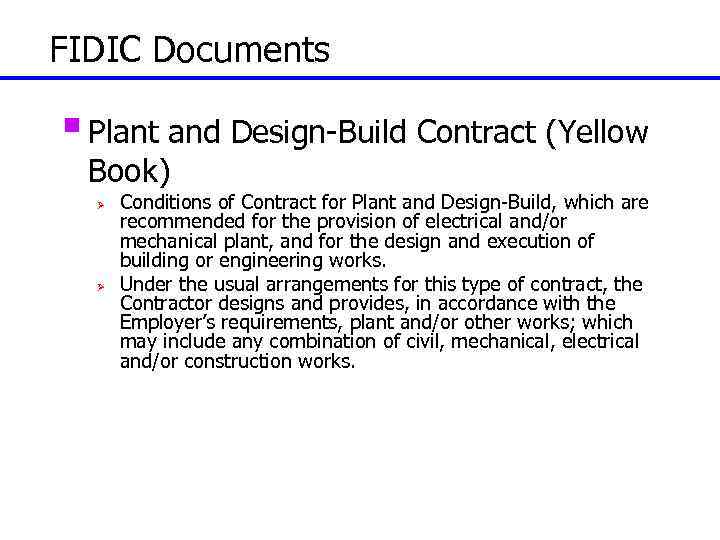 FIDIC Documents § Plant and Design-Build Contract (Yellow Book) Ø Ø Conditions of Contract for Plant and Design-Build, which are recommended for the provision of electrical and/or mechanical plant, and for the design and execution of building or engineering works. Under the usual arrangements for this type of contract, the Contractor designs and provides, in accordance with the Employer’s requirements, plant and/or other works; which may include any combination of civil, mechanical, electrical and/or construction works.
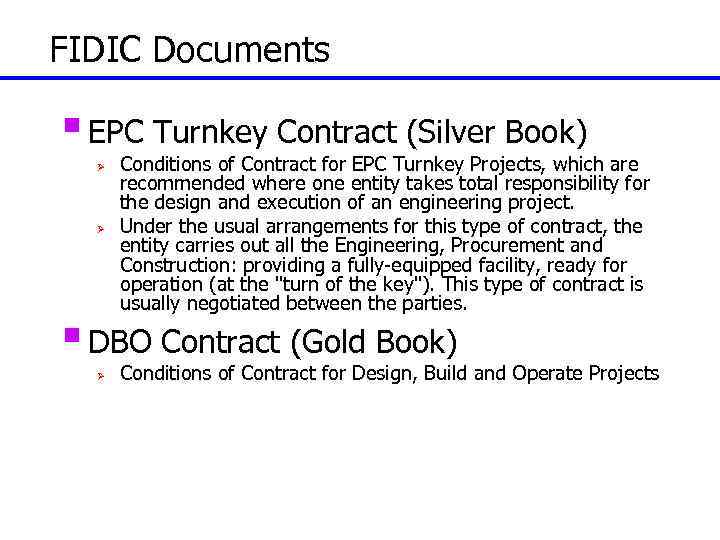 FIDIC Documents § EPC Turnkey Contract (Silver Book) Ø Ø Conditions of Contract for EPC Turnkey Projects, which are recommended where one entity takes total responsibility for the design and execution of an engineering project. Under the usual arrangements for this type of contract, the entity carries out all the Engineering, Procurement and Construction: providing a fully-equipped facility, ready for operation (at the "turn of the key"). This type of contract is usually negotiated between the parties. § DBO Contract (Gold Book) Ø Conditions of Contract for Design, Build and Operate Projects
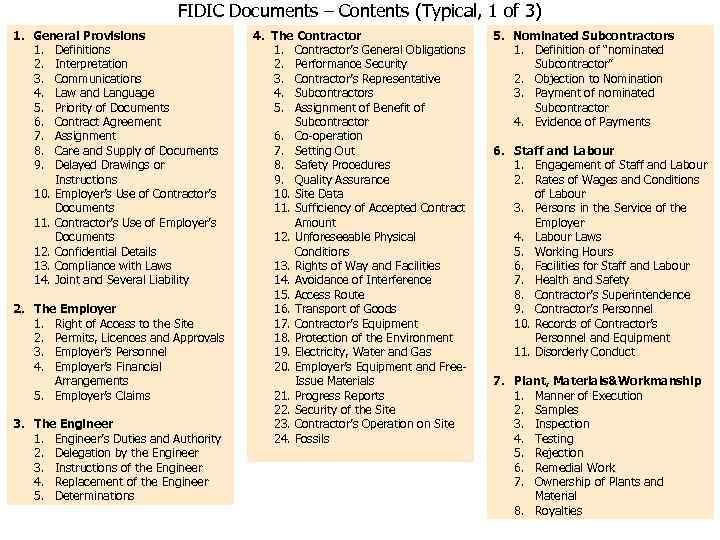 FIDIC Documents – Contents (Typical, 1 of 3) 1. General Provisions 1. Definitions 2. Interpretation 3. Communications 4. Law and Language 5. Priority of Documents 6. Contract Agreement 7. Assignment 8. Care and Supply of Documents 9. Delayed Drawings or Instructions 10. Employer’s Use of Contractor’s Documents 11. Contractor’s Use of Employer’s Documents 12. Confidential Details 13. Compliance with Laws 14. Joint and Several Liability 2. The Employer 1. Right of Access to the Site 2. Permits, Licences and Approvals 3. Employer’s Personnel 4. Employer’s Financial Arrangements 5. Employer’s Claims 3. The Engineer 1. Engineer’s Duties and Authority 2. Delegation by the Engineer 3. Instructions of the Engineer 4. Replacement of the Engineer 5. Determinations 4. The Contractor 1. Contractor’s General Obligations 2. Performance Security 3. Contractor’s Representative 4. Subcontractors 5. Assignment of Benefit of Subcontractor 6. Co-operation 7. Setting Out 8. Safety Procedures 9. Quality Assurance 10. Site Data 11. Sufficiency of Accepted Contract Amount 12. Unforeseeable Physical Conditions 13. Rights of Way and Facilities 14. Avoidance of Interference 15. Access Route 16. Transport of Goods 17. Contractor’s Equipment 18. Protection of the Environment 19. Electricity, Water and Gas 20. Employer’s Equipment and Free. Issue Materials 21. Progress Reports 22. Security of the Site 23. Contractor’s Operation on Site 24. Fossils 5. Nominated Subcontractors 1. Definition of “nominated Subcontractor” 2. Objection to Nomination 3. Payment of nominated Subcontractor 4. Evidence of Payments 6. Staff and Labour 1. Engagement of Staff and Labour 2. Rates of Wages and Conditions of Labour 3. Persons in the Service of the Employer 4. Labour Laws 5. Working Hours 6. Facilities for Staff and Labour 7. Health and Safety 8. Contractor’s Superintendence 9. Contractor’s Personnel 10. Records of Contractor’s Personnel and Equipment 11. Disorderly Conduct 7. Plant, Materials&Workmanship 1. Manner of Execution 2. Samples 3. Inspection 4. Testing 5. Rejection 6. Remedial Work 7. Ownership of Plants and Material 8. Royalties
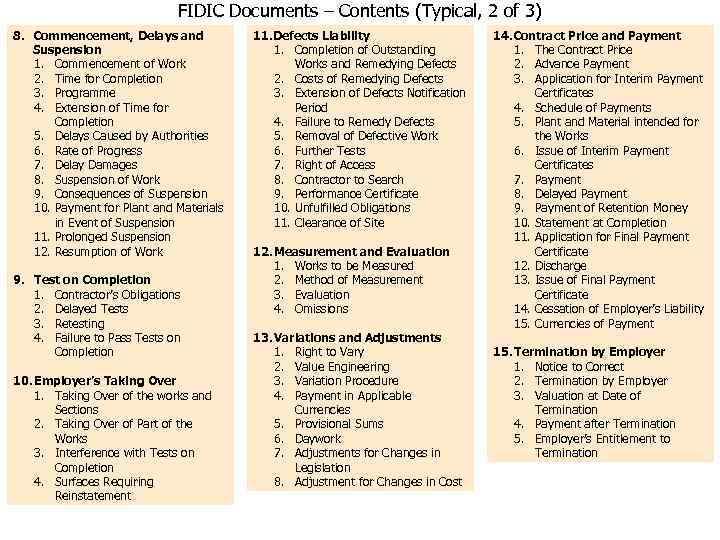 FIDIC Documents – Contents (Typical, 2 of 3) 8. Commencement, Delays and Suspension 1. Commencement of Work 2. Time for Completion 3. Programme 4. Extension of Time for Completion 5. Delays Caused by Authorities 6. Rate of Progress 7. Delay Damages 8. Suspension of Work 9. Consequences of Suspension 10. Payment for Plant and Materials in Event of Suspension 11. Prolonged Suspension 12. Resumption of Work 9. Test on Completion 1. Contractor’s Obligations 2. Delayed Tests 3. Retesting 4. Failure to Pass Tests on Completion 10. Employer’s Taking Over 1. Taking Over of the works and Sections 2. Taking Over of Part of the Works 3. Interference with Tests on Completion 4. Surfaces Requiring Reinstatement 11. Defects Liability 1. Completion of Outstanding Works and Remedying Defects 2. Costs of Remedying Defects 3. Extension of Defects Notification Period 4. Failure to Remedy Defects 5. Removal of Defective Work 6. Further Tests 7. Right of Access 8. Contractor to Search 9. Performance Certificate 10. Unfulfilled Obligations 11. Clearance of Site 12. Measurement and Evaluation 1. Works to be Measured 2. Method of Measurement 3. Evaluation 4. Omissions 13. Variations and Adjustments 1. Right to Vary 2. Value Engineering 3. Variation Procedure 4. Payment in Applicable Currencies 5. Provisional Sums 6. Daywork 7. Adjustments for Changes in Legislation 8. Adjustment for Changes in Cost 14. Contract Price and Payment 1. The Contract Price 2. Advance Payment 3. Application for Interim Payment Certificates 4. Schedule of Payments 5. Plant and Material intended for the Works 6. Issue of Interim Payment Certificates 7. Payment 8. Delayed Payment 9. Payment of Retention Money 10. Statement at Completion 11. Application for Final Payment Certificate 12. Discharge 13. Issue of Final Payment Certificate 14. Cessation of Employer’s Liability 15. Currencies of Payment 15. Termination by Employer 1. Notice to Correct 2. Termination by Employer 3. Valuation at Date of Termination 4. Payment after Termination 5. Employer’s Entitlement to Termination
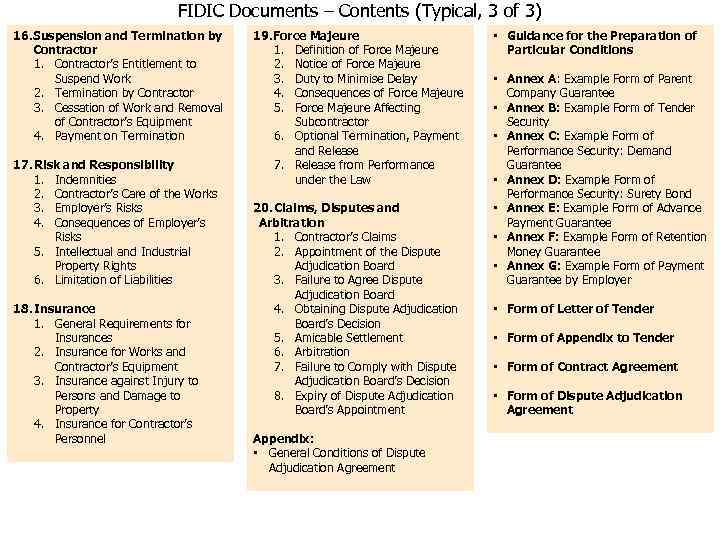 FIDIC Documents – Contents (Typical, 3 of 3) 16. Suspension and Termination by Contractor 1. Contractor’s Entitlement to Suspend Work 2. Termination by Contractor 3. Cessation of Work and Removal of Contractor’s Equipment 4. Payment on Termination 17. Risk and Responsibility 1. Indemnities 2. Contractor’s Care of the Works 3. Employer’s Risks 4. Consequences of Employer’s Risks 5. Intellectual and Industrial Property Rights 6. Limitation of Liabilities 18. Insurance 1. General Requirements for Insurances 2. Insurance for Works and Contractor’s Equipment 3. Insurance against Injury to Persons and Damage to Property 4. Insurance for Contractor’s Personnel 19. Force Majeure 1. Definition of Force Majeure 2. Notice of Force Majeure 3. Duty to Minimise Delay 4. Consequences of Force Majeure 5. Force Majeure Affecting Subcontractor 6. Optional Termination, Payment and Release 7. Release from Performance under the Law 20. Claims, Disputes and Arbitration 1. Contractor’s Claims 2. Appointment of the Dispute Adjudication Board 3. Failure to Agree Dispute Adjudication Board 4. Obtaining Dispute Adjudication Board’s Decision 5. Amicable Settlement 6. Arbitration 7. Failure to Comply with Dispute Adjudication Board’s Decision 8. Expiry of Dispute Adjudication Board’s Appointment Appendix: • General Conditions of Dispute Adjudication Agreement • Guidance for the Preparation of Particular Conditions • Annex A: Example Form of Parent Company Guarantee • Annex B: Example Form of Tender Security • Annex C: Example Form of Performance Security: Demand Guarantee • Annex D: Example Form of Performance Security: Surety Bond • Annex E: Example Form of Advance Payment Guarantee • Annex F: Example Form of Retention Money Guarantee • Annex G: Example Form of Payment Guarantee by Employer • Form of Letter of Tender • Form of Appendix to Tender • Form of Contract Agreement • Form of Dispute Adjudication Agreement
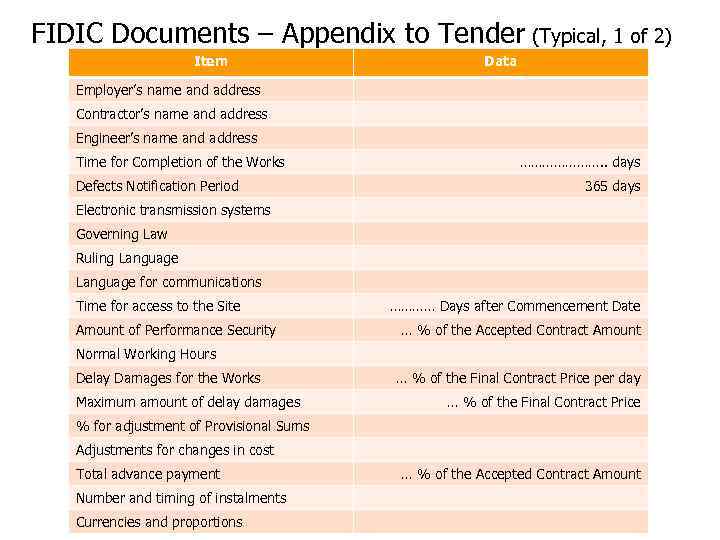 FIDIC Documents – Appendix to Tender (Typical, 1 of 2) Item Data Employer’s name and address Contractor’s name and address Engineer’s name and address Time for Completion of the Works Defects Notification Period …………………. . days 365 days Electronic transmission systems Governing Law Ruling Language for communications Time for access to the Site Amount of Performance Security ………… Days after Commencement Date … % of the Accepted Contract Amount Normal Working Hours Delay Damages for the Works Maximum amount of delay damages … % of the Final Contract Price per day … % of the Final Contract Price % for adjustment of Provisional Sums Adjustments for changes in cost Total advance payment Number and timing of instalments Currencies and proportions … % of the Accepted Contract Amount
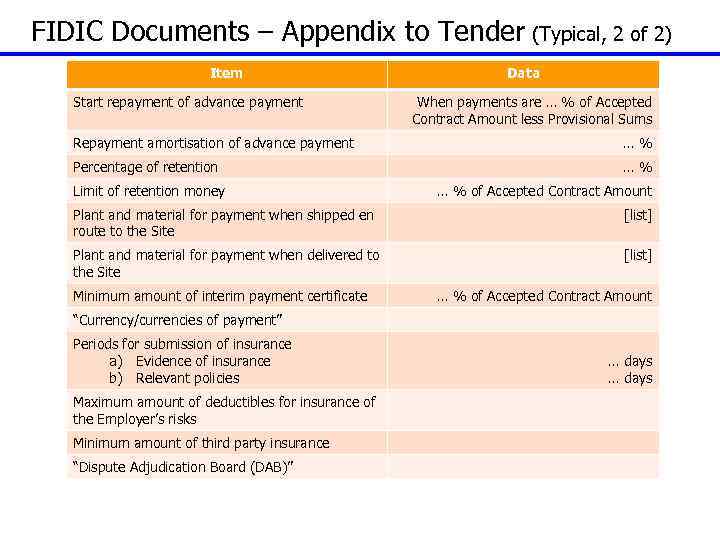 FIDIC Documents – Appendix to Tender (Typical, 2 of 2) Item Start repayment of advance payment Data When payments are … % of Accepted Contract Amount less Provisional Sums Repayment amortisation of advance payment … % Percentage of retention … % Limit of retention money … % of Accepted Contract Amount Plant and material for payment when shipped en route to the Site [list] Plant and material for payment when delivered to the Site [list] Minimum amount of interim payment certificate … % of Accepted Contract Amount “Currency/currencies of payment” Periods for submission of insurance a) Evidence of insurance b) Relevant policies Maximum amount of deductibles for insurance of the Employer’s risks Minimum amount of third party insurance “Dispute Adjudication Board (DAB)” … days
 Bonds: Bid Bonds § Bid (Tender) Bonds Ø Ø An indication of your Company’s ability to carry out the work being bid on Sought by the Buyer to provide a surety should the successful bidder fail to proceed with the contract for any reason Used as a financial fall-back in the event the successful contracting party is unable/unwilling to accept the award of the contract or meet any of its conditions, and it becomes necessary to place the project, or any part of it, out for bid again Benefits • Demonstrates to the Buyer that the bidder is reliable, a sound business and has the ability to carry out the work being bid for • Indicates that your bid is genuine and you have a firm commitment to the project • Secures payment for the Buyer of the guaranteed amount in the event of: – Withdrawal of offer before its expiration date – Repudiation of the contract by the bidder after being awarded – Failure of the successful bidder to provide a replacement Performance Bond
 Bonds: Performance Bonds § Performance Bonds Ø Presented by the successful bidder after being awarded the contract Ø Is an indication that your company has the necessary skills and capabilities to carry out the required work and comply with the agreed terms and conditions of the contract Ø Benefits: • Demonstrates to the Buyer that the bidder has the required skills and financial strength to complete the contract • Pays for completion of the work in the event the contract is not fulfilled
 Bonds: Advance Bonds, Maintenance Bond § Advance Payment Bond is a Guarantee supplied by a § § party receiving an advance payment to the party advancing the payment. It provides that the advanced sum will be returned if the agreement under which the advance was made cannot be fulfilled. Payment Bond protects subcontractors and suppliers by guaranteeing that all claimants will be paid for labor and materials supplied to the contractor for use on the bonded job Maintenance bond guarantees that for a stated period, usually one year, that any defective workmanship or material will be repaired
 Insurance § § § Public liability insurance protects the Contractor and his business against the financial risk of being found liable to a third party and/or the public for death or injury, loss or damage of property or economic loss resulting from his negligence. Mandatory by law Workmen’s Compensation provides for the payment of compensation to workmen for injuries suffered during the course of employment. Mandatory by law Professional indemnity insurance protects advice-based businesses from legal action taken for losses incurred as a result of professional negligence. It provides indemnity cover if the client suffers a loss - material, financial or physical - directly attributed to negligent acts, errors or omissions. 70
 Insurance: Builder’s Risk § Builder's Risk insurance, also known as "course of § § construction", "construction all risk", and "contractor's all risk insurance", is designed to insure buildings or projects against repair or replacement costs while they are under construction and, in some cases, for a specified period afterwards. This insurance will usually also cover build materials, fixtures and appliances all of which are intended to become an integral part of the structure under construction as well as temporary works to facilitate construction. Can be procured by Contractor or Client 71
 Exercise 3: Procurement Strategy § Suggest a high level procurement strategy for the provision of goods and services to accomplish the House Renovation Project 72
 Module 6 Project Plan 73
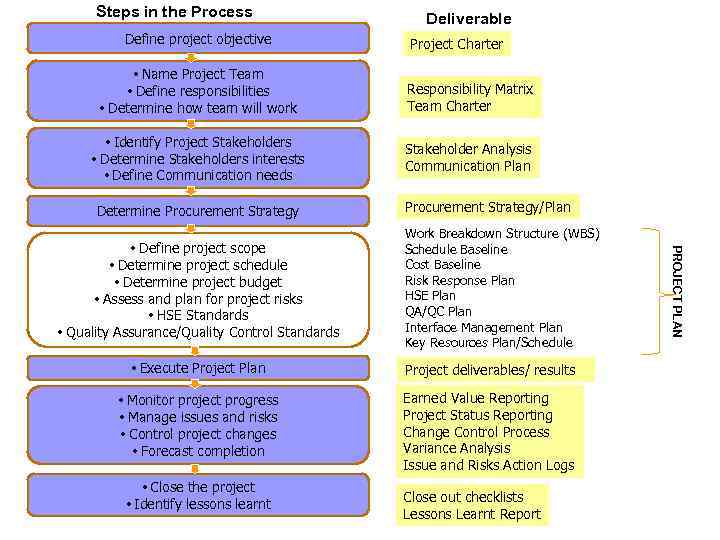 Steps in the Process Define project objective Deliverable Project Charter • Name Project Team • Define responsibilities • Determine how team will work Responsibility Matrix Team Charter • Identify Project Stakeholders • Determine Stakeholders interests • Define Communication needs Stakeholder Analysis Communication Plan Determine Procurement Strategy Work Breakdown Structure (WBS) Schedule Baseline Cost Baseline Risk Response Plan HSE Plan QA/QC Plan Interface Management Plan Key Resources Plan/Schedule • Execute Project Plan Project deliverables/ results • Monitor project progress • Manage issues and risks • Control project changes • Forecast completion PROJECT PLAN • Define project scope • Determine project schedule • Determine project budget • Assess and plan for project risks • HSE Standards • Quality Assurance/Quality Control Standards Procurement Strategy/Plan Earned Value Reporting Project Status Reporting Change Control Process Variance Analysis Issue and Risks Action Logs • Close the project • Identify lessons learnt Close out checklists Lessons Learnt Report 74
 Project Scope Definition § Project scope defines the services, equipment, and materials to be provided and the work to be accomplished based on contract parameters Purpose § To develop an understanding of the project’s content and complexity; to determine what work will be done for the project and how it will be done 75
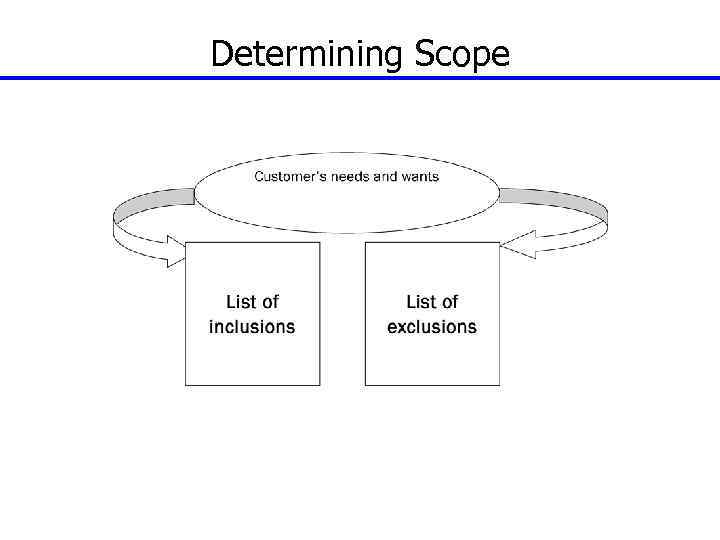 Determining Scope 76
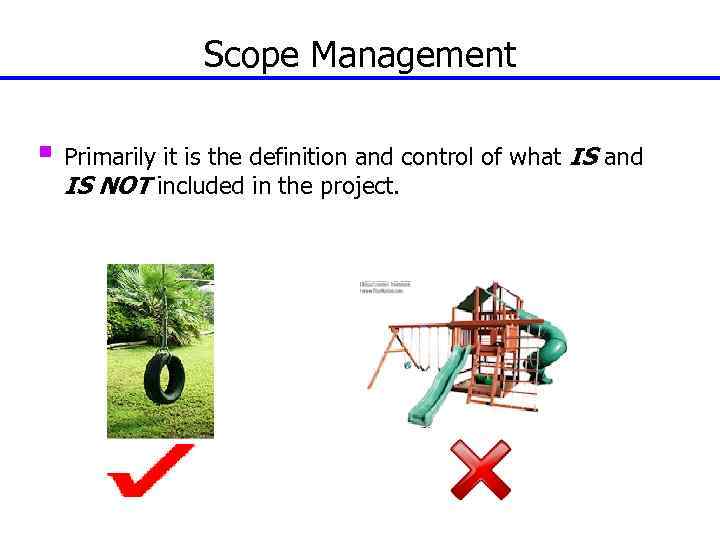 Scope Management § Primarily it is the definition and control of what IS and IS NOT included in the project.
 Scope Statement § Product Scope Description Ø § § Product Acceptance Criteria Ø Generally identifies what is excluded from the project. Explicitly stating what is out of scope for the project helps to manage stakeholders expectations Project Constraints Ø § Deliverables include both the outputs that comprise the product or service of the project, as well as ancillary results, such as project management reports and documentation. Project Exclusions Ø § Defines the process and criteria for accepting completed products, services or results Project Deliverables Ø § Progressively elaborates the characteristics of the product, service, or result described in the project charter and requirements documentation Lists and describes the specific project constraints associated with the project scope that limits the team’s options, for example, a predefined budget or any imposed dates or schedule milestones that are issued by the customer or performing organisation Project Assumptions Ø Lists and describes the specific project assumptions associated with the project scope and the potential impacts of these assumptions if they prove to be false 78
 Create WBS Subdividing the major project deliverables and project work into smaller, more manageable components
 Work Breakdown Structure ØThe WBS Ø Is the scope of work ØThe WBS helps Ø Ø The customer, management, and the technical team visualize the project The project team communicate Build the foundation for the schedule and cost performance measurement Facilitate assignment of task accountability
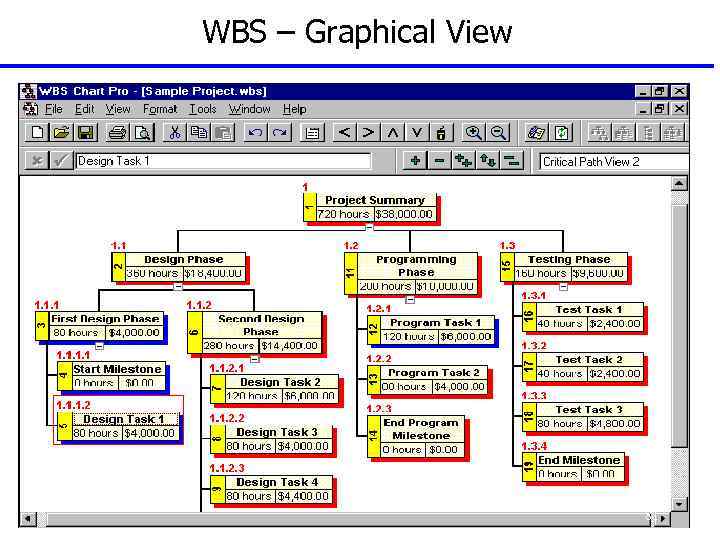 WBS – Graphical View 81
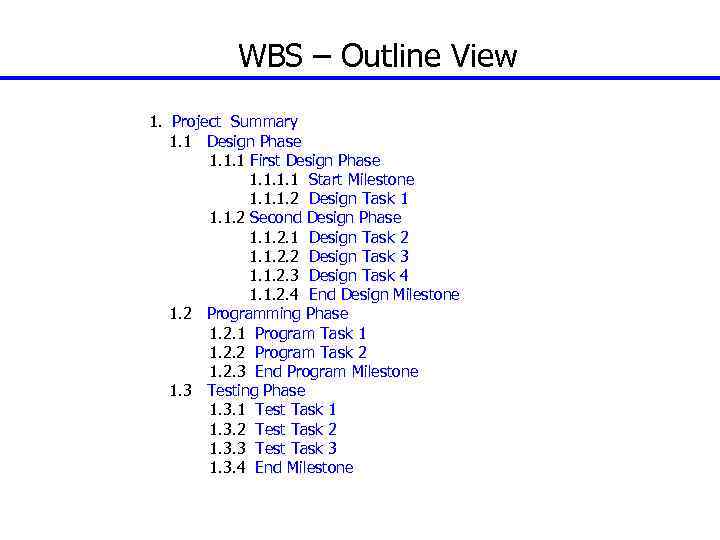 WBS – Outline View 1. Project Summary 1. 1 Design Phase 1. 1. 1 First Design Phase 1. 1 Start Milestone 1. 1. 1. 2 Design Task 1 1. 1. 2 Second Design Phase 1. 1. 2. 1 Design Task 2 1. 1. 2. 2 Design Task 3 1. 1. 2. 3 Design Task 4 1. 1. 2. 4 End Design Milestone 1. 2 Programming Phase 1. 2. 1 Program Task 1 1. 2. 2 Program Task 2 1. 2. 3 End Program Milestone 1. 3 Testing Phase 1. 3. 1 Test Task 1 1. 3. 2 Test Task 2 1. 3. 3 Test Task 3 1. 3. 4 End Milestone 82
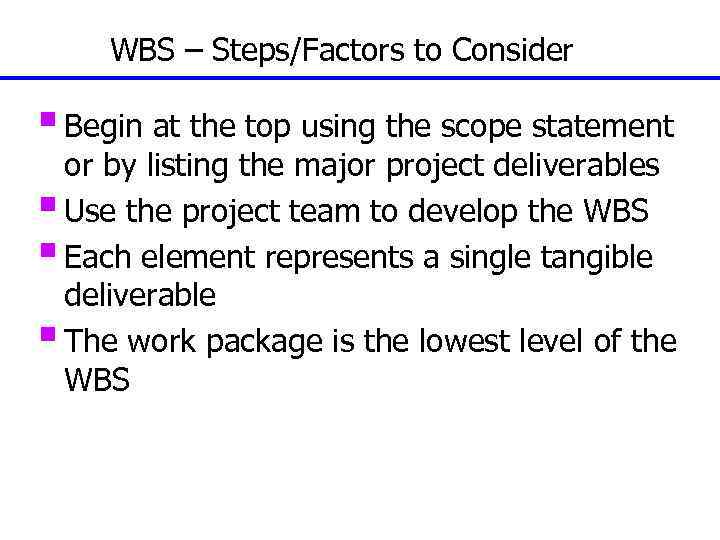 WBS – Steps/Factors to Consider § Begin at the top using the scope statement or by listing the major project deliverables § Use the project team to develop the WBS § Each element represents a single tangible deliverable § The work package is the lowest level of the WBS 83
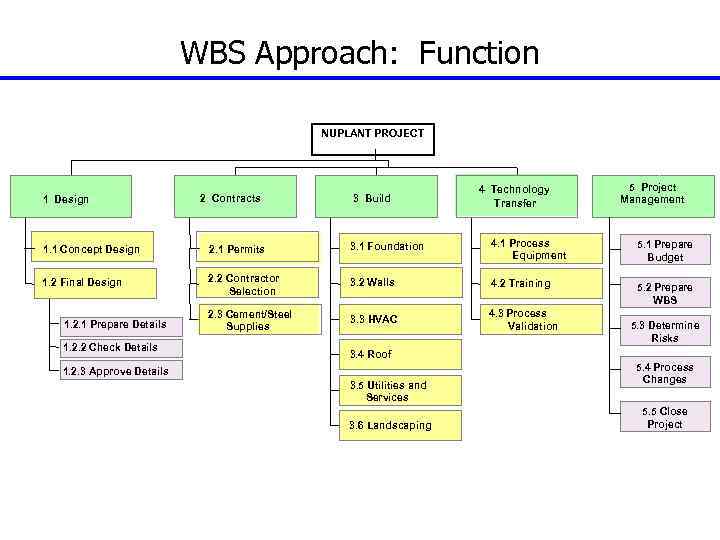 WBS Approach: Function NUPLANT PROJECT 1 Design 2 Contracts 3 Build 4 Technology Transfer 5 Project Management 1. 1 Concept Design 2. 1 Permits 3. 1 Foundation 4. 1 Process Equipment 5. 1 Prepare Budget 1. 2 Final Design 2. 2 Contractor Selection 3. 2 Walls 4. 2 Training 5. 2 Prepare WBS 2. 3 Cement/Steel Supplies 3. 3 HVAC 4. 3 Process Validation 1. 2. 1 Prepare Details 1. 2. 2 Check Details 5. 3 Determine Risks 3. 4 Roof 1. 2. 3 Approve Details 3. 5 Utilities and Services 3. 6 Landscaping 5. 4 Process Changes 5. 5 Close Project
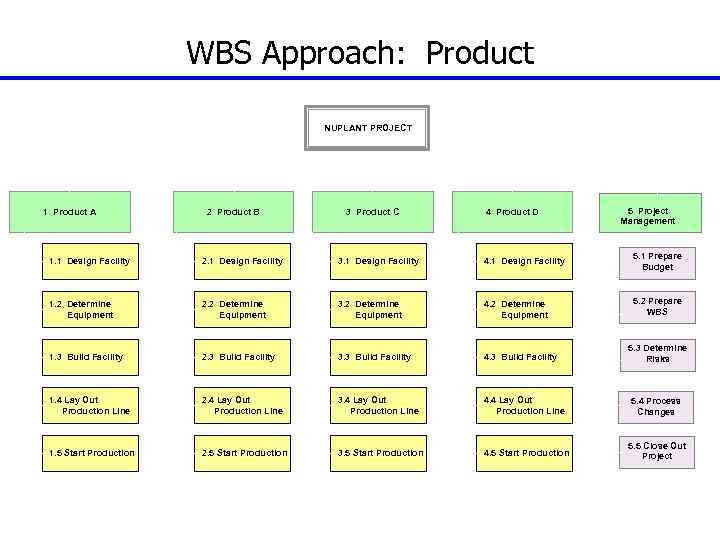 WBS Approach: Product NUPLANT PROJECT 1 Product A 2 Product B 3 Product C 4 Product D 5 Project Management 1. 1 Design Facility 2. 1 Design Facility 3. 1 Design Facility 4. 1 Design Facility 5. 1 Prepare Budget 1. 2 Determine Equipment 2. 2 Determine Equipment 3. 2 Determine Equipment 4. 2 Determine Equipment 5. 2 Prepare WBS 1. 3 Build Facility 2. 3 Build Facility 3. 3 Build Facility 4. 3 Build Facility 1. 4 Lay Out Production Line 2. 4 Lay Out Production Line 3. 4 Lay Out Production Line 4. 4 Lay Out Production Line 5. 4 Process Changes 1. 5 Start Production 2. 5 Start Production 3. 5 Start Production 4. 5 Start Production 5. 5 Close Out Project 5. 3 Determine Risks
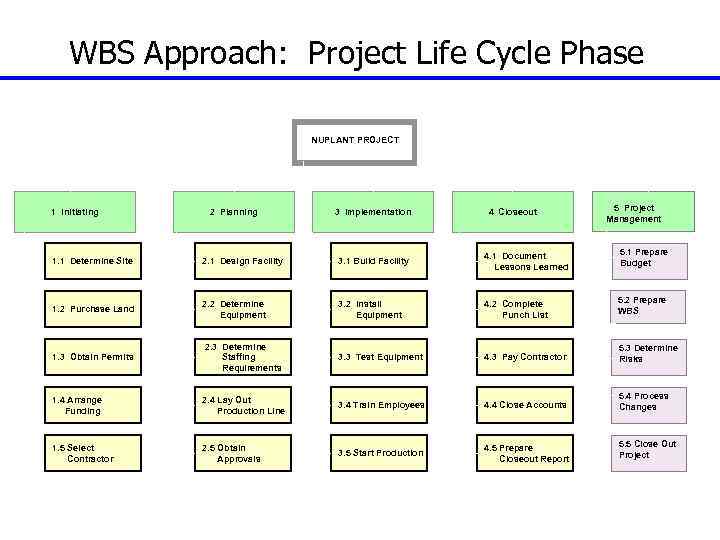 WBS Approach: Project Life Cycle Phase NUPLANT PROJECT 1 Initiating 2 Planning 3 Implementation 4 Closeout 5 Project Management 1. 1 Determine Site 2. 1 Design Facility 3. 1 Build Facility 4. 1 Document Lessons Learned 5. 1 Prepare Budget 1. 2 Purchase Land 2. 2 Determine Equipment 3. 2 Install Equipment 4. 2 Complete Punch List 5. 2 Prepare WBS 1. 3 Obtain Permits 2. 3 Determine Staffing Requirements 3. 3 Test Equipment 4. 3 Pay Contractor 5. 3 Determine Risks 1. 4 Arrange Funding 2. 4 Lay Out Production Line 3. 4 Train Employees 4. 4 Close Accounts 5. 4 Process Changes 1. 5 Select Contractor 2. 5 Obtain Approvals 3. 5 Start Production 4. 5 Prepare Closeout Report 5. 5 Close Out Project
 Exercise 4: Work Breakdown Structure § Use the sample Project Charter provided by the facilitator and your own knowledge and experience to prepare a WBS for the House Renovation Project 87
 Project Schedule § Develop Schedule is the process of analysing activity sequences, durations, resource requirements, and schedule constraints to create the project schedule Purpose § To determine whether it is possible to meet the project objectives § To track and communicate on project progress and status § To determine how possible changes could impact on the project 88
 Activity Sequencing Identifying and documenting dependencies among schedule activities 89
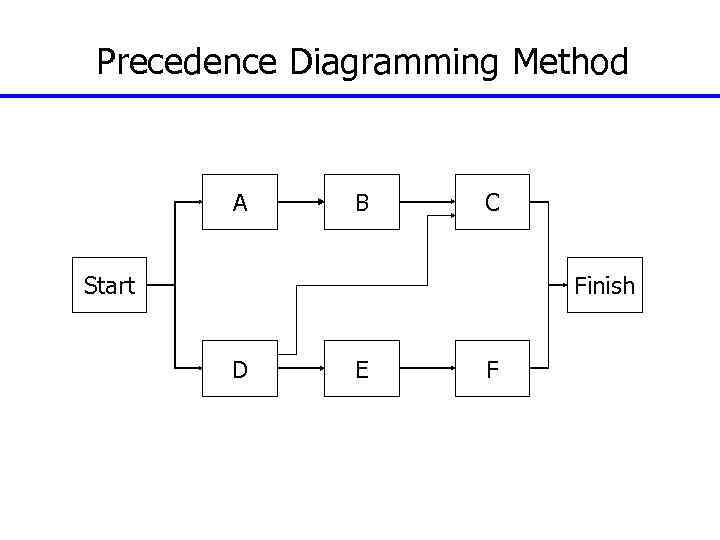 Precedence Diagramming Method A B C Start Finish D E F 90
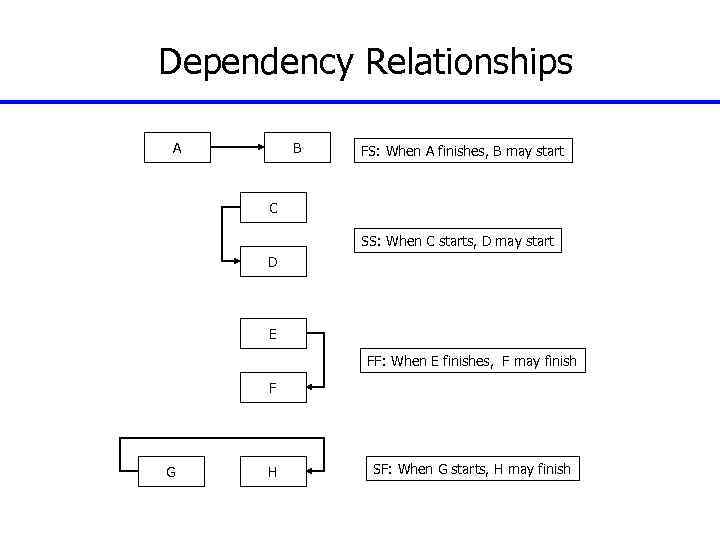 Dependency Relationships A B FS: When A finishes, B may start C SS: When C starts, D may start D E FF: When E finishes, F may finish F G H SF: When G starts, H may finish 91
 Lag and Lead § Lag Ø A fixed duration between a predecessor and successor § Lead Ø Overlap between successor and predecessor (Negative lag) 92
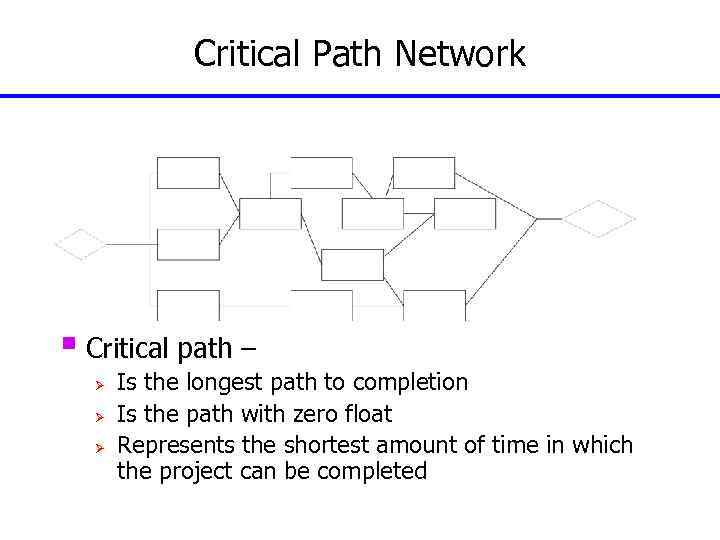 Critical Path Network Finish Start § Critical path – Ø Ø Ø Is the longest path to completion Is the path with zero float Represents the shortest amount of time in which the project can be completed 93
 Schedule Terminology Activity – a work element that consumes time and resources Relationships – dependencies that exist between activities Early start/early finish – earliest that a task can begin or finish based on the forward pass Late start/late finish – the latest that a task can begin or finish based on the backward pass 94
 Schedule Terminology (Cont’d) Float – amount of time an activity can be delayed from its early start and/or early finish without delaying the project finish date Critical Path – longest path through network; also the shortest possible duration of the project Lag/lead time – fixed delay/overlap between activity start/finish Predecessor – the “from” activity Successor – the “to” activity 95
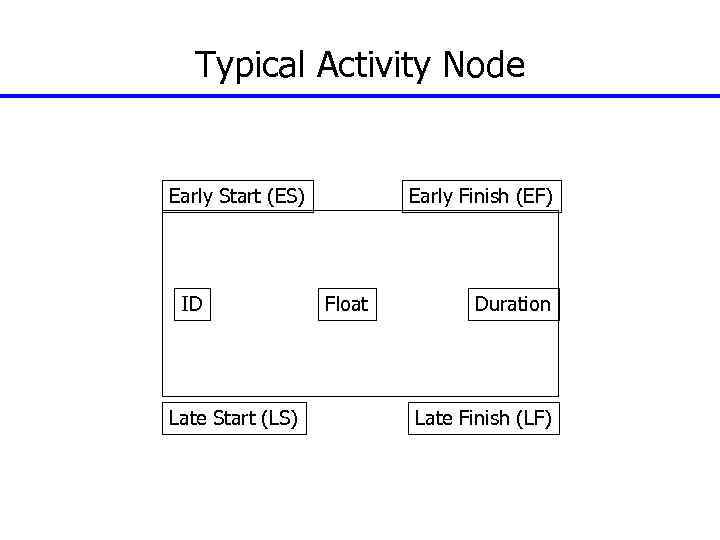 Typical Activity Node Early Start (ES) ID Late Start (LS) Early Finish (EF) Float Duration Late Finish (LF)
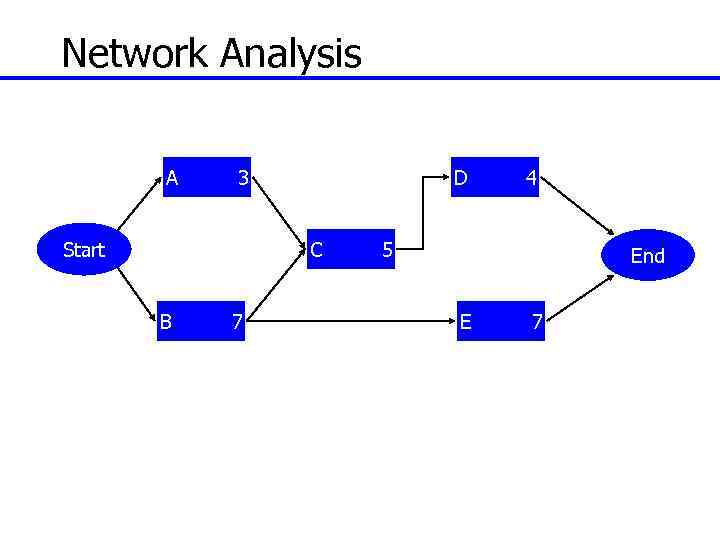 Network Analysis A 3 D C Start B 7 4 5 End E 7
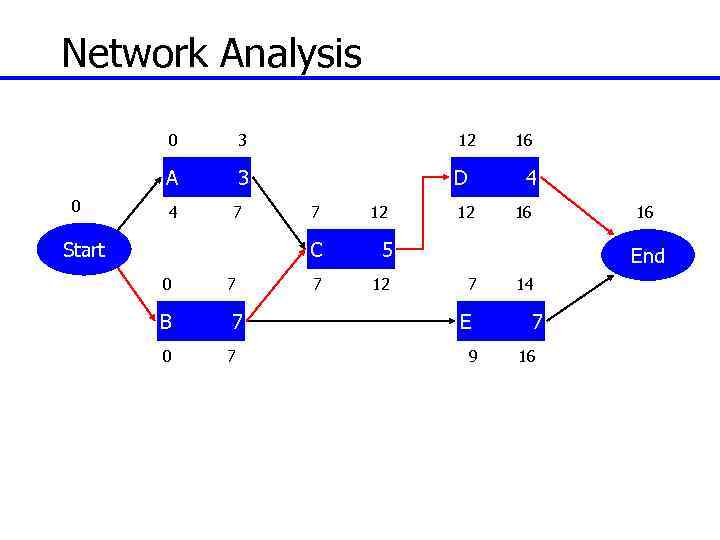 Network Analysis 0 3 A 0 12 16 D 3 4 7 7 12 C Start 0 7 B 7 0 7 4 12 16 5 7 12 16 End 7 14 E 7 9 16
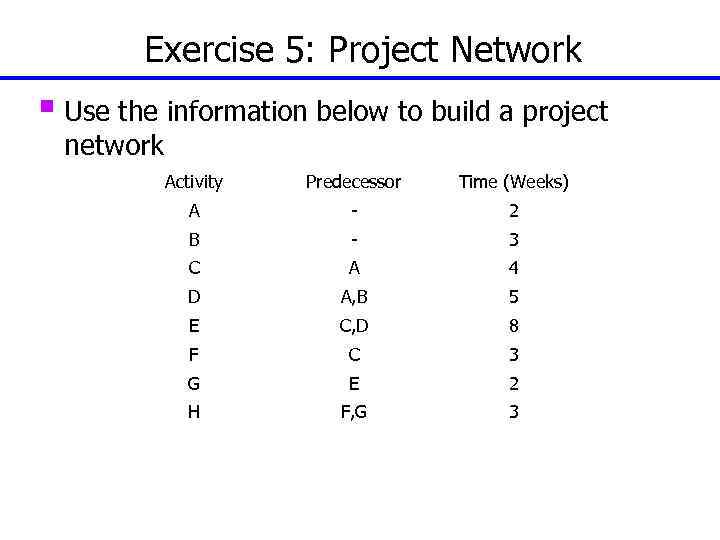 Exercise 5: Project Network § Use the information below to build a project network Activity Predecessor Time (Weeks) A - 2 B - 3 C A 4 D A, B 5 E C, D 8 F C 3 G E 2 H F, G 3
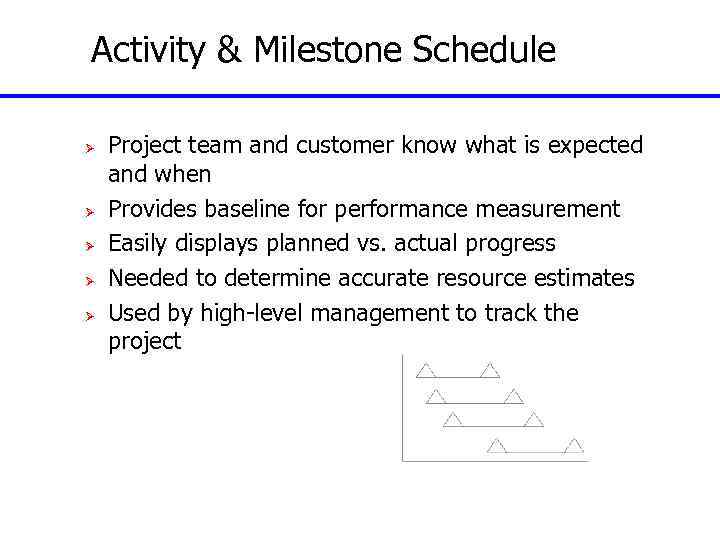 Activity & Milestone Schedule Ø Ø Ø Project team and customer know what is expected and when Provides baseline for performance measurement Easily displays planned vs. actual progress Needed to determine accurate resource estimates Used by high-level management to track the project Task 1 Task 2 Task 3 Task 4 100
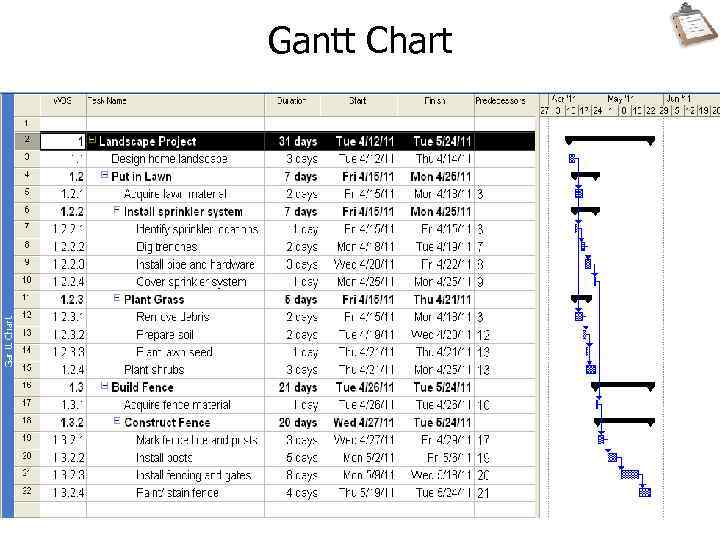 Gantt Chart
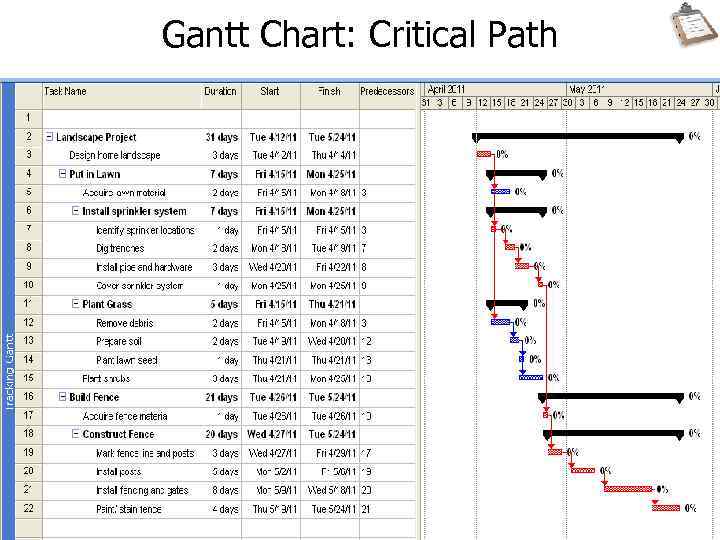 Gantt Chart: Critical Path
 Exercise 6: Project Schedule § Use the sample WBS provided by the facilitator and your own knowledge and experience to identify the sequence of activities and develop a preliminary schedule for the project 103
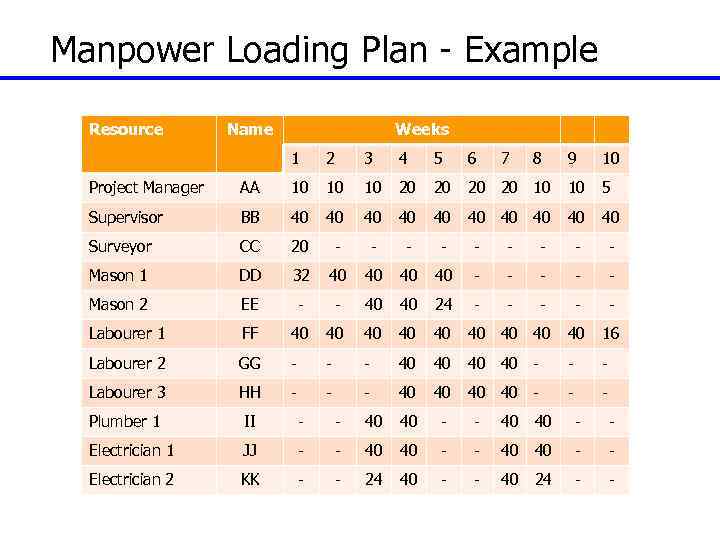 Manpower Loading Plan - Example Resource Name Weeks 1 2 3 4 5 6 7 8 9 10 Project Manager AA 10 10 10 20 20 10 10 5 Supervisor BB 40 40 40 Surveyor CC 20 - - - - - Mason 1 DD 32 40 40 - - - Mason 2 EE - - 40 40 24 - - - Labourer 1 FF 40 40 40 16 Labourer 2 GG - - - 40 40 - - - Labourer 3 HH - - - 40 40 - - - Plumber 1 II - 40 Task 3 40 - - 40 40 - - Electrician 1 JJ - 40 Task 4 40 - - 40 40 - - Electrician 2 KK - - 40 24 - - Task 1 Task 2 24 104
 Cost Estimating Developing an approximation of the costs of the resources needed to complete project activities 105
 What to include in your estimates § Materials could include Ø Ø Ø Ø Hardware Software Suppliers Facilities Tools Travel Special equipment Shipping § Human Resources could include Ø Ø Ø Customer resources Business partner Supplier Technical support Consultants 106
 Cost Estimating Methodologies § Analogous § Parametric § Detailed (Bottom-up) § Vendor Quotes 107
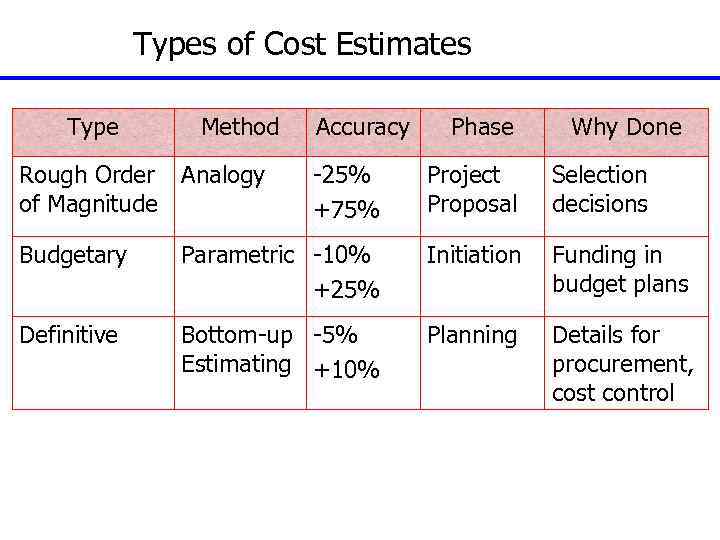 Types of Cost Estimates Type Method Rough Order Analogy of Magnitude Accuracy Phase Why Done -25% +75% Project Proposal Selection decisions Budgetary Parametric -10% +25% Initiation Funding in budget plans Definitive Bottom-up -5% Estimating +10% Planning Details for procurement, cost control 108
 Cost Estimating: Terminology § Contingency § Management reserve § Dayworks § Prime cost sum § Provisional sum § Attendance 109
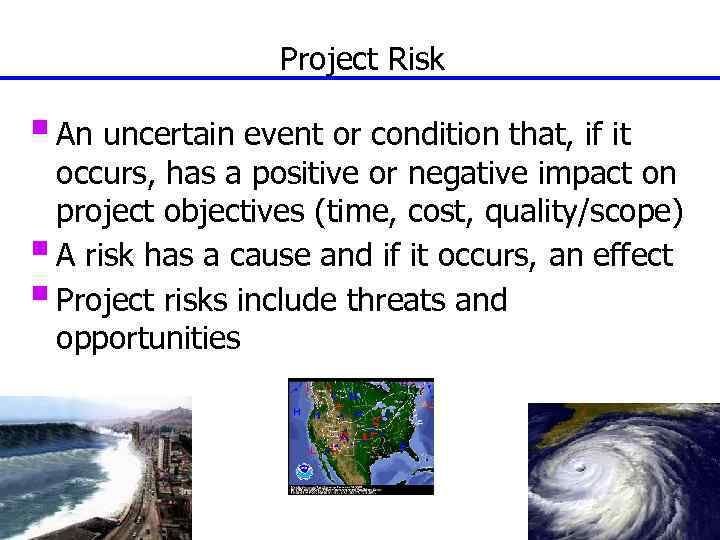 Project Risk § An uncertain event or condition that, if it occurs, has a positive or negative impact on project objectives (time, cost, quality/scope) § A risk has a cause and if it occurs, an effect § Project risks include threats and opportunities 110
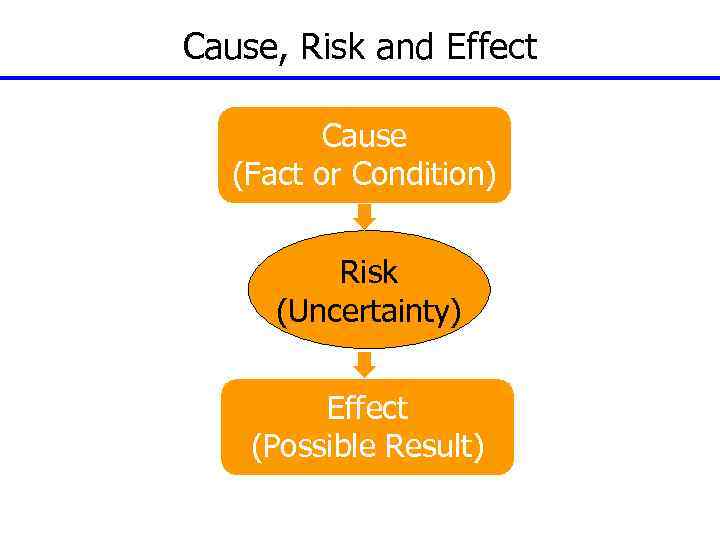 Cause, Risk and Effect Cause (Fact or Condition) Risk (Uncertainty) Effect (Possible Result) 111
 Risk Factors All project risks are characterised by the following three risk factors: 1. Risk Event – precisely what might happen to the detriment or advantage to the project 2. Risk Probability – how likely the event is to occur 3. Risk Impact or Amount at Stake – the severity of the consequence if the Risk Event occurs 112
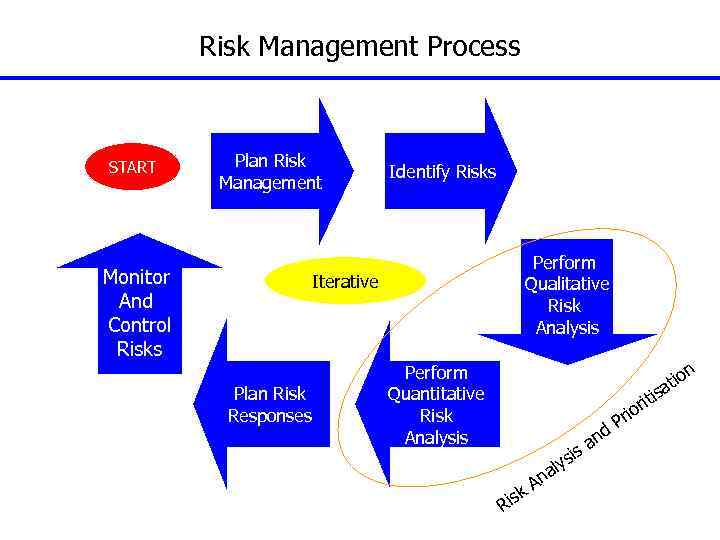 Risk Management Process START Plan Risk Management Monitor And Control Risks Identify Risks Perform Qualitative Risk Analysis Iterative Plan Risk Responses Perform Quantitative Risk Analysis io Pr is d an n s aly R A sk i r n tio a itis
 Plan Risk Management § The process of deciding how to conduct risk management activities for a project To ensure that the level, type and visibility of risk management are commensurate with both the risk and importance of the project to the organisation: § Ø Ø § To provide sufficient resources and time for risk management activities To establish an agreed-upon basis for evaluating risks Should begin as a project is conceived and should be completed early during project planning 114
 Identify Risks § Determining which risks might affect the project and documenting their characteristics § An iterative process as new risks may evolve or become known as the project progresses § Team (and external experts as required) activity § Identify both negative (threats) and positive (opportunity) risks 115
 Identify Risks: Tools & Techniques § Documentation Review Ø Ø Present Project Previous Projects, Lessons Learnt Database § Information Gathering Techniques Ø Ø Ø Brainstorming Nominal Group Technique Delphi Technique Interviewing Root Cause Analysis § Checklist Analysis § Assumptions Analysis § Diagramming Techniques Ø Ø Ø Cause and Effect Diagrams System or Process Flow Charts Influence Diagrams § SWOT Analysis § Expert Judgement 116
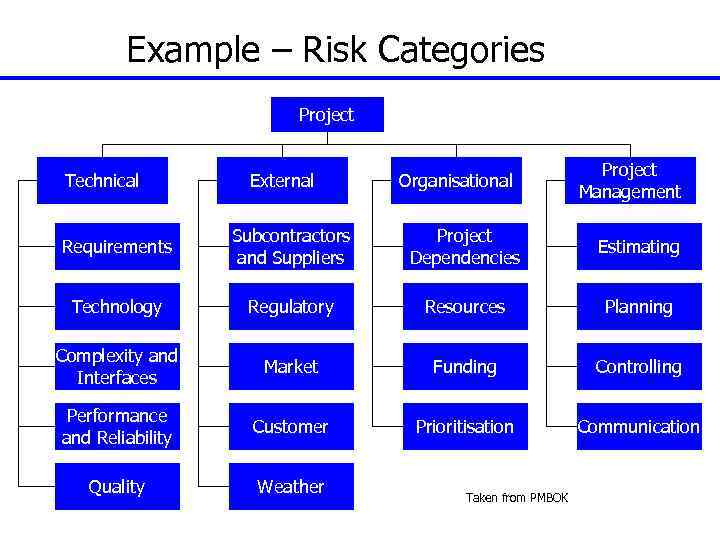 Example – Risk Categories Project Technical External Organisational Project Management Requirements Subcontractors and Suppliers Project Dependencies Estimating Technology Regulatory Resources Planning Complexity and Interfaces Market Funding Controlling Performance and Reliability Customer Prioritisation Communication Quality Weather Taken from PMBOK
 Perform Qualitative Risk Analysis § Process for prioritising the identified risks for further analysis or action by assessing and combining their probability of occurrence and impact § Takes into account other factors such as time frame for response and organisation’s risk tolerance associated with project objectives of scope, cost, schedule and quality 118
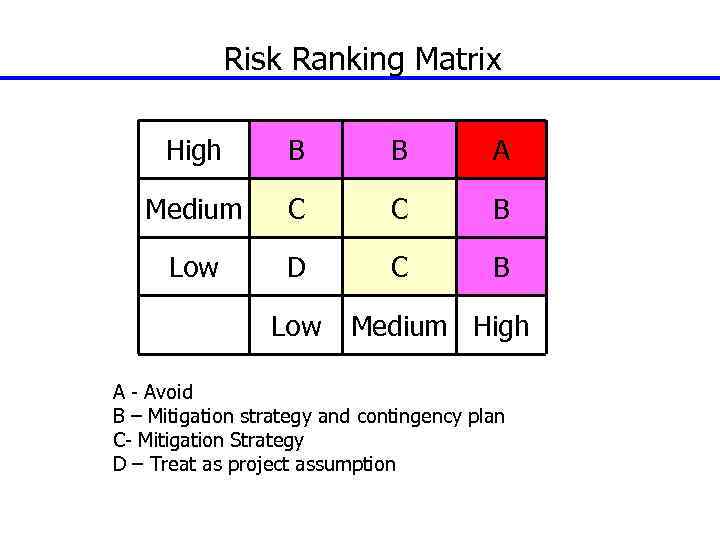 Risk Ranking Matrix High B B A Medium C C B Low D C B Low Medium High A - Avoid B – Mitigation strategy and contingency plan C- Mitigation Strategy D – Treat as project assumption 119
 Perform Quantitative Risk Analysis § Provides a numerical estimate of the overall effect of § § risk on the objectives of the project, based on current plans and information, when considering risks simultaneously Results can be used to evaluate the likelihood of success in achieving project objectives and to estimate contingency reserves, usually for time and cost that are appropriate to both the risks and the risk tolerance of project stakeholders Presents a quantitative approach to making decisions in the presence of uncertainty 120
 Plan Risk Responses § The process of developing options and determining actions to enhance opportunities and reduce threats to project’s objectives § Includes the identification and assignment of one person to take responsibility for each agreed-to and funded risk response § Addresses risks by their priority, inserting resources and activities into the budget, schedule and project management plan, as needed 121
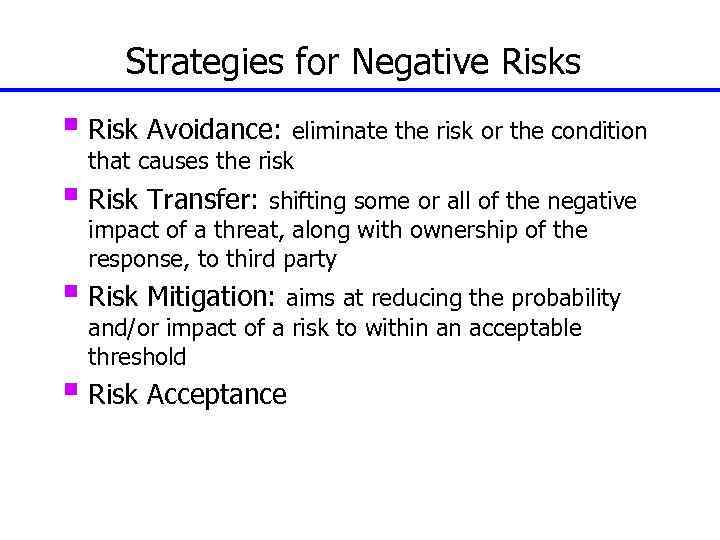 Strategies for Negative Risks § Risk Avoidance: eliminate the risk or the condition that causes the risk § Risk Transfer: shifting some or all of the negative impact of a threat, along with ownership of the response, to third party § Risk Mitigation: aims at reducing the probability and/or impact of a risk to within an acceptable threshold § Risk Acceptance 122
 Strategies for Positive Risks (1 of 2) § Exploit: seeks to eliminate the uncertainty associated with a particular upside risk by ensuring the opportunity definitely happens. Examples: Ø Assigning an organisation’s most talented resources to the project to reduce the time for completion or to provide lower cost than originally planned § Share: allocating some or all of the ownership of the opportunity to a third party who is best able to capture the opportunity for the benefit of the project. Example: Ø Forming risk-sharing partnerships, teams, special-purpose companies, or joint ventures, for the express purpose of taking advantage of the opportunity so that all parties gain from their actions 123
 Strategies for Positive Risks (2 of 2) § Enhance: increase the probability and/or the positive impacts of an opportunity. Identifying and maximising key drivers of these positive-impact risks may increase the probability of their occurrence. Examples include adding more resources to an activity to finish early § Accept: being willing/prepared to take advantage of an opportunity if it comes along 124
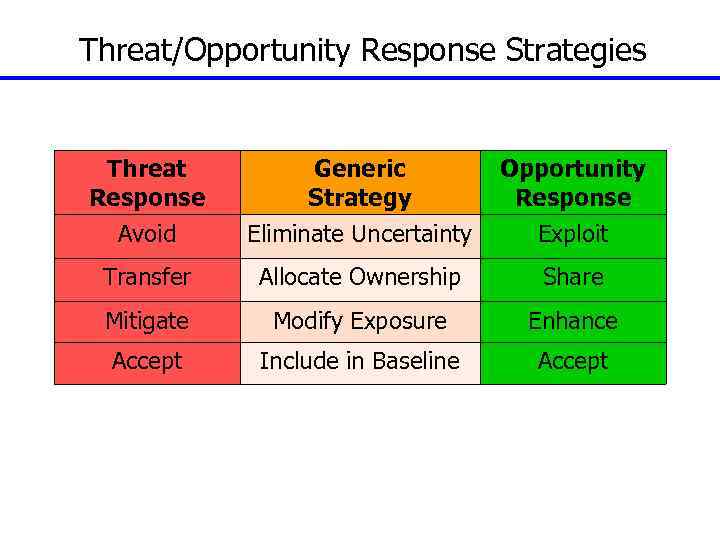 Threat/Opportunity Response Strategies Threat Response Generic Strategy Opportunity Response Avoid Eliminate Uncertainty Exploit Transfer Allocate Ownership Share Mitigate Modify Exposure Enhance Accept Include in Baseline Accept
 Monitor and Control Risks § Process of implementing risk response plans, tracking § identified risks, monitoring residual risks, identifying new risks, and evaluating risk process effectiveness throughout the life of the project Risk reassessment: Ø Ø Ø Periodic review to ensure that information remains current Occurrence of major or unexpected risk Need to analyse a complex change request Phase end review Project re-planning or major plan elaboration § An ongoing process for the life of the project 126
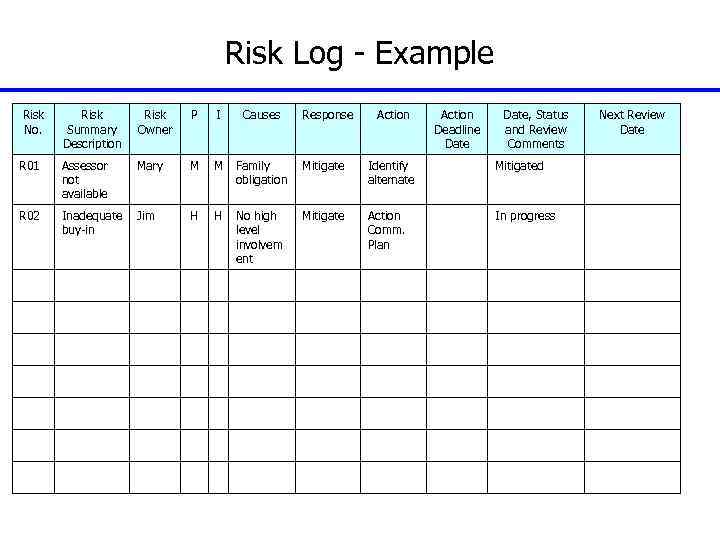 Risk Log - Example Risk No. Risk Summary Description Risk Owner P I Causes Response Action Deadline Date, Status and Review Comments R 01 Assessor not available Mary M M Family obligation Mitigate Identify alternate Mitigated R 02 Inadequate Jim buy-in H H No high level involvem ent Mitigate Action Comm. Plan Next Review Date In progress 127
 Exercise 7: Project Risk Management § Identify your top ten (10) risk events for the project and create a risk log detailing the risk management strategy and relevant actions to manage the risks 128
 HSE Management Plan §Compliance with HSE Policy and Plan §Have an HSE kick-off meeting §Get commitment from all team members §Track statistics & use trends for predictive purposes §Implement measures to reduce risk of HSE accidents/ incidents during project
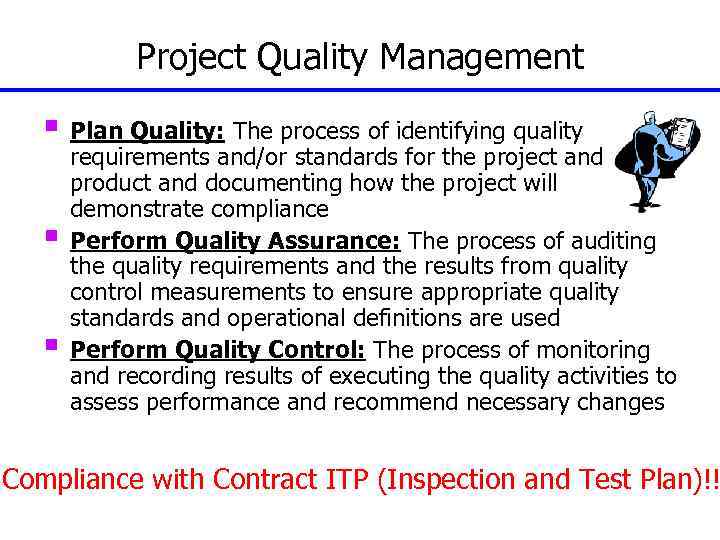 Project Quality Management § Plan Quality: The process of identifying quality § § requirements and/or standards for the project and product and documenting how the project will demonstrate compliance Perform Quality Assurance: The process of auditing the quality requirements and the results from quality control measurements to ensure appropriate quality standards and operational definitions are used Perform Quality Control: The process of monitoring and recording results of executing the quality activities to assess performance and recommend necessary changes Compliance with Contract ITP (Inspection and Test Plan)!!
 Module 7 Execute and Control Project Plan 131
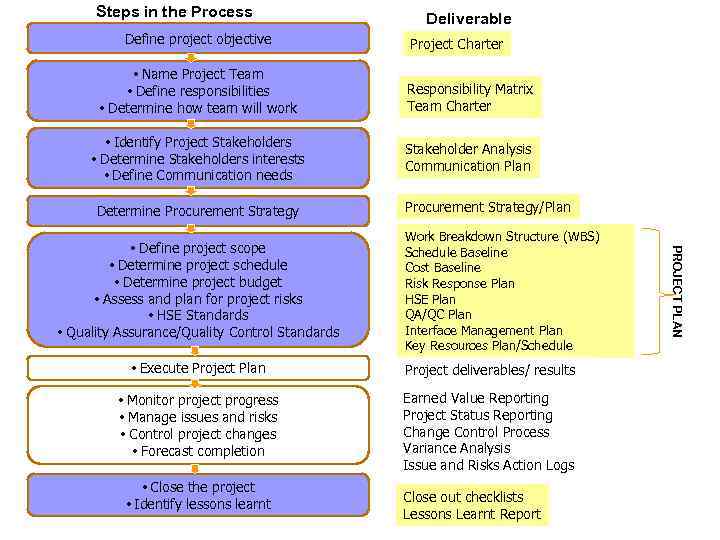 Steps in the Process Define project objective Deliverable Project Charter • Name Project Team • Define responsibilities • Determine how team will work Responsibility Matrix Team Charter • Identify Project Stakeholders • Determine Stakeholders interests • Define Communication needs Stakeholder Analysis Communication Plan Determine Procurement Strategy Work Breakdown Structure (WBS) Schedule Baseline Cost Baseline Risk Response Plan HSE Plan QA/QC Plan Interface Management Plan Key Resources Plan/Schedule • Execute Project Plan Project deliverables/ results • Monitor project progress • Manage issues and risks • Control project changes • Forecast completion PROJECT PLAN • Define project scope • Determine project schedule • Determine project budget • Assess and plan for project risks • HSE Standards • Quality Assurance/Quality Control Standards Procurement Strategy/Plan Earned Value Reporting Project Status Reporting Change Control Process Variance Analysis Issue and Risks Action Logs • Close the project • Identify lessons learnt Close out checklists Lessons Learnt Report 132
 If we continue the way we’re going, where will we end up?
 Performance Reporting Collecting and distributing performance information. This includes status reporting, progress measurement and forecasting. 134
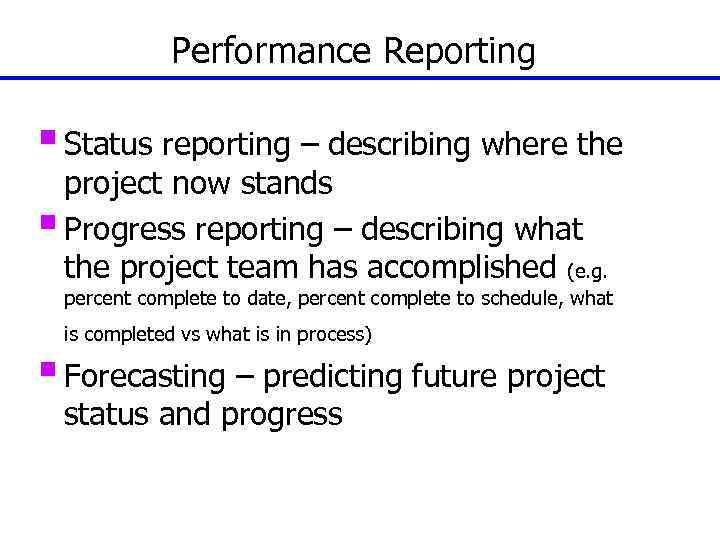 Performance Reporting § Status reporting – describing where the project now stands § Progress reporting – describing what the project team has accomplished (e. g. percent complete to date, percent complete to schedule, what § Forecasting – predicting future project status and progress is completed vs what is in process) 135
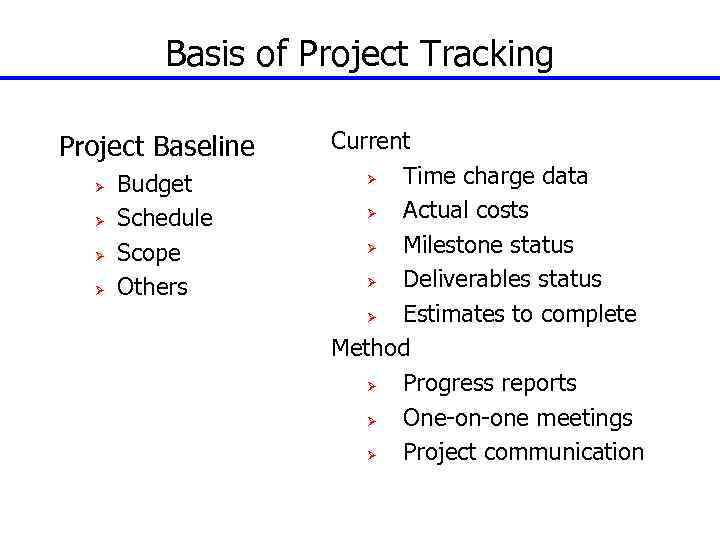 Basis of Project Tracking Project Baseline Ø Ø Budget Schedule Scope Others Current Ø Time charge data Ø Actual costs Ø Milestone status Ø Deliverables status Ø Estimates to complete Method Ø Progress reports Ø One-on-one meetings Ø Project communication 136
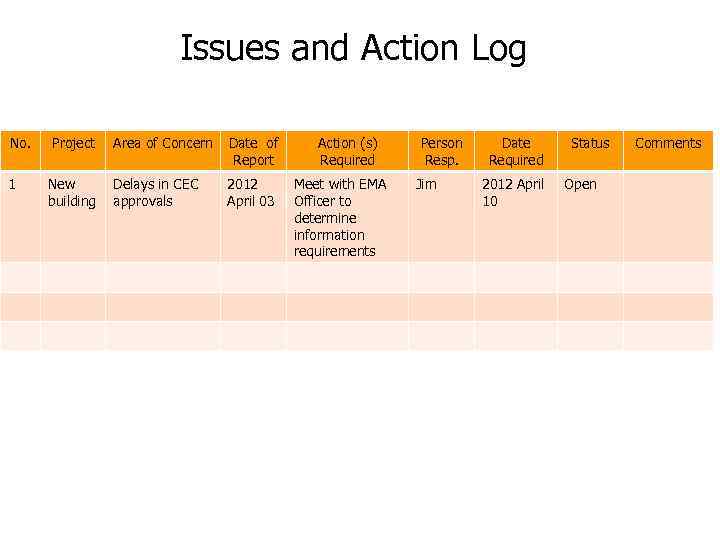 Issues and Action Log No. Project Area of Concern Date of Report 1 New building Delays in CEC approvals 2012 April 03 Action (s) Required Meet with EMA Officer to determine information requirements Person Resp. Jim Date Required 2012 April 10 Status Open Comments
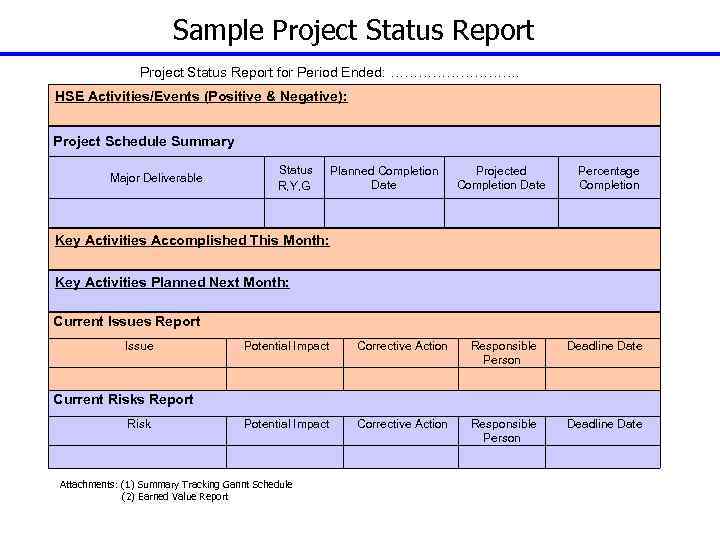 Sample Project Status Report for Period Ended: ……………. HSE Activities/Events (Positive & Negative): Project Schedule Summary Major Deliverable Status R, Y, G Planned Completion Date Projected Completion Date Percentage Completion Key Activities Accomplished This Month: Key Activities Planned Next Month: Current Issues Report Issue Potential Impact Corrective Action Responsible Person Deadline Date Current Risks Report Risk Attachments: (1) Summary Tracking Gannt Schedule (2) Earned Value Report
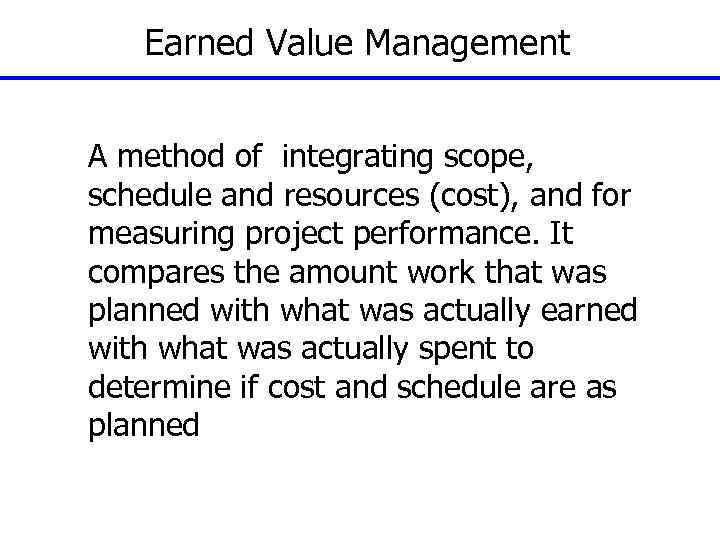 Earned Value Management A method of integrating scope, schedule and resources (cost), and for measuring project performance. It compares the amount work that was planned with what was actually earned with what was actually spent to determine if cost and schedule are as planned
 Value of Earned Value § Schedule Status Reporting § Cost Status Reporting § Forecasting
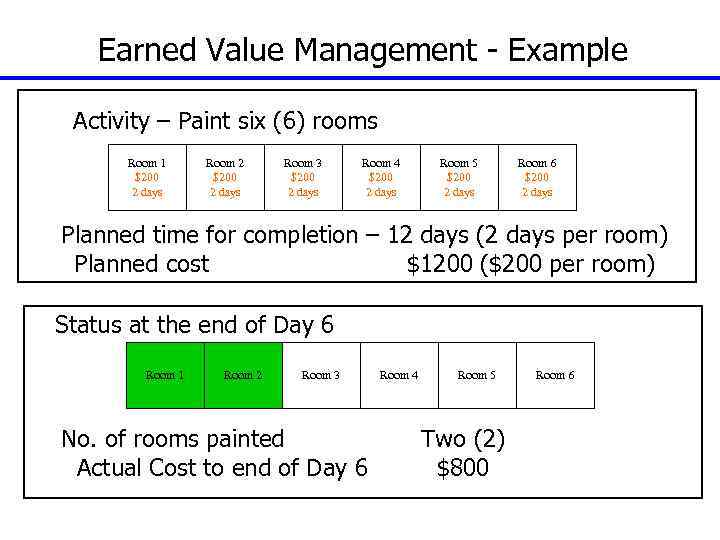 Earned Value Management - Example Activity – Paint six (6) rooms Room 1 $200 2 days Room 2 $200 2 days Room 3 $200 2 days Room 4 $200 2 days Room 5 $200 2 days Room 6 $200 2 days Planned time for completion – 12 days (2 days per room) Planned cost $1200 ($200 per room) Status at the end of Day 6 Room 1 Room 2 Room 3 No. of rooms painted Actual Cost to end of Day 6 Room 4 Room 5 Two (2) $800 Room 6
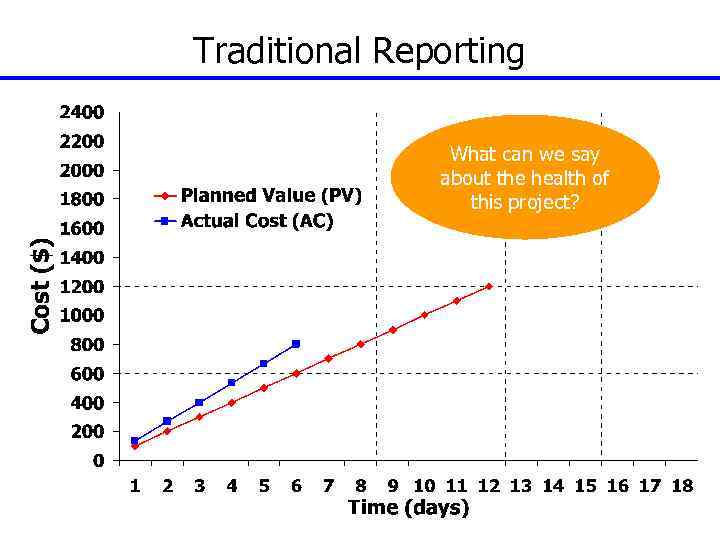 Traditional Reporting What can we say about the health of this project?
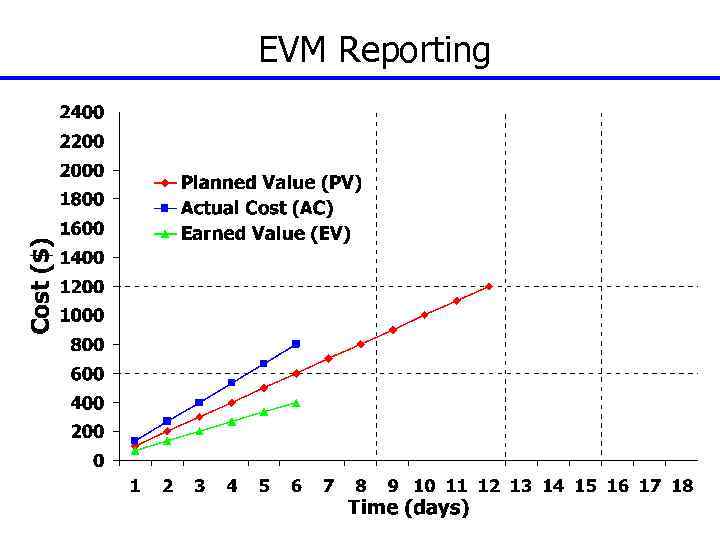 EVM Reporting
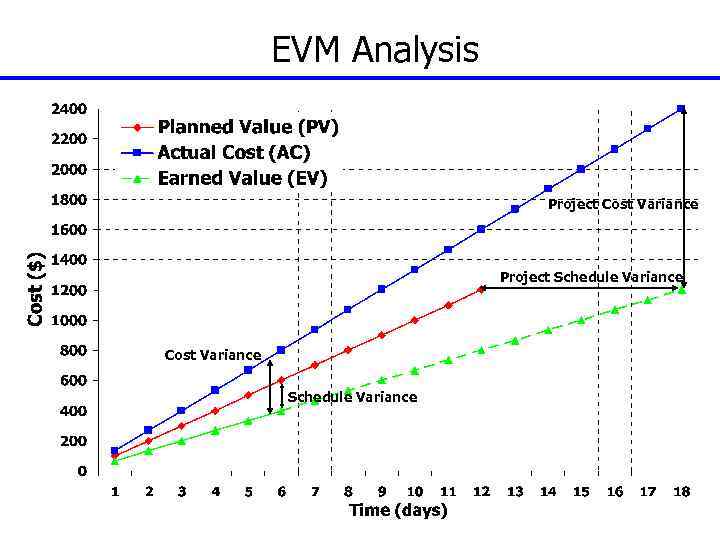 EVM Analysis Project Cost Variance Project Schedule Variance Cost Variance Schedule Variance
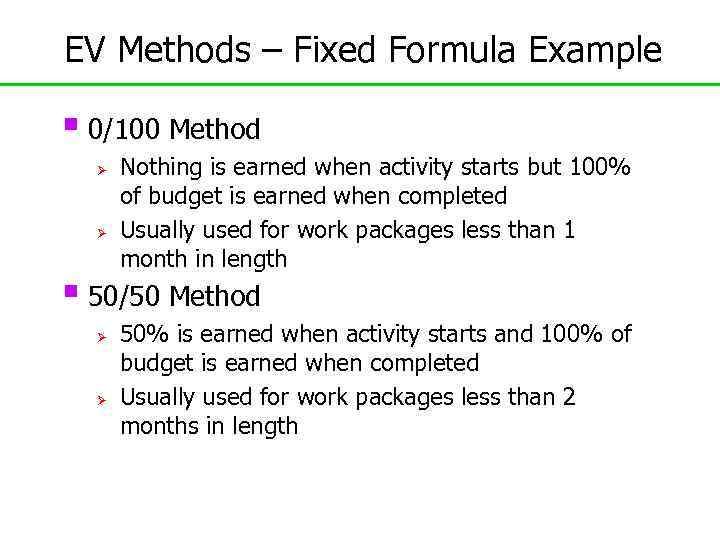 EV Methods – Fixed Formula Example § 0/100 Method Ø Ø Nothing is earned when activity starts but 100% of budget is earned when completed Usually used for work packages less than 1 month in length § 50/50 Method Ø Ø 50% is earned when activity starts and 100% of budget is earned when completed Usually used for work packages less than 2 months in length 145
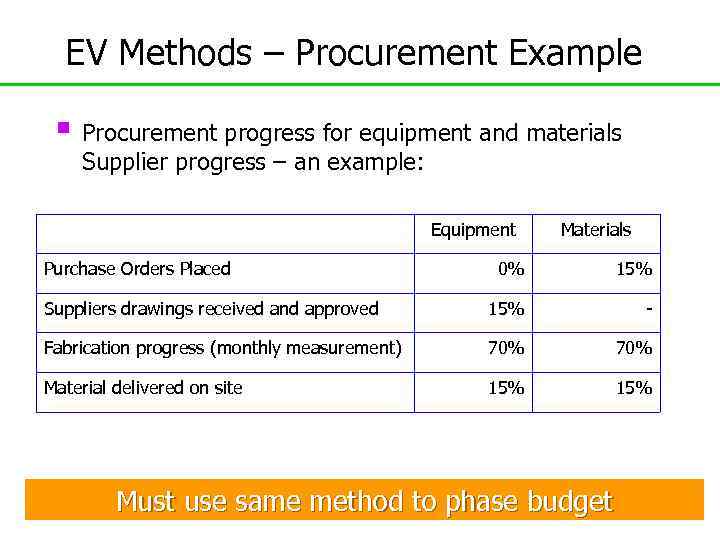 EV Methods – Procurement Example § Procurement progress for equipment and materials Supplier progress – an example: Equipment Purchase Orders Placed Materials 0% 15% Suppliers drawings received and approved 15% - Fabrication progress (monthly measurement) 70% Material delivered on site 15% Must use same method to phase budget 146
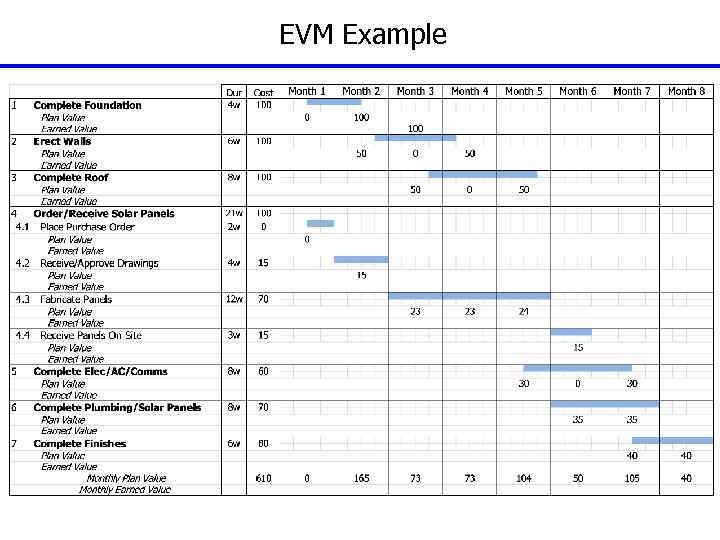 EVM Example 147
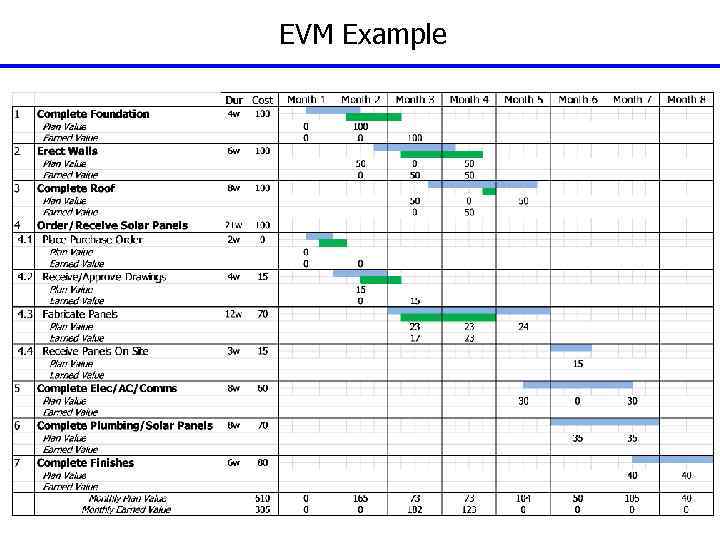 EVM Example 148
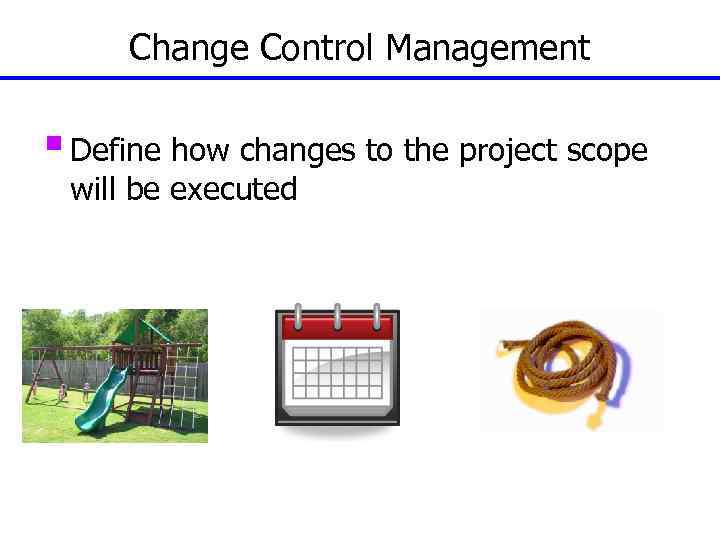 Change Control Management § Define how changes to the project scope will be executed Technical Specification Changes Scope Change Schedule changes All changes require collaboration and buy in via the project sponsor’s signature prior to implementation of the changes
 Integrated Change Control System § Formal process for requesting, documenting and subsequent approval of changes to the project § Comprises project change log, project change request, project impact statement and approving authority § Approved changes can change the project cost and schedule baseline 150
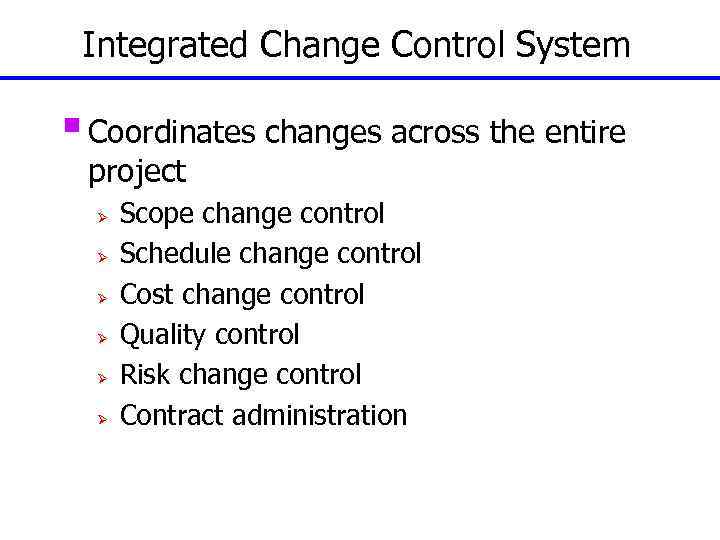 Integrated Change Control System § Coordinates changes across the entire project Ø Ø Ø Scope change control Schedule change control Cost change control Quality control Risk change control Contract administration
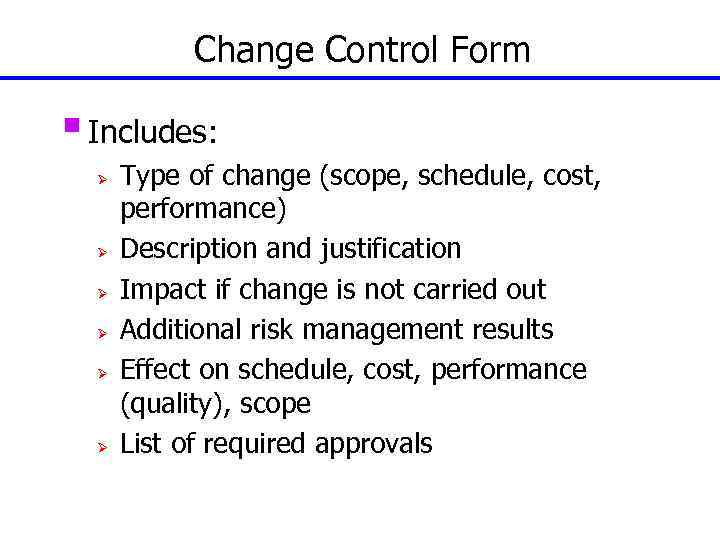 Change Control Form § Includes: Ø Ø Ø Type of change (scope, schedule, cost, performance) Description and justification Impact if change is not carried out Additional risk management results Effect on schedule, cost, performance (quality), scope List of required approvals 152
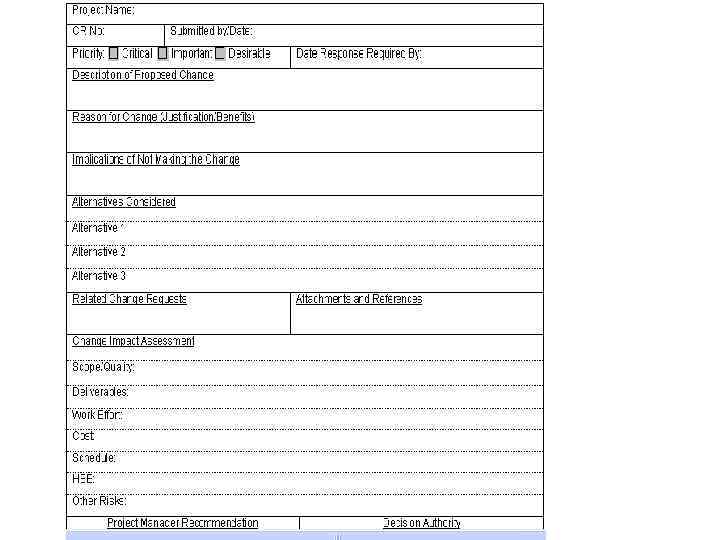 Example: Change Request Form
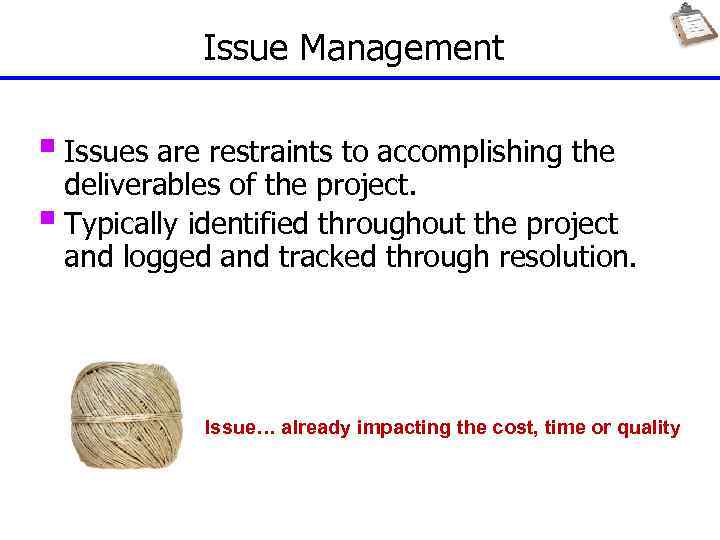 Issue Management § Issues are restraints to accomplishing the deliverables of the project. § Typically identified throughout the project and logged and tracked through resolution. Issue… already impacting the cost, time or quality Rope not thick enough?
 Module 8 Project Closeout 155
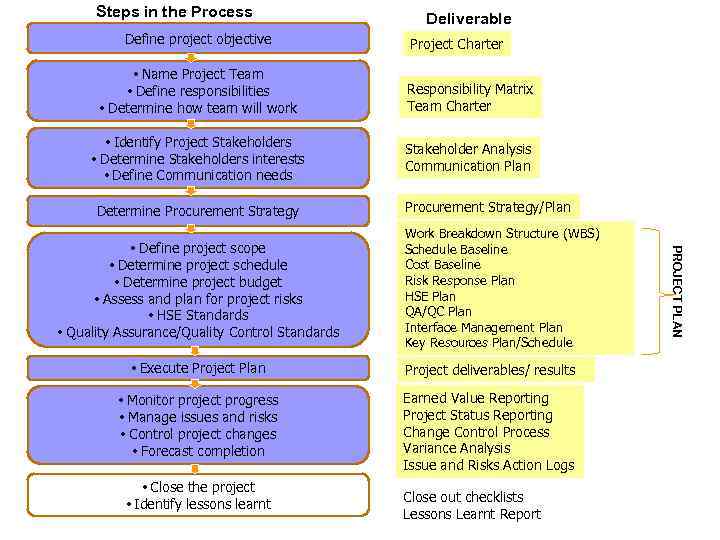 Steps in the Process Define project objective Deliverable Project Charter • Name Project Team • Define responsibilities • Determine how team will work Responsibility Matrix Team Charter • Identify Project Stakeholders • Determine Stakeholders interests • Define Communication needs Stakeholder Analysis Communication Plan Determine Procurement Strategy Work Breakdown Structure (WBS) Schedule Baseline Cost Baseline Risk Response Plan HSE Plan QA/QC Plan Interface Management Plan Key Resources Plan/Schedule • Execute Project Plan Project deliverables/ results • Monitor project progress • Manage issues and risks • Control project changes • Forecast completion PROJECT PLAN • Define project scope • Determine project schedule • Determine project budget • Assess and plan for project risks • HSE Standards • Quality Assurance/Quality Control Standards Procurement Strategy/Plan Earned Value Reporting Project Status Reporting Change Control Process Variance Analysis Issue and Risks Action Logs • Close the project • Identify lessons learnt Close out checklists Lessons Learnt Report 156
 Close-Out § The last major phase of a project's life cycle is the close-out. The key activity in project closeout is gathering project records and disseminating information to formalize acceptance of the product, service or project as well as to perform project closure.
 Close Project § Comprises: Ø Ø Ø Product verification Integrated activities to collect project records Analyse project success or failure Gather lessons learned Archiving and disseminating such information for future use 158
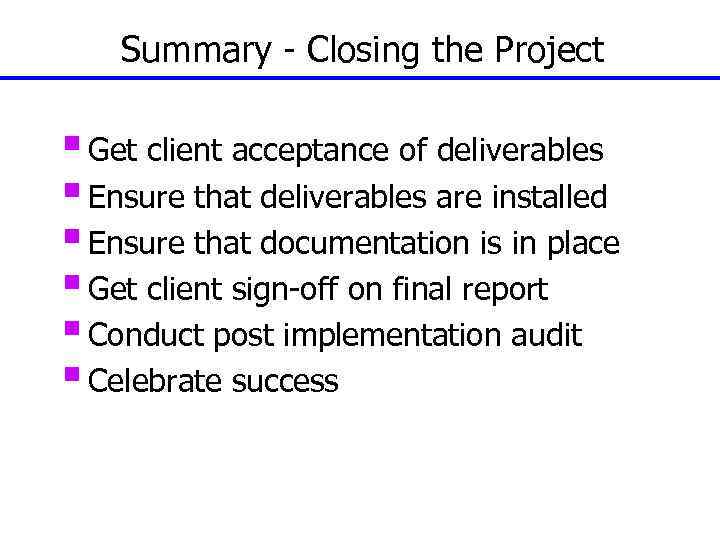 Summary - Closing the Project § Get client acceptance of deliverables § Ensure that deliverables are installed § Ensure that documentation is in place § Get client sign-off on final report § Conduct post implementation audit § Celebrate success 159
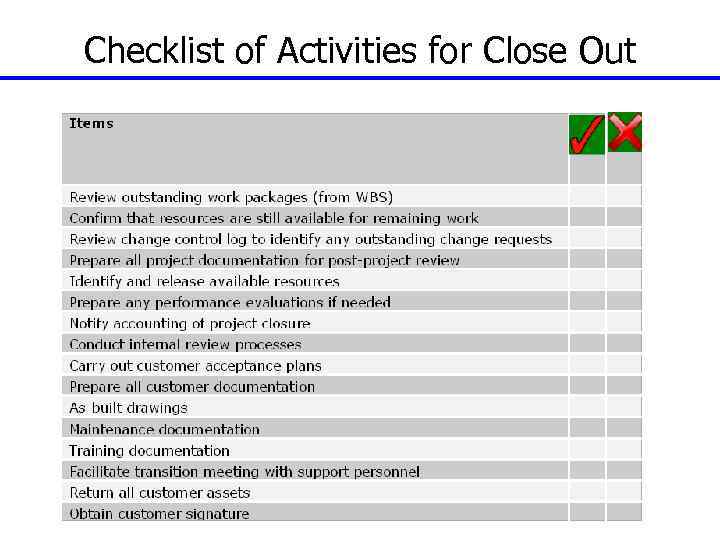 Checklist of Activities for Close Out
 Lessons Learned § Lessons learned are used to document the successes and failures of the project. The Lessons Learned Report records the problems and corrective actions for problems that may have applicability to all projects. It is a source of information to solve project problems. § It can be searched to see if other projects have experienced similar problems and what the corrective action resolved the problem.
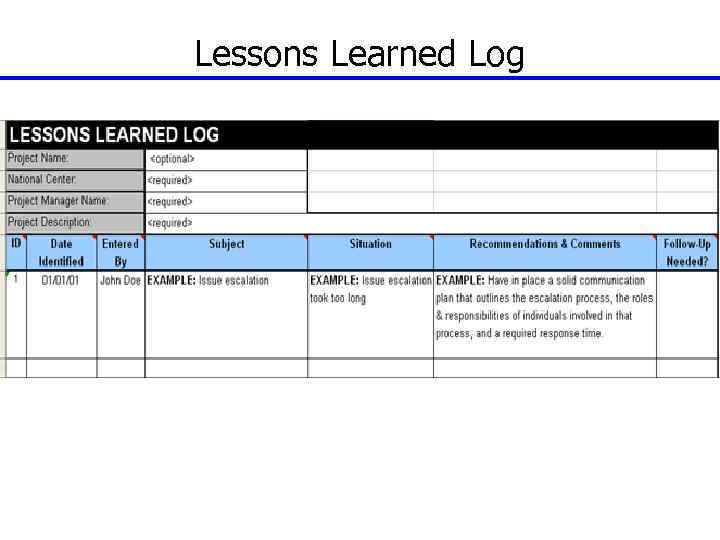 Lessons Learned Log