


 Скачать презентацию Project Management A Tool For ATO Success Presented
ed478d10e1924d79000e2c793dea466a.ppt
- Количество слайдов: 44
 Project Management A Tool For ATO Success Presented by: Pat A. Eigbe, PMP® Office of Innovations and Solutions, ATO-P February 18, 2004 Pat A. Eigbe, PMP®
 Briefing Outline Q Project Management (PM) as a Tool Q Project Management Terminology Q PM Relationship to other Disciplines Q Project Management Processes Q Project Management Tools & Techniques Q Summary/Conclusion Q Questions February 18, 2004 Pat A. Eigbe, PMP® 2
 Project Management as a Tool Q Minimize Fire Drills Q Efficient Use of Resources Q Develop Better Metrics Q On-time and On-budget Product Delivery Q Apply Lessons Learned Q Better Communications Between Stakeholders Q Make Proactive Decisions February 18, 2004 Pat A. Eigbe, PMP® 3
 Communications Understanding our Environment Tell the Marine to secure a building: they will kill everybody and point guns at the building. Tell the Air Force to secure a building: they will drive everybody out and lease the building to the highest bidder. Tell the Army to secure a building: they will surround the building and point guns at the house. Tell the Navy to secure a building: they will turn off all the lights, lock up the house, and go home. February 18, 2004 Pat A. Eigbe, PMP® 4
 Project Management (PM) Terms Q Project - A temporary endeavor undertaken to create a unique product or service. a ATOP or VSCS - Project has a specific purpose with a start and an end date. Q Project Management - the Application of Knowledge, Skills, Tools, and Techniques to Project Activities to Meet Project Requirements. February 18, 2004 Pat A. Eigbe, PMP® 5
 Project Management Terms II Q Program - A group of related projects managed in a coordinated way. Programs usually include an element of ongoing activity. CPDLC, SMA, URET CCLD, p. FAST, as FFP 1 a PM Tools Development as part of Program Management a QA Project/Program Manager (PM) - The Individual Responsible for Managing a Project/Program. February 18, 2004 Pat A. Eigbe, PMP® 6
 Project Management Terms III Q Work Breakdown Structure (WBS) “A deliverable-oriented grouping of project elements that organizes and defines the total scope of the project. Each descending level represents an increasingly detailed definition of a project work. February 18, 2004 Pat A. Eigbe, PMP® 7
 Project Management Terms IV Q FAA standard wbs 1 -0. ppt Q WBS Dictionary 3. 1 Q Requirement to use FAA Standard WBS – Mandatory February 18, 2004 Pat A. Eigbe, PMP® 8
 Project Management Terms V Q Q Q Deliverable – Tangible, verifiable work product/service. Work Package – A deliverable at the lowest level of the work breakdown structure. A work package may be divided into activities. Activity - Work elements with expected duration, cost, & resources that may be subdivided into tasks. February 18, 2004 Pat A. Eigbe, PMP® 9
 Project Management Terms – VI Q Stakeholder – Individuals or Organizations that will be Impacted by the Outcome of a Project. Q OBS: An Organizational Chart Relating Work Packages to Organization Units. Q Responsibility Matrix: Relates Organization Structure to WBS & Ensures that each Element of the Project’s Scope is Assigned to a Responsible Individual(s). February 18, 2004 Pat A. Eigbe, PMP® 10
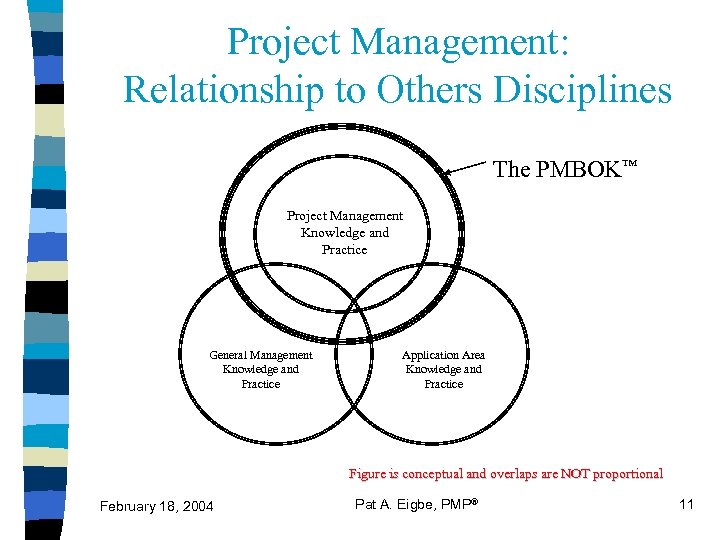 Project Management: Relationship to Others Disciplines The PMBOK™ Project Management Knowledge and Practice General Management Knowledge and Practice Application Area Knowledge and Practice Figure is conceptual and overlaps are NOT proportional February 18, 2004 Pat A. Eigbe, PMP® 11
 Systems Engineering/PM Relationship – I Q PM Needs SE for Integrated PM System Design & Implementation a Requirements for HW and SW Tools a Q SE Needs PM for Planning and tracking a Managing Resources a Q Q PM System Designer Must Understand both SE Not Necessary for PM Practitioners February 18, 2004 Pat A. Eigbe, PMP® 12
 Systems Engineering/PM Relationship - II Q Risk Management PM - Schedule, Cost & Technical/Quality a SE – Compatibility of Components of a System or Sub-System a Q Quality Management PM - Process for Producing the Product a SE - Ensure Product Meets the Technical or Quality Specifications a February 18, 2004 Pat A. Eigbe, PMP® 13
 Systems Engineering/PM Relationship - III Q Configuration Management PM - Ensure Integrity of Schedule and System for Schedule Management a SE - Ensure Integrity of the System as Designed a Q Change Management PM - Changes to Project Scope a SE - Changes to System Requirement a Q Measurement PM – Program cost & schedule performance a SE – Technical Performance a February 18, 2004 Pat A. Eigbe, PMP® 14
 PMI Certification Q What is PMP® Q What PMP® is not Q PMP® Value to Holder & Employer Q PMP® Certification Process link – visit Q http: //pm. act. faa. gov February 18, 2004 Pat A. Eigbe, PMP® 15
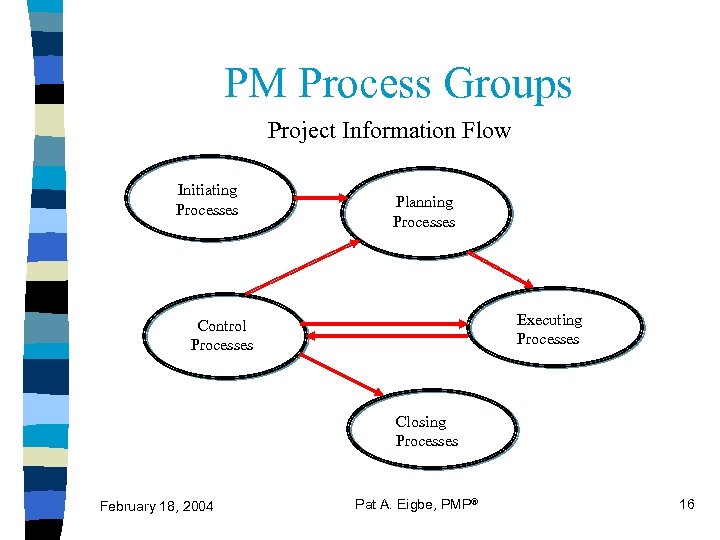 PM Process Groups Project Information Flow Initiating Processes Planning Processes Executing Processes Control Processes Closing Processes February 18, 2004 Pat A. Eigbe, PMP® 16
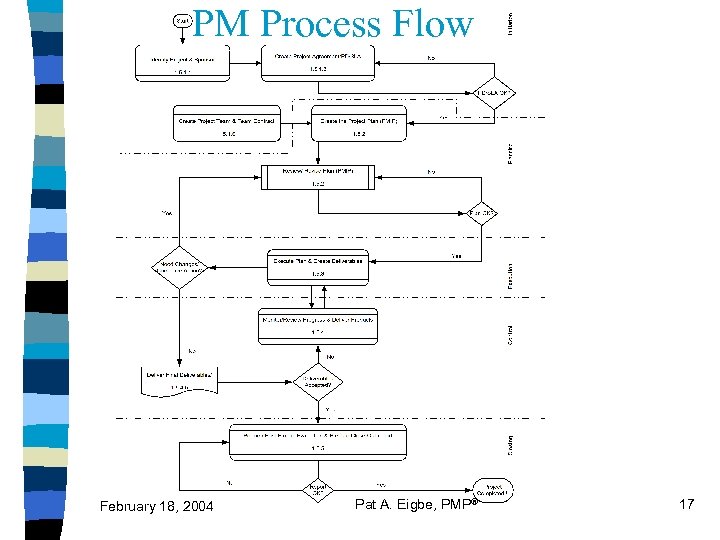 PM Process Flow February 18, 2004 Pat A. Eigbe, PMP® 17
 Initiation Processes Q Identify project and sponsor Q Appoint Project Manager Q Train team on Project Management Process a Project Plan (PMIP) a Q Develop Program Directive to Include WBS that Covers the Scope a High-level Milestones a Budget resources a February 18, 2004 Pat A. Eigbe, PMP® 18
 Planning Processes I Q Identify Life Cycle approach Evolutionary (AMS 6101, Section 2. 2) a Incremental a Waterfall a Q Risk Management plan February 18, 2004 Pat A. Eigbe, PMP® 19
 Planning Processes II Q Get approval for Program Directive Q Identify quality standards - use specs, IEEE, ISO, PMBOK® Q Organizational structure Q Communications - who needs, what Q Acquire human resources for projects February 18, 2004 Pat A. Eigbe, PMP® 20
 Planning Processes III (Schedule Development) Q Update & Decompose WBS Q Identify activities Q Sequence Q Estimate duration Q Estimate cost Q Allocate resources to work packages Q Baseline schedule February 18, 2004 Pat A. Eigbe, PMP® 21
 Planning Processes IV Q Risk management detail: Identification a Analysis a Response a Procurement a February 18, 2004 Pat A. Eigbe, PMP® 22
 Implementation/Execution Processes Q Use the PMIP to execute project activities Q Assess Technical Performance to assure product acceptance Q Distribute project information Q Make purchases Q Develop team skills/competencies Q Develop a Configuration Management plan February 18, 2004 Pat A. Eigbe, PMP® 23
 Performance Measurement Variances Q Performance Indices Q Schedule performance Index (SPI) a Cost performance Index (CPI) a Q Earned Value Management System (EVMS) February 18, 2004 Pat A. Eigbe, PMP® 24
 Earned Value Management System Highlights Q What is EVMS Q Planning for EVMS Q Tracking & Analysis Q Elements of EV Analysis Q Project Cost & Schedule Forecasting Q EV Reporting February 18, 2004 Pat A. Eigbe, PMP® 25
 Earned Value Management System (EVMS) - I Q EV - Tool for Measuring Project Performance Q Integrates Cost, Scope & Schedule measurements Q Compares work actually accomplished to work planned Q EV is an Early Warning System Q Helps management make proactive decisions to keep projects on course February 18, 2004 Pat A. Eigbe, PMP® 26
 Earned Value Management System (EVMS) - II Q Involves Calculating 3 key Elements Budget - BCWS a Actual Cost - ACWP a Earned Value/Physical Progress - BCWP a Q Basis for variance analysis February 18, 2004 Pat A. Eigbe, PMP® 27
 Planning for EVMS - I Q Create a work breakdown structure Q Organize work into discrete work packages and activities Q Allocate a budget to each of the activities Q Develop a schedule and Assign resources Q Must include all project work in the schedule Q Establish the Project Baseline February 18, 2004 Pat A. Eigbe, PMP® 28
 Planning for EVMS - II Q Award performance credit for physical % complete: Q 0 -100 Short duration tasks < 160 hours a EV is Zero until activity is complete a Q 50 -100 Duration less than 600 hours a 50% at start of activity & 50% at completion a February 18, 2004 Pat A. Eigbe, PMP® 29
 Planning for EVMS - III Q Interim milestone; Duration less than 600 hours a Based on completed milestone for task a Q Level of Effort (LOE) Long duration & consistent tasks a Difficult to measure - no deliverables a Measured by duration of time used e. g. 10 weeks support is 50% complete at 5 weeks a February 18, 2004 Pat A. Eigbe, PMP® 30
 Tracking & Analysis Q Each update cycle/Reporting Period: Obtain physical % complete for each task a Calculate EV for each task a Sum up EV for all tasks as project EV a Calculate actual expenditure for actual work completed during the period a Compare the Cumulative EV to Actual expenditure a February 18, 2004 Pat A. Eigbe, PMP® 31
 Elements of EV Analysis - I Q Performance indices relate value of work performed to dollar spent. e. g. CPI = 0. 65 means that for every dollar spent, actual value of the work performed is $0. 65. Q Cumulative CPI used to forecast project cost at completion Q Cumulative SPI used to forecast project completion date February 18, 2004 Pat A. Eigbe, PMP® 32
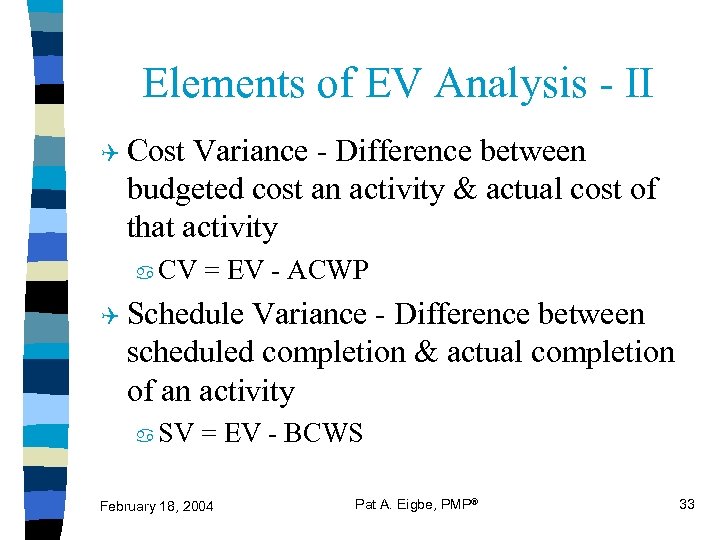 Elements of EV Analysis - II Q Cost Variance - Difference between budgeted cost an activity & actual cost of that activity a CV = EV - ACWP Q Schedule Variance - Difference between scheduled completion & actual completion of an activity a SV = EV - BCWS February 18, 2004 Pat A. Eigbe, PMP® 33
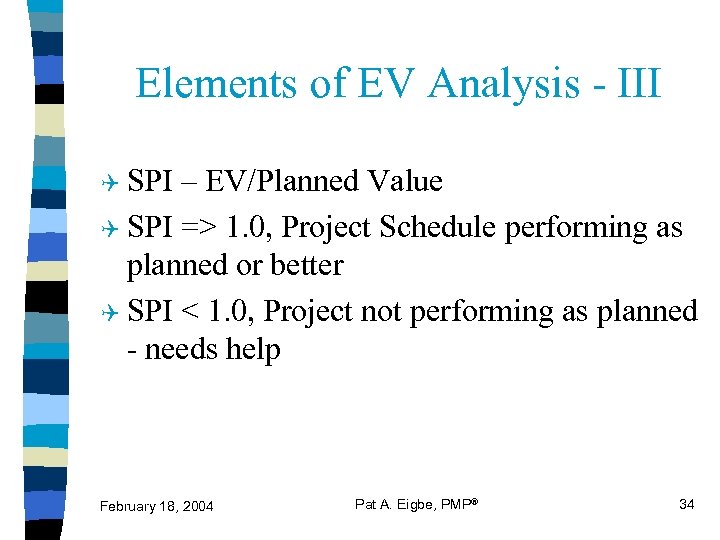 Elements of EV Analysis - III Q SPI – EV/Planned Value Q SPI => 1. 0, Project Schedule performing as planned or better Q SPI < 1. 0, Project not performing as planned - needs help February 18, 2004 Pat A. Eigbe, PMP® 34
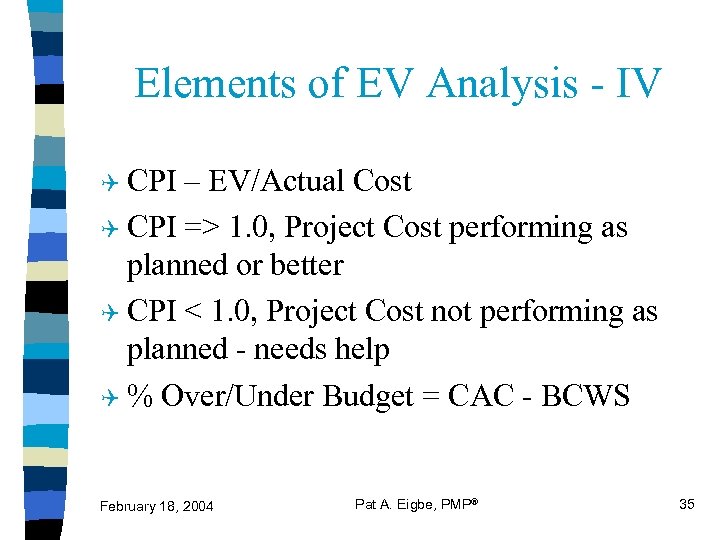 Elements of EV Analysis - IV Q CPI – EV/Actual Cost Q CPI => 1. 0, Project Cost performing as planned or better Q CPI < 1. 0, Project Cost not performing as planned - needs help Q % Over/Under Budget = CAC - BCWS February 18, 2004 Pat A. Eigbe, PMP® 35
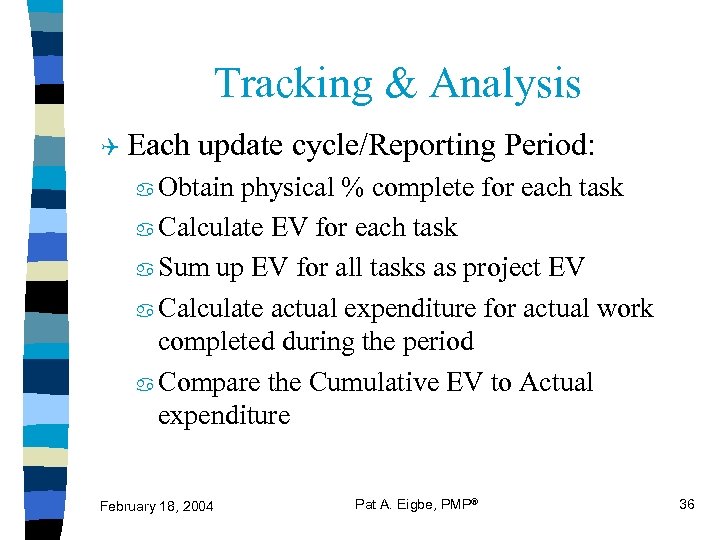 Tracking & Analysis Q Each update cycle/Reporting Period: Obtain physical % complete for each task a Calculate EV for each task a Sum up EV for all tasks as project EV a Calculate actual expenditure for actual work completed during the period a Compare the Cumulative EV to Actual expenditure a February 18, 2004 Pat A. Eigbe, PMP® 36
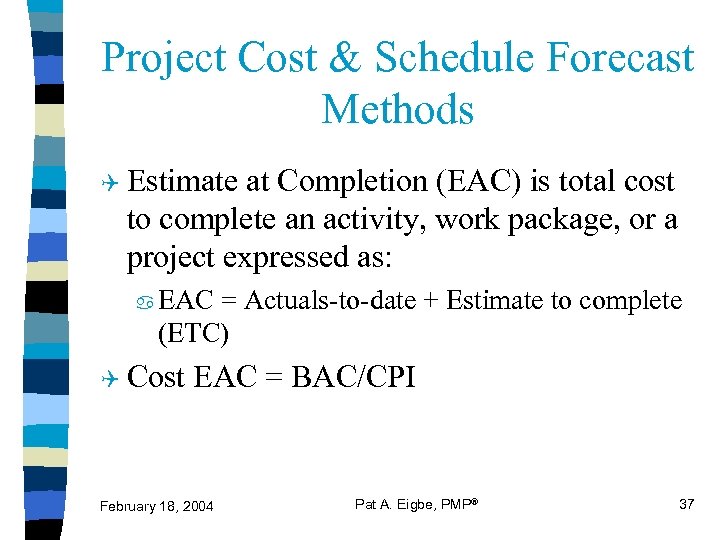 Project Cost & Schedule Forecast Methods Q Estimate at Completion (EAC) is total cost to complete an activity, work package, or a project expressed as: a EAC = Actuals-to-date + Estimate to complete (ETC) Q Cost EAC = BAC/CPI February 18, 2004 Pat A. Eigbe, PMP® 37
 EV Reporting Q Interpret the output of EV calculations Q Take corrective action as necessary Q Recommend corrective action as necessary February 18, 2004 Pat A. Eigbe, PMP® 38
 Control Processes I Q Coordinate and control changes to project scope/requirements a schedule a budget a Q Monitor and manage product quality Q Measure progress and report performance February 18, 2004 Pat A. Eigbe, PMP® 39
 Control Processes II Q Monitor and control risks keep track of identified risks a monitor residual risks a identify new risks a ensure execution of risk plans a assess effectiveness in reducing risk a February 18, 2004 Pat A. Eigbe, PMP® 40
 Closing Processes Q Close out contracts Q Resolve any outstanding issues Q Document lessons learned Q Evaluate project Q Archive all project documents February 18, 2004 Pat A. Eigbe, PMP® 41
 Conclusion Q Defined Frequently used PM Terminologies Q Discussed Objectives of Adopting Project Management Principles. Q Discussed PM Processes, Tools & Techniques Q Discussed EVMS Overview Q Questions February 18, 2004 Pat A. Eigbe, PMP® 42
 References Q Q Q Project Management Institute (PMI), 2000. A Guide to the Project Management Body of Knowledge (the PMBOK® Guide) Stratton R. W. , 1999. Improving SPI and CPI Calculations on LOE Heavy Programs, Proceedings of the 30 th Annual PMI Seminars & Symposium Fleming and Koppeman, 1996. Earned Value Project Management. Ibbs W & Reginato J. , 2002. Quantifying the Value of Project Management Kerzner H, 2003. Project Management: A Systems Approach to Planning, Scheduling, and Controlling. FAST @ http: //fast. faa. gov/wbssec. htm February 18, 2004 Pat A. Eigbe, PMP® 43
 Questions/Need Help? http: //pm. act. faa. gov Pat A. Eigbe, PMP® Ext. 5 -7857 patrick. eigbe@faa. gov February 18, 2004 Pat A. Eigbe, PMP® 44