


 Скачать презентацию Project IEEE P 802 15 Working Group for
300831217c74675f5b3bb6667082aa02.ppt
- Количество слайдов: 47
 Project: IEEE P 802. 15 Working Group for Wireless Personal Area Networks (WPANs) Submission Title: [TG 4 a-Sand. Links-CFP-Presentation] Date Submitted: [4 Jan, 2005] Source: [Dani Raphaeli, Gidi Kaplan] Company: [Sand. Links] Address: [Hanehoshet 6, Tel Aviv, Israel] E-Mail: [danr@eng. tau. ac. il] Re: [802. 15. 4 a Call for proposal] Abstract: [A proposal for the P 802. 15. 4 a alt-PHY standard] Purpose: [Response to WPAN-802. 15. 4 a Call for Proposals] Notice: This document has been prepared to assist the IEEE P 802. 15. It is offered as a basis for discussion and is not binding on the contributing individual(s) or organization(s). The material in this document is subject to change in form and content after further study. The contributor(s) reserve(s) the right to add, amend or withdraw material contained herein. Release: The contributor acknowledges and accepts that this contribution becomes the property of IEEE and may be made publicly available by P 802. 15.
 Low-Rate UWB Alternate Physical Layer Proposal Submission for TG 802. 15. 4 a Jan ‘ 05 Meeting Dr. Dani Raphaeli & Dr. Gideon Kaplan Sand. Links
 Outline • General Overview • Signal and Packet design • Communication Performance – Sensitivity, Acquisition – Interference & Coexistence – Aggregate Rate • Ranging • MAC Protocol Considerations • Block Diagrams and Technical Feasibility • Cost/Complexity • Scalability • Power Consumption • Summary
 Technical Requirements of TG-4 a • • • Low complexity and cost Low power consumption Precision location (highly desired – relative ranging) ranging Extended range Robustness (against MP, against interference) Mobility Low bit rate for each individual link High Aggregated rate at a collector node Random, ad-hoc, topology Work under current 15. 4 MAC
 General Overview of Proposal • Symbol Interleaved Impulse Radio • 500 Mhz bandwidth in UWB band – Optional: 80 Mhz in 2. 4 GHz, 200 Mhz in 5. 2 Ghz • May choose (program) one of several Center Frequencies • Use of Round Trip Delay for ranging • Low data rate per device allows to obtain PER and Ranging within substantial distances, for various channel models • High total (aggregate) rate • Suitable for very low-cost (small die size) implementation in a standard process • Robust, Flexible and Scalable solution.
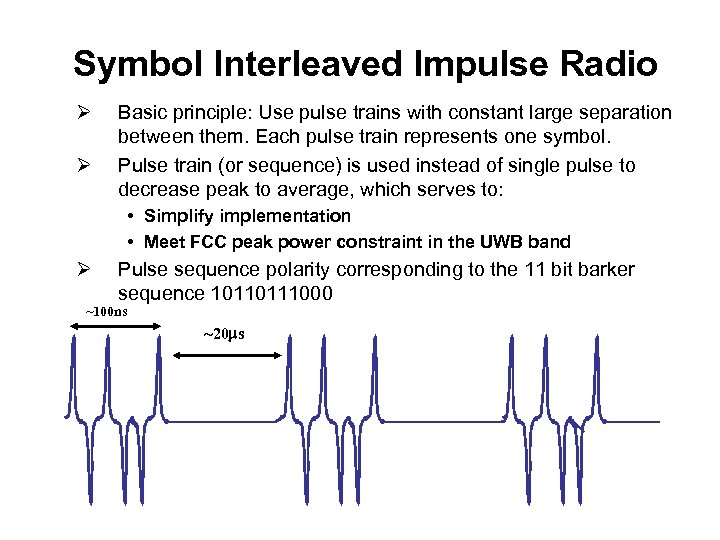 Symbol Interleaved Impulse Radio Ø Ø Basic principle: Use pulse trains with constant large separation between them. Each pulse train represents one symbol. Pulse train (or sequence) is used instead of single pulse to decrease peak to average, which serves to: • Simplify implementation • Meet FCC peak power constraint in the UWB band Ø Pulse sequence polarity corresponding to the 11 bit barker sequence 10110111000 ~100 ns ~20 s
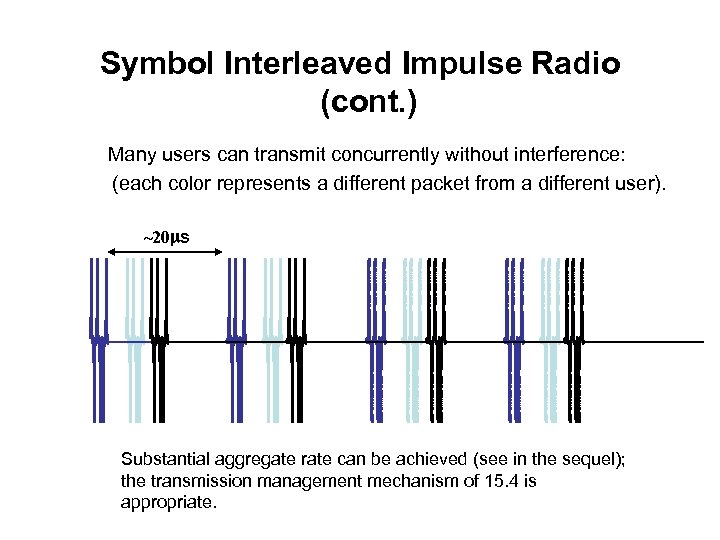 Symbol Interleaved Impulse Radio (cont. ) Many users can transmit concurrently without interference: (each color represents a different packet from a different user). ~20 s Substantial aggregate rate can be achieved (see in the sequel); the transmission management mechanism of 15. 4 is appropriate.
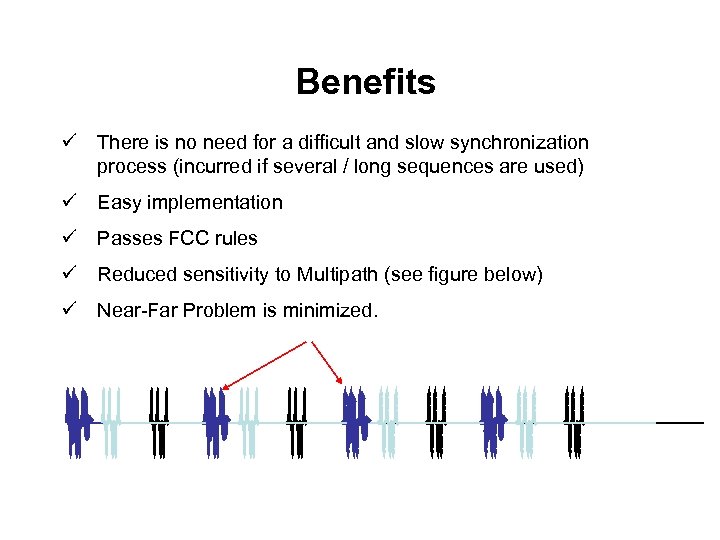 Benefits ü There is no need for a difficult and slow synchronization process (incurred if several / long sequences are used) ü Easy implementation ü Passes FCC rules ü Reduced sensitivity to Multipath (see figure below) ü Near-Far Problem is minimized.
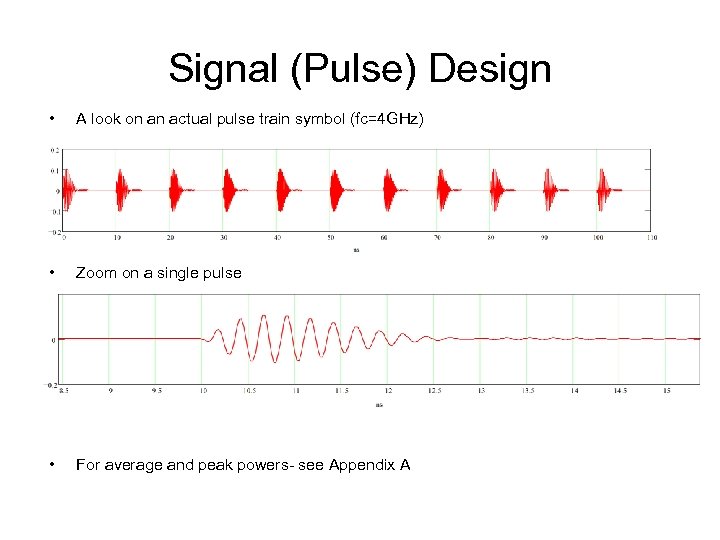 Signal (Pulse) Design • A look on an actual pulse train symbol (fc=4 GHz) • Zoom on a single pulse • For average and peak powers- see Appendix A
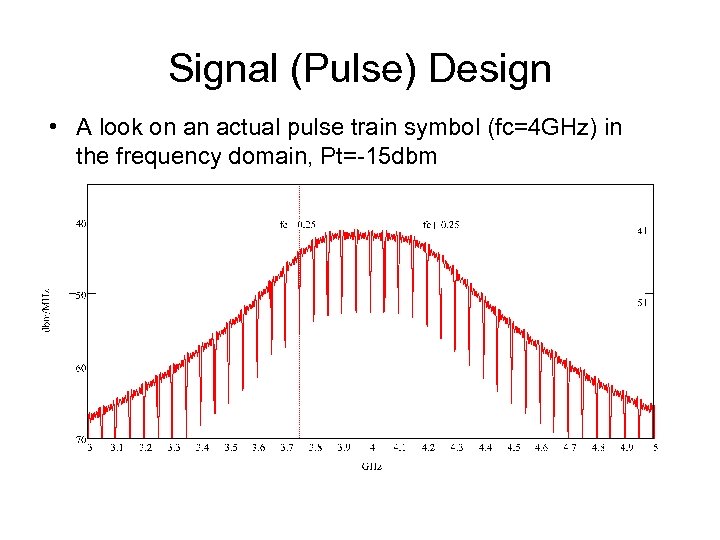 Signal (Pulse) Design • A look on an actual pulse train symbol (fc=4 GHz) in the frequency domain, Pt=-15 dbm
 Packet Structure Design • Preamble (un-modulated) part enables to synchronize on received signal and for receiver acquisition and training. • Data part uses PPM (binary, possibly M-ary) to convey message [SPDU]. Message lengths – between 7 to 128 Octets (MAC limit). Nominal symbol rate is 50 Ksym/sec. • Response (un-modulated) part allows for synchronous Ack (see in the following) plus data response. • Total packet length – typically 10 to 20 msec.
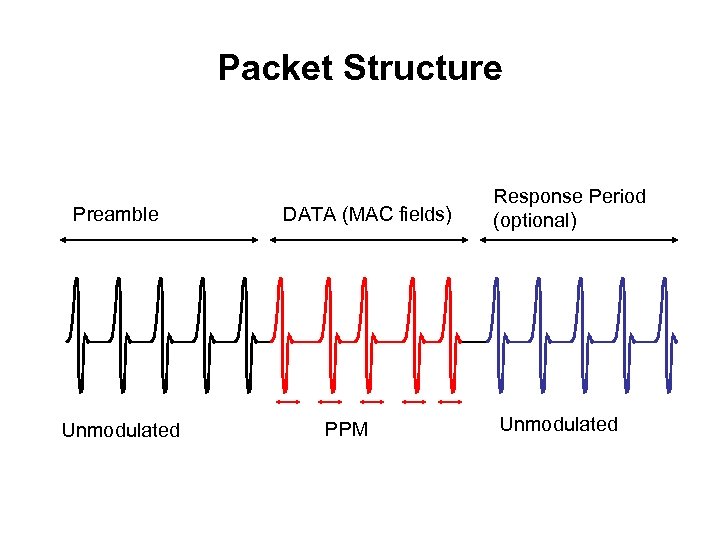 Packet Structure Preamble Unmodulated DATA (MAC fields) PPM Response Period (optional) Unmodulated
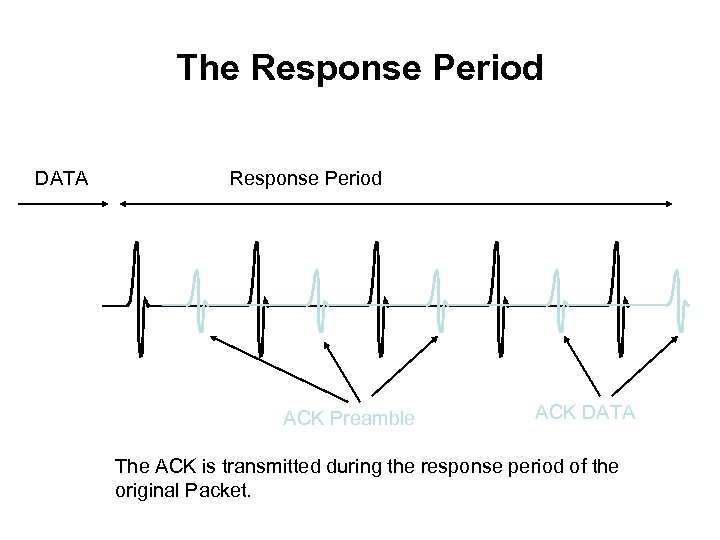 The Response Period DATA Response Period ACK Preamble ACK DATA The ACK is transmitted during the response period of the original Packet.
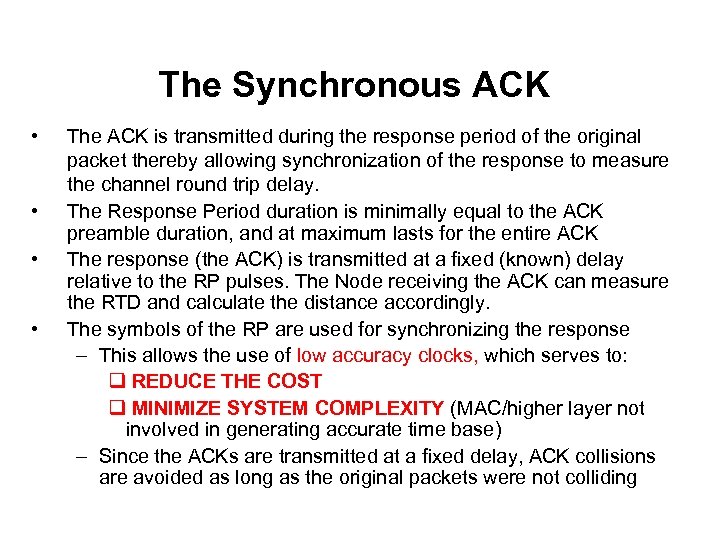 The Synchronous ACK • • The ACK is transmitted during the response period of the original packet thereby allowing synchronization of the response to measure the channel round trip delay. The Response Period duration is minimally equal to the ACK preamble duration, and at maximum lasts for the entire ACK The response (the ACK) is transmitted at a fixed (known) delay relative to the RP pulses. The Node receiving the ACK can measure the RTD and calculate the distance accordingly. The symbols of the RP are used for synchronizing the response – This allows the use of low accuracy clocks, which serves to: q REDUCE THE COST q MINIMIZE SYSTEM COMPLEXITY (MAC/higher layer not involved in generating accurate time base) – Since the ACKs are transmitted at a fixed delay, ACK collisions are avoided as long as the original packets were not colliding
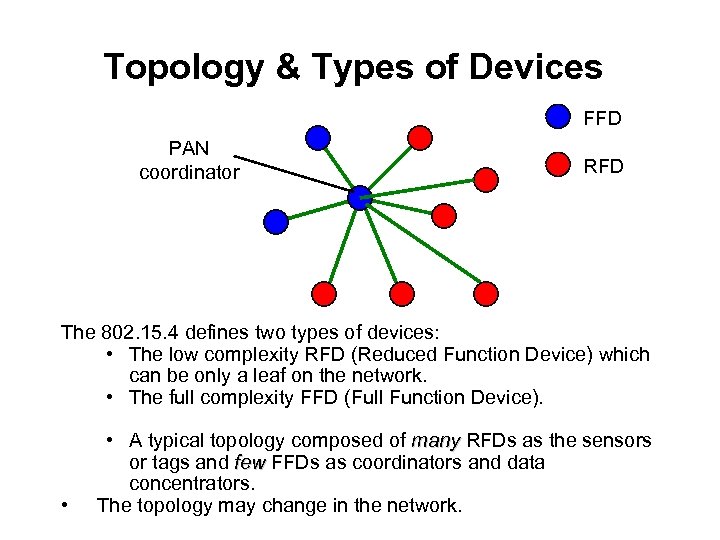 Topology & Types of Devices FFD PAN coordinator RFD The 802. 15. 4 defines two types of devices: • The low complexity RFD (Reduced Function Device) which can be only a leaf on the network. • The full complexity FFD (Full Function Device). • • A typical topology composed of many RFDs as the sensors or tags and few FFDs as coordinators and data concentrators. The topology may change in the network.
 Types of Devices (cont) • We propose asymmetric PHY: FFD with higher functionality and higher cost and RFD with lower functionality and cost. • The ultra low cost RFD (Reduced Function Device) is not required to be able to receive multiple packets. It will be capable of: – Responding to FFD requests. – Sending packets to a FFD – Requesting for a pending packet • The FFD (Full Function Device) is expected to be able to receive simultaneous multiple packets concurrently. It will be capable of: – Receiving many packets at the same time and responding each of them with ACK. – Calculating the distance to each node it received ACK from – Responding to RFD data requests.
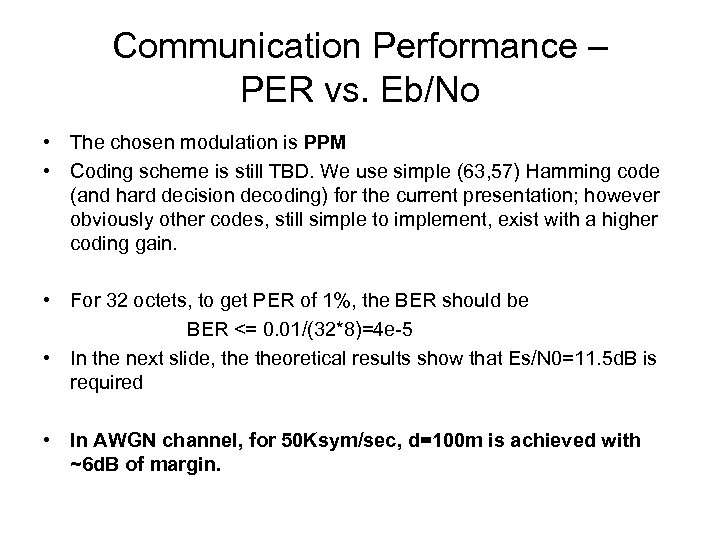 Communication Performance – PER vs. Eb/No • The chosen modulation is PPM • Coding scheme is still TBD. We use simple (63, 57) Hamming code (and hard decision decoding) for the current presentation; however obviously other codes, still simple to implement, exist with a higher coding gain. • For 32 octets, to get PER of 1%, the BER should be BER <= 0. 01/(32*8)=4 e-5 • In the next slide, theoretical results show that Es/N 0=11. 5 d. B is required • In AWGN channel, for 50 Ksym/sec, d=100 m is achieved with ~6 d. B of margin.
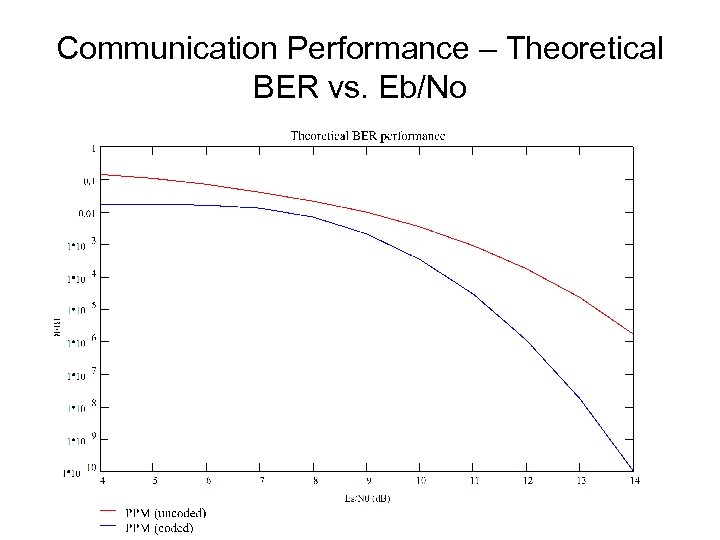 Communication Performance – Theoretical BER vs. Eb/No
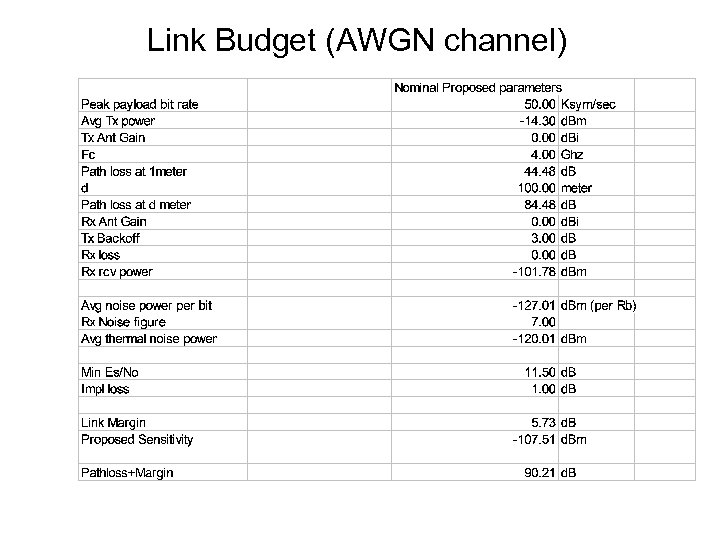 Link Budget (AWGN channel)
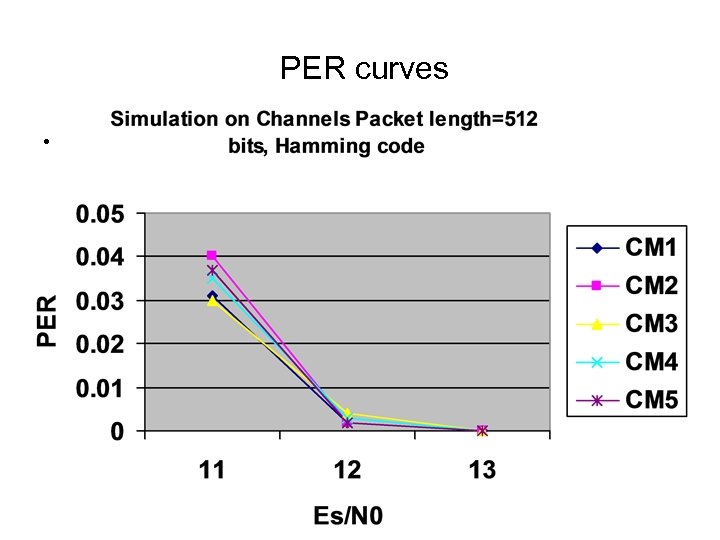
 Performance under Multipath • From the link budget: Receiver Sensitivity is -107. 5 d. Bm; or, total path loss <=90 d. B. • Achievable distances for the 9 channel models defined by the TG 4 a channel modeling subgroup, are shown in the next slide. • PER performance on these channels was checked by system simulation. The simulation includes: v v v Acquisition Tracking Adaptation Demodulation Decoding Packet processing • The PER results for several channel models (presented next) show good match with theoretical predictions.
![Distance vs. Channel Models [50 Ksym/sec] CM Type of Channel Distance [m] 1 Resident.](https://present5.com/presentation/300831217c74675f5b3bb6667082aa02/image-21.jpg "Distance vs. Channel Models [50 Ksym/sec] CM Type of Channel Distance [m] 1 Resident.") Distance vs. Channel Models [50 Ksym/sec] CM Type of Channel Distance [m] 1 Resident. LOS 394 2 Resid. hard NLOS 8. 2 (concrete walls*) 3 Office LOS 1610 4 Office NLOS 20. 6 5 Outdoor LOS 421 6 Outdoor NLOS 75 7 Industrial LOS 421 8 Industrial NLOS 27 9 Farm 393. 5 *The high atten. In 15 -04 -0290 -02 -004 a taken from 802. 15 -02/444
Distance vs. Channel Models [50 Ksym/sec] CM Type of Channel Distance [m] 1 Resident. LOS 394 2 Resid. hard NLOS 8. 2 (concrete walls*) 3 Office LOS 1610 4 Office NLOS 20. 6 5 Outdoor LOS 421 6 Outdoor NLOS 75 7 Industrial LOS 421 8 Industrial NLOS 27 9 Farm 393. 5 *The high atten. In 15 -04 -0290 -02 -004 a taken from 802. 15 -02/444
 PER curves •
 Acquisition • We assume the super-frame structure includes a Beacon transmission • In a steady-state, all devices synchronize to the Beacon transmissions of the PAN coordinator • A quick re-acquisition (in a short length window), to re-align the timing, is performed per each received Beacon. • The device then listens in the address message space to check if data is waiting; otherwise (if the device does not need to transmit) – it goes back to sleep • The quick acquisition is performed over the standard 4 octets preamble of the Beacon packet • All normal transmission packets will also include a 4 octets preamble, used for fine timing acquisition + channel model learning.
 Acquisition (cont. ) • In case a new RFD/FFD device joins an existing network, it has first to synchronize to the super-frame structure (namely to the Beacons transmissions) • One possible mechanism is passive association • Assuming that the power consumption dictates no more than about 1% duty cycle over long periods, this passive process will be relatively slow in time. • If active association is used, faster synchronization can be achieved.
 Interference & Coexistence • Protection against WLAN and other out of band signals (in 2. 4 Ghz, 5. 3 Ghz) aided by a 3 rd order Band-Pass filter in the receiver (or an equivalent LPF after down conversion) • For narrow-band interference (in-band), – High processing gain inherent in the technique (500 MHz/50 KHz=40 d. B) – Adaptive or programmable interference rejection mechanism (with mild requirements) may be employed • A real life effect which should be considered, is the transmission of “wide band noise” (OOB) by other devices, which covers the same freq band as the UWB device • • The result show that at most 1 m separation insures meting the criteria of PER<=1%, for UWB signal level 6 d. B above sensitivity level • For detailed analysis see spreadsheets in submitted material.
 Interference & Coexistence (cont. ) • Under extreme interference cases, a change of the active band may be undertaken (under higher layer command). • Coexistence with other devices (802 type, Vsats, . . ) is achieved with a small distance separation, due to the low average power density level of UWB transmission (detailed analysis in submitted material) • Co-existence with other Piconets – possibly co-located – may be simply achieved by selection of different active frequency bands for the Piconets (up to 3). • The band select filter provides more than 20 d. B attenuation, even for the adjacent bands of 4 Ghz (centered at 3. 5 Ghz, 4. 5 Ghz). • Further simulation results will be provided later on.
 Band Plan • The analysis (e. g. Link Budget) was made with a Fc=4 Ghz (Fl=3. 6 Gh, Fh=4. 4 Ghz for -10 d. B points) • The UWB freq range can be divided to multi-bands, coordinated with other uses defined by the ITU and IEEE bodies • Typically a device may be programmable to one of 3 bands in the range 3 -5 GHz (and additional bands in 6 -10 GHz when higher speed processes will be cost effective) • This enhances the robustness of the design and may serve to improve acceptance by regulation bodies worldwide • Outside the USA, device will operate in 2. 4 GHz or 5. 2 GHz until UWB will be approved worldwide. • Nevertheless, since the high aggregate rate (~10 Mbps) enables virtually all multiple uses in the same area, the standard should allow for lower cost devices to be fabricated for one fixed band.
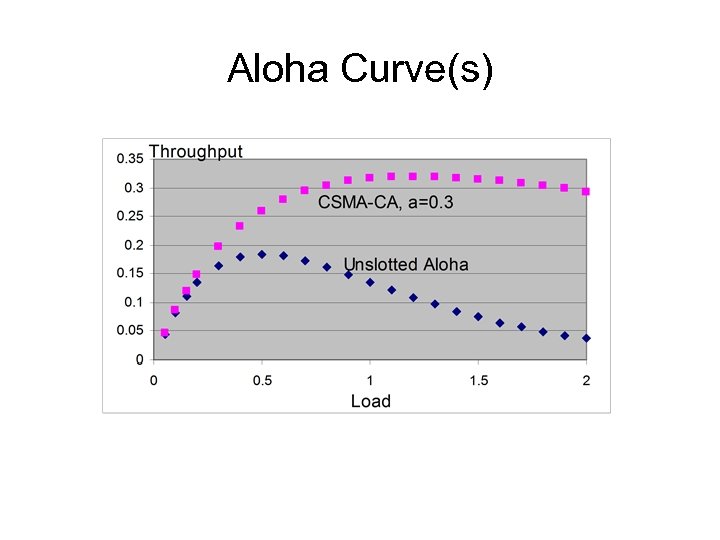
 Aggregate Rate Considerations • Recall the Interleaved pulsed transmission proposed • There are N=200 virtual time slots (of Ts= 100 nsec), totaling 20 usec, between each transmitted symbols of a single packet • The transmitting / answering devices can chose one of the N virtual time slots, to transmit their packet • This choice is kept throughout the packet • Due to the possible spatial layout of the answering devices, round trip delay differences can be larger than Ts. • Thus the basic model is multi-channel (N) un-slotted Aloha • The throughput vs. offered load of such a channel is known, and its peak is 1/2 e (per slot).
 Aggregate Rate (cont. ) • The ALOHA model assumes that if more than one transmission uses the same slot, than there is a collision and none gets through • Recall the Barker sequence (of length 11) Processing Gain, allowing for more than one reception in a time slot, if their sequences are in shift • However some issues like Near-Far (power ratio) and also channel multipath come into play • First analysis estimates that the effective PG is about 3; further simulations are needed to justify this estimate. • Thus the scheme has 3 N effective slots, so the maximum aggregate rate is 3*200*(1/2 e)*1/50 usec = 5. 5 Msym/sec.
 Aloha Curve(s)
 Aggregate Rate (cont. ) • For a ALOHA channel, insuring stability is of importance, by employing simple anti-congestion (“back-off”) mechanisms • Usage of Guaranteed Time Slots (GTS) can further improve the capacity, as these will operate at close to 100% efficiency; However this mode is applicable especially to relatively long transmissions. • Employing a collision avoidance (or CCA) mechanism, performance is improved in the (contention-based) Aloha slots as well as the stability • With CCA employed, for a propagation delay of ~30 nsec, and transmission of 100 nsec, theoretical capacity grows up to to Capacity = 9. 6 Mbs • The transmitting / answering devices hear only a partial population of all devices, thus the actual performance improvement of CCA will be assessed via a simulation (per specific channel and node locations).
 Ranging • Basic method proposed is Round Trip Delay measurement (by a FFD). • Why should we choose RTD for 15. 4 a? – – – – No need for fixed expensive infrastructure. No need to generate a very accurate time base. The only one that can be used in Relative systems. Each node makes its own measurement autonomously. Easy to handle Multipath (take the earliest component). Straightforward to implement. Can handle distance measurement with a single node in case x, y, z coordinate is not necessary.
 Ranging (cont. ) • Ranging is performed at same distance coverage as is for communications • The ranging algorithm uses between 30 to 50 symbols for averaging of the signal • Simulation results: for LOS channel models (residential, office, outdoor), the ranging accuracy is on the order of 0. 3 to 0. 5 meter. [Assuming uncorrelated errors at both measurements of the round trip delay, 1. 4 nsec is equivalent to (1 -way) distance error of 30 cm] • For NLOS channel models that were presented, the first path delay varies randomly in a certain range, in the model realizations; thus, ranging has a large error in some of the models. For CM=4 (office NLOS – probably a “soft” NLOS model), the std deviation is about 3 nsec (0. 66 m). • The random arrival of first cluster in the model needs further discussion.
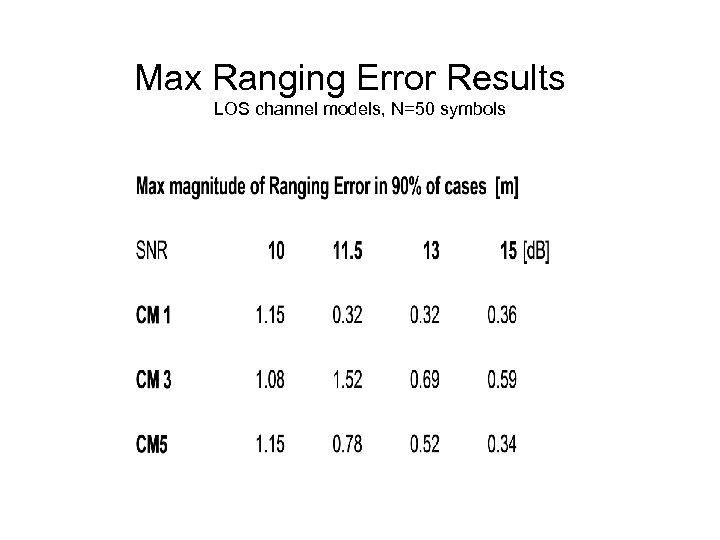 Max Ranging Error Results LOS channel models, N=50 symbols
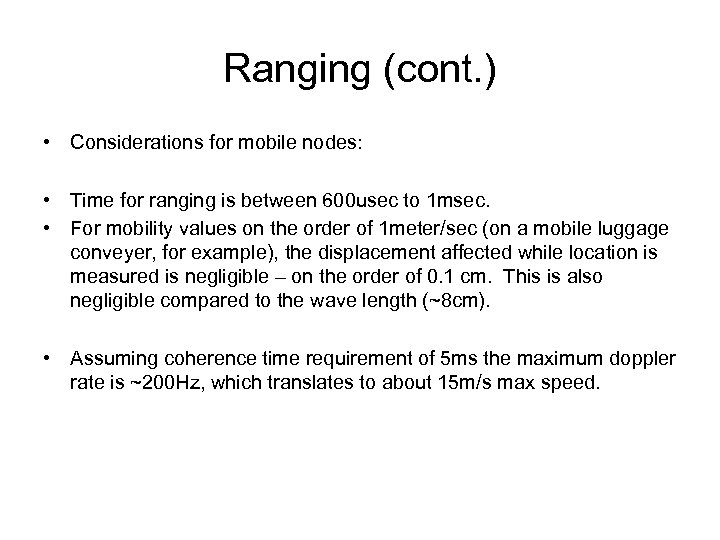 Ranging (cont. ) • Considerations for mobile nodes: • Time for ranging is between 600 usec to 1 msec. • For mobility values on the order of 1 meter/sec (on a mobile luggage conveyer, for example), the displacement affected while location is measured is negligible – on the order of 0. 1 cm. This is also negligible compared to the wave length (~8 cm). • Assuming coherence time requirement of 5 ms the maximum doppler rate is ~200 Hz, which translates to about 15 m/s max speed.
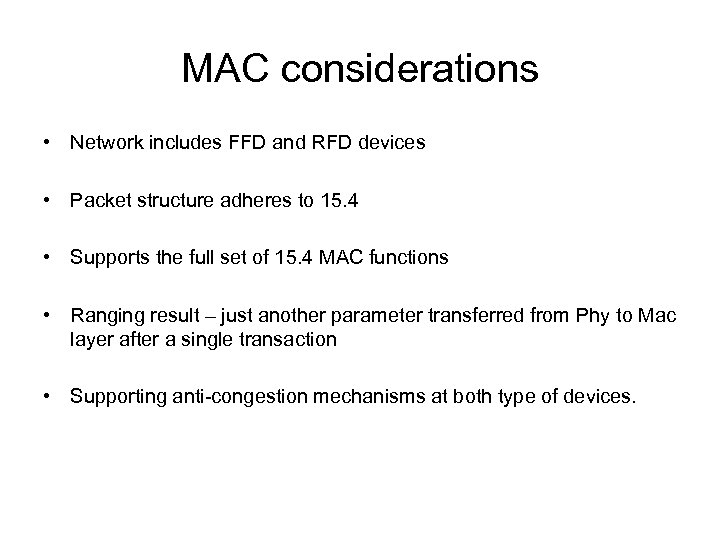 MAC considerations • Network includes FFD and RFD devices • Packet structure adheres to 15. 4 • Supports the full set of 15. 4 MAC functions • Ranging result – just another parameter transferred from Phy to Mac layer after a single transaction • Supporting anti-congestion mechanisms at both type of devices.
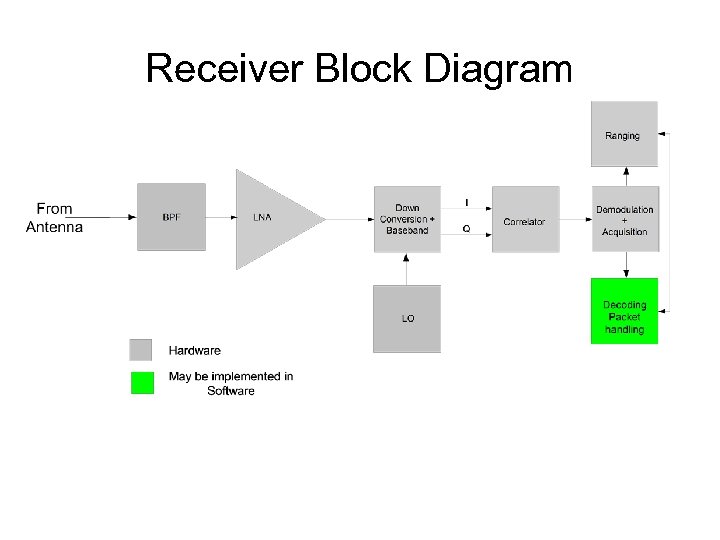 Receiver Block Diagram
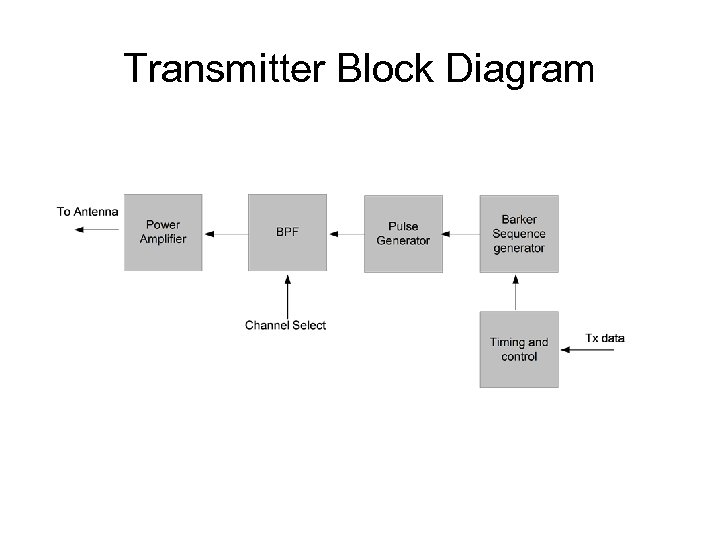 Transmitter Block Diagram
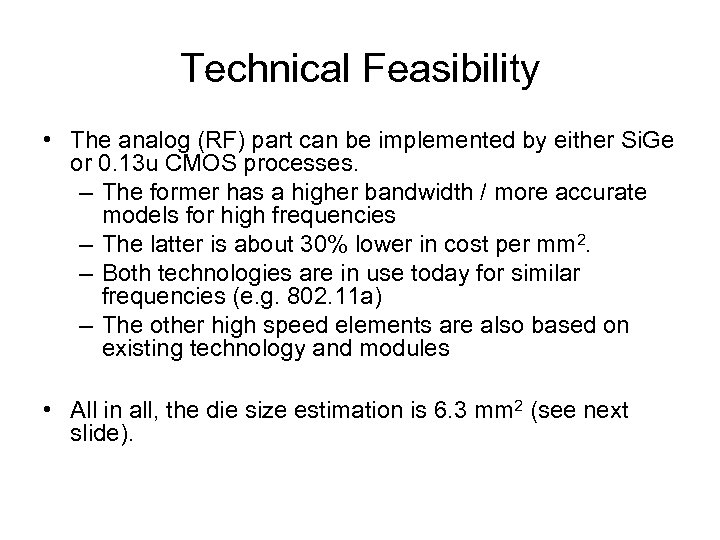 Technical Feasibility • The analog (RF) part can be implemented by either Si. Ge or 0. 13 u CMOS processes. – The former has a higher bandwidth / more accurate models for high frequencies – The latter is about 30% lower in cost per mm 2. – Both technologies are in use today for similar frequencies (e. g. 802. 11 a) – The other high speed elements are also based on existing technology and modules • All in all, the die size estimation is 6. 3 mm 2 (see next slide).
![Estimated Size and Power (RFD) Estimated Die Size [mm 2 ] Power (m. W)](https://present5.com/presentation/300831217c74675f5b3bb6667082aa02/image-40.jpg "Estimated Size and Power (RFD) Estimated Die Size [mm 2 ] Power (m. W)") Estimated Size and Power (RFD) Estimated Die Size [mm 2 ] Power (m. W) Analog Blocks 2. 0 2. 5 Analog To Digital 0. 5 3 Digital Blocks, u. P, RAM, ROM 3. 3 7. 5 Pads 0. 5 Total 6. 3 13. 0
Estimated Size and Power (RFD) Estimated Die Size [mm 2 ] Power (m. W) Analog Blocks 2. 0 2. 5 Analog To Digital 0. 5 3 Digital Blocks, u. P, RAM, ROM 3. 3 7. 5 Pads 0. 5 Total 6. 3 13. 0
 Power Consumption • The low power consumption is due to – Activating the components only when a transmission is expected (note the advantage of a short pulse sequence!) – Low power consumption design methodologies of all the parts • Each device typically listens only to the Beacons and rest of time is in sleep mode, thus the effective average power consumption will be reduced by a large factor (e. g. 1%), enabling long battery life • When in acquisition, a search for a symbol over few hypothesis is made.
 Scalability • • Higher (peer to peer) data rates can be achieved by 1. interleaving few packets from same source, which essentially mean lower separation between consecutive symbols. 2. Using higher order PPM For example: Interleaving 10 packets and using 16 -ary PPM results in 50 Kbps*10*4=2 Mbps • ALL RATES ARE COMPATIBLE AND COEXISTENT! • Lower (peer to peer) data rates can also be achieved (by using lower coding rates, and increasing preamble length accordingly to accommodate lower SNR), but not recommended • ‘Hooks’ for a cognitive radio can be added in the future, for example to add programmable notch filters in the transmitter.
 Summary • The Symbol Interleaved Impulse Radio system is a sound, complete system proposal that simultaneously answers all the technical requirements of TG-4 a of 802. 15 and all minimum SCD criteria • Offers large advantages (vs. conventional DS solutions) in terms of Range, Power, Aggregate rate and Cost • It enables both a robust design in various channels and scenarios, flexibility to a multitude of applications, and a very low-cost solution • Good distance performance on most channel models • We will be happy to cooperate with every one that is interested in this direction, in order to further improve its parameters.
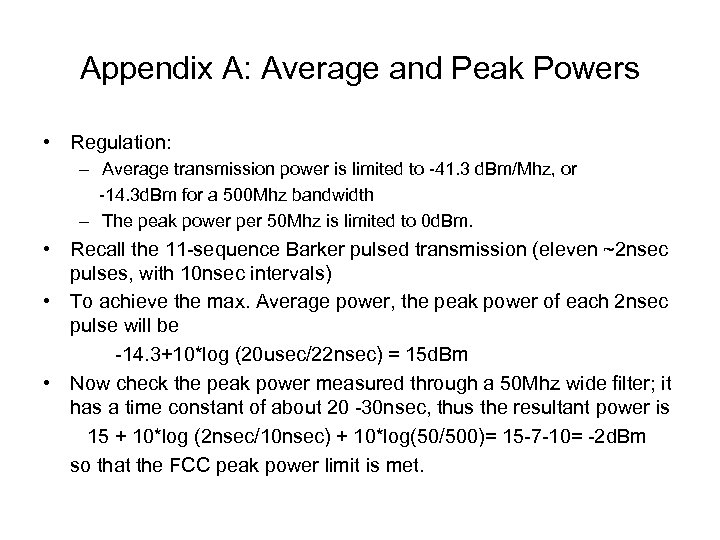 Appendix A: Average and Peak Powers • Regulation: – Average transmission power is limited to -41. 3 d. Bm/Mhz, or -14. 3 d. Bm for a 500 Mhz bandwidth – The peak power per 50 Mhz is limited to 0 d. Bm. • Recall the 11 -sequence Barker pulsed transmission (eleven ~2 nsec pulses, with 10 nsec intervals) • To achieve the max. Average power, the peak power of each 2 nsec pulse will be -14. 3+10*log (20 usec/22 nsec) = 15 d. Bm • Now check the peak power measured through a 50 Mhz wide filter; it has a time constant of about 20 -30 nsec, thus the resultant power is 15 + 10*log (2 nsec/10 nsec) + 10*log(50/500)= 15 -7 -10= -2 d. Bm so that the FCC peak power limit is met.
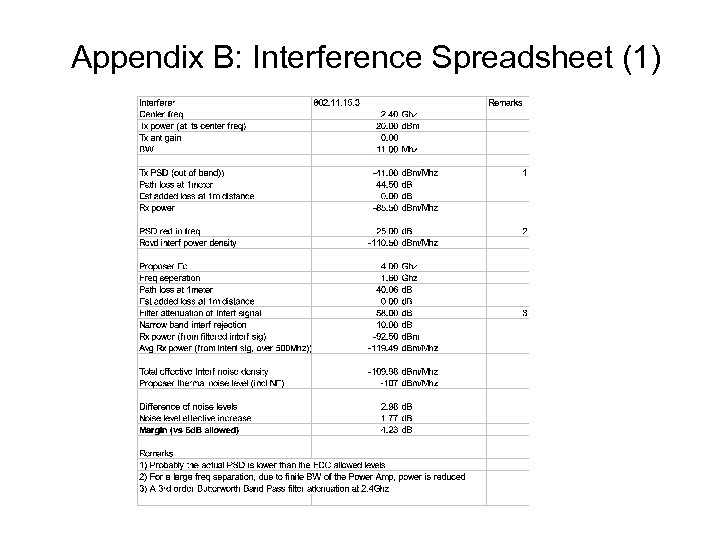 Appendix B: Interference Spreadsheet (1)
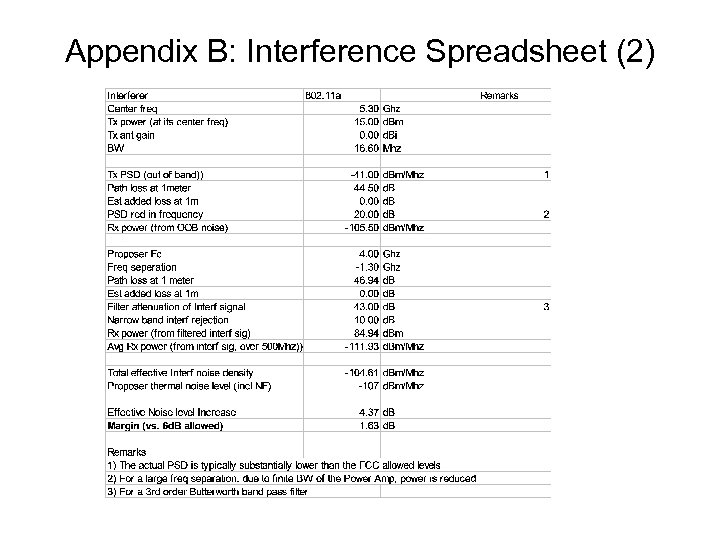 Appendix B: Interference Spreadsheet (2)
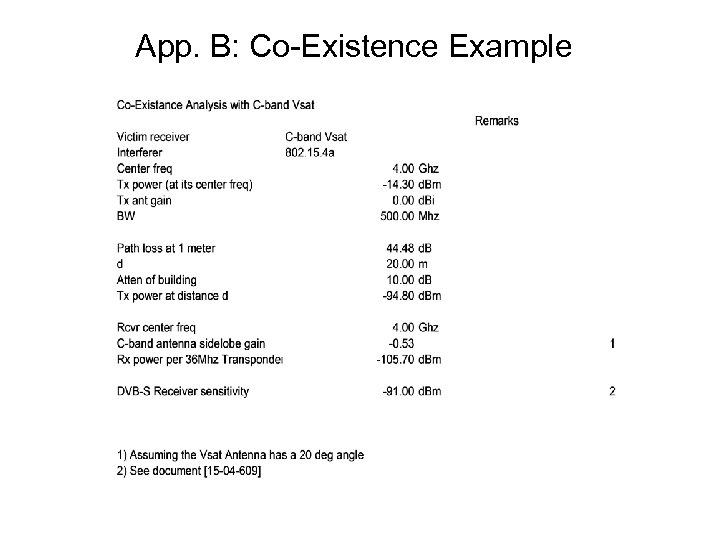 App. B: Co-Existence Example