


 Скачать презентацию PROGRESSIVISM M u c k r a k
8d970dcf498a350f974227b2f81aa53d.ppt
- Количество слайдов: 22
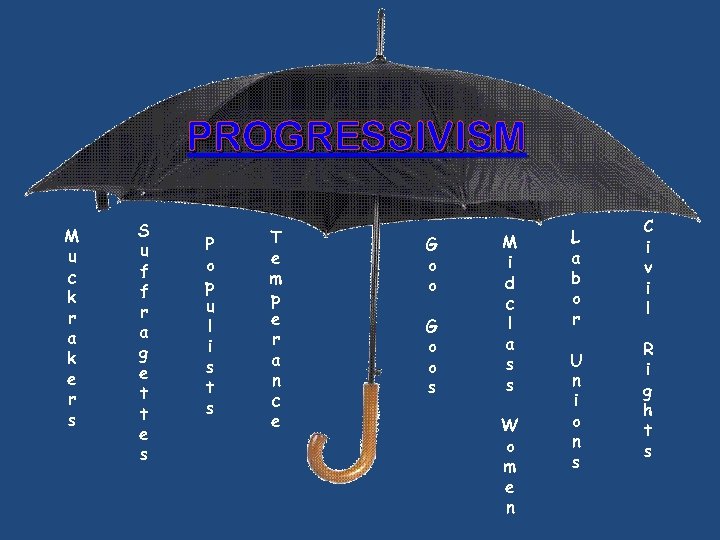 PROGRESSIVISM M u c k r a k e r s S u f f r a g e t t e s P o p u l i s t s T e m p e r a n c e G o o s M i d c l a s s W o m e n L a b o r U n i o n s C i v i l R i g h t s
 I. Progressivism A. Broad-based response to industrialization and its by-products—immigration, urban growth, growing corporate power and widening class divisions • Arose in cities • Enlisted more journalists, academics and social theorists believed social problems could be solved through careful study. • Reformers not radicals
 B. • • The many faces of Progressivism New middle class Middle Class Women Workers themselves Corporate leaders
 C. Intellectuals Offer New Social Views 1. Thorstein Veblen—The Theory of the Leisure Class (1899) “conspicuous consumption” 2. William James—Pragmatism (1907) Truth emerges through practical action 3. Herbert Croly—The Promise of American Life (1909) We need an activist government to promote the welfare of all. 4. Jane Addams—Democracy and Social Ethics (1902) individual well-being depends of the well-being of all
 5. John Dewey—Democracy and Education (1916) Children should learn to live cooperatively as members of a social group. 6. Oliver Wendell Holmes, Jr. —The Common Law (1881) Law must evolve as society changes. Intellectuals provided progressivism’s underlying ideas Attacked the ideas of social Darwinism.
 D. Novelists, Journalists and Artists 1. Frank Norris—The Octopus (1901) RR owners promoted their own interests 2. Theodore Dreiser—The Financier (1912) Stimulates pressure for tougher business reg. 3. Magazines—Mc. Clure’s, Colliers 4. John Spargo—The Bitter Cry of the Children (1906) coal mines in PA and WV
 5. Ida Tarbell—History of the Standard Oil Company 6. Lincoln Steffens—Shame of the Cities **Theodore Roosevelt criticized the authors as muckrakers—awakened middle class readers to the conditions in industrial America. 7. Ashcan School—NY Painters—Portrayed the harshness and vitality of slum life.
 II. State and Local Progressivism A. Reforming the political process 1. city-manager system 2. electoral reform—secret ballot 3. initiative 4. referendum 5. recall 6. 17 th Amendment—direct election of senators *Originally Populist ideas!
 • Electoral reforms lead to REDUCED voter turnout! • Why? • Elimination of party bosses—no more rewards! • New voter registration requirements— reforms actually made it more difficult to register.
 B. Regulating business—protecting workers 1. Frederick W. Taylor—Principles of Scientific Management (1911) “Efficiency” 2. Wisconsin—Gov. Robert La Follette— laboratory—regulate rr’s, mines Adopted direct primary, initiative, referendum and recall
 C. Making cities more livable 1. Municipal reforms—better garbage collection, sewers, water 2. Drop in infant mortality rate 3. “Typhoid Mary” 4. Smoke Prevention Association (1906)
 III. Social Progressivism A. Moral Control in the cities 1. Amusement parks, plane, Model-T, Ragtime, Nickelodeons—Charlie Chaplin 2. Women’s Christian Temperance Union Targeted prostitution 3. Mann Act (1910) Illegal to transport a woman across state lines for immoral purposes ”white slave hysteria”
 4. Anti-Saloon League (1895) Pushed for national prohibition 5. Narcotics Act of 1914—Harrison Act Banned distribution of heroin, morphine, cocaine and other addictive drugs
 B. Immigration Restriction and Eugenics 1. Immigration Restriction League (1894) 2. Eugenics The control of reproduction to alter a plant or animal species—Charles B. Davenport urged immigration restriction to keep America from pollution by inferior stock. 3. The Passing of the Great Race (1916) Madison Grant—used bogus data to denounce immigration from Southern and Eastern Europe—especially Jews. 4. Buck v. Bell—Upheld legalized sterilization of criminals, sex offenders and mentally deficient
 C. Racism and Progressivism 1. Jim Crow Laws—Segregation 2. Mixed Record— a. Lillian Ward & Muckraker Ray Stannard Baker protested racial injustice but… b. DW Griffiths—The Birth of a Nation (1915) Disparaged blacks and glorified the KKK Most progressives kept silent as blacks were lynched, disenfranchised and discriminated against.
 On the evening of March 21, 1915, President Woodrow Wilson attended a special screening at the White House of The Birth of a Nation, a film directed by D. W. Griffith and based on The Clansman, a novel written by Wilson's good friend Thomas Dixon. The film presented a distorted portrait of the South after the Civil War, glorifying the Ku Klux Klan and denigrating blacks. It falsified the period of Reconstruction by presenting blacks as dominating Southern whites and sexually forcing themselves upon white women. The Klan was portrayed as the South's savior from this alleged tyranny. Not only was this portrayal untrue, it was the opposite of what actually happened. During Reconstruction, whites dominated blacks and assaulted black women. The Klan was primarily a white terrorist organization that carried out hundreds of murders. After seeing the film, an enthusiastic Wilson reportedly remarked: "It is like writing history with lightning, and my only regret is that it is all so terribly true. "
 3. African American leaders organize against racism 1. Ida Wells-Barnett—journalist—antilynching campaign 2. W. E. B. Du. Bois Souls of Black Folk — rejected BT Washington’s call for patience— demanded racial equality Niagara movement —Conference led by Du. Bois Vigorous resistance to racism 3. NAACP —Sustained activism & legal challenges to achieve equality
 D. Revival of the Women’s Suffrage Movement 1. Carrie Chapman Catt’s Winning Plan—grass roots organization vs. 2. Alice Paul--Congressional Union for Woman Suffrage (1916) militant—pressured Congress to enact an amendment for suffrage
 3. Charlotte Perkins Gilman—Women and Economics (1898)—Linked women’s subordinate status to economic dependence on men 4. Margaret Sanger (1914) coined the term “birth control” Founded American Birth Control League—ancestor of Planned Parenthood—direct action to promote the cause
 E. Workers Organize 1. Industrial Workers of the World (IWW) “Wobblies” Chicago 1905 Led by Wm “Big Bill” Haywood Led mass strikes, faced gov’t harassment 2. Some turned to socialism—advocated an end to capitalism SPA—Socialist Party of America (1900) Eugene V. Debs—SPA’s candidate 5 X between 1900 -1920
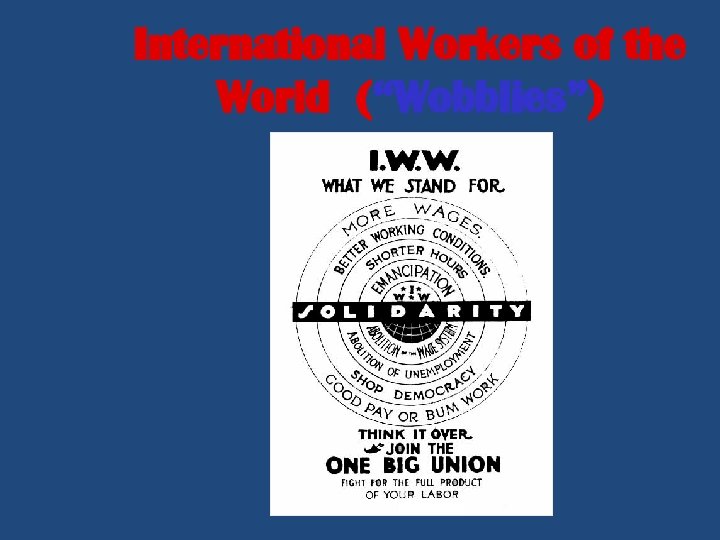 International Workers of the World (“Wobblies”)