


 Скачать презентацию PROGRESSIVE ERA 1890 s-1920 A 21 w 9
61b3540049a59694c7128fdb3a5924b9.ppt
- Количество слайдов: 45
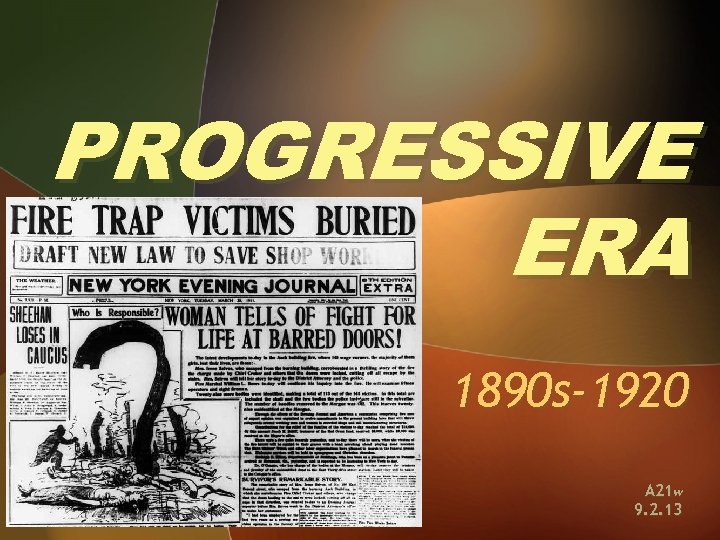 PROGRESSIVE ERA 1890 s-1920 A 21 w 9. 2. 13
 ESSENTIAL QUESTIONS Who were the Progressives? ► What reforms did they seek? ► How successful were Progressive Era reforms in the period 1890 -1920? ► Consider: political change, social change (industrial conditions, urban life, women, prohibition)
 ORIGINS OF PROGRESSIVE REFORM
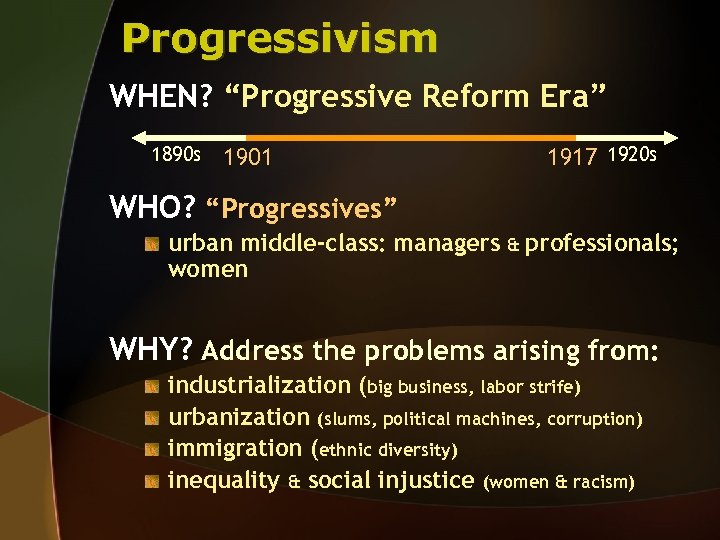 Progressivism WHEN? “Progressive Reform Era” 1890 s 1917 1920 s 1901 WHO? “Progressives” urban middle-class: managers women & professionals; WHY? Address the problems arising from: industrialization (big business, labor strife) urbanization (slums, political machines, corruption) immigration (ethnic diversity) inequality & social injustice (women & racism)
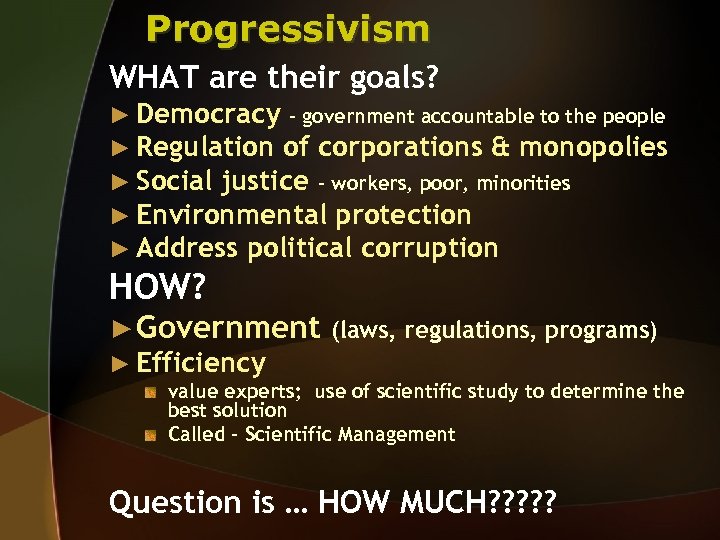 Progressivism WHAT are their goals? ► Democracy – government accountable to the people ► Regulation of corporations & monopolies ► Social justice – workers, poor, minorities ► Environmental protection ► Address political corruption HOW? ► Government (laws, regulations, programs) ► Efficiency value experts; use of scientific study to determine the best solution Called – Scientific Management Question is … HOW MUCH? ? ?
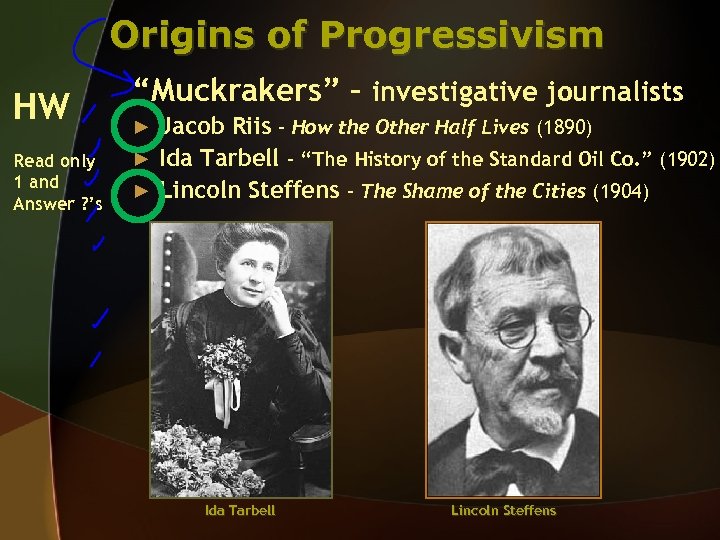 Origins of Progressivism HW Read only 1 and Answer ? ’s “Muckrakers” – investigative journalists Jacob Riis – How the Other Half Lives (1890) ► Ida Tarbell – “The History of the Standard Oil Co. ” (1902) ► Lincoln Steffens – The Shame of the Cities (1904) ► Ida Tarbell Lincoln Steffens
 REFORMS
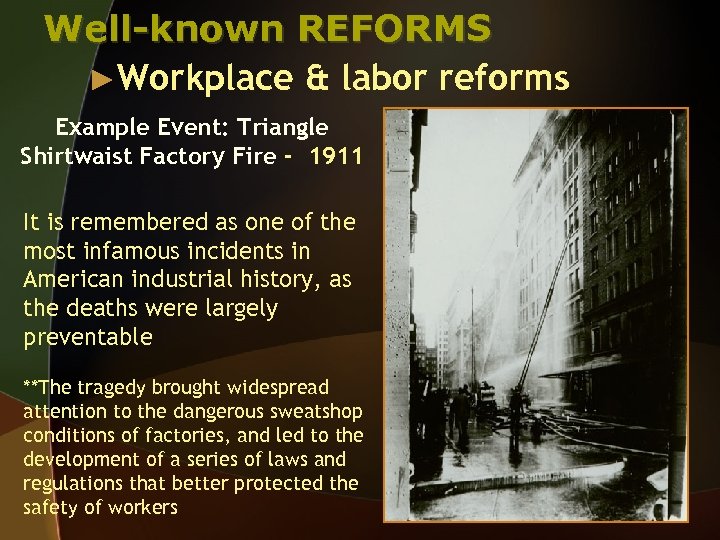 Well-known REFORMS ►Workplace & labor reforms Example Event: Triangle Shirtwaist Factory Fire - 1911 It is remembered as one of the most infamous incidents in American industrial history, as the deaths were largely preventable **The tragedy brought widespread attention to the dangerous sweatshop conditions of factories, and led to the development of a series of laws and regulations that better protected the safety of workers
 As we watch…in your notebook I. What were conditions like in the factory for the workers? Who was working? Work day? Working conditions? Safety? II. What happened to start the fire? III. Immediate Reaction of the workers IV. During the fire…what was happening? V. Problems that occurred battling the fire? VI. Aftermath
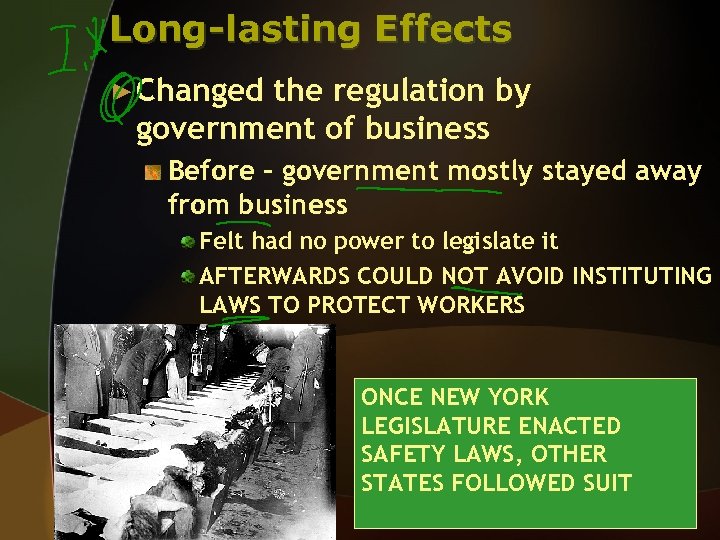 Long-lasting Effects ► Changed the regulation by government of business Before – government mostly stayed away from business Felt had no power to legislate it AFTERWARDS COULD NOT AVOID INSTITUTING LAWS TO PROTECT WORKERS ONCE NEW YORK LEGISLATURE ENACTED SAFETY LAWS, OTHER STATES FOLLOWED SUIT
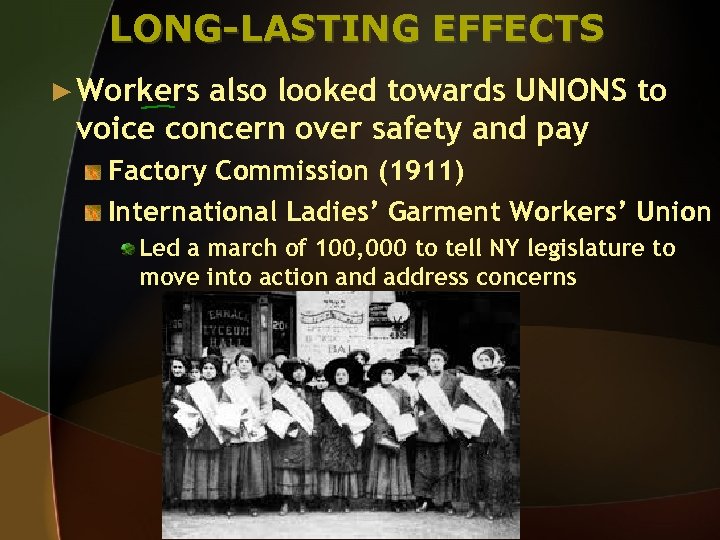 LONG-LASTING EFFECTS ► Workers also looked towards UNIONS to voice concern over safety and pay Factory Commission (1911) International Ladies’ Garment Workers’ Union Led a march of 100, 000 to tell NY legislature to move into action and address concerns
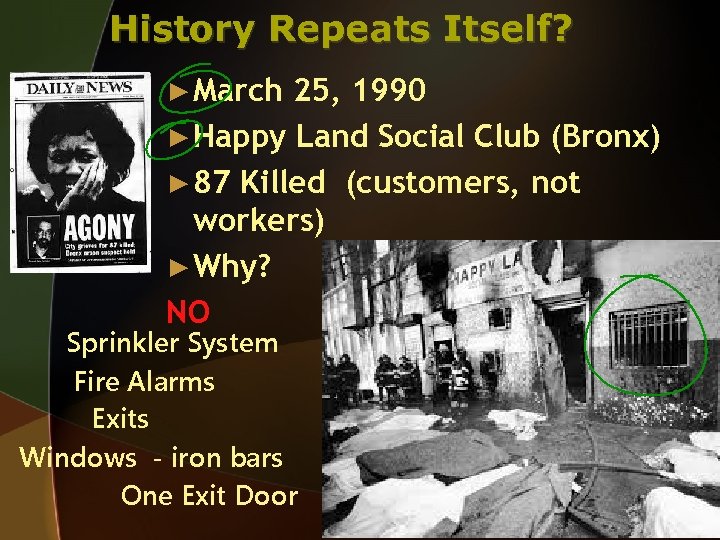 History Repeats Itself? ► March 25, 1990 ► Happy Land Social Club (Bronx) ► 87 Killed (customers, not workers) ► Why? NO Sprinkler System Fire Alarms Exits Windows - iron bars One Exit Door
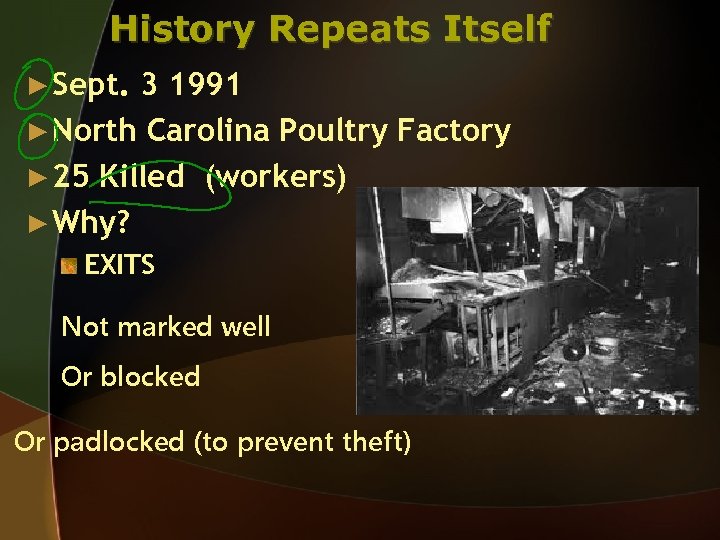 History Repeats Itself ► Sept. 3 1991 ► North Carolina Poultry Factory ► 25 Killed (workers) ► Why? EXITS Not marked well Or blocked Or padlocked (to prevent theft)
 Reforms into today ► Countless state and federal laws ► Unions gathered numerous new workers ► Employers have a clear set of guidelines that need to be followed to ensure safety of their employees Look Around You… Fire Drills and instructions posted Firefighting equipment must be maintained and portable fire extinguishers Fire Sprinklers Employee training
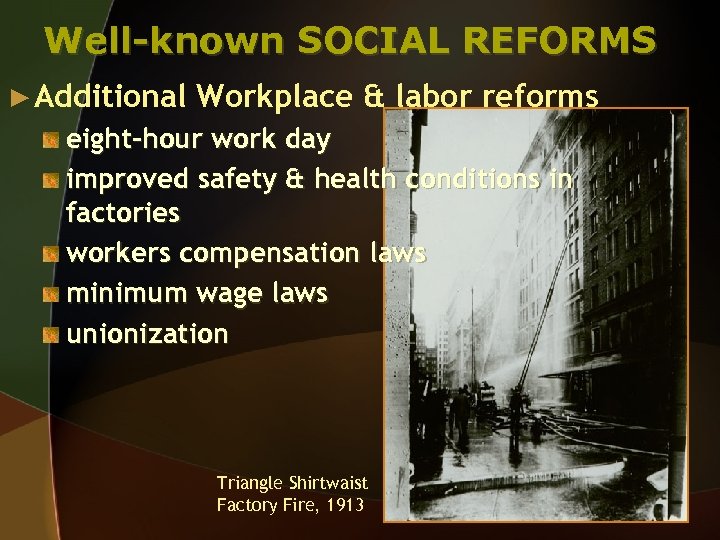 Well-known SOCIAL REFORMS ► Additional Workplace & labor reforms eight-hour work day improved safety & health conditions in factories workers compensation laws minimum wage laws unionization Triangle Shirtwaist Factory Fire, 1913
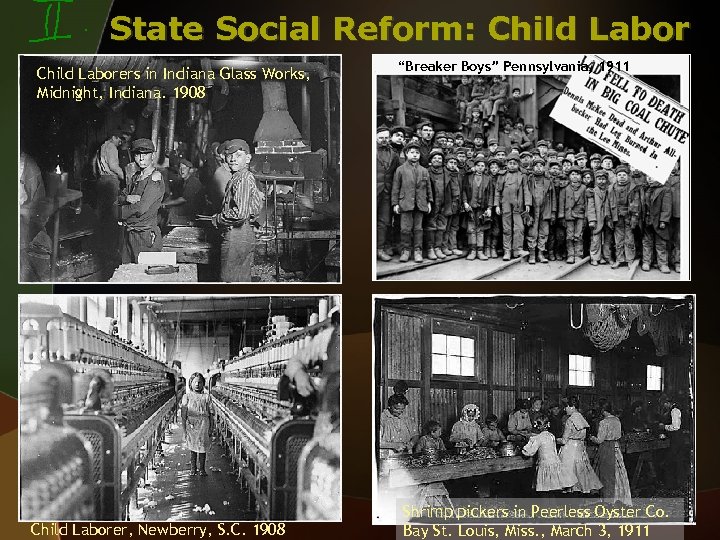 State Social Reform: Child Laborers in Indiana Glass Works, Midnight, Indiana. 1908 Child Laborer, Newberry, S. C. 1908 “Breaker Boys” Pennsylvania, 1911 Shrimp pickers in Peerless Oyster Co. Bay St. Louis, Miss. , March 3, 1911
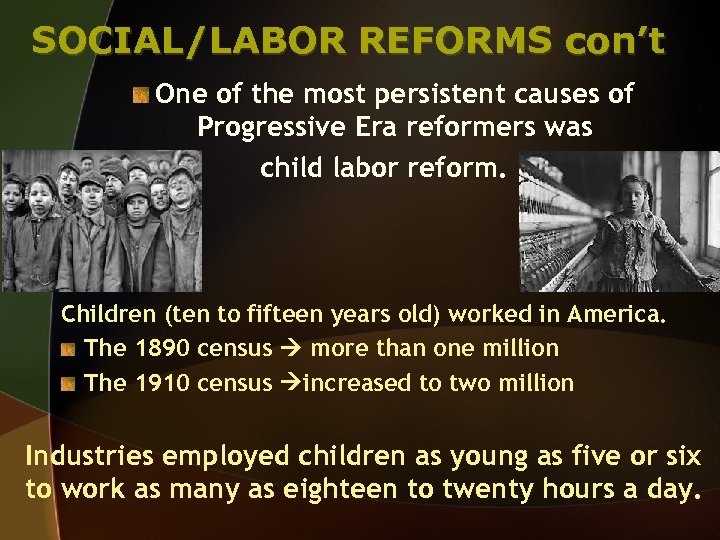 SOCIAL/LABOR REFORMS con’t One of the most persistent causes of Progressive Era reformers was child labor reform. Children (ten to fifteen years old) worked in America. The 1890 census more than one million The 1910 census increased to two million Industries employed children as young as five or six to work as many as eighteen to twenty hours a day.
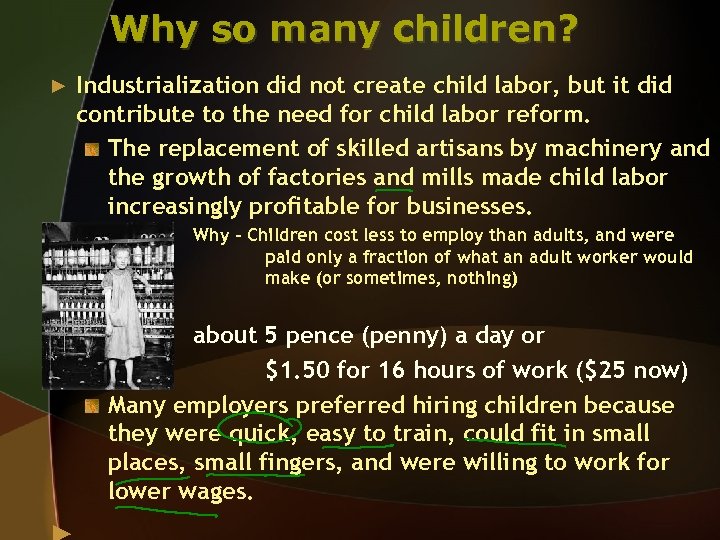 Why so many children? ► Industrialization did not create child labor, but it did contribute to the need for child labor reform. The replacement of skilled artisans by machinery and the growth of factories and mills made child labor increasingly profitable for businesses. Why - Children cost less to employ than adults, and were paid only a fraction of what an adult worker would make (or sometimes, nothing) about 5 pence (penny) a day or $1. 50 for 16 hours of work ($25 now) Many employers preferred hiring children because they were quick, easy to train, could fit in small places, small fingers, and were willing to work for lower wages.
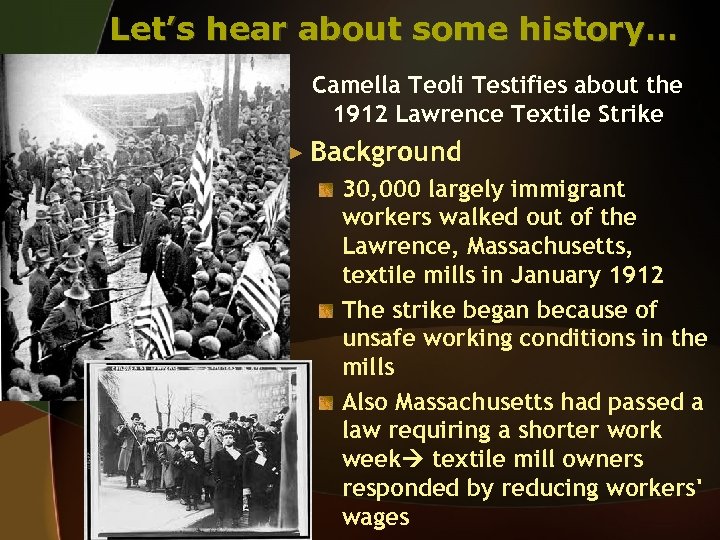 Let’s hear about some history… Camella Teoli Testifies about the 1912 Lawrence Textile Strike ► Background 30, 000 largely immigrant workers walked out of the Lawrence, Massachusetts, textile mills in January 1912 The strike began because of unsafe working conditions in the mills Also Massachusetts had passed a law requiring a shorter work week textile mill owners responded by reducing workers' wages
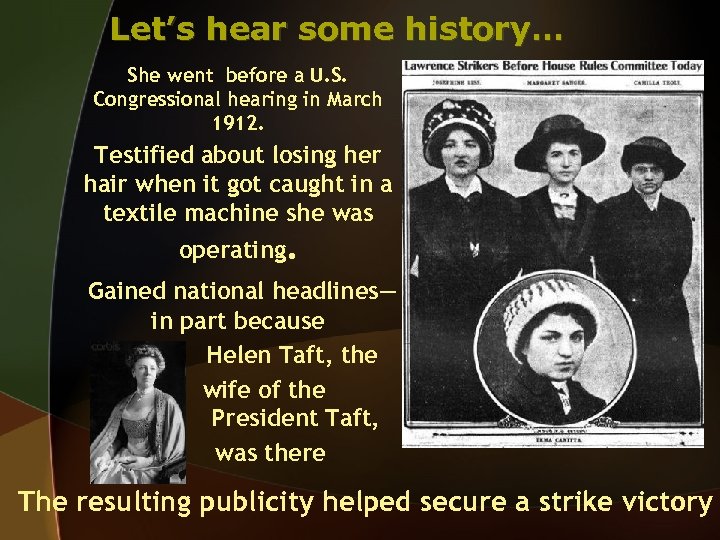 Let’s hear some history… She went before a U. S. Congressional hearing in March 1912. Testified about losing her hair when it got caught in a textile machine she was operating. Gained national headlines— in part because Helen Taft, the wife of the President Taft, was there The resulting publicity helped secure a strike victory
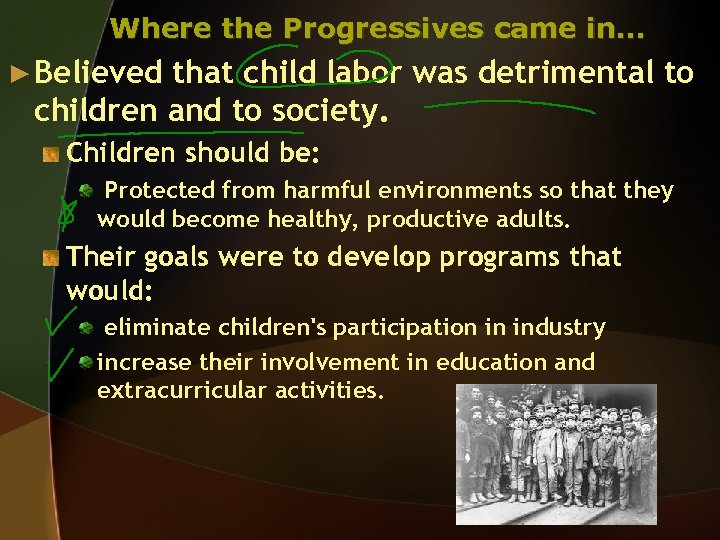 Where the Progressives came in… ► Believed that child labor was detrimental to children and to society. Children should be: Protected from harmful environments so that they would become healthy, productive adults. Their goals were to develop programs that would: eliminate children's participation in industry increase their involvement in education and extracurricular activities.
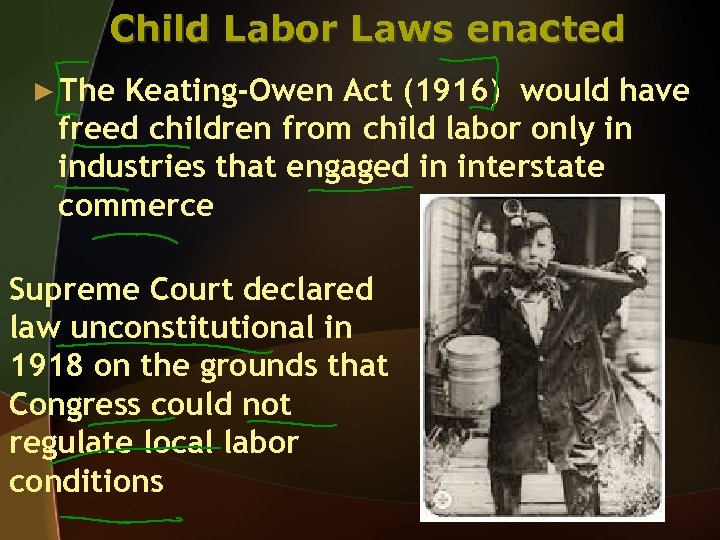 Child Labor Laws enacted ► The Keating-Owen Act (1916) would have freed children from child labor only in industries that engaged in interstate commerce Supreme Court declared law unconstitutional in 1918 on the grounds that Congress could not regulate local labor conditions
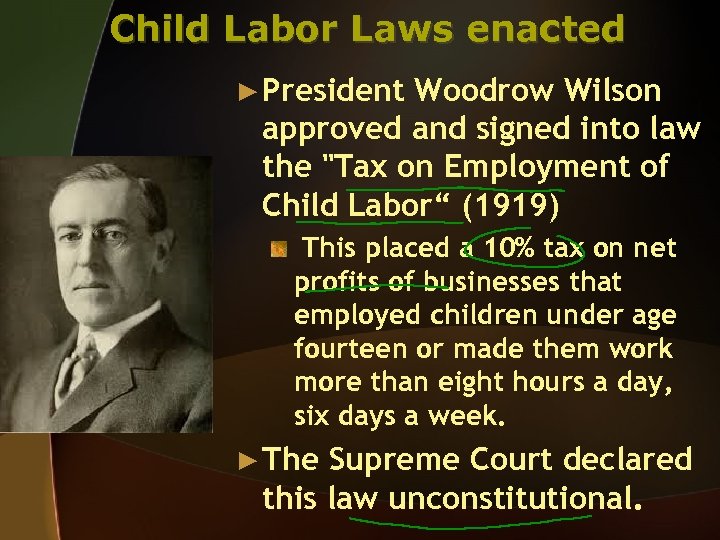 Child Labor Laws enacted ► President Woodrow Wilson approved and signed into law the "Tax on Employment of Child Labor“ (1919) This placed a 10% tax on net profits of businesses that employed children under age fourteen or made them work more than eight hours a day, six days a week. ► The Supreme Court declared this law unconstitutional.
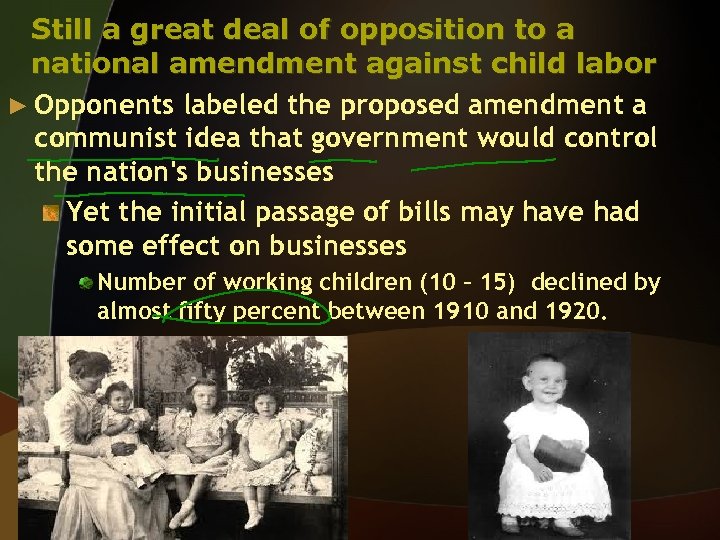 Still a great deal of opposition to a national amendment against child labor ► Opponents labeled the proposed amendment a communist idea that government would control the nation's businesses Yet the initial passage of bills may have had some effect on businesses Number of working children (10 – 15) declined by almost fifty percent between 1910 and 1920.
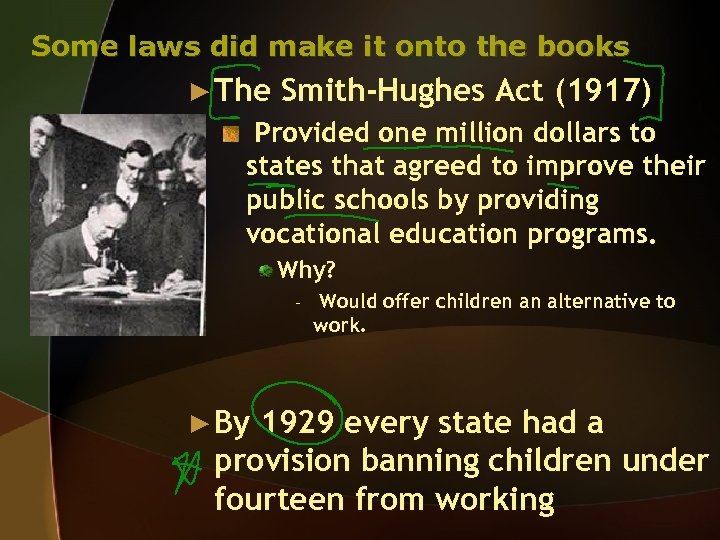 Some laws did make it onto the books ► The Smith-Hughes Act (1917) Provided one million dollars to states that agreed to improve their public schools by providing vocational education programs. Why? – ► By Would offer children an alternative to work. 1929 every state had a provision banning children under fourteen from working
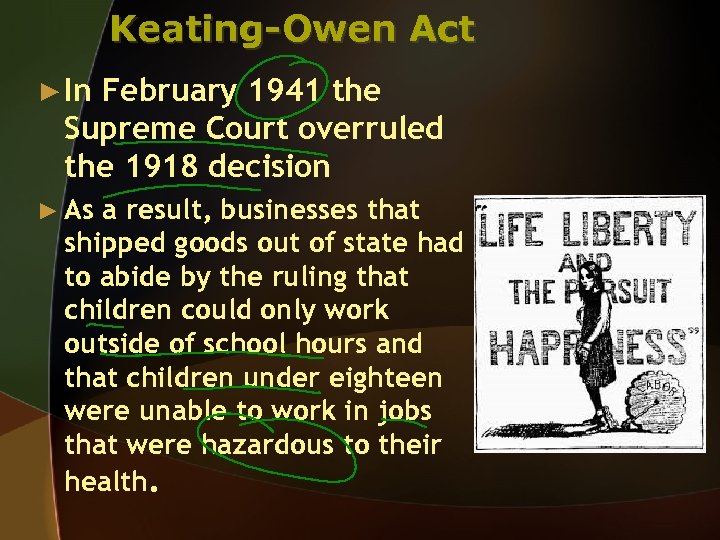 Keating-Owen Act ► In February 1941 the Supreme Court overruled the 1918 decision ► As a result, businesses that shipped goods out of state had to abide by the ruling that children could only work outside of school hours and that children under eighteen were unable to work in jobs that were hazardous to their health.
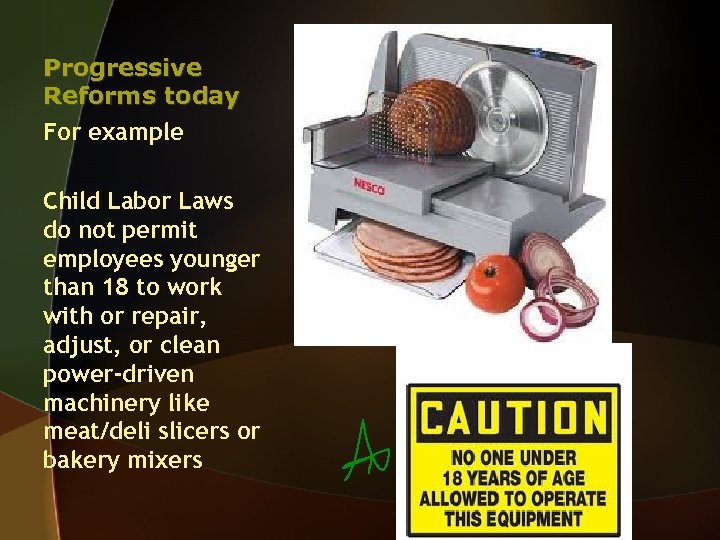 Progressive Reforms today For example Child Labor Laws do not permit employees younger than 18 to work with or repair, adjust, or clean power-driven machinery like meat/deli slicers or bakery mixers
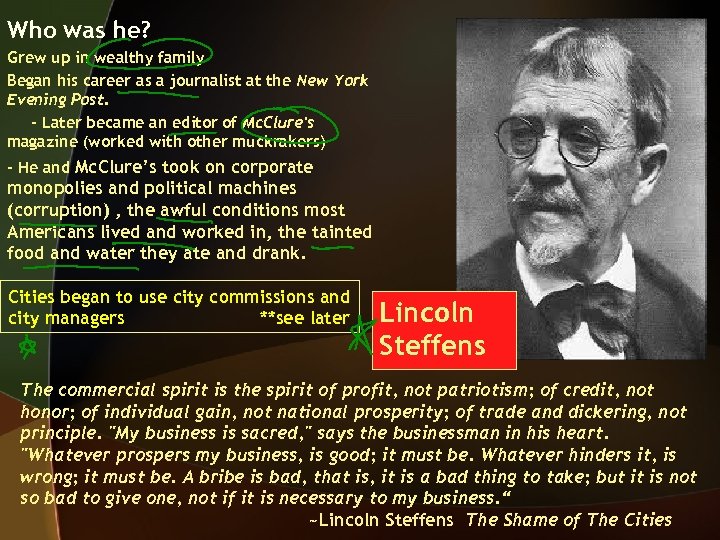 Who was he? Grew up in wealthy family Began his career as a journalist at the New York Evening Post. - Later became an editor of Mc. Clure's magazine (worked with other muckrakers) - He and Mc. Clure’s took on corporate monopolies and political machines (corruption) , the awful conditions most Americans lived and worked in, the tainted food and water they ate and drank. Cities began to use city commissions and city managers **see later Lincoln Steffens The commercial spirit is the spirit of profit, not patriotism; of credit, not honor; of individual gain, not national prosperity; of trade and dickering, not principle. "My business is sacred, " says the businessman in his heart. "Whatever prospers my business, is good; it must be. Whatever hinders it, is wrong; it must be. A bribe is bad, that is, it is a bad thing to take; but it is not so bad to give one, not if it is necessary to my business. “ ~Lincoln Steffens The Shame of The Cities
 Protect Social Welfare
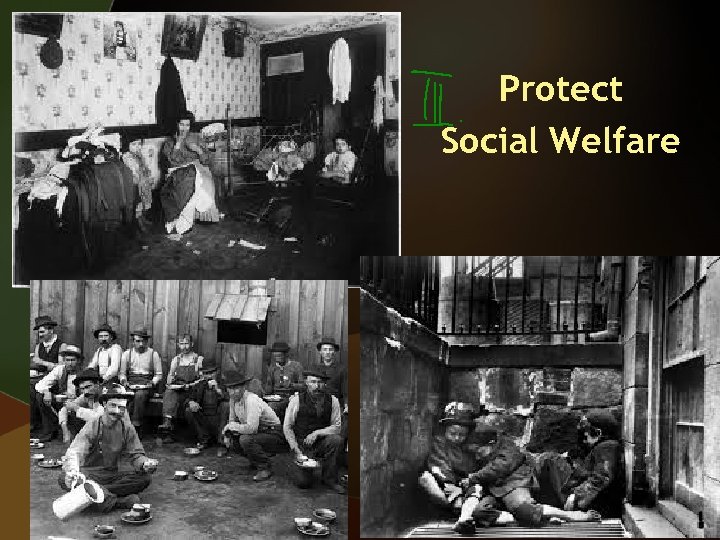
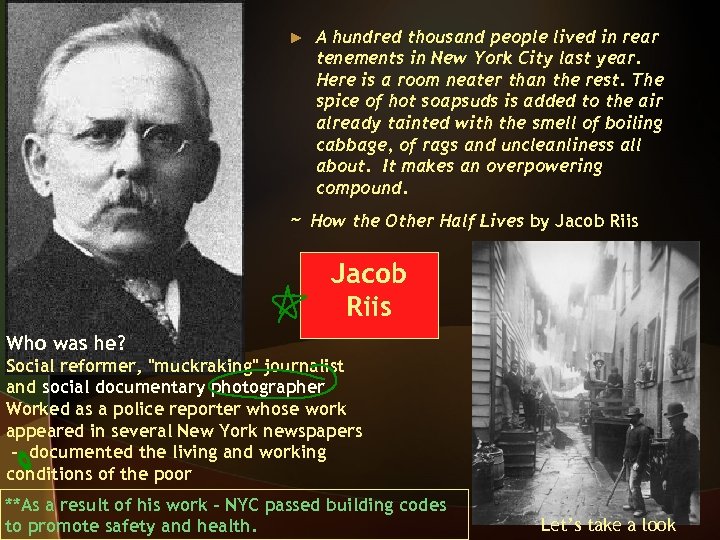 ► ~ A hundred thousand people lived in rear tenements in New York City last year. Here is a room neater than the rest. The spice of hot soapsuds is added to the air already tainted with the smell of boiling cabbage, of rags and uncleanliness all about. It makes an overpowering compound. How the Other Half Lives by Jacob Riis Who was he? Social reformer, "muckraking" journalist and social documentary photographer Worked as a police reporter whose work appeared in several New York newspapers - documented the living and working conditions of the poor **As a result of his work - NYC passed building codes to promote safety and health. Let’s take a look
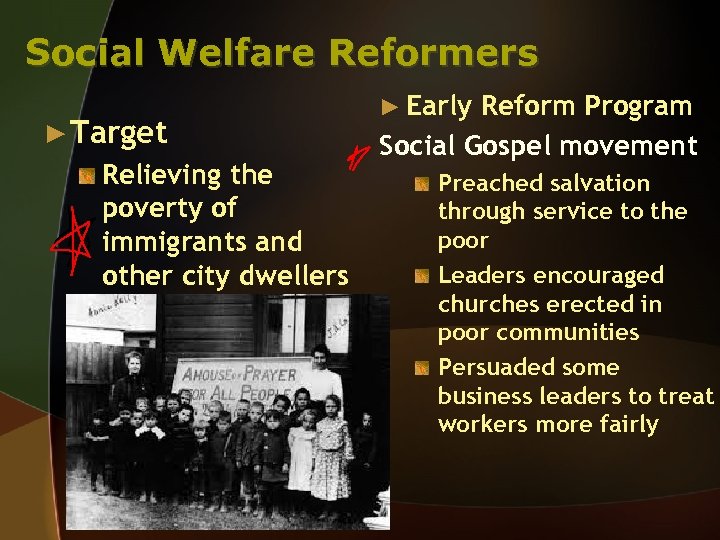 Social Welfare Reformers ► Target Relieving the poverty of immigrants and other city dwellers ► Early Reform Program Social Gospel movement Preached salvation through service to the poor Leaders encouraged churches erected in poor communities Persuaded some business leaders to treat workers more fairly
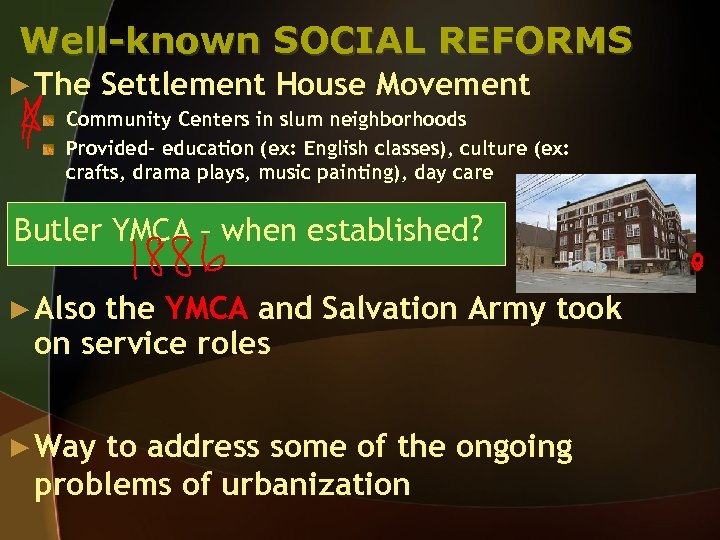 Well-known SOCIAL REFORMS ► The Settlement House Movement Community Centers in slum neighborhoods Provided- education (ex: English classes), culture (ex: crafts, drama plays, music painting), day care Butler YMCA – when established? ► Also the YMCA and Salvation Army took on service roles ► Way to address some of the ongoing problems of urbanization
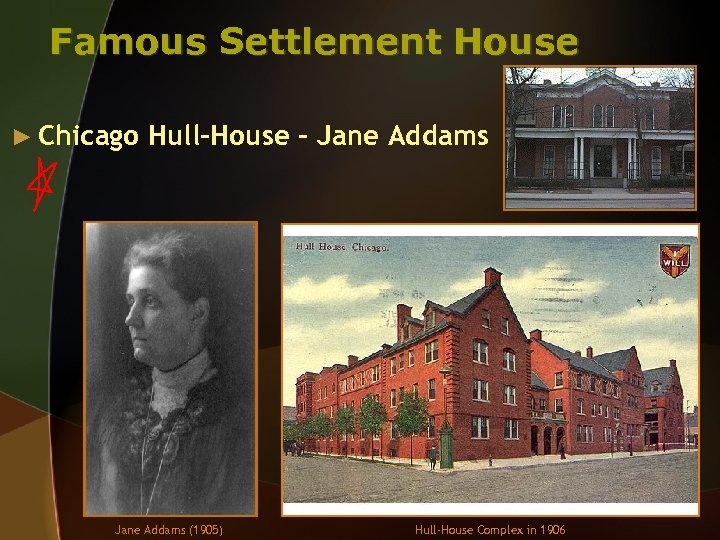 Famous Settlement House ► Chicago Hull-House – Jane Addams (1905) Hull-House Complex in 1906
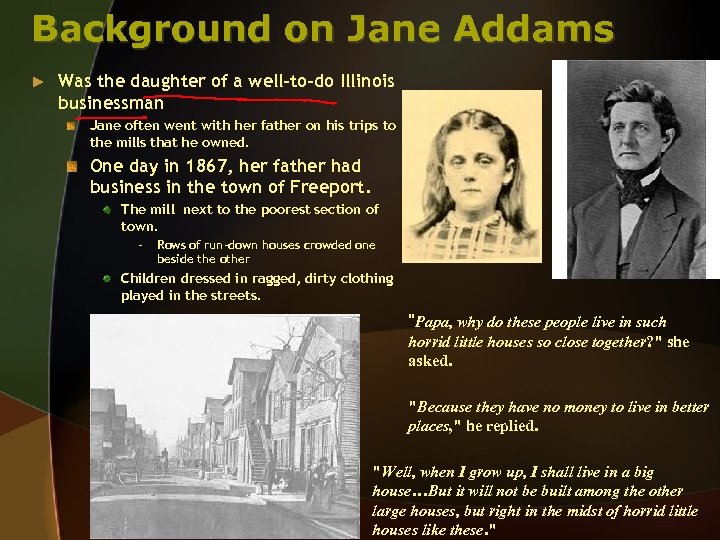 Background on Jane Addams ► Was the daughter of a well-to-do Illinois businessman Jane often went with her father on his trips to the mills that he owned. One day in 1867, her father had business in the town of Freeport. The mill next to the poorest section of town. – Rows of run-down houses crowded one beside the other Children dressed in ragged, dirty clothing played in the streets. "Papa, why do these people live in such horrid little houses so close together? " she asked. "Because they have no money to live in better places, " he replied. "Well, when I grow up, I shall live in a big house…But it will not be built among the other large houses, but right in the midst of horrid little houses like these. "
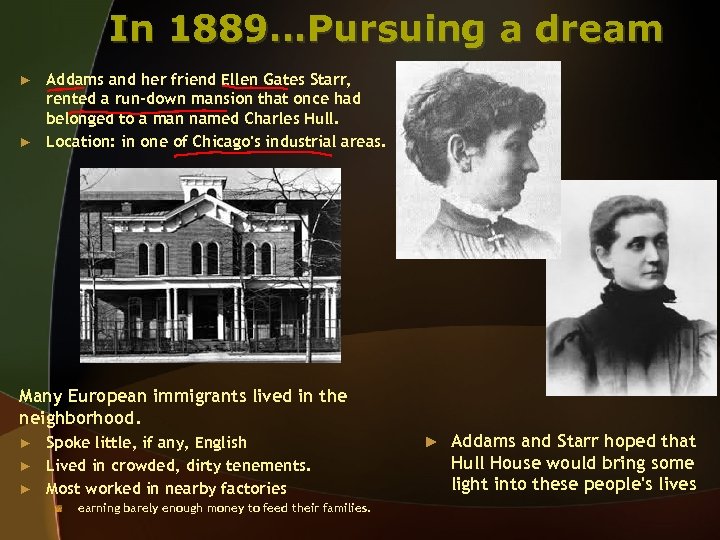 In 1889…Pursuing a dream Addams and her friend Ellen Gates Starr, rented a run-down mansion that once had belonged to a man named Charles Hull. ► Location: in one of Chicago's industrial areas. ► Many European immigrants lived in the neighborhood. Spoke little, if any, English ► Lived in crowded, dirty tenements. ► Most worked in nearby factories ► earning barely enough money to feed their families. ► Addams and Starr hoped that Hull House would bring some light into these people's lives
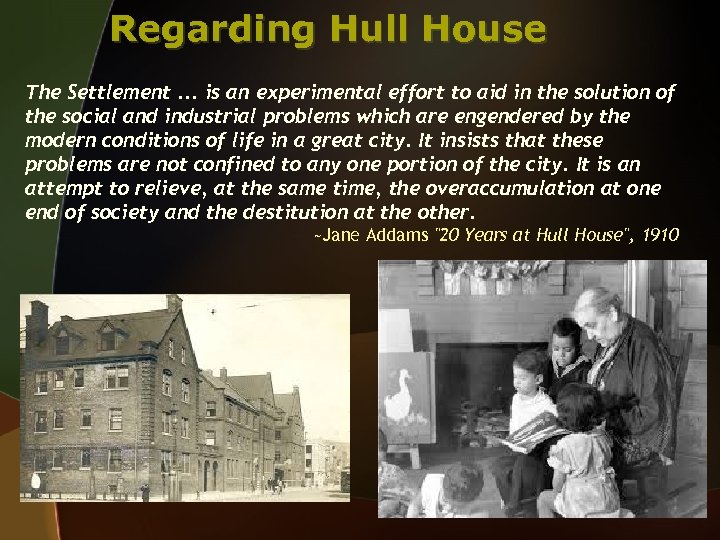 Regarding Hull House The Settlement. . . is an experimental effort to aid in the solution of the social and industrial problems which are engendered by the modern conditions of life in a great city. It insists that these problems are not confined to any one portion of the city. It is an attempt to relieve, at the same time, the overaccumulation at one end of society and the destitution at the other. ~Jane Addams "20 Years at Hull House", 1910
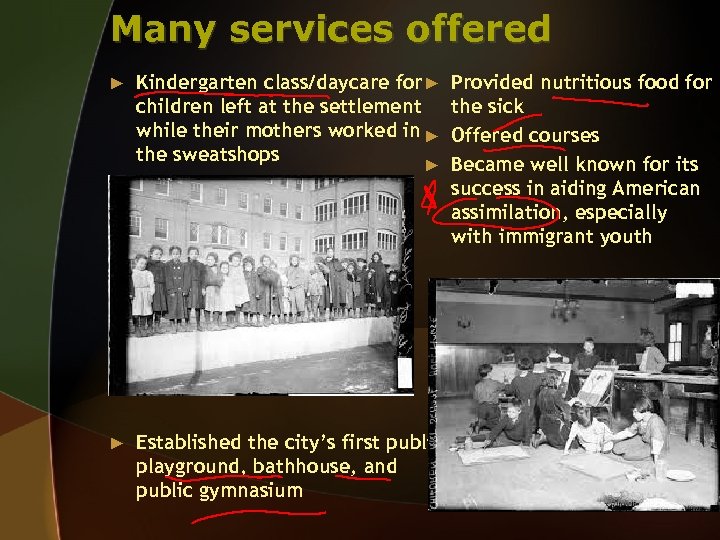 Many services offered ► Kindergarten class/daycare for ► children left at the settlement while their mothers worked in ► the sweatshops ► ► Established the city’s first public playground, bathhouse, and public gymnasium Provided nutritious food for the sick Offered courses Became well known for its success in aiding American assimilation, especially with immigrant youth
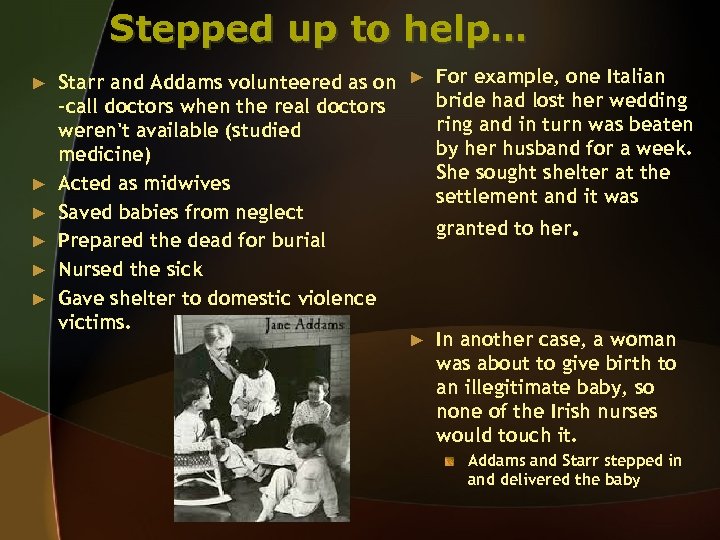 Stepped up to help… ► ► ► Starr and Addams volunteered as on ► For example, one Italian bride had lost her wedding -call doctors when the real doctors ring and in turn was beaten weren't available (studied by her husband for a week. medicine) She sought shelter at the Acted as midwives settlement and it was Saved babies from neglect granted to her. Prepared the dead for burial Nursed the sick Gave shelter to domestic violence victims. ► In another case, a woman was about to give birth to an illegitimate baby, so none of the Irish nurses would touch it. Addams and Starr stepped in and delivered the baby
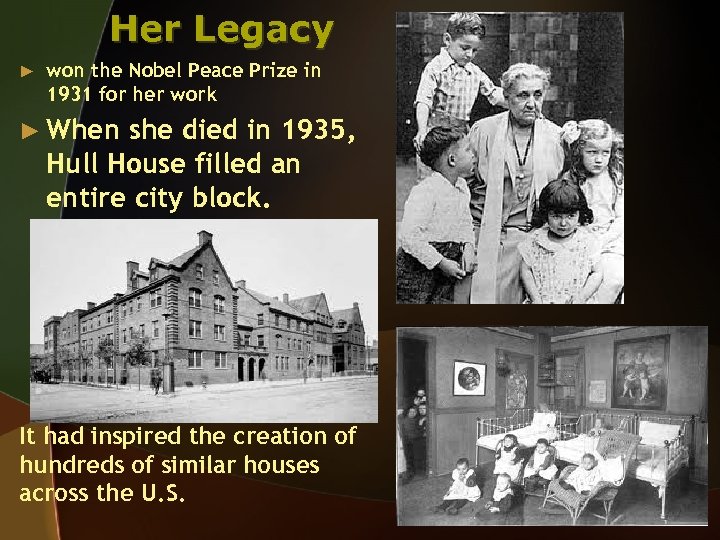 Her Legacy ► won the Nobel Peace Prize in 1931 for her work ► When she died in 1935, Hull House filled an entire city block. It had inspired the creation of hundreds of similar houses across the U. S.
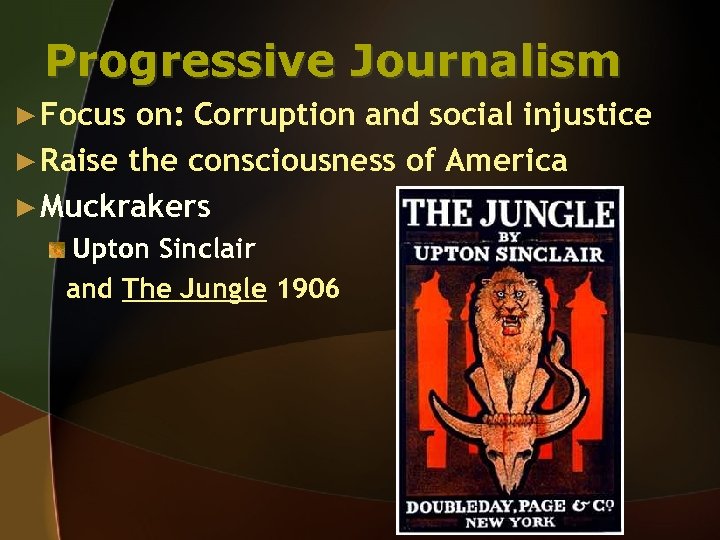 Progressive Journalism ► Focus on: Corruption and social injustice ► Raise the consciousness of America ► Muckrakers Upton Sinclair and The Jungle 1906
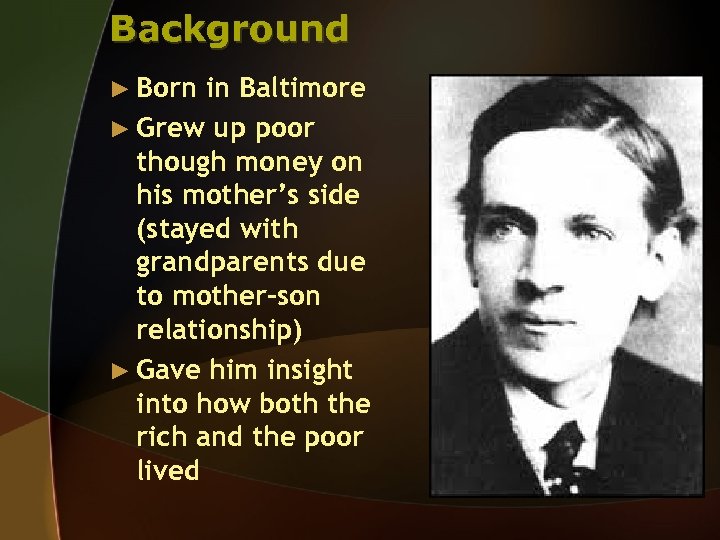 Background ► Born in Baltimore ► Grew up poor though money on his mother’s side (stayed with grandparents due to mother-son relationship) ► Gave him insight into how both the rich and the poor lived
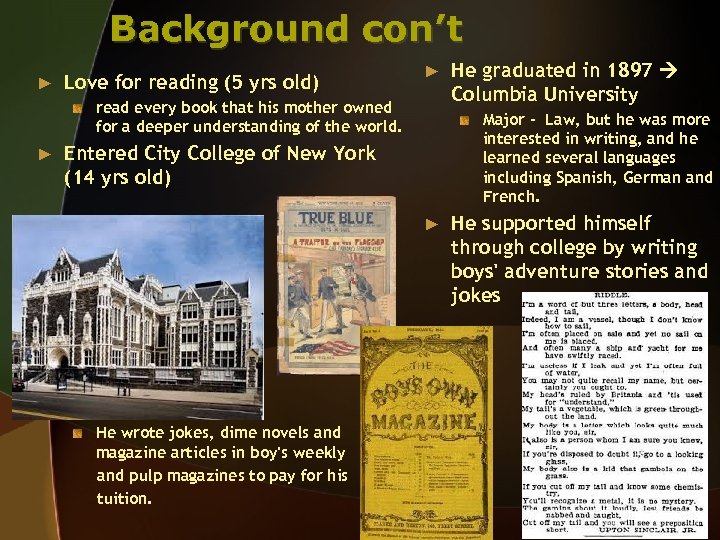 Background con’t ► Love for reading (5 yrs old) ► read every book that his mother owned for a deeper understanding of the world. ► Major - Law, but he was more interested in writing, and he learned several languages including Spanish, German and French. Entered City College of New York (14 yrs old) ► He wrote jokes, dime novels and magazine articles in boy's weekly and pulp magazines to pay for his tuition. He graduated in 1897 Columbia University He supported himself through college by writing boys' adventure stories and jokes
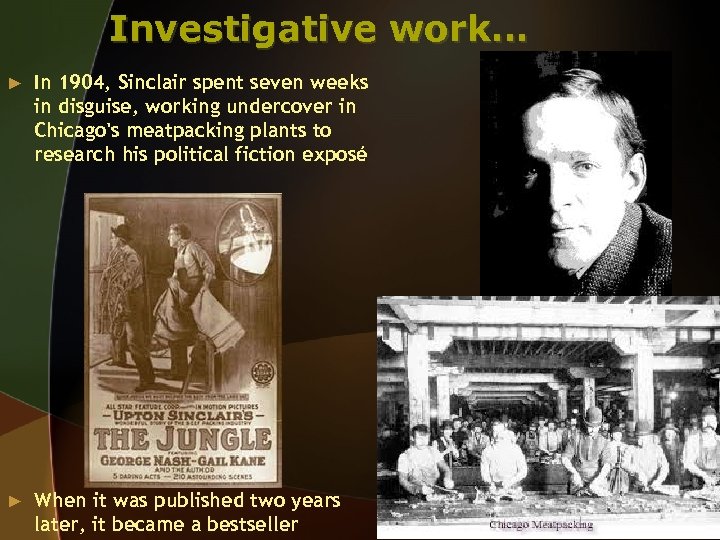 Investigative work… ► In 1904, Sinclair spent seven weeks in disguise, working undercover in Chicago's meatpacking plants to research his political fiction exposé ► When it was published two years later, it became a bestseller
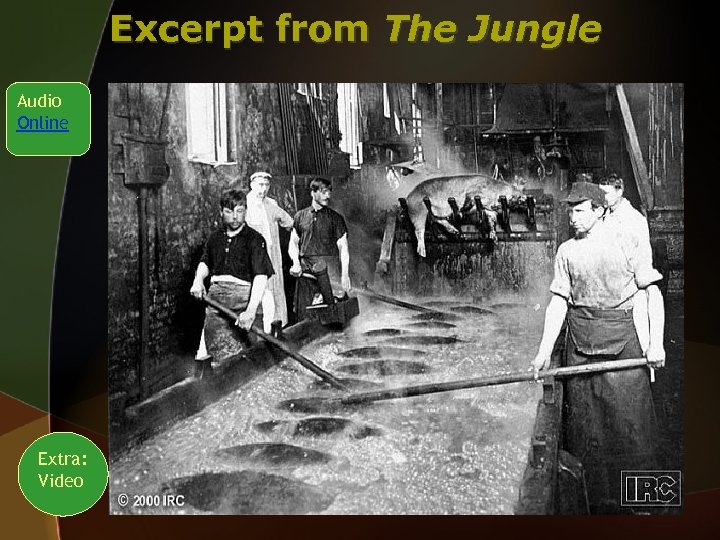 Excerpt from The Jungle Audio Online Extra: Video
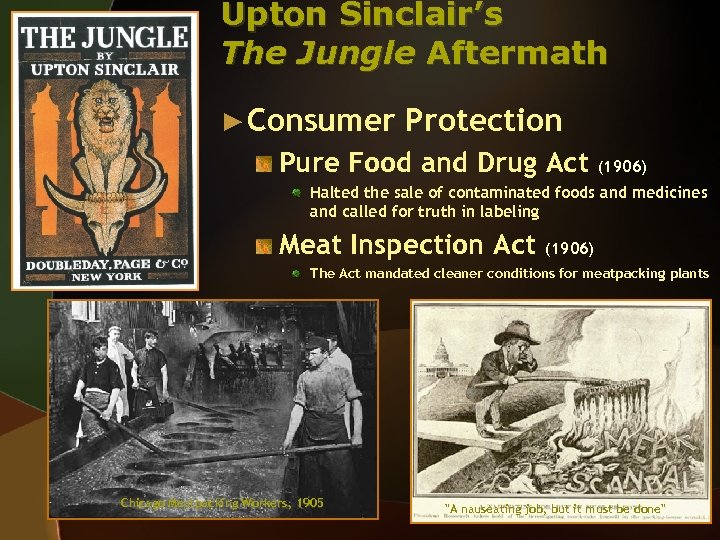 Upton Sinclair’s The Jungle Aftermath ► Consumer Protection Pure Food and Drug Act (1906) Halted the sale of contaminated foods and medicines and called for truth in labeling Meat Inspection Act (1906) The Act mandated cleaner conditions for meatpacking plants Chicago Meatpacking Workers, 1905 "A nauseating job, but it must be done"