


 Скачать презентацию Progress on the Strategic Plan of the National
8807a74ca32448662167c0a7ee5bf3a6.ppt
- Количество слайдов: 89
 Progress on the Strategic Plan of the National RBS Program 2012 -2016 Fred Messmann, Chair
 Overview • QUICK brief on HIGHLIGHTS from each objective—will move fast! • Great progress to report from Objective Teams—Thanks! • For DETAILED information, please see each team’s full reports on Basecamp or the Objective Leader or Coast Guard Objective Liaison 2
 1 SAFETY EDUCATION CERTIFICATES & SUCCESSFUL COURSE COMPLETIONS: PAM DILLON, OBJECTIVE LEADER 3
 Objective 1 Increase the number of persons who complete a boating safety course… • Team is working on a method to accurately count course completions/ certificates to set a baseline target. • Need to correct for both underreporting and double-counting. 4
 Objective 1 - Progress • USCG conducting program visits/ audits with each state – Discussing PRPII reporting, including number of certificates • NASBLA & SLOs met at USCGAUX N-Train in Jan 2012 – Identified gaps in reporting – NASBLA pledged to work with states & course providers to improve reporting 5
 Objective 1 - Progress • NASBLA Ed Committee Recommendations: – Clarify terms used on PRP II – Simplify performance reporting forms to reflect data being requested – Establish reporting criteria for skills-based/ on-the-water courses/ certificates 6
 Objective 1 - Progress • Strat 1. 3 – MA & NY are pursuing various legislative proposals to increase boating safety education • MO pursuing legislation to allow non residents to operate w/o boater education 7
 Objective 1 - Progress • Strat 1. 5 – Measure Effectiveness of Education Methods: – Under USCG grant, NASBLA managed study comparing knowledge retention for on-line vs. classroom boating safety courses – Found very small differences between participant test scores when comparing online vs. classroom training and voluntary vs. state-mandated training 8
 Objective 1 - Progress • Strat 1. 5 cont: – Participants suggested more focus on waterway navigation, consequences of alcohol usage and more scenario and performancebased training opportunities. 9
 2 BOATING SAFETY OUTREACH: LARRY MEDDOCK, OBJECTIVE LEADER 10
 Objective 2 Deliver effective boating safety messages through educational resources and media • Reports received from: PWIA, NSBC, NASBLA, CGAUX, USPS, FL Fish & Wildlife Commission • New outreach website: www. boatingmag. com/boatingsafety – Approved by USCG & launched in Dec 11 2011
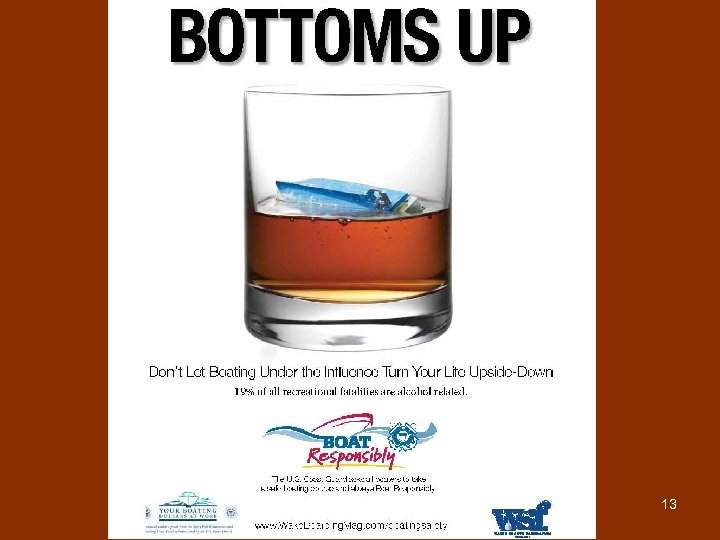
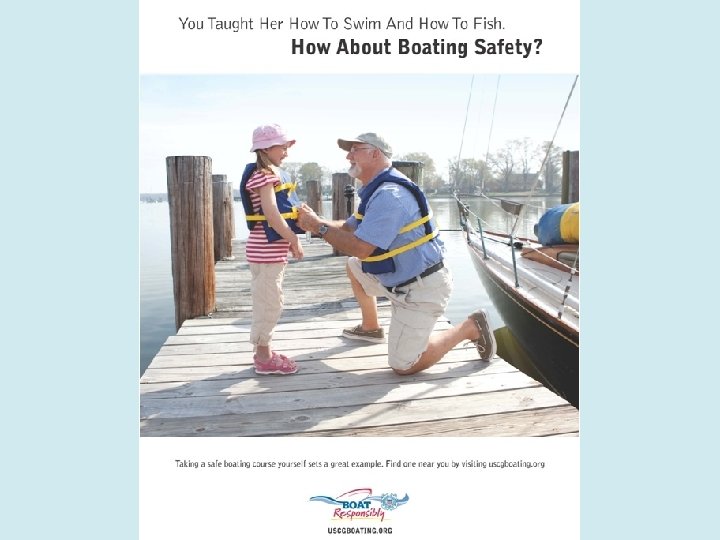
 Objective 2 - Progress • ‘Bottoms Up’ Ad: – Full page Ad in 8 magazines – 14 Websites have Banner Ads – 14 Electronic Newsletters have Banner Ads & Newsletters link to. com/boatingsafety • ‘Grandpa’ Ad: – Approved & getting into circulation 12
 13
13
 Objective 2 - Progress • Strategy 2. 3 – NSBC, through its "Wear It!" campaign, will fund approx 10 projects throughout the country to promote "Wear It!" on a grassroots level • Strategy 2. 4 – The "Wear It!" campaign: – Created 2012 Press Kit and in process of distributing to traditional mass media – Working to get 2012 PSA filmed and will distribute to television and radio 15
 Objective 2 - Progress • Strategy 2. 5 – NSBC manages multiple Facebook, Twitter, You. Tube, Vimeo, Linked. In, etc. accounts to promote its message of safer boating through education, outreach, & training • Strategy 2. 6 – NSBC continues to translate its “Wear It!” resources: – Offers logo in Spanish, French, Portuguese & other languages upon request – “Wear It!” campaign offers a variety of Spanish publications through its Free Resources 16
 Objective 2 - Progress • Strategy 2. 6 Con’t – • USPS currently developing courses for Spanish speaking constituents • FL FWC: – Created and distributes educational material and other outreach products in Spanish – Continues to distribute PWC safety checklists in English, French, German and Spanish 17
 Objective 2 - Progress • Strategy 2. 7 – NSBC coordinates with state agencies to offer “Wear It!” resources & information for law enforcement officers to share with boaters • Strategy 2. 8 – NSBC coordinates with the marine dealer network to deliver its general boating safety messages and “Wear It!” message 18
 Objective 2 - Progress • FL FWC Outreach: – Post Online Calendar & Post Class Information – 3 Boating Safety Course Instructor Workshops conducted – Engaging the public on “Wear It Florida!” through mass media & focusing messaging on at-risk geographic areas. 19
 3 ADVANCED AND/OR ON-WATER SKILLS-BASED BOATING EDUCATION: CECILIA DUER, OBJECTIVE LEADER 20
 Objective 3 Increase the number of boaters who completed advanced and/or on-water skills -based education • Strat 3. 1 - Team already requesting data from course providers; beginning to track participation 21
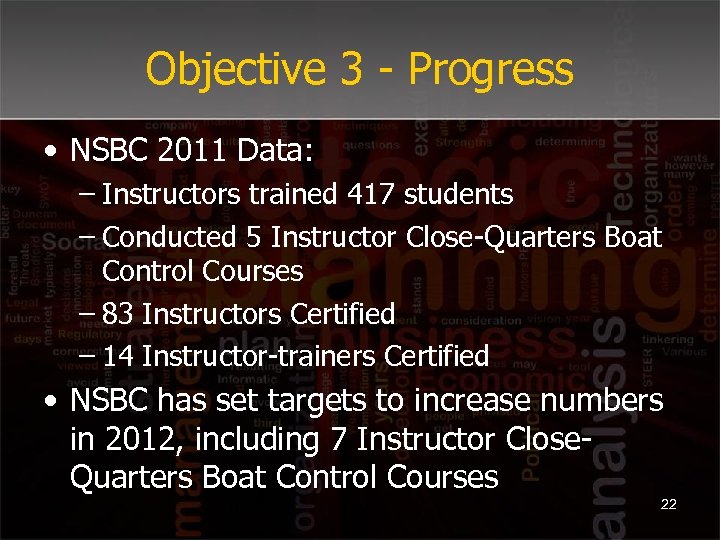 Objective 3 - Progress • NSBC 2011 Data: – Instructors trained 417 students – Conducted 5 Instructor Close-Quarters Boat Control Courses – 83 Instructors Certified – 14 Instructor-trainers Certified • NSBC has set targets to increase numbers in 2012, including 7 Instructor Close. Quarters Boat Control Courses 22
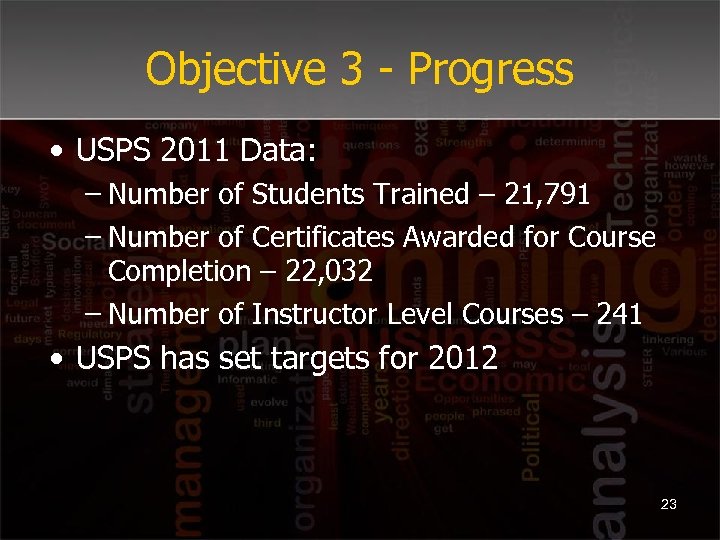 Objective 3 - Progress • USPS 2011 Data: – Number of Students Trained – 21, 791 – Number of Certificates Awarded for Course Completion – 22, 032 – Number of Instructor Level Courses – 241 • USPS has set targets for 2012 23
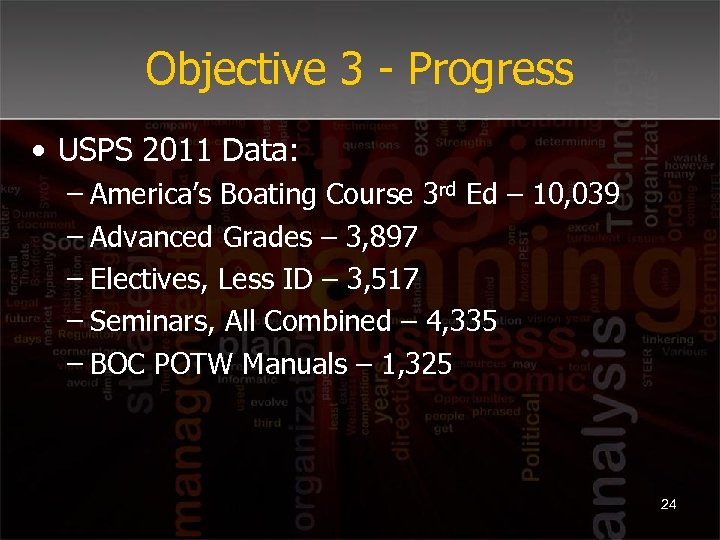 Objective 3 - Progress • USPS 2011 Data: – America’s Boating Course 3 rd Ed – 10, 039 – Advanced Grades – 3, 897 – Electives, Less ID – 3, 517 – Seminars, All Combined – 4, 335 – BOC POTW Manuals – 1, 325 24
 Objective 3 - Progress • ACA 2011 Data: – New ACA Instructors Certified – 1, 625 – Reported Number On-Water Skills Participants = 50, 466 – Estimated Number On-Water Skills Participants = 132, 725 25
 Objective 3 - Progress • Boy Scouts 2011 Course Completions (estimates): – Over 42, 000 adults complete the online Safety Afloat training annually – 93, 000 Merit Badges awarded in Canoeing, Small Boat Sailing, Rowing, Motorboating, Whitewater • Boy Scouts distributed 1 copy of the new Safety Afloat/ Paddle Craft Safety DVD to all local councils/chapters, includes instruction guide & PPT presentation. 26
 Objective 3 - Progress • NWSC 2011 Course Completions: – Cold Water Immersion Prevention Rescue, Recover, and Re-warm - 60 – Personal Watercraft Basic Operation, Maintenance and Rescue Course – 22 27
 Objective 3 - Progress • SOA has 18 locations in 10 states, including DC Program requires: – Successful completion of NASBLA course – Drowning prevention & equipment orientation in pool – Underway via sail, paddle and power 28
 Objective 3 - Progress • Strat 3. 2 Non profit grant was let to coordinate best practices for on-water skills-based education courses • Strat 3. 3 Targets to be developed based on data from course providers (via Strats 3. 1 & 3. 2) 29
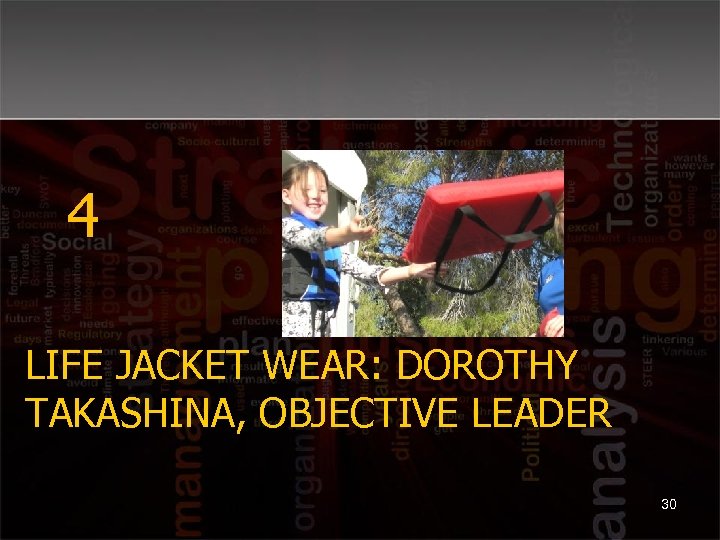 4 LIFE JACKET WEAR: DOROTHY TAKASHINA, OBJECTIVE LEADER 30
 Objective 4 Increase life jacket wear rates nationwide… • Strat 4. 1 – Continue to work with JSI on the National Life Jacket Wear Rate Observation Study. Conduct study annually in Wear It targeted campaign states & special projects. • Continue independent observations to validate life jacket wear rates and report 31 results to NBSAC.
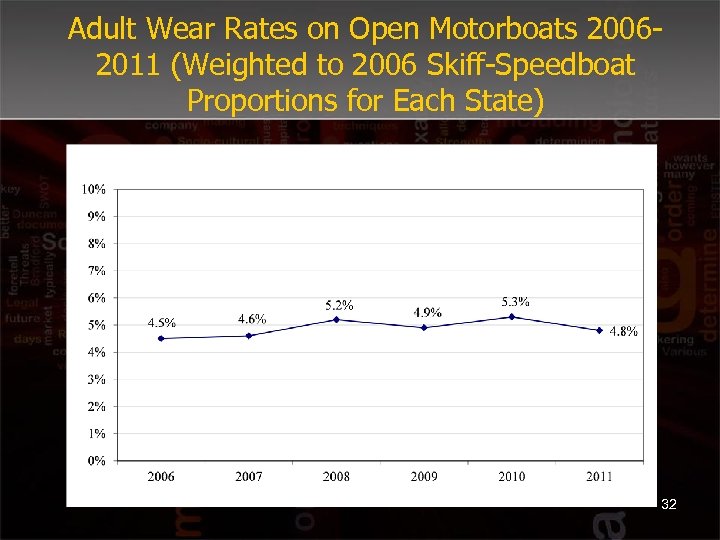 Adult Wear Rates on Open Motorboats 20062011 (Weighted to 2006 Skiff-Speedboat Proportions for Each State) 32
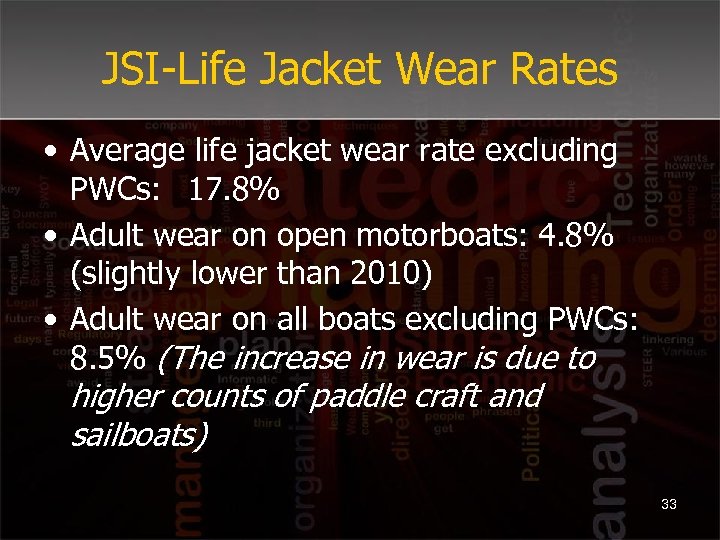 JSI-Life Jacket Wear Rates • Average life jacket wear rate excluding PWCs: 17. 8% • Adult wear on open motorboats: 4. 8% (slightly lower than 2010) • Adult wear on all boats excluding PWCs: 8. 5% (The increase in wear is due to higher counts of paddle craft and sailboats) 33
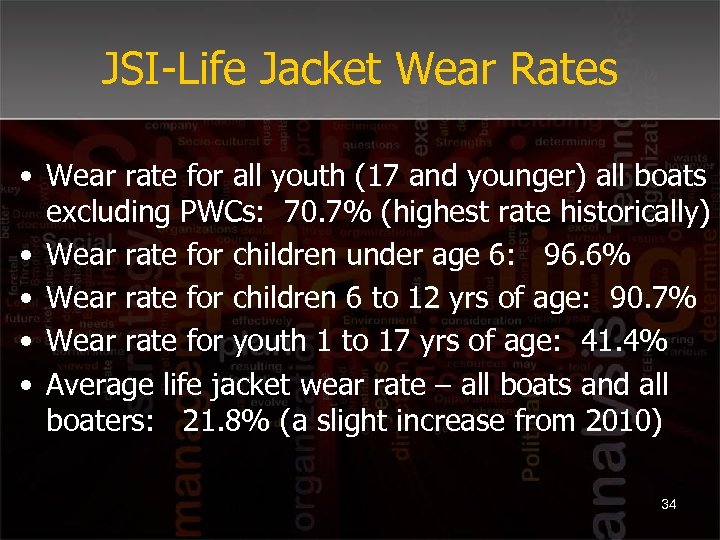 JSI-Life Jacket Wear Rates • Wear rate for all youth (17 and younger) all boats excluding PWCs: 70. 7% (highest rate historically) • Wear rate for children under age 6: 96. 6% • Wear rate for children 6 to 12 yrs of age: 90. 7% • Wear rate for youth 1 to 17 yrs of age: 41. 4% • Average life jacket wear rate – all boats and all boaters: 21. 8% (a slight increase from 2010) 34
 Objective 4 - Progress • Strategy 4. 1. 3: Engage in independent observations… On-water observation results by the National Water Safety Congress are currently being reviewed by USCG Boating Safety Division. 35
 • Strat 4. 2: Wear Rate Tiger Team increased outreach to domestic partners and international partners including Canada, Mexico, Australia, the UK, Japan, Brazil, Suriname, Nigeria and New Zealand. • Tiger Team identified multiple at–risk boating populations (unskilled, uneducated, alcohol impaired, etc) 36
 Objective 4 - Progress • Strat 4. 2. 3 Ready Set Inflate! expanded in 2012 to include all life jackets, with special outreach to children, charging children to carry Wear It! message to parents “Wear It!” survey indicated significant increase in positive attitude toward life jacket wear and wear rate • Strat 4. 2. 4 -Tiger Team identified traditional and non -traditional influencers 37
 Objective 4 - Progress • Strat 4. 3 – • USCG Auxiliarists nationwide will wear inflatable life jackets for vessel safety checks, boating safety courses, etc • FL purchased life jacket kits for all USCG Auxiliary Flotillas & US Power Squadrons 38
 Objective 4 - Progress • Strat 4. 3 cont • NASBLA passed 2011 resolution recommending mandatory wear of life jackets by marine law officers, rescue personnel and agency employees. • NABA, WSBLAA, SSBLAA passed resolutions regarding mandatory wearing of life jackets by marine law enforcement officers and agency personnel 39
 Objective 4 - Progress • NMMA requires customers to wear life jackets for on-water demos. • Strat 4. 4 USCG published Final Rule on April 3, 2012 regarding inflatable PFDsharmonizes structural/performance standards with industry standards. -Also removes the words “approved for use by adults only” though requires further rulemaking for standards for inflatable PFDs 40 for persons under 16 years of age.
 Objective 4 - Progress • Strat 4. 5 – Life jacket work group completed its evaluation and provided recommendation via NBSAC to USCG – USCG currently reviewing feasibility of rulemaking. – More work to do… 41
 Objective 4 - Progress • Strat 4. 6 – Sea Tow conducting survey to gather number of life jacket loaner programs and number of life jackets available through those programs (being conducted through N/P grant) • In 2011: -2, 067 life jacket loaner stations -38, 143 life jackets available to borrow 42
 Objective 4 - Progress Strat 4. 7 – NMMA Boat and Yacht Certification Committee voted to require material regarding life jacket wear in owners manuals as part of NMMA Boat and Yacht Certification program 43
 5 OPERATOR COMPLIANCE, NAVIGATION RULES: TOM DOGAN, OBJECTIVE LEADER 44
 Objective 5 Reduce fatalities associated with Nav Rules violations… • New Objective Leader: Tom Dogan 45
 Objective 5 - Progress • Strategy 5. 4 – Improve Consistency in Recording NAVRULES violations as contributing factors in BARD • ERAC/USCG Accident Reporting Terms and Definitions Project team reviewing and proposing revisions to Accident Contributing Factors/Causes 46
 Objective 5 - Progress • Proposed Navigation Rules-related Accident Contributing Factors include: – – Too Fast for Conditions Lack of or Improper Navigation Lights Failure to Maintain Safe Distance Failure to Maintain a Proper Lookout (with accompanying distraction codes) – Operator Inattention (with accompanying distraction codes) – Failure to Take Adequate Evasive Action 47
 Objective 5 - Progress • The National Safe Boating Council just completed a navigation rules awareness website and video called • Future updates on Obj. 5 coming soon. 48
 6 BOATING UNDER THE INFLUENCE: RICHARD MOORE, OBJECTIVE LEADER 49
 Objective 6 Achieve 5% overall decrease in the number of deaths by CY 2016 where use of alcohol or drug use was cause of accident… Good measurement data becoming available Lots of progress from Obj 6 team 50
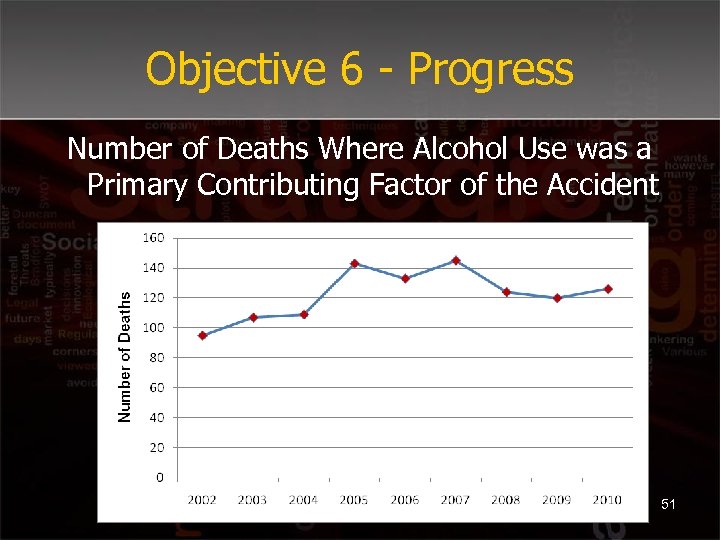 Objective 6 - Progress Number of Deaths Where Alcohol Use was a Primary Contributing Factor of the Accident 51
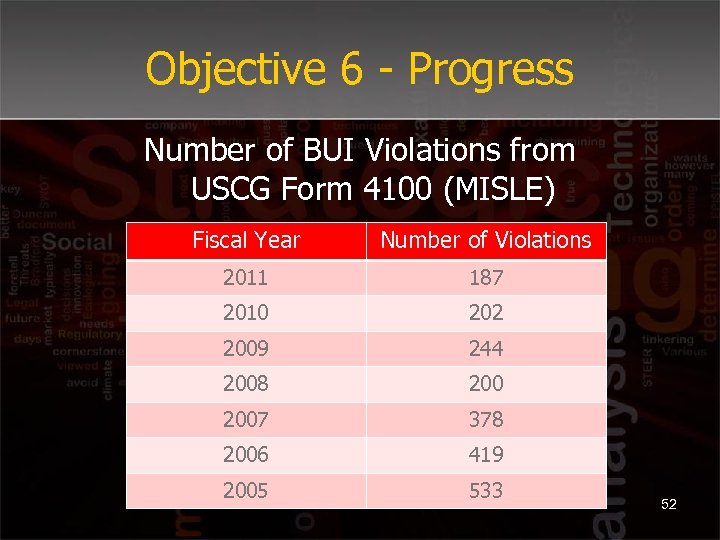 Objective 6 - Progress Number of BUI Violations from USCG Form 4100 (MISLE) Fiscal Year Number of Violations 2011 187 2010 202 2009 244 2008 2007 378 2006 419 2005 533 52
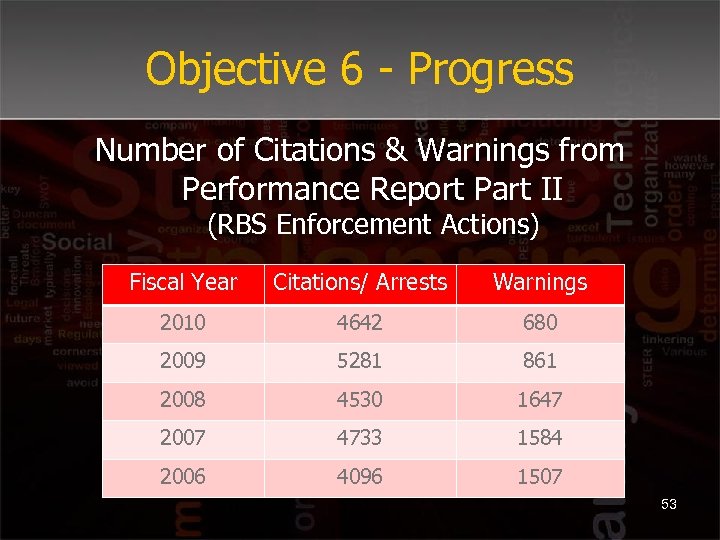 Objective 6 - Progress Number of Citations & Warnings from Performance Report Part II (RBS Enforcement Actions) Fiscal Year Citations/ Arrests Warnings 2010 4642 680 2009 5281 861 2008 4530 1647 2007 4733 1584 2006 4096 1507 53
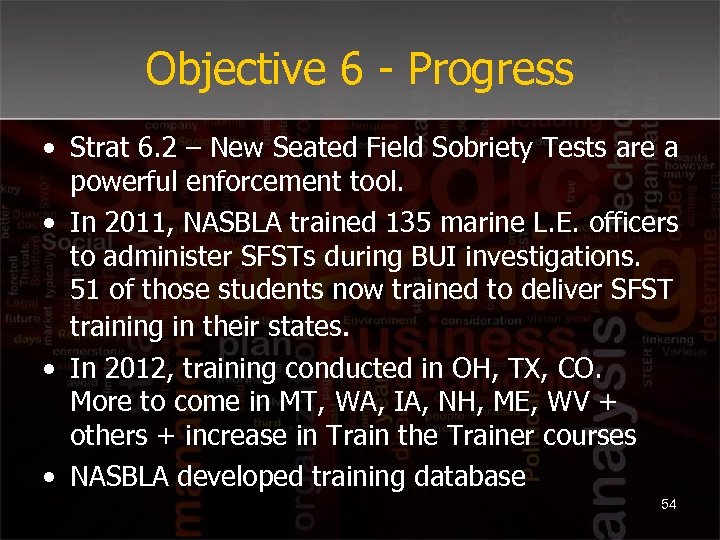 Objective 6 - Progress • Strat 6. 2 – New Seated Field Sobriety Tests are a powerful enforcement tool. • In 2011, NASBLA trained 135 marine L. E. officers to administer SFSTs during BUI investigations. 51 of those students now trained to deliver SFST training in their states. • In 2012, training conducted in OH, TX, CO. More to come in MT, WA, IA, NH, ME, WV + others + increase in Train the Trainer courses • NASBLA developed training database 54
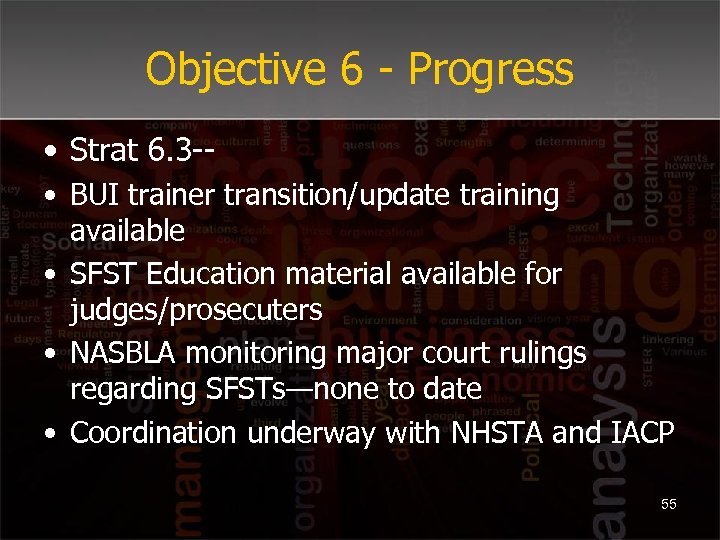 Objective 6 - Progress • Strat 6. 3 -- • BUI trainer transition/update training available • SFST Education material available for judges/prosecuters • NASBLA monitoring major court rulings regarding SFSTs—none to date • Coordination underway with NHSTA and IACP 55
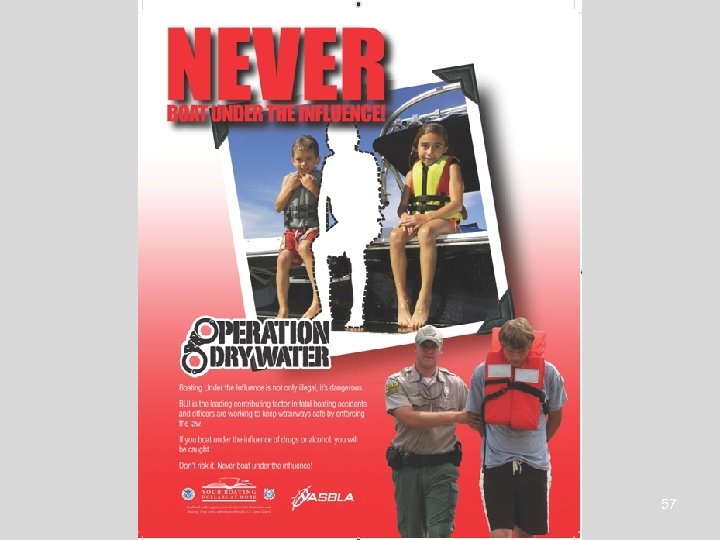
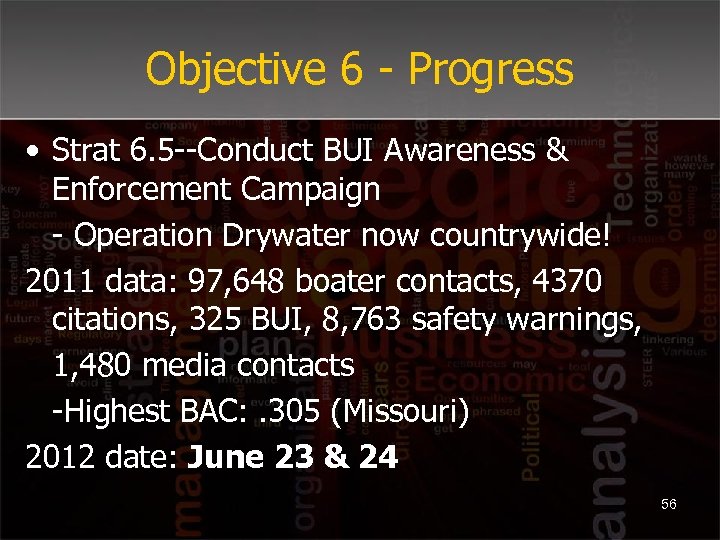 Objective 6 - Progress • Strat 6. 5 --Conduct BUI Awareness & Enforcement Campaign - Operation Drywater now countrywide! 2011 data: 97, 648 boater contacts, 4370 citations, 325 BUI, 8, 763 safety warnings, 1, 480 media contacts -Highest BAC: . 305 (Missouri) 2012 date: June 23 & 24 56
 57
57
 7 MANUFACTURER COMPLIANCE: MARCIA KULL, OBJECTIVE LEADER 58
 Objective 7 Decrease the recreational boat manufacturer ratio of discrepancies per factory inspection… • Continue to gather and provide the number of visits, number of discrepancies, number of recalls, and discrepancies per factory inspection 59
 Objective 7 - Progress • NMMA Boat & Yacht Certification programs recently approved adding 2 additional standards for its standards basis: – S-7: Capacity Plates – A-33: Engine/propulsion Cut-off Devices. • BIRMC released its Warning Label Methodology Study, to ABYC Technical Committee, for use as a justification for all future ABYC-produced warning labels on 60 boats
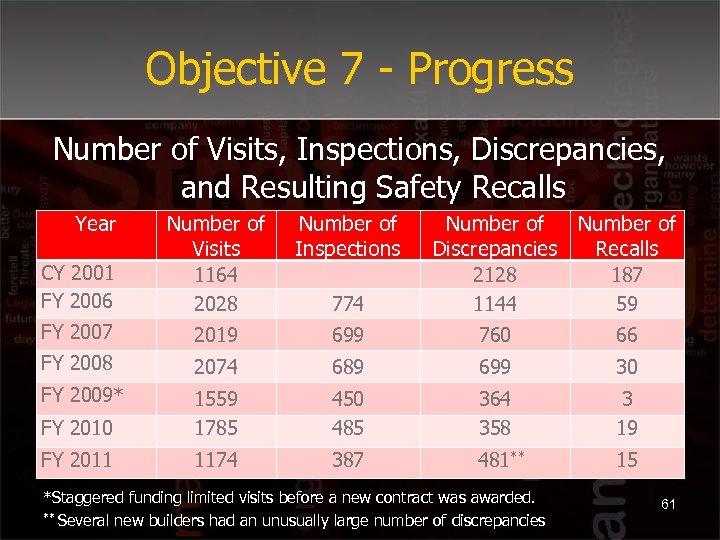 Objective 7 - Progress Number of Visits, Inspections, Discrepancies, and Resulting Safety Recalls Year Number of Inspections FY 2007 Number of Visits 1164 2028 2019 FY 2008 2074 689 699 30 FY 2009* FY 2010 1559 1785 450 485 364 358 3 19 FY 2011 1174 387 481** 15 CY 2001 FY 2006 774 699 Number of Discrepancies Recalls 2128 187 1144 59 760 66 *Staggered funding limited visits before a new contract was awarded. ** Several new builders had an unusually large number of discrepancies 61
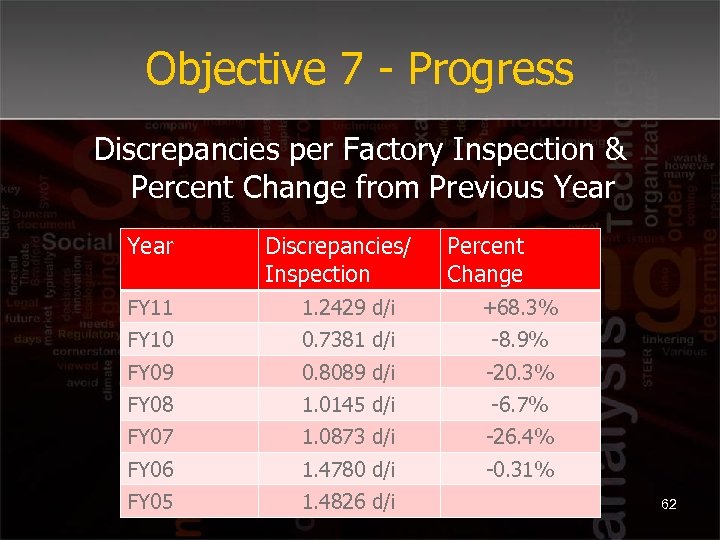 Objective 7 - Progress Discrepancies per Factory Inspection & Percent Change from Previous Year Discrepancies/ Inspection Percent Change FY 11 1. 2429 d/i FY 10 0. 7381 d/i -8. 9% FY 09 0. 8089 d/i -20. 3% FY 08 1. 0145 d/i -6. 7% FY 07 1. 0873 d/i -26. 4% FY 06 1. 4780 d/i -0. 31% FY 05 1. 4826 d/i +68. 3% 62
 8 OPERATOR COMPLIANCE, USCG REQUIRED SAFETY EQUIPMENT: BRIAN KEMPF, OBJECTIVE LEADER 63
 Objective 8 Increase compliance levels for specific required safety equipment on recreational boats • New Objective Leader: Brian Kempf 64
 Objective 8 - Progress • USBI awarded FY 2012 Fast Track grant – 2 -yr enhanced VSC program to identify deficient items during routine VSCs – Pilot will be conducted in 6 states this summer • NASBLA Law Enforcement Committee – Working on creative messaging to evaluate & improve outreach efforts of law enforcement agents 65
 Objective 8 - Progress • Via FY 2011 NP grant, ABYC developing a Boating Safety Checklist, Owner’s manual & Registration Renewal Notice • Applications submitted for FY 2012 NP grants to work towards increasing boaters’ knowledge of required safety equipment & encouraging boaters to purchase it 66
 9 BOATING ACCIDENT REPORTING: FRED MESSMANN, OBJECTIVE LEADER 67
 Objective 9 Using the baseline BARD data from 2008, work towards a goal of 100% by 2016, for complete, accurate, and timely accident report submission… 68
 Objective 9 - Progress • Over the last two years, in continuing support of the previous (2007 -2011) strategic plan- • First large scale effort was 2010, CG Notice of Proposed Rulemaking on Changes to Standard Numbering System (SNS), Vessel Identification System (VIS), and Boating Accident Reporting Database (BARD) • Final Rule effective April 27, 2012 (Federal Register, March 28, 2012) 69
 Objective 9 - Progress • Strategy 9. 1 – Recommendations of the “Regulatory Review and Accident Reporting Requirement Regulation” Task Force – Second was in 2011, the CG Recreational Vessel Accident Reporting Notice and Request for Comments on the NBSAC recommendations • NASBLA/USCG conducted a national teleconference/webinar on Nov. 20, 2011 • 34 comments received by the Coast Guard, 31 of which were state/territory responses 70
 Objective 9 - Progress • Strategy 9. 2 – Develop a two-tiered boating accident notification/reporting system. . . and related strategies FR Request for Comments • Strategy 9. 3 – Clarify through policy and regulation which watercraft qualify for boating accident reporting FR Request for Comments • Strategy 9. 4 – Include exclusive state waters in accident reporting requirements FR Request for Comments • Strategy 9. 5 - Clarify injury reporting using OSHA Standards as a basis FR Request for Comments 71
 Objective 9 - Progress • Strategy 9. 6 – Revise criteria to exclude swimmers and voluntarily leaving vessel from accident reporting requirement FR Request for Comments • Strategy 9. 7 – Create decision matrix pending • Strategy 9. 8 – Establish protocols on accident notification, responsibility for investigations and submitting accident reports FR Request for Comments • Strategy 9. 9 – Amend CFR specifying essential elements for accident notification FR Request for Comments 72
 Objective 9 - Progress • Strategy 9. 10 – Amend CFR moving essential elements out and placing in CG policy document FR Request for Comments • Strategy 9. 11 – Revise guidance document CG 449 and make available electronically USCG drafting 2 -volume COMDTINST covering aspects of manufacturing, defects, and accident reporting for state • Strategy 9. 12 – Examine harmonization of recreational and commercial accident cause data FR Request for Comments • Strategy 9. 13 – Research methods to help extrapolate unreported accident data OBJ 10 73
 Objective 9 - Progress • Strategy 9. 14 – Draft text discussing possible errors and limits to interpretation of BARD data • Boating Statistics 2010 (pages 8 -13) contains updated guidance regarding limits to interpretation of data. Will review annually and update as necessary • Strategy 9. 15 – Examine the suitability of additional models of accident causation (human factors) for use in describing fatal recreational boating accidents. Part of the ERAC C 2 work in progress 74
 Objective 9 - Progress • Strategy 9. 16 – Assist the states in conducting training, education and outreach efforts directed toward the boating public and accident investigators and regarding boating accident notification and reporting regulatory and policy revisions. Part of the ERAC B 1 work group tied with A 1 work in progress 75
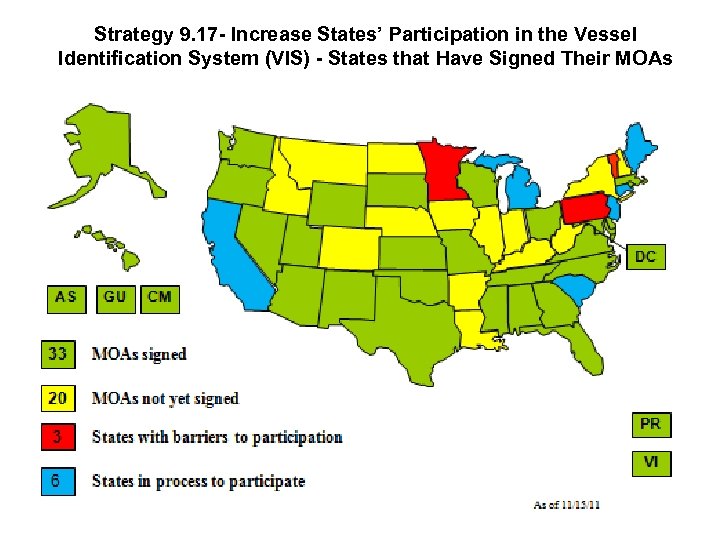 Strategy 9. 17 - Increase States’ Participation in the Vessel Identification System (VIS) - States that Have Signed Their MOAs 76
 Objective 9 - Progress • Strategy 9. 18 – Link BARD to VIS NLT April 2016 PENDING • Strategy 9. 19 – Manufacturer Provision of Vessel Information: NMMA and NICB partnering with secure information site for data sharing work in progress 77
 Objective 9 - Progress • Objective 9: Boating Accident Reporting • Objective 10: Research & Development • In general support of these two objectives, and the collective strategies intended to clarify and standardize elements of the accident reporting system and ultimately improve the quality and consistency of the accident report data. 78
 10 RESEARCH AND DEVELOPMENT: L. DANIEL MAXIM, OBJECTIVE LEADER 79
 Objective 10 Gather and analyze data relevant to recreational boating accidents and exposure 80
 Objective 10 - Progress • National Recreational Boating Survey underway – key topic covered in separate presentation by Dr. Phillipe Gwet • Numerous other projects underway (e. g. , NASBLA ERAC Committee) to increase utility of BARD data – Revision of contributing factor codes in BARD – Initiation of human factors study 81
 Objective 10 - Progress • Project underway to effect continuous improvements in data displays used to summarize data in Boating Statistics • BARD analyses done on night boating accidents – clear finding, night boating accidents present greater risk of fatalities • Life jacket wear rate study issued in 2012 (see graphs) – trends do not provide encouragement 82
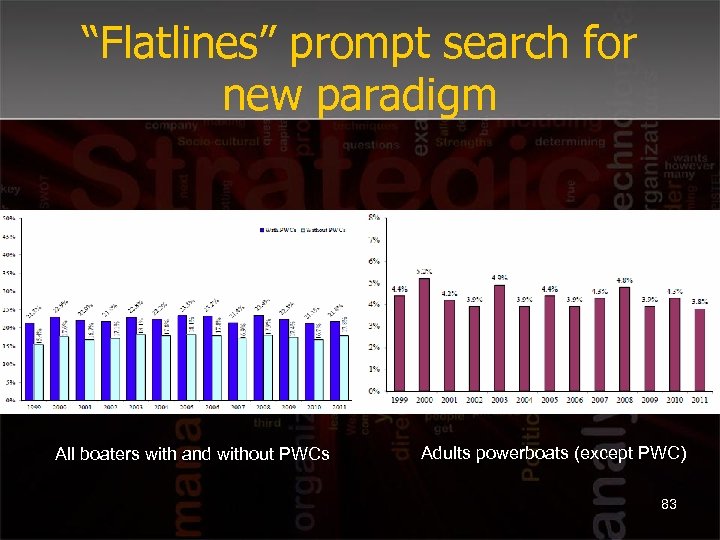 “Flatlines” prompt search for new paradigm All boaters with and without PWCs Adults powerboats (except PWC) 83
 To Do • No answers yet on ways to impute missing data (compensate for non-response) • No analyses yet on links between absent safety equipment and accidents – fast track grant let on Vessel Safety Checks (Grantee: USBI) • No analyses yet on boaters with limited English proficiency or PRPII 84
 11 NON-PROFIT GRANTS: L. DANIEL MAXIM, OBJECTIVE LEADER 85
 Objective 11 - Progress Improve the effectiveness of and access to the grant products of the non-profit organizations • CG developed a new administrative process for tracking and evaluating grants; most N/P grantees have been visited • New administrative process developed to officially close out grant awards 86
 Objective 11 - Progress • Backlog of grants for years 2009 & 2010 completed using new process; 2011 to be completed by Fall 2012 when more complete presentation to NBSAC will be given (including 2011 grant recipients) • Instituted ASAP (Automated Standard Application for Payments) for more rapid payment of grantees – now two weeks • List of 2010 & 2011 Grantees, projects, and project status in development – Will provide in Fall 87
 Opportunities • Consultations with CG SMEs to be used to identify noteworthy grants – How would NBSAC like to receive this information? • Information on incomplete/overdue grants will also be shared – How would NBSAC like to receive this information? 88
 Thanks to all the Objective teams for all your time and hard work! 89