


 Скачать презентацию Progress in the field of first mirrors A
89146416293e0f7258502a3d42339282.ppt
- Количество слайдов: 29
 Progress in the field of first mirrors A. Litnovsky for the First Mirror SWG 1
 First mirror activity in the Russian Federation Compiled by K. Vukolov A. Litnovsky First mirror SWG Report, ITPA -10, Moscow, April 12, 2006 2
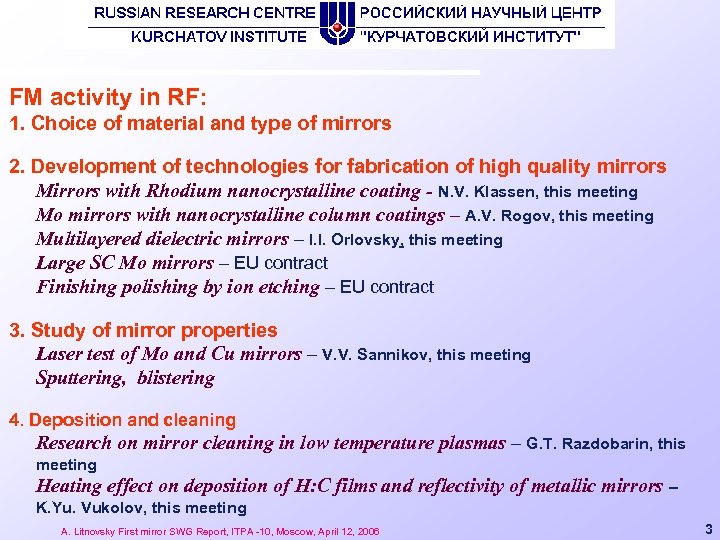 FM activity in RF: 1. Choice of material and type of mirrors 2. Development of technologies for fabrication of high quality mirrors Mirrors with Rhodium nanocrystalline coating - N. V. Klassen, this meeting Mo mirrors with nanocrystalline column coatings – A. V. Rogov, this meeting Multilayered dielectric mirrors – I. I. Orlovsky, this meeting Large SC Mo mirrors – EU contract Finishing polishing by ion etching – EU contract 3. Study of mirror properties Laser test of Mo and Cu mirrors – V. V. Sannikov, this meeting Sputtering, blistering 4. Deposition and cleaning Research on mirror cleaning in low temperature plasmas – G. T. Razdobarin, this meeting Heating effect on deposition of H: C films and reflectivity of metallic mirrors – K. Yu. Vukolov, this meeting A. Litnovsky First mirror SWG Report, ITPA -10, Moscow, April 12, 2006 3
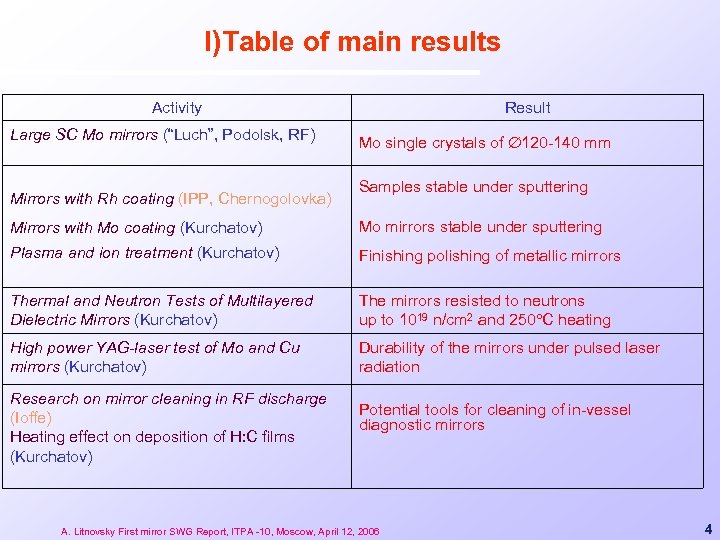 I)Table of main results Activity Large SC Mo mirrors (“Luch”, Podolsk, RF) Mirrors with Rh coating (IPP, Chernogolovka) Result Mo single crystals of 120 -140 mm Samples stable under sputtering Mirrors with Mo coating (Kurchatov) Mo mirrors stable under sputtering Plasma and ion treatment (Kurchatov) Finishing polishing of metallic mirrors Thermal and Neutron Tests of Multilayered Dielectric Mirrors (Kurchatov) The mirrors resisted to neutrons up to 1019 n/cm 2 and 250 C heating High power YAG-laser test of Mo and Cu mirrors (Kurchatov) Durability of the mirrors under pulsed laser radiation Research on mirror cleaning in RF discharge (Ioffe) Heating effect on deposition of H: C films (Kurchatov) Potential tools for cleaning of in-vessel diagnostic mirrors A. Litnovsky First mirror SWG Report, ITPA -10, Moscow, April 12, 2006 4
 Investigations at IPP Forschungszentrum Jülich A. Litnovsky for A. Kirschner, A. Kreter, S. Droste, V. Philipps, P. Wienhold, D. Borodin and TEXTOR Team. TEC Institut für Plasmaphysik EURATOM Assoziation – FZJ A. Litnovsky First mirror SWG Report, ITPA -10, Moscow, April 12, 2006 Forschungszentrum Jülich in der Helmholtz-Gemeinschaft 5
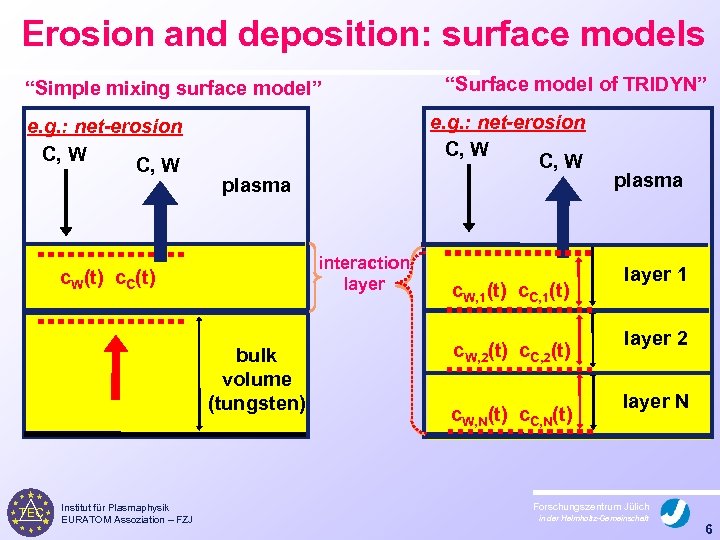 Erosion and deposition: surface models “Simple mixing surface model” e. g. : net-erosion C, W plasma interaction layer c. W(t) c. C(t) bulk volume (tungsten) TEC Institut für Plasmaphysik EURATOM Assoziation – FZJ “Surface model of TRIDYN” c. W, 1(t) c. C, 1(t) c. W, 2(t) c. C, 2(t) c. W, N(t) c. C, N(t) plasma layer 1 layer 2 layer N Forschungszentrum Jülich in der Helmholtz-Gemeinschaft 6
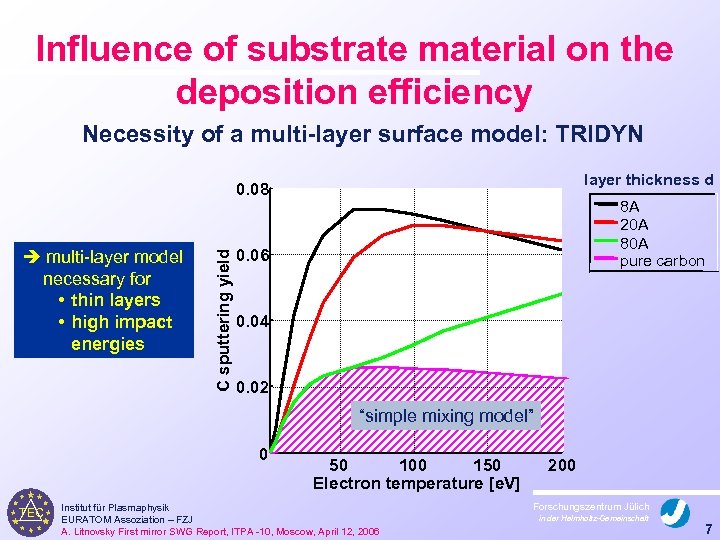 Influence of substrate material on the deposition efficiency Necessity of a multi-layer surface model: TRIDYN multi-layer model necessary for • thin layers • high impact energies C sputtering yield 0. 08 layer thickness d 8 A 20 A 80 A pure carbon 0. 06 0. 04 0. 02 “simple mixing model” 0 TEC 50 100 150 Electron temperature [e. V] Institut für Plasmaphysik EURATOM Assoziation – FZJ A. Litnovsky First mirror SWG Report, ITPA -10, Moscow, April 12, 2006 200 Forschungszentrum Jülich in der Helmholtz-Gemeinschaft 7
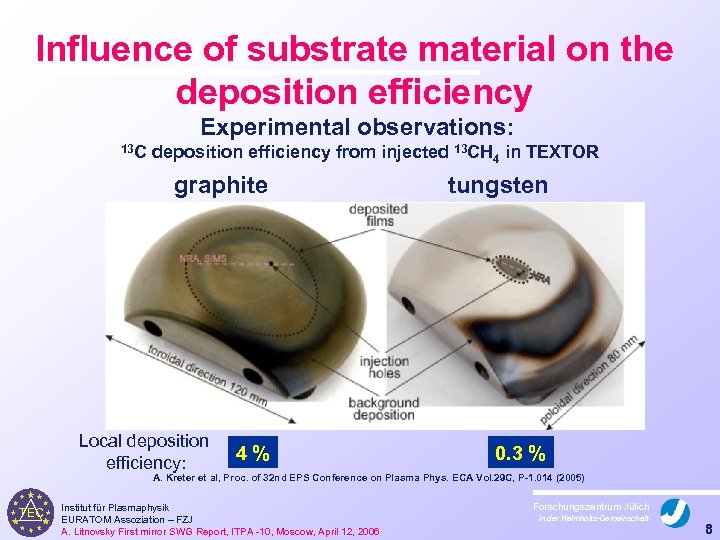 Influence of substrate material on the deposition efficiency Experimental observations: 13 C deposition efficiency from injected 13 CH 4 in TEXTOR graphite tungsten Local deposition efficiency: 4 % 0. 3 % A. Kreter et al, Proc. of 32 nd EPS Conference on Plasma Phys. ECA Vol. 29 C, P-1. 014 (2005) TEC Institut für Plasmaphysik EURATOM Assoziation – FZJ A. Litnovsky First mirror SWG Report, ITPA -10, Moscow, April 12, 2006 Forschungszentrum Jülich in der Helmholtz-Gemeinschaft 8
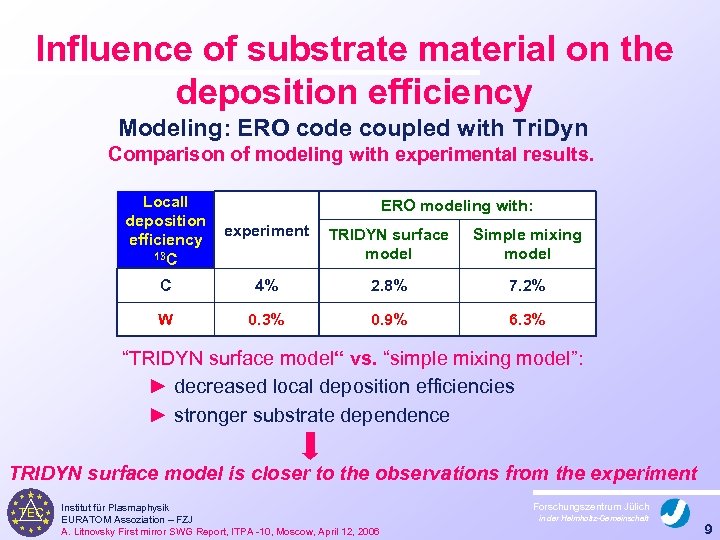 Influence of substrate material on the deposition efficiency Modeling: ERO code coupled with Tri. Dyn Comparison of modeling with experimental results. Locall deposition experiment efficiency 13 C ERO modeling with: TRIDYN surface model Simple mixing model C 4% 2. 8% 7. 2% W 0. 3% 0. 9% 6. 3% “TRIDYN surface model“ vs. “simple mixing model”: ► decreased local deposition efficiencies ► stronger substrate dependence TRIDYN surface model is closer to the observations from the experiment TEC Institut für Plasmaphysik EURATOM Assoziation – FZJ A. Litnovsky First mirror SWG Report, ITPA -10, Moscow, April 12, 2006 Forschungszentrum Jülich in der Helmholtz-Gemeinschaft 9
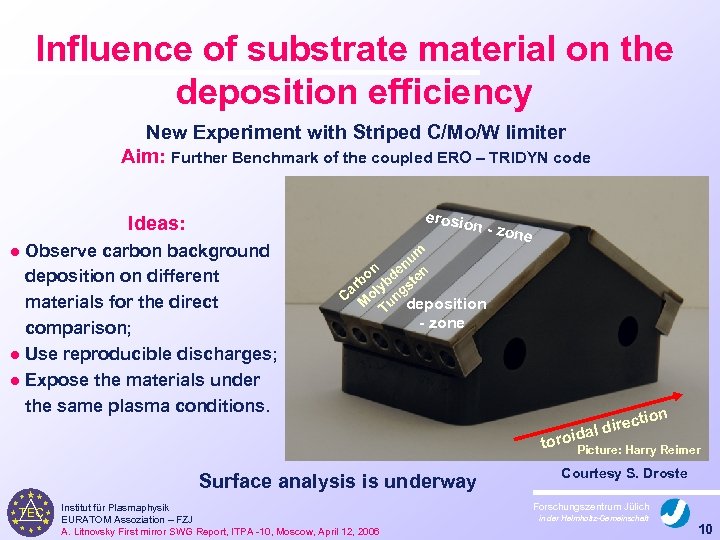 Influence of substrate material on the deposition efficiency New Experiment with Striped C/Mo/W limiter Aim: Further Benchmark of the coupled ERO – TRIDYN code erosio Ideas: ● Observe carbon background deposition on different materials for the direct comparison; ● Use reproducible discharges; ● Expose the materials under the same plasma conditions. n - zon e m nu n e n bo ybd ste r l Ca Mo ung T deposition - zone ion irect al d oroid t Surface analysis is underway TEC Institut für Plasmaphysik EURATOM Assoziation – FZJ A. Litnovsky First mirror SWG Report, ITPA -10, Moscow, April 12, 2006 Picture: Harry Reimer Courtesy S. Droste Forschungszentrum Jülich in der Helmholtz-Gemeinschaft 10
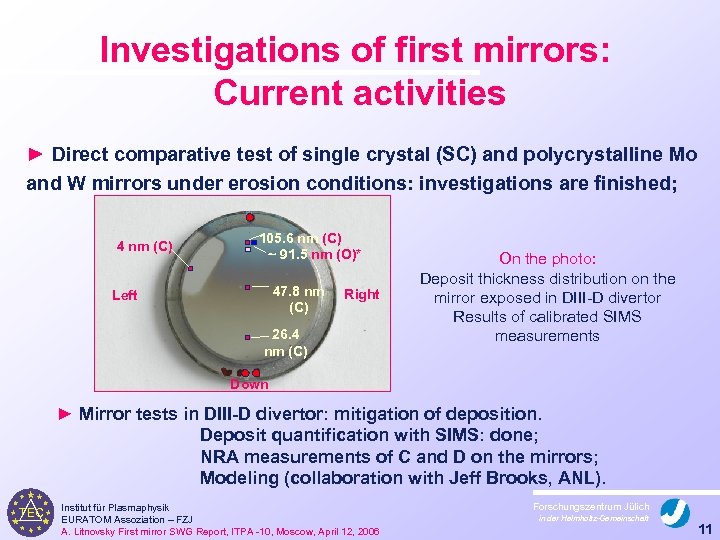 Investigations of first mirrors: Current activities ► Direct comparative test of single crystal (SC) and polycrystalline Mo and W mirrors under erosion conditions: investigations are finished; 4 nm (C) 105. 6 nm (C) ~ 91. 5 nm (O)* 47. 8 nm (C) Left Right 26. 4 nm (C) On the photo: Deposit thickness distribution on the mirror exposed in DIII-D divertor Results of calibrated SIMS measurements Down ► Mirror tests in DIII-D divertor: mitigation of deposition. Deposit quantification with SIMS: done; NRA measurements of C and D on the mirrors; Modeling (collaboration with Jeff Brooks, ANL). TEC Institut für Plasmaphysik EURATOM Assoziation – FZJ A. Litnovsky First mirror SWG Report, ITPA -10, Moscow, April 12, 2006 Forschungszentrum Jülich in der Helmholtz-Gemeinschaft 11
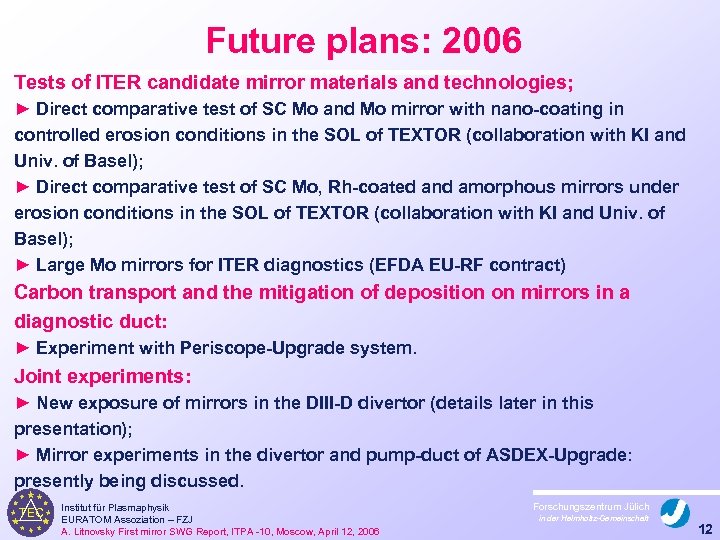 Future plans: 2006 Tests of ITER candidate mirror materials and technologies; ► Direct comparative test of SC Mo and Mo mirror with nano-coating in controlled erosion conditions in the SOL of TEXTOR (collaboration with KI and Univ. of Basel); ► Direct comparative test of SC Mo, Rh-coated and amorphous mirrors under erosion conditions in the SOL of TEXTOR (collaboration with KI and Univ. of Basel); ► Large Mo mirrors for ITER diagnostics (EFDA EU-RF contract) Carbon transport and the mitigation of deposition on mirrors in a diagnostic duct: ► Experiment with Periscope-Upgrade system. Joint experiments: ► New exposure of mirrors in the DIII-D divertor (details later in this presentation); ► Mirror experiments in the divertor and pump-duct of ASDEX-Upgrade: presently being discussed. TEC Institut für Plasmaphysik EURATOM Assoziation – FZJ A. Litnovsky First mirror SWG Report, ITPA -10, Moscow, April 12, 2006 Forschungszentrum Jülich in der Helmholtz-Gemeinschaft 12
 Investigations performed in the University of Basel and in TCV Tokamak Compiled by G. De Temmerman A. Litnovsky First mirror SWG Report, ITPA -10, Moscow, April 12, 2006 13
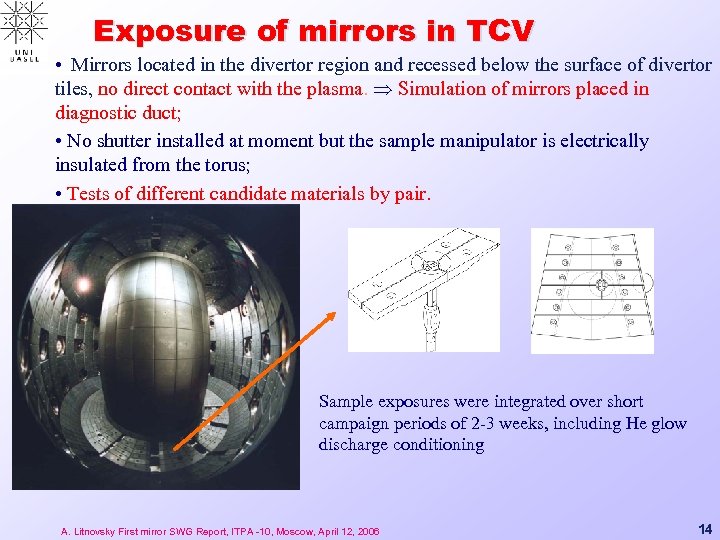 Exposure of mirrors in TCV • Mirrors located in the divertor region and recessed below the surface of divertor tiles, no direct contact with the plasma. Simulation of mirrors placed in diagnostic duct; • No shutter installed at moment but the sample manipulator is electrically insulated from the torus; • Tests of different candidate materials by pair. Sample exposures were integrated over short campaign periods of 2 -3 weeks, including He glow discharge conditioning A. Litnovsky First mirror SWG Report, ITPA -10, Moscow, April 12, 2006 14
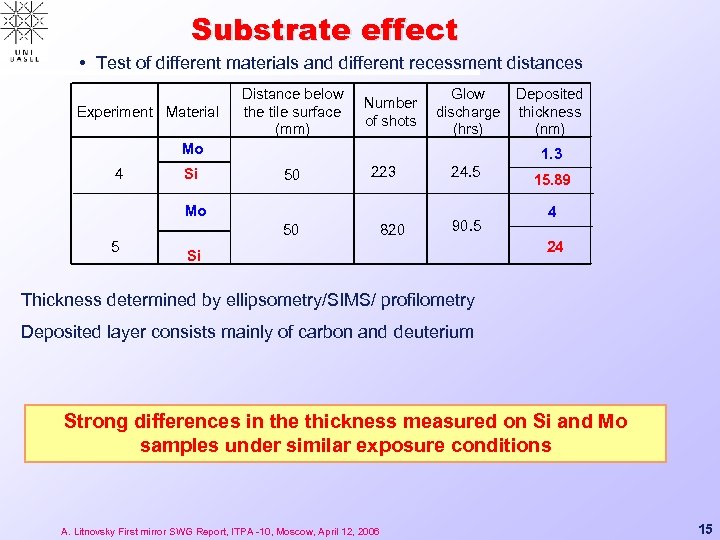 Substrate effect • Test of different materials and different recessment distances Experiment Material Distance below the tile surface (mm) Number of shots Glow discharge (hrs) Mo 4 Si 1. 3 50 223 Mo 50 5 Deposited thickness (nm) 820 24. 5 90. 5 Si 15. 89 4 24 Thickness determined by ellipsometry/SIMS/ profilometry Deposited layer consists mainly of carbon and deuterium Strong differences in the thickness measured on Si and Mo samples under similar exposure conditions A. Litnovsky First mirror SWG Report, ITPA -10, Moscow, April 12, 2006 15
 Mirror research at DIII-D: status overview D. Rudakov, A. Litnovsky, S. L. Allen, J. A. Boedo, R. L. Boivin, N. H. Brooks, M. E. Fenstermacher, M. Groth, C. J. Lasnier, A. G. Mc. Lean, R. E. Moyer, V. Philipps, P. C. Stangeby, G. De Temmerman, W. R. Wampler, J. G. Watkins, W. P. West, P. Wienhold, C. P. C. Wong. A. Litnovsky First mirror SWG Report, ITPA -10, Moscow, April 12, 2006 16
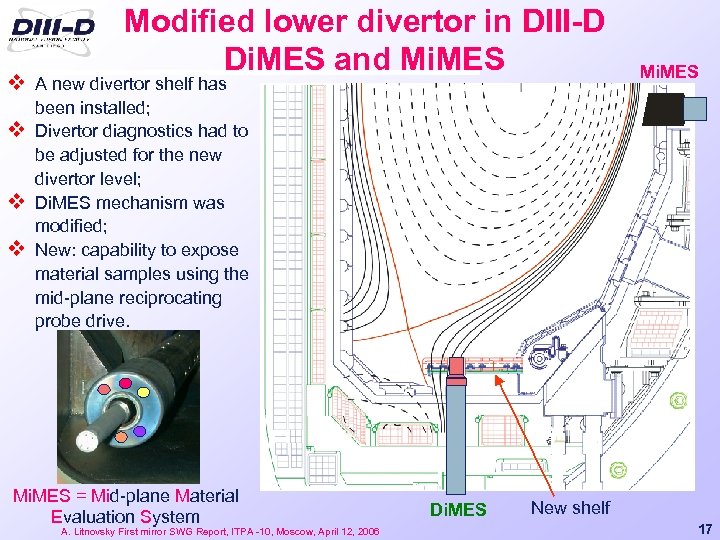 Modified lower divertor in DIII-D Di. MES and Mi. MES v A new divertor shelf has v v v Mi. MES been installed; Divertor diagnostics had to be adjusted for the new divertor level; Di. MES mechanism was modified; New: capability to expose material samples using the mid-plane reciprocating probe drive. Mi. MES = Mid-plane Material Evaluation System A. Litnovsky First mirror SWG Report, ITPA -10, Moscow, April 12, 2006 Di. MES New shelf 17
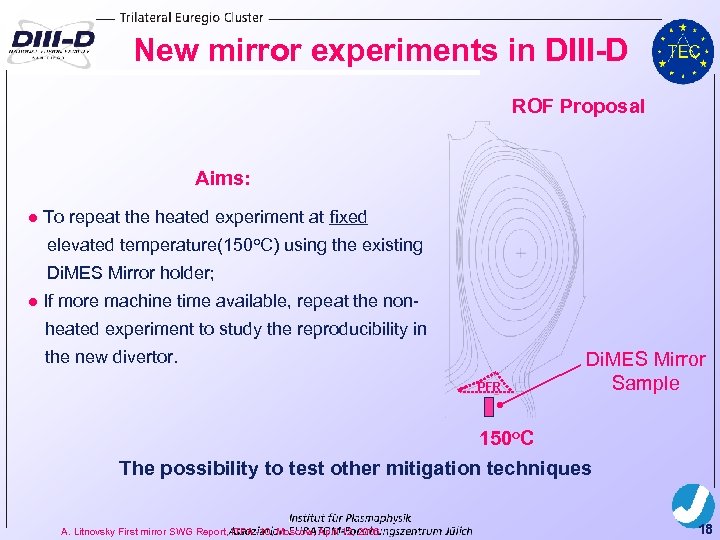 New mirror experiments in DIII-D ROF Proposal Aims: ● To repeat the heated experiment at fixed elevated temperature(150 o. C) using the existing Di. MES Mirror holder; ● If more machine time available, repeat the nonheated experiment to study the reproducibility in the new divertor. PFR Di. MES Mirror Sample 150 o. C The possibility to test other mitigation techniques A. Litnovsky First mirror SWG Report, ITPA -10, Moscow, April 12, 2006 18
 Modeling: joint activities of ORNL (USA) and CEA Cadarache (EU) Compiled by J. Hogan A. Litnovsky First mirror SWG Report, ITPA -10, Moscow, April 12, 2006 19
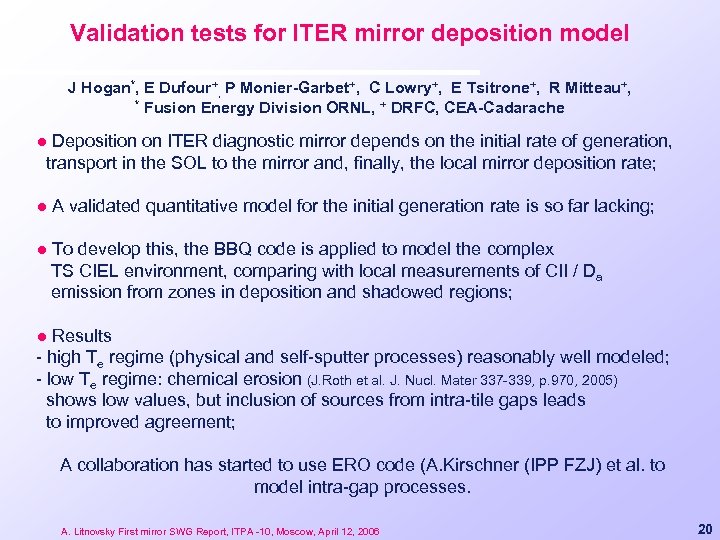 Validation tests for ITER mirror deposition model J Hogan*, E Dufour+, P Monier-Garbet+, C Lowry+, E Tsitrone+, R Mitteau+, * Fusion Energy Division ORNL, + DRFC, CEA-Cadarache ● Deposition on ITER diagnostic mirror depends on the initial rate of generation, transport in the SOL to the mirror and, finally, the local mirror deposition rate; ● A validated quantitative model for the initial generation rate is so far lacking; ● To develop this, the BBQ code is applied to model the complex TS CIEL environment, comparing with local measurements of CII / Da emission from zones in deposition and shadowed regions; ● Results - high Te regime (physical and self-sputter processes) reasonably well modeled; - low Te regime: chemical erosion (J. Roth et al. J. Nucl. Mater 337 -339, p. 970, 2005) shows low values, but inclusion of sources from intra-tile gaps leads to improved agreement; A collaboration has started to use ERO code (A. Kirschner (IPP FZJ) et al. to model intra-gap processes. A. Litnovsky First mirror SWG Report, ITPA -10, Moscow, April 12, 2006 20
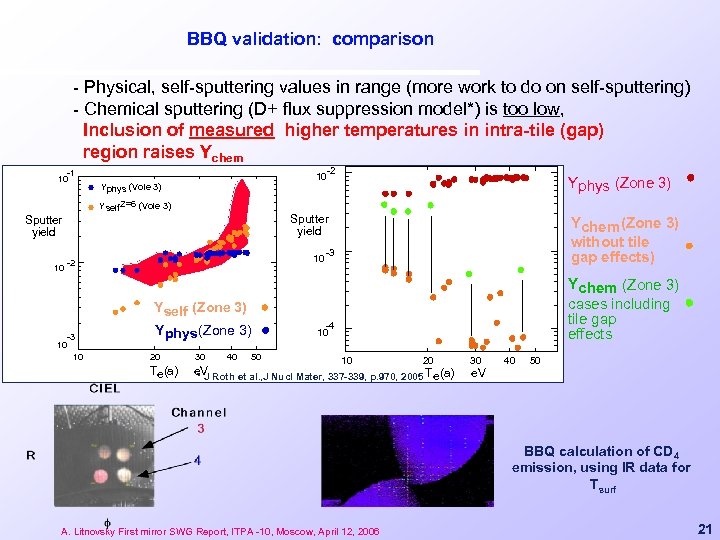 BBQ validation: comparison - Physical, self-sputtering values in range (more work to do on self-sputtering) - Chemical sputtering (D+ flux suppression model*) is too low, Inclusion of measured higher temperatures in intra-tile (gap) region raises Ychem -1 10 -2 10 Yphys (Voie 3) Yself. Z=6 (Voie 3) Sputter yield 10 Yphys (Zone 3) 10 -2 Ychem (Zone 3) without tile gap effects) -3 Ychem (Zone 3) cases including tile gap effects Yself (Zone 3) -3 10 10 -4 10 Yphys (Zone 3) 20 30 40 50 Te(a) e. V * J Roth et al. , J Nucl Mater, 337 -339, p. 970, 2005 Te(a) 10 20 30 40 50 e. V BBQ calculation of CD 4 emission, using IR data for Tsurf A. Litnovsky First mirror SWG Report, ITPA -10, Moscow, April 12, 2006 21
 Mirror Research at ANL (USA) Compiled by J. Brooks and J. P. Allain A. Litnovsky First mirror SWG Report, ITPA -10, Moscow, April 12, 2006 22
 Status/plans for ITER diagnostic mirror research J. N. Brooks, J. P. Allain, A. Hassanein, M. Nieto Argonne National Laboratory 10 th ITPA TG on Diagnostics, Moscow April 10 -14, 2006 23
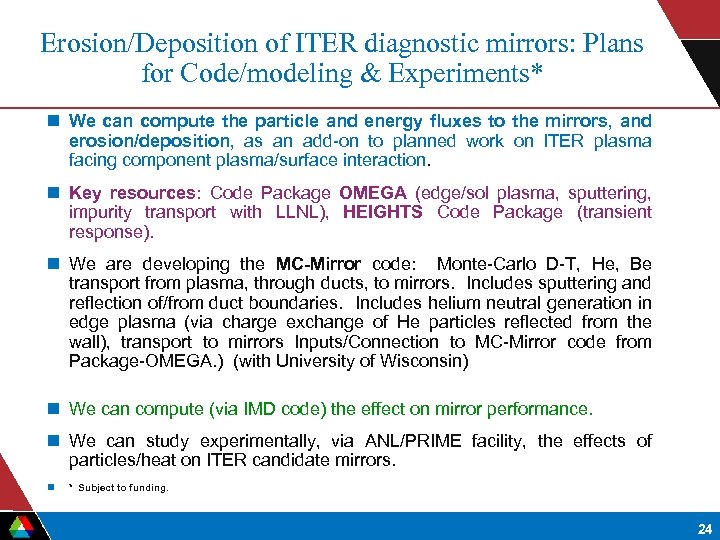 Erosion/Deposition of ITER diagnostic mirrors: Plans for Code/modeling & Experiments* n We can compute the particle and energy fluxes to the mirrors, and erosion/deposition, as an add-on to planned work on ITER plasma facing component plasma/surface interaction. n Key resources: Code Package OMEGA (edge/sol plasma, sputtering, impurity transport with LLNL), HEIGHTS Code Package (transient response). n We are developing the MC-Mirror code: Monte-Carlo D-T, He, Be transport from plasma, through ducts, to mirrors. Includes sputtering and reflection of/from duct boundaries. Includes helium neutral generation in edge plasma (via charge exchange of He particles reflected from the wall), transport to mirrors Inputs/Connection to MC-Mirror code from Package-OMEGA. ) (with University of Wisconsin) n We can compute (via IMD code) the effect on mirror performance. n We can study experimentally, via ANL/PRIME facility, the effects of particles/heat on ITER candidate mirrors. n * Subject to funding. 24
 ANL Preliminary Tasks: IMD code n IMD (D. L. Windt, Comp Phys 12 (1998) 360) is a computational program that models the optical properties including: reflectance, transmittance, phase shifts and electric-field intensities of multi-layer films and multi-component surfaces; n IMD will be linked with particle-induced damage surface codes; n Preliminary scoping tests of a Au-coated (1. 0 µm) mirror with various Be coating thicknesses using the IMD computational code; 25
 We couple our modeling capabilities with in-house experimental measurements n The Particle and Radiation Interaction with Matter Experiments (PRIME) facility includes: – State-of-the art in-situ surface metrology (IMPACT experiment) that monitors the behavior of surfaces at various depth scales under highflux ion irradiation; – Several ion sources with fluxes 1011 -1016 ions/(cm 2*sec), 25 -500 C, impact angles 0 -65 degrees, 5 -5000 e. V; – Species: H, D, He, C, N, O, Ne, Ar, Kr, Xe, and Sn; others: C 60, Aun – A full-scale, high-power laser system custom designed and tunable between 193 -nm and 2200 -nm; – Up to three ion sources can be run simultaneously. n Experience: We have studied extensively the role of energetic ions on plasma-facing mirror performance used in EUV lithography; n This expertise can be leveraged to further understand the role of particles on first mirrors in ITER and to develop schemes of their protection. 26
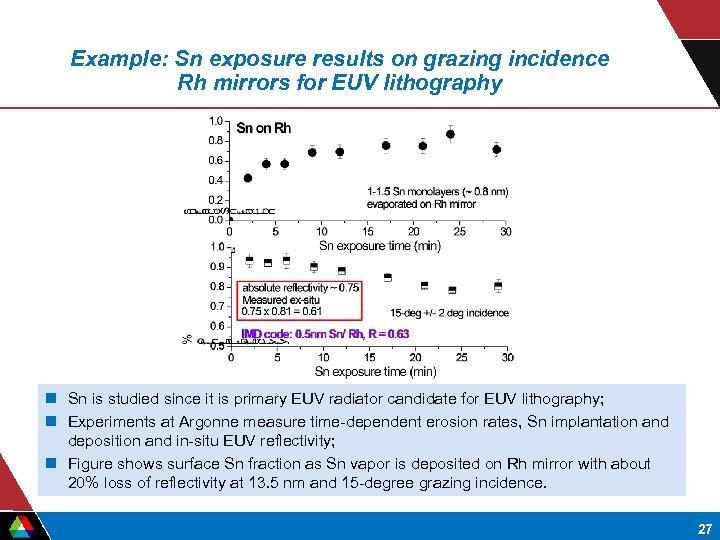 Example: Sn exposure results on grazing incidence Rh mirrors for EUV lithography n Sn is studied since it is primary EUV radiator candidate for EUV lithography; n Experiments at Argonne measure time-dependent erosion rates, Sn implantation and deposition and in-situ EUV reflectivity; n Figure shows surface Sn fraction as Sn vapor is deposited on Rh mirror with about 20% loss of reflectivity at 13. 5 nm and 15 -degree grazing incidence. 27
 Summary ● Significant progress is achieved in the R&D of mirrors for erosion environment; ● Intensive research is ongoing in the field of mirror cleaning techniques; ● The mitigation of the deposition at elevated temperatures is proven to be a complex process, depending on exposure conditions; ● The choice of the substrate (mirror) material strongly influences the deposition efficiency. This needs to be investigated in future in more details; ● Good potential and interest in modeling of mirror performance in ITER, made and planned experiments; ● Closer collaboration with PWI community on issues of common interest. A. Litnovsky First mirror SWG Report, ITPA -10, Moscow, April 12, 2006 28
 Thank you A. Litnovsky First mirror SWG Report, ITPA -10, Moscow, April 12, 2006 29