


 Скачать презентацию Programming on the Grid using Grid RPC Yoshio
6e20e35073ebf4e8c2ede0d2556336a7.ppt
- Количество слайдов: 78
 Programming on the Grid using Grid. RPC Yoshio Tanaka (yoshio. tanaka@aist. go. jp) Grid Technology Research Center, AIST National Institute of Advanced Industrial Science and Technology
 Outline What is Grid. RPC? Overview v. s. MPI Typical scenarios Overview of Ninf-G and Grid. RPC API Ninf-G: Overview and architecture Grid. RPC API Ninf-G API How to develop Grid applications using Ninf-G Build remote libraries Develop a client program Run Recent activities/achievements in Ninf project
 What is Grid. RPC? Programming model on Grid based on Grid Remote Procedure Call (Grid. RPC)
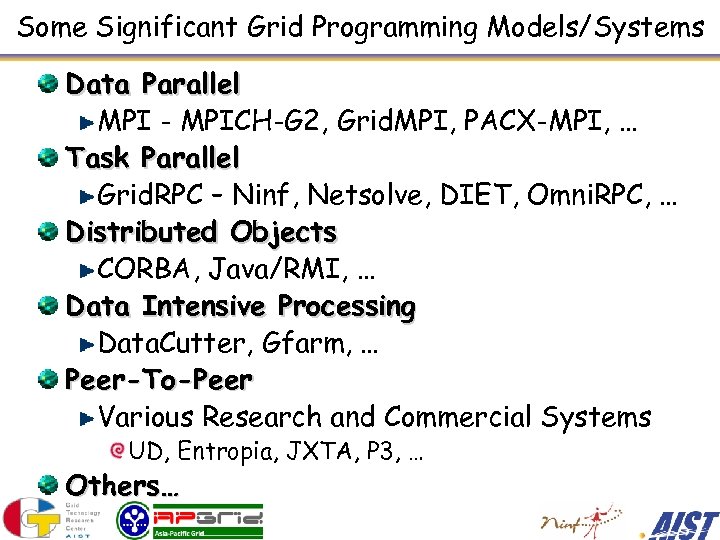 Some Significant Grid Programming Models/Systems Data Parallel MPI - MPICH-G 2, Grid. MPI, PACX-MPI, … Task Parallel Grid. RPC – Ninf, Netsolve, DIET, Omni. RPC, … Distributed Objects CORBA, Java/RMI, … Data Intensive Processing Data. Cutter, Gfarm, … Peer-To-Peer Various Research and Commercial Systems UD, Entropia, JXTA, P 3, … Others…
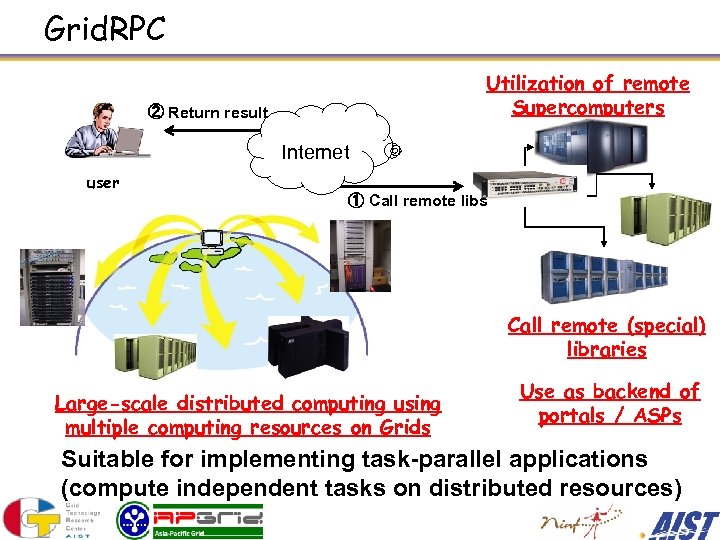 Grid. RPC Utilization of remote Supercomputers ② Return result Internet user ① Call remote libs Call remote (special) libraries Large-scale distributed computing using multiple computing resources on Grids Use as backend of portals / ASPs Suitable for implementing task-parallel applications (compute independent tasks on distributed resources)
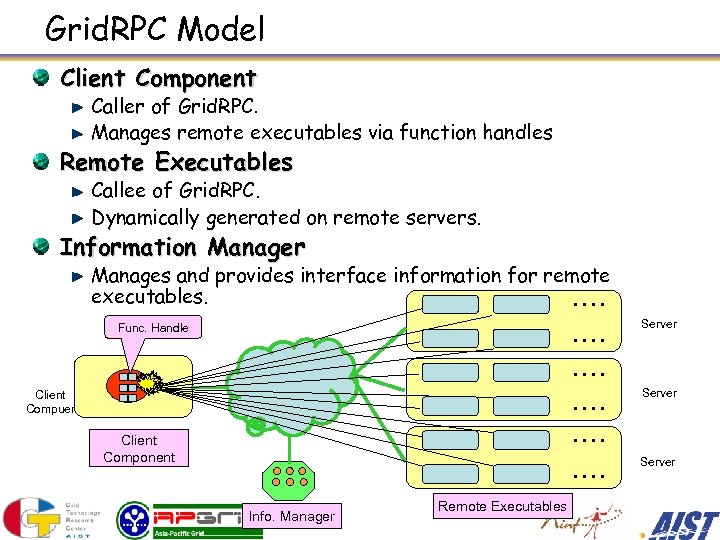 Grid. RPC Model Client Component Caller of Grid. RPC. Manages remote executables via function handles Remote Executables Callee of Grid. RPC. Dynamically generated on remote servers. Information Manager Manages and provides interface information for remote executables. ・・・・ Server Func. Handle ・・・・ Server Client Compuer ・・・・ Client Component ・・・・ Info. Manager Remote Executables 遠隔実行プログラム Server
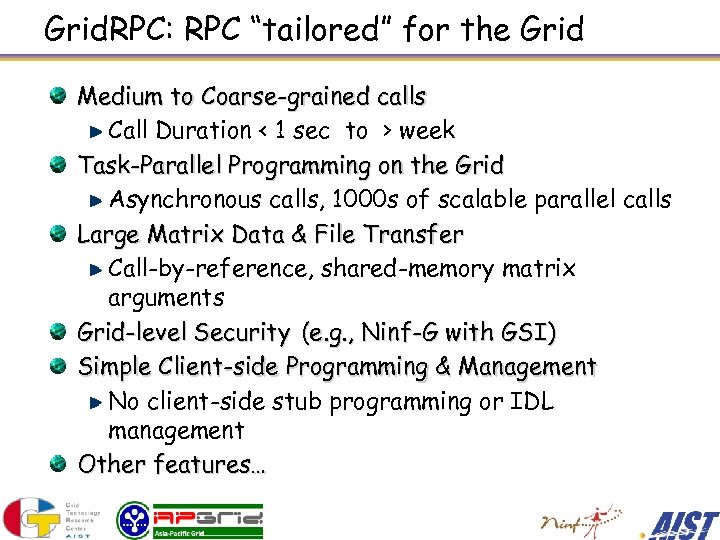 Grid. RPC: RPC “tailored” for the Grid Medium to Coarse-grained calls Call Duration < 1 sec to > week Task-Parallel Programming on the Grid Asynchronous calls, 1000 s of scalable parallel calls Large Matrix Data & File Transfer Call-by-reference, shared-memory matrix arguments Grid-level Security (e. g. , Ninf-G with GSI) Simple Client-side Programming & Management No client-side stub programming or IDL management Other features…
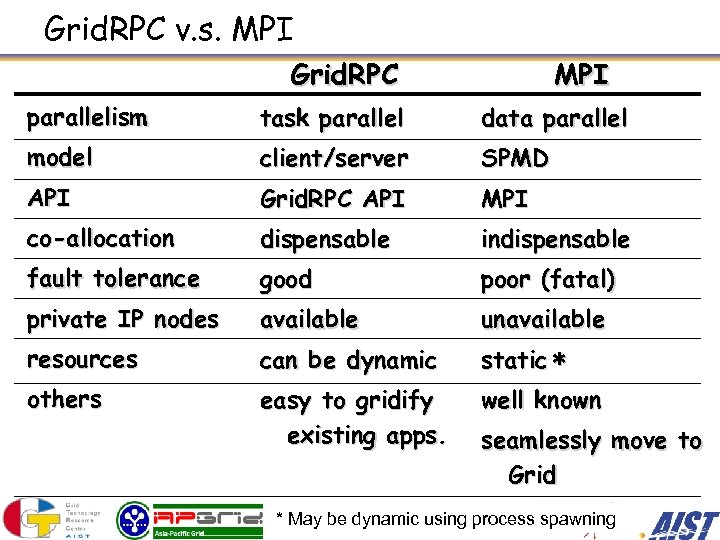 Grid. RPC v. s. MPI Grid. RPC MPI parallelism task parallel data parallel model client/server SPMD API Grid. RPC API MPI co-allocation dispensable indispensable fault tolerance good poor (fatal) private IP nodes available unavailable resources can be dynamic static* others easy to gridify existing apps. well known seamlessly move to Grid * May be dynamic using process spawning
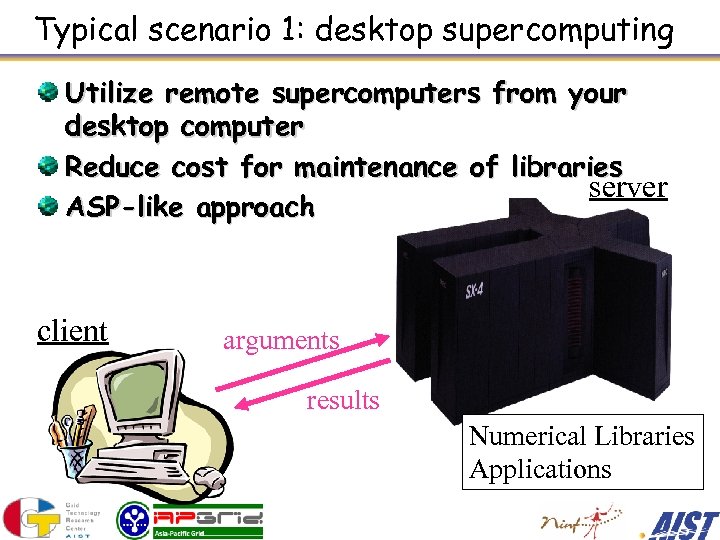 Typical scenario 1: desktop supercomputing Utilize remote supercomputers from your desktop computer Reduce cost for maintenance of libraries server ASP-like approach client arguments results Numerical Libraries Applications
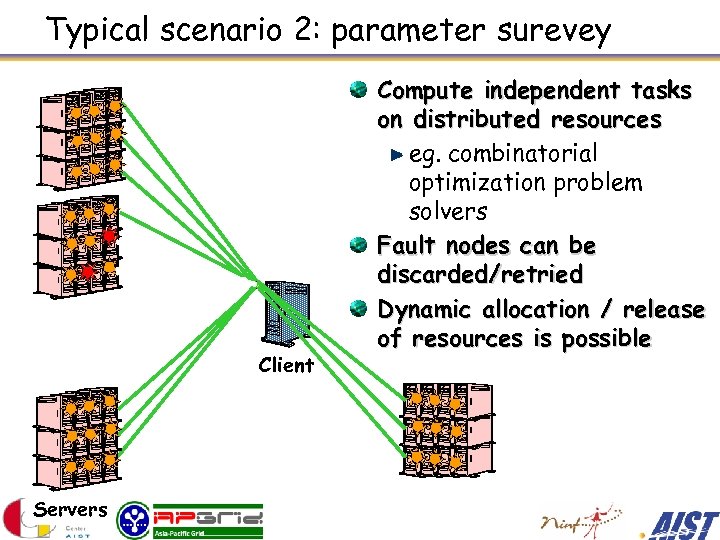 Typical scenario 2: parameter surevey Client Servers Compute independent tasks on distributed resources eg. combinatorial optimization problem solvers Fault nodes can be discarded/retried Dynamic allocation / release of resources is possible
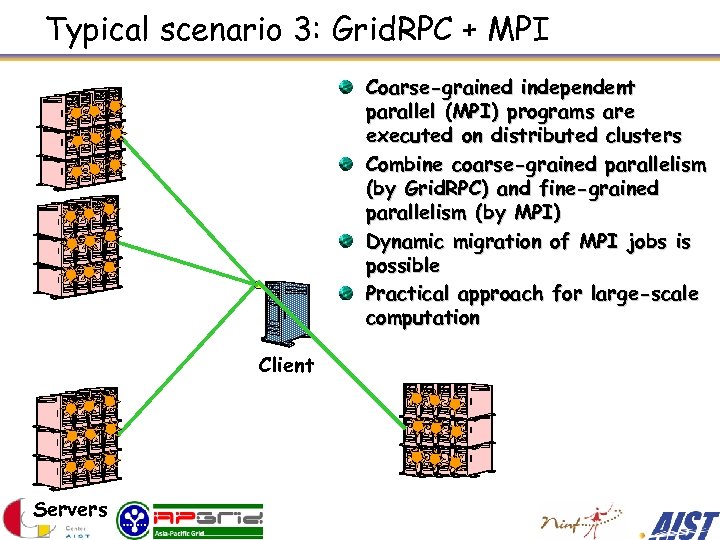 Typical scenario 3: Grid. RPC + MPI Coarse-grained independent parallel (MPI) programs are executed on distributed clusters Combine coarse-grained parallelism (by Grid. RPC) and fine-grained parallelism (by MPI) Dynamic migration of MPI jobs is possible Practical approach for large-scale computation Client Servers
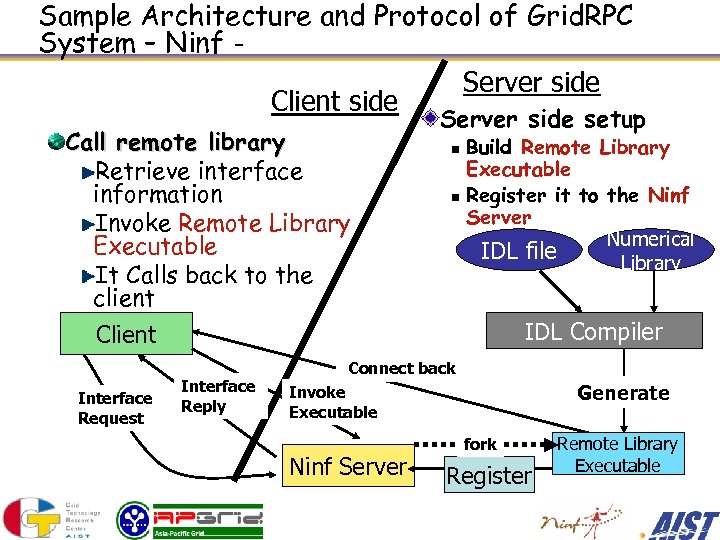 Sample Architecture and Protocol of Grid. RPC System – Ninf Server side Client side Call remote library Retrieve interface information Invoke Remote Library Executable It Calls back to the client Server side setup Build Remote Library Executable n Register it to the Ninf Server Numerical IDL file Library n IDL Compiler Client Interface Request Interface Reply Connect back Generate Invoke Executable Ninf Server fork Register Remote Library Executable
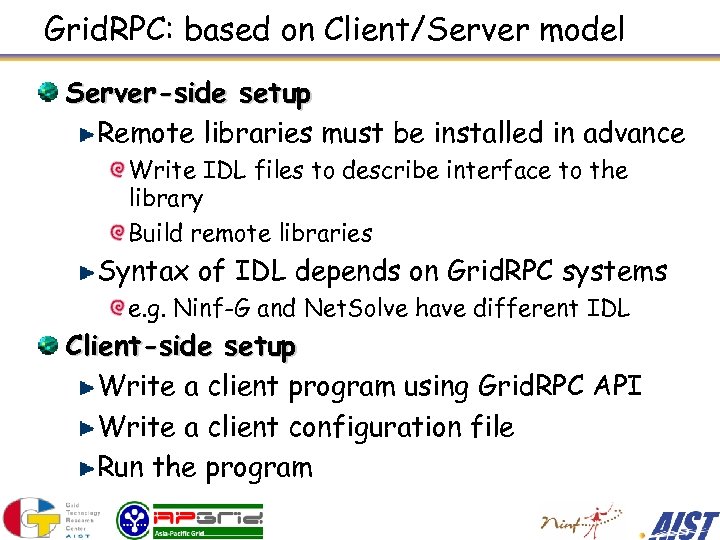 Grid. RPC: based on Client/Server model Server-side setup Remote libraries must be installed in advance Write IDL files to describe interface to the library Build remote libraries Syntax of IDL depends on Grid. RPC systems e. g. Ninf-G and Net. Solve have different IDL Client-side setup Write a client program using Grid. RPC API Write a client configuration file Run the program
 Ninf-G Overview and Architecture National Institute of Advanced Industrial Science and Technology
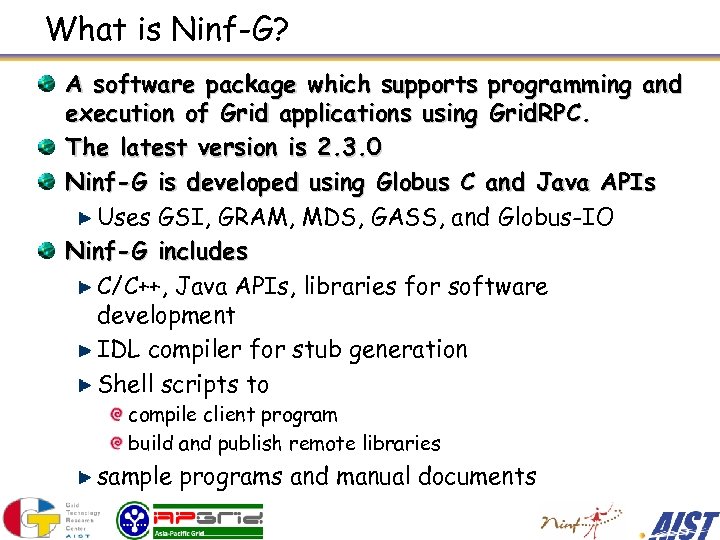 What is Ninf-G? A software package which supports programming and execution of Grid applications using Grid. RPC. The latest version is 2. 3. 0 Ninf-G is developed using Globus C and Java APIs Uses GSI, GRAM, MDS, GASS, and Globus-IO Ninf-G includes C/C++, Java APIs, libraries for software development IDL compiler for stub generation Shell scripts to compile client program build and publish remote libraries sample programs and manual documents
 Globus Toolkit Defacto standard as low-level Grid middleware
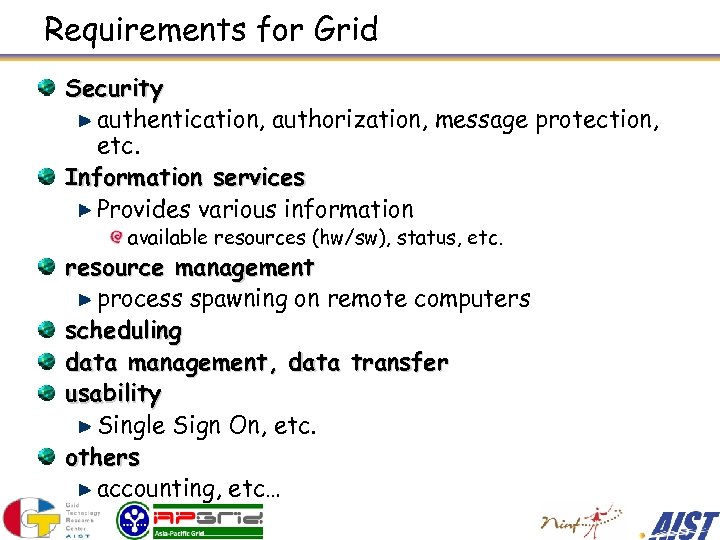 Requirements for Grid Security authentication, authorization, message protection, etc. Information services Provides various information available resources (hw/sw), status, etc. resource management process spawning on remote computers scheduling data management, data transfer usability Single Sign On, etc. others accounting, etc…
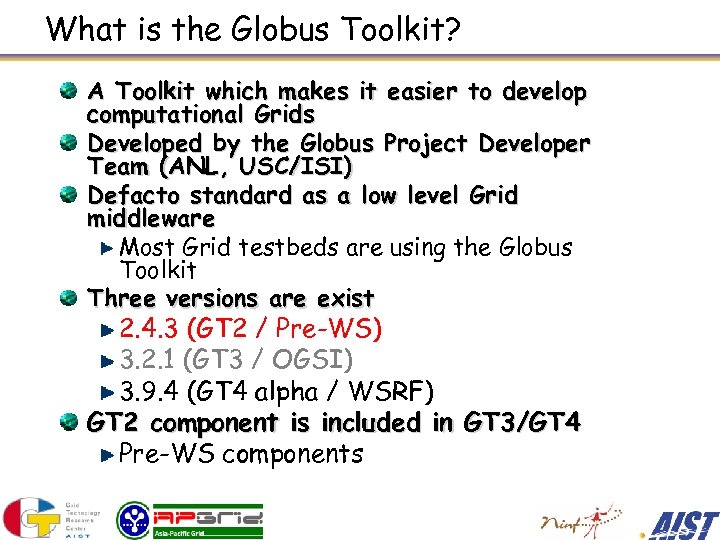 What is the Globus Toolkit? A Toolkit which makes it easier to develop computational Grids Developed by the Globus Project Developer Team (ANL, USC/ISI) Defacto standard as a low level Grid middleware Most Grid testbeds are using the Globus Toolkit Three versions are exist 2. 4. 3 (GT 2 / Pre-WS) 3. 2. 1 (GT 3 / OGSI) 3. 9. 4 (GT 4 alpha / WSRF) GT 2 component is included in GT 3/GT 4 Pre-WS components
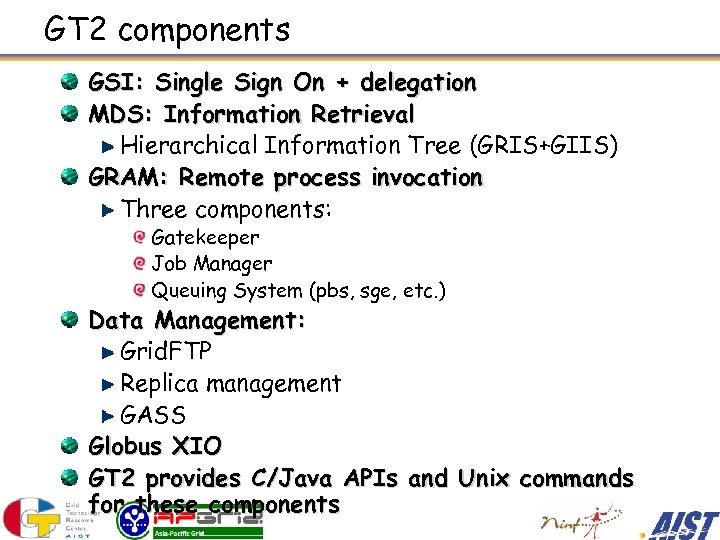 GT 2 components GSI: Single Sign On + delegation MDS: Information Retrieval Hierarchical Information Tree (GRIS+GIIS) GRAM: Remote process invocation Three components: Gatekeeper Job Manager Queuing System (pbs, sge, etc. ) Data Management: Grid. FTP Replica management GASS Globus XIO GT 2 provides C/Java APIs and Unix commands for these components
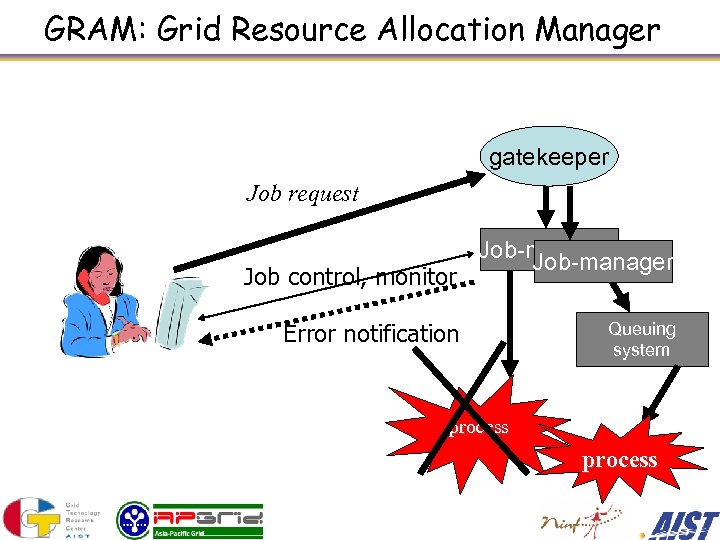 GRAM: Grid Resource Allocation Manager gatekeeper Job request Job control, monitor Job-manager Error notification Queuing system process
 Some notes on the GT 2 (1/2) Globus Toolkit is not providing a framework for anonymous computing and mega-computing Users are required to have an account on servers to which the user would be mapped when accessing the servers to have a user certificate issued by a trusted CA to be allowed by the administrator of the server Complete differences with mega-computing framework such as SETI@HOME
 Some notes on the GT 2 (2/2) Do not think that the Globus Toolkit solves all problems on the Grid. The Globus Toolkit is a set of tools for the easy development of computational Grids and middleware The Globus Toolkit includes low-level APIs and several UNIX commands It is not easy to develop application programs using Globus APIs. High-level middleware helps application development. Several necessary functions on the computational Grids are not supported by the Globus Toolkit. Brokering, Co-scheduling, Fault Managements, etc. Other supposed problems using IP-unreachable resources (private IP addresses + MPICH-G 2) scalability (ldap, maintenance of grid-mapfiles, etc. )
 Ninf-G Overview and architecture National Institute of Advanced Industrial Science and Technology
 Terminology Ninf-G Client This is a program written by a user for the purpose of controlling the execution of computation. Ninf-G IDL (Interface Description Language) is a language for describing interfaces for functions and objects those are expected to be called by Ninf-G client. Ninf-G Stub Ninf-G stub is a wrapper function of a remote function/object. It is generated by the stub generator according to the interface description for user-defined functions and methods.
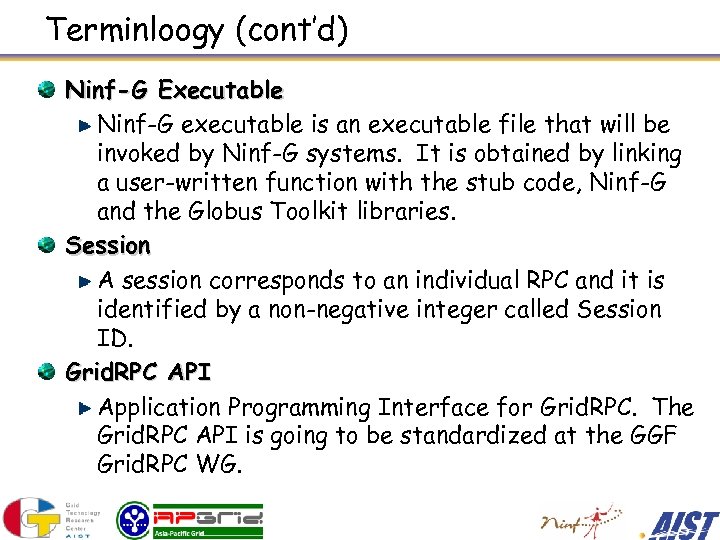 Terminloogy (cont’d) Ninf-G Executable Ninf-G executable is an executable file that will be invoked by Ninf-G systems. It is obtained by linking a user-written function with the stub code, Ninf-G and the Globus Toolkit libraries. Session A session corresponds to an individual RPC and it is identified by a non-negative integer called Session ID. Grid. RPC API Application Programming Interface for Grid. RPC. The Grid. RPC API is going to be standardized at the GGF Grid. RPC WG.
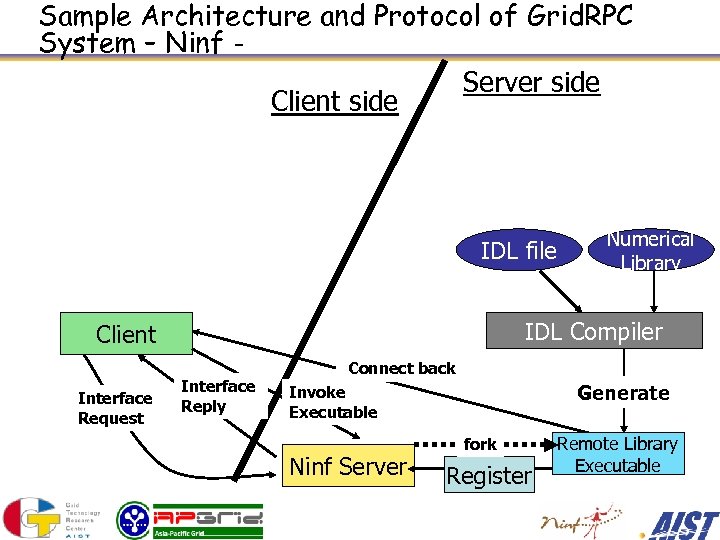 Sample Architecture and Protocol of Grid. RPC System – Ninf Server side Client side IDL file IDL Compiler Client Interface Request Numerical Library Interface Reply Connect back Generate Invoke Executable Ninf Server fork Register Remote Library Executable
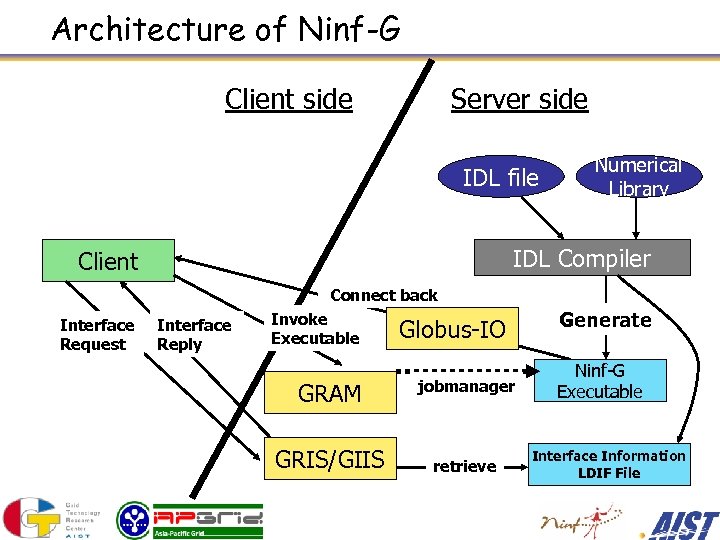 Architecture of Ninf-G Client side Server side IDL file Numerical Library IDL Compiler Client Connect back Interface Request Interface Reply Invoke Executable Globus-IO GRAM jobmanager GRIS/GIIS retrieve Generate Ninf-G Executable Interface Information LDIF File
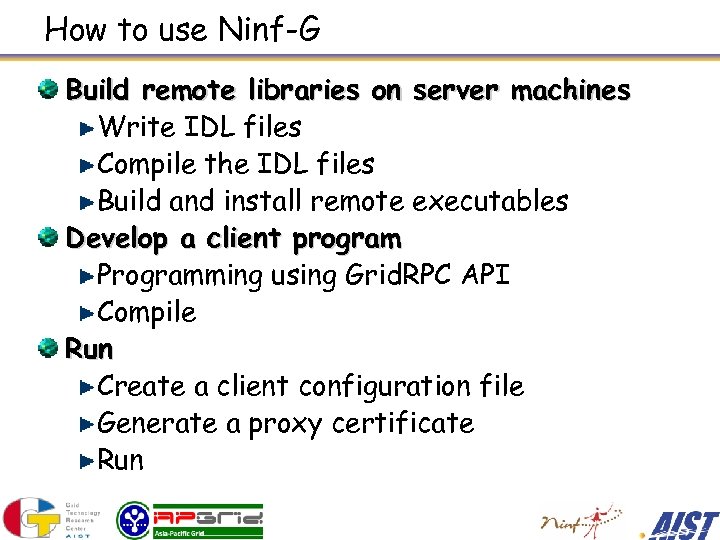 How to use Ninf-G Build remote libraries on server machines Write IDL files Compile the IDL files Build and install remote executables Develop a client program Programming using Grid. RPC API Compile Run Create a client configuration file Generate a proxy certificate Run
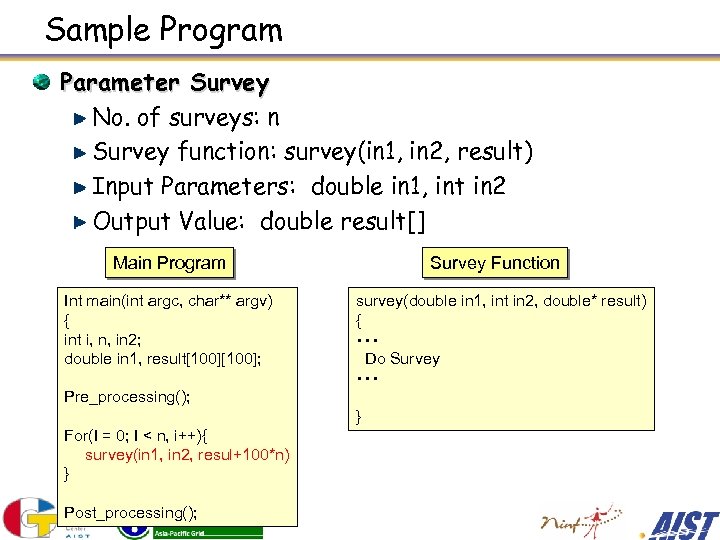 Sample Program Parameter Survey No. of surveys: n Survey function: survey(in 1, in 2, result) Input Parameters: double in 1, int in 2 Output Value: double result[] Main Program Int main(int argc, char** argv) { int i, n, in 2; double in 1, result[100]; Survey Function survey(double in 1, int in 2, double* result) { ・・・ Do Survey ・・・ Pre_processing(); } For(I = 0; I < n, i++){ survey(in 1, in 2, resul+100*n) } Post_processing();
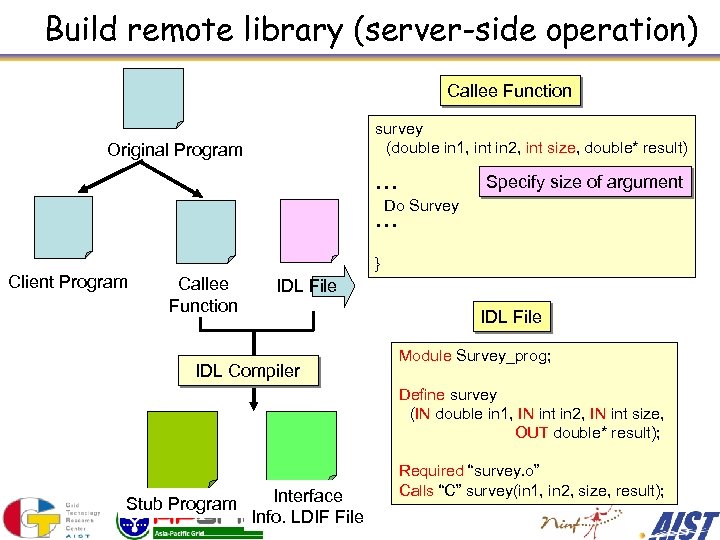 Build remote library (server-side operation) Callee Function survey (double in 1, int in 2, int size, double* result) Original Program Survey Function survey (double in 1, int in 2, double* result) { ・・・ Client Program Callee IDL File Do Survey Function ・・・ } IDL Compiler ・・・ Do Survey ・・・ Specify size of argument } IDL File Module Survey_prog; Define survey (IN double in 1, IN int in 2, IN int size, OUT double* result); Stub Program Interface Info. LDIF File Required “survey. o” Calls “C” survey(in 1, in 2, size, result);
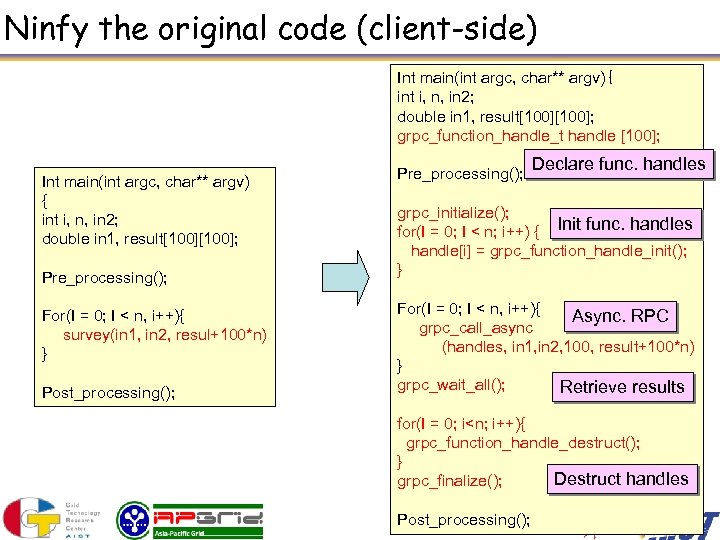 Ninfy the original code (client-side) Int main(int argc, char** argv){ int i, n, in 2; double in 1, result[100]; grpc_function_handle_t handle [100]; Int main(int argc, char** argv) { int i, n, in 2; double in 1, result[100]; Pre_processing(); For(I = 0; I < n, i++){ survey(in 1, in 2, resul+100*n) } Post_processing(); Pre_processing(); Declare func. handles grpc_initialize(); for(I = 0; I < n; i++) { Init func. handles handle[i] = grpc_function_handle_init(); } For(I = 0; I < n, i++){ Async. RPC grpc_call_async (handles, in 1, in 2, 100, result+100*n) } grpc_wait_all(); Retrieve results for(I = 0; i
 Ninf-G How to build remote libraries National Institute of Advanced Industrial Science and Technology
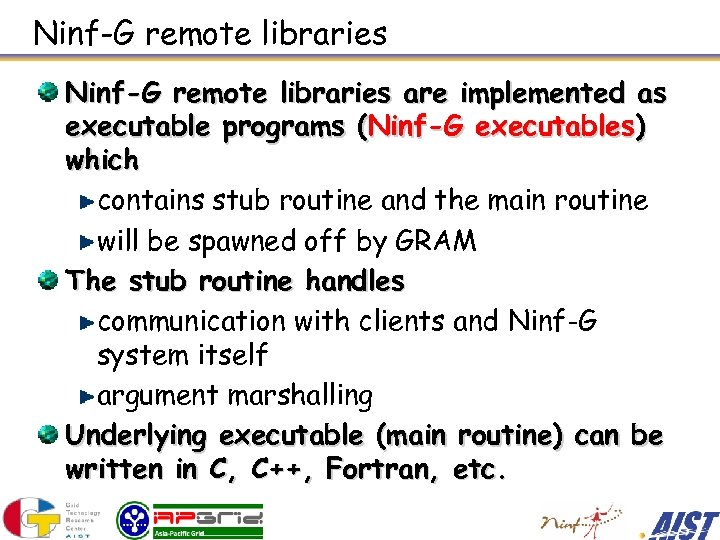 Ninf-G remote libraries are implemented as executable programs (Ninf-G executables) which contains stub routine and the main routine will be spawned off by GRAM The stub routine handles communication with clients and Ninf-G system itself argument marshalling Underlying executable (main routine) can be written in C, C++, Fortran, etc.
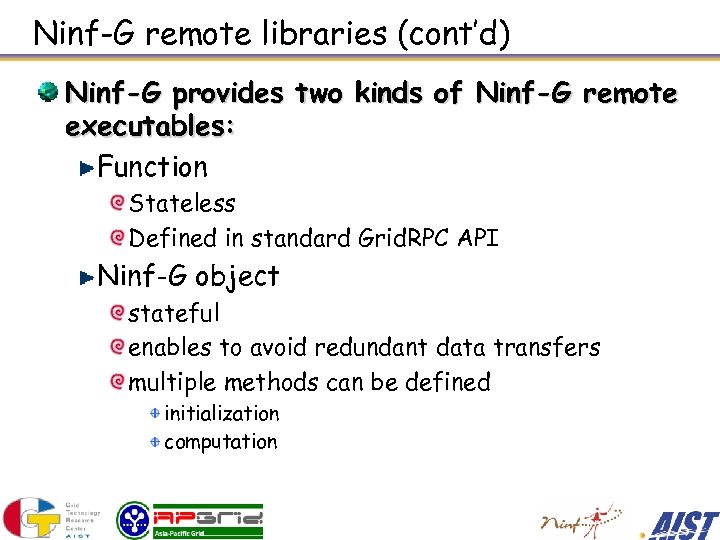 Ninf-G remote libraries (cont’d) Ninf-G provides two kinds of Ninf-G remote executables: Function Stateless Defined in standard Grid. RPC API Ninf-G object stateful enables to avoid redundant data transfers multiple methods can be defined initialization computation
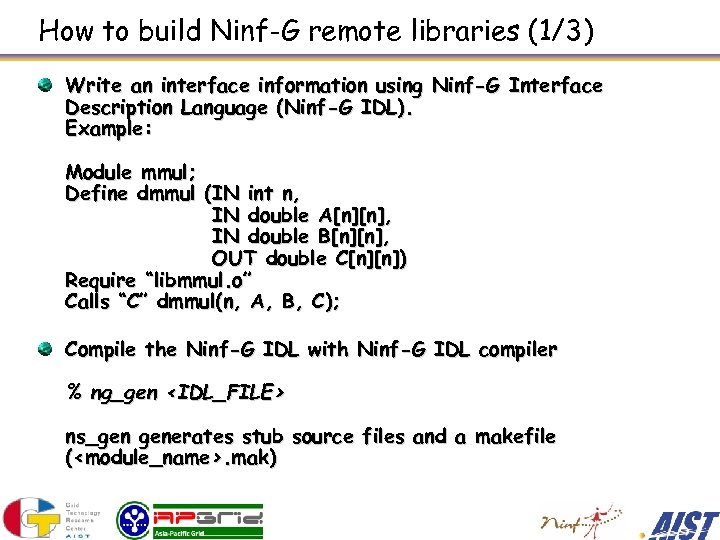 How to build Ninf-G remote libraries (1/3) Write an interface information using Ninf-G Interface Description Language (Ninf-G IDL). Example: Module mmul; Define dmmul (IN int n, IN double A[n][n], IN double B[n][n], OUT double C[n][n]) Require “libmmul. o” Calls “C” dmmul(n, A, B, C); Compile the Ninf-G IDL with Ninf-G IDL compiler % ng_gen
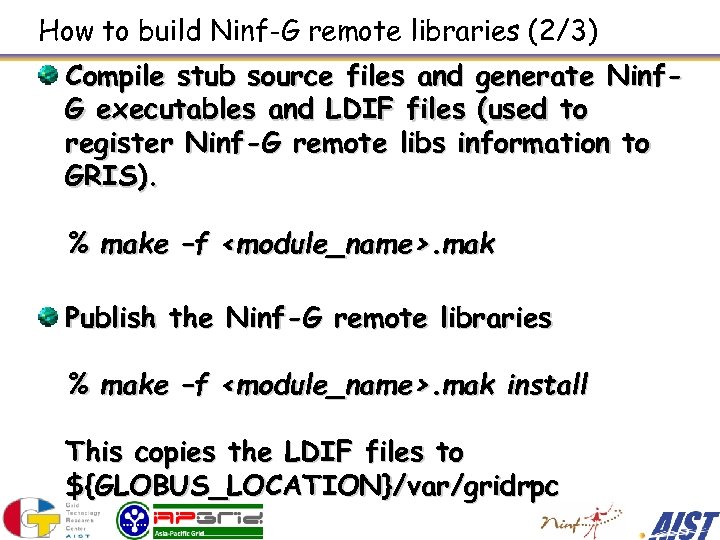 How to build Ninf-G remote libraries (2/3) Compile stub source files and generate Ninf. G executables and LDIF files (used to register Ninf-G remote libs information to GRIS). % make –f
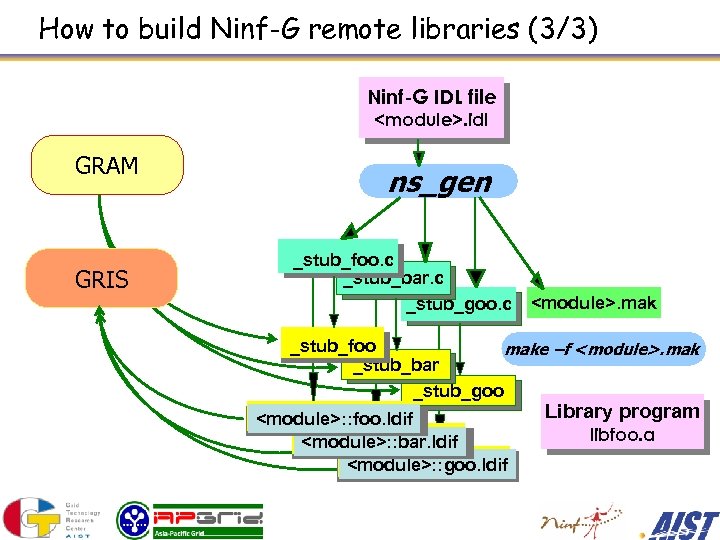 How to build Ninf-G remote libraries (3/3) Ninf-G IDL file
![How to define a remote function Define routine_name (parameters…) [“description”] [Required “object files or](https://present5.com/presentation/6e20e35073ebf4e8c2ede0d2556336a7/image-38.jpg "How to define a remote function Define routine_name (parameters…) [“description”] [Required “object files or") How to define a remote function Define routine_name (parameters…) [“description”] [Required “object files or libraries”] [Backend “MPI”|”BLACS”] [Shrink “yes”|”no”] {{C descriptions} | Calls “C”|”Fortran” calling sequence} declares function interface, required libraries and the main routine. Syntax of parameter description: [mode-spec] [type-spec] formal_parameter [[dimension [: range]]+]+
How to define a remote function Define routine_name (parameters…) [“description”] [Required “object files or libraries”] [Backend “MPI”|”BLACS”] [Shrink “yes”|”no”] {{C descriptions} | Calls “C”|”Fortran” calling sequence} declares function interface, required libraries and the main routine. Syntax of parameter description: [mode-spec] [type-spec] formal_parameter [[dimension [: range]]+]+
![How to define a remote object Def. Class class name [“description”] [Required “object files](https://present5.com/presentation/6e20e35073ebf4e8c2ede0d2556336a7/image-39.jpg "How to define a remote object Def. Class class name [“description”] [Required “object files") How to define a remote object Def. Class class name [“description”] [Required “object files or libraries”] [Backend “MPI” | “BLACS”] [Language “C” | “fortran”] [Shrink “yes” | “no”] { [Def. State{. . . }] Def. Method method name (args…) {calling sequence} Declares an interface for Ninf-G objects
How to define a remote object Def. Class class name [“description”] [Required “object files or libraries”] [Backend “MPI” | “BLACS”] [Language “C” | “fortran”] [Shrink “yes” | “no”] { [Def. State{. . . }] Def. Method method name (args…) {calling sequence} Declares an interface for Ninf-G objects
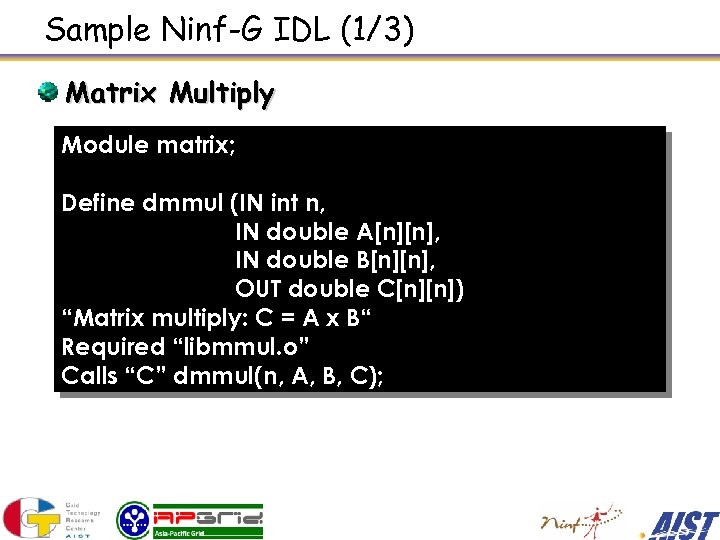 Sample Ninf-G IDL (1/3) Matrix Multiply Module matrix; Define dmmul (IN int n, IN double A[n][n], IN double B[n][n], OUT double C[n][n]) “Matrix multiply: C = A x B“ Required “libmmul. o” Calls “C” dmmul(n, A, B, C);
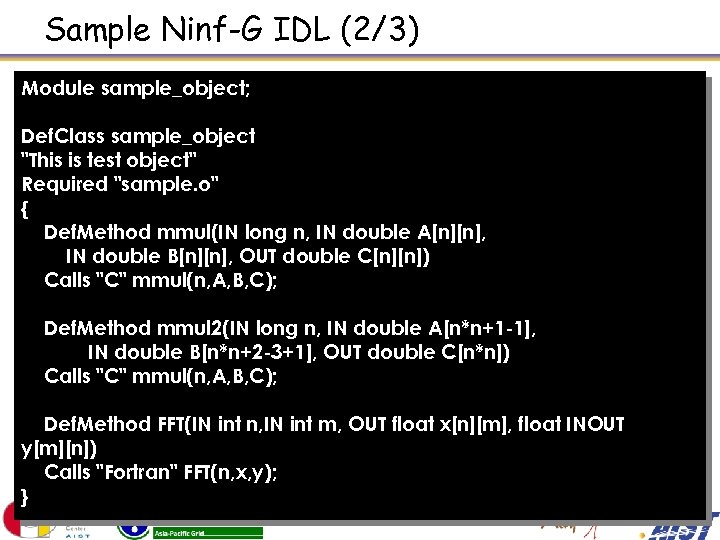 Sample Ninf-G IDL (2/3) Module sample_object; Def. Class sample_object "This is test object" Required "sample. o" { Def. Method mmul(IN long n, IN double A[n][n], IN double B[n][n], OUT double C[n][n]) Calls "C" mmul(n, A, B, C); Def. Method mmul 2(IN long n, IN double A[n*n+1 -1], IN double B[n*n+2 -3+1], OUT double C[n*n]) Calls "C" mmul(n, A, B, C); Def. Method FFT(IN int n, IN int m, OUT float x[n][m], float INOUT y[m][n]) Calls "Fortran" FFT(n, x, y); }
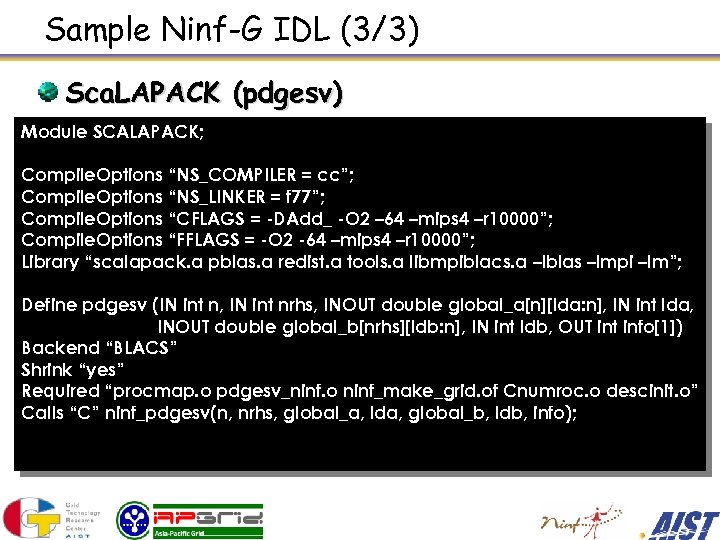 Sample Ninf-G IDL (3/3) Sca. LAPACK (pdgesv) Module SCALAPACK; Compile. Options “NS_COMPILER = cc”; Compile. Options “NS_LINKER = f 77”; Compile. Options “CFLAGS = -DAdd_ -O 2 – 64 –mips 4 –r 10000”; Compile. Options “FFLAGS = -O 2 -64 –mips 4 –r 10000”; Library “scalapack. a pblas. a redist. a tools. a libmpiblacs. a –lblas –lmpi –lm”; Define pdgesv (IN int n, IN int nrhs, INOUT double global_a[n][lda: n], IN int lda, INOUT double global_b[nrhs][ldb: n], IN int ldb, OUT int info[1]) Backend “BLACS” Shrink “yes” Required “procmap. o pdgesv_ninf. o ninf_make_grid. of Cnumroc. o descinit. o” Calls “C” ninf_pdgesv(n, nrhs, global_a, lda, global_b, ldb, info);
 Ninf-G How to call Remote Libraries - client side APIs and operations - National Institute of Advanced Industrial Science and Technology
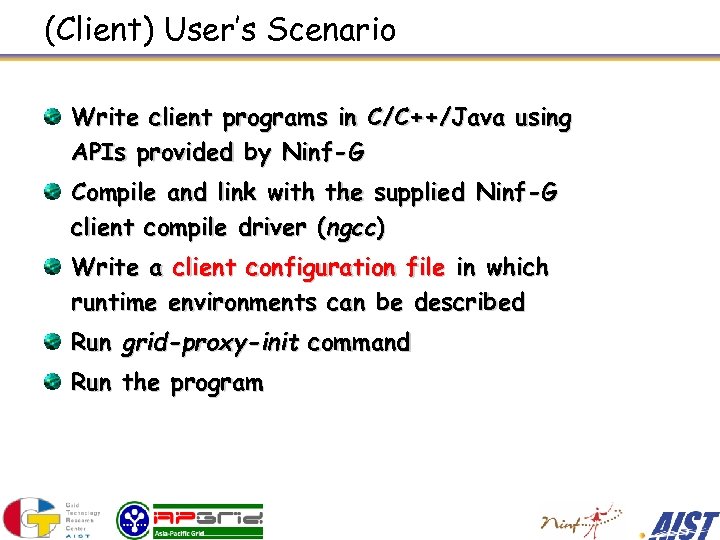 (Client) User’s Scenario Write client programs in C/C++/Java using APIs provided by Ninf-G Compile and link with the supplied Ninf-G client compile driver (ngcc) Write a client configuration file in which runtime environments can be described Run grid-proxy-init command Run the program
 Grid. RPC API / Ninf-G APIs for programming client applications
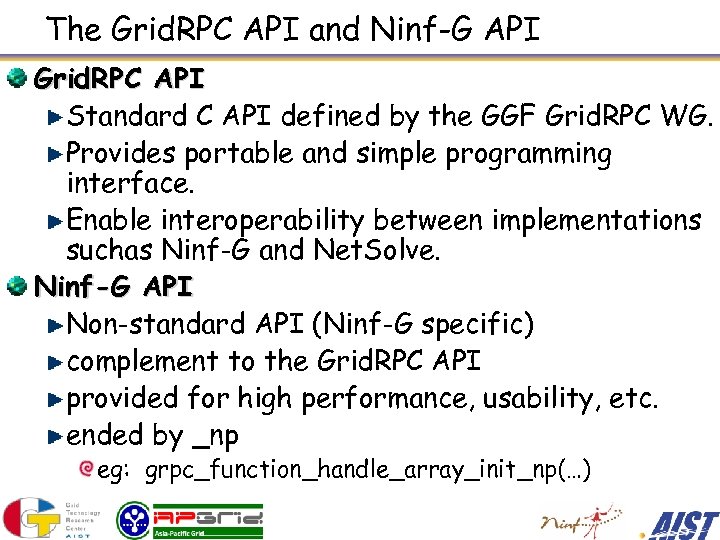 The Grid. RPC API and Ninf-G API Grid. RPC API Standard C API defined by the GGF Grid. RPC WG. Provides portable and simple programming interface. Enable interoperability between implementations suchas Ninf-G and Net. Solve. Ninf-G API Non-standard API (Ninf-G specific) complement to the Grid. RPC API provided for high performance, usability, etc. ended by _np eg: grpc_function_handle_array_init_np(…)
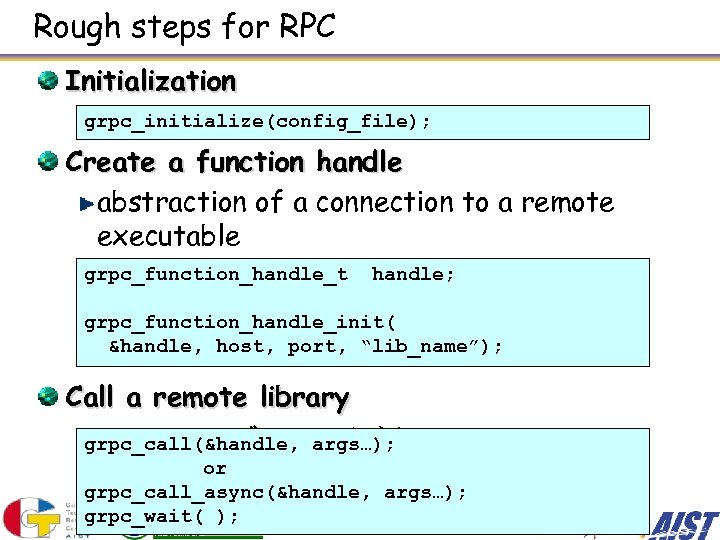 Rough steps for RPC Initialization grpc_initialize(config_file); Create a function handle abstraction of a connection to a remote executable grpc_function_handle_t handle; grpc_function_handle_init( &handle, host, port, “lib_name”); Call a remote library リモートライブラリの呼び出し grpc_call(&handle, args…); or grpc_call_async(&handle, args…); grpc_wait( );
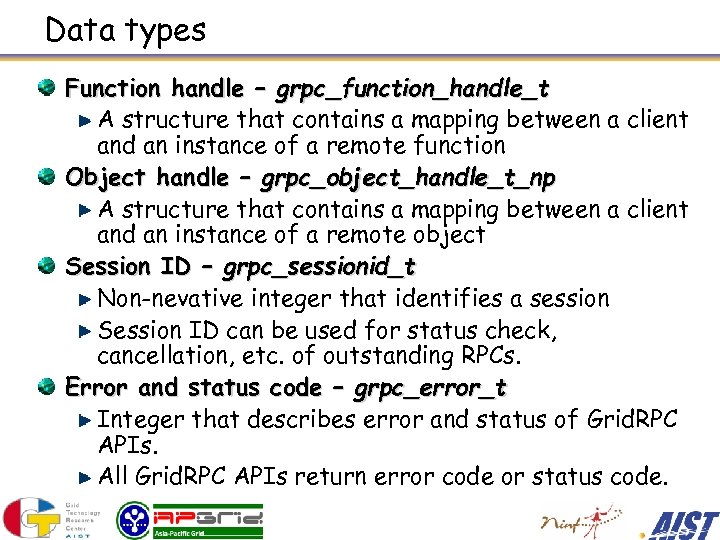 Data types Function handle – grpc_function_handle_t A structure that contains a mapping between a client and an instance of a remote function Object handle – grpc_object_handle_t_np A structure that contains a mapping between a client and an instance of a remote object Session ID – grpc_sessionid_t Non-nevative integer that identifies a session Session ID can be used for status check, cancellation, etc. of outstanding RPCs. Error and status code – grpc_error_t Integer that describes error and status of Grid. RPC APIs. All Grid. RPC APIs return error code or status code.
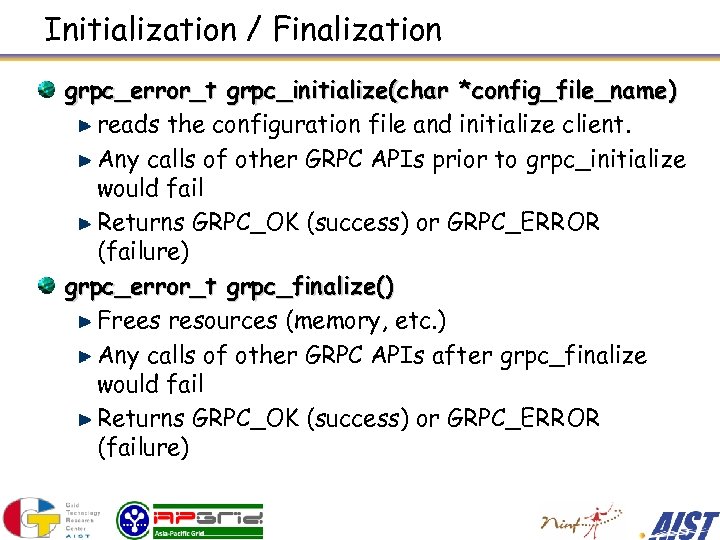 Initialization / Finalization grpc_error_t grpc_initialize(char *config_file_name) reads the configuration file and initialize client. Any calls of other GRPC APIs prior to grpc_initialize would fail Returns GRPC_OK (success) or GRPC_ERROR (failure) grpc_error_t grpc_finalize() Frees resources (memory, etc. ) Any calls of other GRPC APIs after grpc_finalize would fail Returns GRPC_OK (success) or GRPC_ERROR (failure)
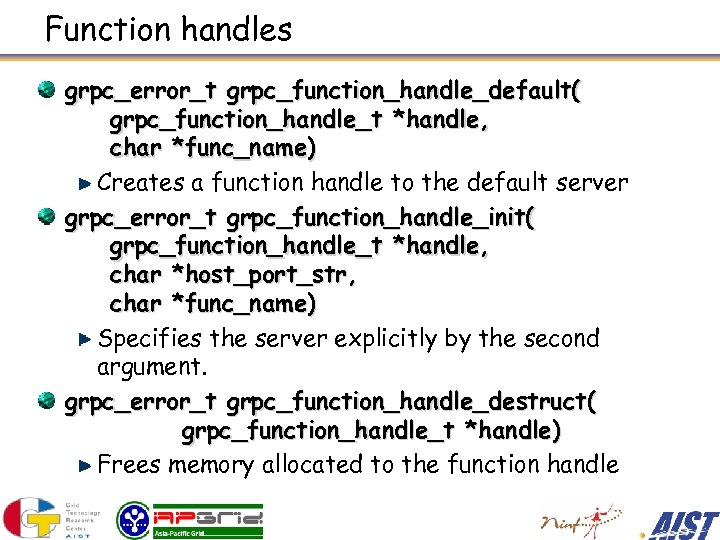 Function handles grpc_error_t grpc_function_handle_default( grpc_function_handle_t *handle, char *func_name) Creates a function handle to the default server grpc_error_t grpc_function_handle_init( grpc_function_handle_t *handle, char *host_port_str, char *func_name) Specifies the server explicitly by the second argument. grpc_error_t grpc_function_handle_destruct( grpc_function_handle_t *handle) Frees memory allocated to the function handle
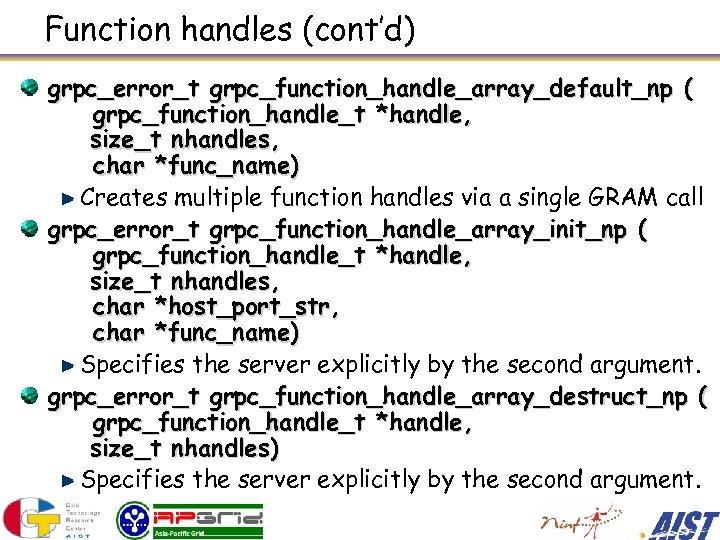 Function handles (cont’d) grpc_error_t grpc_function_handle_array_default_np ( grpc_function_handle_t *handle, size_t nhandles, char *func_name) Creates multiple function handles via a single GRAM call grpc_error_t grpc_function_handle_array_init_np ( grpc_function_handle_t *handle, size_t nhandles, char *host_port_str, char *func_name) Specifies the server explicitly by the second argument. grpc_error_t grpc_function_handle_array_destruct_np ( grpc_function_handle_t *handle, size_t nhandles) Specifies the server explicitly by the second argument.
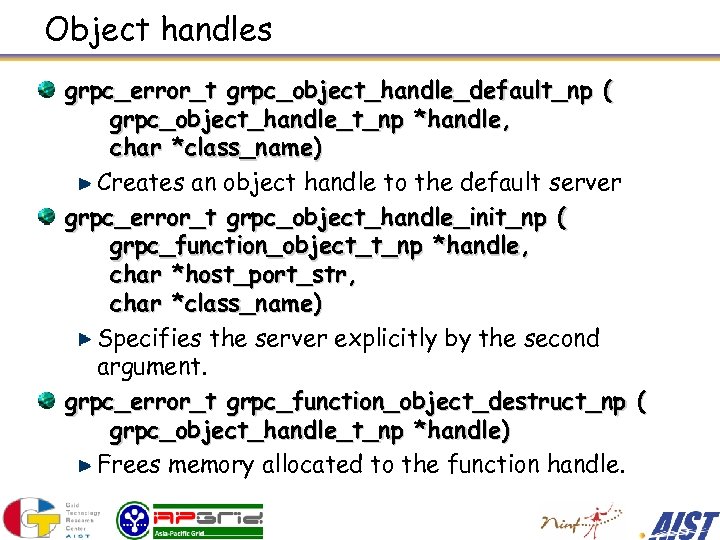 Object handles grpc_error_t grpc_object_handle_default_np ( grpc_object_handle_t_np *handle, char *class_name) Creates an object handle to the default server grpc_error_t grpc_object_handle_init_np ( grpc_function_object_t_np *handle, char *host_port_str, char *class_name) Specifies the server explicitly by the second argument. grpc_error_t grpc_function_object_destruct_np ( grpc_object_handle_t_np *handle) Frees memory allocated to the function handle.
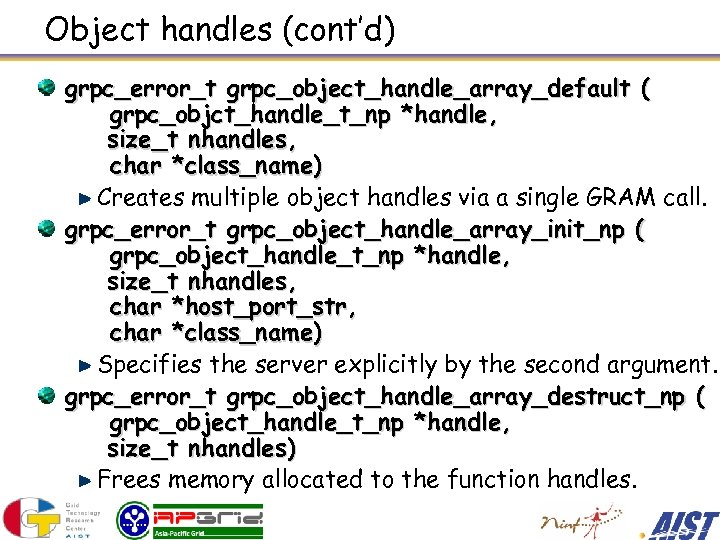 Object handles (cont’d) grpc_error_t grpc_object_handle_array_default ( grpc_objct_handle_t_np *handle, size_t nhandles, char *class_name) Creates multiple object handles via a single GRAM call. grpc_error_t grpc_object_handle_array_init_np ( grpc_object_handle_t_np *handle, size_t nhandles, char *host_port_str, char *class_name) Specifies the server explicitly by the second argument. grpc_error_t grpc_object_handle_array_destruct_np ( grpc_object_handle_t_np *handle, size_t nhandles) Frees memory allocated to the function handles.
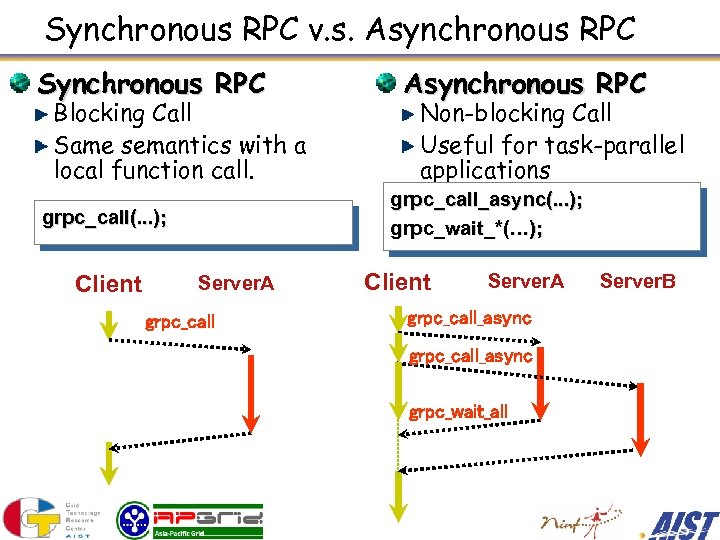 Synchronous RPC v. s. Asynchronous RPC Synchronous RPC Blocking Call Same semantics with a local function call. Non-blocking Call Useful for task-parallel applications grpc_call_async(. . . ); grpc_wait_*(…); grpc_call(. . . ); Client Asynchronous RPC Server. A grpc_call Client Server. A grpc_call_async grpc_wait_all Server. B
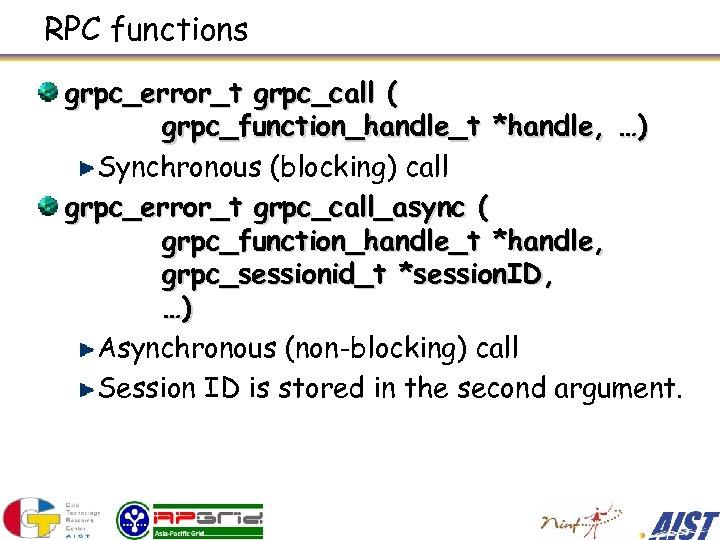 RPC functions grpc_error_t grpc_call ( grpc_function_handle_t *handle, …) Synchronous (blocking) call grpc_error_t grpc_call_async ( grpc_function_handle_t *handle, grpc_sessionid_t *session. ID, …) Asynchronous (non-blocking) call Session ID is stored in the second argument.
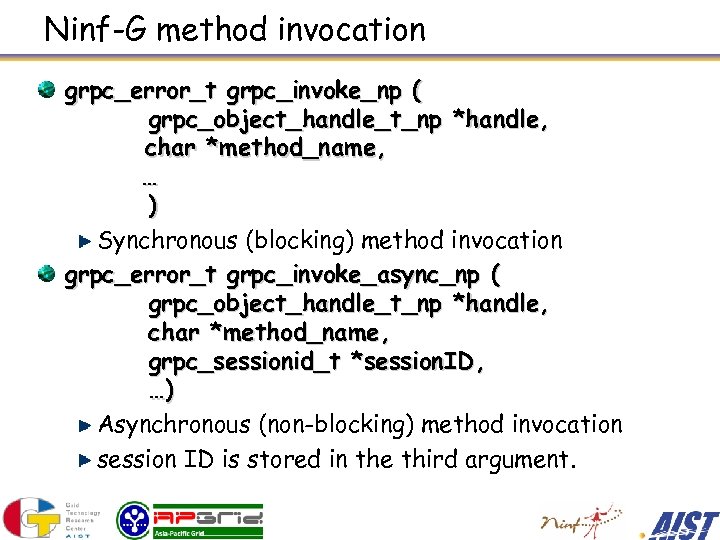 Ninf-G method invocation grpc_error_t grpc_invoke_np ( grpc_object_handle_t_np *handle, char *method_name, … ) Synchronous (blocking) method invocation grpc_error_t grpc_invoke_async_np ( grpc_object_handle_t_np *handle, char *method_name, grpc_sessionid_t *session. ID, …) Asynchronous (non-blocking) method invocation session ID is stored in the third argument.
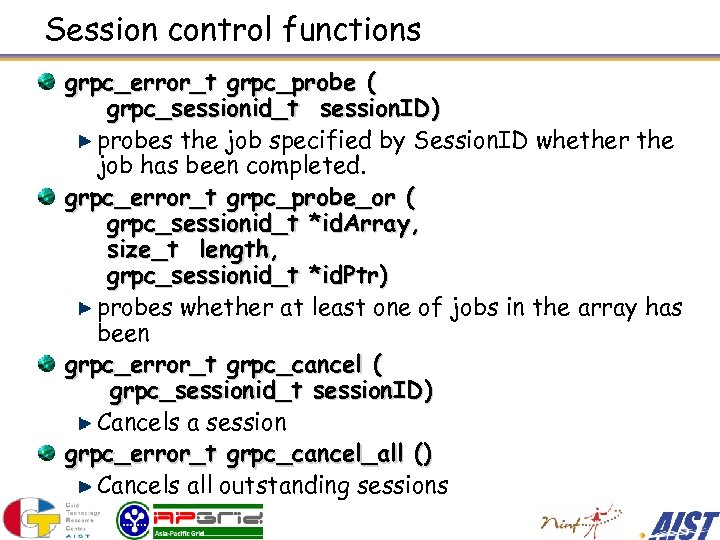 Session control functions grpc_error_t grpc_probe ( grpc_sessionid_t session. ID) probes the job specified by Session. ID whether the job has been completed. grpc_error_t grpc_probe_or ( grpc_sessionid_t *id. Array, size_t length, grpc_sessionid_t *id. Ptr) probes whether at least one of jobs in the array has been grpc_error_t grpc_cancel ( grpc_sessionid_t session. ID) Cancels a session grpc_error_t grpc_cancel_all () Cancels all outstanding sessions
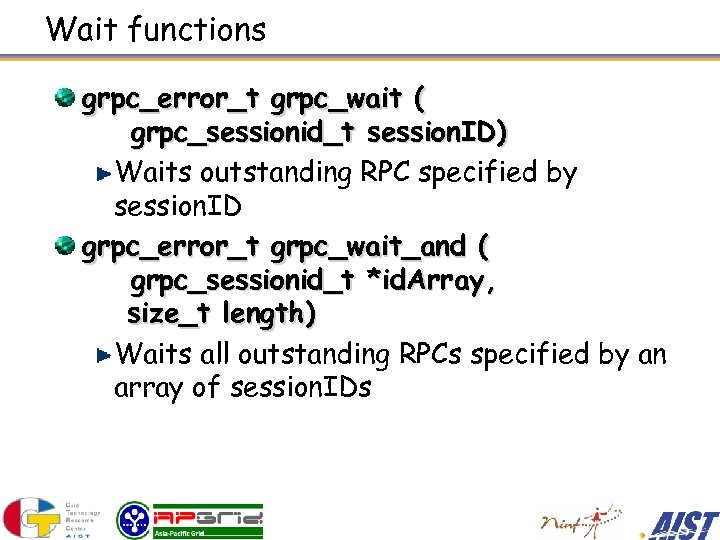 Wait functions grpc_error_t grpc_wait ( grpc_sessionid_t session. ID) Waits outstanding RPC specified by session. ID grpc_error_t grpc_wait_and ( grpc_sessionid_t *id. Array, size_t length) Waits all outstanding RPCs specified by an array of session. IDs
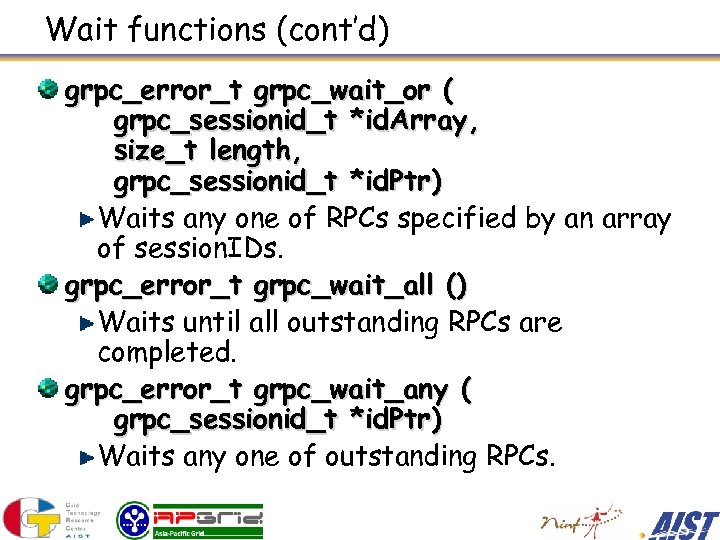 Wait functions (cont’d) grpc_error_t grpc_wait_or ( grpc_sessionid_t *id. Array, size_t length, grpc_sessionid_t *id. Ptr) Waits any one of RPCs specified by an array of session. IDs. grpc_error_t grpc_wait_all () Waits until all outstanding RPCs are completed. grpc_error_t grpc_wait_any ( grpc_sessionid_t *id. Ptr) Waits any one of outstanding RPCs.
 Ninf-G Compile and run National Institute of Advanced Industrial Science and Technology
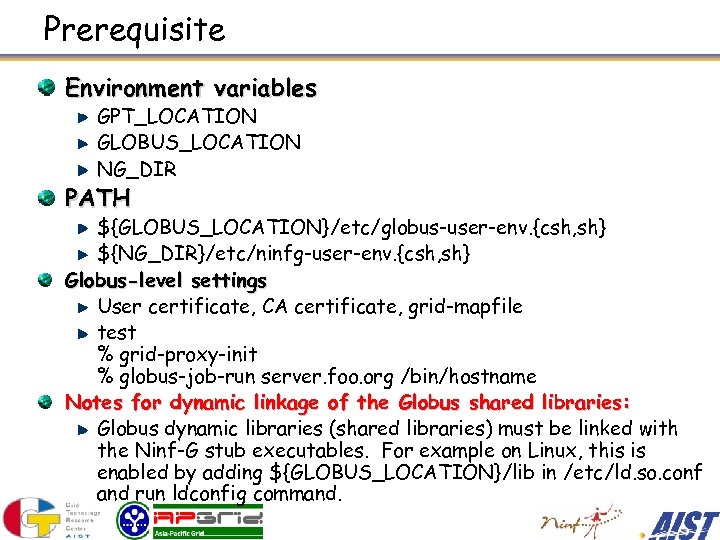 Prerequisite Environment variables GPT_LOCATION GLOBUS_LOCATION NG_DIR PATH ${GLOBUS_LOCATION}/etc/globus-user-env. {csh, sh} ${NG_DIR}/etc/ninfg-user-env. {csh, sh} Globus-level settings User certificate, CA certificate, grid-mapfile test % grid-proxy-init % globus-job-run server. foo. org /bin/hostname Notes for dynamic linkage of the Globus shared libraries: Globus dynamic libraries (shared libraries) must be linked with the Ninf-G stub executables. For example on Linux, this is enabled by adding ${GLOBUS_LOCATION}/lib in /etc/ld. so. conf and run ldconfig command.
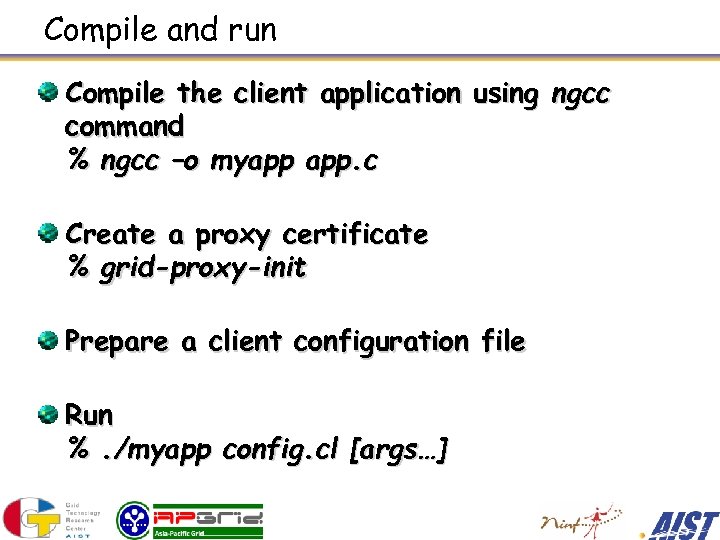 Compile and run Compile the client application using ngcc command % ngcc –o myapp app. c Create a proxy certificate % grid-proxy-init Prepare a client configuration file Run %. /myapp config. cl [args…]
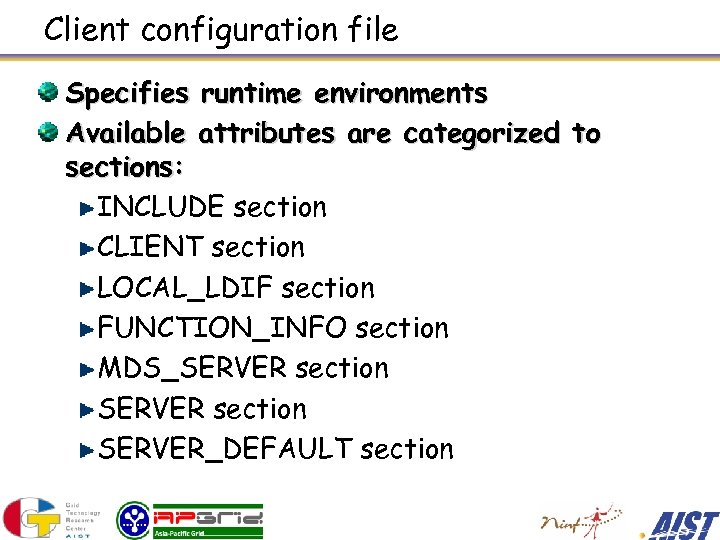 Client configuration file Specifies runtime environments Available attributes are categorized to sections: INCLUDE section CLIENT section LOCAL_LDIF section FUNCTION_INFO section MDS_SERVER section SERVER_DEFAULT section
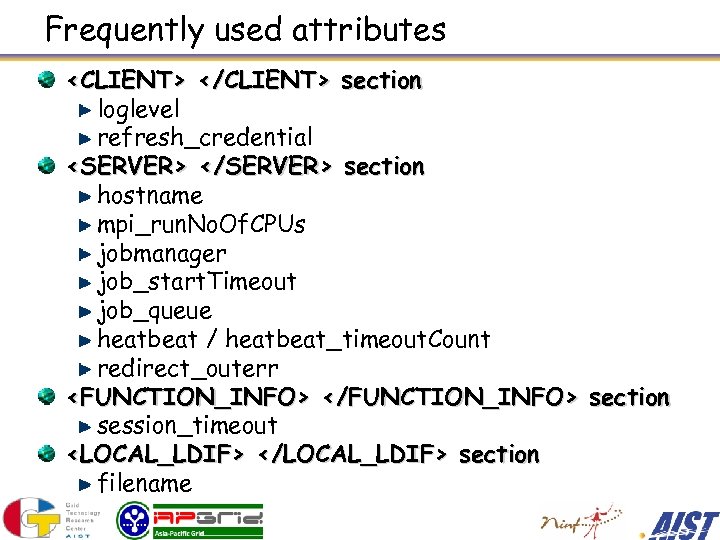 Frequently used attributes
 Ninf-G Summary National Institute of Advanced Industrial Science and Technology
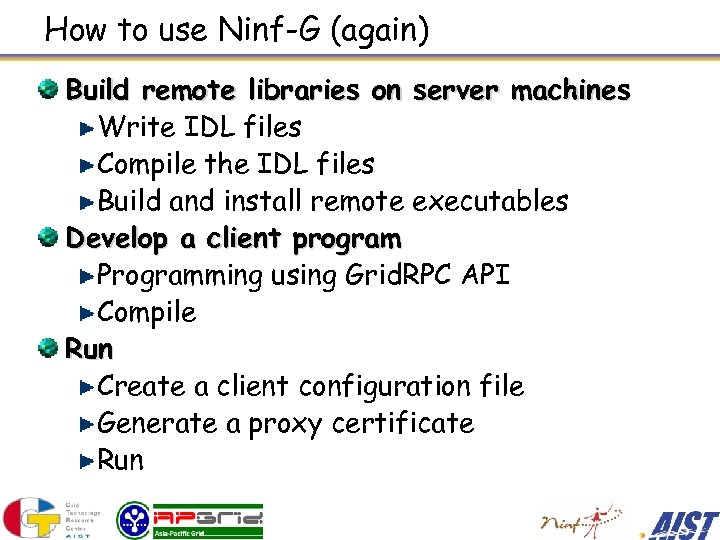 How to use Ninf-G (again) Build remote libraries on server machines Write IDL files Compile the IDL files Build and install remote executables Develop a client program Programming using Grid. RPC API Compile Run Create a client configuration file Generate a proxy certificate Run
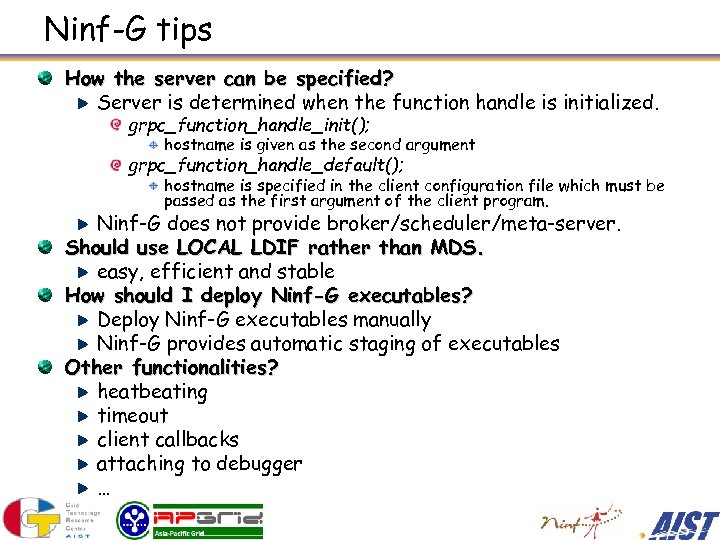 Ninf-G tips How the server can be specified? Server is determined when the function handle is initialized. grpc_function_handle_init(); hostname is given as the second argument grpc_function_handle_default(); hostname is specified in the client configuration file which must be passed as the first argument of the client program. Ninf-G does not provide broker/scheduler/meta-server. Should use LOCAL LDIF rather than MDS. easy, efficient and stable How should I deploy Ninf-G executables? Deploy Ninf-G executables manually Ninf-G provides automatic staging of executables Other functionalities? heatbeating timeout client callbacks attaching to debugger …
 Ninf-G Recent achievements National Institute of Advanced Industrial Science and Technology
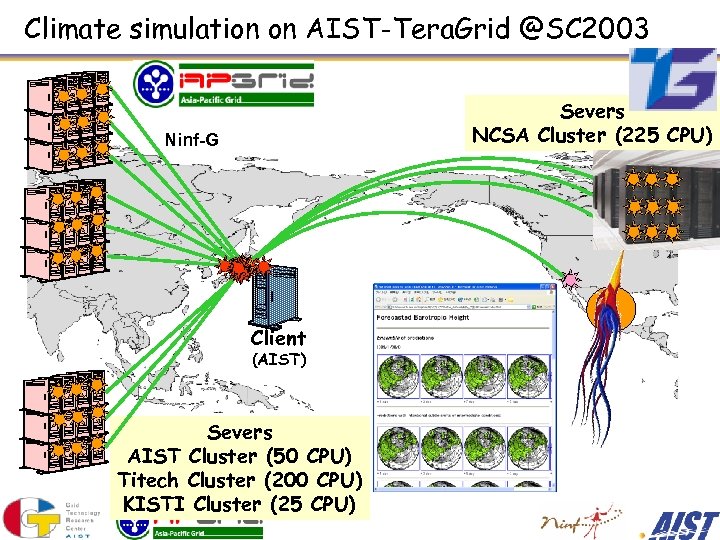 Climate simulation on AIST-Tera. Grid @SC 2003 Severs NCSA Cluster (225 CPU) Ninf-G Client (AIST) Severs AIST Cluster (50 CPU) Titech Cluster (200 CPU) KISTI Cluster (25 CPU)
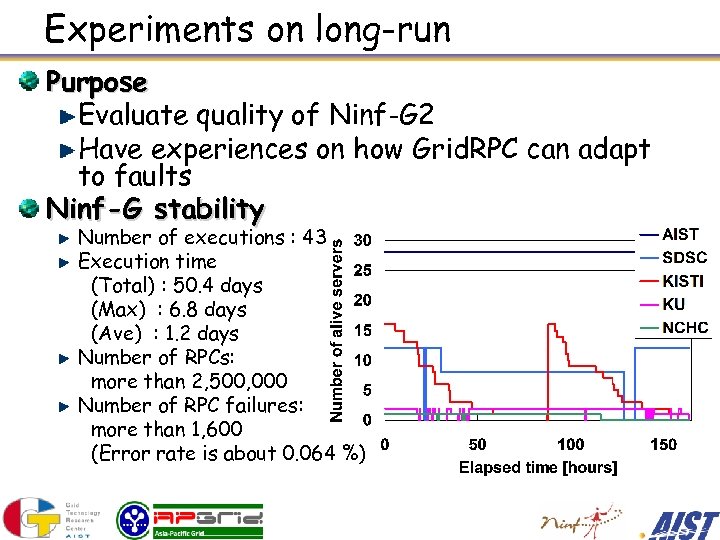 Experiments on long-run Purpose Evaluate quality of Ninf-G 2 Have experiences on how Grid. RPC can adapt to faults Ninf-G stability Number of executions : 43 Execution time (Total) : 50. 4 days (Max) : 6. 8 days (Ave) : 1. 2 days Number of RPCs: more than 2, 500, 000 Number of RPC failures: more than 1, 600 (Error rate is about 0. 064 %)
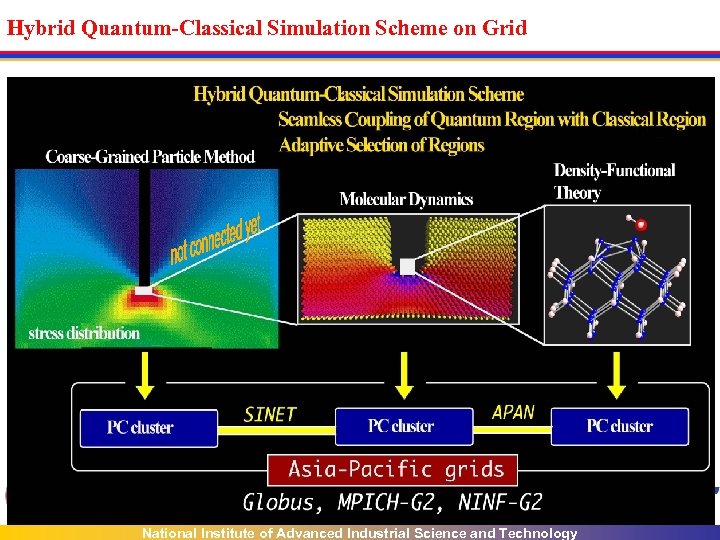 Hybrid Quantum-Classical Simulation Scheme on Grid National Institute of Advanced Industrial Science and Technology
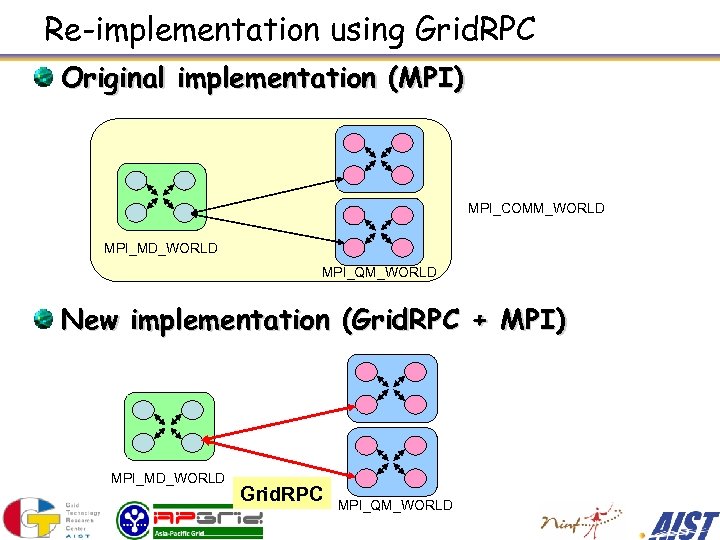 Re-implementation using Grid. RPC Original implementation (MPI) MPI_COMM_WORLD MPI_MD_WORLD MPI_QM_WORLD New implementation (Grid. RPC + MPI) MPI_MD_WORLD Grid. RPC MPI_QM_WORLD
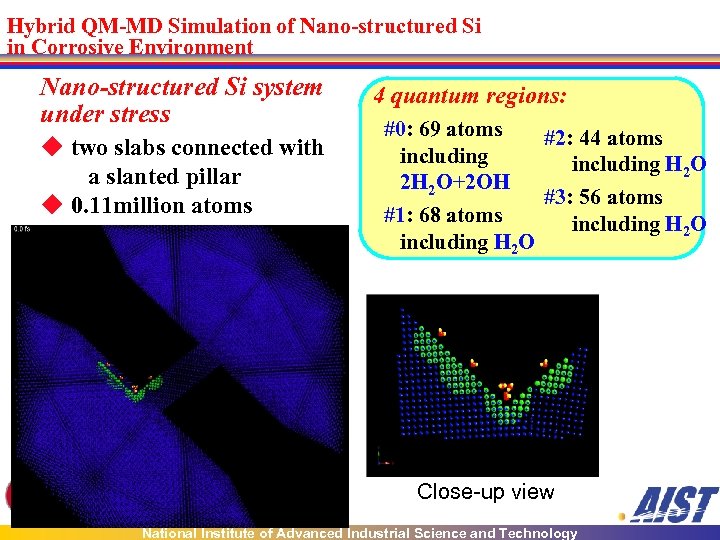 Hybrid QM-MD Simulation of Nano-structured Si in Corrosive Environment Nano-structured Si system under stress ◆ two slabs connected with a slanted pillar ◆ 0. 11 million atoms 4 quantum regions: #0: 69 atoms including 2 H 2 O+2 OH #1: 68 atoms including H 2 O #2: 44 atoms including H 2 O #3: 56 atoms including H 2 O Close-up view National Institute of Advanced Industrial Science and Technology
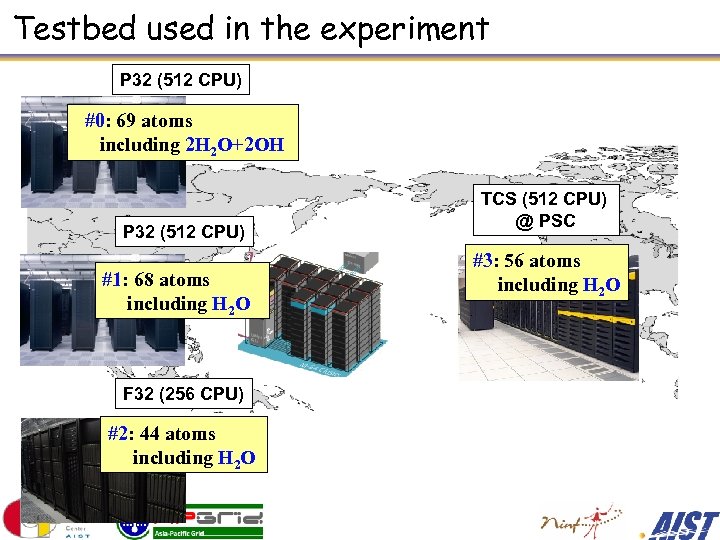 Testbed used in the experiment P 32 (512 CPU) #0: 69 atoms including 2 H 2 O+2 OH P 32 (512 CPU) #1: 68 atoms including H 2 O F 32 (256 CPU) #2: 44 atoms including H 2 O TCS (512 CPU) @ PSC #3: 56 atoms including H 2 O
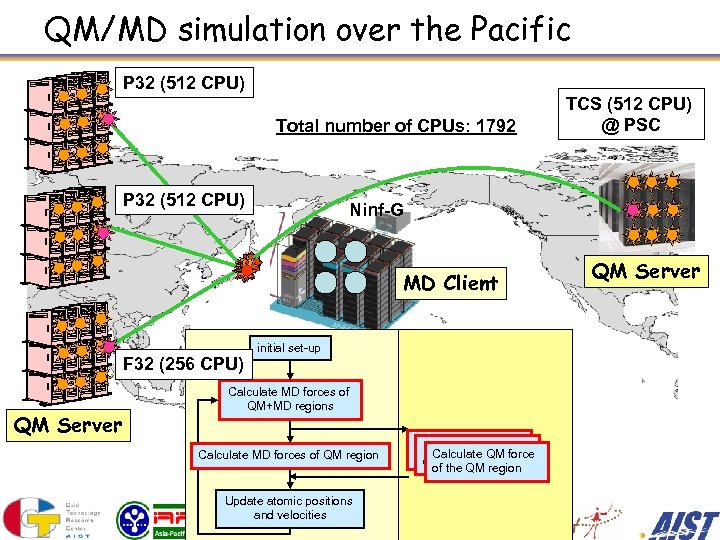 QM/MD simulation over the Pacific P 32 (512 CPU) Total number of CPUs: 1792 P 32 (512 CPU) Ninf-G MD Client initial set-up F 32 (256 CPU) QM Server TCS (512 CPU) @ PSC Calculate MD forces of QM+MD regions Calculate MD forces of QM region Update atomic positions and velocities Calculate QM force ofof. Calculate QM force the QM region of the QM region QM Server
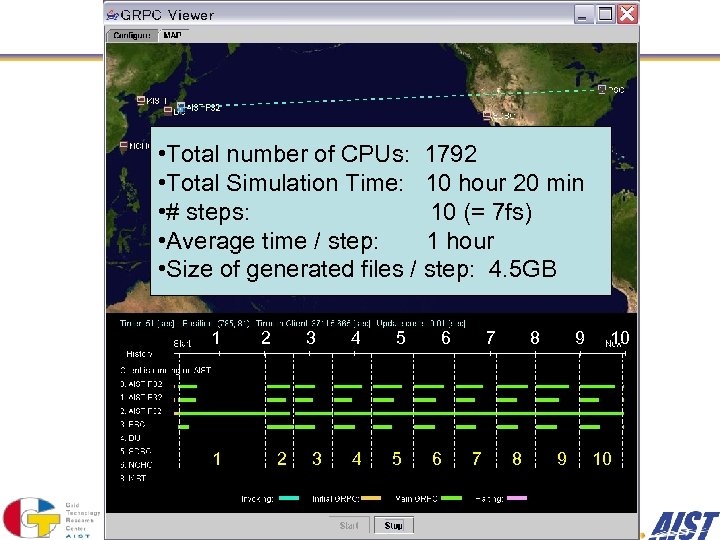 • Total number of CPUs: 1792 • Total Simulation Time: 10 hour 20 min • # steps: 10 (= 7 fs) • Average time / step: 1 hour • Size of generated files / step: 4. 5 GB 1 1 2 3 4 5 6 6 7 7 8 8 9 9 10 10
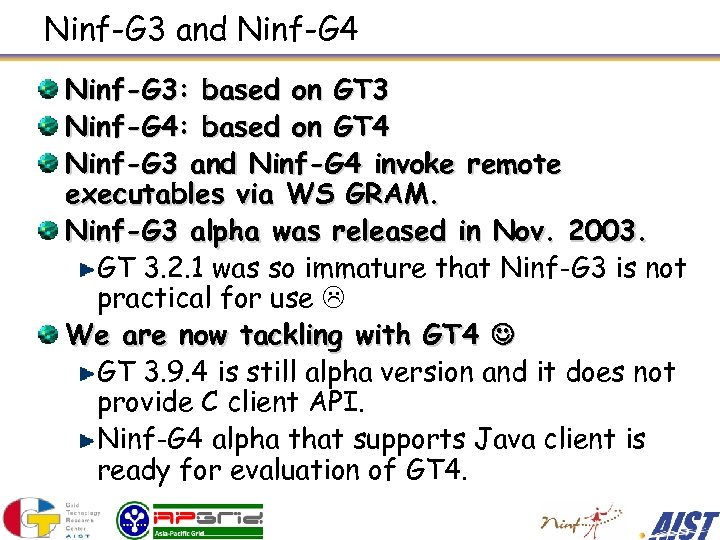 Ninf-G 3 and Ninf-G 4 Ninf-G 3: based on GT 3 Ninf-G 4: based on GT 4 Ninf-G 3 and Ninf-G 4 invoke remote executables via WS GRAM. Ninf-G 3 alpha was released in Nov. 2003. GT 3. 2. 1 was so immature that Ninf-G 3 is not practical for use We are now tackling with GT 4 GT 3. 9. 4 is still alpha version and it does not provide C client API. Ninf-G 4 alpha that supports Java client is ready for evaluation of GT 4.
 For more info, related links Ninf project ML ninf@apgrid. org Ninf-G Users’ ML ninf-users@apgrid. org Ninf project home page http: //ninf. apgrid. org Global Grid Forum http: //www. ggf. org/ GGF Grid. RPC WG http: //forge. gridforum. org/projects/gridrpc-wg/ Globus Alliance http: //www. globus. org/