 Скачать презентацию Programming Multi-Core Processors based Embedded Systems A Hands-On
699a724845abd3b6b3571f94c90cadde.ppt
- Количество слайдов: 85




Programming Multi-Core Processors based Embedded Systems A Hands-On Experience on Cavium Octeon based Platforms Lecture 4: Layering & Deep Packet Inspection
Course Outline n n Introduction Multi-threading on multi-core processors Applications for multi-core processors Application layer computing on multi-core n n n Application layer protocols Deep packet inspection and content processing Performance measurement and tuning Copyright © 2009 4 -2 KICS, UET
Agenda for Today n Application layer protocols n n Application layering Layer 4 -7 applications Header and deep packet inspection Performance considerations n n Case study: deep packet inspection Case study: deep message inspection Copyright © 2009 4 -3 KICS, UET
Multi-Core Systems for Application Layer n Internet architecture typically consists of n n Network core Network edge and access network End-point hosts Compute capabilities within networks n n Historically, network does simple operations Compute intensive tasks left to end hosts n n Examples: packet re-assembly, state-ful protocol processing, content filtering and matching, etc. However, “intelligence” moving to networks from end hosts with increasing processor capabilities Copyright © 2009 4 -4 KICS, UET
Multi-Core Systems for Application Layer (2) n Increasing processing capabilities in networks n n n Moore’s law in 90’s: increasing clock frequencies Moore’s law in 00’s: increasing number of cores Additional capabilities are being used for: n n n Access control, filtering, caching, load balancing, packet header and content inspection, and intrusion detection In addition to regular switching and routing Enabling new computing paradigms: n n n Network as a platform Software as a Service (Saa. S) Cloud Computing Copyright © 2009 4 -5 KICS, UET
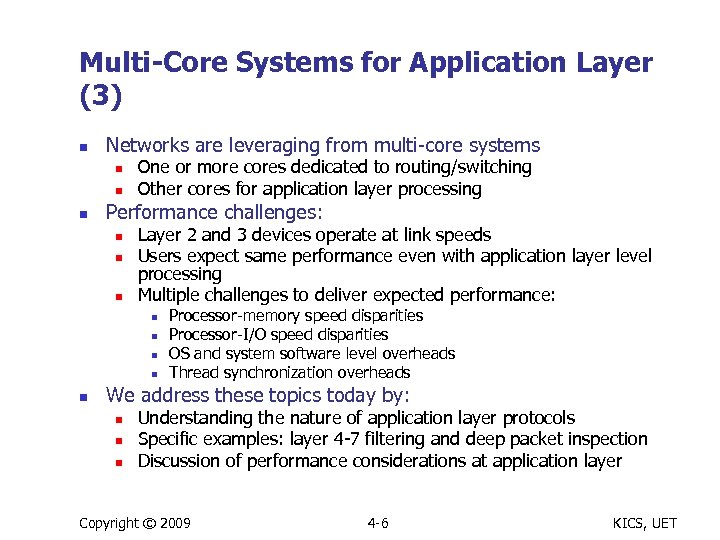
Multi-Core Systems for Application Layer (3) n Networks are leveraging from multi-core systems n n n One or more cores dedicated to routing/switching Other cores for application layer processing Performance challenges: n n n Layer 2 and 3 devices operate at link speeds Users expect same performance even with application layer level processing Multiple challenges to deliver expected performance: n n n Processor-memory speed disparities Processor-I/O speed disparities OS and system software level overheads Thread synchronization overheads We address these topics today by: n n n Understanding the nature of application layer protocols Specific examples: layer 4 -7 filtering and deep packet inspection Discussion of performance considerations at application layer Copyright © 2009 4 -6 KICS, UET
Application Layering Distributed Operating Systems By Andrew S. Tanenbaum
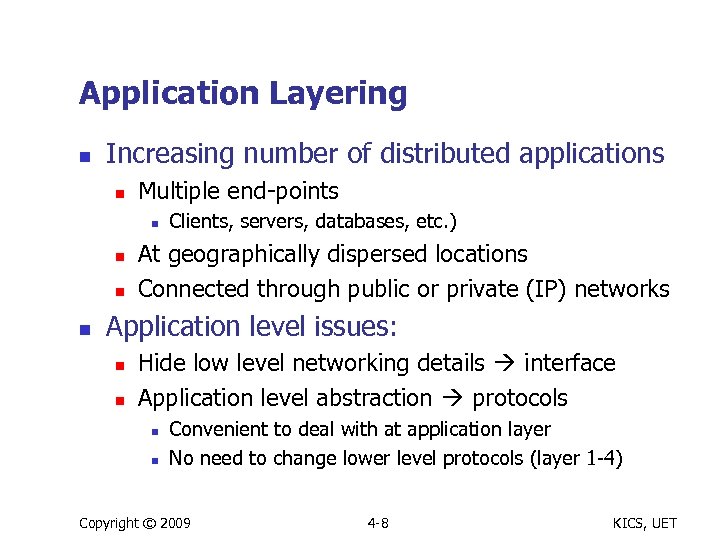
Application Layering n Increasing number of distributed applications n Multiple end-points n n Clients, servers, databases, etc. ) At geographically dispersed locations Connected through public or private (IP) networks Application level issues: n n Hide low level networking details interface Application level abstraction protocols n n Convenient to deal with at application layer No need to change lower level protocols (layer 1 -4) Copyright © 2009 4 -8 KICS, UET
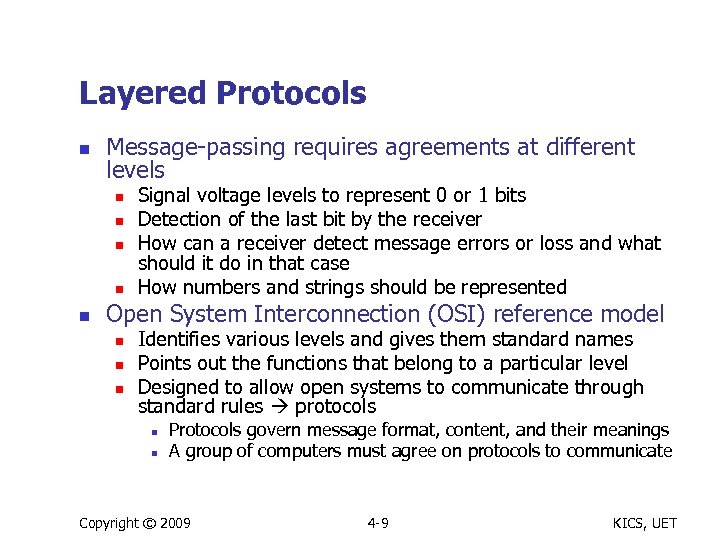
Layered Protocols n Message-passing requires agreements at different levels n n n Signal voltage levels to represent 0 or 1 bits Detection of the last bit by the receiver How can a receiver detect message errors or loss and what should it do in that case How numbers and strings should be represented Open System Interconnection (OSI) reference model n n n Identifies various levels and gives them standard names Points out the functions that belong to a particular level Designed to allow open systems to communicate through standard rules protocols n n Protocols govern message format, content, and their meanings A group of computers must agree on protocols to communicate Copyright © 2009 4 -9 KICS, UET
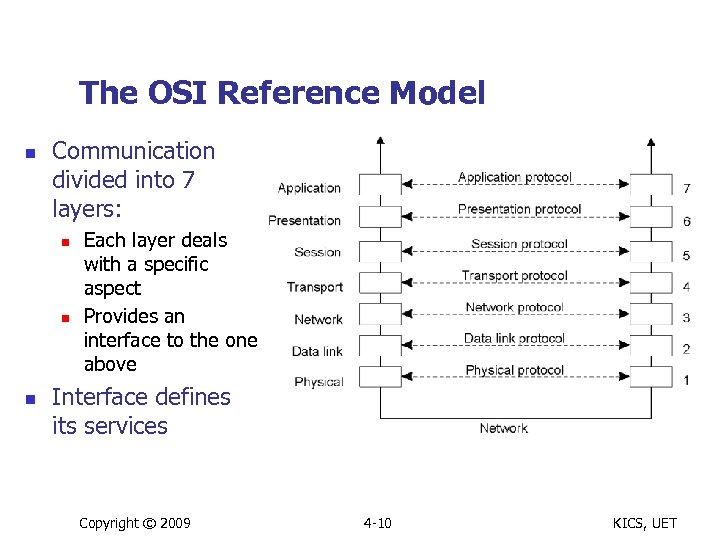
The OSI Reference Model n Communication divided into 7 layers: n n n Each layer deals with a specific aspect Provides an interface to the one above Interface defines its services Copyright © 2009 4 -10 KICS, UET
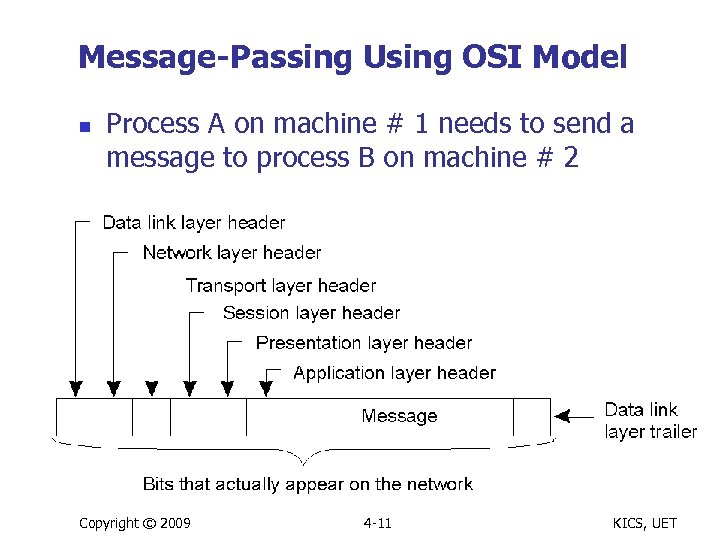
Message-Passing Using OSI Model n n Process A on machine # 1 needs to send a message to process B on machine # 2 Message is built up through layers before it goes to the network Copyright © 2009 4 -11 KICS, UET
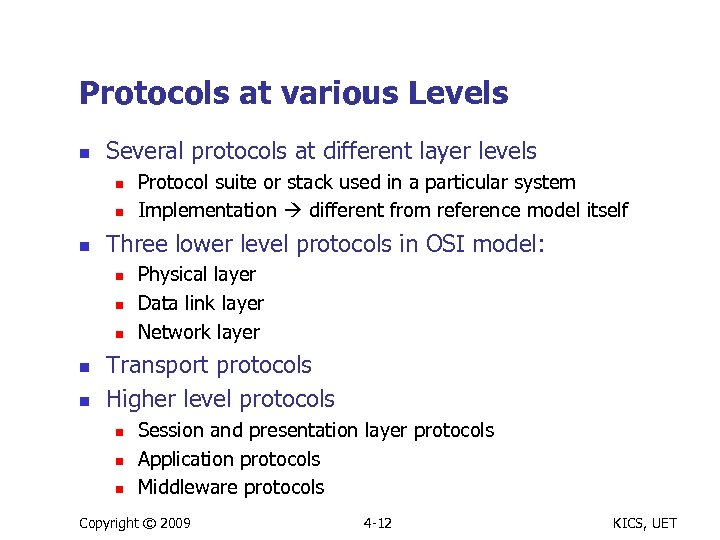
Protocols at various Levels n Several protocols at different layer levels n n n Three lower level protocols in OSI model: n n n Protocol suite or stack used in a particular system Implementation different from reference model itself Physical layer Data link layer Network layer Transport protocols Higher level protocols n n n Session and presentation layer protocols Application protocols Middleware protocols Copyright © 2009 4 -12 KICS, UET
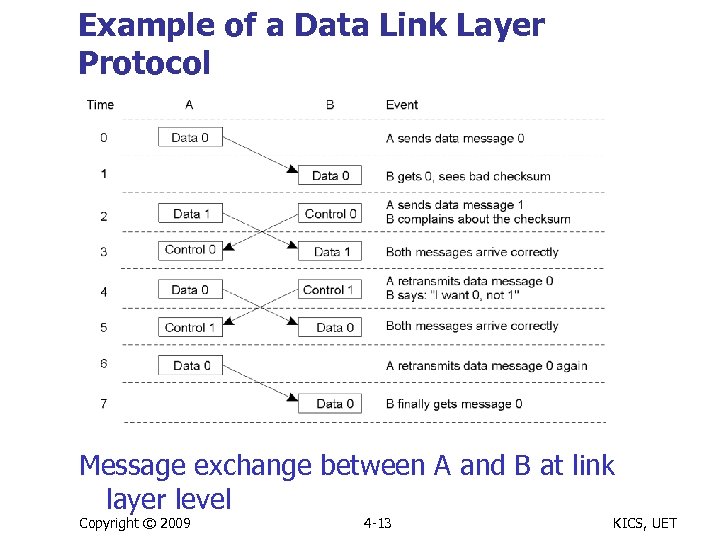
Example of a Data Link Layer Protocol Message exchange between A and B at link layer level Copyright © 2009 4 -13 KICS, UET
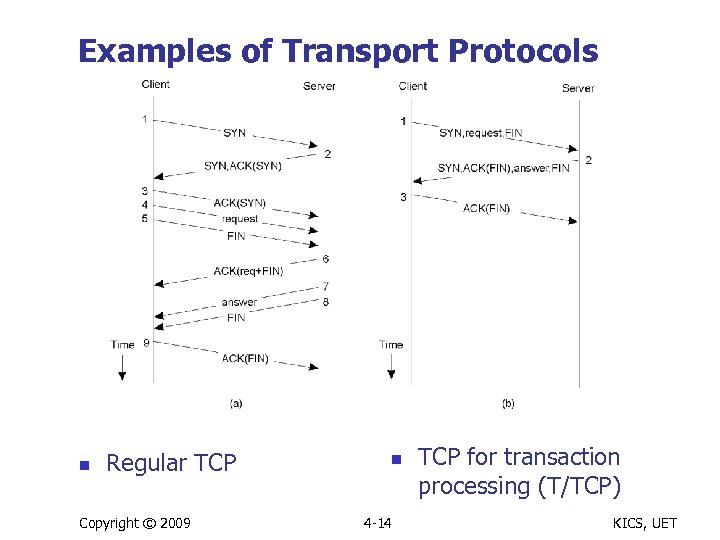
Examples of Transport Protocols n Regular TCP Copyright © 2009 n 4 -14 TCP for transaction processing (T/TCP) KICS, UET
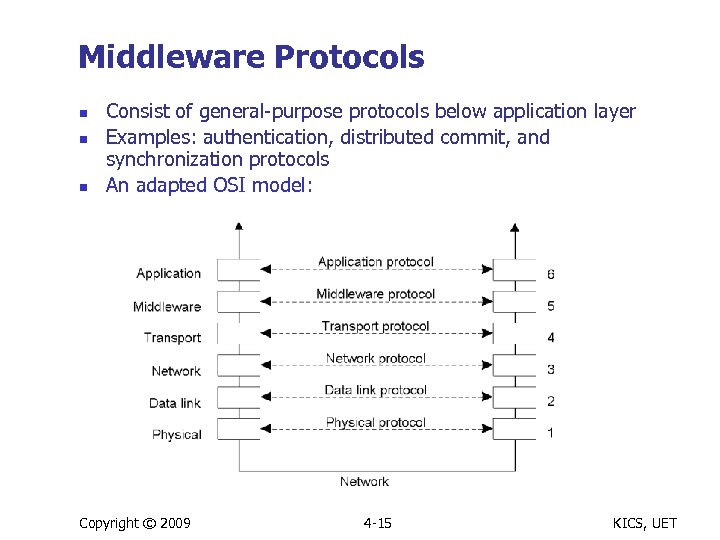
Middleware Protocols n n n Consist of general-purpose protocols below application layer Examples: authentication, distributed commit, and synchronization protocols An adapted OSI model: Copyright © 2009 4 -15 KICS, UET
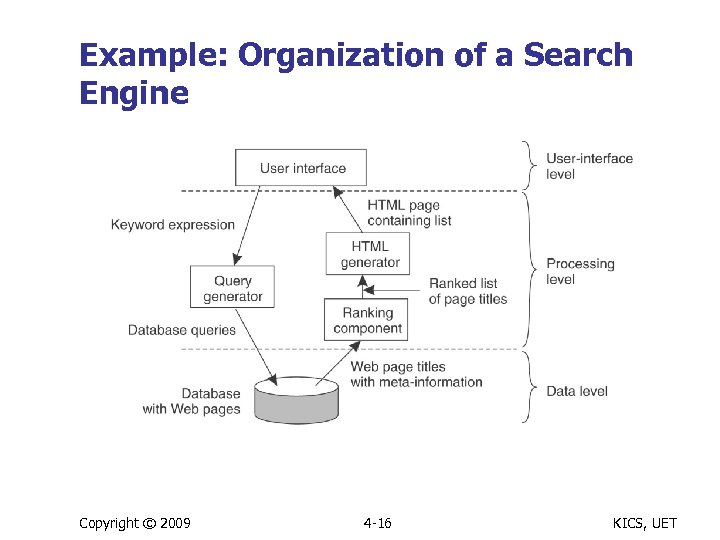
Example: Organization of a Search Engine Copyright © 2009 4 -16 KICS, UET
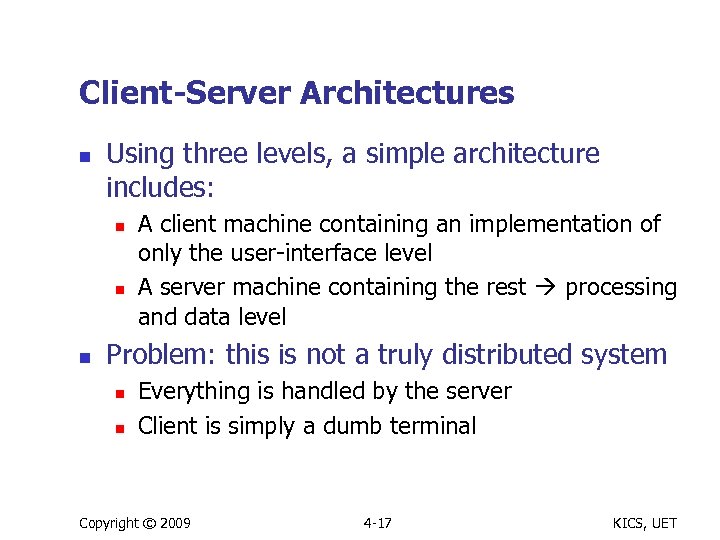
Client-Server Architectures n Using three levels, a simple architecture includes: n n n A client machine containing an implementation of only the user-interface level A server machine containing the rest processing and data level Problem: this is not a truly distributed system n n Everything is handled by the server Client is simply a dumb terminal Copyright © 2009 4 -17 KICS, UET
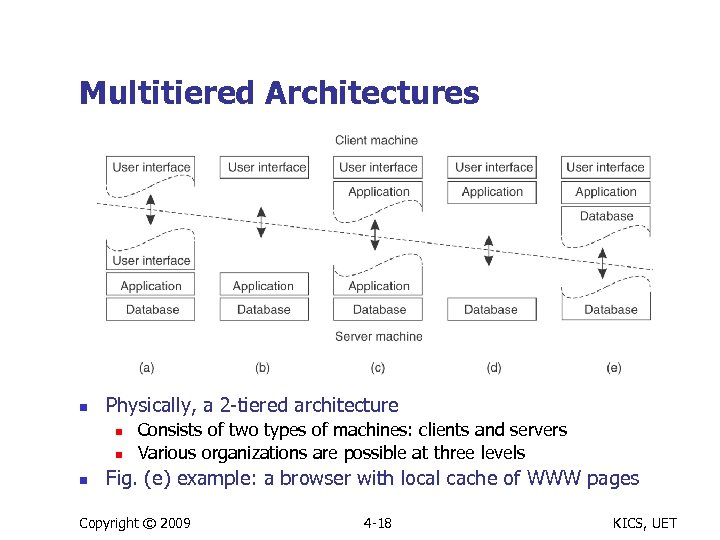
Multitiered Architectures n Physically, a 2 -tiered architecture n n n Consists of two types of machines: clients and servers Various organizations are possible at three levels Fig. (e) example: a browser with local cache of WWW pages Copyright © 2009 4 -18 KICS, UET
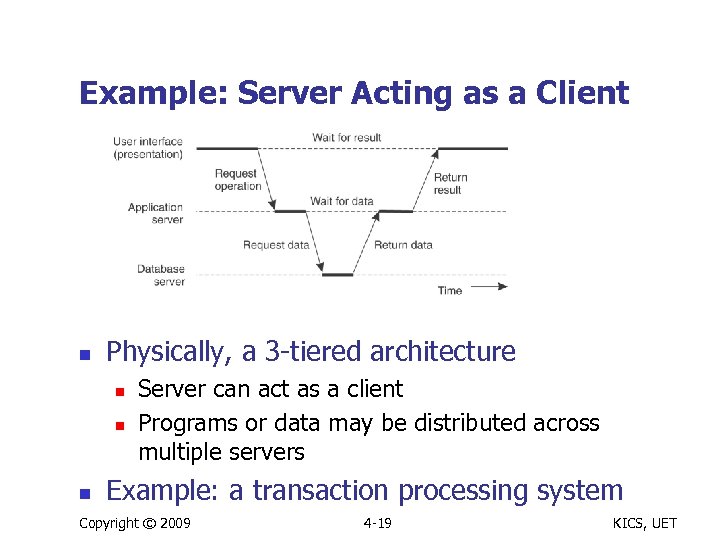
Example: Server Acting as a Client n Physically, a 3 -tiered architecture n n n Server can act as a client Programs or data may be distributed across multiple servers Example: a transaction processing system Copyright © 2009 4 -19 KICS, UET
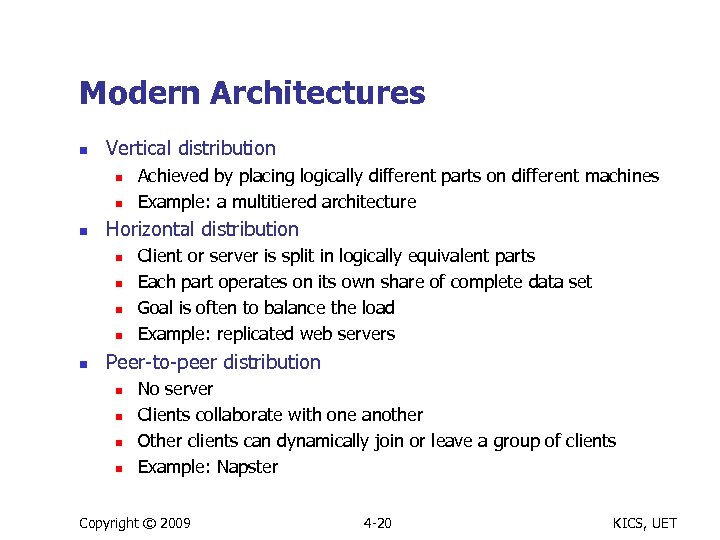
Modern Architectures n Vertical distribution n Horizontal distribution n n Achieved by placing logically different parts on different machines Example: a multitiered architecture Client or server is split in logically equivalent parts Each part operates on its own share of complete data set Goal is often to balance the load Example: replicated web servers Peer-to-peer distribution n n No server Clients collaborate with one another Other clients can dynamically join or leave a group of clients Example: Napster Copyright © 2009 4 -20 KICS, UET
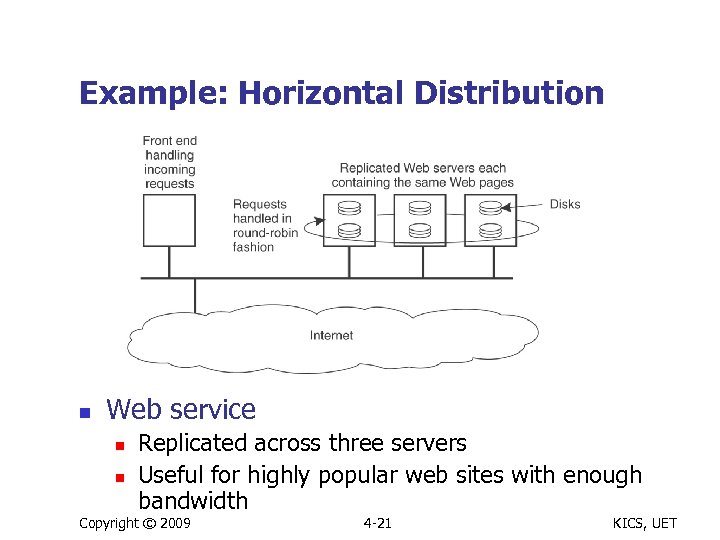
Example: Horizontal Distribution n Web service n n Replicated across three servers Useful for highly popular web sites with enough bandwidth Copyright © 2009 4 -21 KICS, UET
Layer 4 -7 Applications Examples and Multi-Core Platforms
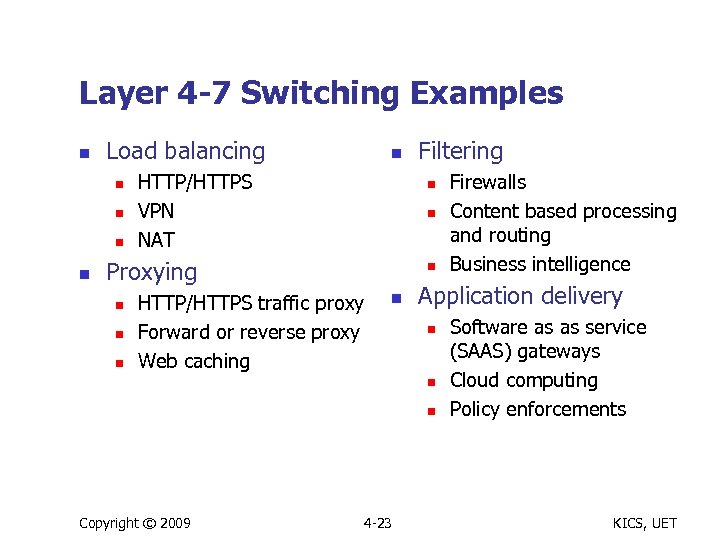
Layer 4 -7 Switching Examples n Load balancing n n n HTTP/HTTPS VPN NAT n n Proxying n n n Filtering n HTTP/HTTPS traffic proxy Forward or reverse proxy Web caching n Application delivery n n n Copyright © 2009 4 -23 Firewalls Content based processing and routing Business intelligence Software as as service (SAAS) gateways Cloud computing Policy enforcements KICS, UET
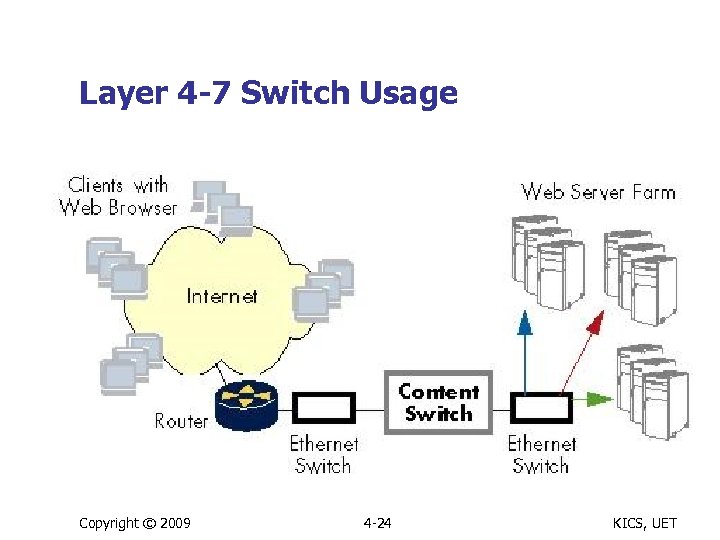
Layer 4 -7 Switch Usage Copyright © 2009 4 -24 KICS, UET
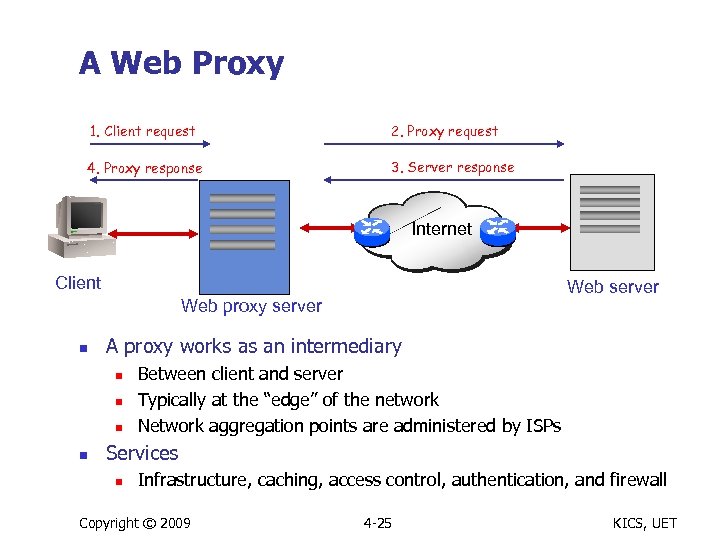
A Web Proxy 1. Client request 2. Proxy request 4. Proxy response 3. Server response Internet Client Web server Web proxy server n A proxy works as an intermediary n n Between client and server Typically at the “edge” of the network Network aggregation points are administered by ISPs Services n Infrastructure, caching, access control, authentication, and firewall Copyright © 2009 4 -25 KICS, UET
Caching Services n Caching is beneficial for entire web infrastructure n n n Types of transactions that can be cached n n n Upstream bandwidth saving Improved latency for the end user Content distribution to downstream users Less load on servers HTTP FTP Gopher NNTP Streaming media Proxy should be transparent for other types transactions n For example, SSL tunneling Copyright © 2009 4 -26 KICS, UET
Modes of Proxy Usage n Server vs. appliance n Proxy is a software application n n Proxy is a pre-packaged box n n Explicit: user explicitly points the browser to a proxy n n Example: ITC proxy Transparent: user is unaware of the proxy n Example: WCCP, L-4 switches, WPAD (Web Proxy Auto Discovery), and others Forward vs. reverse n n n Examples: Cisco, Cache. Flow, and Network Appliances caching products Explicit vs. transparent n n Examples: Microsoft Proxy, Inktomi Traffic Server, and Squid Forward: used for bandwidth saving at aggregation points Reverse: used as a server accelerator Single vs. hierarchical (chained) vs. cluster (array) configurations n n Distributed caching Load balancing Copyright © 2009 4 -27 KICS, UET
Platforms for Layer 4 -7: Multi-Core n Requirements for layer 4 -7 devices: n n Suitable processor for a spectrum of applications Efficient memory hierarchy Efficient I/O and networking support A flexible operating environment n n A generic OS (typically POSIX compliant) System level support for development and maintenance High throughput to match user expectations Multi-core systems are the choice n n n Technology and price-performance dictates it OS and system software support Multi-threading to achieve high application performance Copyright © 2009 4 -28 KICS, UET
Deep Packet Inspection T. Lam et al. , “XML Document Parsing: Operational and Performance Characteristics, ” IEEE Computer, Sept. , 2008
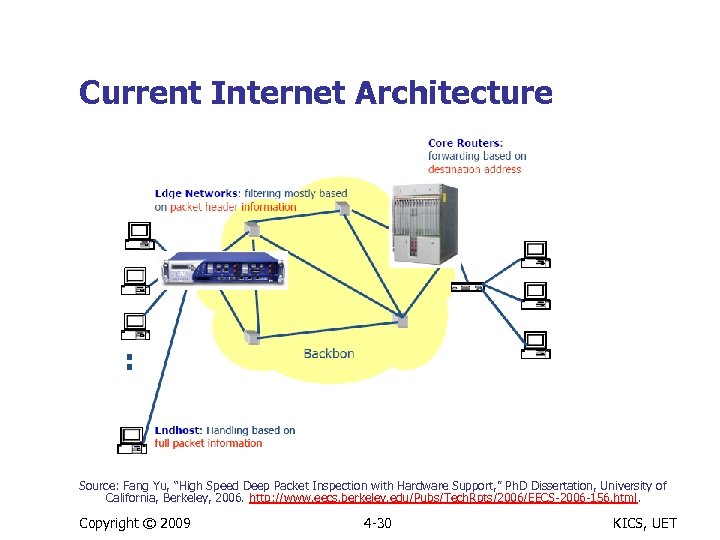
Current Internet Architecture Source: Fang Yu, “High Speed Deep Packet Inspection with Hardware Support, ” Ph. D Dissertation, University of California, Berkeley, 2006. http: //www. eecs. berkeley. edu/Pubs/Tech. Rpts/2006/EECS-2006 -156. html. Copyright © 2009 4 -30 KICS, UET
Characteristics of Internet Architecture n Internet core n n Limited to packet routing and switching Typically, little or no “intelligence” involved Use only packet header information Network edges n n n Perform application level functions Increasing “intelligence” at edges and hosts Involves processing packet header as well as content deep packet inspection n n One or more packets Stateless or state-ful Copyright © 2009 4 -31 KICS, UET
Deep Packet Inspection (DPI) n n Unlike traditional packet inspection, DPI checks the complete payload instead of just the packet header(5 -tuple) to make the decision. When protocol ID is hidden, DPI is required to find out protocol information in the packet payload based on predefined protocol features. Copyright © 2009 4 -32 KICS, UET
DPI—Classification and Matching n Packet classification depends on: n n n DPI applications n n n Inspecting header layer 2 -4 protocols Inspecting pay load layer 7 protocols DPI Detect virus, spam, etc. Network intrusion detection Network montoring Load balancing DPI is all about comparing content against a set of specified patterns Copyright © 2009 2007 4 -33 33 KICS, UET
Example DPI Applications n Stopping worms from spreading n n n Current schemes rely on end-host anti-virus software and are not very effective DPI allows content checking at network edges Content based routing n n n Identifying HTML traffic for a web server Directing XML traffic to an application server Balancing load Copyright © 2009 4 -34 KICS, UET
Representing a Pattern n An explicit text string n n n A regular expression n n Represents what we are looking for One string can represent only one pattern Replacing strings for regular text searching Enhance the expressive power of a pattern More flexible and widely understood Other possibilities e. g. , Xpath n Standard language for matching in XML content Copyright © 2009 2007 4 -35 35 KICS, UET
Complexities with DPI n Patterns are pre-defined keywords or strings n n n Explicit strings Regular expressions Patterns related requirements: n n n Match multiple patterns Simultaneously or in specified sequence For wide variety of attacks One packet to be matched against 1000’s of signatures Example: SNORT has more than 4000 signatures Copyright © 2009 2007 4 -36 36 KICS, UET
Complexities with DPI (2) n Keywords complexities: n n n Performance challenge: n n n Can be of any length Can be anywhere in the payload of a packet Match at line speed Continuously increasing: 10, 100, 1, 000, 10, 000 Mbps Flexibility to accommodate new patterns Copyright © 2009 4 -37 KICS, UET
XML Pattern Matching n XML is widely used at application layer n n n Stages for XML processing: n n n Extensible Markup Language De facto standard for Internet document format Parsing Access Modification Serialization Parsing is the most expensive operation Copyright © 2009 4 -38 KICS, UET
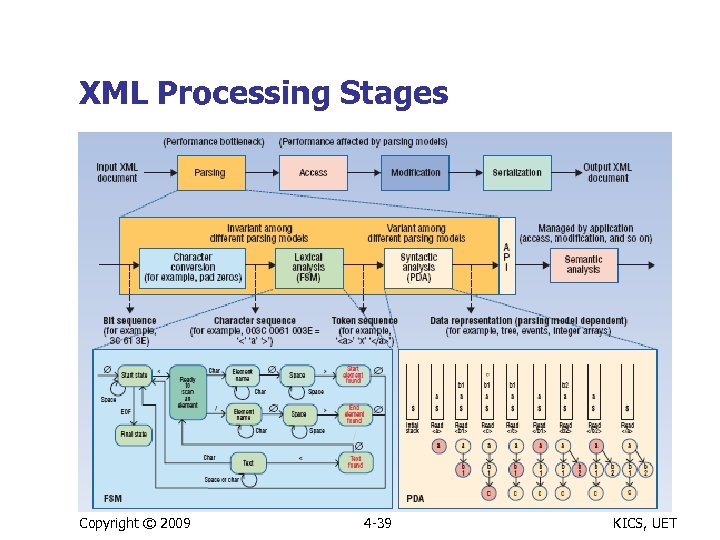
XML Processing Stages Copyright © 2009 4 -39 KICS, UET
DPI Case Study: A Layer 7 Filter n Linux L 7 filter: n n An extension to Netfilter Classify packets in connection D. Guo et al. “A Scalable Multithreaded L 7 -filter Design for Multi-Core Servers, ” ANCS ’ 08, 2008 Multi-core architecture n Multi-core architecture duplicates hardware resources such as ALU, L 1 cache, etc. on the same die, and hence allows multiple processes to run concurrently on different cores. Copyright © 2009 4 -40 KICS, UET
Implementation Details n Offline model n n Connection level parallelism n n Well-controlled research environment Faster processing Better cache performance Connection-based affinity for multi-core scalability Direct mapping in VM n Transplant native optimization to VM Copyright © 2009 4 -41 KICS, UET
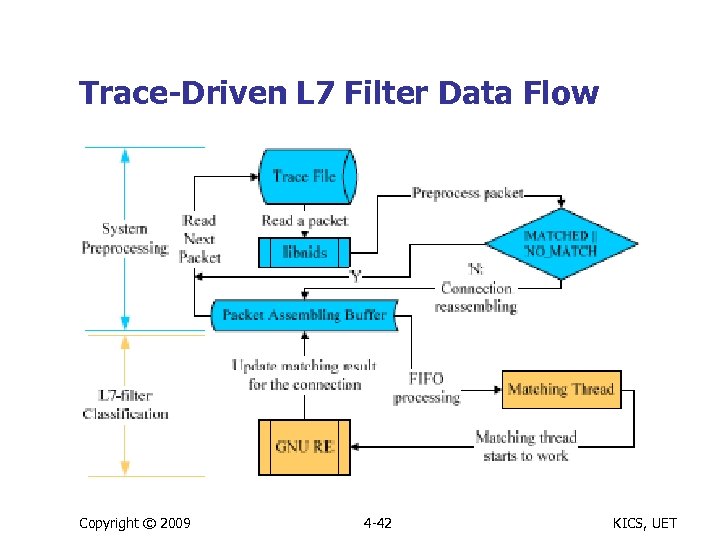
Trace-Driven L 7 Filter Data Flow Copyright © 2009 4 -42 KICS, UET
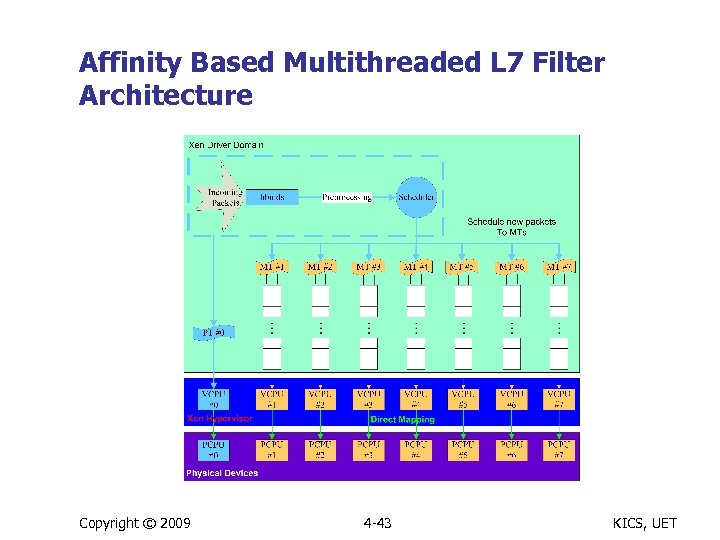
Affinity Based Multithreaded L 7 Filter Architecture Copyright © 2009 4 -43 KICS, UET
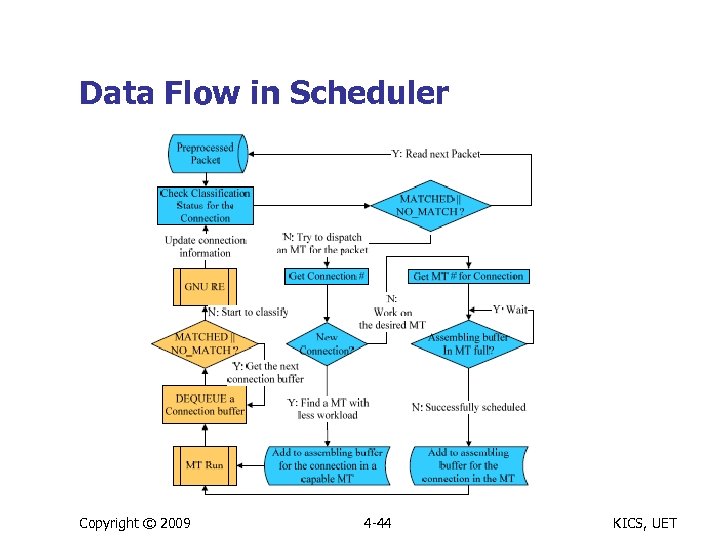
Data Flow in Scheduler Copyright © 2009 4 -44 KICS, UET
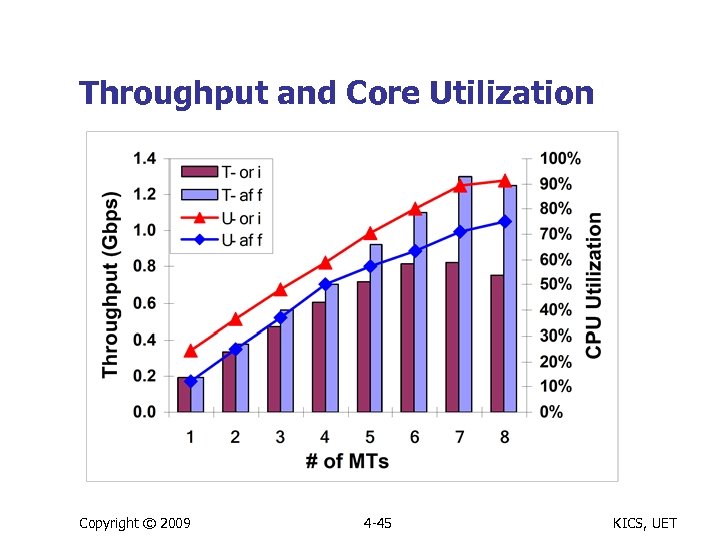
Throughput and Core Utilization Copyright © 2009 4 -45 KICS, UET
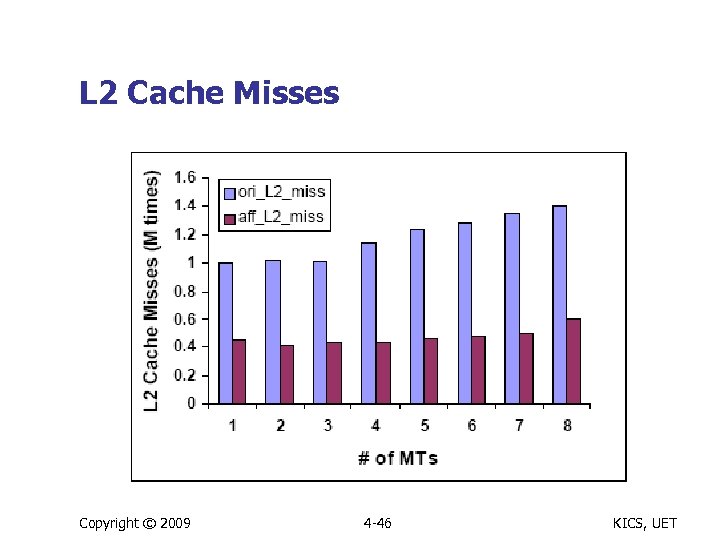
L 2 Cache Misses Copyright © 2009 4 -46 KICS, UET
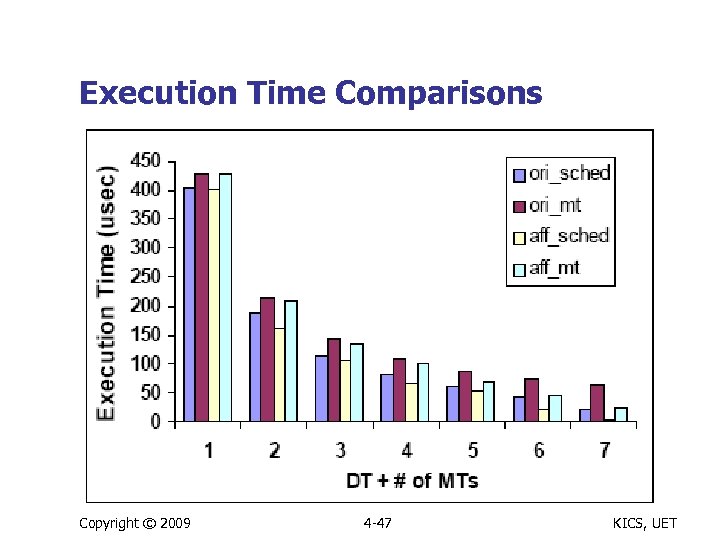
Execution Time Comparisons Copyright © 2009 4 -47 KICS, UET
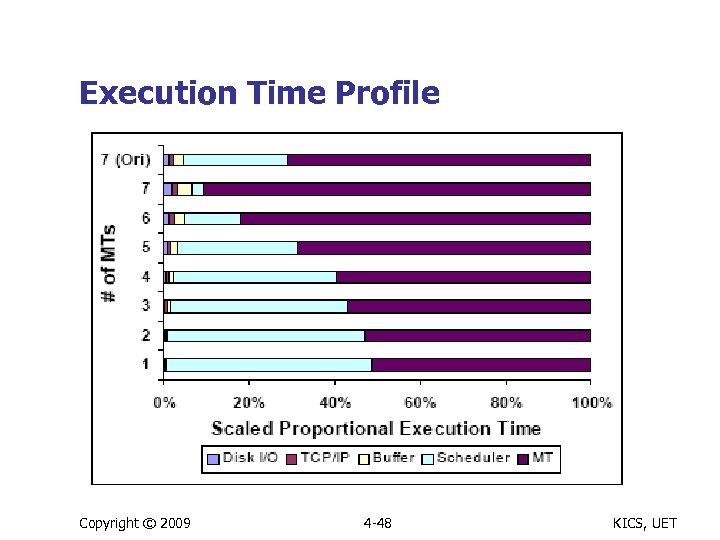
Execution Time Profile Copyright © 2009 4 -48 KICS, UET
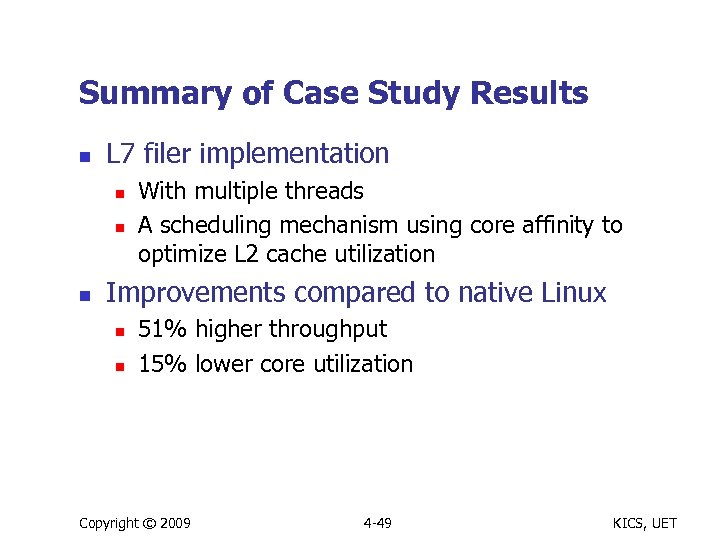
Summary of Case Study Results n L 7 filer implementation n With multiple threads A scheduling mechanism using core affinity to optimize L 2 cache utilization Improvements compared to native Linux n n 51% higher throughput 15% lower core utilization Copyright © 2009 4 -49 KICS, UET

Performance Consideration Case Studies
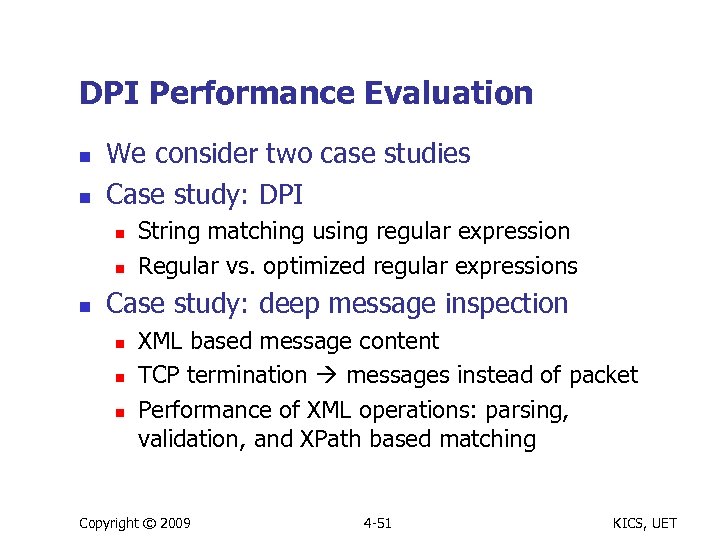
DPI Performance Evaluation n n We consider two case studies Case study: DPI n n n String matching using regular expression Regular vs. optimized regular expressions Case study: deep message inspection n XML based message content TCP termination messages instead of packet Performance of XML operations: parsing, validation, and XPath based matching Copyright © 2009 4 -51 KICS, UET

Case Stdy: Efficient Regular Expression Matching for Deep Packet Inspection Fang Yu et al. , ANCS ’ 06, 2006
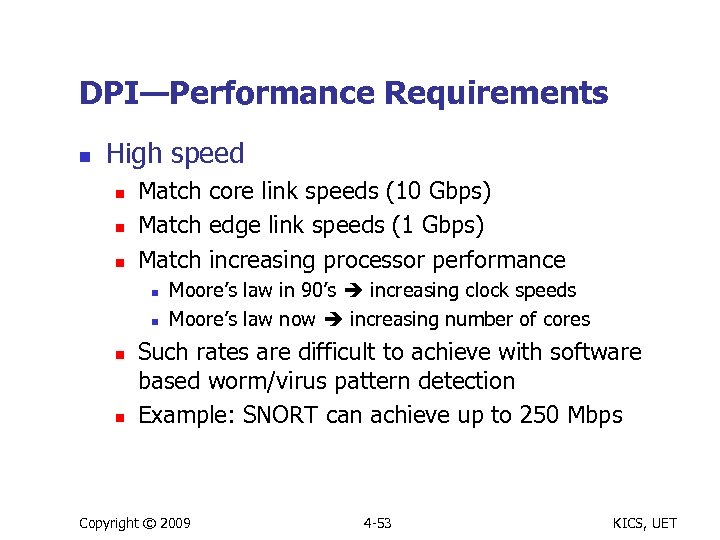
DPI—Performance Requirements n High speed n n n Match core link speeds (10 Gbps) Match edge link speeds (1 Gbps) Match increasing processor performance n n Moore’s law in 90’s increasing clock speeds Moore’s law now increasing number of cores Such rates are difficult to achieve with software based worm/virus pattern detection Example: SNORT can achieve up to 250 Mbps Copyright © 2009 4 -53 KICS, UET
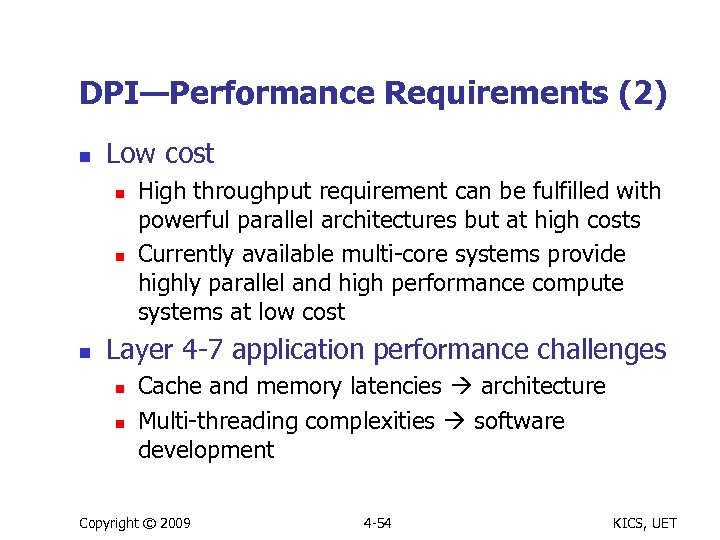
DPI—Performance Requirements (2) n Low cost n n n High throughput requirement can be fulfilled with powerful parallel architectures but at high costs Currently available multi-core systems provide highly parallel and high performance compute systems at low cost Layer 4 -7 application performance challenges n n Cache and memory latencies architecture Multi-threading complexities software development Copyright © 2009 4 -54 KICS, UET
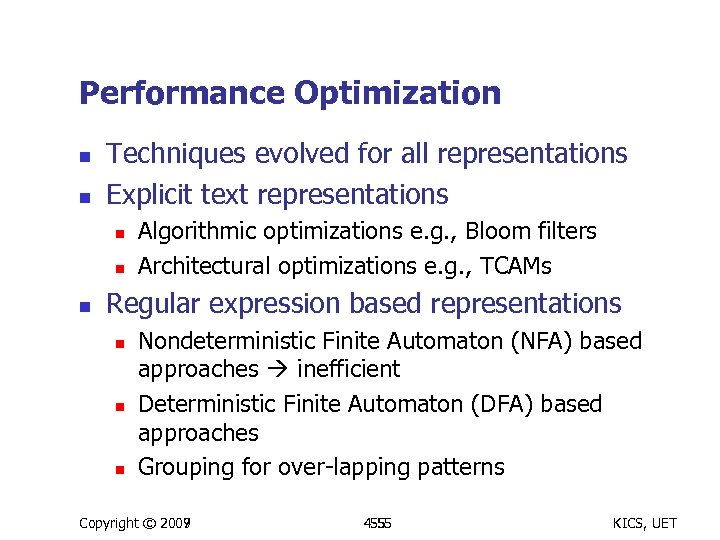
Performance Optimization n n Techniques evolved for all representations Explicit text representations n n n Algorithmic optimizations e. g. , Bloom filters Architectural optimizations e. g. , TCAMs Regular expression based representations n n n Nondeterministic Finite Automaton (NFA) based approaches inefficient Deterministic Finite Automaton (DFA) based approaches Grouping for over-lapping patterns Copyright © 2009 2007 4 -55 55 KICS, UET
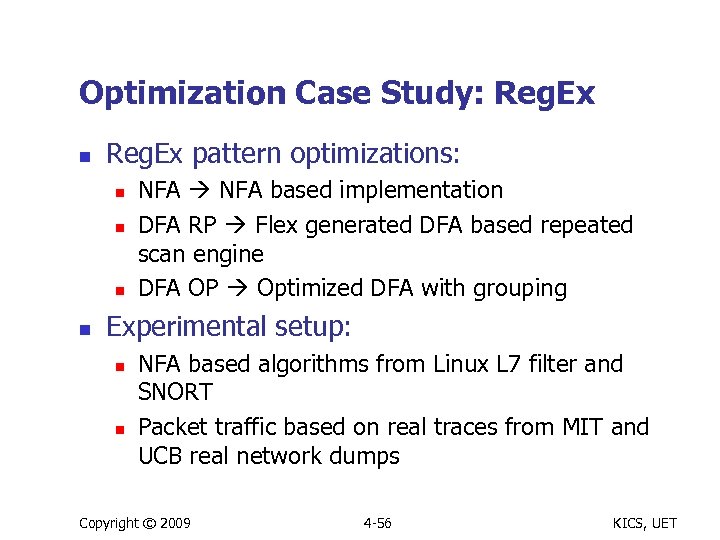
Optimization Case Study: Reg. Ex n Reg. Ex pattern optimizations: n n NFA based implementation DFA RP Flex generated DFA based repeated scan engine DFA OP Optimized DFA with grouping Experimental setup: n n NFA based algorithms from Linux L 7 filter and SNORT Packet traffic based on real traces from MIT and UCB real network dumps Copyright © 2009 4 -56 KICS, UET
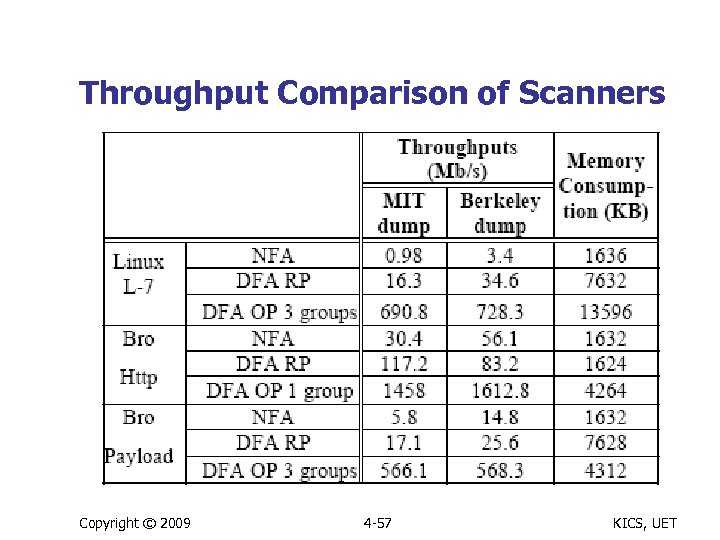
Throughput Comparison of Scanners Copyright © 2009 4 -57 KICS, UET
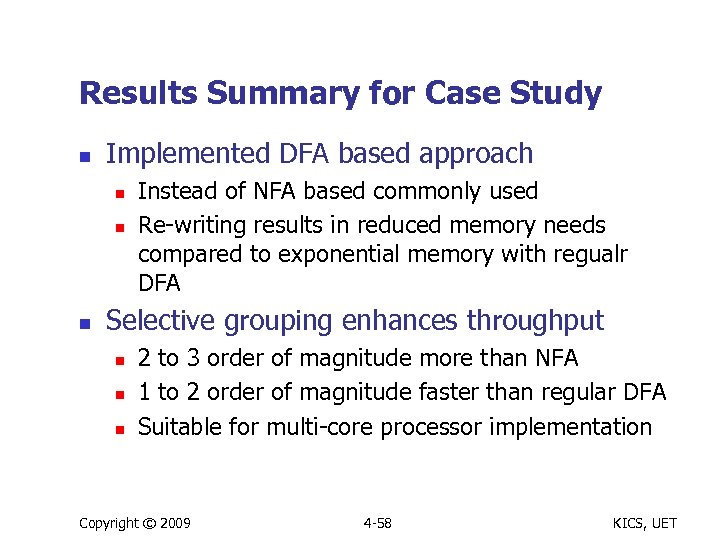
Results Summary for Case Study n Implemented DFA based approach n n n Instead of NFA based commonly used Re-writing results in reduced memory needs compared to exponential memory with regualr DFA Selective grouping enhances throughput n n n 2 to 3 order of magnitude more than NFA 1 to 2 order of magnitude faster than regular DFA Suitable for multi-core processor implementation Copyright © 2009 4 -58 KICS, UET
Case Study: Benchmarking XML Based Application Oriented Network Infrastructure and Services Abdul Waheed and Jason Ding SAINT ’ 07 January 18, 2007
Outline n Application oriented networking n n n Benchmarking n n n AON benchmarking requirements State of application services benchmarks AONBench n n Application services in network infrastructure Role of XML for AON Methodology Specifications Case studies of using AONBench Conclusions Copyright © 2009 4 -60 KICS, UET
Application Oriented Networking (AON) n Increasing “intelligence” in the network n n AON provides application awareness in the network n n n Beyond switching, routing, and traffic engineering functions Traditionally, complex functions left to end hosts Cost-effective processing capabilities enable increasing complex functions within the network Provides value added functions in network infrastructure Adds value to a vast array of enterprise applications Examples: n n n Network edge devices for caching, filtering, and security Protocol translation for integration at enterprise level Network policing and monitoring conformance to SLAs Copyright © 2009 4 -61 KICS, UET
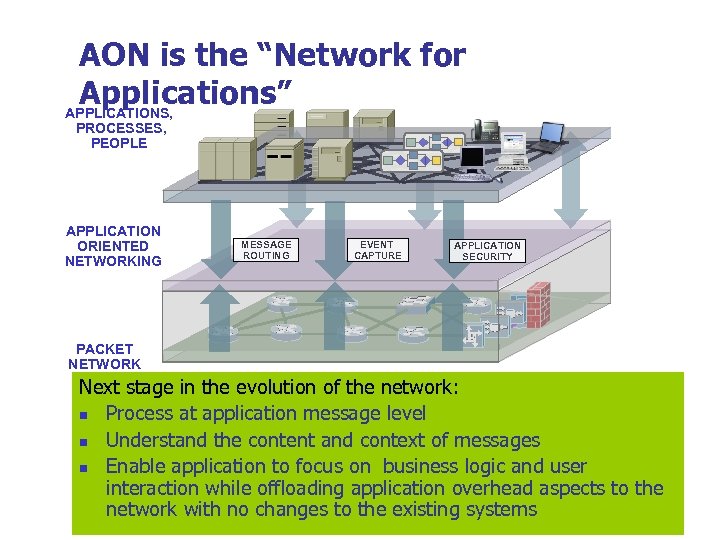
AON is the “Network for Applications” APPLICATIONS, PROCESSES, PEOPLE APPLICATION ORIENTED NETWORKING MESSAGE ROUTING EVENT CAPTURE APPLICATION SECURITY PACKET NETWORK Next stage in the evolution of the network: n Process at application message level n Understand the content and context of messages n Enable application to focus on business logic and user interaction while offloading application overhead aspects to the network with no changes to the existing systems Copyright © 2009 4 -62 KICS, UET
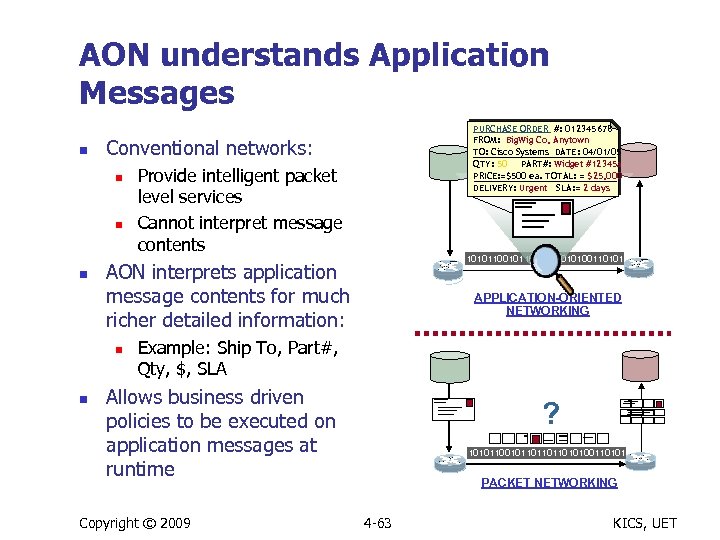
AON understands Application Messages n Conventional networks: n n n Provide intelligent packet level services Cannot interpret message contents 101011011011010100110101 AON interprets application message contents for much richer detailed information: n n PURCHASE ORDER #: 012345678 FROM: Big. Wig Co, Anytown TO: Cisco Systems DATE: 04/01/05 QTY: 50 PART#: Widget #12345 a PRICE: =$500 ea. TOTAL: = $25, 000 DELIVERY: Urgent SLA: = 2 days APPLICATION-ORIENTED NETWORKING Example: Ship To, Part#, Qty, $, SLA Allows business driven policies to be executed on application messages at runtime Copyright © 2009 ? 101011011011010100110101 PACKET NETWORKING 4 -63 KICS, UET
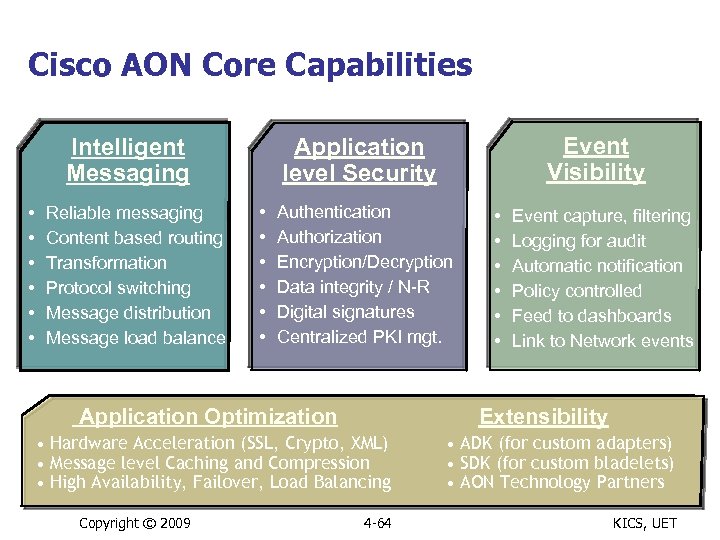
Cisco AON Core Capabilities • • • Reliable messaging Content based routing Transformation Protocol switching Message distribution Message load balance • • • Authentication Authorization Encryption/Decryption Data integrity / N-R Digital signatures Centralized PKI mgt. Application Optimization • • • Event capture, filtering Logging for audit Automatic notification Policy controlled Feed to dashboards Link to Network events Extensibility • Hardware Acceleration (SSL, Crypto, XML) • Message level Caching and Compression • High Availability, Failover, Load Balancing Copyright © 2009 Event Visibility Application level Security Intelligent Messaging 4 -64 • ADK (for custom adapters) • SDK (for custom bladelets) • AON Technology Partners KICS, UET
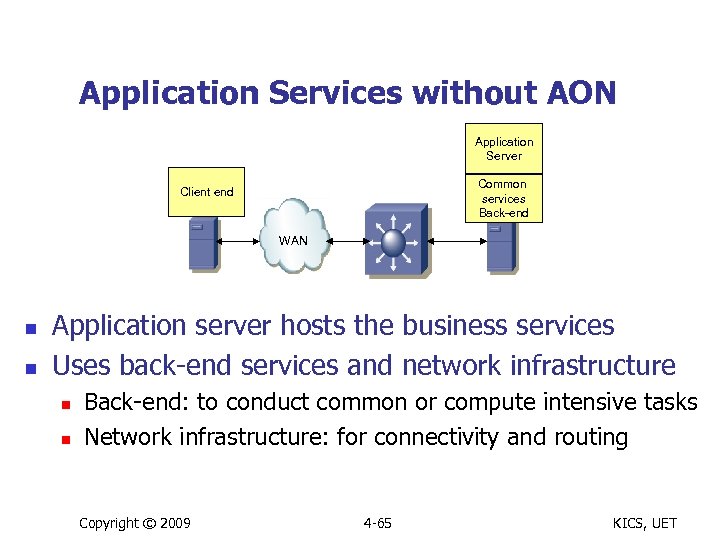
Application Services without AON Application Server Common services Back-end Client end WAN n n Application server hosts the business services Uses back-end services and network infrastructure n n Back-end: to conduct common or compute intensive tasks Network infrastructure: for connectivity and routing Copyright © 2009 4 -65 KICS, UET
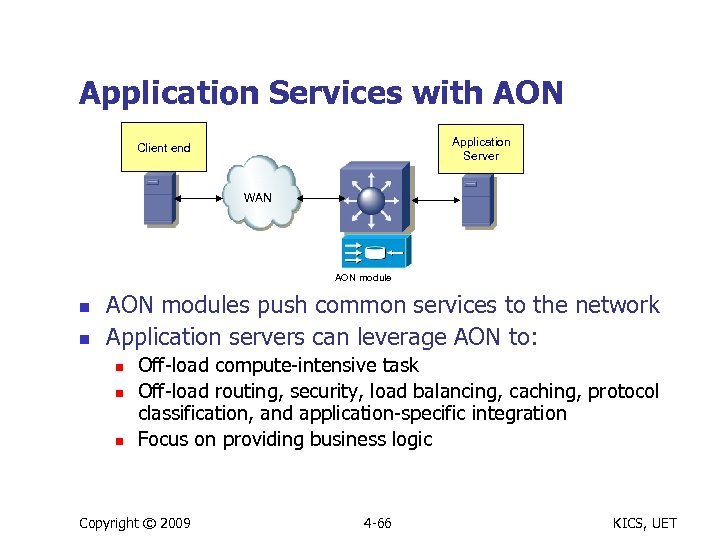
Application Services with AON Application Server Client end WAN AON module n n AON modules push common services to the network Application servers can leverage AON to: n n n Off-load compute-intensive task Off-load routing, security, load balancing, caching, protocol classification, and application-specific integration Focus on providing business logic Copyright © 2009 4 -66 KICS, UET
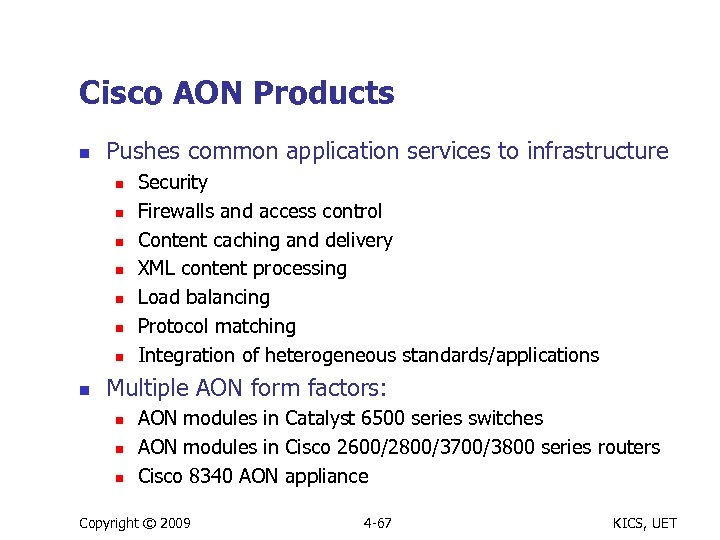
Cisco AON Products n Pushes common application services to infrastructure n n n n Security Firewalls and access control Content caching and delivery XML content processing Load balancing Protocol matching Integration of heterogeneous standards/applications Multiple AON form factors: n n n AON modules in Catalyst 6500 series switches AON modules in Cisco 2600/2800/3700/3800 series routers Cisco 8340 AON appliance Copyright © 2009 4 -67 KICS, UET
Role of XML for AON n XML is becoming ubiquitous for network applications n n n XML features n n Similar to IP, which is ubiquitous for packet routing Application message content is increasingly XML Self defining, extensible format Convenient to parse, validate, and transform Suitable for integrating multiple services in enterprise networks Performance is a challenge n n n Different from stateless packet (header) processing XML processing and security are compute-intensive Benchmarking is needed as AON awareness grows Copyright © 2009 4 -68 KICS, UET
Requirements for an AON Benchmark n Benchmark should be vendor-neutral n n n It should be open n n Need a level playing field for everyone Should focus on services rather than specific products Open in terms of specifications Also, open source tools User should be able to employ their own choice of tools Benchmarks should exercise n n Networking/web services and XML Content processing services, such as parsing, pattern matching, validation, transformation, and security Copyright © 2009 4 -69 KICS, UET
State of Application Services Benchmarks n Two distinct classes of benchmarks: WWW and XML n n n Available benchmarks lack all requirements: n n Web services benchmarks XML microbenchmarks XML storage management benchmarks XML security benchmarks Benchmark either web services or XML processing Product-specific benchmarks Commercial tools that are not open benchmarks or specification for benchmarking Our approach: n n Provide open specifications for benchmarking Leave tool development/selection to the evaluator Copyright © 2009 4 -70 KICS, UET

AONBench n AONBench is not a benchmarking tools n n n Methodology n n Setup needed for measurements Setup for service request and response Criteria for XML functional success and failure Specifications n n n Consists of two parts: methodology and specifications Tool development or selection is left to the evaluator Application services based use cases XML messages with schemas and style sheets We do have two realizations of AONBench n n Using public domain tools Using custom tools Copyright © 2009 4 -71 KICS, UET
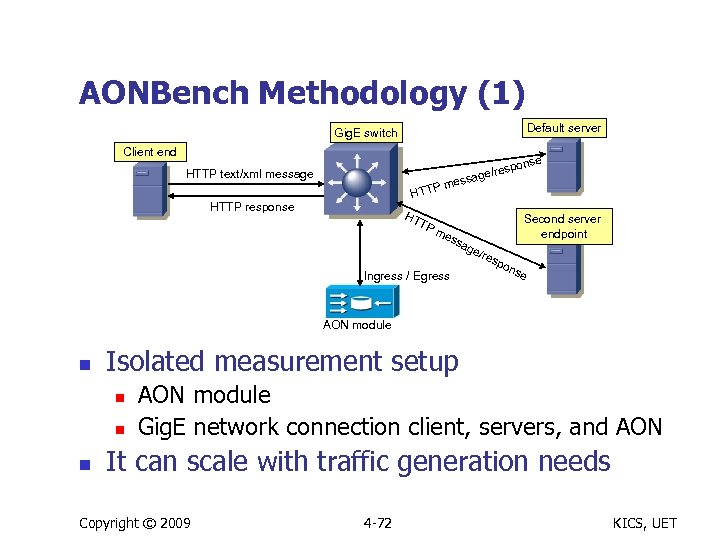
AONBench Methodology (1) Default server Gig. E switch Client end se spon ge/re ssa HTTP text/xml message me P HTTP response HT TP m ess Ingress / Egress ag Second server endpoint e/r esp on se AON module n Isolated measurement setup n n n AON module Gig. E network connection client, servers, and AON It can scale with traffic generation needs Copyright © 2009 4 -72 KICS, UET
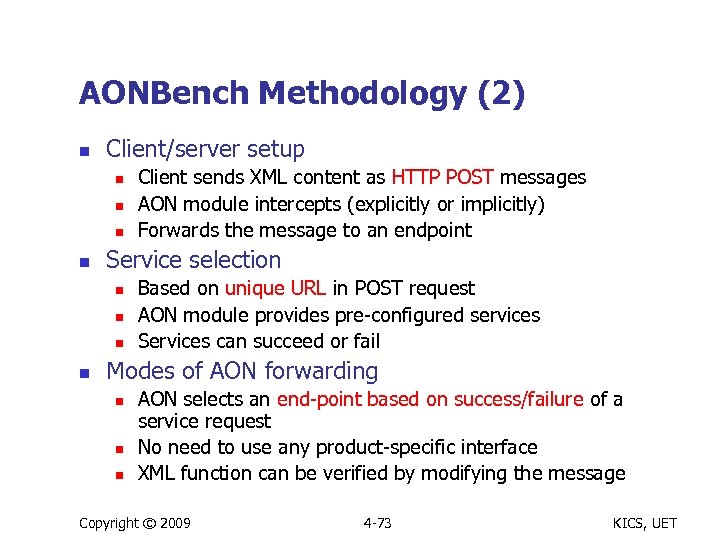
AONBench Methodology (2) n Client/server setup n n Service selection n n Client sends XML content as HTTP POST messages AON module intercepts (explicitly or implicitly) Forwards the message to an endpoint Based on unique URL in POST request AON module provides pre-configured services Services can succeed or fail Modes of AON forwarding n n n AON selects an end-point based on success/failure of a service request No need to use any product-specific interface XML function can be verified by modifying the message Copyright © 2009 4 -73 KICS, UET
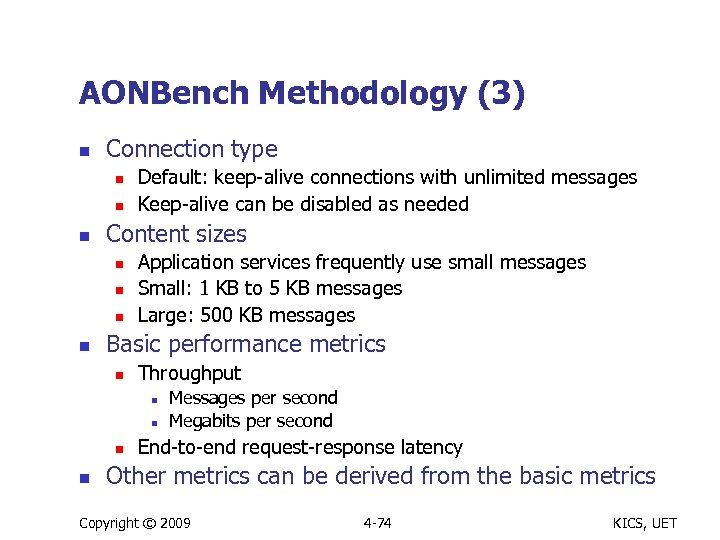
AONBench Methodology (3) n Connection type n n n Content sizes n n Default: keep-alive connections with unlimited messages Keep-alive can be disabled as needed Application services frequently use small messages Small: 1 KB to 5 KB messages Large: 500 KB messages Basic performance metrics n Throughput n n Messages per second Megabits per second End-to-end request-response latency Other metrics can be derived from the basic metrics Copyright © 2009 4 -74 KICS, UET
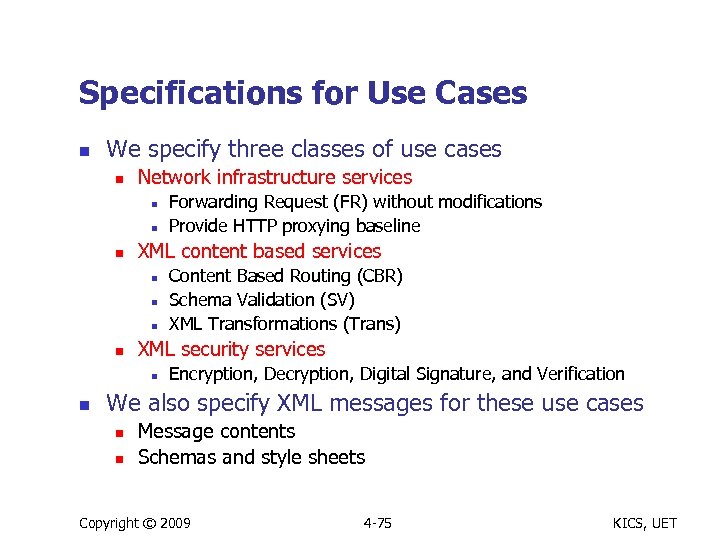
Specifications for Use Cases n We specify three classes of use cases n Network infrastructure services n n n XML content based services n n Content Based Routing (CBR) Schema Validation (SV) XML Transformations (Trans) XML security services n n Forwarding Request (FR) without modifications Provide HTTP proxying baseline Encryption, Decryption, Digital Signature, and Verification We also specify XML messages for these use cases n n Message contents Schemas and style sheets Copyright © 2009 4 -75 KICS, UET
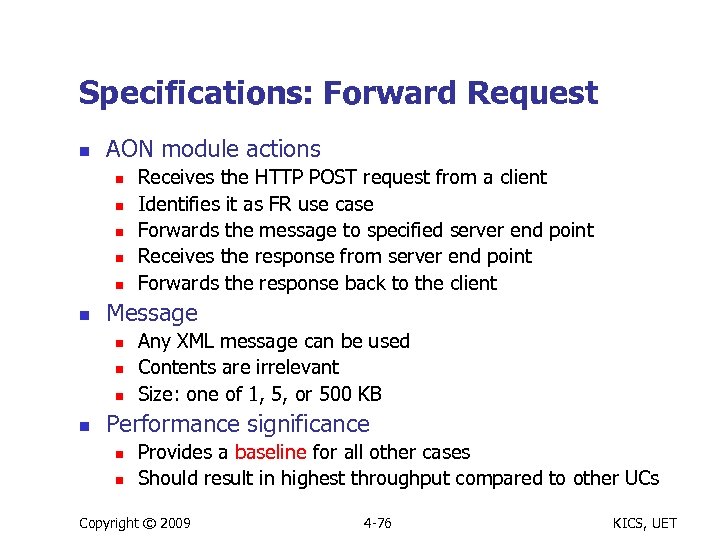
Specifications: Forward Request n AON module actions n n n Message n n Receives the HTTP POST request from a client Identifies it as FR use case Forwards the message to specified server end point Receives the response from server end point Forwards the response back to the client Any XML message can be used Contents are irrelevant Size: one of 1, 5, or 500 KB Performance significance n n Provides a baseline for all other cases Should result in highest throughput compared to other UCs Copyright © 2009 4 -76 KICS, UET
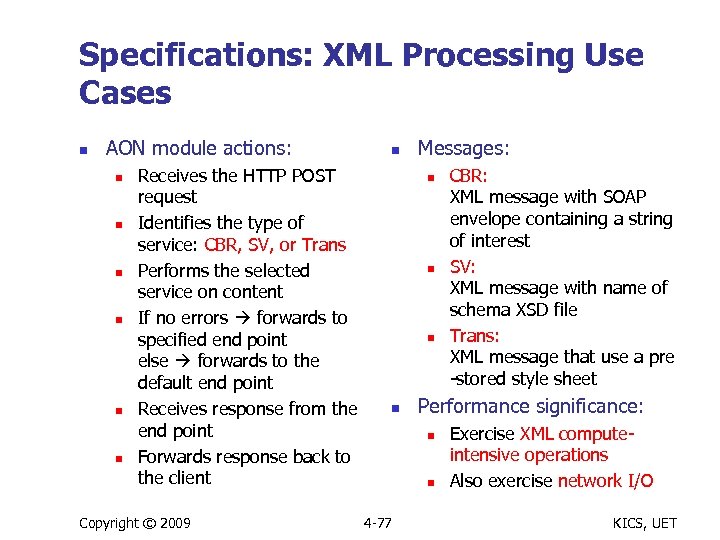
Specifications: XML Processing Use Cases n AON module actions: n n n Receives the HTTP POST request Identifies the type of service: CBR, SV, or Trans Performs the selected service on content If no errors forwards to specified end point else forwards to the default end point Receives response from the end point Forwards response back to the client Copyright © 2009 n Messages: n n Performance significance: n n 4 -77 CBR: XML message with SOAP envelope containing a string of interest SV: XML message with name of schema XSD file Trans: XML message that use a pre -stored style sheet Exercise XML computeintensive operations Also exercise network I/O KICS, UET
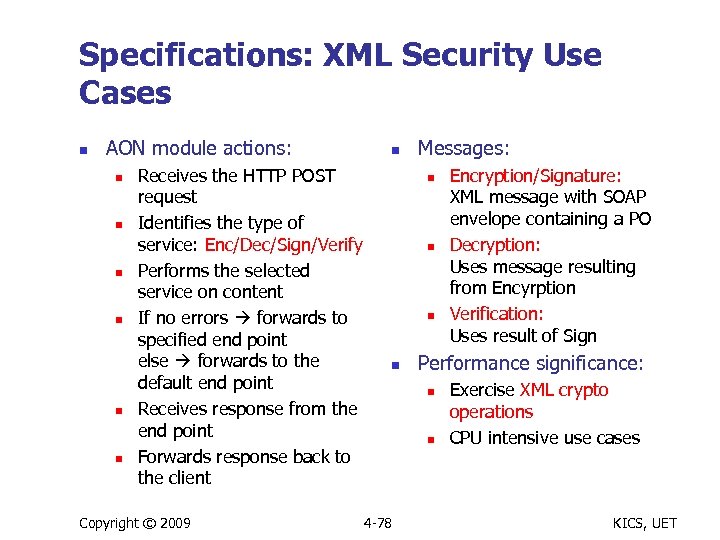
Specifications: XML Security Use Cases n AON module actions: n n n Receives the HTTP POST request Identifies the type of service: Enc/Dec/Sign/Verify Performs the selected service on content If no errors forwards to specified end point else forwards to the default end point Receives response from the end point Forwards response back to the client Copyright © 2009 n Messages: n n Performance significance: n n 4 -78 Encryption/Signature: XML message with SOAP envelope containing a PO Decryption: Uses message resulting from Encyrption Verification: Uses result of Sign Exercise XML crypto operations CPU intensive use cases KICS, UET
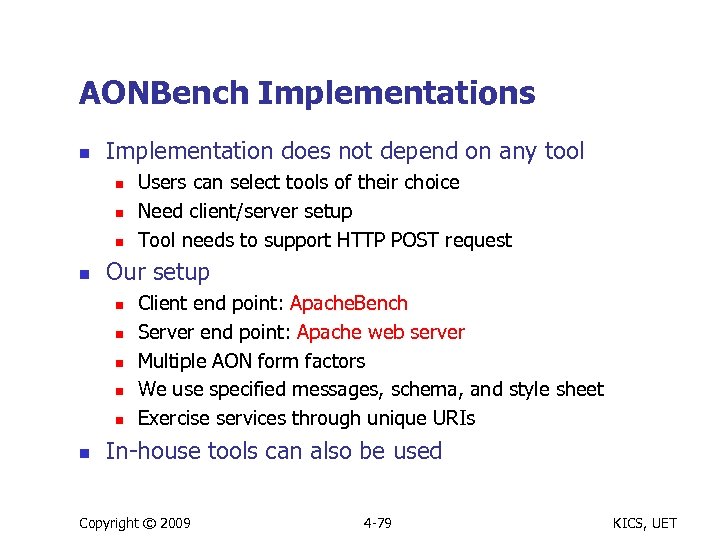
AONBench Implementations n Implementation does not depend on any tool n n Our setup n n n Users can select tools of their choice Need client/server setup Tool needs to support HTTP POST request Client end point: Apache. Bench Server end point: Apache web server Multiple AON form factors We use specified messages, schema, and style sheet Exercise services through unique URIs In-house tools can also be used Copyright © 2009 4 -79 KICS, UET
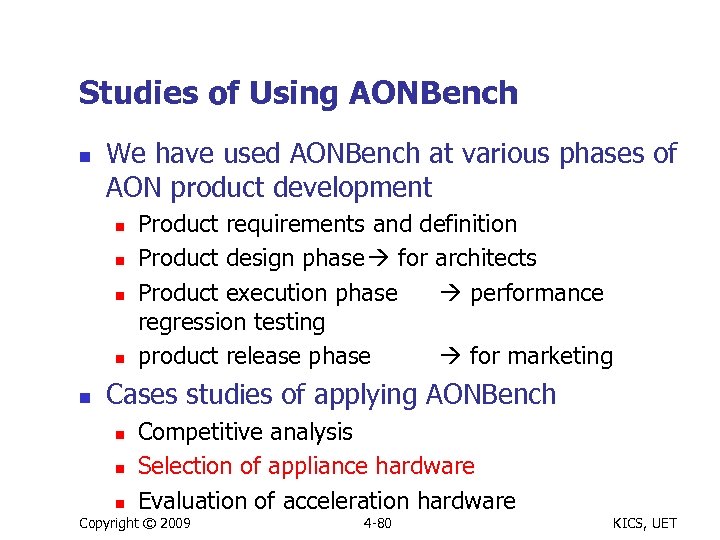
Studies of Using AONBench n We have used AONBench at various phases of AON product development n n n Product requirements and definition Product design phase for architects Product execution phase performance regression testing product release phase for marketing Cases studies of applying AONBench n n Competitive analysis Selection of appliance hardware Evaluation of acceleration hardware n Copyright © 2009 4 -80 KICS, UET
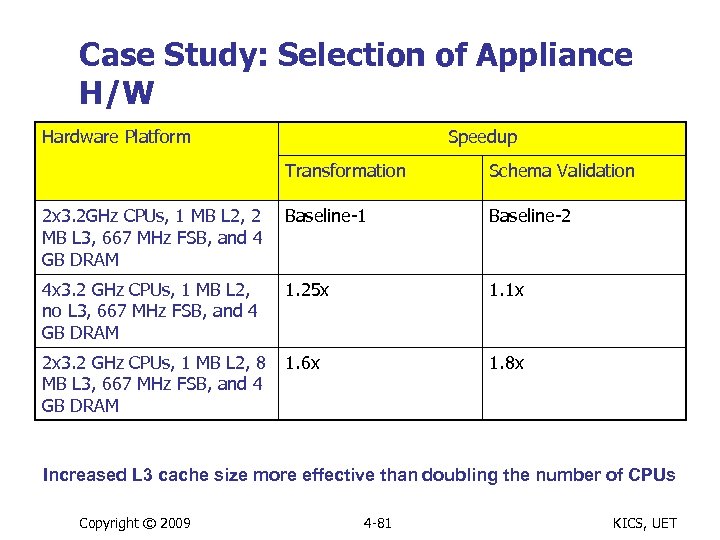
Case Study: Selection of Appliance H/W Hardware Platform Speedup Transformation Schema Validation 2 x 3. 2 GHz CPUs, 1 MB L 2, 2 MB L 3, 667 MHz FSB, and 4 GB DRAM Baseline-1 Baseline-2 4 x 3. 2 GHz CPUs, 1 MB L 2, no L 3, 667 MHz FSB, and 4 GB DRAM 1. 25 x 1. 1 x 2 x 3. 2 GHz CPUs, 1 MB L 2, 8 MB L 3, 667 MHz FSB, and 4 GB DRAM 1. 6 x 1. 8 x Increased L 3 cache size more effective than doubling the number of CPUs Copyright © 2009 4 -81 KICS, UET
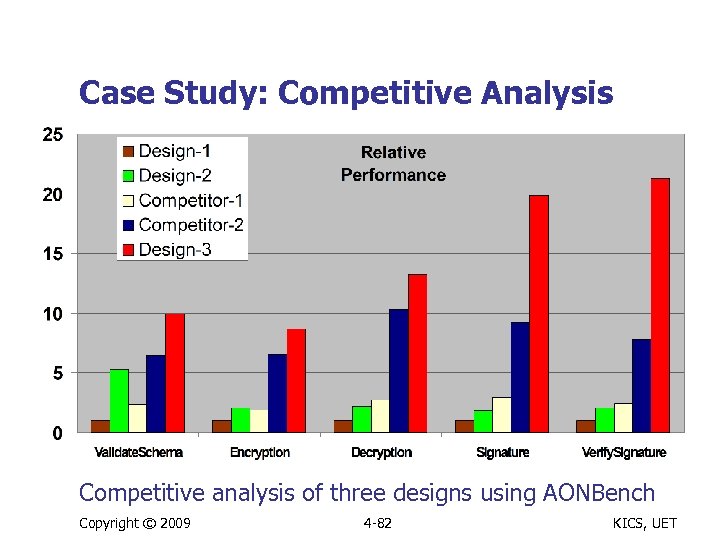
Case Study: Competitive Analysis Competitive analysis of three designs using AONBench Copyright © 2009 4 -82 KICS, UET
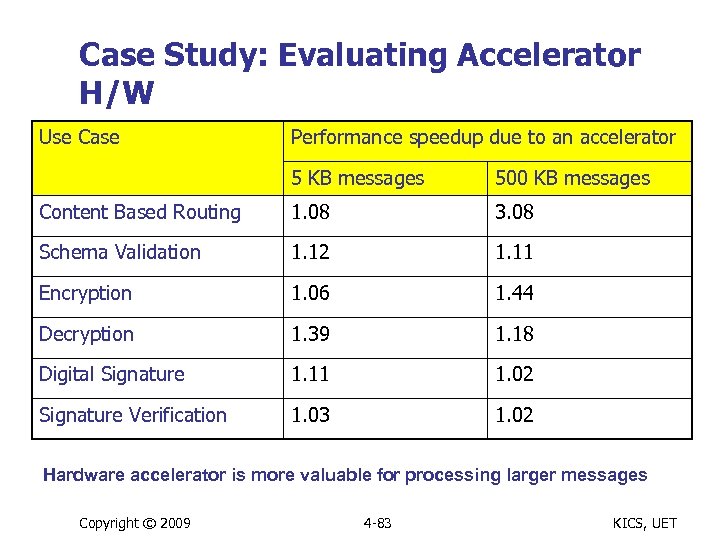
Case Study: Evaluating Accelerator H/W Use Case Performance speedup due to an accelerator 5 KB messages 500 KB messages Content Based Routing 1. 08 3. 08 Schema Validation 1. 12 1. 11 Encryption 1. 06 1. 44 Decryption 1. 39 1. 18 Digital Signature 1. 11 1. 02 Signature Verification 1. 03 1. 02 Hardware accelerator is more valuable for processing larger messages Copyright © 2009 4 -83 KICS, UET
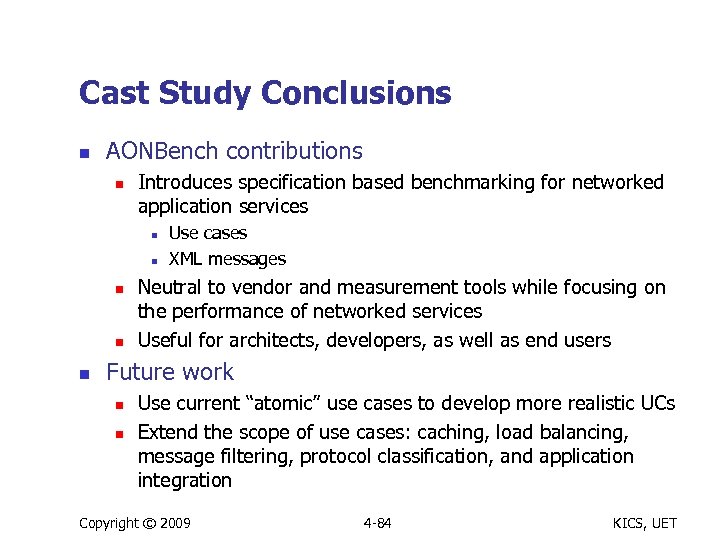
Cast Study Conclusions n AONBench contributions n Introduces specification based benchmarking for networked application services n n n Use cases XML messages Neutral to vendor and measurement tools while focusing on the performance of networked services Useful for architects, developers, as well as end users Future work n n Use current “atomic” use cases to develop more realistic UCs Extend the scope of use cases: caching, load balancing, message filtering, protocol classification, and application integration Copyright © 2009 4 -84 KICS, UET
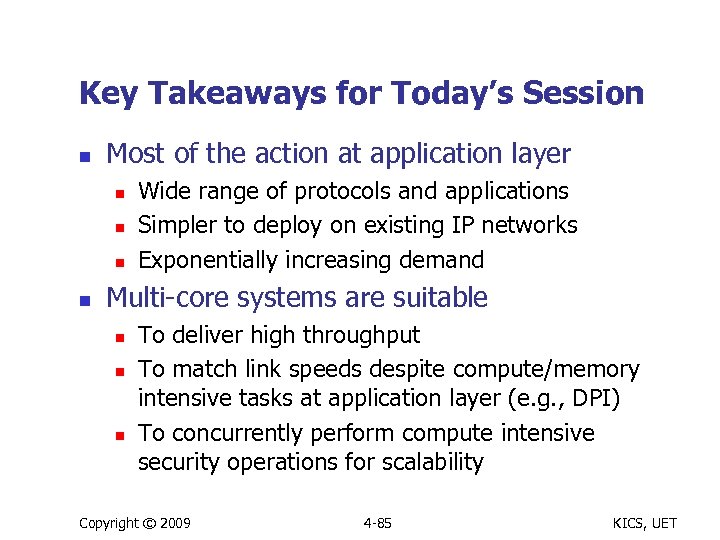
Key Takeaways for Today’s Session n Most of the action at application layer n n Wide range of protocols and applications Simpler to deploy on existing IP networks Exponentially increasing demand Multi-core systems are suitable n n n To deliver high throughput To match link speeds despite compute/memory intensive tasks at application layer (e. g. , DPI) To concurrently perform compute intensive security operations for scalability Copyright © 2009 4 -85 KICS, UET
Скачать презентацию Programming Multi-Core Processors based Embedded Systems A Hands-On
699a724845abd3b6b3571f94c90cadde.ppt