


 Скачать презентацию PROGRAMMING METHODOLOGY CONNIE HEITMEYER Center for High Assurance
c5a0581c4b22b5f5b798c9a4d4929f38.ppt
- Количество слайдов: 11
 PROGRAMMING METHODOLOGY CONNIE HEITMEYER Center for High Assurance Computer Systems Naval Research Laboratory Washington, DC Workshop on the Verification Grand Challenge SRI International February 21 -23, 2005
 OUTLINE • • Background: The SCR toolset Programming Methodology – State of the art – State of the practice Mathematics vs. Engineering – Components of a well-founded software engineering discipline How to deal with legacy code – An alternative proposal 2/24/05 2
 SCR TOOLSET: HISTORY AND OVERVIEW • I am the chief designer of the SCR toolset, which supports the specification of requirements in the SCR tabular notation – • • • 2/24/05 Based on original A-7 requirements method originated by Dave Parnas et al. in the late 1970 s Major objective of the SCR method and tools To produce a validated, verified requirements specification Attributes of a high quality requirements spec – – Precise and unambiguous Readable by practitioners AND customers Complete and consistent; correctness validated by domain experts Freedom from implementation bias Benefits of a high quality requirements spec - solid basis for – – – Automated test case generation (satisfying some coverage criterion) Automated generation of provably correct, efficient code Developing a new version of the system Other major benefit - serves as a precise means of communication between all of the stakeholders: the customers, the future users, the developers, etc. SCR tools have been used in over 30 university courses, conference tutorials, and industry tutorials 3
 SCR TOOLS • • • SCR TOOLSET most mature tools Distributed to 200+ org’ns in industry, govt. , and academia Focus on safetycritical, securitycritical systems ANALYSIS TOOLS • TAME is an interface to PVS designed to prove properties of state machine models system spec SPECIFICATION EDITOR DEPENDENCY GRAPH BROWSER modes CONSISTEN CY CHECKER terms cont vars conditions events mon vars SIMULATO R MODEL CHECKER THEOREM PROVER (TAME) PROPERTY CHECKER (Salsa) INVARIANT GENERATOR TEST CASE GENERATOR CODE GENERATOR Research Prototypes Current focus: Optimized, provably correct code
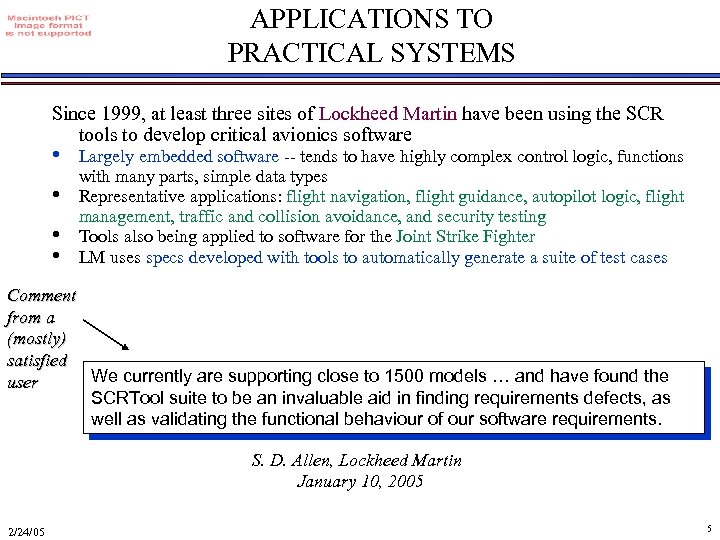 APPLICATIONS TO PRACTICAL SYSTEMS Since 1999, at least three sites of Lockheed Martin have been using the SCR tools to develop critical avionics software • • Largely embedded software -- tends to have highly complex control logic, functions with many parts, simple data types Representative applications: flight navigation, flight guidance, autopilot logic, flight management, traffic and collision avoidance, and security testing Tools also being applied to software for the Joint Strike Fighter LM uses specs developed with tools to automatically generate a suite of test cases Comment from a (mostly) satisfied We currently are supporting close to 1500 models … and have found the user SCRTool suite to be an invaluable aid in finding requirements defects, as well as validating the functional behaviour of our software requirements. S. D. Allen, Lockheed Martin January 10, 2005 2/24/05 5
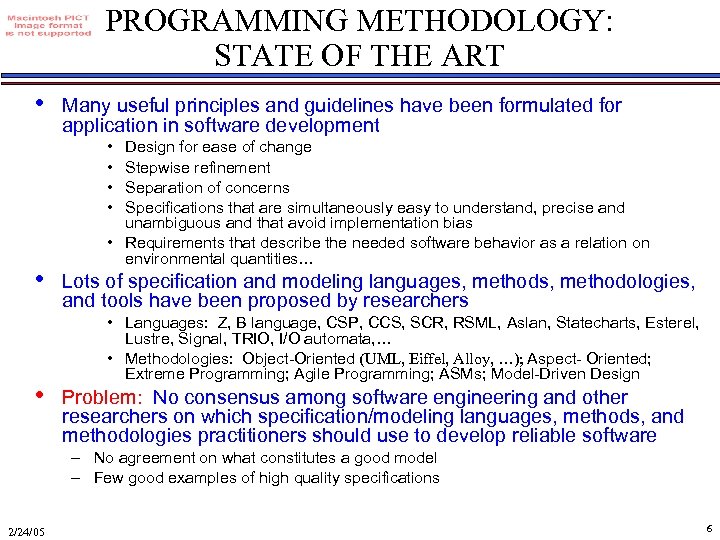 PROGRAMMING METHODOLOGY: STATE OF THE ART • Many useful principles and guidelines have been formulated for application in software development • • • Design for ease of change Stepwise refinement Separation of concerns Specifications that are simultaneously easy to understand, precise and unambiguous and that avoid implementation bias • Requirements that describe the needed software behavior as a relation on environmental quantities… Lots of specification and modeling languages, methodologies, and tools have been proposed by researchers • Languages: Z, B language, CSP, CCS, SCR, RSML, Aslan, Statecharts, Esterel, Lustre, Signal, TRIO, I/O automata, … • Methodologies: Object-Oriented (UML, Eiffel, Alloy, …); Aspect- Oriented; Extreme Programming; Agile Programming; ASMs; Model-Driven Design Problem: No consensus among software engineering and other researchers on which specification/modeling languages, methods, and methodologies practitioners should use to develop reliable software – No agreement on what constitutes a good model – Few good examples of high quality specifications 2/24/05 6
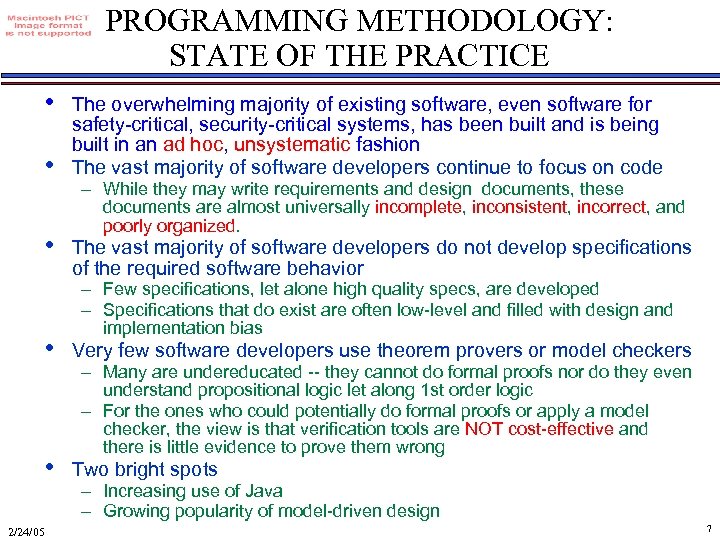 PROGRAMMING METHODOLOGY: STATE OF THE PRACTICE • • • The overwhelming majority of existing software, even software for safety-critical, security-critical systems, has been built and is being built in an ad hoc, unsystematic fashion The vast majority of software developers continue to focus on code – While they may write requirements and design documents, these documents are almost universally incomplete, inconsistent, incorrect, and poorly organized. The vast majority of software developers do not develop specifications of the required software behavior – Few specifications, let alone high quality specs, are developed – Specifications that do exist are often low-level and filled with design and implementation bias • Very few software developers use theorem provers or model checkers • Two bright spots 2/24/05 – Many are undereducated -- they cannot do formal proofs nor do they even understand propositional logic let along 1 st order logic – For the ones who could potentially do formal proofs or apply a model checker, the view is that verification tools are NOT cost-effective and there is little evidence to prove them wrong – Increasing use of Java – Growing popularity of model-driven design 7
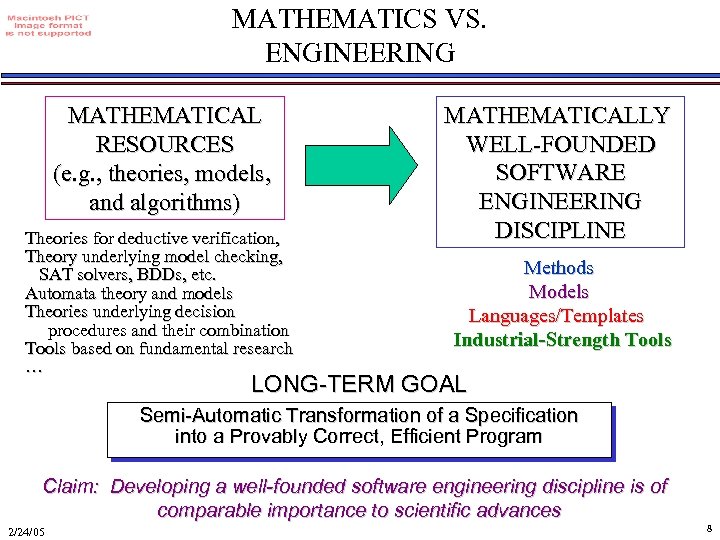 MATHEMATICS VS. ENGINEERING MATHEMATICAL RESOURCES (e. g. , theories, models, and algorithms) Theories for deductive verification, Theory underlying model checking, SAT solvers, BDDs, etc. Automata theory and models Theories underlying decision procedures and their combination Tools based on fundamental research … MATHEMATICALLY WELL-FOUNDED SOFTWARE ENGINEERING DISCIPLINE Methods Models Languages/Templates Industrial-Strength Tools LONG-TERM GOAL Semi-Automatic Transformation of a Specification into a Provably Correct, Efficient Program Claim: Developing a well-founded software engineering discipline is of comparable importance to scientific advances 2/24/05 8
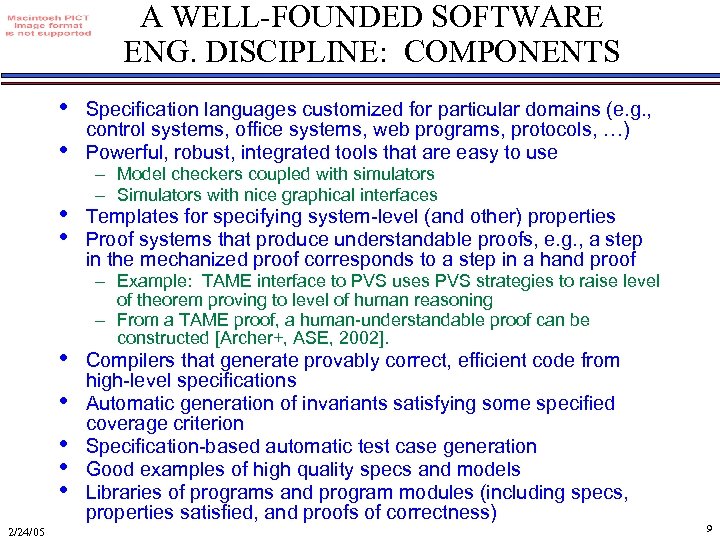 A WELL-FOUNDED SOFTWARE ENG. DISCIPLINE: COMPONENTS • • • 2/24/05 Specification languages customized for particular domains (e. g. , control systems, office systems, web programs, protocols, …) Powerful, robust, integrated tools that are easy to use – Model checkers coupled with simulators – Simulators with nice graphical interfaces Templates for specifying system-level (and other) properties Proof systems that produce understandable proofs, e. g. , a step in the mechanized proof corresponds to a step in a hand proof – Example: TAME interface to PVS uses PVS strategies to raise level of theorem proving to level of human reasoning – From a TAME proof, a human-understandable proof can be constructed [Archer+, ASE, 2002]. Compilers that generate provably correct, efficient code from high-level specifications Automatic generation of invariants satisfying some specified coverage criterion Specification-based automatic test case generation Good examples of high quality specs and models Libraries of programs and program modules (including specs, properties satisfied, and proofs of correctness) 9
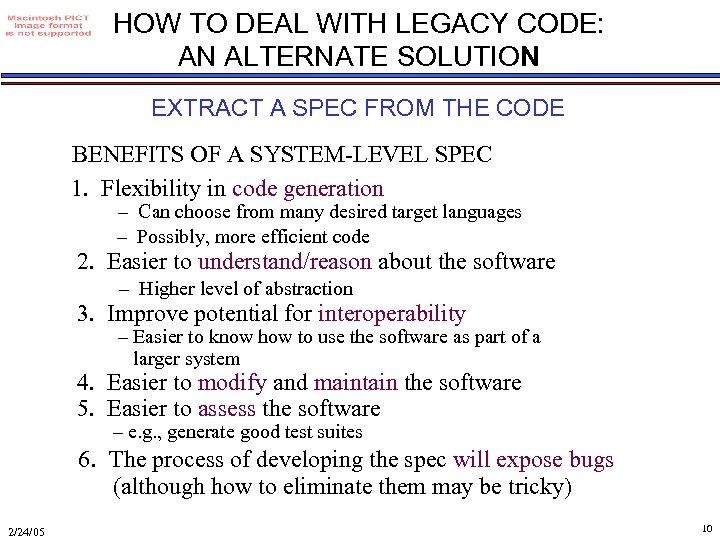 HOW TO DEAL WITH LEGACY CODE: AN ALTERNATE SOLUTION EXTRACT A SPEC FROM THE CODE BENEFITS OF A SYSTEM-LEVEL SPEC 1. Flexibility in code generation – Can choose from many desired target languages – Possibly, more efficient code 2. Easier to understand/reason about the software – Higher level of abstraction 3. Improve potential for interoperability – Easier to know how to use the software as part of a larger system 4. Easier to modify and maintain the software 5. Easier to assess the software – e. g. , generate good test suites 6. The process of developing the spec will expose bugs (although how to eliminate them may be tricky) 2/24/05 10
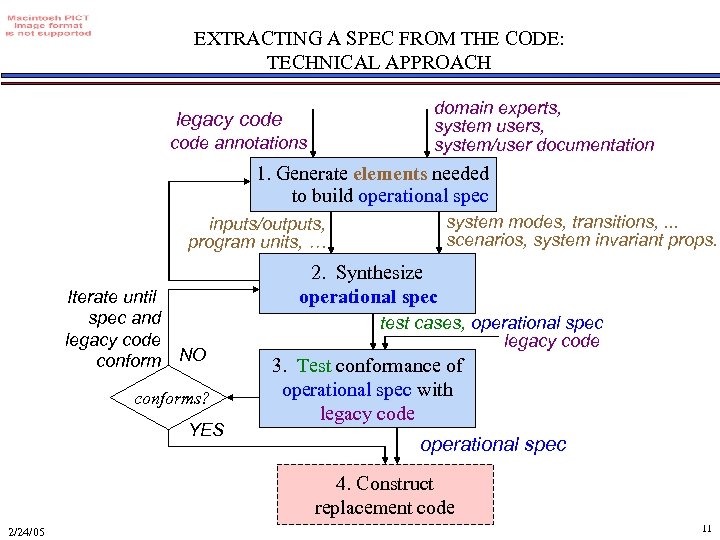 EXTRACTING A SPEC FROM THE CODE: TECHNICAL APPROACH domain experts, system users, system/user documentation legacy code annotations 1. Generate elements needed to build operational spec system modes, transitions, . . . scenarios, system invariant props. inputs/outputs, program units, … Iterate until spec and legacy code conform NO conforms? YES 2. Synthesize operational spec test cases, operational spec legacy code 3. Test conformance of operational spec with legacy code operational spec 4. Construct replacement code 2/24/05 11