


 Скачать презентацию Programming Environment and Performance Modeling for million-processor machines
1bf7032897067e4b91f66cac61e31be2.ppt
- Количество слайдов: 30
 Programming Environment and Performance Modeling for million-processor machines Laxmikant (Sanjay) Kale Parallel Programming Laboratory Department of Computer Science University of Illinois at Urbana-Champaign Http: //charm. Cs. uiuc. edu NGS Workshop: Feb 2002 PPL-Dept of Computer Science, UIUC
 Context: Group Mission and Approach • To enhance Performance and Productivity in programming complex parallel applications – Performance: scalable to very large number of processors – Productivity: of human programmers – Complex: irregular structure, dynamic variations • Approach: Application Oriented yet CS centered research – Develop enabling technology, for a wide collection of apps. – Develop, use and test it in the context of real applications – Develop standard library of reusable parallel components NGS Workshop: Feb 2002 PPL-Dept of Computer Science, UIUC
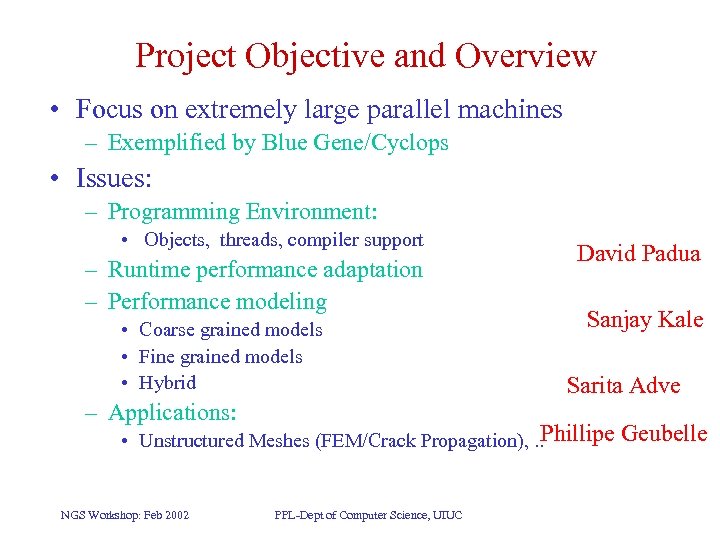 Project Objective and Overview • Focus on extremely large parallel machines – Exemplified by Blue Gene/Cyclops • Issues: – Programming Environment: • Objects, threads, compiler support – Runtime performance adaptation – Performance modeling • Coarse grained models • Fine grained models • Hybrid – Applications: David Padua Sanjay Kale Sarita Adve • Unstructured Meshes (FEM/Crack Propagation), . . Phillipe Geubelle NGS Workshop: Feb 2002 PPL-Dept of Computer Science, UIUC
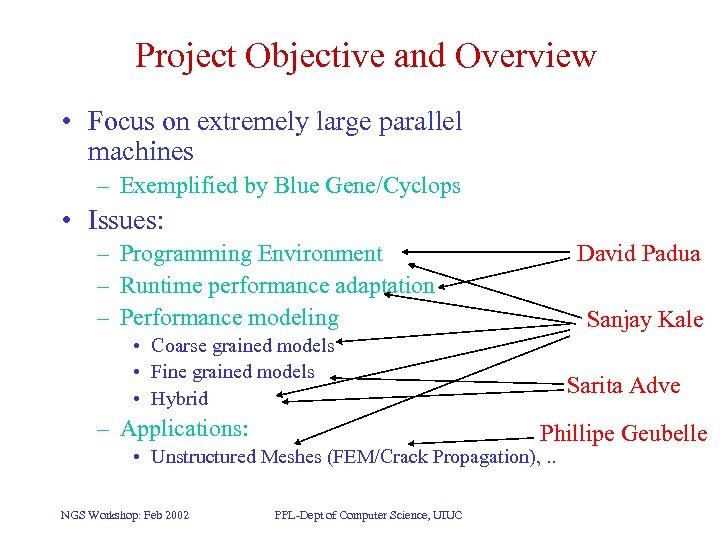 Project Objective and Overview • Focus on extremely large parallel machines – Exemplified by Blue Gene/Cyclops • Issues: David Padua – Programming Environment – Runtime performance adaptation – Performance modeling Sanjay Kale • Coarse grained models • Fine grained models • Hybrid – Applications: Sarita Adve Phillipe Geubelle • Unstructured Meshes (FEM/Crack Propagation), . . NGS Workshop: Feb 2002 PPL-Dept of Computer Science, UIUC
 Multi-partition Decomposition • Idea: divide the computation into a large number of pieces – Independent of number of processors – Typically larger than number of processors – Let the system map entities to processors • Optimal division of labor between “system” and programmer: • Decomposition done by programmer, • Everything else automated NGS Workshop: Feb 2002 PPL-Dept of Computer Science, UIUC
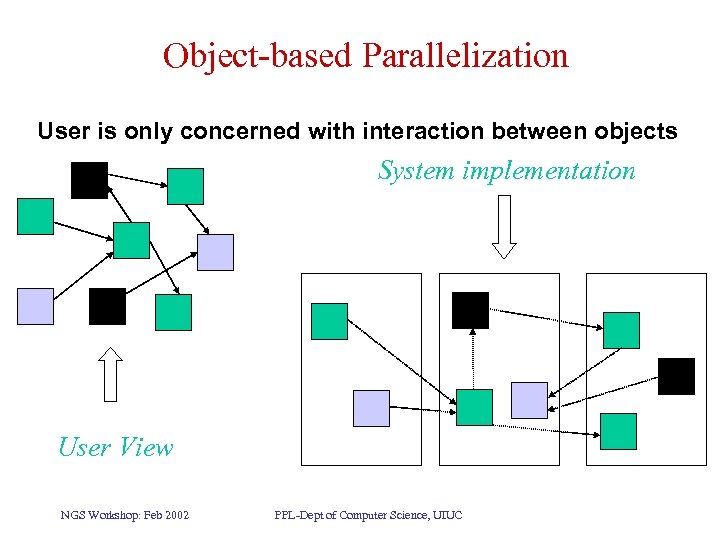 Object-based Parallelization User is only concerned with interaction between objects System implementation User View NGS Workshop: Feb 2002 PPL-Dept of Computer Science, UIUC
 Charm++ • Parallel C++ with Data Driven Objects • Object Arrays/ Object Collections • Object Groups: – Global object with a “representative” on each PE • • • Asynchronous method invocation Prioritized scheduling Information sharing abstractions: readonly, tables, . . Mature, robust, portable http: //charm. cs. uiuc. edu NGS Workshop: Feb 2002 PPL-Dept of Computer Science, UIUC
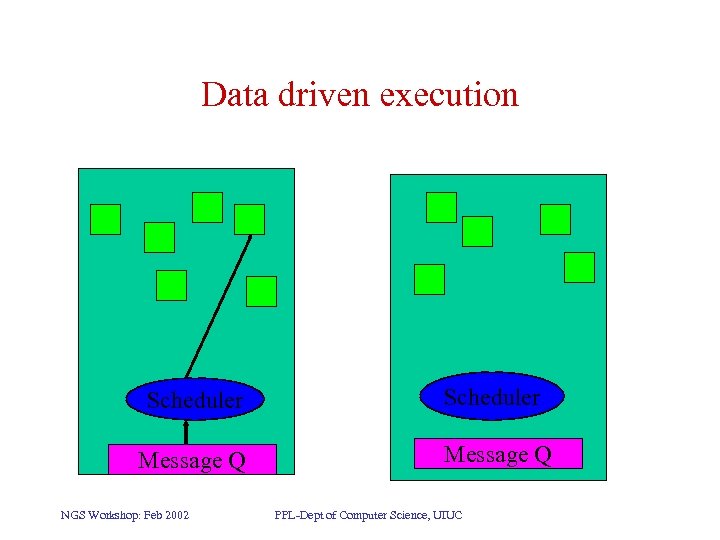 Data driven execution Scheduler Message Q NGS Workshop: Feb 2002 PPL-Dept of Computer Science, UIUC
 Load Balancing Framework • Based on object migration – Partitions implemented as objects (or threads) are mapped to available processors by LB framework • Measurement based load balancers: – Principle of persistence • Computational loads and communication patterns – Runtime system measures actual computation times of every partition, as well as communication patterns • Variety of “plug-in” LB strategies available – Scalable to a few thousand processors – Including those for situations when principle of persistence does not apply NGS Workshop: Feb 2002 PPL-Dept of Computer Science, UIUC
 Building on Object-based Parallelism • Application induced load imbalances • Environment induced performance issues: – – Dealing with extraneous loads on shared m/cs Vacating workstations Heterogeneous clusters Shrinking and Expanding jobs to available Pes • Object “migration”: novel uses – Automatic checkpointing – Automatic prefetching for out-of-core execution • Reuse: object based components NGS Workshop: Feb 2002 PPL-Dept of Computer Science, UIUC
 Applications • Charm++ developed in the context of real applications • Current applications we are involved with: – Molecular dynamics – Crack propagation – Rocket simulation: fluid dynamics + structures + – QM/MM: Material properties via quantum mech – Cosmology simulations: parallel analysis+viz – Cosmology: gravitational with multiple timestepping NGS Workshop: Feb 2002 PPL-Dept of Computer Science, UIUC
![Molecular Dynamics • Collection of [charged] atoms, with bonds • Newtonian mechanics • At](https://present5.com/presentation/1bf7032897067e4b91f66cac61e31be2/image-12.jpg "Molecular Dynamics • Collection of [charged] atoms, with bonds • Newtonian mechanics • At") Molecular Dynamics • Collection of [charged] atoms, with bonds • Newtonian mechanics • At each time-step – Calculate forces on each atom • Bonds: • Non-bonded: electrostatic and van der Waal’s – Calculate velocities and advance positions • 1 femtosecond time-step, millions needed! • Thousands of atoms (1, 000 - 100, 000) NGS Workshop: Feb 2002 PPL-Dept of Computer Science, UIUC
Molecular Dynamics • Collection of [charged] atoms, with bonds • Newtonian mechanics • At each time-step – Calculate forces on each atom • Bonds: • Non-bonded: electrostatic and van der Waal’s – Calculate velocities and advance positions • 1 femtosecond time-step, millions needed! • Thousands of atoms (1, 000 - 100, 000) NGS Workshop: Feb 2002 PPL-Dept of Computer Science, UIUC
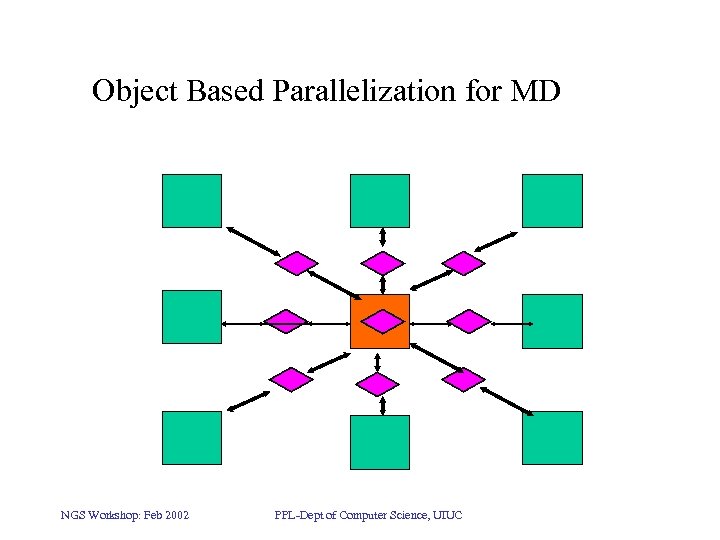 Object Based Parallelization for MD NGS Workshop: Feb 2002 PPL-Dept of Computer Science, UIUC
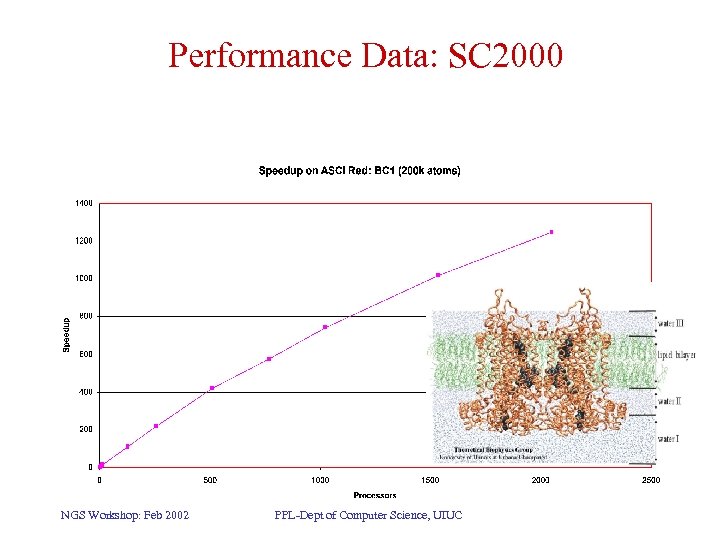 Performance Data: SC 2000 NGS Workshop: Feb 2002 PPL-Dept of Computer Science, UIUC
 Charm++ Is a Good Match for M-PIM • Encapsulation : objects • Cost model: – Object data, read-only data, remote data • • Migration and resource management: automatic One sided communication: since the beginning Asynchronous global operations (reductions, . . ) Modularity: – see 1996 paper for why DD Objects enable modularity • Acceptability: – C++ – Now also: AMPI on top of charm++ NGS Workshop: Feb 2002 PPL-Dept of Computer Science, UIUC
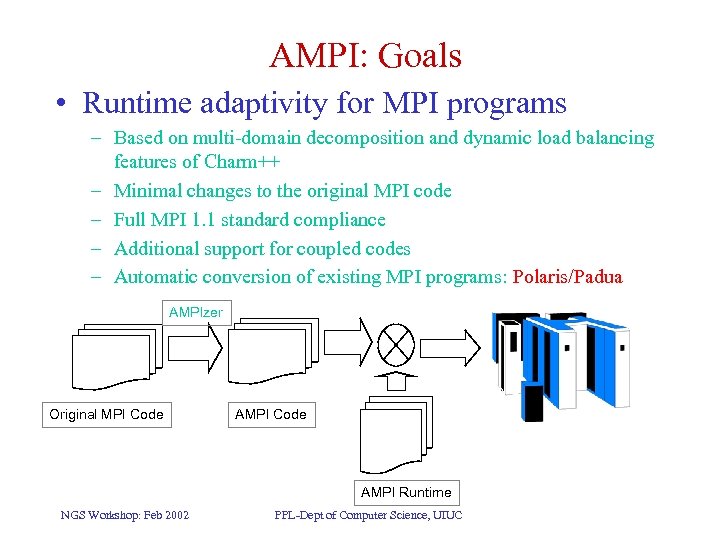 AMPI: Goals • Runtime adaptivity for MPI programs – Based on multi-domain decomposition and dynamic load balancing features of Charm++ – Minimal changes to the original MPI code – Full MPI 1. 1 standard compliance – Additional support for coupled codes – Automatic conversion of existing MPI programs: Polaris/Padua AMPIzer Original MPI Code AMPI Runtime NGS Workshop: Feb 2002 PPL-Dept of Computer Science, UIUC
 How Good Is the Programmability • I. E. Do programmers find it easy/good – We think so – Certainly a good intermediate level model • Higher level abstractions can be built on it • But what kinds of abstractions? • We think domain-specific ones NGS Workshop: Feb 2002 PPL-Dept of Computer Science, UIUC
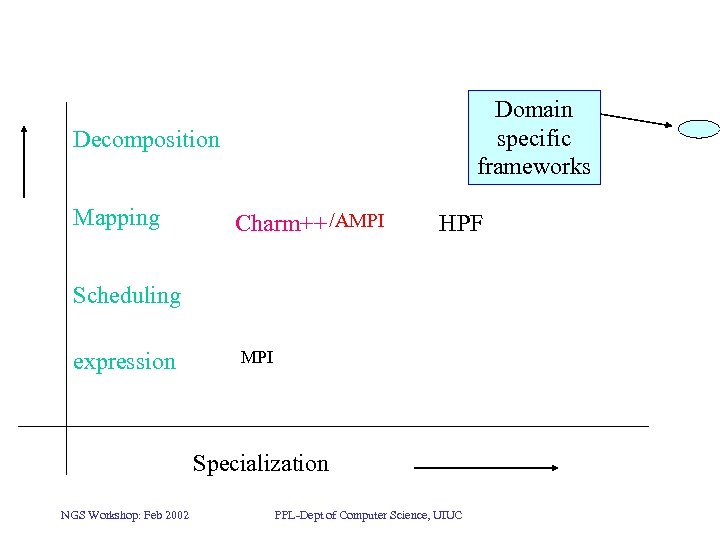 Domain specific frameworks Decomposition Mapping Charm++ /AMPI HPF Scheduling expression MPI Specialization NGS Workshop: Feb 2002 PPL-Dept of Computer Science, UIUC
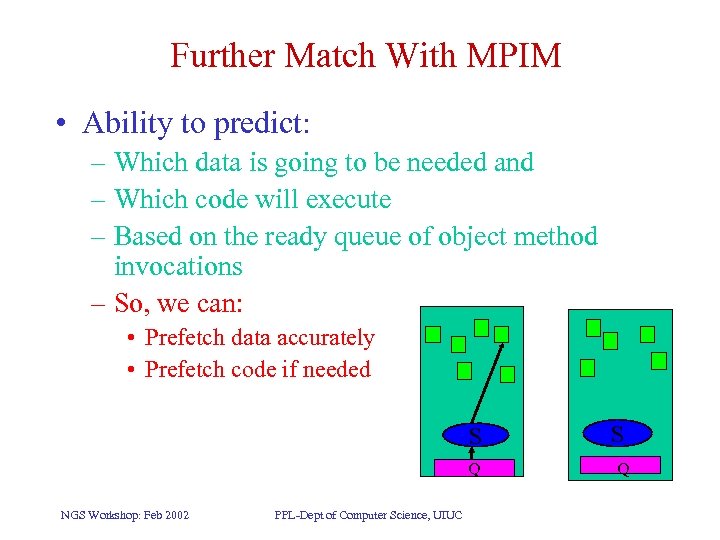 Further Match With MPIM • Ability to predict: – Which data is going to be needed and – Which code will execute – Based on the ready queue of object method invocations – So, we can: • Prefetch data accurately • Prefetch code if needed S Q NGS Workshop: Feb 2002 PPL-Dept of Computer Science, UIUC S Q
 So, What Are We Doing About It? • How to develop any programming environment for a machine that isn’t built yet • Blue Gene/C emulator using charm++ – Completed last year – Implememnts low level BG/C API • Packet sends, extract packet from comm buffers – Emulation runs on machines with hundreds of “normal” processors • Charm++ on blue Gene /C Emulator NGS Workshop: Feb 2002 PPL-Dept of Computer Science, UIUC
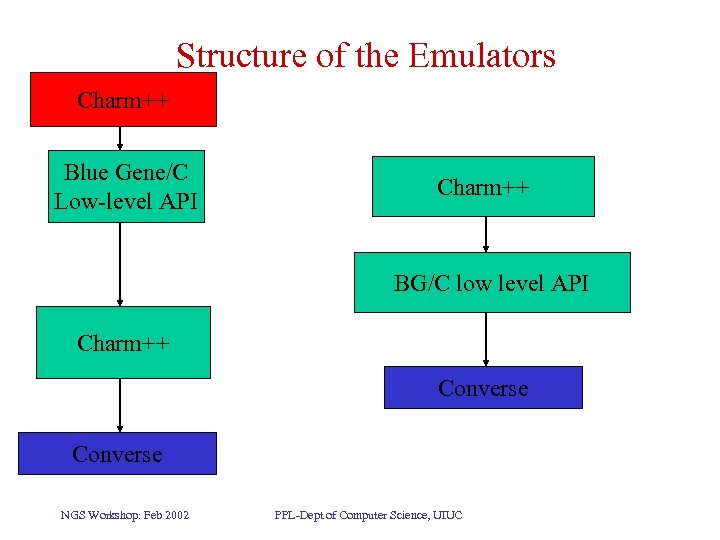 Structure of the Emulators Charm++ Blue Gene/C Low-level API Charm++ BG/C low level API Charm++ Converse NGS Workshop: Feb 2002 PPL-Dept of Computer Science, UIUC
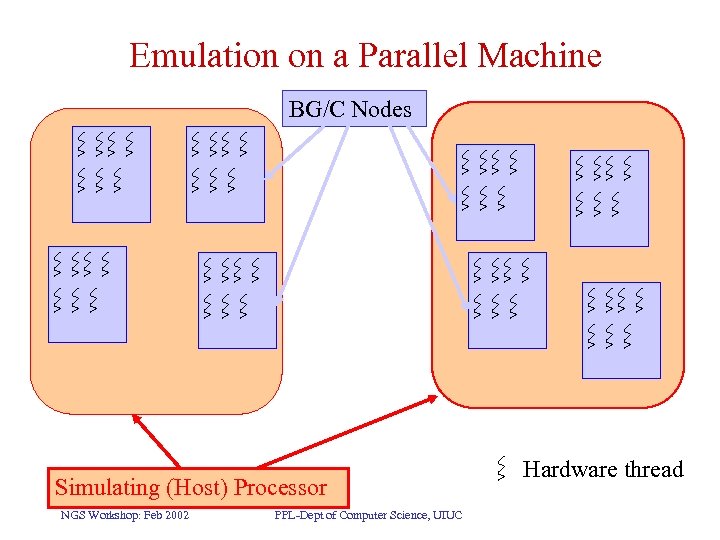 Emulation on a Parallel Machine BG/C Nodes Simulating (Host) Processor NGS Workshop: Feb 2002 PPL-Dept of Computer Science, UIUC Hardware thread
 Extensions to Charm++ for BG/C • Microtasks: – Objects may fire microtasks that can be executed by any thread on the same node – Increases parallelism – Overhead: sub-microsecond • Issue: – Object affinity: map to thread or node? • Thread, currently. • Microtasks alleviate load balancing within a node NGS Workshop: Feb 2002 PPL-Dept of Computer Science, UIUC
 Emulation efficiency • How much time does it take to run an emulation? – 8 Million processors being emulated on 100 – In addition, lower cache performance – Lots of tiny messages • On a Linux cluster: – Emulation shows good speedup NGS Workshop: Feb 2002 PPL-Dept of Computer Science, UIUC
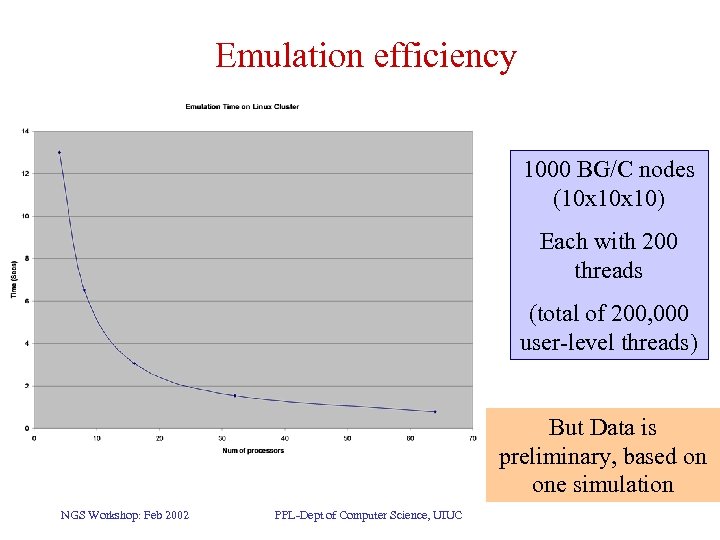 Emulation efficiency 1000 BG/C nodes (10 x 10) Each with 200 threads (total of 200, 000 user-level threads) But Data is preliminary, based on one simulation NGS Workshop: Feb 2002 PPL-Dept of Computer Science, UIUC
 Emulator to Simulator • Step 1: Coarse grained simulation – Simulation: performance prediction capability – Models contention for processor/thread – Also models communication delay based on distance – Doesn’t model memory access on chip, or network – How to do this in spite of out-of-order message delivery? • Rely on determinism of Charm++ programs • Time stamped messages and threads • Parallel time-stamp correction algorithm NGS Workshop: Feb 2002 PPL-Dept of Computer Science, UIUC
 Applications on the current system • Using BG Charm++ • Lean. MD: – Research quality Molecular Dyanmics – Version 0: only electrostatics + van der Vaal • Simple AMR kernel – Adaptive tree to generate millions of objects • Each holding a 3 D array – Communication with “neighbors” • Tree makes it harder to find nbrs, but Charm makes it easy NGS Workshop: Feb 2002 PPL-Dept of Computer Science, UIUC
 Emulator to Simulator • Step 2: Add fine grained procesor simulation – Sarita Adve: RSIM based simulation of a node • SMP node simulation: completed – Also: simulation of interconnection network – Millions of thread units/caches to simulate in detail? • Step 3: Hybrid simulation – Instead: use detailed simulation to build model – Drive coarse simulation using model behavior – Further help from compiler and RTS NGS Workshop: Feb 2002 PPL-Dept of Computer Science, UIUC
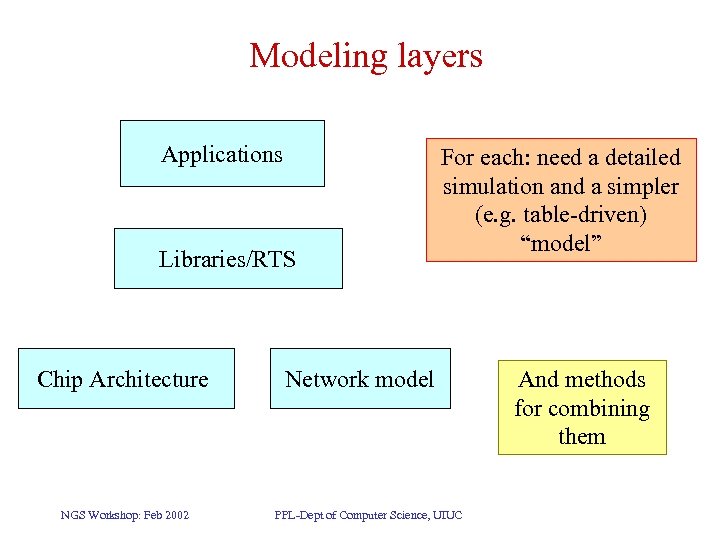 Modeling layers Applications Libraries/RTS Chip Architecture NGS Workshop: Feb 2002 For each: need a detailed simulation and a simpler (e. g. table-driven) “model” Network model PPL-Dept of Computer Science, UIUC And methods for combining them
 Summary • Charm++ (data-driven migratable objects) – is a well-matched candidate programming model for M -PIMs • We have developed an Emulator/Simulator – For BG/C – Runs on parallel machines • We have Implemented multi-million object applications using Charm++ – And tested on emulated Blue Gene/C • More info: http: //charm. cs. uiuc. edu – Emulator is available for download, along with Charm NGS Workshop: Feb 2002 PPL-Dept of Computer Science, UIUC