 Скачать презентацию Programmable Architecture for the Creation and Seamless Control
d555db12d3d787af7a11dba13de973ec.ppt
- Количество слайдов: 34



Programmable Architecture for the Creation and Seamless Control of Hybrid Services Constant Gbaguidi Swiss Federal Institute of Technology (Lausanne)
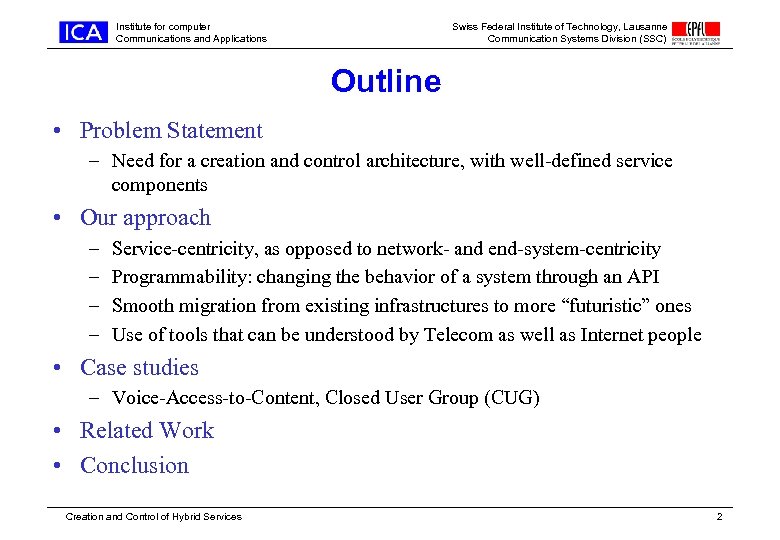
Institute for computer Communications and Applications Swiss Federal Institute of Technology, Lausanne Communication Systems Division (SSC) Outline • Problem Statement – Need for a creation and control architecture, with well-defined service components • Our approach – – Service-centricity, as opposed to network- and end-system-centricity Programmability: changing the behavior of a system through an API Smooth migration from existing infrastructures to more “futuristic” ones Use of tools that can be understood by Telecom as well as Internet people • Case studies – Voice-Access-to-Content, Closed User Group (CUG) • Related Work • Conclusion Creation and Control of Hybrid Services 2
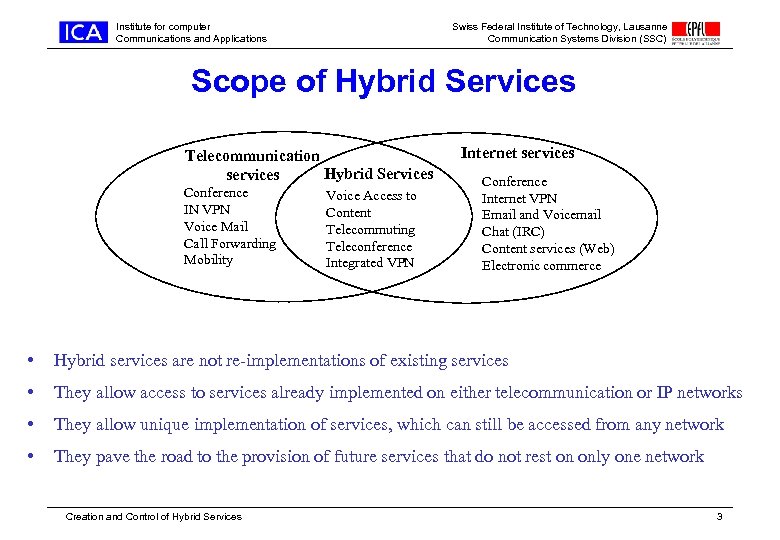
Institute for computer Communications and Applications Swiss Federal Institute of Technology, Lausanne Communication Systems Division (SSC) Scope of Hybrid Services Telecommunication Hybrid Services services Conference IN VPN Voice Mail Call Forwarding Mobility Voice Access to Content Telecommuting Teleconference Integrated VPN Internet services Conference Internet VPN Email and Voicemail Chat (IRC) Content services (Web) Electronic commerce • Hybrid services are not re-implementations of existing services • They allow access to services already implemented on either telecommunication or IP networks • They allow unique implementation of services, which can still be accessed from any network • They pave the road to the provision of future services that do not rest on only one network Creation and Control of Hybrid Services 3
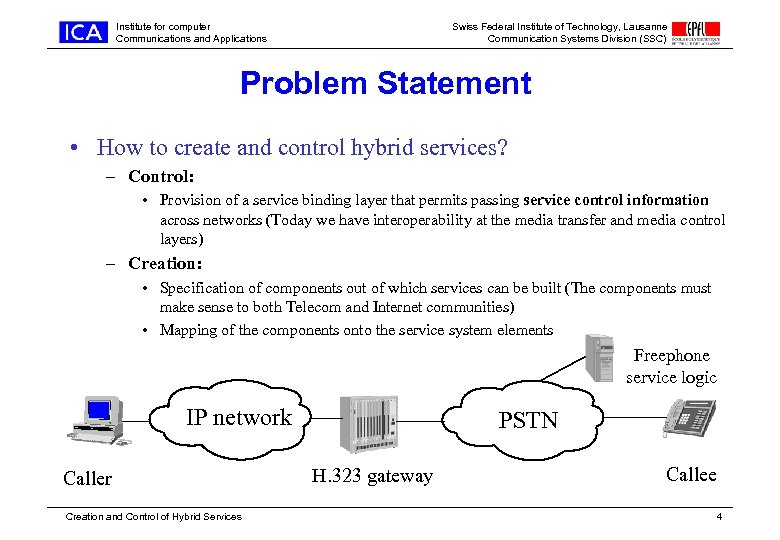
Institute for computer Communications and Applications Swiss Federal Institute of Technology, Lausanne Communication Systems Division (SSC) Problem Statement • How to create and control hybrid services? – Control: • Provision of a service binding layer that permits passing service control information across networks (Today we have interoperability at the media transfer and media control layers) – Creation: • Specification of components out of which services can be built (The components must make sense to both Telecom and Internet communities) • Mapping of the components onto the service system elements Freephone service logic IP network Caller Creation and Control of Hybrid Services PSTN H. 323 gateway Callee 4
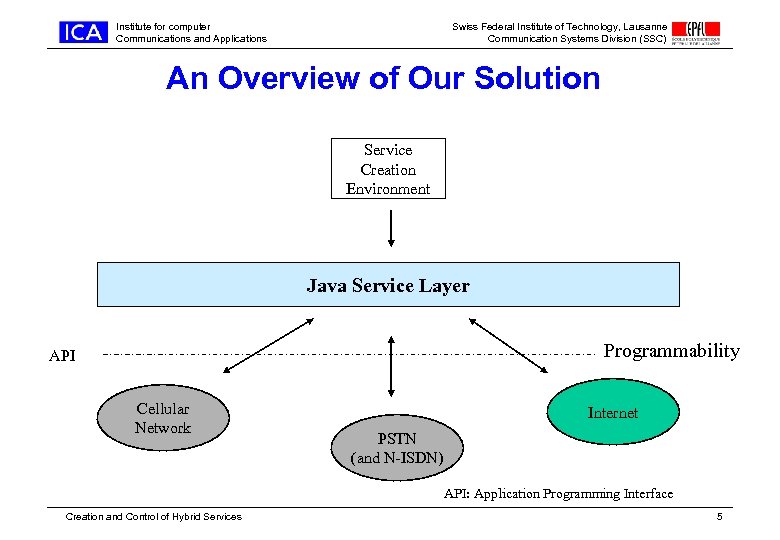
Institute for computer Communications and Applications Swiss Federal Institute of Technology, Lausanne Communication Systems Division (SSC) An Overview of Our Solution Service Creation Environment Java Service Layer Programmability API Cellular Network Internet PSTN (and N-ISDN) API: Application Programming Interface Creation and Control of Hybrid Services 5
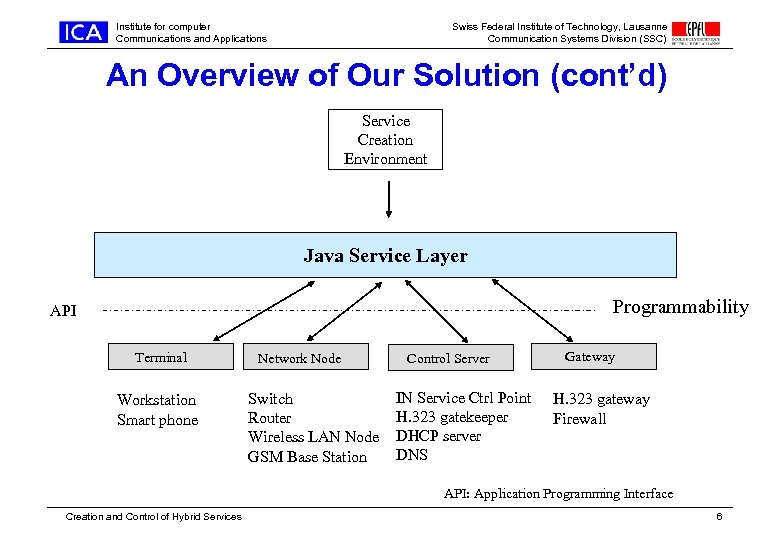
Institute for computer Communications and Applications Swiss Federal Institute of Technology, Lausanne Communication Systems Division (SSC) An Overview of Our Solution (cont’d) Service Creation Environment Java Service Layer Programmability API Terminal Workstation Smart phone Network Node Switch Router Wireless LAN Node GSM Base Station Control Server IN Service Ctrl Point H. 323 gatekeeper DHCP server DNS Gateway H. 323 gateway Firewall API: Application Programming Interface Creation and Control of Hybrid Services 6
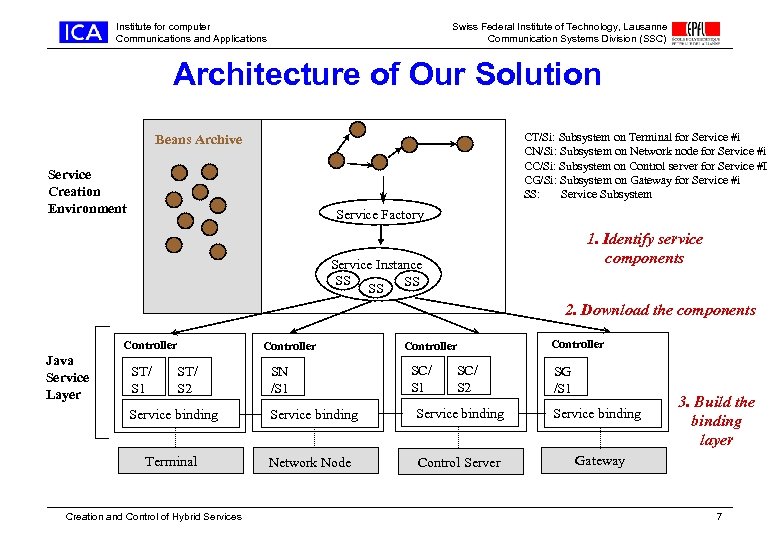
Institute for computer Communications and Applications Swiss Federal Institute of Technology, Lausanne Communication Systems Division (SSC) Architecture of Our Solution CT/Si: Subsystem on Terminal for Service #i CN/Si: Subsystem on Network node for Service #i CC/Si: Subsystem on Control server for Service #I CG/Si: Subsystem on Gateway for Service #i SS: Service Subsystem Beans Archive Service Creation Environment Service Factory 1. Identify service components Service Instance SS SS SS 2. Download the components Controller Java Service Layer ST/ S 1 Controller ST/ S 2 SN /S 1 Controller SC/ S 1 SC/ S 2 Controller SG /S 1 Service binding Terminal Network Node Control Server 3. Build the binding layer Gateway Creation and Control of Hybrid Services 7
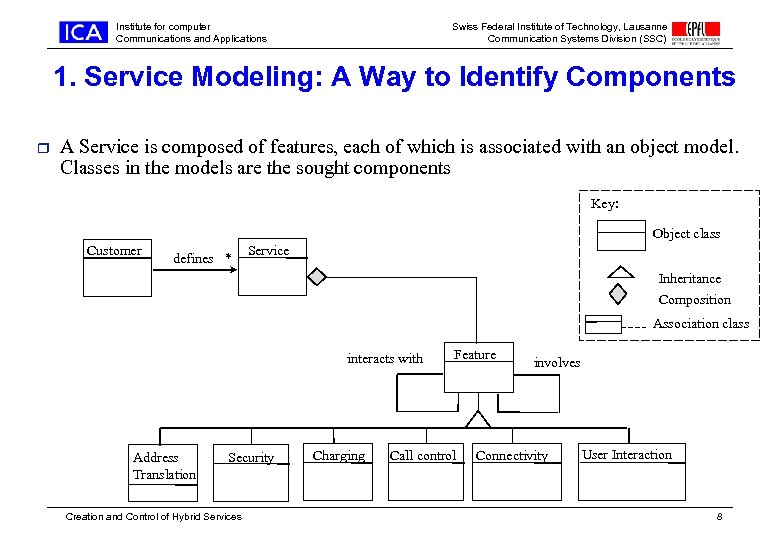
Institute for computer Communications and Applications Swiss Federal Institute of Technology, Lausanne Communication Systems Division (SSC) 1. Service Modeling: A Way to Identify Components r A Service is composed of features, each of which is associated with an object model. Classes in the models are the sought components Key: Object class Customer defines * Service Inheritance Composition Association class interacts with Address Translation Security Creation and Control of Hybrid Services Charging Feature Call control involves Connectivity User Interaction 8
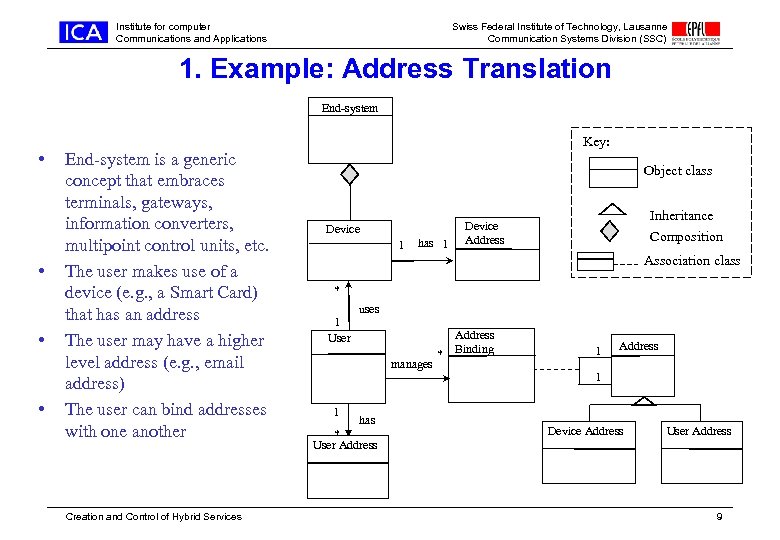
Institute for computer Communications and Applications Swiss Federal Institute of Technology, Lausanne Communication Systems Division (SSC) 1. Example: Address Translation End-system • • End-system is a generic concept that embraces terminals, gateways, information converters, multipoint control units, etc. The user makes use of a device (e. g. , a Smart Card) that has an address The user may have a higher level address (e. g. , email address) The user can bind addresses with one another Creation and Control of Hybrid Services Key: Object class Device 1 has 1 Inheritance Composition Device Address Association class * 1 User uses manages * Address Binding 1 Address 1 1 has * User Address Device Address User Address 9
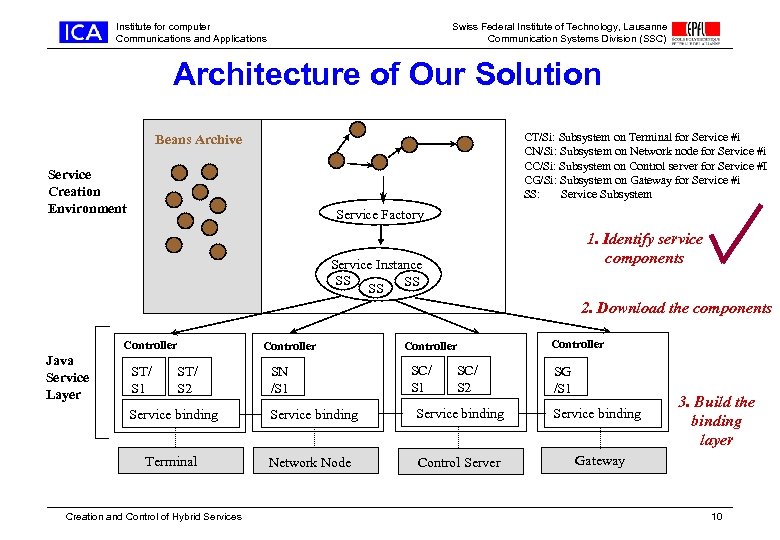
Institute for computer Communications and Applications Swiss Federal Institute of Technology, Lausanne Communication Systems Division (SSC) Architecture of Our Solution CT/Si: Subsystem on Terminal for Service #i CN/Si: Subsystem on Network node for Service #i CC/Si: Subsystem on Control server for Service #I CG/Si: Subsystem on Gateway for Service #i SS: Service Subsystem Beans Archive Service Creation Environment Service Factory 1. Identify service components Service Instance SS SS SS 2. Download the components Controller Java Service Layer ST/ S 1 Controller ST/ S 2 SN /S 1 Controller SC/ S 1 SC/ S 2 Controller SG /S 1 Service binding Terminal Network Node Control Server 3. Build the binding layer Gateway Creation and Control of Hybrid Services 10
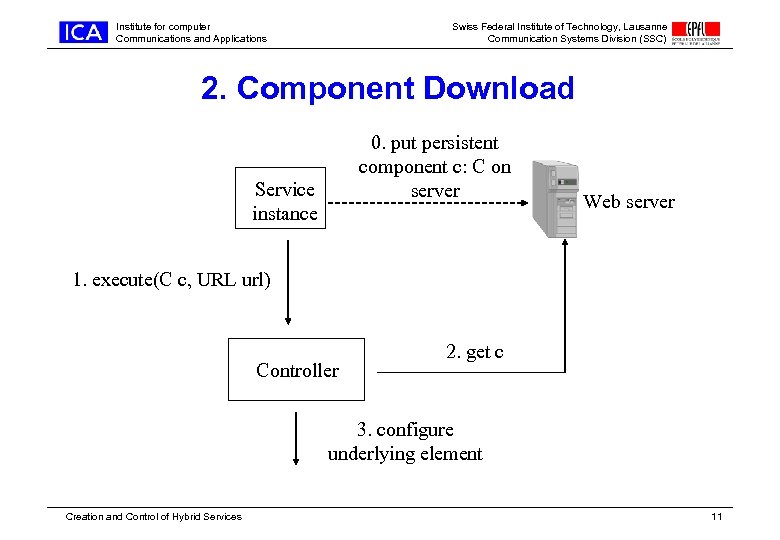
Institute for computer Communications and Applications Swiss Federal Institute of Technology, Lausanne Communication Systems Division (SSC) 2. Component Download 0. put persistent component c: C on server Service instance Web server 1. execute(C c, URL url) Controller 2. get c 3. configure underlying element Creation and Control of Hybrid Services 11
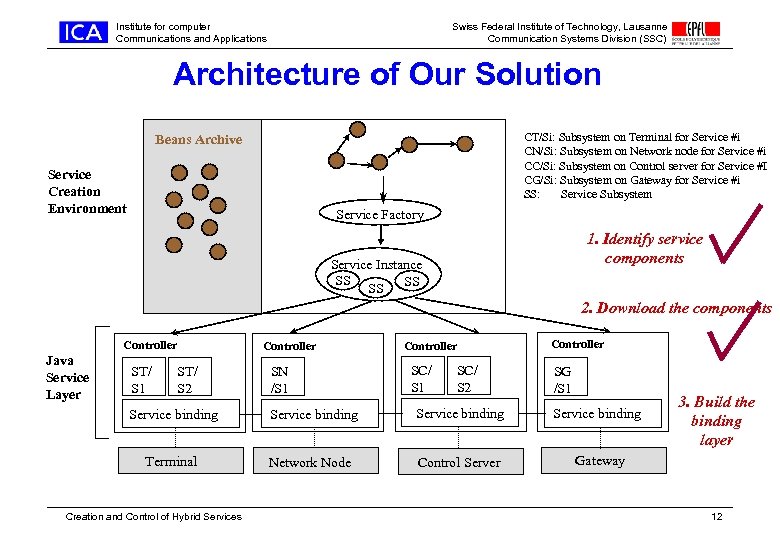
Institute for computer Communications and Applications Swiss Federal Institute of Technology, Lausanne Communication Systems Division (SSC) Architecture of Our Solution CT/Si: Subsystem on Terminal for Service #i CN/Si: Subsystem on Network node for Service #i CC/Si: Subsystem on Control server for Service #I CG/Si: Subsystem on Gateway for Service #i SS: Service Subsystem Beans Archive Service Creation Environment Service Factory 1. Identify service components Service Instance SS SS SS 2. Download the components Controller Java Service Layer ST/ S 1 Controller ST/ S 2 SN /S 1 Controller SC/ S 1 SC/ S 2 Controller SG /S 1 Service binding Terminal Network Node Control Server 3. Build the binding layer Gateway Creation and Control of Hybrid Services 12
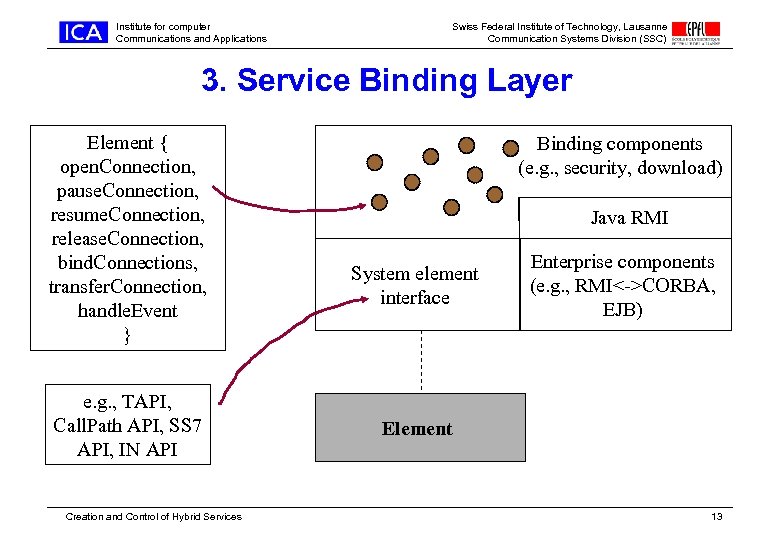
Institute for computer Communications and Applications Swiss Federal Institute of Technology, Lausanne Communication Systems Division (SSC) 3. Service Binding Layer Element { open. Connection, pause. Connection, resume. Connection, release. Connection, bind. Connections, transfer. Connection, handle. Event } e. g. , TAPI, Call. Path API, SS 7 API, IN API Creation and Control of Hybrid Services Binding components (e. g. , security, download) Java RMI System element interface Enterprise components (e. g. , RMI<->CORBA, EJB) Element 13
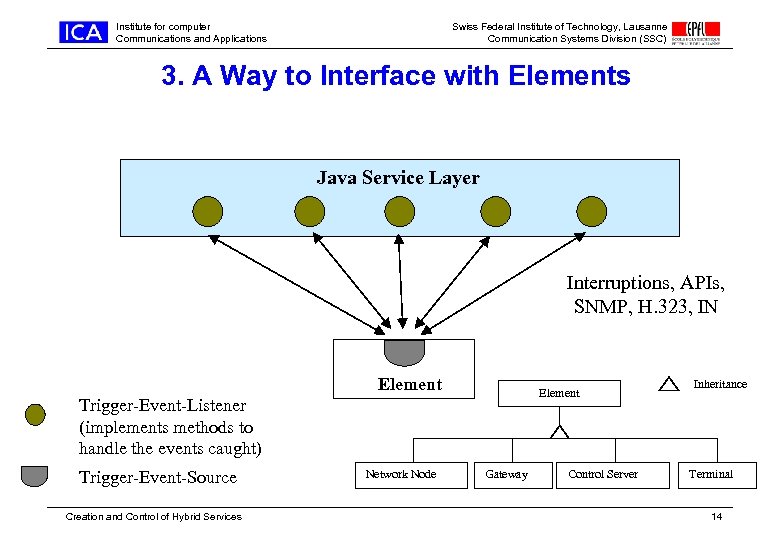
Institute for computer Communications and Applications Swiss Federal Institute of Technology, Lausanne Communication Systems Division (SSC) 3. A Way to Interface with Elements Java Service Layer Interruptions, APIs, SNMP, H. 323, IN Element Trigger-Event-Listener (implements methods to handle the events caught) Trigger-Event-Source Creation and Control of Hybrid Services Network Node Gateway Control Server Inheritance Terminal 14
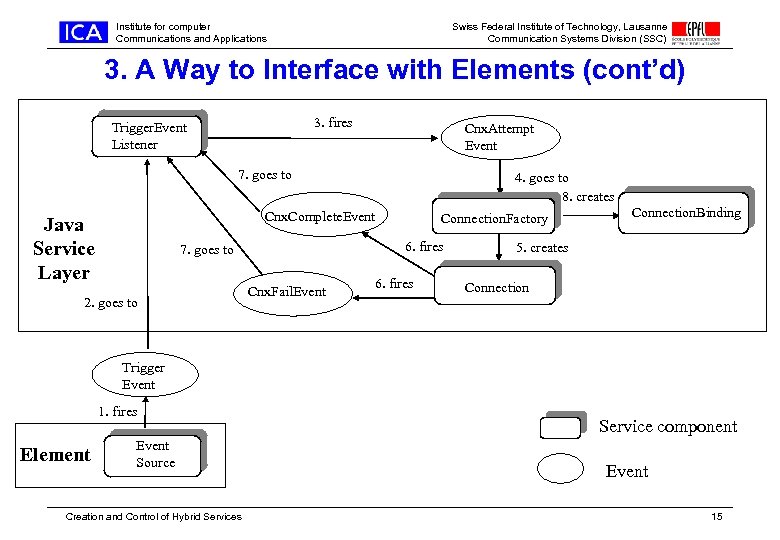
Institute for computer Communications and Applications Swiss Federal Institute of Technology, Lausanne Communication Systems Division (SSC) 3. A Way to Interface with Elements (cont’d) 3. fires Trigger. Event Listener Cnx. Attempt Event 7. goes to 4. goes to 8. creates Cnx. Complete. Event Java Service Layer 6. fires 7. goes to 2. goes to Connection. Factory Cnx. Fail. Event 6. fires Connection. Binding 5. creates Connection Trigger Event 1. fires Element Event Source Creation and Control of Hybrid Services Service component Event 15
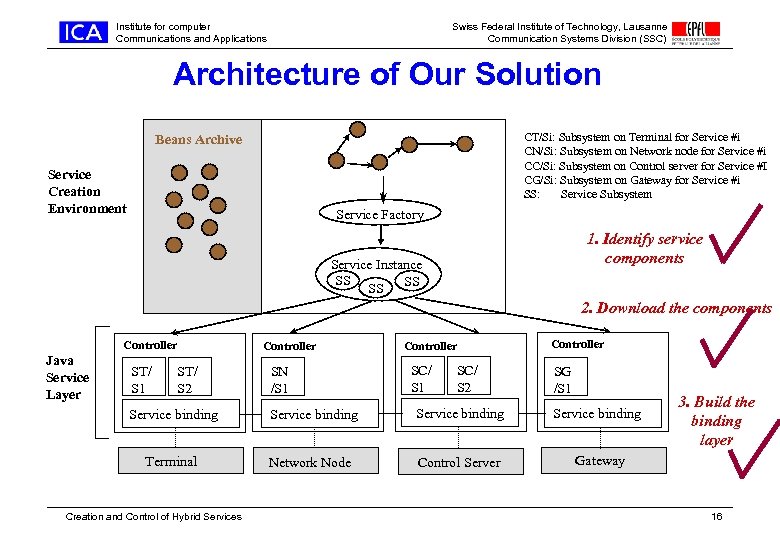
Institute for computer Communications and Applications Swiss Federal Institute of Technology, Lausanne Communication Systems Division (SSC) Architecture of Our Solution CT/Si: Subsystem on Terminal for Service #i CN/Si: Subsystem on Network node for Service #i CC/Si: Subsystem on Control server for Service #I CG/Si: Subsystem on Gateway for Service #i SS: Service Subsystem Beans Archive Service Creation Environment Service Factory 1. Identify service components Service Instance SS SS SS 2. Download the components Controller Java Service Layer ST/ S 1 Controller ST/ S 2 SN /S 1 Controller SC/ S 1 SC/ S 2 Controller SG /S 1 Service binding Terminal Network Node Control Server 3. Build the binding layer Gateway Creation and Control of Hybrid Services 16
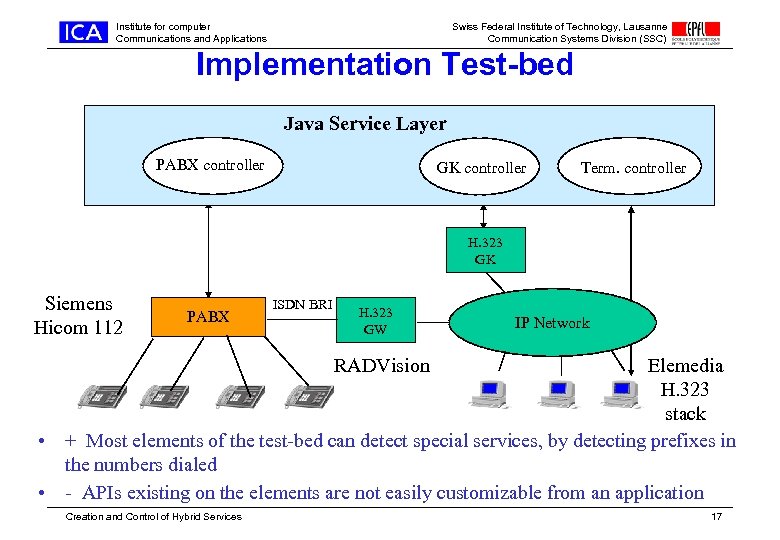
Institute for computer Communications and Applications Swiss Federal Institute of Technology, Lausanne Communication Systems Division (SSC) Implementation Test-bed Java Service Layer PABX controller GK controller Term. controller H. 323 GK Siemens Hicom 112 PABX ISDN BRI H. 323 GW IP Network RADVision Elemedia H. 323 stack • + Most elements of the test-bed can detect special services, by detecting prefixes in the numbers dialed • - APIs existing on the elements are not easily customizable from an application Creation and Control of Hybrid Services 17
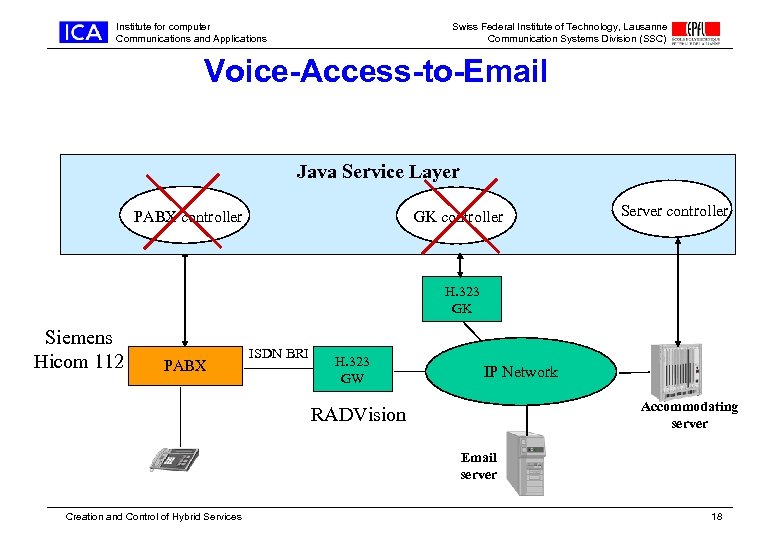
Institute for computer Communications and Applications Swiss Federal Institute of Technology, Lausanne Communication Systems Division (SSC) Voice-Access-to-Email Java Service Layer PABX controller GK controller Server controller H. 323 GK Siemens Hicom 112 PABX ISDN BRI H. 323 GW IP Network Accommodating server RADVision Email server Creation and Control of Hybrid Services 18
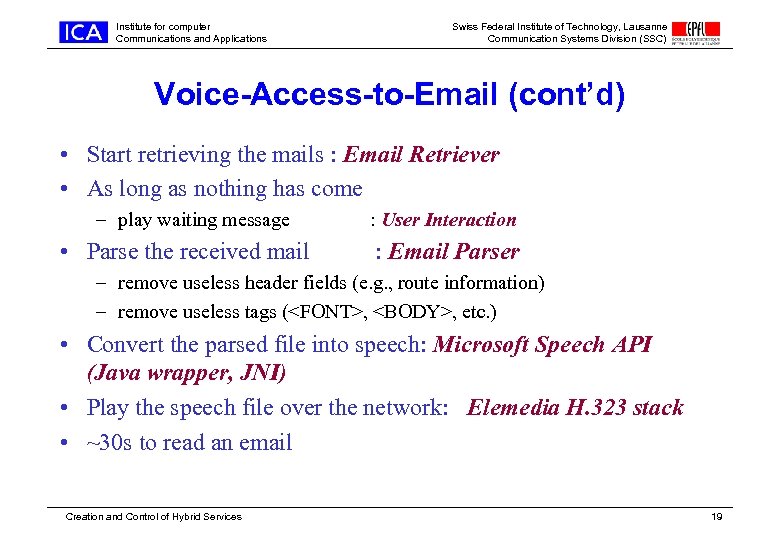
Institute for computer Communications and Applications Swiss Federal Institute of Technology, Lausanne Communication Systems Division (SSC) Voice-Access-to-Email (cont’d) • Start retrieving the mails : Email Retriever • As long as nothing has come – play waiting message • Parse the received mail : User Interaction : Email Parser – remove useless header fields (e. g. , route information) – remove useless tags (<FONT>, <BODY>, etc. ) • Convert the parsed file into speech: Microsoft Speech API (Java wrapper, JNI) • Play the speech file over the network: Elemedia H. 323 stack • ~30 s to read an email Creation and Control of Hybrid Services 19
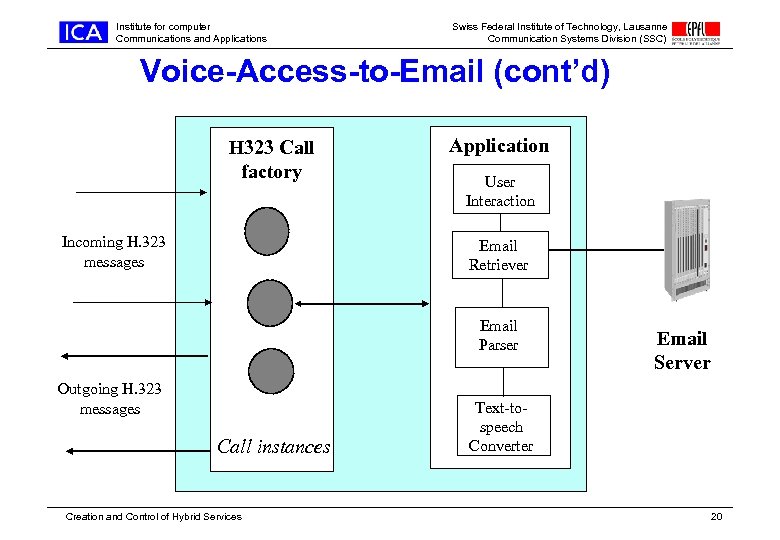
Institute for computer Communications and Applications Swiss Federal Institute of Technology, Lausanne Communication Systems Division (SSC) Voice-Access-to-Email (cont’d) H 323 Call factory Incoming H. 323 messages Application User Interaction Email Retriever Email Parser Outgoing H. 323 messages Call instances Creation and Control of Hybrid Services Email Server Text-tospeech Converter 20
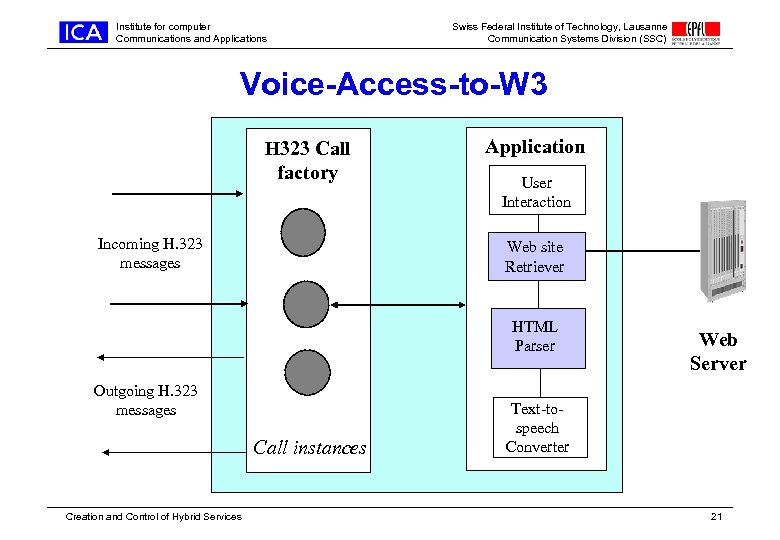
Institute for computer Communications and Applications Swiss Federal Institute of Technology, Lausanne Communication Systems Division (SSC) Voice-Access-to-W 3 H 323 Call factory Incoming H. 323 messages Application User Interaction Web site Retriever HTML Parser Outgoing H. 323 messages Call instances Creation and Control of Hybrid Services Web Server Text-tospeech Converter 21
Institute for computer Communications and Applications Swiss Federal Institute of Technology, Lausanne Communication Systems Division (SSC) Voice-Access-to-W 3: HTML Parser • Replace a link by an announcement like “Press 234 if you wanna learn more about this topic” • Remove applet information • Remove scripts • A dedicated language would be a suitable solution but then all pages would have to be re-written! Creation and Control of Hybrid Services 22
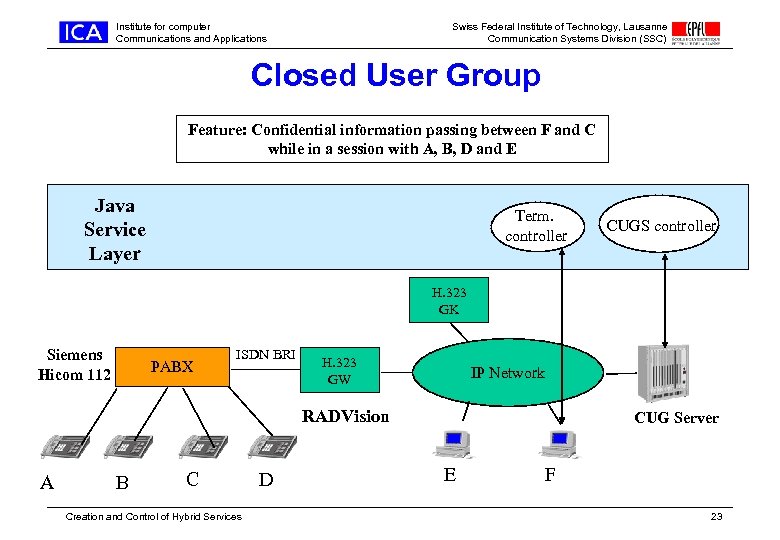
Institute for computer Communications and Applications Swiss Federal Institute of Technology, Lausanne Communication Systems Division (SSC) Closed User Group Feature: Confidential information passing between F and C while in a session with A, B, D and E Java Service Layer Term. controller CUGS controller H. 323 GK Siemens Hicom 112 PABX ISDN BRI H. 323 GW IP Network RADVision A B C Creation and Control of Hybrid Services D CUG Server E F 23
Institute for computer Communications and Applications Swiss Federal Institute of Technology, Lausanne Communication Systems Division (SSC) Learnings • The proposed architecture can be used to enhance the service offerings of current platforms • To fully take advantage of the architecture, we need APIs for the platform elements • Service composability within the architecture has been illustrated • Java is a good candidate Creation and Control of Hybrid Services 24
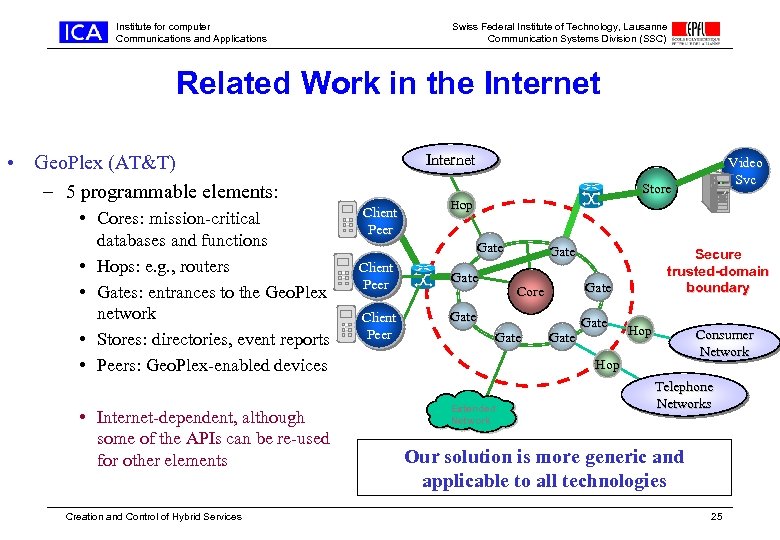
Institute for computer Communications and Applications Swiss Federal Institute of Technology, Lausanne Communication Systems Division (SSC) Related Work in the Internet • Geo. Plex (AT&T) – 5 programmable elements: • Cores: mission-critical databases and functions • Hops: e. g. , routers • Gates: entrances to the Geo. Plex network • Stores: directories, event reports • Peers: Geo. Plex-enabled devices • Internet-dependent, although some of the APIs can be re-used for other elements Creation and Control of Hybrid Services Video Svc Store Client e Peer Hop Gate e Client Peer Gate Core Gate Secure trusted-domain boundary Gate Hop Consumer Network Hop Extended Network Telephone Networks Our solution is more generic and applicable to all technologies 25
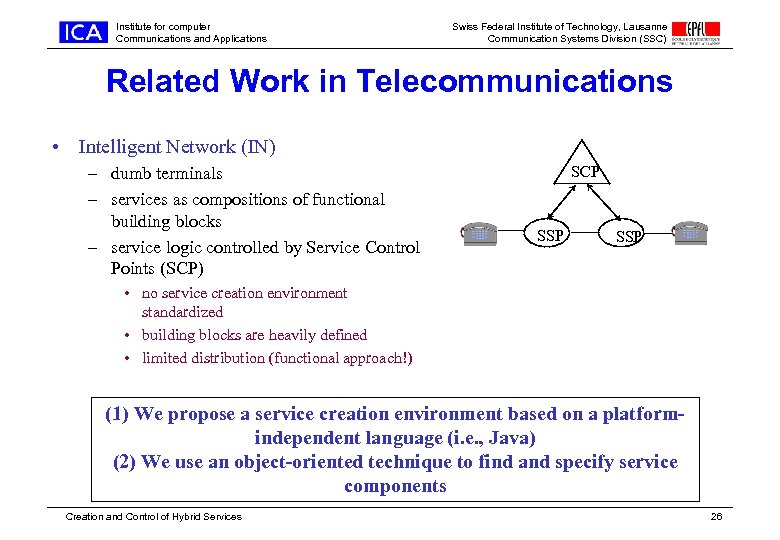
Institute for computer Communications and Applications Swiss Federal Institute of Technology, Lausanne Communication Systems Division (SSC) Related Work in Telecommunications • Intelligent Network (IN) – dumb terminals – services as compositions of functional building blocks – service logic controlled by Service Control Points (SCP) SCP SSP • no service creation environment standardized • building blocks are heavily defined • limited distribution (functional approach!) (1) We propose a service creation environment based on a platformindependent language (i. e. , Java) (2) We use an object-oriented technique to find and specify service components Creation and Control of Hybrid Services 26
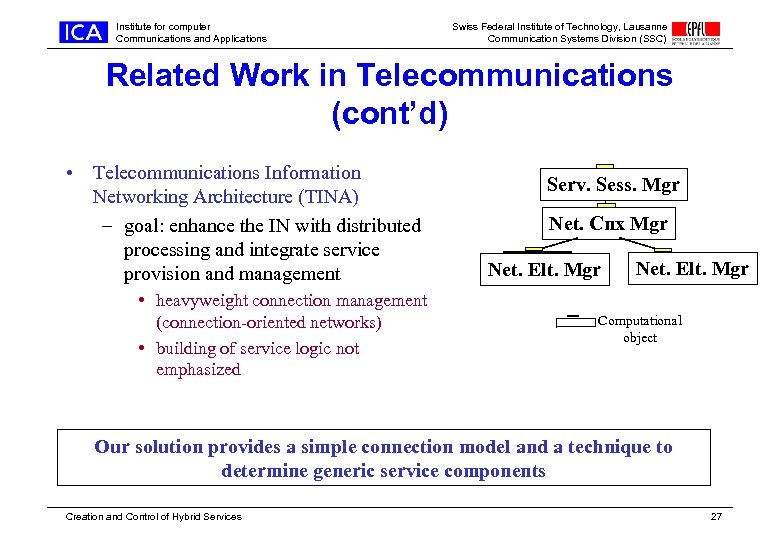
Institute for computer Communications and Applications Swiss Federal Institute of Technology, Lausanne Communication Systems Division (SSC) Related Work in Telecommunications (cont’d) • Telecommunications Information Networking Architecture (TINA) – goal: enhance the IN with distributed processing and integrate service provision and management • heavyweight connection management (connection-oriented networks) • building of service logic not emphasized Serv. Sess. Mgr Net. Cnx Mgr Net. Elt. Mgr Computational object Our solution provides a simple connection model and a technique to determine generic service components Creation and Control of Hybrid Services 27
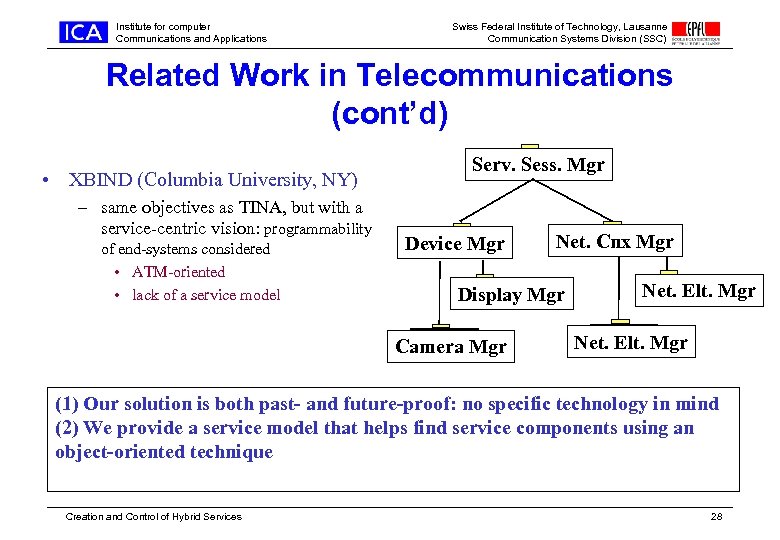
Institute for computer Communications and Applications Swiss Federal Institute of Technology, Lausanne Communication Systems Division (SSC) Related Work in Telecommunications (cont’d) • XBIND (Columbia University, NY) – same objectives as TINA, but with a service-centric vision: programmability of end-systems considered • ATM-oriented • lack of a service model Serv. Sess. Mgr Device Mgr Net. Cnx Mgr Display Mgr Camera Mgr Net. Elt. Mgr (1) Our solution is both past- and future-proof: no specific technology in mind (2) We provide a service model that helps find service components using an object-oriented technique Creation and Control of Hybrid Services 28
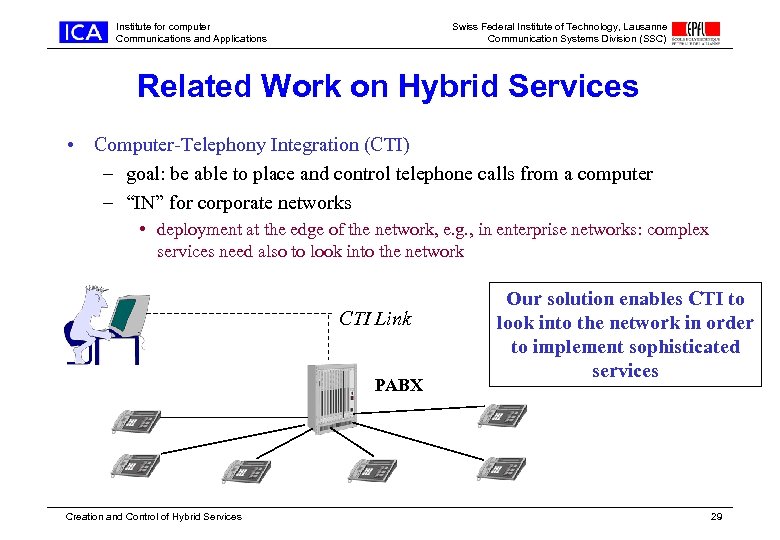
Institute for computer Communications and Applications Swiss Federal Institute of Technology, Lausanne Communication Systems Division (SSC) Related Work on Hybrid Services • Computer-Telephony Integration (CTI) – goal: be able to place and control telephone calls from a computer – “IN” for corporate networks • deployment at the edge of the network, e. g. , in enterprise networks: complex services need also to look into the network CTI Link PABX Creation and Control of Hybrid Services Our solution enables CTI to look into the network in order to implement sophisticated services 29
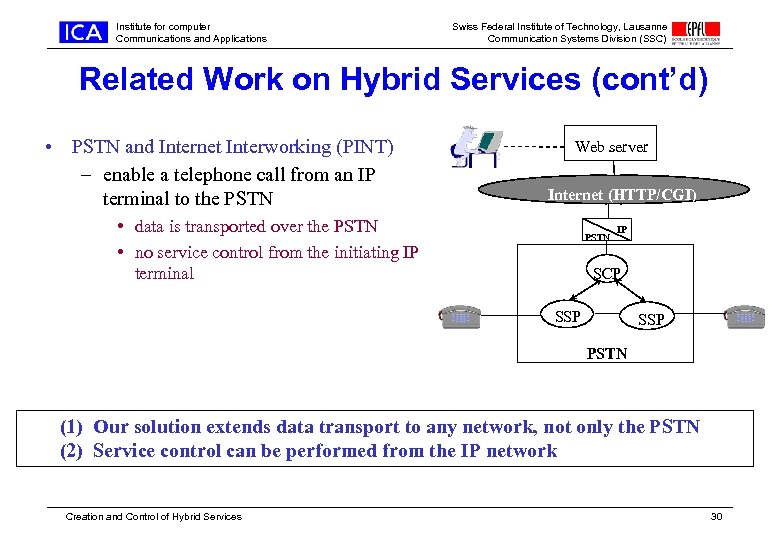
Institute for computer Communications and Applications Swiss Federal Institute of Technology, Lausanne Communication Systems Division (SSC) Related Work on Hybrid Services (cont’d) • PSTN and Internet Interworking (PINT) – enable a telephone call from an IP terminal to the PSTN Web server Internet (HTTP/CGI) • data is transported over the PSTN • no service control from the initiating IP terminal PSTN IP SCP SSP PSTN (1) Our solution extends data transport to any network, not only the PSTN (2) Service control can be performed from the IP network Creation and Control of Hybrid Services 30
Institute for computer Communications and Applications Swiss Federal Institute of Technology, Lausanne Communication Systems Division (SSC) Summary • Legacy systems are unlikely to disappear overnight: the future will be hybrid • Main contributions – Thorough assessment of the benefits in integrating Telecoms and Internet – A service-centric and programmable architecture – A method for determining service components – A method for interfacing with service system elements, including existing networks and mechanisms • We provide a unified way to interface with existing networks • Our method enables smooth introduction of new services Creation and Control of Hybrid Services 31
Institute for computer Communications and Applications Swiss Federal Institute of Technology, Lausanne Communication Systems Division (SSC) Summary (cont’d) • Future directions – Inter-provider interface • how to make service control layers of different operators talk to one another? – Management • how to manage the behavior of a service? • how to allocate resources for a service and control this allocation? • how to solve feature interactions? – Performance • what do we need to do in order to build a system that performs as reliably as the PSTN? Creation and Control of Hybrid Services 32
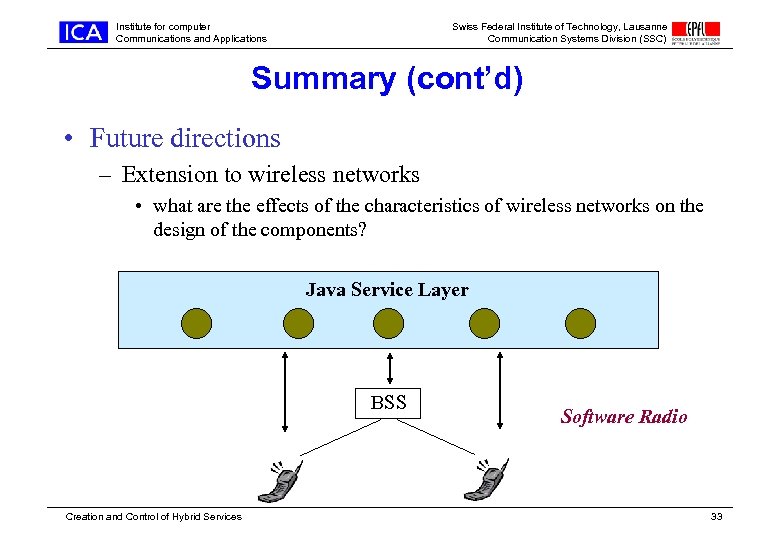
Institute for computer Communications and Applications Swiss Federal Institute of Technology, Lausanne Communication Systems Division (SSC) Summary (cont’d) • Future directions – Extension to wireless networks • what are the effects of the characteristics of wireless networks on the design of the components? Java Service Layer BSS Creation and Control of Hybrid Services Software Radio 33
Institute for computer Communications and Applications Swiss Federal Institute of Technology, Lausanne Communication Systems Division (SSC) References • J. P. Hubaux, C. Gbaguidi, S. Koppenhoefer and J. Y. Le Boudec, “The impact of the Internet on Telecommunication architectures”, Computer Networks, Feb. 1999 • C. Gbaguidi, J. P. Hubaux, G. Pacifici and A. N. Tantawi, “Integration of Internet and Telecommunications: An architecture for hybrid services”, JSAC, Sept. 1999. • C. Gbaguidi, J. P. Hubaux, M. Hamdi and A. N. Tantawi, “A programmable architecture for the provision of hybrid services”, IEEE Comm. Mag. , July 1999. • C. Gbaguidi, S. Znaty and J. P. Hubaux, “Multimedia resources: An information model and its application to an MPEG 2 video codec”, JNSM, Sept. 1998. Creation and Control of Hybrid Services 34
Скачать презентацию Programmable Architecture for the Creation and Seamless Control
d555db12d3d787af7a11dba13de973ec.ppt