 Скачать презентацию Programa para a America Latina e o Caribe
b6f15d6e83c9535d66b56838e62df330.ppt
- Количество слайдов: 43



Programa para a America Latina e o Caribe Woodrow Wilson International Center for Scholars Comparative Urban Studies Project Access to Urban Land Losing Ground? Alternatives to informality Martim O. Smolka Washington DC , September 14, 2006 Martim Smolka - msmolka@lincolninst. edu 1
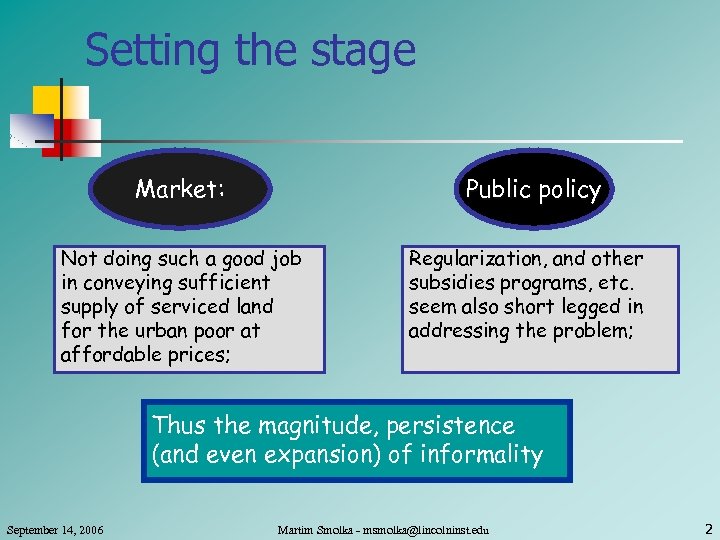
Setting the stage Market: Public policy Not doing such a good job in conveying sufficient supply of serviced land for the urban poor at affordable prices; Regularization, and other subsidies programs, etc. seem also short legged in addressing the problem; Thus the magnitude, persistence (and even expansion) of informality September 14, 2006 Martim Smolka - msmolka@lincolninst. edu 2
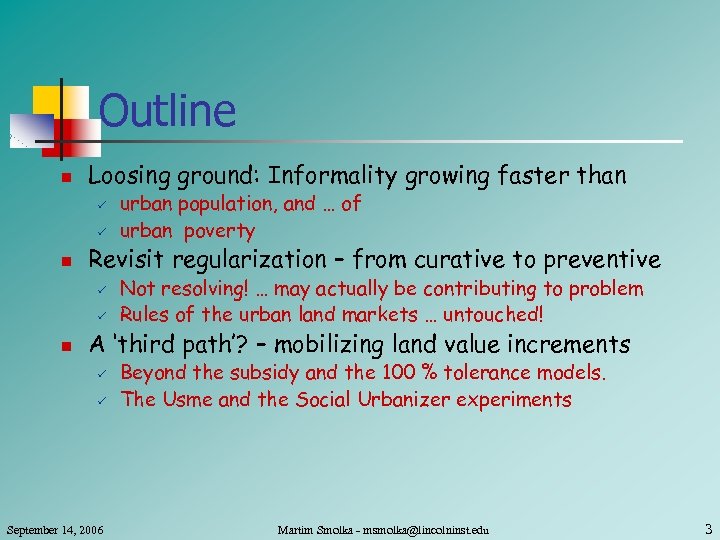
Outline n Loosing ground: Informality growing faster than ü ü n Revisit regularization – from curative to preventive ü ü n urban population, and … of urban poverty Not resolving! … may actually be contributing to problem Rules of the urban land markets … untouched! A ‘third path’? – mobilizing land value increments ü ü September 14, 2006 Beyond the subsidy and the 100 % tolerance models. The Usme and the Social Urbanizer experiments Martim Smolka - msmolka@lincolninst. edu 3
September 14, 2006 Martim Smolka - msmolka@lincolninst. edu 4
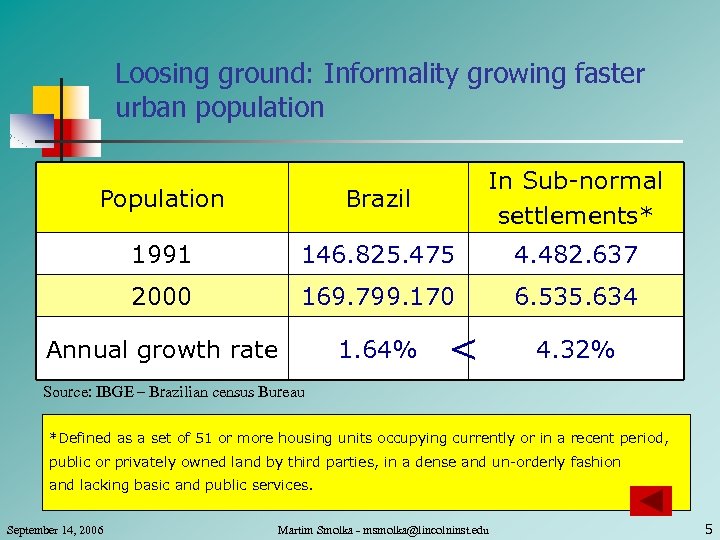
Loosing ground: Informality growing faster urban population Population Brazil In Sub-normal settlements* 1991 146. 825. 475 4. 482. 637 2000 169. 799. 170 6. 535. 634 Annual growth rate 1. 64% < 4. 32% Source: IBGE – Brazilian census Bureau *Defined as a set of 51 or more housing units occupying currently or in a recent period, public or privately owned land by third parties, in a dense and un-orderly fashion and lacking basic and public services. September 14, 2006 Martim Smolka - msmolka@lincolninst. edu 5
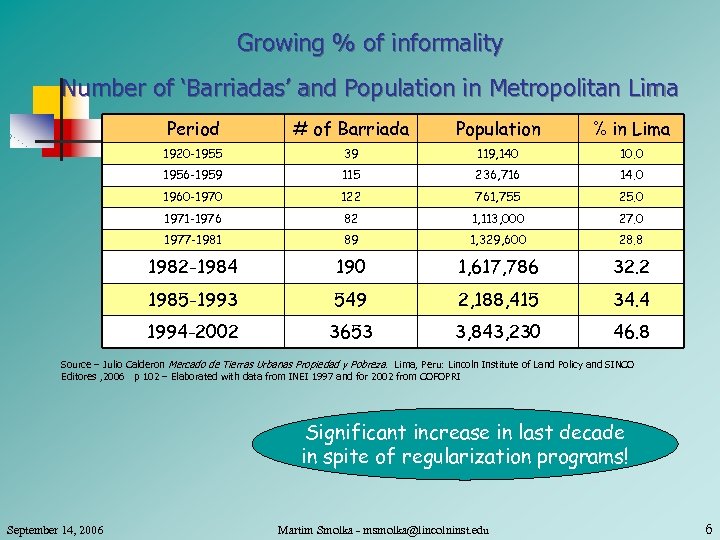
Growing % of informality Number of ‘Barriadas’ and Population in Metropolitan Lima Period # of Barriada Population % in Lima 1920 -1955 39 119, 140 10. 0 1956 -1959 115 236, 716 14. 0 1960 -1970 122 761, 755 25. 0 1971 -1976 82 1, 113, 000 27. 0 1977 -1981 89 1, 329, 600 28. 8 1982 -1984 190 1, 617, 786 32. 2 1985 -1993 549 2, 188, 415 34. 4 1994 -2002 3653 3, 843, 230 46. 8 Source – Julio Calderon Mercado de Tierras Urbanas Propiedad y Pobreza. Lima, Peru: Lincoln Institute of Land Policy and SINCO Editores , 2006 p 102 – Elaborated with data from INEI 1997 and for 2002 from COFOPRI Significant increase in last decade in spite of regularization programs! September 14, 2006 Martim Smolka - msmolka@lincolninst. edu 6
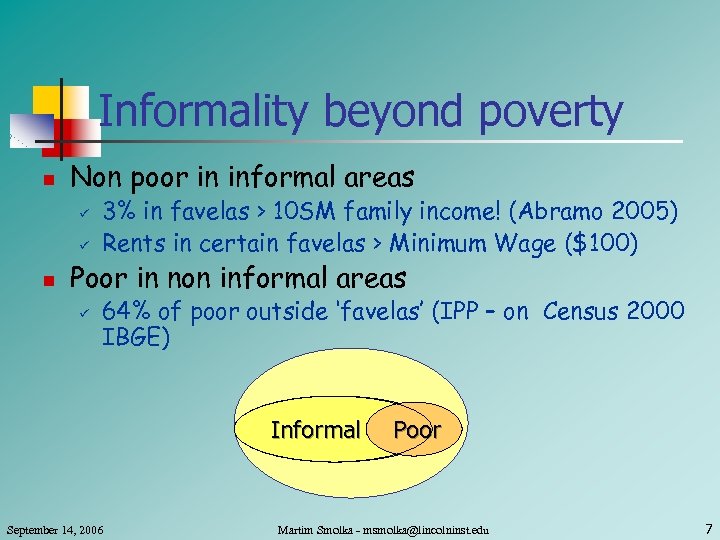
Informality beyond poverty n Non poor in informal areas ü ü n 3% in favelas > 10 SM family income! (Abramo 2005) Rents in certain favelas > Minimum Wage ($100) Poor in non informal areas ü 64% of poor outside ‘favelas’ (IPP – on Census 2000 IBGE) Informal September 14, 2006 Poor Martim Smolka - msmolka@lincolninst. edu 7
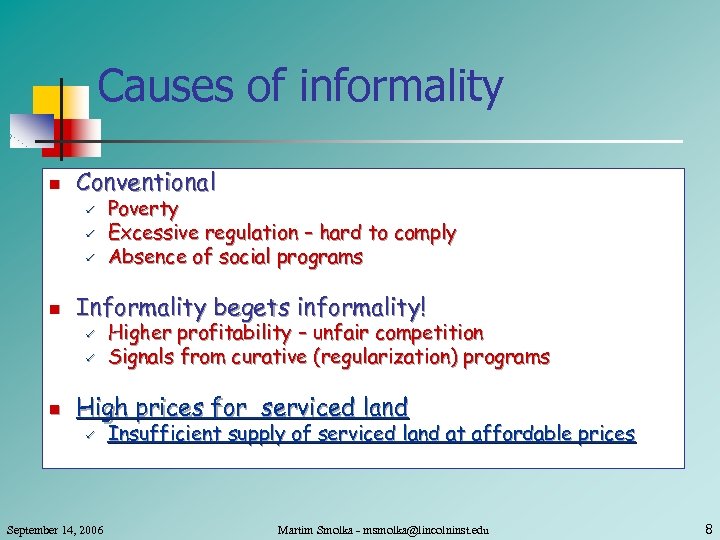
Causes of informality n Conventional ü ü ü n Informality begets informality! ü ü n Poverty Excessive regulation – hard to comply Absence of social programs Higher profitability – unfair competition Signals from curative (regularization) programs High prices for serviced land ü September 14, 2006 Insufficient supply of serviced land at affordable prices Martim Smolka - msmolka@lincolninst. edu 8

September 14, 2006 Martim Smolka - msmolka@lincolninst. edu 9
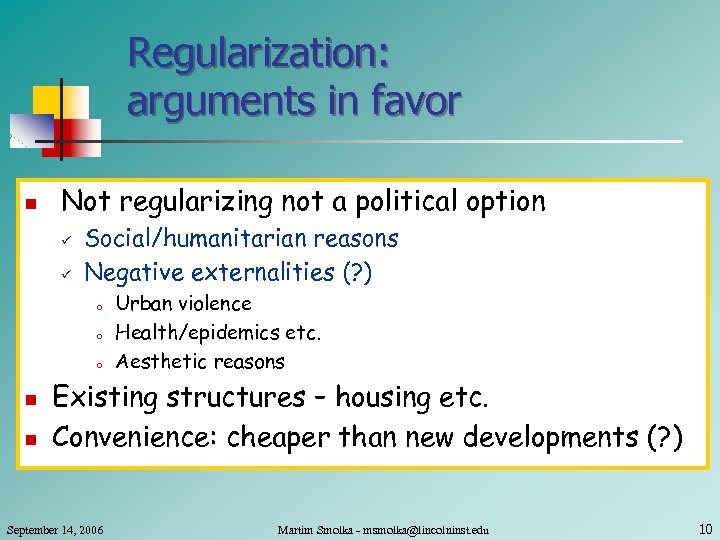
Regularization: arguments in favor n Not regularizing not a political option ü ü Social/humanitarian reasons Negative externalities (? ) o o o n n Urban violence Health/epidemics etc. Aesthetic reasons Existing structures – housing etc. Convenience: cheaper than new developments (? ) September 14, 2006 Martim Smolka - msmolka@lincolninst. edu 10
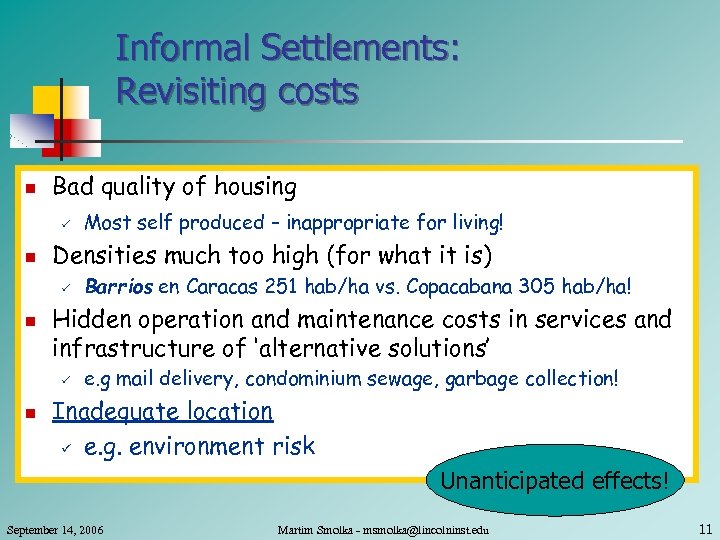
Informal Settlements: Revisiting costs n Bad quality of housing ü n Densities much too high (for what it is) ü n Barrios en Caracas 251 hab/ha vs. Copacabana 305 hab/ha! Hidden operation and maintenance costs in services and infrastructure of ‘alternative solutions’ ü n Most self produced – inappropriate for living! e. g mail delivery, condominium sewage, garbage collection! Inadequate location ü e. g. environment risk Unanticipated effects! September 14, 2006 Martim Smolka - msmolka@lincolninst. edu 11
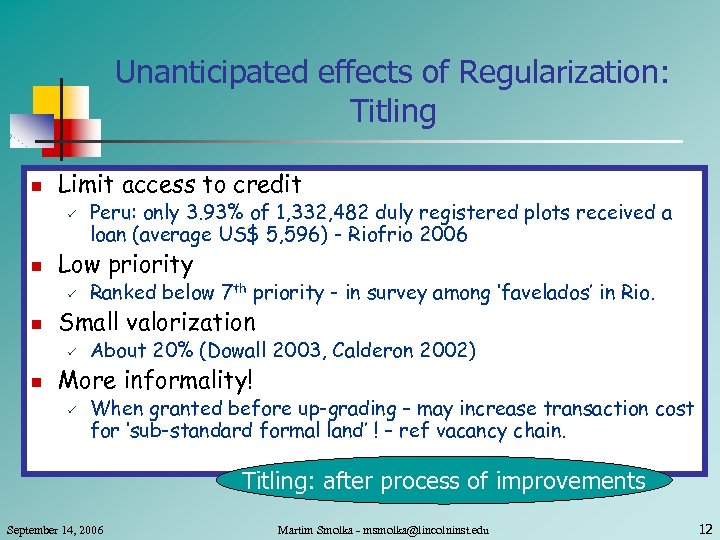
Unanticipated effects of Regularization: Titling n Limit access to credit ü n Low priority ü n Ranked below 7 th priority - in survey among ‘favelados’ in Rio. Small valorization ü n Peru: only 3. 93% of 1, 332, 482 duly registered plots received a loan (average US$ 5, 596) - Riofrio 2006 About 20% (Dowall 2003, Calderon 2002) More informality! ü When granted before up-grading – may increase transaction cost for ‘sub-standard formal land’ ! – ref vacancy chain. Titling: after process of improvements September 14, 2006 Martim Smolka - msmolka@lincolninst. edu 12
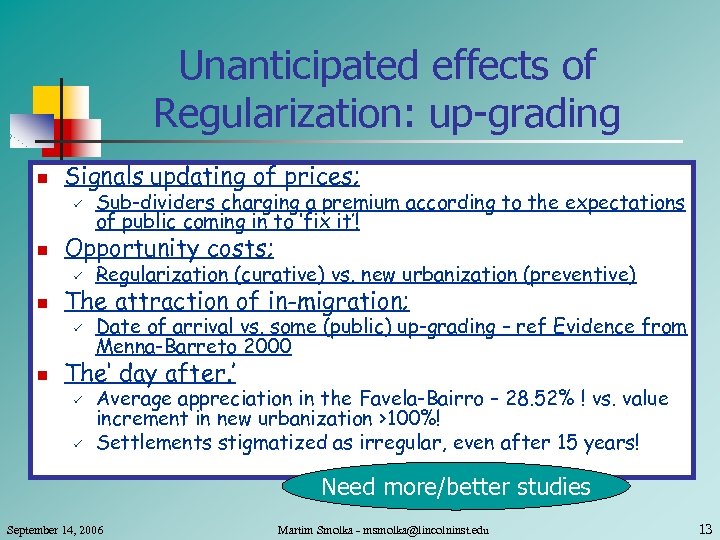
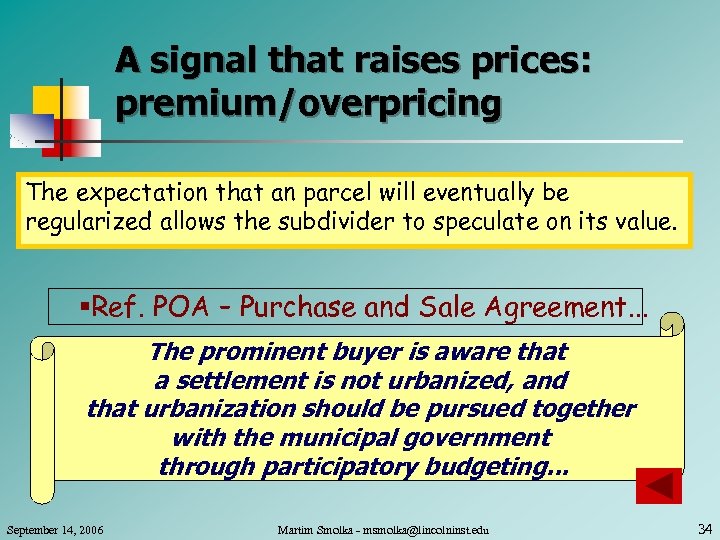
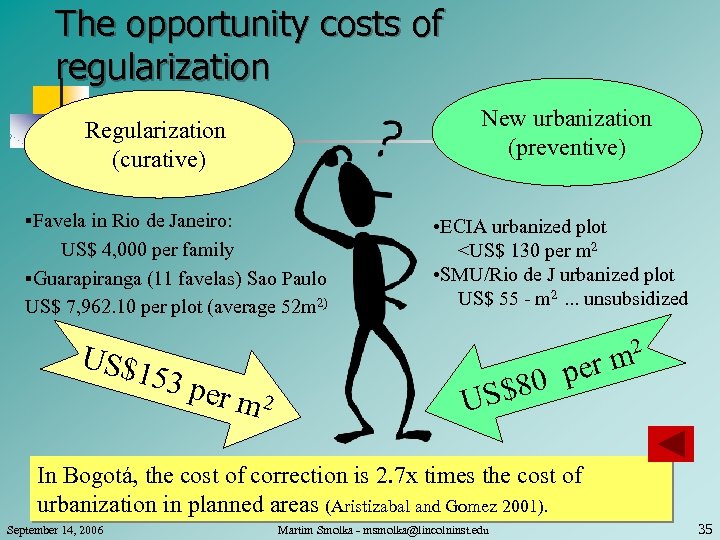
Unanticipated effects of Regularization: up-grading n Signals updating of prices; ü n Sub-dividers charging a premium according to the expectations of public coming in to ‘fix it’! Opportunity costs; ü ü n n Regularization (curative) vs. new urbanization (preventive) Date of arrival vs. some (public) up-grading – ref Evidence from Menna-Barreto 2000 The attraction of in-migration; The‘ day after. ’ ü ü Average appreciation in the Favela-Bairro – 28. 52% ! vs. value increment in new urbanization >100%! Settlements stigmatized as irregular, even after 15 years! Need more/better studies September 14, 2006 Martim Smolka - msmolka@lincolninst. edu 13
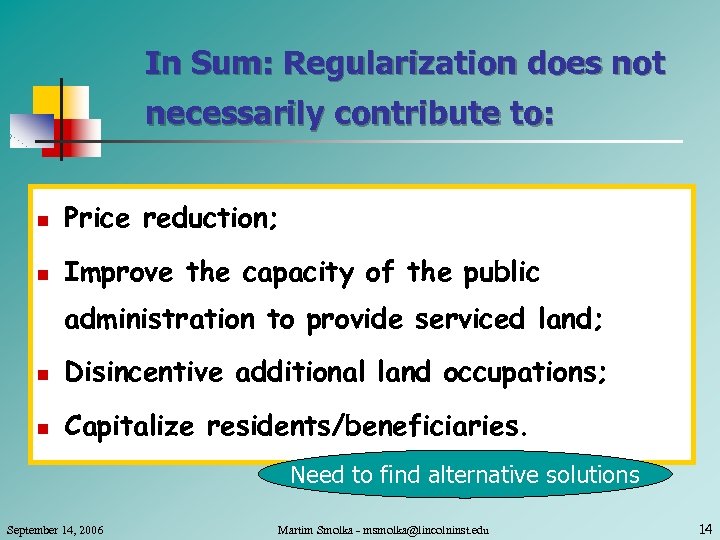
In Sum: Regularization does not necessarily contribute to: n Price reduction; n Improve the capacity of the public administration to provide serviced land; n Disincentive additional land occupations; n Capitalize residents/beneficiaries. Need to find alternative solutions September 14, 2006 Martim Smolka - msmolka@lincolninst. edu 14
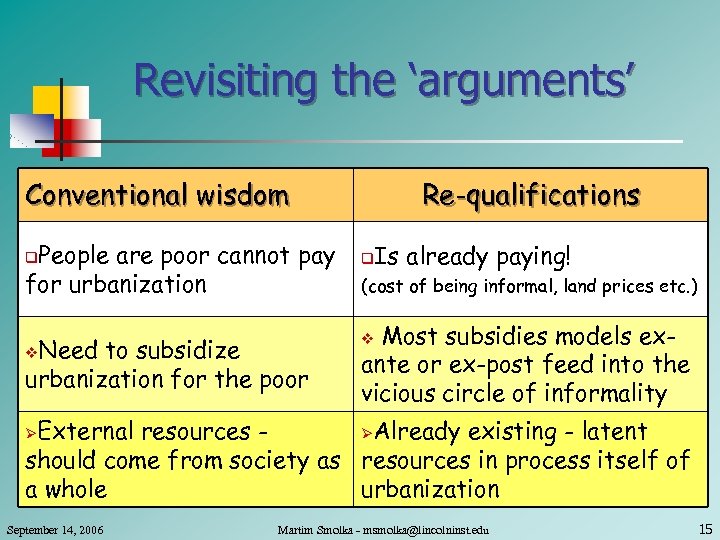
Revisiting the ‘arguments’ Conventional wisdom People are poor cannot pay for urbanization q Need to subsidize urbanization for the poor v Re-qualifications q Is already paying! (cost of being informal, land prices etc. ) Most subsidies models exante or ex-post feed into the vicious circle of informality v External resources ØAlready existing - latent should come from society as resources in process itself of a whole urbanization Ø September 14, 2006 Martim Smolka - msmolka@lincolninst. edu 15

September 14, 2006 Martim Smolka - msmolka@lincolninst. edu 16
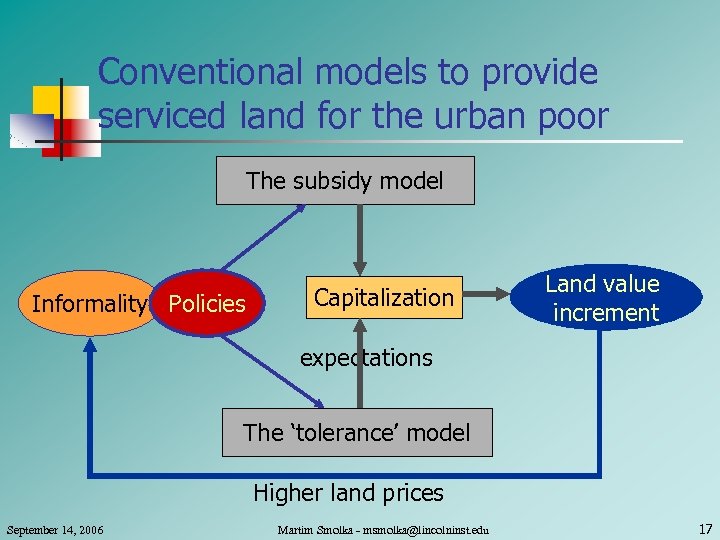
Conventional models to provide serviced land for the urban poor The subsidy model Informality Policies Capitalization Land value increment expectations The ‘tolerance’ model Higher land prices September 14, 2006 Martim Smolka - msmolka@lincolninst. edu 17
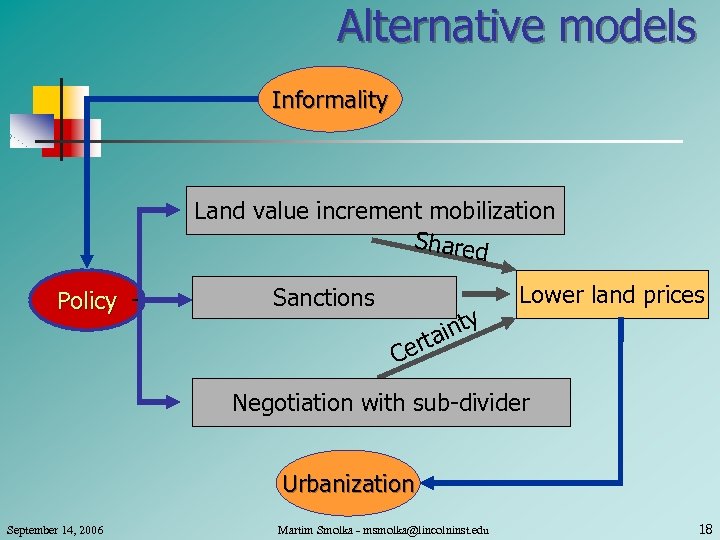
Alternative models Informality Land value increment mobilization Shared Policy Sanctions inty ta Lower land prices Cer Negotiation with sub-divider Urbanization September 14, 2006 Martim Smolka - msmolka@lincolninst. edu 18
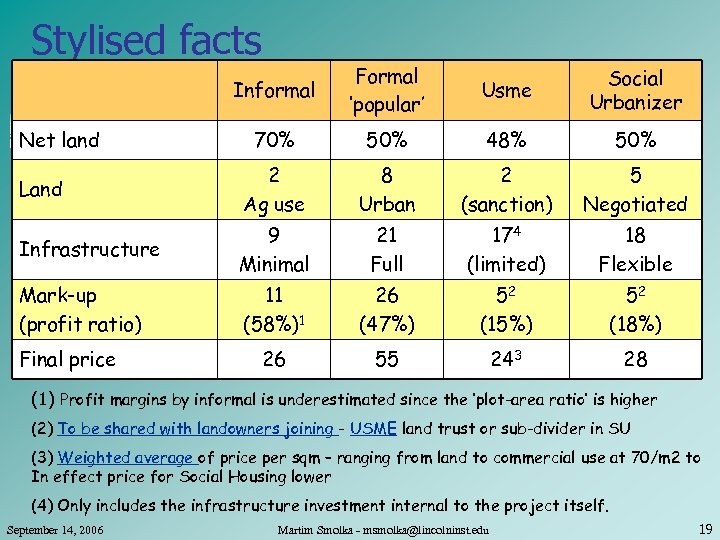
Stylised facts Informal Formal ‘popular’ Usme Social Urbanizer 70% 50% 48% 50% Land 2 Ag use 8 Urban 2 (sanction) 5 Negotiated Infrastructure 9 Minimal 21 Full 174 (limited) 18 Flexible Mark-up (profit ratio) 11 (58%)1 26 (47%) 52 (15%) 52 (18%) 26 55 243 28 Net land Final price (1) Profit margins by informal is underestimated since the ‘plot-area ratio’ is higher (2) To be shared with landowners joining - USME land trust or sub-divider in SU (3) Weighted average of price per sqm – ranging from land to commercial use at 70/m 2 to In effect price for Social Housing lower (4) Only includes the infrastructure investment internal to the project itself. September 14, 2006 Martim Smolka - msmolka@lincolninst. edu 19
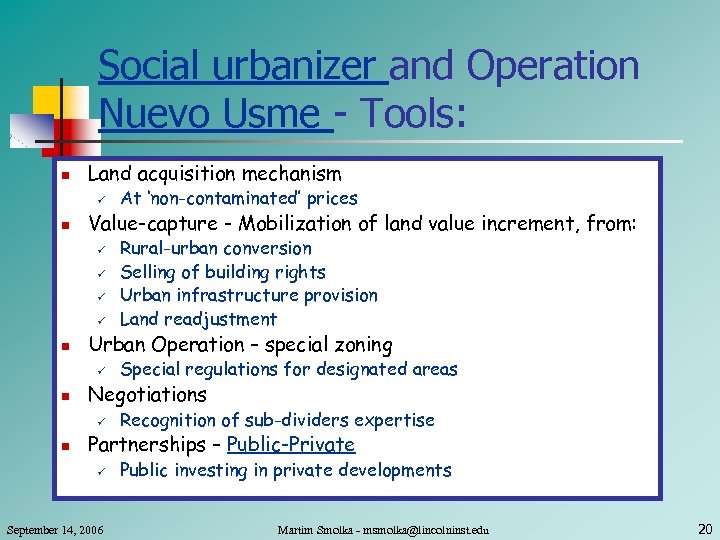
Social urbanizer and Operation Nuevo Usme - Tools: n Land acquisition mechanism ü n Value-capture - Mobilization of land value increment, from: ü ü n Special regulations for designated areas Negotiations ü n Rural-urban conversion Selling of building rights Urban infrastructure provision Land readjustment Urban Operation – special zoning ü n At ‘non-contaminated’ prices Recognition of sub-dividers expertise Partnerships – Public-Private ü September 14, 2006 Public investing in private developments Martim Smolka - msmolka@lincolninst. edu 20
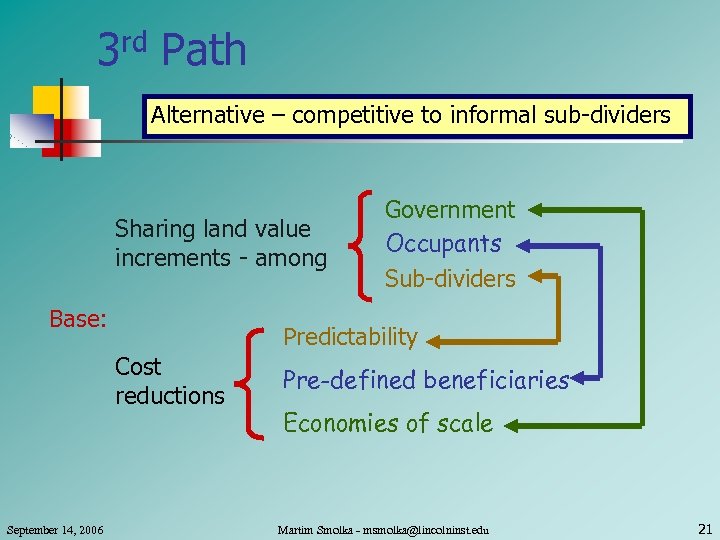
3 rd Path Alternative – competitive to informal sub-dividers Sharing land value increments - among Base: Predictability Cost reductions September 14, 2006 Government Occupants Sub-dividers Pre-defined beneficiaries Economies of scale Martim Smolka - msmolka@lincolninst. edu 21
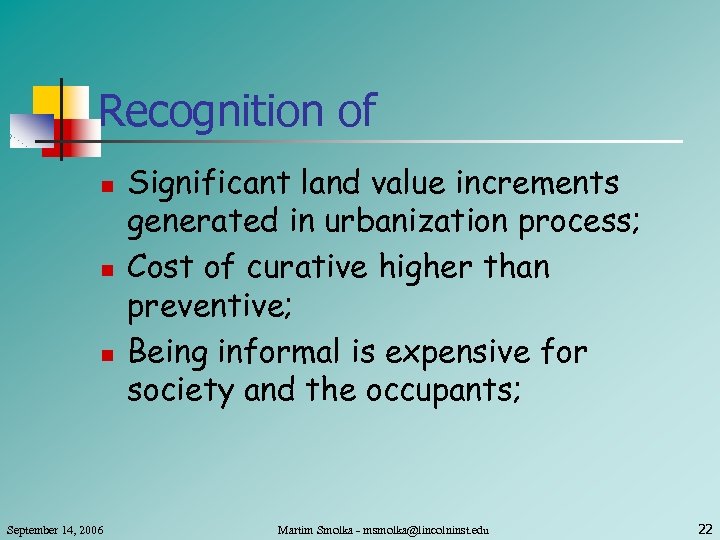
Recognition of n n n September 14, 2006 Significant land value increments generated in urbanization process; Cost of curative higher than preventive; Being informal is expensive for society and the occupants; Martim Smolka - msmolka@lincolninst. edu 22
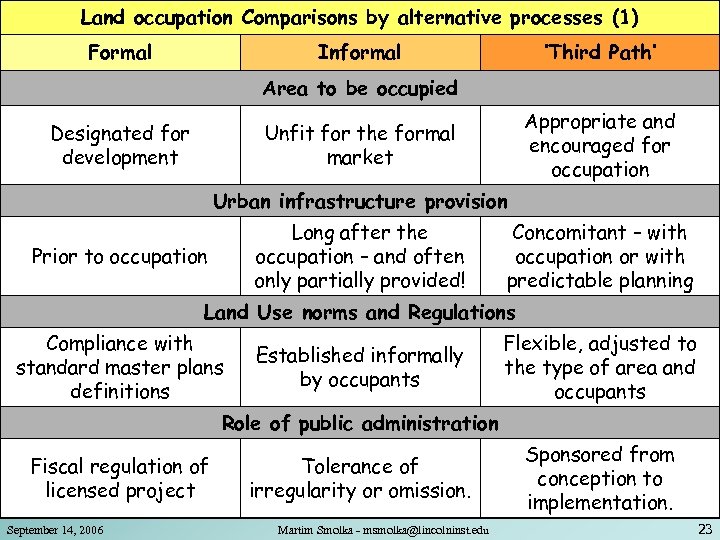
Land occupation Comparisons by alternative processes (1) Formal Informal ‘Third Path’ Area to be occupied Designated for development Appropriate and encouraged for occupation Unfit for the formal market Urban infrastructure provision Long after the occupation – and often only partially provided! Prior to occupation Concomitant – with occupation or with predictable planning Land Use norms and Regulations Compliance with standard master plans definitions Established informally by occupants Flexible, adjusted to the type of area and occupants Role of public administration Fiscal regulation of licensed project September 14, 2006 Tolerance of irregularity or omission. Martim Smolka - msmolka@lincolninst. edu Sponsored from conception to implementation. 23
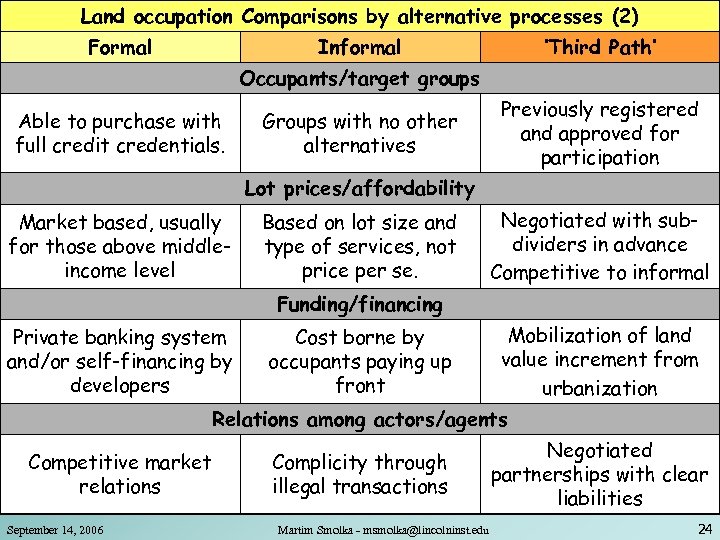
Land occupation Comparisons by alternative processes (2) Formal Informal ‘Third Path’ Occupants/target groups Able to purchase with full credit credentials. Groups with no other alternatives Previously registered and approved for participation Lot prices/affordability Market based, usually for those above middleincome level Based on lot size and type of services, not price per se. Negotiated with subdividers in advance Competitive to informal Funding/financing Private banking system and/or self-financing by developers Cost borne by occupants paying up front Mobilization of land value increment from urbanization Relations among actors/agents Competitive market relations September 14, 2006 Complicity through illegal transactions Martim Smolka - msmolka@lincolninst. edu Negotiated partnerships with clear liabilities 24
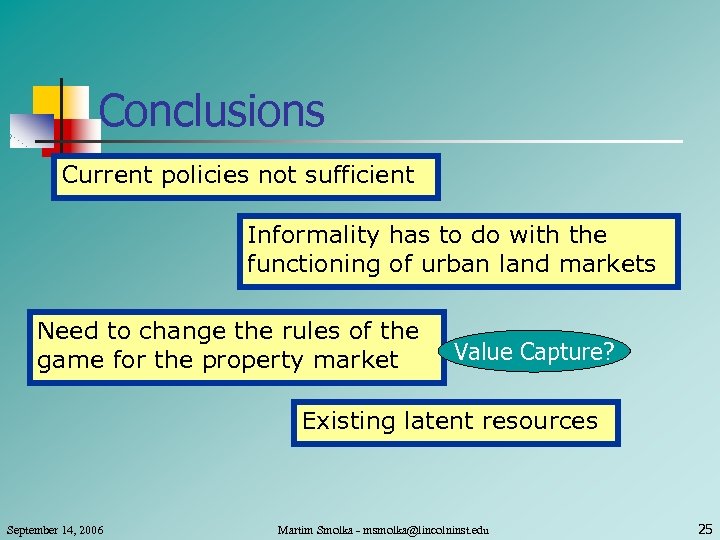
Conclusions Current policies not sufficient Informality has to do with the functioning of urban land markets Need to change the rules of the game for the property market Value Capture? Existing latent resources September 14, 2006 Martim Smolka - msmolka@lincolninst. edu 25

September 14, 2006 Martim Smolka - msmolka@lincolninst. edu 26

Martim Oscar Smolka Senior Fellow and Director of the Latin America and the Caribbean Program Lincoln Institute of Land Policy 113 Brattle Street Cambridge, MA 02138, USA Phone direct : 1 - (617) 503 2155 or 661 -3016 ext. 155 Fax: 1 - (617) 661 -7235 e-mail: msmolka@lincolninst. edu http: \www. lincolninst. edu September 14, 2006 Martim Smolka - msmolka@lincolninst. edu 27
Hyperlinks September 14, 2006 Martim Smolka - msmolka@lincolninst. edu 28
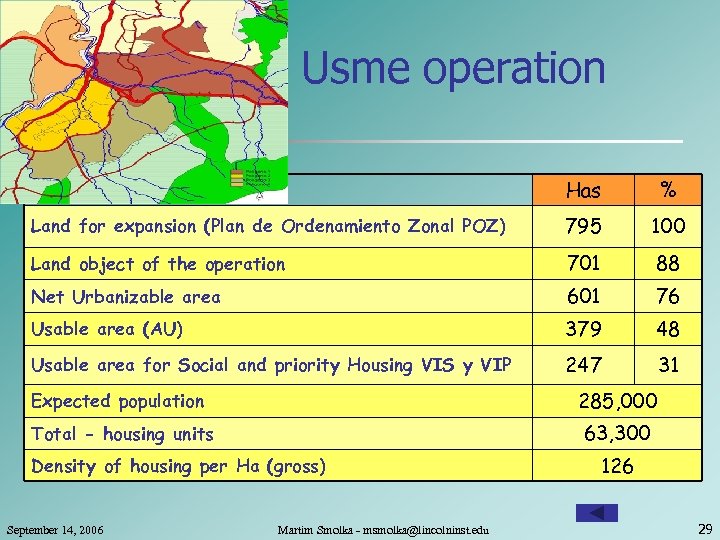
Usme operation Has % Land for expansion (Plan de Ordenamiento Zonal POZ) 795 100 Land object of the operation 701 88 Net Urbanizable area 601 76 Usable area (AU) 379 48 Usable area for Social and priority Housing VIS y VIP 247 31 Expected population 285, 000 Total - housing units 63, 300 Density of housing per Ha (gross) September 14, 2006 Martim Smolka - msmolka@lincolninst. edu 126 29
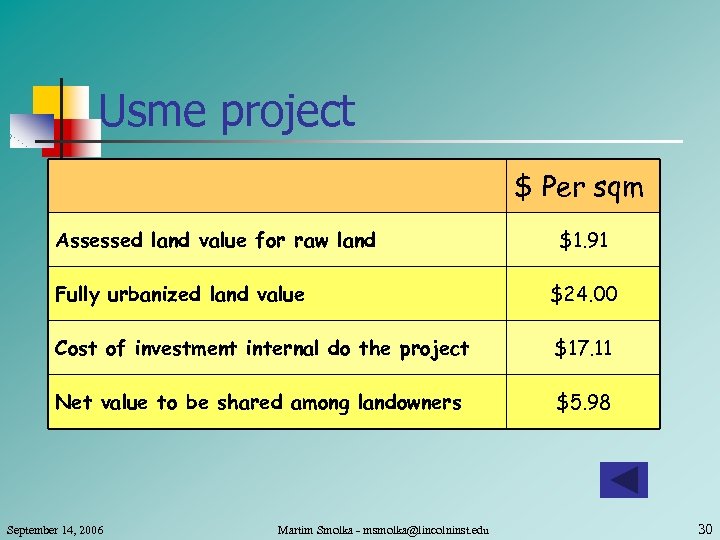
Usme project $ Per sqm Assessed land value for raw land $1. 91 Fully urbanized land value $24. 00 Cost of investment internal do the project $17. 11 Net value to be shared among landowners $5. 98 September 14, 2006 Martim Smolka - msmolka@lincolninst. edu 30
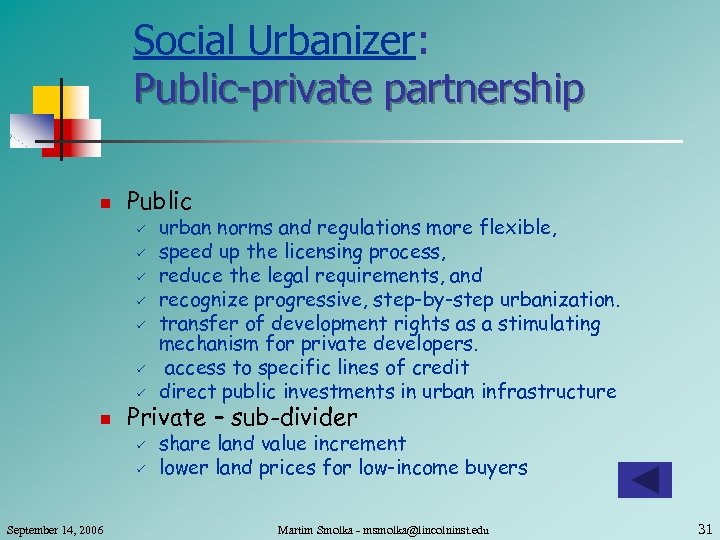
Social Urbanizer: Public-private partnership n Public ü ü ü ü n Private – sub-divider ü ü September 14, 2006 urban norms and regulations more flexible, speed up the licensing process, reduce the legal requirements, and recognize progressive, step-by-step urbanization. transfer of development rights as a stimulating mechanism for private developers. access to specific lines of credit direct public investments in urban infrastructure share land value increment lower land prices for low-income buyers Martim Smolka - msmolka@lincolninst. edu 31
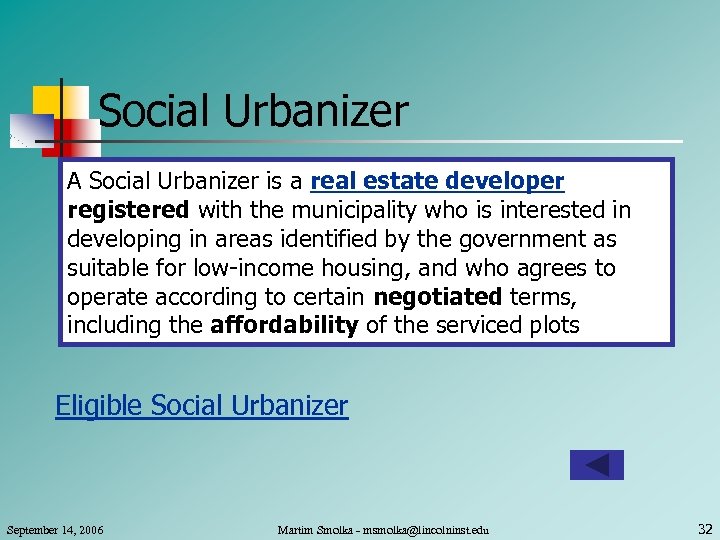
Social Urbanizer A Social Urbanizer is a real estate developer registered with the municipality who is interested in developing in areas identified by the government as suitable for low-income housing, and who agrees to operate according to certain negotiated terms, including the affordability of the serviced plots Eligible Social Urbanizer September 14, 2006 Martim Smolka - msmolka@lincolninst. edu 32
Eligible Social Urbanizer n n September 14, 2006 Registered real estate developers, Contractors already working in the informal market, Landowners and Self-managed cooperatives. Martim Smolka - msmolka@lincolninst. edu 33
A signal that raises prices: premium/overpricing The expectation that an parcel will eventually be regularized allows the subdivider to speculate on its value. §Ref. POA – Purchase and Sale Agreement. . . The prominent buyer is aware that a settlement is not urbanized, and that urbanization should be pursued together with the municipal government through participatory budgeting. . . September 14, 2006 Martim Smolka - msmolka@lincolninst. edu 34
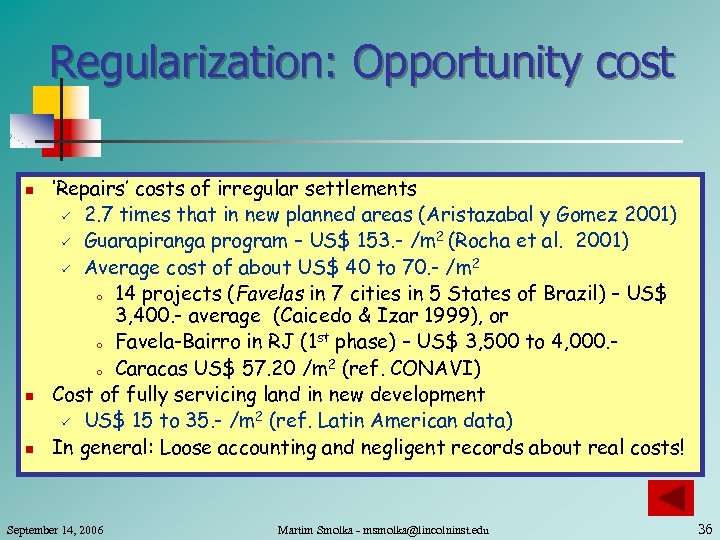
The opportunity costs of regularization New urbanization (preventive) Regularization (curative) §Favela in Rio de Janeiro: US$ 4, 000 per family §Guarapiranga (11 favelas) Sao Paulo US$ 7, 962. 10 per plot (average 52 m 2) US$ 153 p er • ECIA urbanized plot <US$ 130 per m 2 • SMU/Rio de J urbanized plot US$ 55 - m 2 . . . unsubsidized 2 m 2 per m 80 $ US In Bogotá, the cost of correction is 2. 7 x times the cost of urbanization in planned areas (Aristizabal and Gomez 2001). September 14, 2006 Martim Smolka - msmolka@lincolninst. edu 35
Regularization: Opportunity cost n n n ‘Repairs’ costs of irregular settlements ü 2. 7 times that in new planned areas (Aristazabal y Gomez 2001) 2 ü Guarapiranga program – US$ 153. - /m (Rocha et al. 2001) 2 ü Average cost of about US$ 40 to 70. - /m o 14 projects (Favelas in 7 cities in 5 States of Brazil) – US$ 3, 400. - average (Caicedo & Izar 1999), or st phase) – US$ 3, 500 to 4, 000. o Favela-Bairro in RJ (1 2 o Caracas US$ 57. 20 /m (ref. CONAVI) Cost of fully servicing land in new development 2 ü US$ 15 to 35. - /m (ref. Latin American data) In general: Loose accounting and negligent records about real costs! September 14, 2006 Martim Smolka - msmolka@lincolninst. edu 36
The expectation of regularization is a factor in irregularization Irregular land occupations and elections. ü Miguel Arraes, Roriz, etc. n Date of arrival in settlements. ü Evidence of H. Menna Barreto (2000). n Temporary settlements become permanent. ü Riofrio 1991. § Peru – irregularity from 17% (1961), to 38% (2000) (Calderón 2001) n September 14, 2006 Martim Smolka - msmolka@lincolninst. edu 37
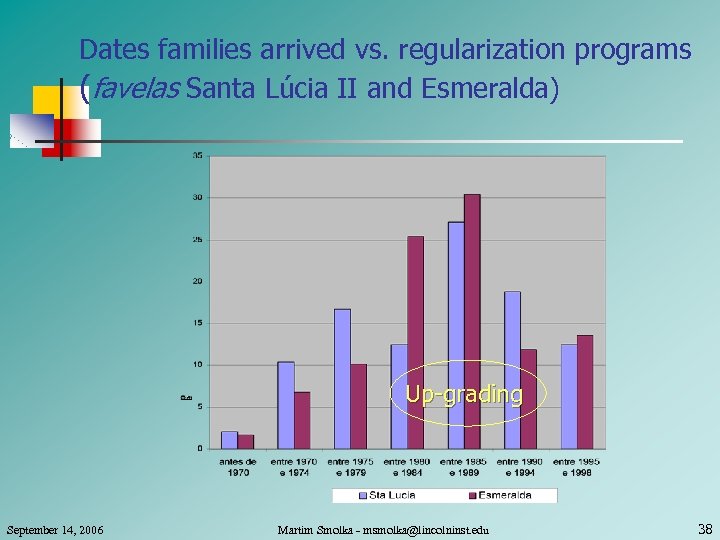
Dates families arrived vs. regularization programs (favelas Santa Lúcia II and Esmeralda) Up-grading September 14, 2006 Martim Smolka - msmolka@lincolninst. edu 38
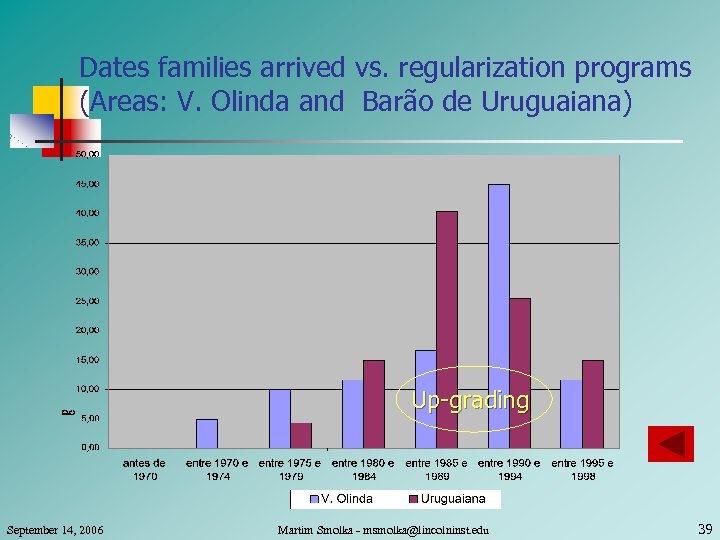
Dates families arrived vs. regularization programs (Areas: V. Olinda and Barão de Uruguaiana) Up-grading September 14, 2006 Martim Smolka - msmolka@lincolninst. edu 39
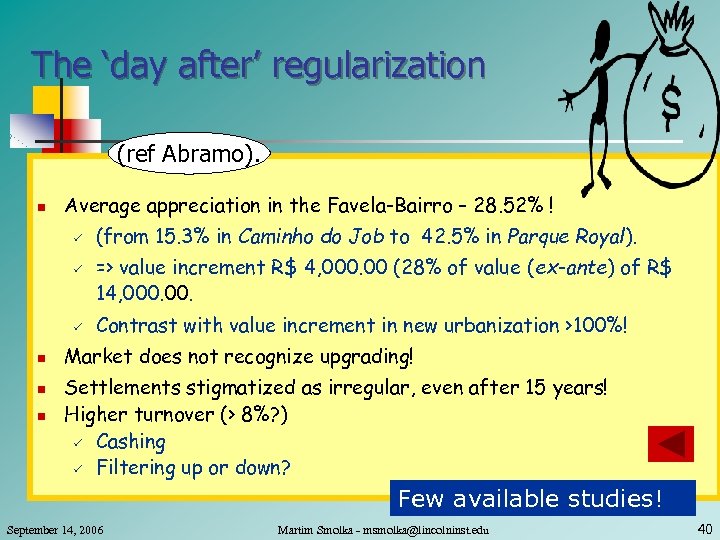
The ‘day after’ regularization (ref Abramo). n Average appreciation in the Favela-Bairro – 28. 52% ! ü ü ü n n n (from 15. 3% in Caminho do Job to 42. 5% in Parque Royal). => value increment R$ 4, 000. 00 (28% of value (ex-ante) of R$ 14, 000. Contrast with value increment in new urbanization >100%! Market does not recognize upgrading! Settlements stigmatized as irregular, even after 15 years! Higher turnover (> 8%? ) ü Cashing ü Filtering up or down? Few available studies! September 14, 2006 Martim Smolka - msmolka@lincolninst. edu 40
Belem n n n Informal housing occupying 25% of the area and 1/3 of the population 93 favelas (Censo 2000), in 1990 they were ‘just’ 20! Population growth (ref. Ipea, 1999) ü ü n September 14, 2006 Total = 2, 2 % per year. Informal areas = 6, 8%. No access to sewage network in 95% of the city! Martim Smolka - msmolka@lincolninst. edu 41
Usme Project (tools) n Land acquisition mechanism ü n At ‘non-contaminated’ prices Value-capture ü Participación en plusvalías o o ü Contribución de Valorización o ü On urban infrastructure provision Land readjustment o September 14, 2006 Rural-urban conversion Selling of building rights POZ and Plan Parcial Martim Smolka - msmolka@lincolninst. edu 42
Social Urbanizer (tools) n Urban Operation ü ü n Value-capture – ü n (Selling of) Building rights (CODC) Negotiations ü n Special regulations for designated areas Land value increment – ear-marked to area Recognition of sub-dividers expertise Partnerships – Public-Private ü September 14, 2006 Public investing in private developments Martim Smolka - msmolka@lincolninst. edu 43
Скачать презентацию Programa para a America Latina e o Caribe
b6f15d6e83c9535d66b56838e62df330.ppt