


 Скачать презентацию Program Verification 6 EC version only Erik Poll
bed61f6564deea8bcc427c34457009e6.ppt
- Количество слайдов: 39
 Program Verification (6 EC version only) Erik Poll Digital Security Radboud University Nijmegen
 Overview • Program Verification using Verification Condition Generators • JML – a formal specification language for Java Used for the program verification exercise 2
 Program verification • Formally proving (in the mathematical/logical sense) that a program satisfies some property – eg that it does not crash, always terminates, never terminates, meets some functional specification, meets some security requirement, etc – for all possible executions: ie all possible inputs and all possible scheduling of parallel threads. • NB in industry, the term verification is used for testing but testing provides only weaker guarantees – because testing will only try some executions – except in rare case where you can do exhaustive testing 3
 What do we need for program verification? 1. a formal semantics of the programming language 2. a specification language to express properties 3. a logic to reason about programs and specifications – aka a program logic 4. a verification tool to support all this These topics are investigation in the field of formal methods 4
![What to verify? Example For the program. . . x[4] = false; . .](https://present5.com/presentation/bed61f6564deea8bcc427c34457009e6/image-5.jpg "What to verify? Example For the program. . . x[4] = false; . .") What to verify? Example For the program. . . x[4] = false; . . . we might want to verify that here x is not null and 4 is within the array bounds (and that x is a Boolean array) • Proving absence of runtime exceptions (or, in an unsafe language like C, memory-safety, or more generally, the absence of undefined behavior) is a great bottom-line specification to start verification! • Typing is a simple form of program verification, for a limited and relatively weak class of properties, eg “x is a byte array” A type checker can be regarded as an automated program verifier for this class of properties. 5
What to verify? Example For the program. . . x[4] = false; . . . we might want to verify that here x is not null and 4 is within the array bounds (and that x is a Boolean array) • Proving absence of runtime exceptions (or, in an unsafe language like C, memory-safety, or more generally, the absence of undefined behavior) is a great bottom-line specification to start verification! • Typing is a simple form of program verification, for a limited and relatively weak class of properties, eg “x is a byte array” A type checker can be regarded as an automated program verifier for this class of properties. 5
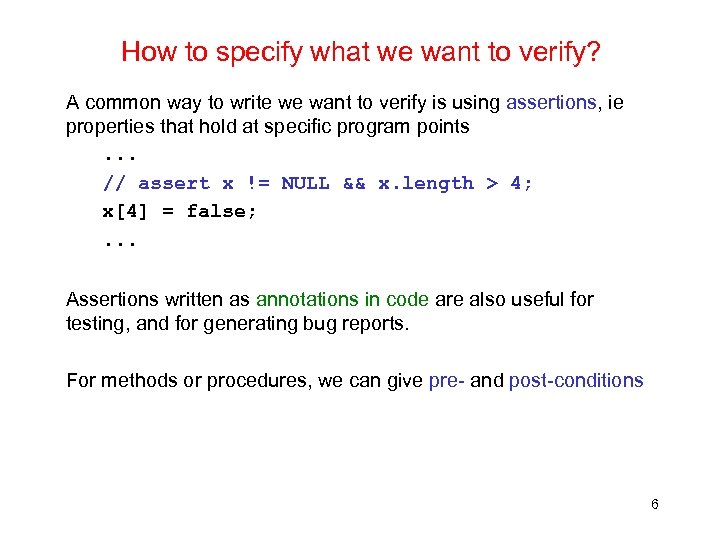 How to specify what we want to verify? A common way to write we want to verify is using assertions, ie properties that hold at specific program points. . . // assert x != NULL && x. length > 4; x[4] = false; . . . Assertions written as annotations in code are also useful for testing, and for generating bug reports. For methods or procedures, we can give pre- and post-conditions 6
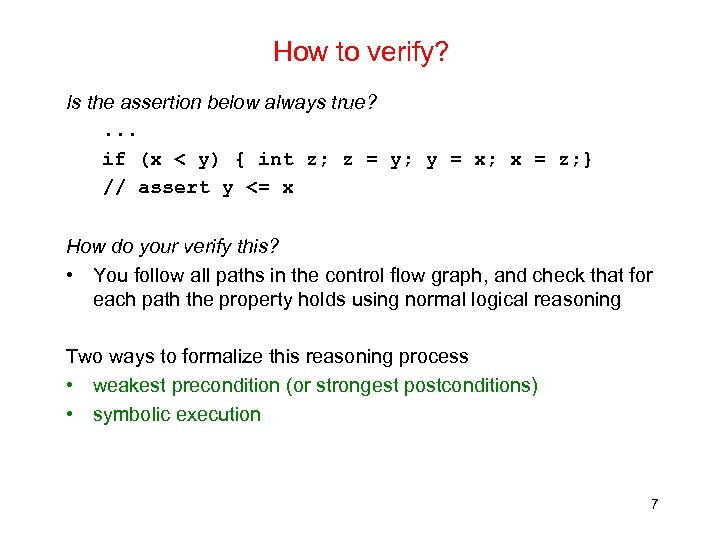 How to verify? Is the assertion below always true? . . . if (x < y) { int z; z = y; y = x; x = z; } // assert y <= x How do your verify this? • You follow all paths in the control flow graph, and check that for each path the property holds using normal logical reasoning Two ways to formalize this reasoning process • weakest precondition (or strongest postconditions) • symbolic execution 7
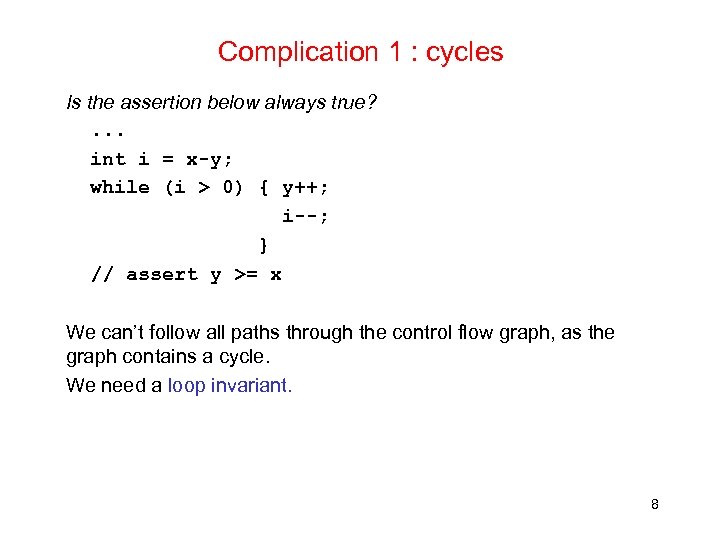 Complication 1 : cycles Is the assertion below always true? . . . int i = x-y; while (i > 0) { y++; i--; } // assert y >= x We can’t follow all paths through the control flow graph, as the graph contains a cycle. We need a loop invariant. 8
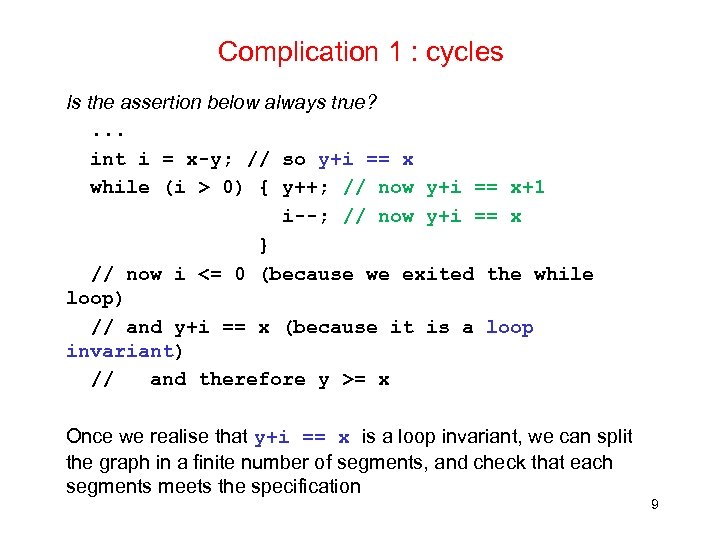 Complication 1 : cycles Is the assertion below always true? . . . int i = x-y; // so y+i == x while (i > 0) { y++; // now y+i == x+1 i--; // now y+i == x } // now i <= 0 (because we exited the while loop) // and y+i == x (because it is a loop invariant) // and therefore y >= x Once we realise that y+i == x is a loop invariant, we can split the graph in a finite number of segments, and check that each segments meets the specification 9
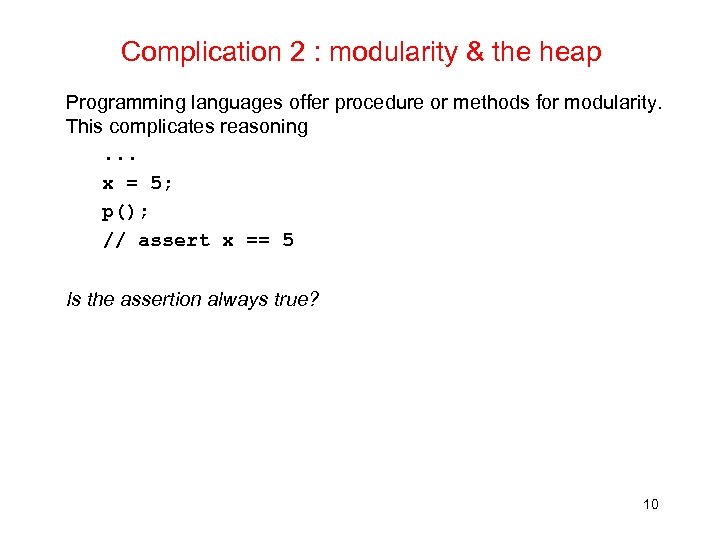 Complication 2 : modularity & the heap Programming languages offer procedure or methods for modularity. This complicates reasoning. . . x = 5; p(); // assert x == 5 Is the assertion always true? 10
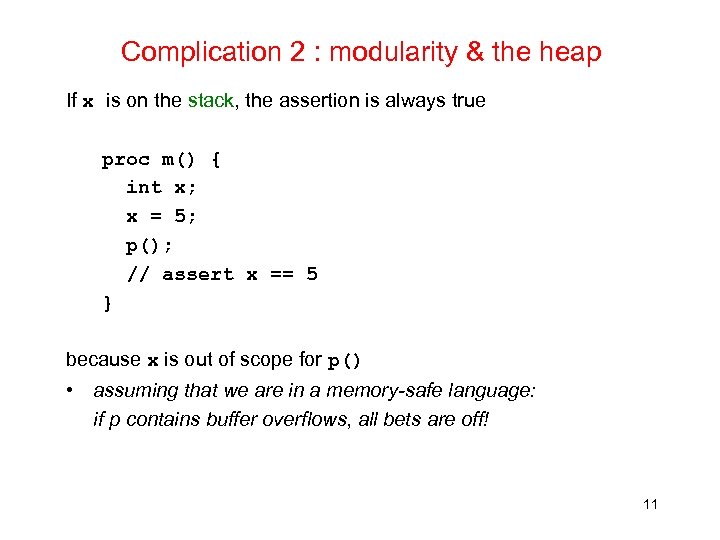 Complication 2 : modularity & the heap If x is on the stack, the assertion is always true proc m() { int x; x = 5; p(); // assert x == 5 } because x is out of scope for p() • assuming that we are in a memory-safe language: if p contains buffer overflows, all bets are off! 11
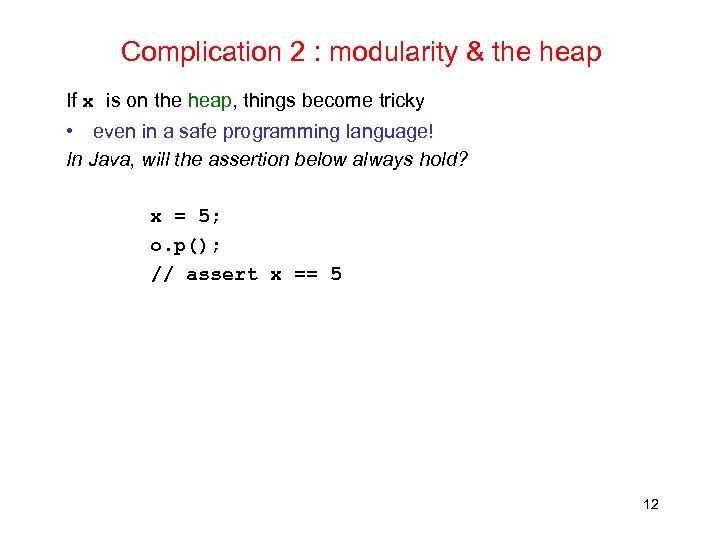 Complication 2 : modularity & the heap If x is on the heap, things become tricky • even in a safe programming language! In Java, will the assertion below always hold? x = 5; o. p(); // assert x == 5 12
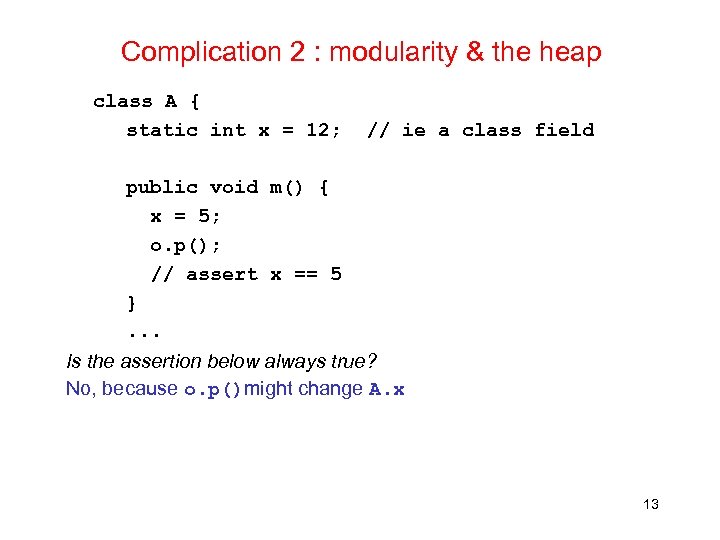 Complication 2 : modularity & the heap class A { static int x = 12; // ie a class field public void m() { x = 5; o. p(); // assert x == 5 }. . . Is the assertion below always true? No, because o. p()might change A. x 13
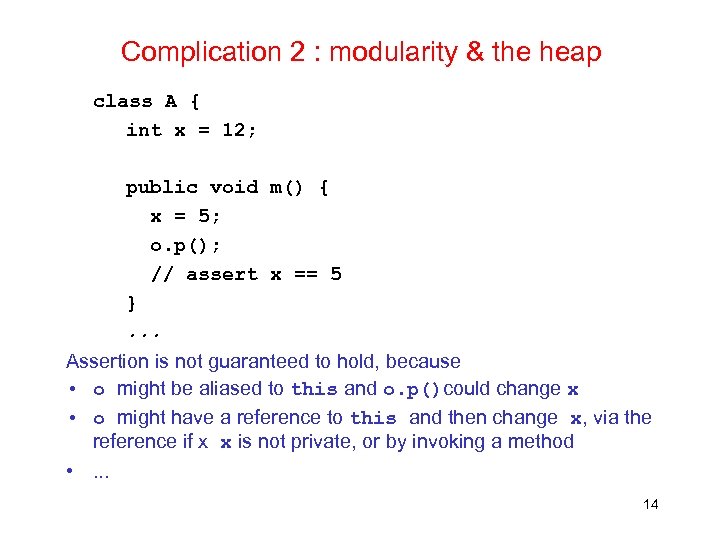 Complication 2 : modularity & the heap class A { int x = 12; public void m() { x = 5; o. p(); // assert x == 5 }. . . Assertion is not guaranteed to hold, because • o might be aliased to this and o. p()could change x • o might have a reference to this and then change x, via the reference if x x is not private, or by invoking a method • . . . 14
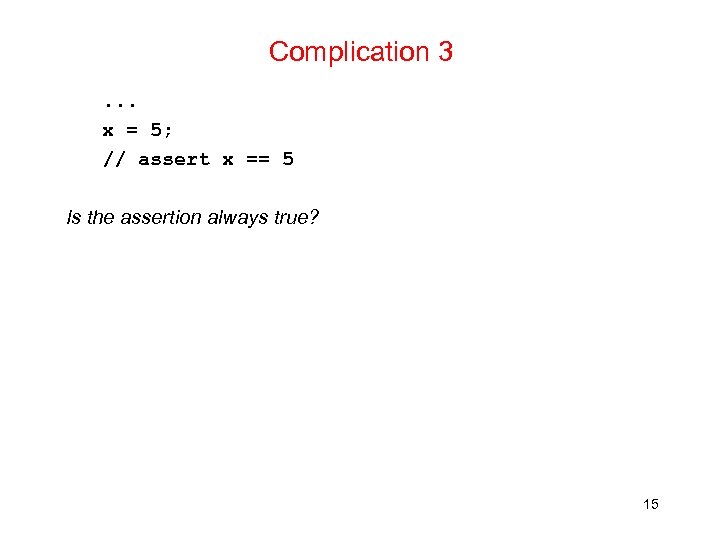 Complication 3. . . x = 5; // assert x == 5 Is the assertion always true? 15
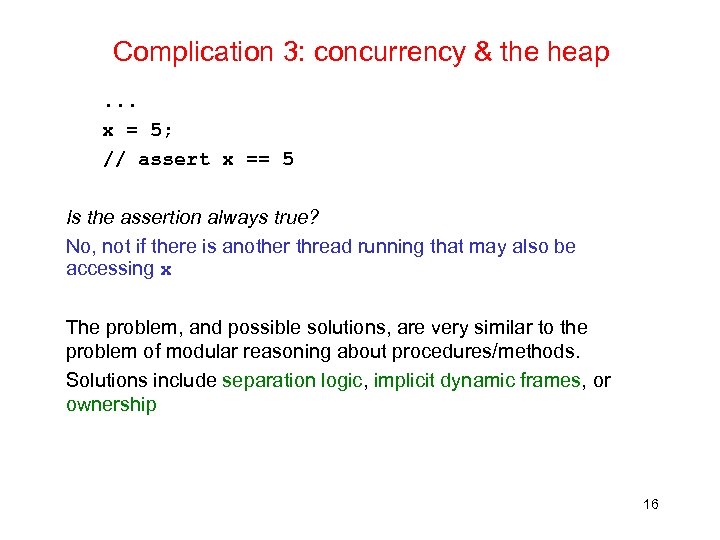 Complication 3: concurrency & the heap. . . x = 5; // assert x == 5 Is the assertion always true? No, not if there is another thread running that may also be accessing x The problem, and possible solutions, are very similar to the problem of modular reasoning about procedures/methods. Solutions include separation logic, implicit dynamic frames, or ownership 16
 Program Verification using Verification Condition Generation
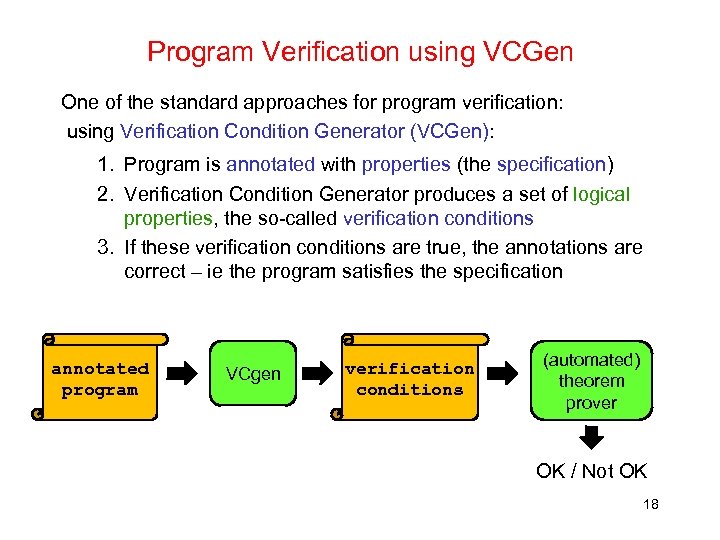 Program Verification using VCGen One of the standard approaches for program verification: using Verification Condition Generator (VCGen): 1. Program is annotated with properties (the specification) 2. Verification Condition Generator produces a set of logical properties, the so-called verification conditions 3. If these verification conditions are true, the annotations are correct – ie the program satisfies the specification annotated program VCgen verification conditions (automated) theorem prover OK / Not OK 18
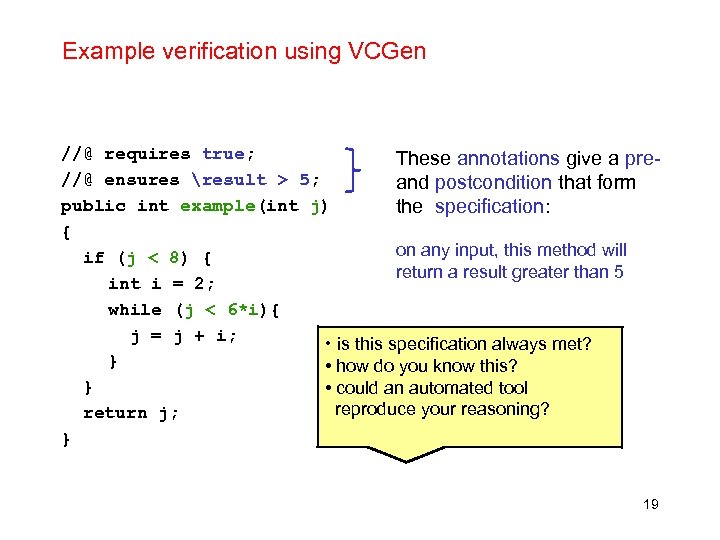 Example verification using VCGen //@ requires true; These annotations give a pre//@ ensures result > 5; and postcondition that form public int example(int j) the specification: { on any input, this method will if (j < 8) { return a result greater than 5 int i = 2; while (j < 6*i){ j = j + i; • is this specification always met? } • how do you know this? } • could an automated tool reproduce your reasoning? return j; } 19
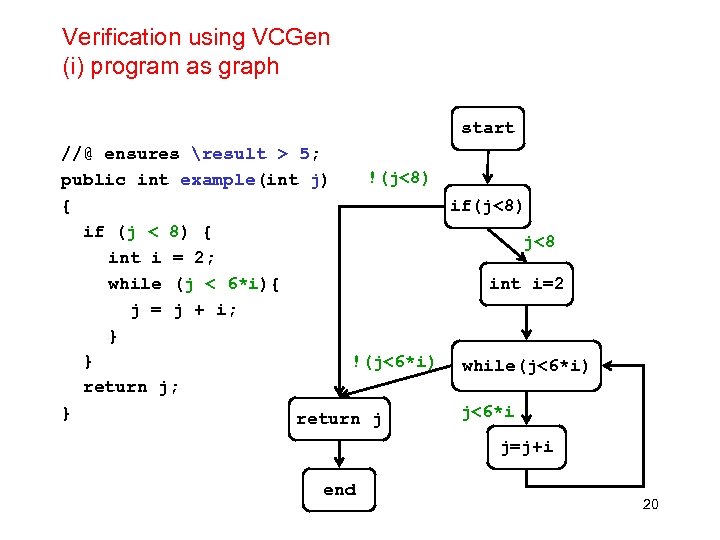 Verification using VCGen (i) program as graph start //@ ensures result > 5; !(j<8) public int example(int j) { if(j<8) if (j < 8) { j<8 int i = 2; while (j < 6*i){ int i=2 j = j + i; } } !(j<6*i) while(j<6*i) return j; j<6*i } return j j=j+i end 20
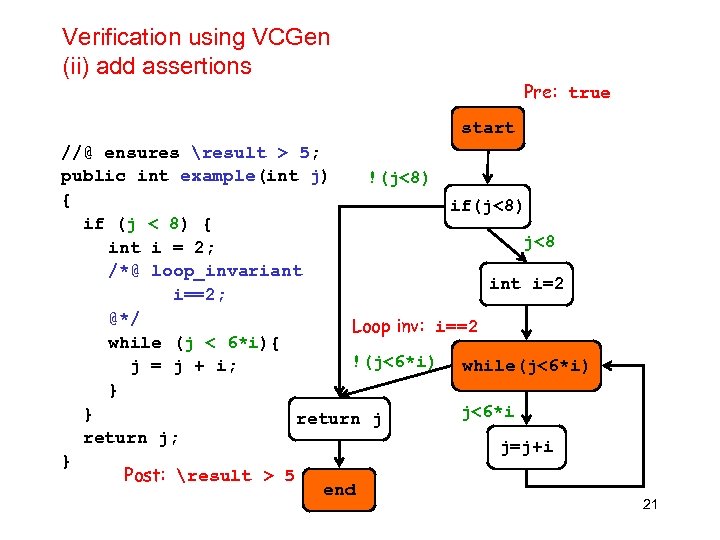 Verification using VCGen (ii) add assertions Pre: true start //@ ensures result > 5; public int example(int j) !(j<8) { if(j<8) if (j < 8) { j<8 int i = 2; /*@ loop_invariant i=2 i==2; @*/ Loop inv: i==2 while (j < 6*i){ !(j<6*i) while(j<6*i) j = j + i; } j<6*i } return j; j=j+i } Post: result > 5 end 21
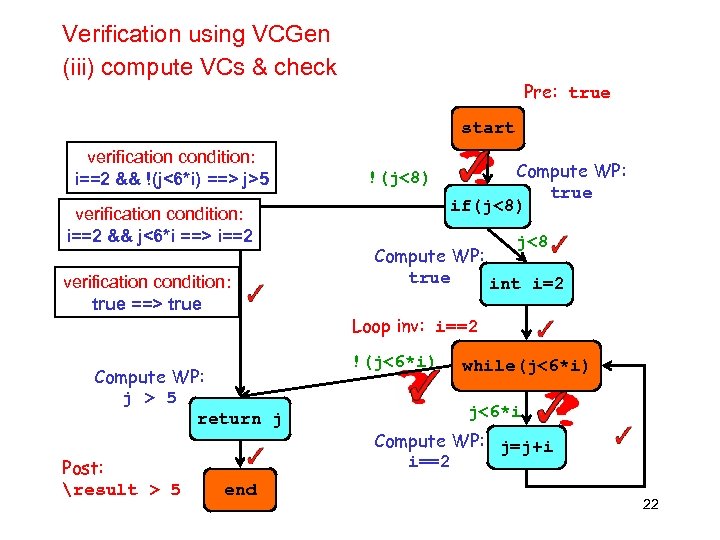 Verification using VCGen (iii) compute VCs & check Pre: true start verification condition: i==2 && !(j<6*i) ==> j>5 verification condition: i==2 && j<6*i ==> i==2 verification condition: true ==> true Compute WP: j > 5 return j Post: result > 5 end !(j<8) Compute WP: true if(j<8) j<8 Compute WP: true int i=2 Loop inv: i==2 !(j<6*i) while(j<6*i) j<6*i Compute WP: j=j+i i==2 22
 Verification condition generation Given a postcondition and loop invariants • compute a assertion Ps for every state s based on assertions Ps’ of the states s’ reachable from s – key idea: Ps is the weakest predicate such that if it hold in state s, and the program goes to state s’ then Ps’ will hold in that state s’ • all that remains to be verified – Pre P 0 the precondition specified in the program implies the assertion computed for the initial state – Loops Ps each loop assertion specified in the program implies the assertion computed for that state 23
 “Opposite” approach: forward instead of backwards Instead of working backwards from the postcondition of the final state, you can work forward from the precondition in the initial state: you then compute strongest postconditions instead of weakest preconditions This is very similar to symbolic execution of a program. 24
 Tricky issues in program verification Whatever the approach, the bottlenecks in program verification remain… 1. pointers / references & the heap Reasoning about data on the heap is difficult. Even in a language with automatic memory management, such as Java or C#, we still have the complication of aliasing 2. concurrency aka multi-threading 25
 Nice examples of program verification for security • Verification of Microsoft Hyper-V Hypervisor using the VCC program verifier for C [2009] the motivation to verify this is… security! • Info on VCC http: //research. microsoft. com/en-us/projects/vcc/ • Video presentation on VCC http: //channel 9. msdn. com/posts/Peli/Michal-Moskal-and-The-Verified-C-Compiler/ • Verification of se. L 4 microkernel in L 4. verified project at NICTA http: //ssrg. nicta. com. au/projects/TS/l 4. verified/ 26
 JML Formal specification for Java
 JML • Formal specification language for Java Properties can be specified in Design-By-Contract style, using pre/postconditions and object invariants NB by default, in JML invariants are object invariants, not loop invariants. • Various tools to check JML specifications by eg – runtime checking – program verification 28
 to make JML easy to use • JML annotations are added as special Java comments, between /*@. . @*/ or after //@ • JML specs can be in. java files, or in separate. jml files • Properties specified using Java syntax, extended with some operators old( ), result, forall, exists, ==> , . . and some keywords requires, ensures, invariant, . . 29
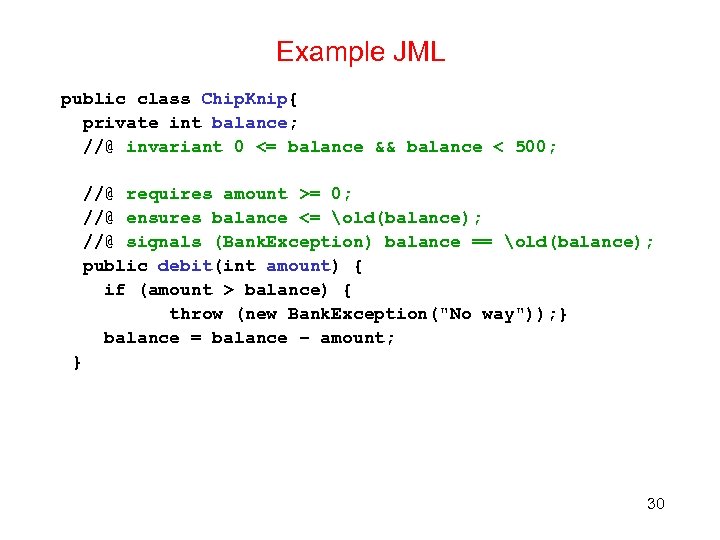 Example JML public class Chip. Knip{ private int balance; //@ invariant 0 <= balance && balance < 500; //@ requires amount >= 0; //@ ensures balance <= old(balance); //@ signals (Bank. Exception) balance == old(balance); public debit(int amount) { if (amount > balance) { throw (new Bank. Exception("No way")); } balance = balance – amount; } 30
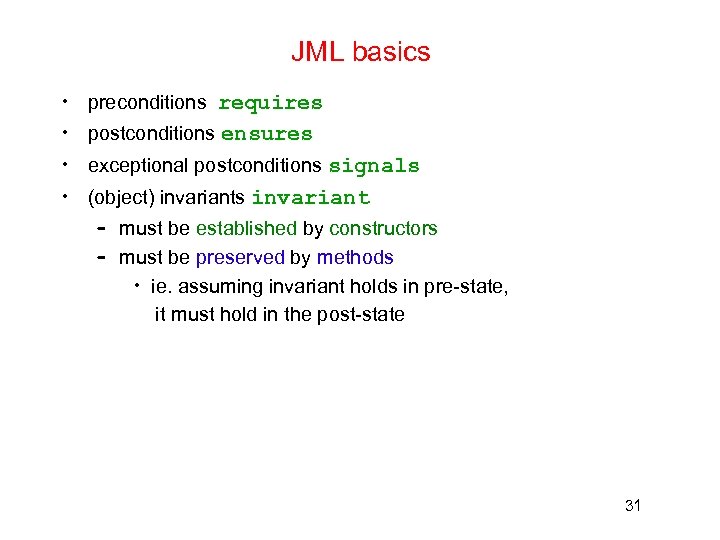 JML basics • preconditions requires • postconditions ensures • exceptional postconditions signals • (object) invariants invariant – must be established by constructors – must be preserved by methods • ie. assuming invariant holds in pre-state, it must hold in the post-state 31
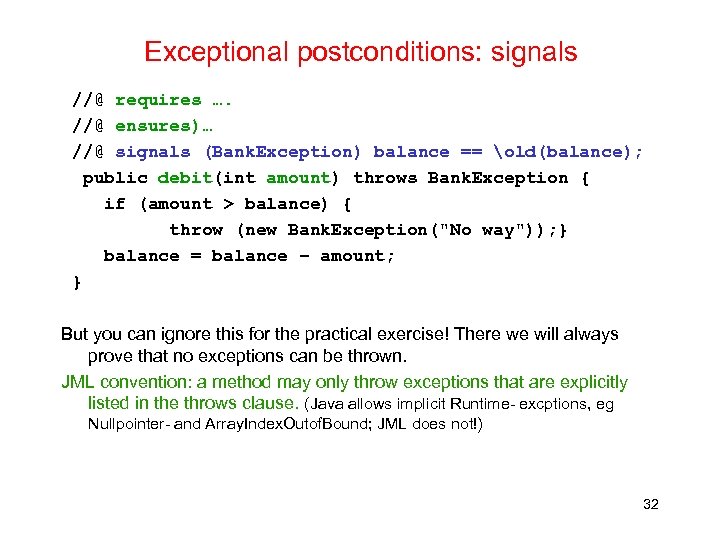 Exceptional postconditions: signals //@ requires …. //@ ensures)… //@ signals (Bank. Exception) balance == old(balance); public debit(int amount) throws Bank. Exception { if (amount > balance) { throw (new Bank. Exception("No way")); } balance = balance – amount; } But you can ignore this for the practical exercise! There we will always prove that no exceptions can be thrown. JML convention: a method may only throw exceptions that are explicitly listed in the throws clause. (Java allows implicit Runtime- excptions, eg Nullpointer- and Array. Index. Outof. Bound; JML does not!) 32
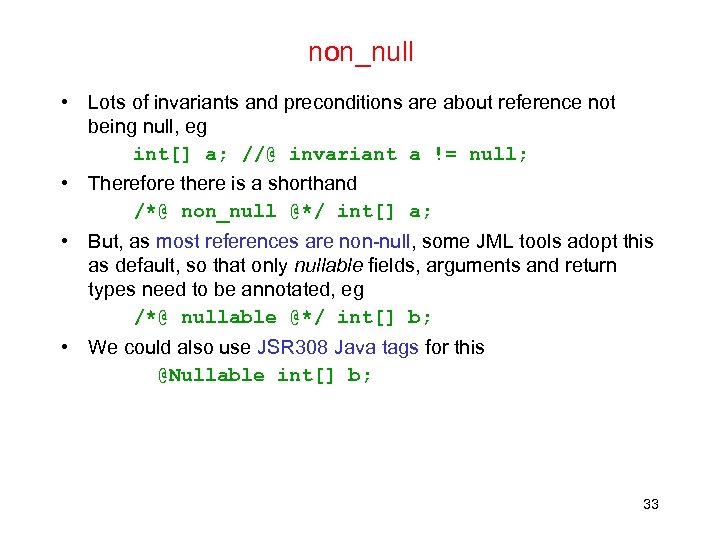 non_null • Lots of invariants and preconditions are about reference not being null, eg int[] a; //@ invariant a != null; • Therefore there is a shorthand /*@ non_null @*/ int[] a; • But, as most references are non-null, some JML tools adopt this as default, so that only nullable fields, arguments and return types need to be annotated, eg /*@ nullable @*/ int[] b; • We could also use JSR 308 Java tags for this @Nullable int[] b; 33
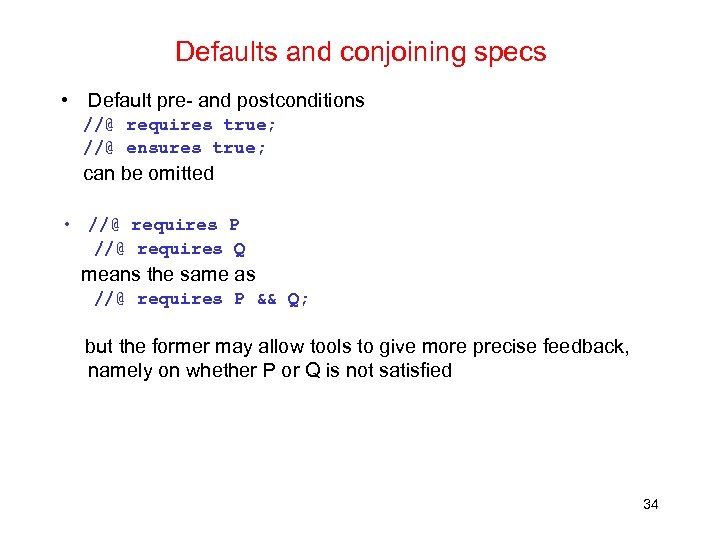 Defaults and conjoining specs • Default pre- and postconditions //@ requires true; //@ ensures true; can be omitted • //@ requires P //@ requires Q means the same as //@ requires P && Q; but the former may allow tools to give more precise feedback, namely on whether P or Q is not satisfied 34
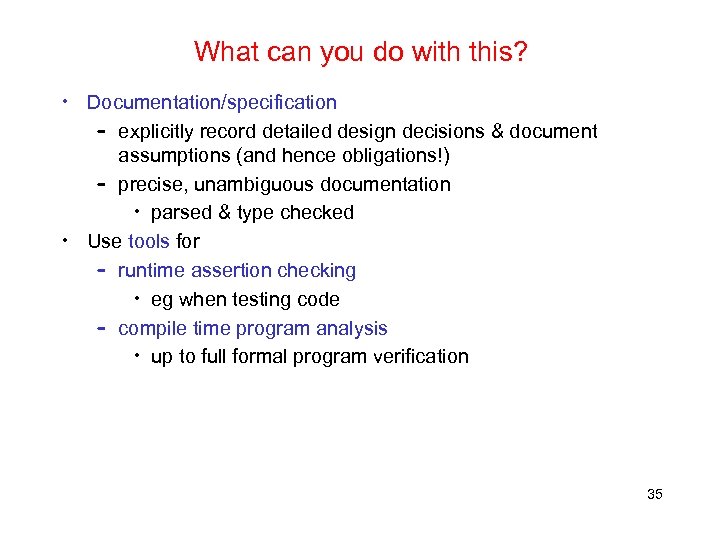 What can you do with this? • Documentation/specification – explicitly record detailed design decisions & document assumptions (and hence obligations!) – precise, unambiguous documentation • parsed & type checked • Use tools for – runtime assertion checking • eg when testing code – compile time program analysis • up to full formal program verification 35
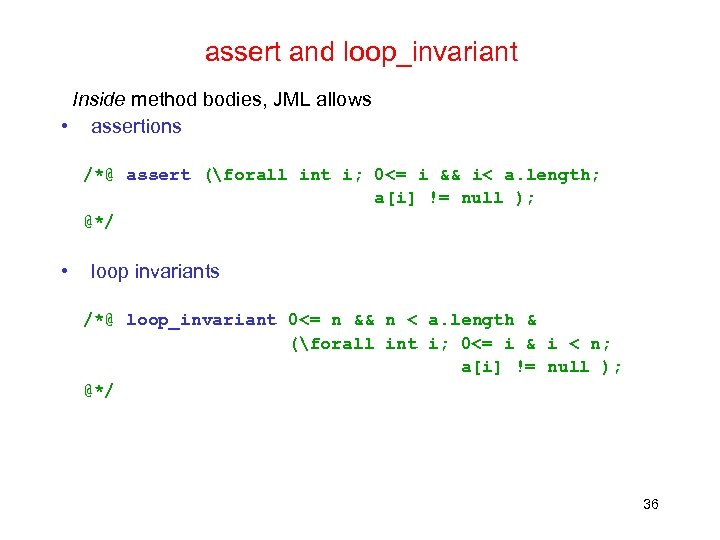 assert and loop_invariant Inside method bodies, JML allows • assertions /*@ assert (forall int i; 0<= i && i< a. length; a[i] != null ); @*/ • loop invariants /*@ loop_invariant 0<= n && n < a. length & (forall int i; 0<= i & i < n; a[i] != null ); @*/ 36
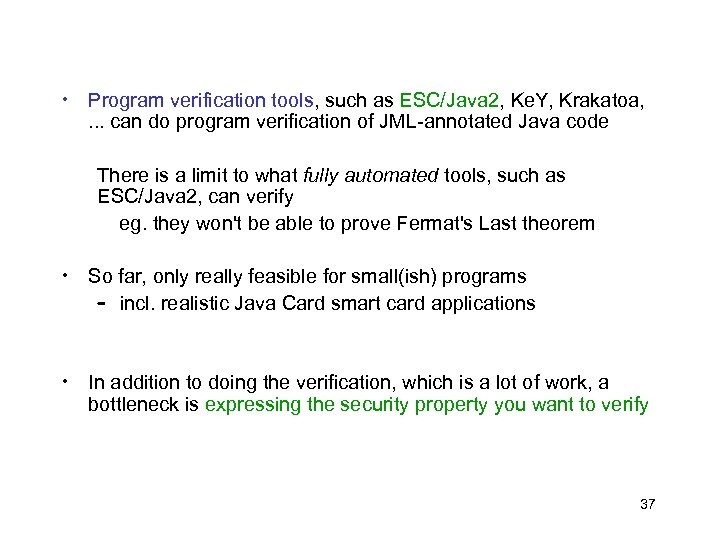 • Program verification tools, such as ESC/Java 2, Ke. Y, Krakatoa, . . . can do program verification of JML-annotated Java code There is a limit to what fully automated tools, such as ESC/Java 2, can verify eg. they won't be able to prove Fermat's Last theorem • So far, only really feasible for small(ish) programs – incl. realistic Java Card smart card applications • In addition to doing the verification, which is a lot of work, a bottleneck is expressing the security property you want to verify 37
 JML for security JML can be used to specify for instance 1. which – if any - exceptions can be thrown incorrectly/not handling errors common source of security problems 2. security-critical invariants to be preserved even when exceptions occur 3. assumptions on input the application relies on 4. any property expressible by security automaton Simply trying to verify that a program throws no exceptions – or just no Nullpointer-exceptions - will expose many (implicit) invariants and assumptions on input 38
 Related work • Spec# for C# by Rustan Leino & co at Microsoft Research • Spark. Ada for Ada by Praxis High Integrity System • ACSL for C used in the Frama-C toolset https: //www. youtube. com/watch? v=J_xgb. O 5 -32 k Some industrial usage, but esp. for safety-critical software (notably in avionics) rather than security-critical software 39