


 Скачать презентацию Program Systems Institute of the Russian Academy of
5ea60cf3a74a0087a5c10c2a426bf033.ppt
- Количество слайдов: 41
 Program Systems Institute of the Russian Academy of Sciences Research Center for Multiprocessor Systems Doctor Sergei Abramov q Supercomputers and multiprocessor software. q Technologies for regional computer networks building. q Functional programming, supercompilation and metacomputation theories, and their applications to practical programming.
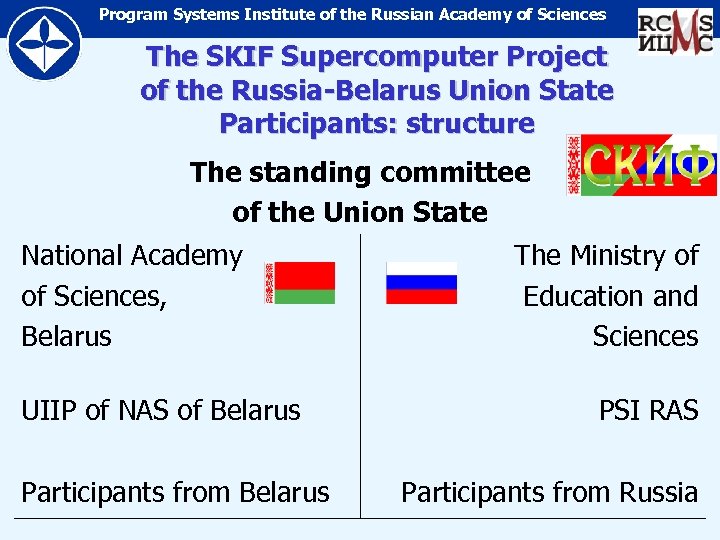 Program Systems Institute of the Russian Academy of Sciences The SKIF Supercomputer Project of the Russia-Belarus Union State Participants: structure The standing committee of the Union State National Academy of Sciences, Belarus UIIP of NAS of Belarus Participants from Belarus The Ministry of Education and Sciences PSI RAS Participants from Russia
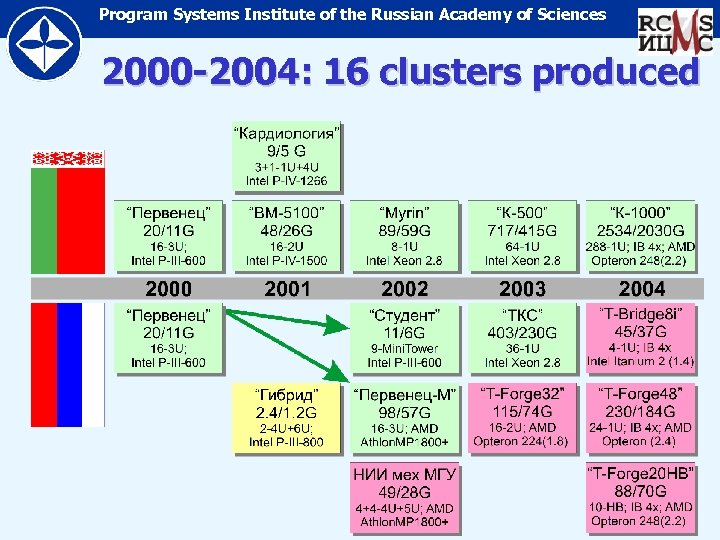 Program Systems Institute of the Russian Academy of Sciences 2000 -2004: 16 clusters produced
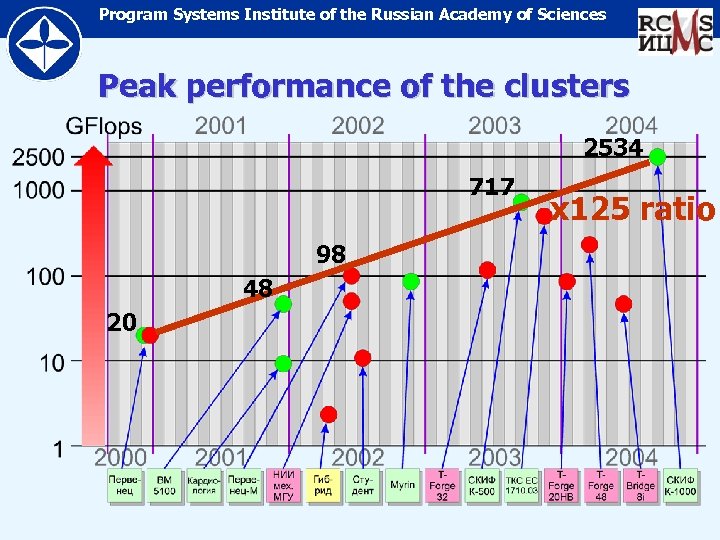 Program Systems Institute of the Russian Academy of Sciences Peak performance of the clusters 2534 717 98 48 20 x 125 ratio
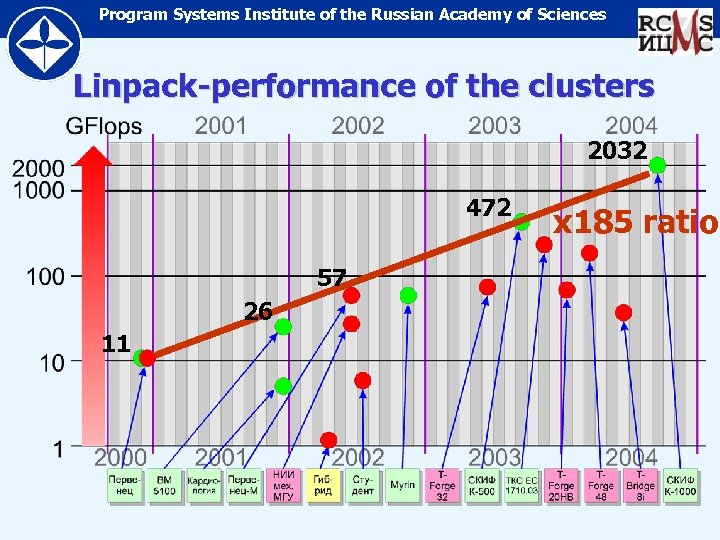 Program Systems Institute of the Russian Academy of Sciences Linpack-performance of the clusters 2032 472 57 26 11 x 185 ratio
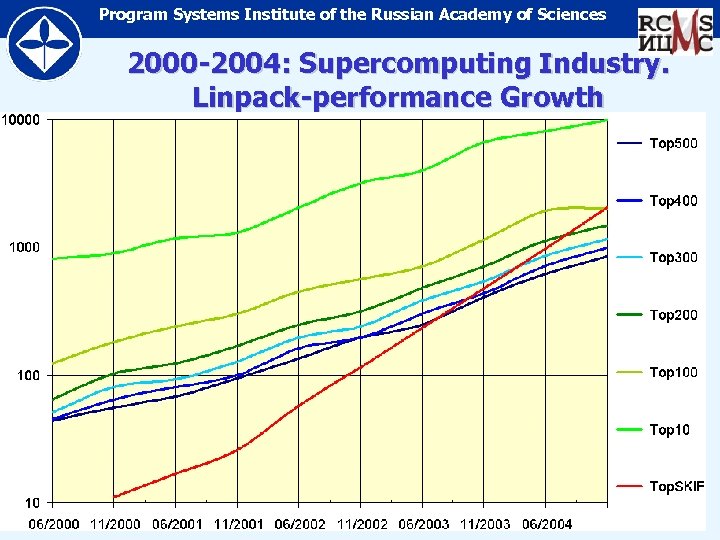 Program Systems Institute of the Russian Academy of Sciences 2000 -2004: Supercomputing Industry. Linpack-performance Growth
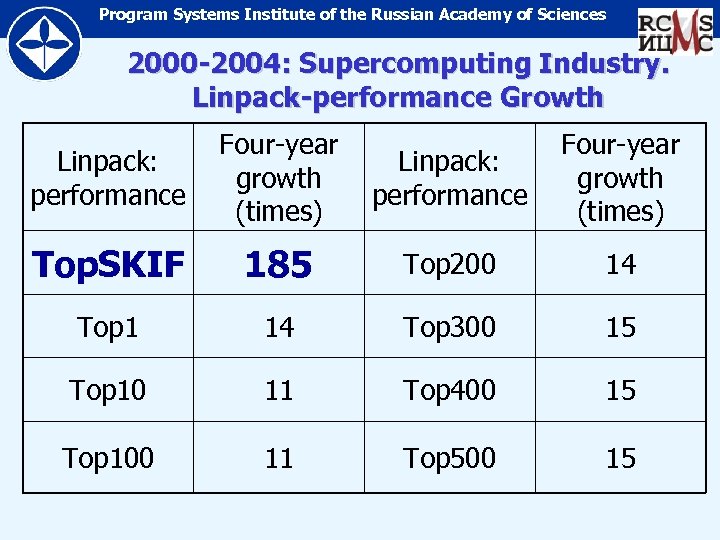 Program Systems Institute of the Russian Academy of Sciences 2000 -2004: Supercomputing Industry. Linpack-performance Growth Linpack: performance Four-year growth (times) Top. SKIF 185 Top 200 14 Top 1 14 Top 300 15 Top 10 11 Top 400 15 Top 100 11 Top 500 15
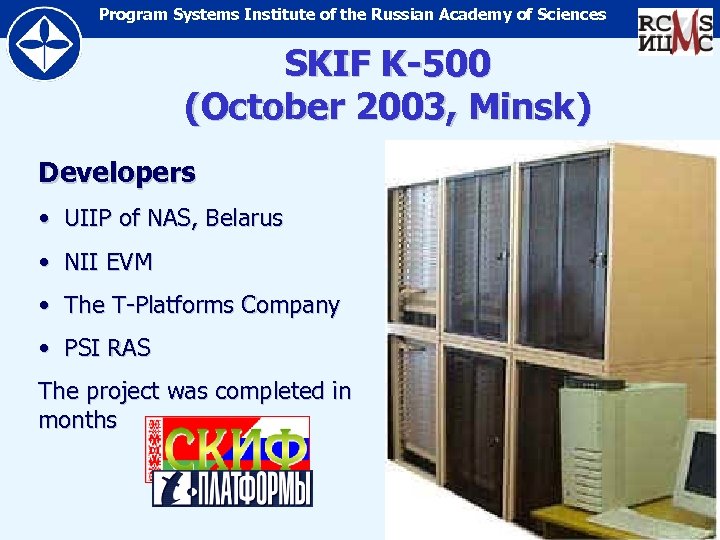 Program Systems Institute of the Russian Academy of Sciences SKIF K-500 (October 2003, Minsk) Developers • UIIP of NAS, Belarus • NII EVM • The T-Platforms Company • PSI RAS The project was completed in months
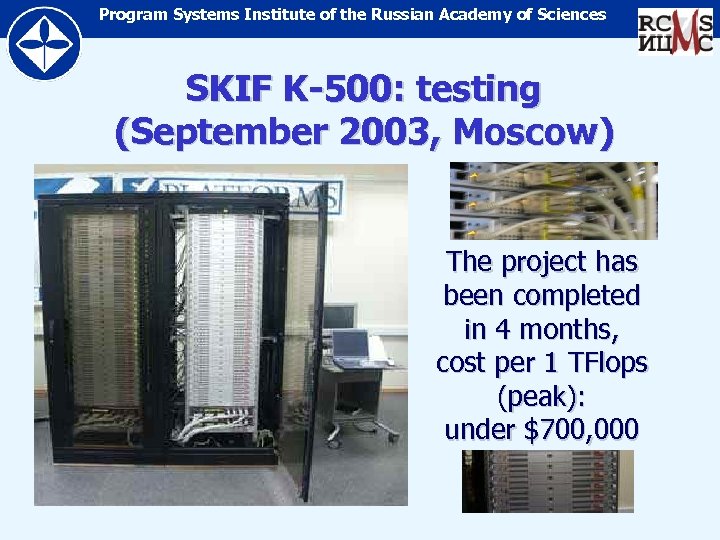 Program Systems Institute of the Russian Academy of Sciences SKIF K-500: testing (September 2003, Moscow) The project has been completed in 4 months, cost per 1 TFlops (peak): under $700, 000
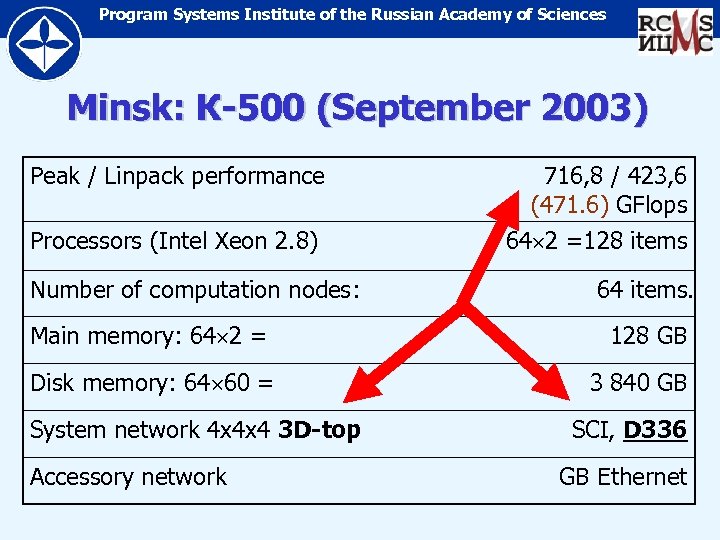 Program Systems Institute of the Russian Academy of Sciences Minsk: К-500 (September 2003) Peak / Linpack performance Processors (Intel Xeon 2. 8) Number of computation nodes: Main memory: 64 2 = Disk memory: 64 60 = System network 4 x 4 х4 3 D-top Accessory network 716, 8 / 423, 6 (471. 6) GFlops 64 2 =128 items 64 items. 128 GB 3 840 GB SCI, D 336 GB Ethernet
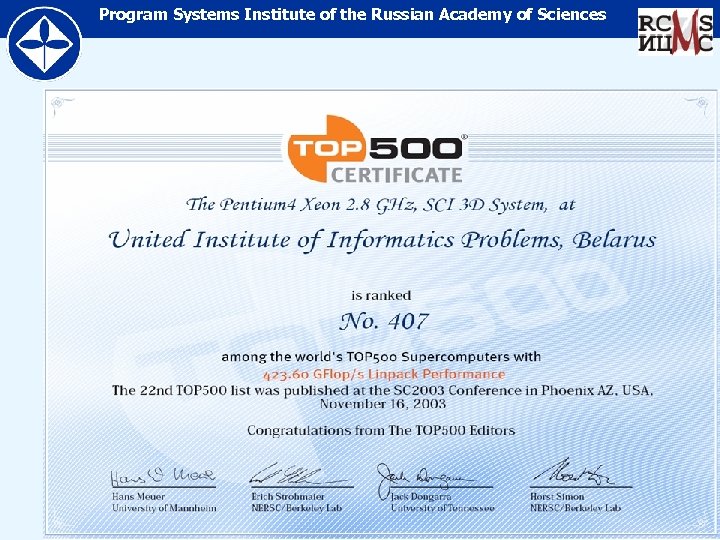 Program Systems Institute of the Russian Academy of Sciences
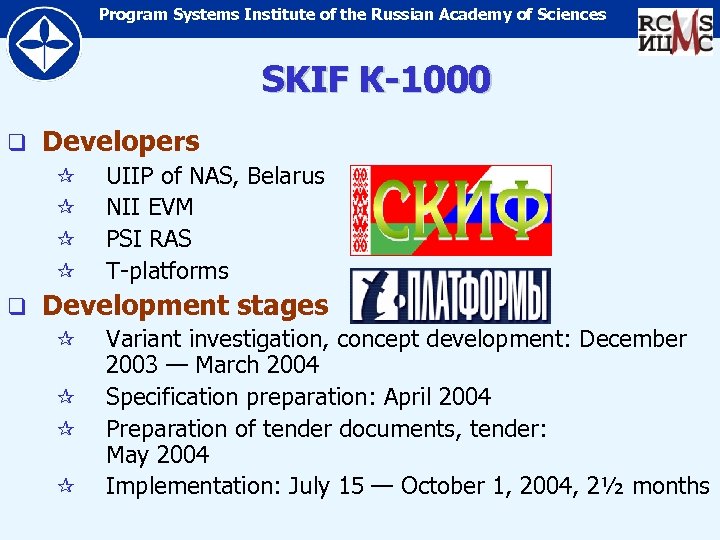 Program Systems Institute of the Russian Academy of Sciences SKIF К-1000 q Developers ¶ ¶ q UIIP of NAS, Belarus NII EVM PSI RAS T-platforms Development stages ¶ ¶ Variant investigation, concept development: December 2003 — March 2004 Specification preparation: April 2004 Preparation of tender documents, tender: May 2004 Implementation: July 15 — October 1, 2004, 2½ months
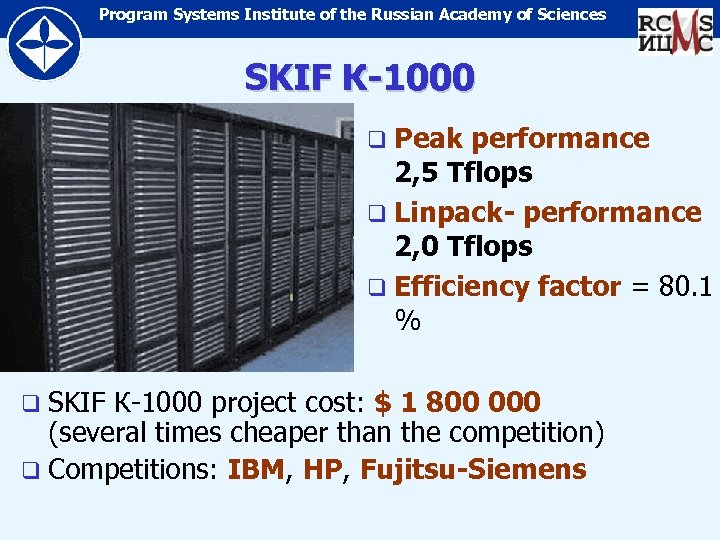 Program Systems Institute of the Russian Academy of Sciences SKIF К-1000 q Peak performance 2, 5 Tflops q Linpack- performance 2, 0 Tflops q Efficiency factor = 80. 1 % q SKIF К-1000 project cost: $ 1 800 000 (several times cheaper than the competition) q Competitions: IBM, HP, Fujitsu-Siemens
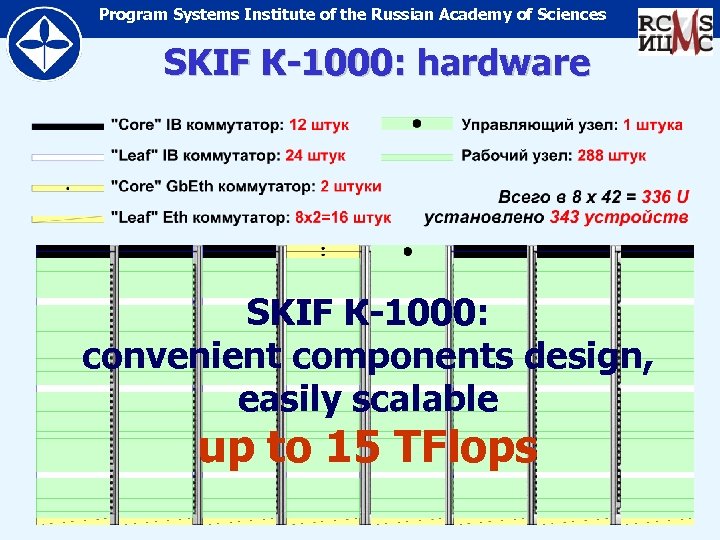 Program Systems Institute of the Russian Academy of Sciences SKIF К-1000: hardware SKIF К-1000: convenient components design, easily scalable up to 15 TFlops
 Program Systems Institute of the Russian Academy of Sciences
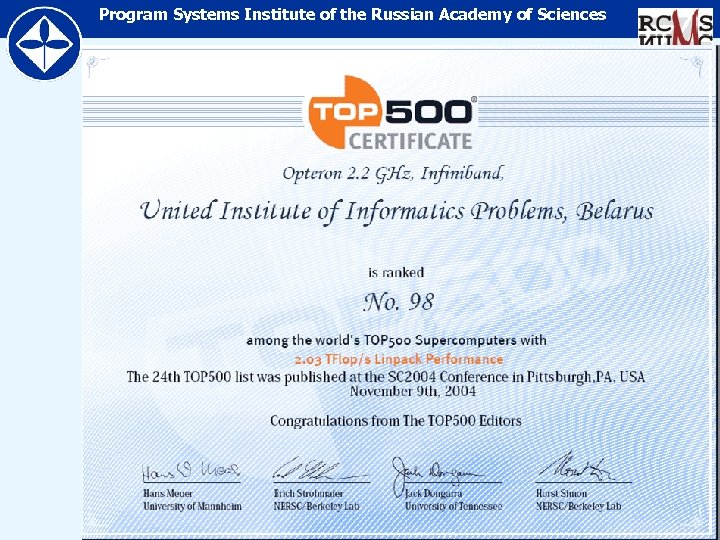
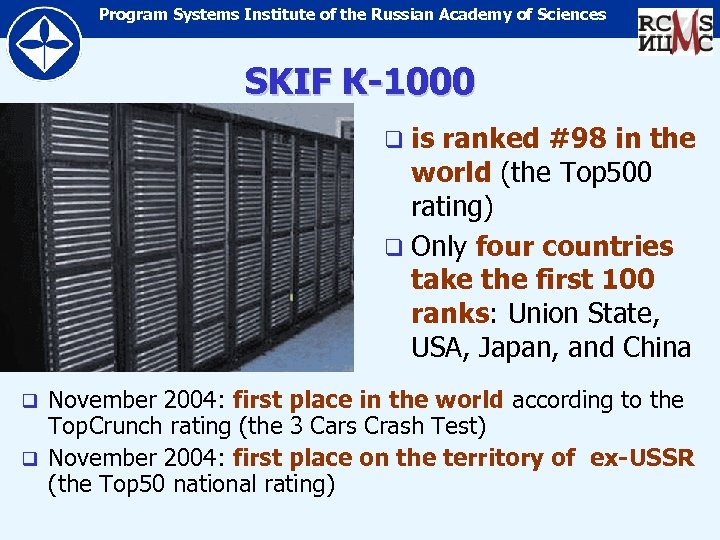 Program Systems Institute of the Russian Academy of Sciences SKIF К-1000 q is ranked #98 in the world (the Top 500 rating) q Only four countries take the first 100 ranks: Union State, USA, Japan, and China November 2004: first place in the world according to the Top. Crunch rating (the 3 Cars Crash Test) q November 2004: first place on the territory of ex-USSR (the Top 50 national rating) q
 Program Systems Institute of the Russian Academy of Sciences SKIF in the Top 50 rating On December 7, 2004 seven SKIF computers were listed of fifty most powerful supercomputers of the Commonwealth of Independent States (Тор50, http: //www. supercomputers. ru) and took the following places: 1, 6, 8, 20, 22, 34 q Installations of the SKIF family take 14% of all places in the list q Their total peak performance amounts to 25% from the sum of all peak performances of all the systems presented in the Top 50 list q Their total Linpack performance amounts to 33% from the sum of all Linpack performances of all systems presented in the Top 50 list q
 Program Systems Institute of the Russian Academy of Sciences Cluster-level Software Suite Linux-SKIF OS kernel q PVFS-SKIF — parallel file system q Open. PBS-SKIF — batch queue q FLAME-SKIF — the system of monitoring and control (reset, power on/off) over installations of the SKIF family q
 Program Systems Institute of the Russian Academy of Sciences Cluster-level Software Suite q Open. TS — open architecture T -system ¶ the TG++ compiler for the T++ language ¶ the TF 2 TC translator (T-Fortran T++) q TDB — distributed interactive debugger for MPI programs supporting T-programs debugging (Total. View counterpart)
 Program Systems Institute of the Russian Academy of Sciences Cluster-level Software Suite 6 software applications in the Open. TS environment q 12 adapted free packages, libraries, and applications q 14 in-house designed applications (3 of them in the AI field) q The platform is compatible with commercial engineering packages (over 6 fields of application) q
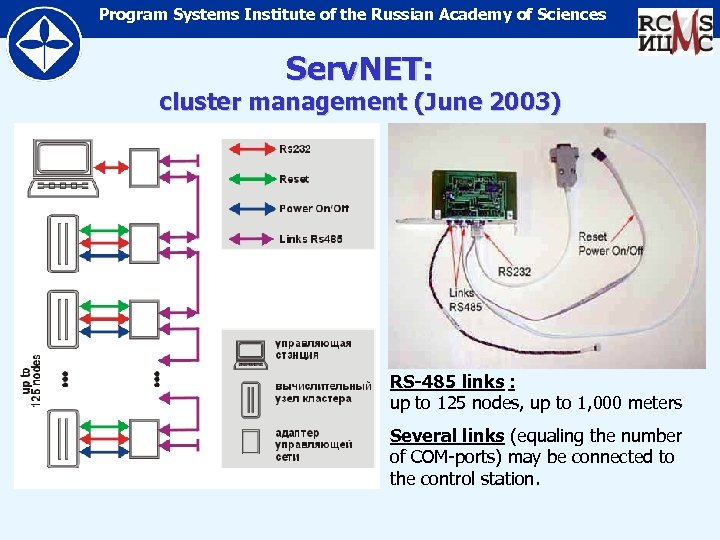 Program Systems Institute of the Russian Academy of Sciences Serv. NET: cluster management (June 2003) RS-485 links : up to 125 nodes, up to 1, 000 meters Several links (equaling the number of COM-ports) may be connected to the control station.
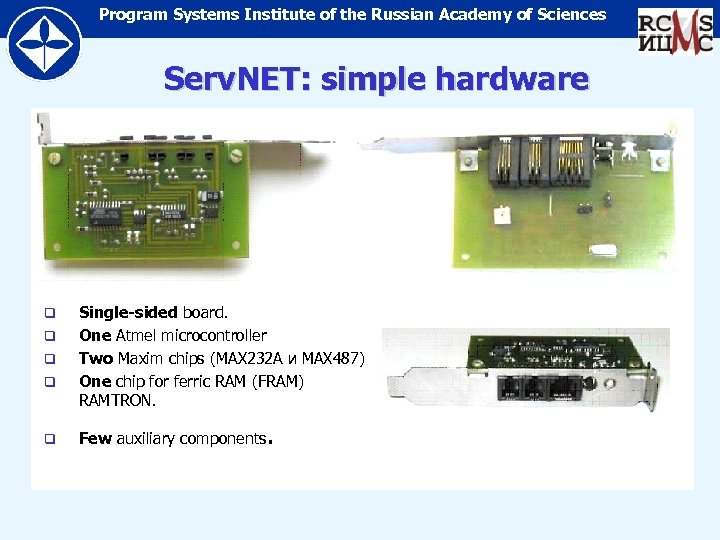 Program Systems Institute of the Russian Academy of Sciences Serv. NET: simple hardware q q q Single-sided board. One Atmel microcontroller Two Maxim chips (MAX 232 A и MAX 487) One chip for ferric RAM (FRAM) RAMTRON. Few auxiliary components .
 Program Systems Institute of the Russian Academy of Sciences Serv. NET: functionality Selective node reset (SW: groups). q Selective switching on/off of node’s power supply (SW: groups, also “smooth”, with a target latency “between nodes”). q Access to the serial console of the node allowing. . . q
 Program Systems Institute of the Russian Academy of Sciences Access to the serial console of the node allows the following: q q q To change the parameters of the BIOS node. LILO: select an OS to be loaded and the loading parameters of the Linux core. To execute any commands in a console regime. To monitor critical messages of the OS. To read several last console messages from the nonvolatile memory of the Serv. NET board after failure.
 Program Systems Institute of the Russian Academy of Sciences Serv. NET: production Development – PSI of RAS, Production – Computer Research Institute, Minsk. q A pilot of more than 200 items has been produced. Serv. NET has been installed in: q ¶ ¶ q T-Forge 32 (16 nodes). “SKIF К-500” (64 nodes) and other clusters in Minsk. Clusters in Pereslavl. Clusters in the Research Computing Center of the Moscow State University (58 Serv. NET boards). Serv. NET v. 2: 2004, developed by PSI of RAS and T-platforms, produced by T-platforms.
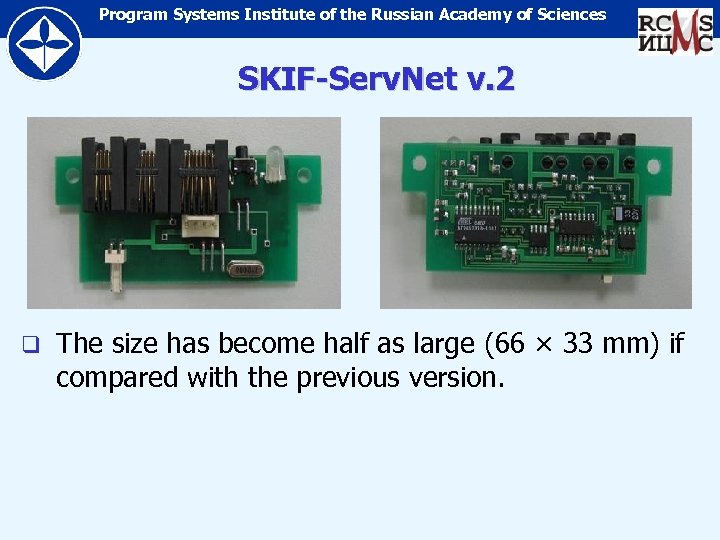 Program Systems Institute of the Russian Academy of Sciences SKIF-Serv. Net v. 2 q The size has become half as large (66 × 33 mm) if compared with the previous version.
 Program Systems Institute of the Russian Academy of Sciences Design and Development of Regional Telecommunication Systems Head: Yury Shevchuk, Ph. D. q The Botik Lab. : Activities ¶Develops cost effective solutions for regional computer networks (BOTIK Technologies) ¶Implements the technology in Pereslavl region for testing and enhancement ¶Transfers the approved technology to Russian regions and the CIS countries
 Program Systems Institute of the Russian Academy of Sciences The BOTIK Network q Started in 1994: 11 -year history q State-of-the-art ¶More than 900 subscribers ¶More than 3000 networked PCs ¶External traffic: 250 Gb/month q 4 technology transfer contracts ¶Almaty, Kazakhstan ¶Moscow ¶Ramenskoye, Moscow region ¶Severomorsk, Murmansk region
 Program Systems Institute of the Russian Academy of Sciences The BOTIK Technologies: Core q PC router ¶IBM PC + Linux + in-house designed HW & SW q Other hardware solutions ¶Resistance to low-quality power supply, temperature difference, and vandalism ¶Self-recovery and self-monitoring of devices ¶Wireless solutions for rural regions ¶Etherbox: sensor networks device q Software solutions for regional networks ¶Network Administration System: +10, 000 lines…
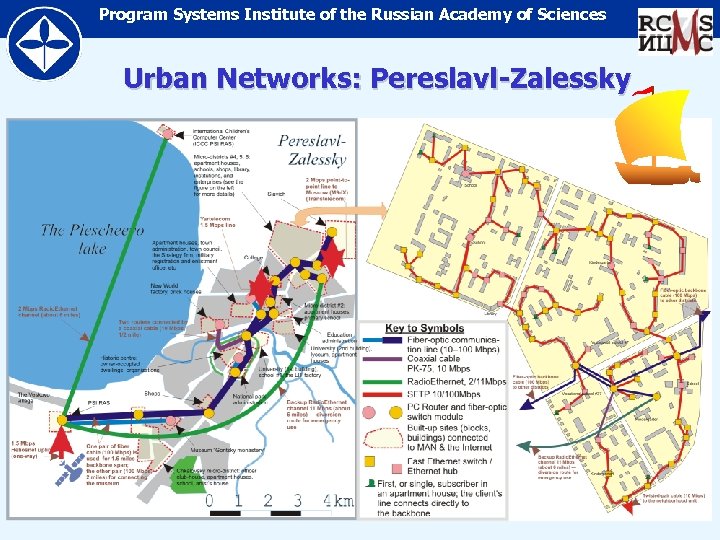 Program Systems Institute of the Russian Academy of Sciences Urban Networks: Pereslavl-Zalessky
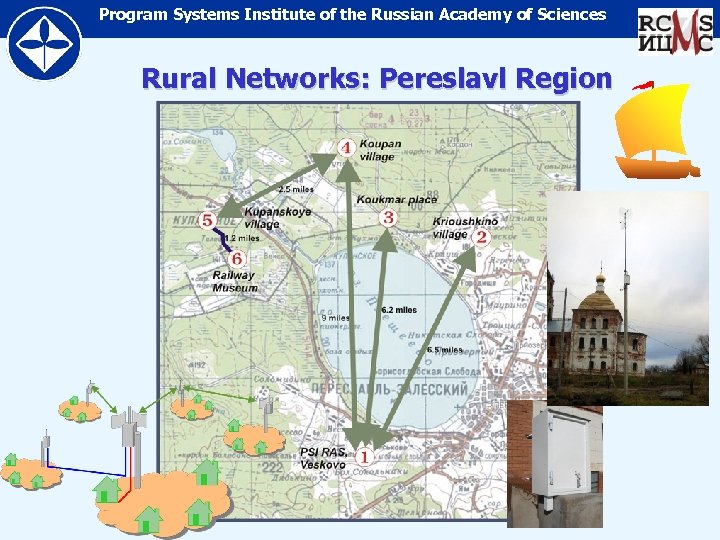 Program Systems Institute of the Russian Academy of Sciences Rural Networks: Pereslavl Region
 Program Systems Institute of the Russian Academy of Sciences Functional programming, supercompilation and metacomputation theories, and their applications to practical programming
 Program Systems Institute of the Russian Academy of Sciences Functional programming in IPS RAS q Supercompilation, program specialization. q Metacomputation, semantics modifiers – reusing “semantics components”. q Implementation of functional programming languages. q Applied computer algebraic libraries.
 Program Systems Institute of the Russian Academy of Sciences Reasons for program optimization q The methods can do almost nothing with programs that are already carefully optimized by a professional programmer in a lower-level language. The methods can clean a program of natural inefficiencies if the program has been developed “inefficiently” in a structured way, using various “high-level” techniques like 1. interpretation of specialized application-oriented 2. component programming from libraries of general re- languages and usable software, etc. Thus, the methods are directed to provide degrees of freedom for new software technologies rather than to optimizing programs written in an old style.
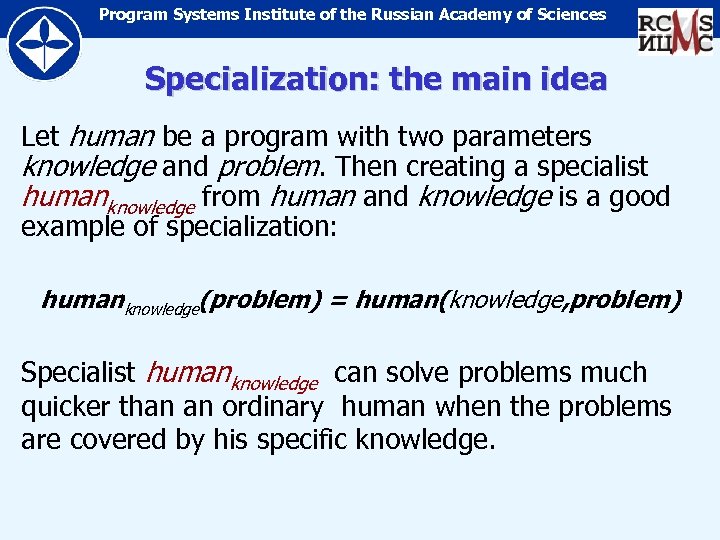 Program Systems Institute of the Russian Academy of Sciences Specialization: the main idea Let human be a program with two parameters knowledge and problem. Then creating a specialist humanknowledge from human and knowledge is a good example of specialization: humanknowledge(problem) = human(knowledge, problem) Specialist humanknowledge can solve problems much quicker than an ordinary human when the problems are covered by his specific knowledge.
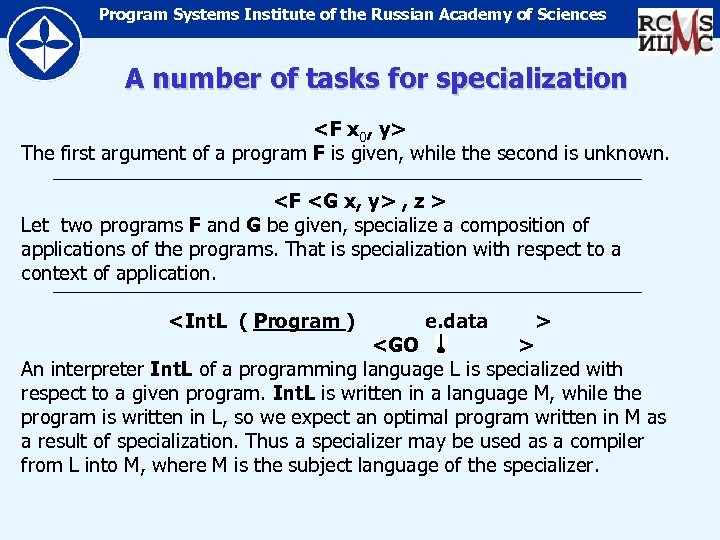 Program Systems Institute of the Russian Academy of Sciences A number of tasks for specialization
 Program Systems Institute of the Russian Academy of Sciences What is supercompilation ? Supercompilation is a technique of specialization of programs written in a functional programming language. The technique was introduced in the 1970 s by V. F. Turchin. He proposed a task of creating tools to observe operational semantics of a program, when a function F that is to be computed by the program is fixed. As a result of such observations a new algorithmic definition of an extension of the function F must be constructed. His ideas were studied by a number of authors for a long time. q The main aim of a supercompiler is to perform as many actions of a given parameterized application of a program uniformly on the parameters as possible. q q Also supercompilers can be used • as theorem provers for program verification; • as compilers by specialization of operational specifications; • for porting a non-standard semantics from one programming language to another; by specialization of a semantics modifier.
 Program Systems Institute of the Russian Academy of Sciences The Supercompiler SCP 4 q is an experimental specializer for a functional language Refal-5. (There are no special restrictions on the input language. ) SCP 4 has been implemented once again using Refal-5. Sources of the supercompiler, executable modules and sources of Refal-5 are available for immediate free download: http: //www. botik. ru/pub/local/scp/refal 5/ Windows 98 Windows NT/2000/XP Linux (Intel)
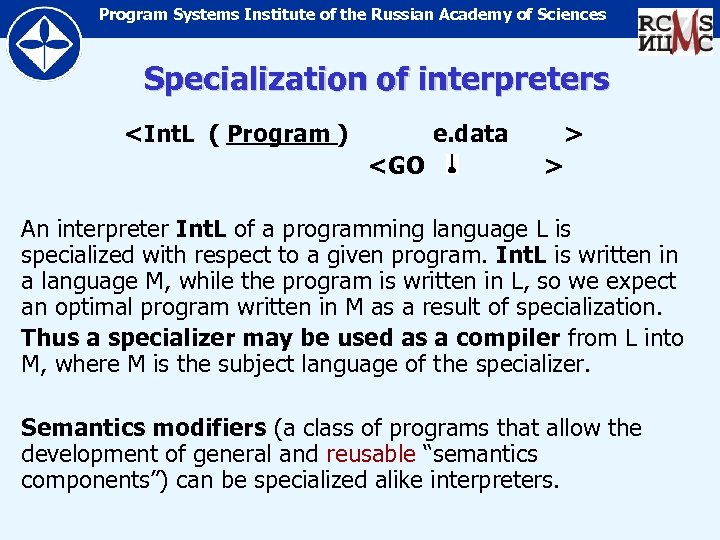 Program Systems Institute of the Russian Academy of Sciences Specialization of interpreters
 Program Systems Institute of the Russian Academy of Sciences Verification of parameterized systems by the supercompiler SCP 4 q Successful experiments on verification of cache coherence protocols: ¶IEEE Futurebus+, MOESI, MSI, “Illinois”, “Firefly”, “Berkeley”. q More parameterized protocols: ¶Java Meta-Locking Algorithm, Reader-Writer protocol.
![Program Systems Institute of the Russian Academy of Sciences References [1] Abramov S. M.](https://present5.com/presentation/5ea60cf3a74a0087a5c10c2a426bf033/image-41.jpg "Program Systems Institute of the Russian Academy of Sciences References [1] Abramov S. M.") Program Systems Institute of the Russian Academy of Sciences References [1] Abramov S. M. , and Glueck R. From standard to non-standard semantics by semantics modifiers. International Journal of Foundation of Computer Science, Vol. 12 No. 2, pp: 171 -211, 2001. [2] Nemytykh A. P. , and Turchin V. F. The Supercompiler Scp 4: sources, on-line demonstration. http: //www. botik. ru/pub/local/scp/refal 5/ , 2000. [3] Nemytykh A. P. , The Supercompiler Scp 4: General Structure. , LNCS vol. 2890, pp. 162 -170, 2003. [4] Nemytykh A. P. , A Note on Elimination of Simplest Recursions. In Proceedings of the ACM SIGPLAN Asia-PEPM'02, 138 -146. ACM Press, 2002. [5] Korlyukov A. V. , and Nemytykh A. P. , Supercompilation of Double Interpretation. (How One Hour of the Machine's Time Can Be Turned to One Second). (In English), Vestnik natcional’nogo tekhnicheskogo universiteta “Khar’kovskogo politekhnicheskogo instituta”, Khar’kov, No. 1, 2004. [6] Lisitsa A. , and Nemytykh A. P. , Verification via Supercompilation. http: //www. csc. liv. ac. uk/~alexei/Veri. Super/ , 2005.
Program Systems Institute of the Russian Academy of Sciences References [1] Abramov S. M. , and Glueck R. From standard to non-standard semantics by semantics modifiers. International Journal of Foundation of Computer Science, Vol. 12 No. 2, pp: 171 -211, 2001. [2] Nemytykh A. P. , and Turchin V. F. The Supercompiler Scp 4: sources, on-line demonstration. http: //www. botik. ru/pub/local/scp/refal 5/ , 2000. [3] Nemytykh A. P. , The Supercompiler Scp 4: General Structure. , LNCS vol. 2890, pp. 162 -170, 2003. [4] Nemytykh A. P. , A Note on Elimination of Simplest Recursions. In Proceedings of the ACM SIGPLAN Asia-PEPM'02, 138 -146. ACM Press, 2002. [5] Korlyukov A. V. , and Nemytykh A. P. , Supercompilation of Double Interpretation. (How One Hour of the Machine's Time Can Be Turned to One Second). (In English), Vestnik natcional’nogo tekhnicheskogo universiteta “Khar’kovskogo politekhnicheskogo instituta”, Khar’kov, No. 1, 2004. [6] Lisitsa A. , and Nemytykh A. P. , Verification via Supercompilation. http: //www. csc. liv. ac. uk/~alexei/Veri. Super/ , 2005.